


1 Corinthians 2:4
- καὶkaiAndG2532CONJConjunction
- ὁhotheG3588T-NSMDefinite article Nominative Singular Masculine
- λόγοςlogosmessageG3056N-NSMNoun Nominative Singular Masculine
- μουmouof mineG3165P-1GSPersonal pronoun Genitive 1st Singular
- καὶkaiandG2532CONJConjunction
- τὸtotheG3588T-NSNDefinite article Nominative Singular Neuter
- κήρυγμάkērugmapreachingG2782N-NSNNoun Nominative Singular Neuter
- μουmouof mineG3165P-1GSPersonal pronoun Genitive 1st Singular
- οὐκouk[were] notG3756PRT-NNegative Particle Negative
- ἐνeninG1722PREPPreposition
- πειθοῖςpeithoispersuasiveG3981A-DPMAdjective Dative Plural Masculine
- ἀνθρωπίνηςanthrōpinēsof humanG442A-GSFAdjective Genitive Singular Feminine
- σοφίαςsophiasof wisdomG4678N-GSFNoun Genitive Singular Feminine
- λόγοιςlogoiswordsG3056N-DPMNoun Dative Plural Masculine
- ἀλλ᾽all᾽butG235CONJConjunction
- ἐνeninG1722PREPPreposition
- ἀποδείξειapodeixeidemonstrationG585N-DSFNoun Dative Singular Feminine
- πνεύματοςpneumatosof [the] SpiritG4151N-GSNNoun Genitive Singular Neuter
- καὶkaiandG2532CONJConjunction
- δυνάμεωςdunameōsof powerG1411N-GSFNoun Genitive Singular Feminine
English is a literal word-by-word gloss of the Greek, not the KJV's wording. Why?
This is the original text the KJV's translators worked from — each Greek word with its own literal English meaning in this verse, prepared by scholars at Tyndale House, Cambridge. The KJV translates whole sentences, not word by word, so its wording differs: one Greek word can become several English words, and the KJV may choose “charity” where the gloss reads “love”. Both are faithful — they answer different questions. For the KJV's own rendering, switch to the KJV text.
Details
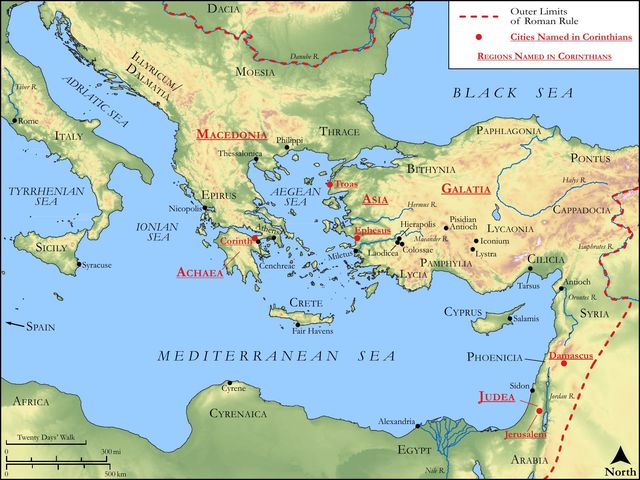
See on the biblical-era map

Study this verse
Public-domain commentary
Matthew Henry
From his Commentary on the Whole Bible. Henry comments on passages, not single verses — this entry covers 1 Corinthians 2:1–5. His two-level outline is real structure in the source text, so it is rendered as structure.
In this passage the apostle pursues his design, and reminds the Corinthians how he acted when he first preached the gospel among them.
I.As to the matter or subject he tell us (Co1 2:2), He determined to know nothing among them but Jesus Christ and him crucified - to make a show of no other knowledge than this, to preach nothing, to discover the knowledge of nothing, but Jesus Christ, and him crucified. Note, Christ, in his person and offices, is the sum and substance of the gospel, and ought to be the great subject of a gospel minister's preaching. His business is to display the banner of the cross, and invite people under it. Any one that heard Paul preach found him to harp so continually on this string that he would say he knew nothing but Christ and him crucified. Whatever other knowledge he had, this was the only knowledge he discovered, and showed himself concerned to propagate among his hearers.
II.The manner wherein he preached Christ is here also observable.
1.Negatively. He came not among them with excellency of speech or wisdom, Co1 2:1. His speech and preaching were not with enticing words of man's wisdom, Co1 2:4. He did not affect to appear a fine orator or a deep philosopher; nor did he insinuate himself into their minds, by a flourish of words, or a pompous show of deep reason and extraordinary science and skill. He did not set himself to captivate the ear by fine turns and eloquent expressions, nor to please and entertain the fancy with lofty flights of sublime notions. Neither his speech, nor the wisdom he taught, savoured of human skill: he learnt both in another school. Divine wisdom needed not to be set off with such human ornaments.
2.Positively. He came among them declaring the testimony of God, Co1 2:1. He published a divine revelation, and gave in sufficient vouchers for the authority of it, both by its consonancy to ancient predictions and by present miraculous operations; and there he left the matter. Ornaments of speech and philosophical skill and argument could add no weight to what came recommended by such authority. He was also among them in weakness and fear, and in much trembling; and yet his speech and preaching were in demonstration of the Spirit and of power, Co1 2:3, Co1 2:4. His enemies in the church of Corinth spoke very contemptuously of him: His bodily presence, say they, is weak, and his speech contemptible, Co2 10:10. Possibly he had a little body, and a low voice; but, though he had not so good an elocution as some, it is plain that he was no mean speaker. The men of Lystra looked on him to be the heathen god Mercury, come down to them in the form of a man, because he was the chief speaker, Act 14:12. Nor did he want courage nor resolution to go through his work; he was in nothing terrified by his adversaries. Yet he was no boaster. He did not proudly vaunt himself, like his opposers. He acted in his office with much modesty, concern, and care. He behaved with great humility among them; not as one grown vain with the honour and authority conferred on him, but as one concerned to approve himself faithful, and fearful of himself, lest he should mismanage in his trust. Observe, None know the fear and trembling of faithful ministers, who are zealous over souls with a godly jealousy; and a deep sense of their own weakness is the occasion of this fear and trembling. They know how insufficient they are, and are therefore fearful for themselves. But, though Paul managed with this modesty and concern, yet he spoke with authority: In the demonstration of the Spirit and of power. He preached the truths of Christ in their native dress, with plainness of speech. He laid down the doctrine as the Spirit delivered it; and left the Spirit, by his external operation in signs and miracles, and his internal influences on the hearts of men, to demonstrate the truth of it, and procure its reception.
III.Here is the end mentioned for which he preached Christ crucified in this manner:
That your faith should not stand in the wisdom of man, but the power of God (Co1 2:5) - that they might not be drawn by human motives, nor overcome by mere human arguments, lest it should be said that either rhetoric or logic had made them Christians. But, when nothing but Christ crucified was plainly preached, the success must be founded, not on human wisdom, but divine evidence and operation. The gospel was so preached that God might appear and be glorified in all.
Historical interpretation
Four Centuries of Reception
3 surviving comments on this verse. Each one is dated, so this reads as a timeline rather than a list.
Select a marker to jump to its quote. Markers stagger vertically where authors wrote within a few decades of each other.
If our Scriptures had persuaded people to believe because they had been written with rhetorical art or philosophical skill, there is no doubt that our faith would be said to depend on the art of words and on human wisdom rather than on the power of God.
"And my speech and my preaching was not in persuasive words of wisdom:" that is, had not the wisdom from without. Now if the doctrine preached had nothing subtle, and they that were called were unlearned, and he that preached was of the same description, and thereto was added persecution, and trembling and fear; tell me, how did they overcome without Divine power? And this is why, having said, "My speech and my preaching was not in persuasive words of wisdom," he added, "but in demonstration of the Spirit and of power."
Dost thou perceive how "the foolishness of God is wiser than men, and the weakness stronger?" They for their part, being unlearned and preaching such a Gospel, in their chains and persecution overcame their persecutors. Whereby? was it not by their furnishing that evidence which is of the Spirit? For this indeed is confessed demonstration. For who, tell me, after he had seen dead men rising to life and devils cast out, could have helped admitting it?
But seeing that there are also deceiving wonders, such as those of sorcerers, he removes this suspicion also. For he said not simply "of power," but first, "of the Spirit," and then, "of power:" signifying that the things done were spiritual.
It is no disparagement, therefore, that the Gospel was not declared by means of wisdom; rather it is a very great ornament. For this, it will be allowed, is the clearest token of its being divine and having its roots from above, out of the heavens.
Again, in the Epistle to the Corinthians he says: "For my speech and my preaching was not in the enticing words of man's wisdom, but in demonstration of the Spirit and of power; that your faith should not stand in the wisdom of men, but in the power of God."
Continue studying 1 Corinthians 2:4 across the web’s major study libraries — every link below opens this exact verse, chapter, or book on the destination site.
Read & Compare
 BibleGatewayThis verse in more than 200 translations and 70 languages.
 Bible.comThe YouVersion reader — hundreds of translations, reading plans, and highlights.
 ESV.orgCrossway's official English Standard Version reader.
 NET BibleThe NET translation with 60,000+ translators' notes on every rendering decision.
 STEP BibleTyndale House's free study tool — original text, vocabulary, and scholarly resources.
 BibliaLogos Bible Software's free web reader.
 USCCBThe New American Bible (Revised Edition) with the U.S. bishops' study notes.
Commentaries
 BibleHub CommentariesDozens of classic commentaries on this verse, gathered on one page.
 StudyLightMore than 100 commentary sets — the largest collection on the web.
 BibleRefPlain-English commentary on what this verse means, verse by verse.
 Enduring WordDavid Guzik's free commentary on this chapter, widely used by Bible teachers.
 Bible Study ToolsVerse commentary alongside Greek and Hebrew study aids.
Original Language & Research
- BibleHub InterlinearThe verse word by word — original language, transliteration, and English.
- BibleHub LexiconEvery word's original-language definition and Strong's entry.
 Blue Letter BibleDeep-study tools — Strong's numbers, concordance, and word studies.
 CNTR CollationThe earliest Greek manuscripts of this verse, collated letter by letter.
Sermons, Hymns & Audio


TrulyRandomVerse is not affiliated with these sites and doesn’t control their content. They’re linked because they’re genuinely useful.
Summary
In the Apostle Paul profoundly articulates the core principle of his apostolic ministry, asserting that his proclamation of the gospel in Corinth was deliberately devoid of human eloquence, rhetorical artistry, or philosophical persuasion. Instead, he declares that the efficacy and impact of his message were solely rooted in and evidenced by the manifest power and undeniable presence of the Holy Spirit, thereby ensuring that the transformative power of the gospel was clearly attributed to God's supernatural work rather than to human ingenuity or intellectual prowess.
Context
ShowHideLiterary Context
This verse is situated within Paul's broader argument in 1 Corinthians 1-2, where he directly confronts the Corinthian church's infatuation with human wisdom, eloquence, and prominent personalities. Having established in 1 Corinthians 1:18-25 that the message of the cross is "foolishness to those who are perishing, but to us who are being saved it is the power of God," Paul then explains his own ministerial approach in light of this divine paradox. He intentionally chose not to employ the sophisticated rhetorical techniques valued in Corinth, ensuring that the Corinthians' faith would rest not on human wisdom but on God's power, as explicitly stated in the subsequent verse, 1 Corinthians 2:5. His personal example serves as a living illustration of the very truth he preaches, reinforcing the supremacy of God's wisdom over human intellect.
Historical & Cultural Context
The city of Corinth was a prominent Roman colony, a bustling commercial hub, and a melting pot of diverse cultures, religions, and philosophical schools. It was particularly renowned for its sophisticated rhetorical tradition, where public speakers and philosophers (like the Sophists) were highly esteemed for their oratorical skills, persuasive arguments, and intellectual prowess. Debates and eloquent speeches were central to public life and education. In such an environment, Paul's seemingly unadorned and straightforward preaching style, as described in 1 Corinthians 2:1-3, would have appeared unimpressive or even foolish to many Corinthians accustomed to the standards of human wisdom. Paul's deliberate eschewal of "enticing words" was a counter-cultural statement, challenging the prevailing values and demonstrating that God's truth operates on an entirely different plane than human intellectual systems.
Key Themes
ShowHideA central theme permeating 1 Corinthians 1-2, and powerfully articulated in this verse, is the stark contrast between divine power and human wisdom. Paul consistently argues that the gospel's effectiveness does not derive from human intellectual capacity or persuasive rhetoric, but from the supernatural work of God. This theme is underscored by his emphasis on the Holy Spirit's demonstration, indicating that the Spirit's presence and activity provided undeniable proof of the gospel's divine origin and truth. This "demonstration" was not merely intellectual assent but tangible evidence of God's transformative power in lives, spiritual discernment, and perhaps even miraculous signs, all serving to ensure that the Corinthians' faith would be founded on God's power, not on the fleeting wisdom of men (1 Corinthians 2:5). This reorients the source of true spiritual understanding and conviction from human effort to divine intervention.
Exposition and Analysis
ShowHideKey Word Analysis
ShowHideFrom πείθω, meaning persuasive. This term refers to words designed to sway an audience through human ingenuity, rhetorical skill, or plausible arguments rather than through inherent truth or divine power. Paul explicitly rejected this approach, indicating a conscious decision to avoid human manipulation or cleverness in his gospel proclamation.
From ἀποδείκνυμι, meaning manifestation, a clear showing, proof, or conclusive evidence. This word signifies that the Spirit's work was not subtle or hidden, but undeniably evident and compelling. It implies a public, undeniable display of God's power that served as irrefutable proof of the gospel's divine origin and truth, making faith a response to observable reality.
From δύναμαι, meaning force (literally or figuratively); specially, miraculous power (usually by implication, a miracle itself). This term denotes inherent ability, strength, or supernatural force. It highlights the divine, supernatural energy accompanying Paul's preaching, distinguishing it sharply from mere human effort or intellectual persuasion. It speaks to the dynamic, life-changing force of God at work.
Verse Breakdown
ShowHide"And my speech and my preaching [was] not with enticing words of man's wisdom"
Paul asserts that his method of communicating the gospel (both his general discourse, lógos, and his specific proclamation of the good news, kḗrygma) deliberately avoided the persuasive, rhetorically crafted language and philosophical arguments that characterized human wisdom (sophía anthrṓpinos). He was not employing the sophisticated oratorical techniques or intellectual appeals that were highly valued in Corinthian society, consciously distancing his ministry from the manipulative or merely intellectual persuasion common among human teachers.
"but in demonstration of the Spirit and of power"
In stark contrast to human wisdom, Paul declares that his ministry was characterized by an undeniable, visible manifestation (apódeixis) of the Holy Spirit (pneûma) and divine power (dýnamis). This means the effectiveness and credibility of his message were not dependent on his own eloquence or reasoning, but on the Holy Spirit's tangible presence and supernatural activity, which authenticated the gospel through transformed lives, spiritual insight, and perhaps even miraculous signs. This divine attestation was the true source of conviction and faith.
Literary Devices
ShowHideThe most prominent literary device in 1 Corinthians 2:4 is Antithesis, or Contrast. Paul constructs a clear and deliberate opposition between two distinct approaches to ministry: "not with enticing words of man's wisdom" but "in demonstration of the Spirit and of power." This stark Juxtaposition highlights the fundamental difference between human-centered and God-centered methods of conveying truth. The negative ("not with...") is immediately followed by the positive ("but in..."), emphasizing that Paul's rejection of one method directly leads to his embrace of the other. This rhetorical choice serves to underscore his central theological point: the gospel's power resides in God, not in human ability, thereby ensuring that all glory redounds to God alone.
Theological and Thematic Connections
ShowHidePaul's declaration in 1 Corinthians 2:4 profoundly shapes our understanding of effective ministry and evangelism. It establishes that the ultimate efficacy of the gospel message does not rest on human intellectual prowess, rhetorical skill, or persuasive arguments, but entirely on the supernatural work of the Holy Spirit. This truth elevates divine power over human wisdom, asserting that genuine spiritual transformation and conviction are God's work, not man's. It underscores the sovereignty of God in salvation and the essential role of the Spirit in illuminating hearts and bringing forth faith, ensuring that faith's foundation is divine, not human.
Reflection and Application
ShowHide1 Corinthians 2:4 serves as a timeless corrective and encouragement for all who seek to communicate the Christian message. In an age that often prioritizes charisma, marketing, and intellectual sophistication, Paul reminds us that true spiritual impact flows from divine power, not human ingenuity. While clear and compelling communication is valuable, we must never mistake eloquence for effectiveness, or human persuasion for divine conviction. This verse calls believers to a profound reliance on the Holy Spirit in all aspects of ministry and witness—in prayer, in proclamation, and in personal conduct. It challenges us to humble ourselves, recognizing that God alone grants growth and understanding, and to trust that He will demonstrate His truth through our weakness, ensuring that His glory is paramount. Our confidence should not be in our abilities, but in the Spirit's power working through us.
Questions for Reflection
ShowHideFAQ
ShowHideWhat does Paul mean by "man's wisdom" and why does he reject it?
ShowHideBy "man's wisdom" (Greek: sophía anthrṓpinos), Paul refers to the intellectual systems, philosophical arguments, rhetorical techniques, and persuasive eloquence that were highly valued in the Greco-Roman world, particularly in Corinth. This wisdom often relied on human reasoning, logical deduction, and skillful argumentation to convince or impress. Paul rejects it not because he is against intellect or clear communication, but because he believes that the profound truth of the gospel—especially the "foolishness" of the cross (1 Corinthians 1:18)—cannot be grasped or truly believed through human intellectual persuasion alone. To rely on it would be to obscure the divine source of the message and to allow faith to rest on human ability rather than on God's power (1 Corinthians 2:5). His rejection is a theological statement, ensuring that God receives all the glory for salvation and spiritual understanding.
What is the "demonstration of the Spirit and of power"?
ShowHideThe "demonstration of the Spirit and of power" refers to the tangible, undeniable evidence of God's presence and activity accompanying Paul's preaching. This was not merely an intellectual presentation of facts, but a dynamic manifestation of divine reality. This "demonstration" (Greek: apódeixis, meaning a clear showing or proof) could include several aspects: the conviction of sin and conversion of hearts, the spiritual illumination that allowed people to grasp divine truths, the transformation of lives, and potentially even miraculous signs and wonders that authenticated the message. It signifies that the gospel was not merely spoken words, but words accompanied by a supernatural force that produced genuine faith and spiritual fruit, proving its divine origin and power. This power is the very dýnamis of God at work, as seen throughout the New Testament in the early church's ministry.
Christ-Centered Fulfillment
ShowHide1 Corinthians 2:4 finds its ultimate fulfillment and paradigm in the person and ministry of Jesus Christ. His earthly ministry was the quintessential "demonstration of the Spirit and of power," utterly devoid of reliance on "enticing words of man's wisdom." Jesus did not employ the rhetorical flourishes of the Sophists or the philosophical arguments of the Greek schools; rather, He spoke with unparalleled authority, and His words were consistently accompanied by acts of divine power. From His very conception by the Holy Spirit (Luke 1:35) to His baptism where the Spirit descended upon Him (Matthew 3:16), Jesus' entire life and ministry were Spirit-empowered. He healed the sick, cast out demons, raised the dead, and taught with a wisdom that astonished His listeners, not because of human eloquence, but because of the inherent divine authority and power that flowed through Him (Mark 1:27). His miracles were not mere displays of power, but "signs" (Greek: sēmeia) that pointed to His divine identity and the truth of His message, serving as irrefutable "demonstrations" of God's presence. Ultimately, His resurrection, accomplished by the power of the Spirit (Romans 8:11), stands as the supreme demonstration of God's power over sin and death, validating His entire mission and ensuring that faith rests not on human wisdom, but on the undeniable power of God revealed in Christ.