


Luke 1:35
Bible text: King James Version (1769 Blayney text) · Public domain
Bible text: King James Version with Strong's numbers · Public domain
Bible text: Berean Standard Bible · Public domain
Bible text: American Standard Version (1901) · Public domain
Bible text: World English Bible, Messianic edition · Public domain
Bible text: Geneva Bible (1599) · Public domain
Bible text: Young's Literal Translation · Public domain
- ΚαὶKaiAndG2532CONJConjunction
- ἀποκριθεὶςapokritheisansweringG611V-AOP-NSMVerb Aorist Passive Deponent Participle Nominative Singular Masculine
- ὁhotheG3588T-NSMDefinite article Nominative Singular Masculine
- ἄγγελοςangelosangelG32N-NSMNoun Nominative Singular Masculine
- εἶπενeipensaidG2036V-2AAI-3SVerb 2nd Aorist Active Indicative 3rd Singular
- αὐτῇ·autēato herG846P-DSFPersonal pronoun Dative Singular Feminine
- πνεῦμαpneuma[the] SpiritG4151N-NSNNoun Nominative Singular Neuter
- ἅγιονhagionHolyG40A-NSNAdjective Nominative Singular Neuter
- ἐπελεύσεταιepeleusetaiwill comeG1904V-FDI-3SVerb Future Middle Deponent Indicative 3rd Singular
- ἐπὶepiuponG1909PREPPreposition
- σὲseyouG4771P-2ASPersonal pronoun Accusative 2nd Singular
- καὶkaiandG2532CONJConjunction
- δύναμιςdunamispowerG1411N-NSFNoun Nominative Singular Feminine
- ὑψίστουhupsistouof [the] Most HighG5310A-GSM-SAdjective Genitive Singular Masculine Superlative
- ἐπισκιάσειepiskiaseiwill overshadowG1982V-FAI-3SVerb Future Active Indicative 3rd Singular
- σοι·soiyouG4771P-2DSPersonal pronoun Dative 2nd Singular
- διὸdiothereforeG1352CONJConjunction
- καὶkaialsoG2532CONJConjunction
- τὸtothe [one]G3588T-NSNDefinite article Nominative Singular Neuter
- γεννώμενονgennōmenonbeing bornG1080V-PPP-NSNVerb Present Passive Participle Nominative Singular Neuter
- ἅγιονhagionHoly [One]G40A-NSNAdjective Nominative Singular Neuter
- κληθήσεταιklēthēsetaiwill be calledG2564V-FPI-3SVerb Future Passive Indicative 3rd Singular
- υἱὸςhuios[the] SonG5207N-NSMNoun Nominative Singular Masculine
- θεοῦtheouof GodG2316N-GSM-TNoun Genitive Singular Masculine Title
English is a literal word-by-word gloss of the Greek, not the KJV's wording. Why?
This is the original text the KJV's translators worked from — each Greek word with its own literal English meaning in this verse, prepared by scholars at Tyndale House, Cambridge. The KJV translates whole sentences, not word by word, so its wording differs: one Greek word can become several English words, and the KJV may choose “charity” where the gloss reads “love”. Both are faithful — they answer different questions. For the KJV's own rendering, switch to the KJV text.
Details
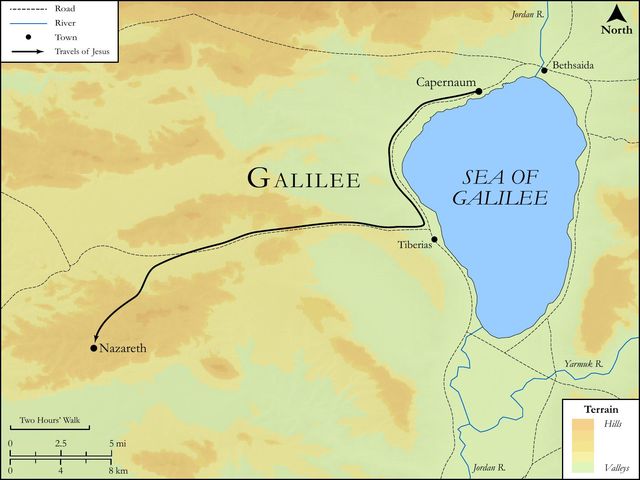
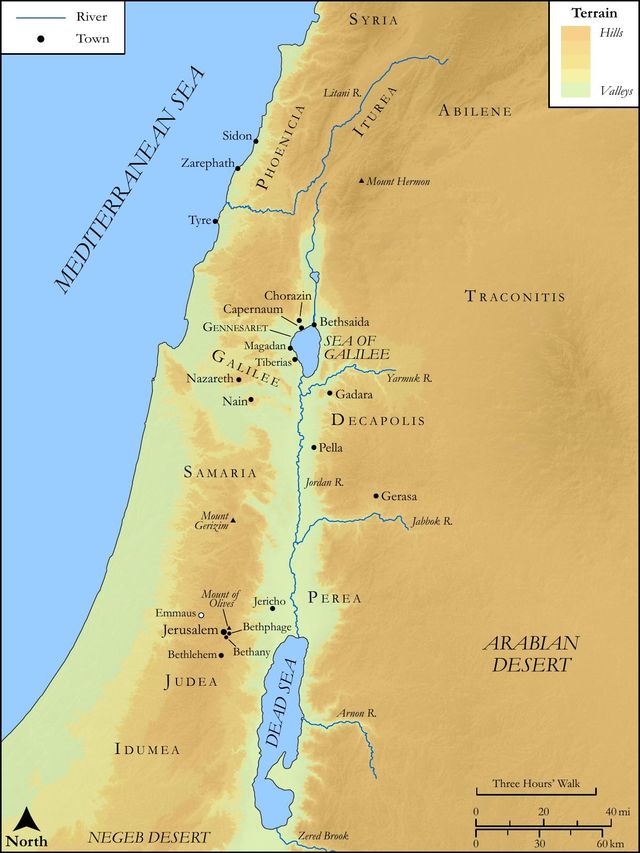
See on the biblical-era maps

Study this verse
Public-domain commentary
Matthew Henry
From his Commentary on the Whole Bible. Henry comments on passages, not single verses — this entry covers Luke 1:26–38. His four-level outline is real structure in the source text, so it is rendered as structure.
We have here notice given us of all that it was fit we should know concerning the incarnation and conception of our blessed Saviour, six months after the conception of John. The same angel, Gabriel, that was employed in making known to Zacharias God's purpose concerning his son, is employed in this also; for in this, the same glorious work of redemption, which was begun in that, is carried on. As bad angels are none of the redeemed, so good angels are none of the redeemers; yet they are employed by the Redeemer as his messengers, and they go cheerfully on his errands, because they are his Father's humble servants, and his children's hearty friends and well-wishers.
I.We have here an account given of the mother of our Lord, of whom he was to be born, whom, though we are not to pray to, yet we ought to praise God for.
1.Her name was Mary, the same name with Miriam, the sister of Moses and Aaron; the name signifies exalted, and a great elevation it was to her indeed to be thus favoured above all the daughters of the house of David.
2.She was a daughter of the royal family, lineally descended from David, and she herself and all her friends knew it, for she went under the title and character of the house of David, though she was poor and low in the world; and she was enabled by God's providence, and the care of the Jews, to preserve their genealogies, to make it out, and as long as the promise of the Messiah was to be fulfilled it was worth keeping; but for those now, who are brought low in the world, to have descended from persons of honour, is not worth mentioning.
3.She was a virgin, a pure unspotted one, but espoused to one of the same royal stock, like her, however, of low estate; so that upon both accounts there was (as it was fit there should be) an equality between them; his name was Joseph; he also was of the house of David, Mat 1:20. Christ's mother was a virgin, because he was not to be born by ordinary generation, but miraculously; it was necessary that he should be so, that, though he must partake of the nature of man, yet not of the corruption of that nature: but he was born of a virgin espoused, made up to be married, and contracted, to put honour upon the married state, that that might not be brought into contempt (which was an ordinance in innocency) by the Redeemer's being born of a virgin.
4.She lived in Nazareth, a city of Galilee, a remote corner of the country, and in no reputation for religion or learning, but which bordered upon the heathen, and therefore was called Galilee of the Gentiles. Christ's having his relations resident there intimates favour in reserve for the Gentile world. And Dr. Lightfoot observes that Jonah was by birth a Galilean, and Elijah and Elisha very much conversant in Galilee, who were all famous prophets of the Gentiles. The angel was sent to her from Nazareth. Note, No distance or disadvantage of place shall be a prejudice to those for whom God has favours in store. The angel Gabriel carries his message as cheerfully to Mary and Nazareth in Galilee as to Zacharias in the temple at Jerusalem.
II.The address of the angel to her, Luk 1:28.
We are not told what she was doing, or how employed, when the angel came unto her; but he surprised her with this salutation, Hail, thou art highly favoured. This was intended to raise in her,
1.A value for herself; and, though it is very rare that any need to have any sparks struck into their breast with such design, yet in some, who like Mary pore only on their low estate, there is occasion for it.
2.An expectation of great news, not from abroad, but from above. Heaven designs, no doubt, uncommon favours for one whom an angel makes court to with such respect, Hail thou, chaire - rejoice thou; it was the usual form of salutation; it expresses an esteem of her, and good-will to her and her prosperity.
(1.)She is dignified: "Thou art highly favoured. God, in his choice of thee to be the mother of the Messiah, has put an honour upon thee peculiar to thyself, above that of Eve, who was the mother of all living." The vulgar Latin translates this grati plena - full of grace, and thence gathers that she had more of the inherent graces of the Spirit than ever any had; whereas it is certain that this bespeaks no other than the singular favour done her in preferring her to conceive and bear our blessed Lord, an honour which, since he was to be the seed of the woman, some woman must have, not for personal merit, but purely for the sake of free grace, and she is pitched upon. Even so, Father, because it seemed good unto thee.
(2.)She has the presence of God with her: "The Lord is with thee, though poor and mean, and perhaps now forecasting how to get a livelihood and maintain a family in the married state." The angel with this word raised the faith of Gideon (Jdg 6:12): The Lord is with thee. Nothing is to be despaired of, not the performance of any service, not the obtaining of any favour, though ever so great, if we have God with us. This word might put her in mind of the Immanuel, God with us, which a virgin shall conceive and bear (Isa 7:14), and why not she?
(3.)She has the blessing of God upon her: "Blessed art thou among women; not only thou shalt be accounted so by men, but thou shalt be so. Thou that art so highly favoured in this instance mayest expect in other things to be blessed." She explains this herself (Luk 1:48), All generations shall call me blessed. Compare it with that which Deborah saith of Jael, another that was the glory of her sex (Jdg 5:24), Blessed shall she be above women in the tent.
III.The consternation she was in, upon this address (Luk 1:29).
When she saw him, and the glories with which he was surrounded, she was troubled at the sight of him, and much more at his saying. Had she been a proud ambitious young woman, that aimed high, and flattered herself with the expectation of great things in the world, she would have been pleased at his saying, would have been puffed up with it, and (as we have reason to think she was a young woman of very good sense) would have had an answer ready, signifying so much: but, instead of that, she is confounded at it, as not conscious to herself of any thing that either merited or promised such great things; and she cast in her mind what manner of salutation this should be. Was it from heaven or of men? Was it to amuse her? was it to ensnare her? was it to banter her? or was there something substantial and weighty in it? But, of all the thoughts she had as to what manner of salutation it should be, I believe she had not the least idea of its being ever intended or used for a prayer, as it is, and has been, for many ages, by the corrupt, degenerate, and anti-christian ages of the church, and to be ten times repeated for the Lord's prayer once; so it is in the church of Rome. But her thoughtfulness upon this occasion gives a very useful intimation to young people of her sex, when addresses are made to them, to consider and cast in their minds what manner of salutations they are, whence they come, and what their tendency is, that they may receive them accordingly, and may always stand on their guard.
IV.The message itself which the angel had to deliver to her.
Some time the angel gives her to pause; but, observing that this did but increase her perplexity, he went on with his errand, Luk 1:30. To what he had said she made no reply; he therefore confirms it: "Fear not, Mary, I have no other design than to assure thee that thou hast found favour with God more than thou thinkest of, as there are many who think they are more favoured with God than they really are." Note, Those that have found favour with God should not give way to disquieting distrustful fears. Doth God favour thee? Fear not, though the world frown upon thee. Is he for thee? No matter who is against thee.
1.Though she is a virgin, she shall have the honour of being a mother: "Thou shalt conceive in thy womb, and bring forth a son, and thou shalt have the naming of him; thou shalt call his name Jesus," Luk 1:31. It was the sentence upon Eve, that, though she should have the honour to be the mother of all living, yet this mortification shall be an allay to that honour, that her desire shall be to her husband, and he shall rule over her, Gen 3:16. But Mary has the honour without the allay.
2.Though she lives in poverty and obscurity, yet she shall have the honour to be the mother of the Messiah; her son shall be named Jesus - a Saviour, such a one as the world needs, rather than such one as the Jews expect.
(1.)He will be very nearly allied to the upper world. He shall be great, truly great, incontestably great; for he shall be called the Son of the Highest, the Son of God who is the Highest; of the same nature, as the son is of the same nature with the father; and very dear to him, as the son is to the father. He shall be called, and not miscalled, the Son of the Highest; for he is himself God over all, blessed for evermore, Rom 9:5. Note, Those who are the children of God, though but by adoption and regeneration, are truly great, and therefore are concerned to be very good, Jo1 3:1, Jo1 3:2.
(2.)He will be very highly preferred in the lower world; for, though born under the most disadvantageous circumstances possible, and appearing in the form of a servant, yet the Lord God shall give unto him the throne of his father David, Luk 1:32. He puts her in mind that she was of the house of David; and that therefore, since neither the Salique law, nor the right of primogeniture, took place in the entail of his throne, it was not impossible but that she might bring forth an heir to it, and therefore might the more easily believe it when she was told by an angel from heaven that she should do so, that after the sceptre had been long departed from that ancient and honourable family it should now at length return to it again, to remain in it, not by succession, but in the same hand to eternity. His people will not give him that throne, will not acknowledge his right to rule them; but the Lord God shall give him a right to rule them, and set him as his king upon the holy hill of Zion. He assures her,
[1.]That his kingdom shall be spiritual: he shall reign over the house of Jacob, not Israel according to the flesh, for they neither came into his interests nor did they continue long a people; it must therefore be a spiritual kingdom, the house of Israel according to the promise, that he must rule over.
[2.]That it shall be eternal: he shall reign for ever, and of his kingdom there shall be no end, as there had been long since of the temporal reign of David's house, and would shortly be of the state of Israel. Other crowns endure not to every generation, but Christ's doth, Pro 27:24. The gospel is the last dispensation, we are to look for no other.
V.The further information given her, upon her enquiry concerning the birth of this prince.
1.It is a just enquiry which she makes: "How shall this be? Luk 1:34. How can I now presently conceive a child" (for so the angel meant) "when I know not a man; must it therefore be otherwise than by ordinary generation? If so, let me now how?" She knew that the Messiah must be born of a virgin; and, if she must be his mother, she desires to know how. This was not the language of her distrust, or any doubt of what the angel said, but of a desire to be further instructed.
2.It is a satisfactory answer that is given to it, Luk 1:35. (1.) She shall conceive by the power of the Holy Ghost, whose proper work and office is to sanctify, and therefore to sanctify the virgin for this purpose. The Holy Ghost is called the power of the Highest. Doth she ask how this shall be? This is enough to help her over all the difficulty there appears in it; a divine power will undertake it, not the power of an angel employed in it, as in other works of wonder, but the power of the Holy Ghost himself.
(2.)She must ask no questions concerning the way and manner how it shall be wrought; for the Holy Ghost, as the power of the Highest, shall overshadow her, as the cloud covered the tabernacle when the glory of God took possession of it, to conceal it from those that would too curiously observe the motions of it, and pry into the mystery of it. The formation of every babe in the womb, and the entrance of the spirit of life into it, is a mystery in nature; none knows the way of the spirit, nor how the bones are formed in the womb of her that is with child, Ecc 11:5. We were made in secret, Psa 139:15, Psa 139:16. Much more was the formation of the child Jesus a mystery; without controversy, great was the mystery of godliness, God manifest in the flesh, Ti1 3:16. It is a new thing created in the earth (Jer 31:22), concerning which we must not covet to be wise above what is written.
(3.)The child she shall conceive is a holy thing, and therefore must not be conceived by ordinary generation, because he must not share in the common corruption and pollution of the human nature. He is spoken of emphatically, That Holy Thing, such as never was; and he shall be called the Son of God, as the Son of the Father by eternal generation, as an indication of which he shall now be formed by the Holy Ghost in the present conception. His human nature must be so produced, as it was fit that should be which was to be taken into union with the divine nature.
3.It was a further encouragement to her faith to be told that her cousin Elisabeth, though stricken in years, was with child, Luk 1:36. Here is an age of wonders beginning, and therefore be not surprised: here is one among thy own relations truly great, though not altogether so great as this; it is usual with God to advance in working wonders. Greater works than these shall ye do. Though Elisabeth was, on the father's side, of the daughters of Aaron (Luk 1:5), yet on the mother's side she might be of the house of David, for those two families often intermarried, as an earnest of the uniting of the royalty and the priesthood of the Messiah. This is the sixth month with her that was called barren. This intimates, as Dr. Lightfoot thinks, that all the instances in the Old Testament of those having children that had been long barren, which was above nature, were designed to prepare the world for the belief of a virgin's bearing a son, which was against nature. And therefore, even in the birth of Isaac, Abraham saw Christ's day, foresaw such a miracle in the birth of Christ. The angel assures Mary of this, to encourage her faith, and concludes with that great truth, of undoubted certainty and universal use, For with God nothing shall be impossible (Luk 1:37), and, if nothing, then not this. Abraham therefore staggered not at the belief of the divine promise, because he was strong in his belief of the divine power, Rom 4:20, Rom 4:21. No word of God must be incredible to us, as long as no work of God is impossible to him.
VI.Her acquiescence in the will of God concerning her, Luk 1:38. She owns herself,
1.A believing subject to the divine authority: "Behold, the handmaid of the Lord. Lord, I am at thy service, at thy disposal, to do what thou commandest me." She objects not the danger of spoiling her marriage, and blemishing her reputation, but leaves the issue with God, and submits entirely to his will.
2.A believing expectant of the divine favour. She is not only content that it should be so, but humbly desires that it may be so: Be it unto me according to thy word. Such a favour as this it was not for her to slight, or be indifferent to; and for what God has promised he will be sought unto; by prayer we must put our amen, or so be it, to the promise. Remember, and perform thy word unto thy servant, upon which thou has caused me to hope. We must, as Mary here, guide our desires by the word of God, and ground our hopes upon it. Be it unto me according to thy word; just so, and no otherwise.
Hereupon, the angel departed from her; having completed the errand he was sent upon, he returned, to give an account of it, and receive new instructions. Converse with angels was always a transient thing, and soon over; it will be constant and permanent in the future state. It is generally supposed that just at this instant the virgin conceived, by the overshadowing power of the Holy Ghost: but, the scripture being decently silent concerning it, it doth not become us to be inquisitive, much less positive.
Historical interpretation
Eighteen Centuries of Reception
32 surviving comments on this verse. Each one is dated, so this reads as a timeline rather than a list.
Select a marker to jump to its quote. Markers stagger vertically where authors wrote within a few decades of each other.
And hear again how Isaiah in express words foretold that He should be born of a virgin; for he spoke thus: "Behold, a virgin shall conceive, and bring forth a son, and they shall say for His name, `God with us.'" For things which were incredible and seemed impossible with men, these God predicted by the Spirit of prophecy as about to come to pass, in order that, when they came to pass, there might be no unbelief, but faith, because of their prediction. But lest some, not understanding the prophecy now cited, should charge us with the very things we have been laying to the charge of the poets who say that Jupiter went in to women through lust, let us try to explain the words. This, then, "Behold, a virgin shall conceive," signifies that a virgin should conceive without intercourse. For if she had had intercourse with any one whatever, she was no longer a virgin; but the power of God having come upon the virgin, overshadowed her, and caused her while yet a virgin to conceive. And the angel of God who was sent to the same virgin at that time brought her good news, saying, "Behold, thou shalt conceive of the Holy Ghost, and shalt bear a Son, and He shall be called the Son of the Highest, and thou shalt call His name Jesus; for He shall save His people from their sins," -as they who have recorded all that concerns our Saviour Jesus Christ have taught, whom we believed, since by Isaiah also, whom we have now adduced, the Spirit of prophecy declared that He should be born as we intimated before. It is wrong, therefore, to understand the Spirit and the power of God as anything else than the Word, who is also the first-born of God, as the foresaid prophet Moses declared; and it was this which, when it came upon the virgin and overshadowed her, caused her to conceive, not by intercourse, but by power. And the name Jesus in the Hebrew language means Σωτήρ (Saviour) in the Greek tongue. Wherefore, too, the angel said to the virgin, "Thou shalt call His name Jesus, for He shall save His people from their sins." And that the prophets are inspired by no other than the Divine Word, even you, as I fancy, will grant.
For the one and the same Spirit of God, who proclaimed by the prophets what and of what sort the advent of the Lord should be, did by these elders give a just interpretation of what had been truly prophesied; and He did Himself, by the apostles, announce that the fullness of the times of the adoption had arrived, that the kingdom of heaven had drawn near, and that He was dwelling within those that believe in Him who was born Emmanuel of the Virgin. To this effect they testify, [saying,] that before Joseph had come together with Mary, while she therefore remained in virginity, "she was found with child of the Holy Ghost;" [Matthew 1:18] and that the angel Gabriel said to her, "The Holy Ghost shall come upon you, and the power of the Highest shall overshadow you; therefore also that holy thing which shall be born of you shall be called the Son of God;" [Luke 1:35] and that the angel said to Joseph in a dream, "Now this was done, that it might be fulfilled which was spoken by Isaiah the prophet, Behold, a virgin shall be with child." [Matthew 1:23] But the elders have thus interpreted what Esaias said: "And the Lord, moreover, said to Ahaz, Ask for yourself a sign from the Lord your God out of the depth below, or from the height above. And Ahaz said, I will not ask, and I will not tempt the Lord. And he said, It is not a small thing for you to weary men; and how does the Lord weary them? Therefore the Lord himself shall give you a sign; Behold, a virgin shall conceive, and bear a son; and you shall call His name Emmanuel. Butter and honey shall He eat: before He knows or chooses out things that are evil, He shall exchange them for what is good; for before the child knows good or evil, He shall not consent to evil, that He may choose that which is good." [Isaiah 7:10-17] Carefully, then, has the Holy Ghost pointed out, by what has been said, His birth from a virgin, and His essence, that He is God (for the name Emmanuel indicates this). And He shows that He is a man, when He says, "Butter and honey shall He eat;" and in that He terms Him a child also, [in saying,] "before He knows good and evil;" for these are all the tokens of a human infant. But that He "will not consent to evil, that He may choose that which is good,"— this is proper to God; that by the fact, that He shall eat butter and honey, we should not understand that He is a mere man only, nor, on the other hand, from the name Emmanuel, should suspect Him to be God without flesh.
Of them Jesus consists-Man. of the flesh; of the Spirit, God-and the angel designated Him as "the Son of God," in respect of that nature, in which He was Spirit, reserving for the flesh the appellation "Son of Man.
After a space of two days, on the third day" -which is His glorious resurrection-He received back into the heavens (whence withal the Spirit Himself had come to the Virgin ) Him whose nativity and passion alike the Jews have failed to acknowledge.
These facts he had also received from the angel, according to our Gospel: "Wherefore that which shall be born of thee shall be called the Holy One, the Son of God; " and, "Thou shalt call his name Jesus.
Forasmuch, however, as it has been declared concerning the Son Himself, Thou hast made Him a little lower than the angels" how will it appear that He put on the nature of angels if He was made lower than the angels, having become man, with flesh and soul as the Son of man? As "the Spirit of God." however, and "the Power of the Highest," can He be regarded as lower than the angels,-He who is verily God, and the Son of God? Well, but as bearing human nature, He is so far made inferior to the angels; but as bearing angelic nature, He to the same degree loses that inferiority.
I will not here largely use the support of the other Gospels, which confirm our belief by the Lord's nativity: it is sufficient to remark that He who had to be born of a virgin is announced in express terms by the angel himself as the Son of God: "The Spirit of God shall come upon thee, and the power of the Highest shall overshadow thee; therefore also the Holy Thing that shall be born of thee shall be called the Son of God." On this passage even they will wish to raise a cavil; but truth will prevail.
All the prophets, therefore, and the law spoke by means of the Demiurge,-a silly god, he says, (and themselves) fools, who knew nothing. On account of this, he says, the Saviour observes: "All that came before me are thieves and robbers." And the apostle (uses these words) "The mystery which was not made known to former generations." For none of the prophets, he says, said anything concerning the things of which we speak; for (a prophet) could not but be ignorant of all (these) things, inasmuch as they certainly had been uttered by the Demiurge only. When, therefore, the creation received completion, and when after (this) there ought to have been the revelation of the sons of God-that is, of the Demiurge, which up to this had been concealed, and in which obscurity the natural man was hid, and had a veil upon the heart;-when (it was time), then, that the veil should be taken away, and that these mysteries should be seen, Jesus was born of Mary the virgin, according to the declaration (in Scripture), "The Holy Ghost will come upon thee"-Sophia is the Spirit-" and the power of the Highest will overshadow thee"-the Highest is the Demiurge,-"wherefore that which shall be born of thee shall be called holy." For he has been generated not from the highest alone, as those created in (the likeness of) Adam have been created from the highest alone-that is, (from) Sophia and the Demiurge. Jesus, however, the new man, (has been generated) from the Holy Spirit-that is, Sophia and the Demiurge-in order that the Demiurge may complete the conformation and constitution of his body, and that the Holy Spirit may supply his essence, and that a celestial Logos may proceed from the Ogdoad being born of Mary.
This is the Spirit that at the beginning "moved upon the thee of the waters; " by whom the world moves; by whom creation consists, and all things have life; who also wrought mightily in the prophets, and descended in flight upon Christ. This is the Spirit that was given to the apostles in the form of fiery tongues. This is the Spirit that David sought when he said, "Create in me a clean heart, O God, and renew a right spirit within me." Of this Spirit Gabriel also spoke to the Virgin, "The Holy Ghost shall come upon thee, and the power of the Highest shall overshadow thee." By this Spirit Peter spake that blessed word, "Thou art the Christ, the Son of the living God." By this Spirit the rock of the Church was stablished. This is the Spirit, the Comforter, that is sent because of thee, that He may show thee to be the Son of God.
Now this (mystery) was not made known to previous generations, as he says, it has been written, "By revelation was made known unto me the mystery; " and, "I have heard inexpressible words which it is not possible for man to declare." The light, (therefore,) which came down from the Ogdoad above to the Son of the Hebdomad, descended from the Hebdomad upon Jesus the son of Mary, and he had radiance imparted to him by being illuminated with the light that shone upon him. This, he says, is that which has been declared: "The Holy Spirit will come upon thee," (meaning) that which proceeded from the Sonship through the conterminous spirit upon the Ogdoad and Hebdomad, as far as Mary; "and the power of the Highest will overshadow thee," (meaning) the power of the anointing, (which streamed) from the (celestial) height above (through) the Demiurge, as far as the creation, which is (as far as) the Son. And as far as that (Son) he says the world consisted thus. And as far as this, the entire Sonship, which is left behind for benefiting the souls in Formlessness, and for being the recipient in turn of benefits,-(this Sonship, I say,) when it is transformed, followed Jesus, and hastened upwards, and came forth purified. And it becomes most refined, so that it could, as the first (Sonship), hasten upwards through its own instrumentality. For it possesses all the power that, according to nature, is firmly connected with the light which from above shone down (upon earth).
That Christ is both man and God, compounded of both natures, that He might be a Mediator between us and the Father. In Jeremiah: "And He is man, and who shall know Him? Also in Numbers: "A Star shall arise out of Jacob, and a man shall rise up from Israel." Also in the same place: "A Man shall go forth out of his seed, and shall rule over many nations; and His kingdom shall be exalted as Gog, and His kingdom shall be increased; and God brought Him forth out of Egypt. His glory is as of the unicorn, and He shall eat the nations of His enemies, and shall take out the marrow of their fatnesses, and will pierce His enemy with His arrows. He couched and lay down as a lion, and as a lion's whelp. Who shall raise Him up? Blessed are they who bless Thee, and cursed are they who curse Thee." Also in Isaiah: "The Spirit of the Lord is upon me; on account whereof He hath anointed me: He hath sent me to tell good tidings to the poor; to heal the bruised in heart, to preach deliverance to the captives, and sight to the blind, to proclaim the acceptable year of the Lord, and the day of retribution." Whence, in the Gospel according to Luke, Gabriel says to Mary: "And the angel, answering, said to her, The Holy Ghost shall come upon thee, and the power of the Highest shall overshadow thee. Wherefore that holy thing which is born of thee shall be called the Son of God." Also in the first Epistle of Paul to the Corinthians: "The first man is of the mud of the earth; the second man is from heaven. As was he from the soil, such are they also that are of the earth; and as is the heavenly, such also are the heavenly. As we have borne the image of him who is of the earth, let us also bear the image of Him who is from heaven."
If any one affirms that Christ was born of the seed of man by the Virgin, in the same manner as all men are born, and refuses to acknowledge that He was made flesh by the Holy Spirit and the holy Virgin Mary, mad became man of the seed of David, even as it is written, let him be anathema.
Explication: How could one say that Christ was born of the seed of man by the Virgin, when the holy Gospel and the angel, in proclaiming the good tidings, testify of Mary the Virgin that she said, "How shall this be, seeing I know not a man? " [Luke 1:34] Wherefore he says, "The Holy Ghost shall come upon you, and the power of the highest shall overshadow you: therefore also that holy thing which shall be born of you shall be called the Son of the Highest." [Luke 1:35] And to Joseph he says, "Fear not to take unto you Mary your wife: for that which is conceived in her is of the Holy Ghost. And she shall bring forth a son, and they shall call His name Jesus: for He shall save His people from their sins." [Matthew 1:20-21]
(Ep. ad Epictetum.) For we confess that which then was taken up from Mary to be of the nature of man and a most real body, the very same also according to nature with our own body. For Mary is our sister, seeing we have all descended from Adam.
It was fitting that the Architect of the works of creation should come and raise up the house that had fallen and that the hovering Spirit should sanctify the buildings that were unclean. Thus, if the Progenitor entrusted the judgment that is to come to his Son, it is clear that he accomplished the creation of humanity and its restoration through him as well. He was the live coal, which had come to kindle the briars and thorns. He dwelt in the womb and cleansed it and sanctified the place of the birth pangs and the curses. The flame, which Moses saw, was moistening the bush and distilling the fat lest it be inflamed. The likeness of refined gold could be seen in the bush, entering into the fire but without being consumed. This happened so that it might make known that living fire which was to come at the end, watering and moistening the womb of the Virgin and clothing it like the fire that enveloped the bush.
(235. Ep. Amph.) Knowledge is spoken of in various ways. The wisdom of our Creator is called knowledge, and an acquaintance with His mighty works, the keeping also of His commandments, and the constant drawing near to Him; and besides these the marriage union is called knowledge, as it is here.
(Lib. de Spirit. Sanct. c. v.) Hence also, St. Paul says, God sent forth his Son, born not (through a woman) but of a woman. For the words through a woman might convey only a notion of birth as a passing through, but when it is said, of a woman, (Gal. 4:4.) there is openly declared a communion of nature between the son and the parent.
Then the virgin was initiated into the mystery by Gabriel. The words of the mystagogy were a blessing. “Hail,” he says, “blessed woman, the Lord is with you.” [...] He says, “You will conceive in your womb and will bear a son and you shall call his name ‘Jesus’.” [Luke 1:31, Protevangelium of James 11.3] And what did Mary do? Listen to the pure virgin’s utterance. The angel declared the birth, and she clings to her virginity, judging incorruption to be nobler than the angelic appearance and could neither disbelieve the angel nor abandon her judgments. She says, I have no experience of intercourse with a husband: “How will this happen to me, since I have not known a husband?” [Luke 1:34] Mary’s very utterance is proof of what is narrated in the apocryphal book [the Protevangelium of James]. For if she had been taken by Joseph for marriage, how could she be totally astonished at the one who announced the birth to her if she was quite favorably disposed to becoming a mother according to the law of nature? But since the flesh that had been consecrated to God had to be kept inviolate like one of the holy dedicated things, this is why she says, “Even if you are an angel, even if you have come from heaven, even if the appearance was beyond humanity, still for a husband to know me is not possible. How will I become a mother without a husband? I know Joseph as a fiancé, but I have not known a husband.” And what did Gabriel (the bridal escort) do? What sort of bridal chamber did he announce for the pure and undefiled marriage? “The Holy Spirit,” he says, “will come upon you and the power of the Most High will overshadow you.” [Luke 1:35, Protevangelium of James 11.3]
(Orat. in Diem Nat. Christi.) Hear the chaste words of the Virgin. The Angel tells her she shall bear a son, but she rests upon her virginity, deeming her inviolability a more precious thing than the Angel's declaration. Hence she says, Seeing that I know not a man.
(sup.) These words of Mary are a token of what she was pondering in the secrets of her heart; for if for the sake of the marriage union she had wished to be espoused to Joseph, why was she seized with astonishment when the conception was made known unto her? seeing in truth she might herself be expecting at the time to become a mother according to the law of nature. But because it was meet that her body being presented to God as an holy offering-should be kept inviolate, therefore she says, Seeing that I know not a man. As if she said, Notwithstanding that thou who speakest art an Angel, yet that I should know a man is plainly an impossible thing. How then can I be a mother, having no husband? For Joseph I have acknowledged as my betrothed.
(Orat. in Diem Nat.) O blessed is that womb which because of the overflowing purity of the Virgin Mary has drawn to itself the gift of life! For in others scarcely indeed shall a pure soul obtain the presence of the Holy Spirit, but in her the flesh is made the receptacle of the Spirit.
(Lib. de Vita Moysis.) For the tables of our nature which guilt had broken, the true Lawgiver has formed anew to Himself from our dust without cohabitation, creating a body capable of taking His divinity, which the finger of God hath carved, that is to say, the Spirit coming upon the Virgin.
(in Diem Natal.) Moreover, the power of the Highest shall overshadow thee. Christ is the power of the most high King, who by the coming of the Holy Spirit is formed in the Virgin.
(Orat. in Diem Nat.) Or he says, overshadow thee, because as a shadow takes its shape from the character of those bodies which go before it, so the signs of the Son's Deity will appear from the power of the Father. (non occ. in Greg. Nyss.). For as in us a certain life-giving power is seen in the material substance, by which man is formed; so in the Virgin, has the power of the Highest in like manner, by the life-giving Spirit, taken from the Virgin's body a fleshly substance inherent in the body to form a new man. Hence it follows, Therefore also that holy thing which shall be born of thee.
It seems that Mary did not believe here, unless you pay careful attention; for it is not right for the chosen one to be seen as unbelieving in conceiving the only-begotten Son of God. But in what way could it happen (although the prerogative of the mother is preserved, to whom it certainly had to be deferred to a greater extent: but as a greater prerogative, a greater faith should also have been reserved for her), therefore in what way could it happen, that Zacharias, who did not believe, was condemned to silence: but Mary, if she had not believed, would be exalted by the infusion of the Holy Spirit? But Mary neither should not believe, nor should she rashly usurp: not believe the angel, usurp divine things. For it was not easy to know the mystery hidden in God from the ages, which even the higher Powers could not know. And yet she did not refuse faith, did not reject the duty: but she adjusted her emotions, promised obedience. For when she says: How will this be done? she did not doubt the outcome, but sought the quality of the effect itself.
It was Mary's part neither to refuse belief in the Angel, nor too hastily take unto herself the divine message. How subdued her answer is, compared with the words of the Priest. Then said Mary to the Angel, How shall this be? She says, How shall this be? He answers, Whereby shall I know this? He refuses to believe that which he says he does not know, and seeks as it were still further authority for belief. She avows herself willing to do that which she doubts not will be done, but how, she is anxious to know. Mary had read, Behold, she shall conceive and bear a son. (Is. 7:14.) She believed therefore that it should be, but how it was to take place she had never read, for even to so great a prophet this had not been revealed. So great a mystery was not to be divulged by the mouth of man, but of an Angel.
(Hom. 49 in Gen.) As if he said, Look not for the order of nature in things which transcend and overpower nature. Dost thou say, How shall this be, seeing I know not a man? Nay rather, shall it happen to thee for this very reason, that thou hast never known a husband. For if thou hadst, thou wouldest not have been thought worthy of the mystery, not that marriage is unholy, but virginity more excellent. It became the common Lord of all both to take part with us, and to differ with us in His nativity; for the being born from the womb, He shared in common with us, but in that He was born without cohabitation, He was exalted far above us.
When God’s coming draws near, the angel Gabriel advances
From the Father’s high throne and enters the house of the Virgin.
“Mary,” he says, “the Holy Spirit will render you fruitful,
And you shall give birth to the Christ, O glorious Virgin.”
He had to be redeemed: my Spirit came down
And impregnated flesh made from the dust
With the divine nature; God has assumed
Humanity, joining it with divinity,
And kindled in men’s hearts new love of me.
But the birth of our Lord Jesus Christ exceeds all understanding and goes beyond any precedent.
Each one is a partaker of this spiritual origin in regeneration. To every one, when he is reborn, the water of baptism is like the Virgin’s womb, for the same Holy Spirit fills the font, who filled the Virgin, that the sin, which that sacred conception overthrew, may be taken away by this mystical washing.
(18 Moral. c. 20. super Job 27:21.) By the term overshadowing, both natures of the Incarnate God are signified. For shadow is formed by light and matter. But the Lord by His Divine nature is light. Because then immaterial light was to be embodied in the Virgin's womb, it is well said unto her, The power of the Highest shall overshadow thee, that is, the human body in thee shall receive an immaterial light of divinity. For this is said to Mary for the heavenly refreshing of her soul.
(18 Moral. c. 52. super Job 28:19.) To distinguish His holiness from ours, Jesus is stated in an especial manner to be born holy. For we although indeed made holy, are not born so, for we are constrained by the very condition of our corruptible nature to cry out with the Prophet, Behold, I was conceived in iniquity. (Ps. 51:5.) But He alone is in truth holy, who was not conceived by the cementing of a fleshly union, nor as the heretics rave, one person in His human nature, another in His divine; not conceived and brought forth a mere man, and afterwards by his merits, obtained that He should be God, but the Angel announcing and the Spirit coming, first the Word in the womb, afterwards within the womb the Word made flesh. Whence it follows, Shall be called the Son of God.
The Lord rests in those hearts which the love of the present age does not inflame, which the desires of the flesh do not burn up, which, set ablaze by their anxieties, do not wither in the lusts of this world. Hence it is also said to Mary: "The Holy Spirit will come upon you, and the power of the Most High will overshadow you." Therefore, the young deer seeks shady places at midday for feeding, because the Lord is fed by such minds as are not burned by bodily desires through the regard of tempering grace.
Let Nestorius then cease to say that the Virgin's Son is only man, and to deny that He is taken up by the Word of God into the unity of the Person. For the Angel when he says that the very same has David for His father whom he declares is called the Son of the Highest, demonstrates the one Person of Christ in two natures. The Angel uses the future tense (vocabitur, regnabit) not because, as the Heretics say, Christ was not before Mary, but because in the same person, man with God shares the same name of Son.
Thou shalt conceive then not by the seed of man whom thou knowest not, but by the operation of the Holy Spirit, with which thou art filled. There shall be no flame of desire in thee when the Holy Spirit shall overshadow thee.
And the angel, responding, said to her: The Holy Spirit will come upon you, and the power of the Most High will overshadow you. Not by the seed of man, which you do not know, he said, but by the work of the Holy Spirit by which you are filled, you will conceive. There will be conception in you, desire will not be. There will be no heat of lust, where the Holy Spirit makes a shadow. Indeed, in that he said, And the power of the Most High will overshadow you, both natures of the incarnate Savior can also be indicated. For a shadow is usually formed by both light and a body. And to whom it is overshadowed, indeed by the light or heat of the sun it is refreshed as much as is sufficient, but the heat of the sun itself, lest it be unbearable, is moderated by an intervening light cloud or some other body. Therefore, to the Blessed Virgin, because as a pure human she could not fully contain all the fullness of the divinity bodily, the power of the Most High overshadowed, that is, the incorporeal light of divinity assumed a body in her of humanity. Of which the prophet beautifully says: Behold, the Lord, he says, ascends upon a light cloud, and will enter Egypt (Isaiah 19), which is to say: Behold, the Word of God coeternal with the Father, and light from light born before the ages, will assume flesh at the end of the ages and a soul not weighed down by any burden of sin, and from the virginal womb, as a bridegroom from his chamber, (Psalm 18) will come forth into the world.
Therefore, the holy one to be born from you will be called the Son of God. In distinction from our holiness, Jesus is asserted to be uniquely holy in his birth. For we, even if we are made holy, are not born holy, because we are constrained by the condition of corruptible nature itself. Rightly, then, we each lament with the Prophet, saying: "Behold, I was conceived in iniquities, and in sins did my mother conceive me" (Psalm 50). But He alone is truly holy who, to overcome the condition of corruptible nature itself, was not conceived from a commingling of carnal union. "The holy one," He says, "will be called the Son of God." What do you say here, Nestorian, who denies the blessed Mary to be the Mother of God, trying to attack the clearly open truth? Behold, It said that God will come, the Son of God will be born. How, then, either is the Son of God not God, or the one who bore God, how can she not be Θεοτόκος, that is, the Mother of God?
Theotokos: Make plain to me, how I, a virgin, shall bear him?
The angel: You seek to know from me the manner of your conceiving, Virgin, but this is beyond all interpretation! The Holy Spirit will overshadow you in his creative power and shall make this come to pass!
Theotokos: When she accepted the suggestion of the serpent, my mother Eve was banished from divine delight. Therefore I fear your strange greeting, for I take care that I not slip.
The angel: I am sent as God’s messenger to disclose the divine will to you. Why are you afraid of me, undefiled one? I rather am afraid of you! Why do you stand in awe of me, O lady, who stand in reverent awe of you?
[...]
The angel: Rejoice, lady; rejoice, most pure virgin! Rejoice, God-containing vessel! Rejoice, candlestick of the light, the restoration of Adam and the deliverance of Eve! Rejoice, holy mountain, shining sanctuary! Rejoice, bridal chamber of immortality!
Theotokos: The descent of the Holy Spirit has purified my soul; it has sanctified my body; it has made me a temple containing God, a divinely adorned tabernacle, a living sanctuary and the pure mother of life.
The angel: I see you as a lamp with many lights; a bridal chamber made by God! Spotless maiden, as an ark of gold, receive now the giver of the law, who through you has been pleased to deliver humankind’s corrupted nature!
(Geometer.) But mark, how the Angel solves the Virgin's doubts, and shows to her the unstained marriage and the unspeakable birth. And the Angel answered, and said unto her, The Holy Spirit shall come upon thee.
(Victor Presbyter.) But observe, how the Angel has declared the whole Trinity to the Virgin, making mention of the Holy Spirit, the Power, and the Most High, for the Trinity is indivisible.c
There is an activity of God displayed throughout creation, a wholesale activity let us say which men refuse to recognize. The miracles done by God incarnate, living as a man in Palestine, perform the very same things as this wholesale activity, but at a different speed and on a smaller scale. One of their chief purposes is that men, having seen a thing done by personal power on the small scale, may recognize, when they see the same thing done on the large scale, that the power behind it is also personal – is indeed the very same person who lived among us two thousand years ago. The miracles in fact are a retelling in small letters of the very same story which is written across the whole world in letters too large for some of us to see...
I can understand the man who denies the miraculous altogether; but what is one to make of the people who admit some miracles but deny the Virgin Birth? Is it that for all their lip service to the laws of Nature there is only one law of Nature that they really believe? Or is it that they see in this miracle a slur upon sexual intercourse which is rapidly becoming the one thing venerated in a world without veneration? No miracle is in fact more significant. What happens in ordinary generation? What is a father’s function in the act of begetting? A microscopic particle of matter from his body fertilizes the female: and with that microscopic particle passes, it may be, the color of his hair and his great grandfather’s hanging lip, and the human form in all its complexity of bones, liver, sinews, heart, and limbs, and pre-human form which the embryo will recapitulate in the womb. Behind every spermatozoon lies the whole history of the universe: locked within it is no small part of the world’s future. That is God’s normal way of making a man – a process that takes centuries, beginning with the creation of matter itself, and narrowing to one second and one particle at the moment of begetting. And once again men will mistake the sense impressions which this creative act throws off for the act itself or else refer it to some infinite being such as Genius. Once, therefore, God does it directly, instantaneously; without a spermatozoon, without the millenniums of organic history behind the spermatozoon. There was of course another reason. This time He was creating not simply a man, but the man who was to be Himself: the only true Man. The process which leads to the spermatozoon has carried down with it through the centuries much undesirable silt; the life which reaches us by that normal route is tainted. To avoid that taint, to give humanity a fresh start, he once short-circuited the process. There is a vulgar anti-God paper which some anonymous donor sends me every week. In it recently I saw the taunt that we Christians believe in a God who committed adultery with the wife of a Jewish carpenter. The answer to that is that if you describe the action of God in fertilizing Mary as “adultery” then, in that sense, God would have committed adultery with every woman who ever had a baby. For what He did once without a human father, He does always even when He uses a human father as His instrument. For the human father in ordinary generation is only a carrier, sometimes an unwilling carrier, always the last in a long line of carriers, of life that comes from the supreme life. Thus the filth that our poor, muddled, sincere, resentful enemies fling at the Holy One, either does not stick, or, sticking, turns into glory.
Continue studying Luke 1:35 across the web’s major study libraries — every link below opens this exact verse, chapter, or book on the destination site.
Read & Compare
 BibleGatewayThis verse in more than 200 translations and 70 languages.
 Bible.comThe YouVersion reader — hundreds of translations, reading plans, and highlights.
 ESV.orgCrossway's official English Standard Version reader.
 NET BibleThe NET translation with 60,000+ translators' notes on every rendering decision.
 STEP BibleTyndale House's free study tool — original text, vocabulary, and scholarly resources.
 BibliaLogos Bible Software's free web reader.
 USCCBThe New American Bible (Revised Edition) with the U.S. bishops' study notes.
Commentaries
 BibleHub CommentariesDozens of classic commentaries on this verse, gathered on one page.
 StudyLightMore than 100 commentary sets — the largest collection on the web.
 BibleRefPlain-English commentary on what this verse means, verse by verse.
 Enduring WordDavid Guzik's free commentary on this chapter, widely used by Bible teachers.
 Bible Study ToolsVerse commentary alongside Greek and Hebrew study aids.
Original Language & Research
- BibleHub InterlinearThe verse word by word — original language, transliteration, and English.
- BibleHub LexiconEvery word's original-language definition and Strong's entry.
 Blue Letter BibleDeep-study tools — Strong's numbers, concordance, and word studies.
 CNTR CollationThe earliest Greek manuscripts of this verse, collated letter by letter.
Sermons, Hymns & Audio


TrulyRandomVerse is not affiliated with these sites and doesn’t control their content. They’re linked because they’re genuinely useful.
Summary
Luke 1:35 stands as a foundational declaration of Christology, delivered by the angel Gabriel to Mary, explaining the miraculous conception of Jesus. This verse unveils the divine agency behind the virgin birth, asserting that the Holy Spirit's direct intervention and the power of God Most High would enable Mary, a virgin, to conceive. Consequently, the child born of her would be uniquely holy and unequivocally identified as the Son of God, establishing His divine nature and unprecedented origin.
Context
ShowHideLiterary Context
Luke 1:35 is the climax of the Annunciation narrative, following Gabriel's initial greeting to Mary and his prophecy regarding the greatness of her future son, Jesus, who would inherit David's throne and reign eternally (Luke 1:32-33). Mary's natural and understandable question, "How shall this be, seeing I know not a man?" (Luke 1:34), directly prompts Gabriel's profound explanation in verse 35. This verse serves as the divine answer, shifting the focus from human impossibility to divine omnipotence, setting the stage for Mary's humble acceptance and the subsequent Magnificat. It is intricately woven into the broader narrative of God's redemptive plan unfolding through unexpected means and individuals.
Historical & Cultural Context
In ancient Jewish culture, lineage was paramount, tracing ancestry through the father. The idea of a virgin conceiving was utterly outside the realm of natural possibility and cultural expectation, making Mary's question in Luke 1:34 entirely rational. Furthermore, the concept of "Son of God" held various meanings in Jewish thought, from a righteous man or a king to a divine being. Gabriel's declaration here, however, transcends these common understandings, pointing to a unique, ontological sonship directly tied to the miraculous conception. The "Highest" (Gk. hypsistos) is a common Old Testament designation for God, emphasizing His supreme authority and power, which would be necessary to accomplish such an unprecedented event.
Key Themes
ShowHideThis verse powerfully contributes to several overarching themes in Luke's Gospel and biblical theology. Firstly, it underscores the sovereignty and omnipotence of God, demonstrating His ability to intervene directly in human history and accomplish the impossible (Luke 1:37). Secondly, it is central to the doctrine of the Virgin Birth, affirming the unique, supernatural origin of Jesus, free from the ordinary means of human procreation. This miraculous conception is foundational to understanding Jesus' divinity and sinlessness, as the "holy thing" born would be "the Son of God." Thirdly, the active role of "the Holy Ghost" (Holy Spirit) and "the power of the Highest" highlights the active agency of the Trinity in God's redemptive plan, a theme consistently present throughout the New Testament, from the Spirit's anointing of Jesus to His empowerment of believers (Acts 1:8).
Exposition and Analysis
ShowHideKey Word Analysis
ShowHideThis word signifies force, ability, or miraculous power. In this context, it refers to the inherent, supernatural might of God, which is the direct cause of the virgin conception. It's not merely an influence but an active, creative energy that enables the impossible.
This verb means to cast a shade upon, to envelop in a haze of brilliancy, or to invest with preternatural influence. It evokes imagery of God's glorious presence, reminiscent of the cloud that covered the Tabernacle (Exodus 40:35) or the Transfiguration (Luke 9:34), signifying a divine, protective, and intimate presence that brings about a sacred, miraculous event.
Meaning sacred, pure, morally blameless, or consecrated. Applied to the child, it emphasizes Jesus' unique purity and separation from sin, a direct consequence of His divine conception, distinguishing Him as uniquely set apart for God's purposes.
Verse Breakdown
ShowHide"And the angel answered and said unto her,"
This phrase sets the stage for Gabriel's authoritative response to Mary's question in Luke 1:34. It underscores that the following explanation is a divine revelation, not a human conjecture, delivered by God's messenger.
"The Holy Ghost shall come upon thee,"
This declares the direct, active, and personal involvement of the Holy Spirit. The verb "come upon" (Gk. epérchomai) indicates a powerful, supernatural descent and influence, initiating the miraculous conception. It signifies the Spirit's creative and life-giving power, bypassing natural procreation.
"and the power of the Highest shall overshadow thee:"
This clause further elaborates on the divine agency. "The Highest" (Gk. hypsistos) refers to God Most High, emphasizing His supreme authority. The act of "overshadowing" (Gk. episkiázō) denotes a divine, protective, and intimate presence, akin to the Shekinah glory, signifying that God's very presence and power would envelop Mary, bringing about the conception.
"therefore also that holy thing which shall be born of thee shall be called the Son of God."
This is the profound consequence of the divine intervention. The "therefore" (Gk. dió) establishes a direct causal link. The child's unique origin—being conceived by the Holy Spirit and the power of the Highest—makes Him uniquely "holy" (Gk. hágios) and confers upon Him the title "Son of God" (Gk. huiós theou), signifying His divine nature and unique relationship with the Father, distinct from any human sonship.
Literary Devices
ShowHideLuke 1:35 employs several significant literary devices. Divine Revelation is central, as the angel Gabriel acts as God's direct mouthpiece, delivering a supernatural explanation for a supernatural event. The phrase "The Holy Ghost shall come upon thee, and the power of the Highest shall overshadow thee" uses Parallelism to emphasize the unified action of the Holy Spirit and God the Father in the miraculous conception. The term "overshadow" functions as Symbolism, evoking the divine presence and glory, reminiscent of the cloud that signified God's presence in the Old Testament Tabernacle and at the Transfiguration. This imagery conveys both the mystery and the sacredness of the event. Furthermore, the description of the child as "that holy thing which shall be born of thee" can be seen as a form of Circumlocution or Euphemism, reverently referring to the unique and sacred nature of the unborn Christ without explicitly naming Him, highlighting His unparalleled purity and divine origin.
Theological and Thematic Connections
ShowHideLuke 1:35 is a cornerstone of Christian theology, affirming the miraculous virgin birth and the divine sonship of Jesus. It reveals that Jesus' identity as the Son of God is not merely a title of honor or adoption, but an ontological reality rooted in His unique conception by the Holy Spirit and the power of God. This event underscores God's absolute sovereignty over creation and His ability to transcend natural laws to accomplish His redemptive purposes. The verse highlights the intimate involvement of all persons of the Trinity in the Incarnation: the Father (the Highest) sending His Spirit (the Holy Ghost) to bring forth the Son. This divine act ensures Jesus' sinless humanity, as He is "that holy thing," unstained by inherited sin, thus qualifying Him as the perfect sacrifice for humanity.
Reflection and Application
ShowHideLuke 1:35 invites believers to marvel at the profound mystery and power of God, reminding us that His ways are far beyond our comprehension. This verse is not merely a historical account but a theological declaration that shapes our understanding of who Jesus is and what God is capable of. It calls us to trust in God's omnipotence, even when circumstances seem impossible, just as Mary had to trust. The unique, holy nature of Jesus, conceived by the Spirit, assures us of His perfect humanity and His divine purity, making Him the only one qualified to redeem humanity. For us, the active presence of the Holy Spirit in Mary's life foreshadows the Spirit's ongoing work in empowering believers for holiness, service, and transformation. We are reminded that God continues to do the impossible in and through those who yield to His divine power, enabling us to live lives that reflect His glory.
Questions for Reflection
ShowHideFAQ
ShowHideHow does this verse explain the virgin birth?
ShowHideLuke 1:35 explains the virgin birth by stating that Mary would conceive not through natural human means, but by the direct, supernatural intervention of God. The angel Gabriel declares, "The Holy Ghost shall come upon thee, and the power of the Highest shall overshadow thee." This means that the Holy Spirit, the third person of the Trinity, would be the active agent in bringing about the conception, and the creative power of God Most High would envelop Mary, enabling her to conceive without sexual intercourse. This divine action ensures that the child born would be uniquely "holy" and rightfully called "the Son of God," signifying His divine origin and nature. It is a testament to God's omnipotence, demonstrating His ability to operate outside the normal laws of nature to fulfill His redemptive plan.
What does "overshadow" mean in this context?
ShowHideThe Greek word for "overshadow" is episkiázō (G1982), which implies a divine, protective, and enveloping presence. In biblical contexts, this word is often associated with the manifestation of God's glory and presence. For instance, a cloud "overshadowed" the disciples at the Transfiguration (Luke 9:34), signifying God's direct presence and approval. Similarly, the cloud of God's glory "overshadowed" the Tabernacle in the Old Testament (Exodus 40:35), indicating His dwelling among His people. In Luke 1:35, "overshadow" signifies that the very presence and power of God would intimately and supernaturally envelop Mary, bringing about the miraculous conception of Jesus. It conveys a sense of divine, sacred, and mysterious power at work, enabling the impossible.
Why is Jesus called "Son of God" here?
ShowHideJesus is called "the Son of God" in Luke 1:35 as a direct consequence of His unique, miraculous conception. The angel Gabriel states, "therefore also that holy thing which shall be born of thee shall be called the Son of God." This title is not merely an honorific or a metaphorical designation, but an affirmation of His divine nature and unique relationship with God the Father. Because He was conceived by the Holy Spirit and the power of the Highest, without a human father, His origin is entirely divine. This establishes His ontological sonship – He is God's Son by nature, not by adoption or metaphor. This declaration is foundational to Christian doctrine, affirming Jesus' pre-existence and His identity as fully God and fully human, the Incarnate Word, who came to reconcile humanity to God (John 1:14).
Christ-Centered Fulfillment
ShowHideLuke 1:35 is a pivotal verse for understanding the Christ-centered nature of God's redemptive plan, as it lays the theological groundwork for Jesus' unique identity and mission. The miraculous conception by the Holy Spirit and the power of the Highest ensures that Jesus is "that holy thing," born without the stain of inherited sin, making Him the only qualified, spotless Lamb of God (John 1:29) to atone for humanity's sin. His designation as "the Son of God" here is not merely a title but an affirmation of His divine nature, establishing His co-equality with the Father and His eternal pre-existence, as echoed in John 1:1-3. This divine sonship means that in Jesus, God Himself has entered human history, taking on flesh (Philippians 2:6-8) to bridge the chasm between a holy God and sinful humanity. The virgin birth, therefore, is not just a miraculous event, but the essential means by which the eternal Son of God became fully human, yet perfectly divine, enabling Him to live a sinless life, offer Himself as the perfect sacrifice, conquer death through His resurrection, and ultimately become the Lord and Savior of all who believe (Romans 1:3-4). Thus, Luke 1:35 profoundly reveals the very heart of the Gospel: God's radical, self-giving love manifested in the person of Jesus Christ.