


1 Corinthians 4:20
- οὐouNotG3756PRT-NNegative Particle Negative
- γὰρgarforG1063CONJConjunction
- ἐνeninG1722PREPPreposition
- λόγῳlogōwordG3056N-DSMNoun Dative Singular Masculine
- ἡhētheG3588T-NSFDefinite article Nominative Singular Feminine
- βασιλείαbasileiakingdomG932N-NSFNoun Nominative Singular Feminine
- τοῦtou<the>G3588T-GSMDefinite article Genitive Singular Masculine
- θεοῦtheouof God [is]G2316N-GSM-TNoun Genitive Singular Masculine Title
- ἀλλ᾽all᾽butG235CONJConjunction
- ἐνeninG1722PREPPreposition
- δυνάμειdunameipowerG1411N-DSFNoun Dative Singular Feminine
English is a literal word-by-word gloss of the Greek, not the KJV's wording. Why?
This is the original text the KJV's translators worked from — each Greek word with its own literal English meaning in this verse, prepared by scholars at Tyndale House, Cambridge. The KJV translates whole sentences, not word by word, so its wording differs: one Greek word can become several English words, and the KJV may choose “charity” where the gloss reads “love”. Both are faithful — they answer different questions. For the KJV's own rendering, switch to the KJV text.
Details
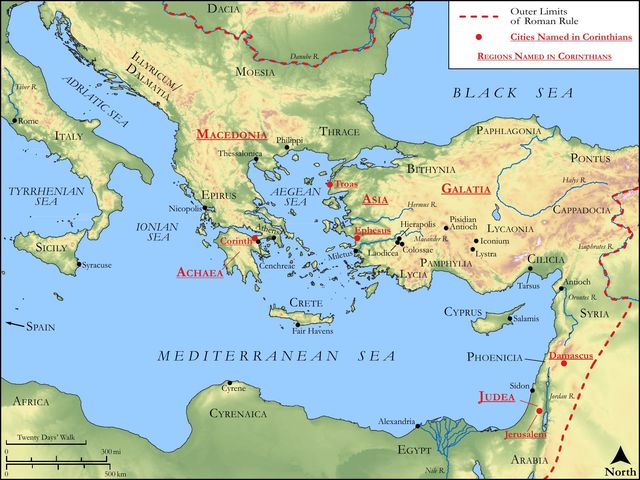
See on the biblical-era map

Study this verse
Public-domain commentary
Matthew Henry
From his Commentary on the Whole Bible. Henry comments on passages, not single verses — this entry covers 1 Corinthians 4:17–21.
Here, I. He tells them of his having sent Timothy to them, to bring them into remembrance of his ways in Christ, as he taught every where in every church (Co1 4:17) - to remind them of his ways in Christ, to refresh their memory as to his preaching and practice, what he taught, and how he lived among them. Note, Those who have had ever so good teaching are apt to forget, and need to have their memories refreshed. The same truth, taught over again, if it give no new light, may make new and quicker impression. He also lets them know that his teaching was the same every where, and in every church. He had not one doctrine for one place and people, and another for another. He kept close to his instructions. What he received of the Lord, that he delivered, Co1 11:23. This was the gospel revelation, which was the equal concern of all men, and did not very from itself. He therefore taught the same things in every church, and lived after the same manner in all times and places. Note, The truth of Christ is one and invariable. What one apostle taught every one taught. What one apostle taught at one time and in one place, he taught at all times and in all places. Christians may mistake and differ in their apprehensions, but Christ and Christian truth are the same yesterday, today, and for ever, Heb 13:8. To render their regard to Timothy the greater, he gives them his character. He was his beloved son, a spiritual child of his, as well as themselves. Note, Spiritual brotherhood should engage affection as well as what is common and natural. The children of one father should have one heart. But he adds, "He is faithful in the Lord - trustworthy, as one that feared the Lord. He will be faithful in the particular office he has now received of the Lord, the particular errand on which he comes; not only from me, but from Christ. He knows what I have taught, and what my conversation has been in all places, and, you may depend upon it, he will make a faithful report." Note, It is a great commendation of any minister that he is faithful in the Lord, faithful to his soul, to his light, to his trust from God; this must go a great way in procuring regard to his message with those that fear God.
II.He rebukes the vanity of those who imagined he would not come to them, by letting them know this was his purpose, though he had sent Timothy: "I will come to you shortly, though some of you are so vain as to think I will not." But he adds, if the Lord will. It seems, as to the common events of life, apostles knew no more than other men, nor were they in these points under inspiration. For, had the apostle certainly known the mind of God in this matter, he would not have expressed himself with this certainty. But he sets a good example to us in it. Note, All our purposes must be formed with a dependence on Providence, and a reserve for the overruling purposes of God. If the Lord will, we shall live, and do this and that, Jam 4:15.
III.He lets them know what would follow upon his coming to them:
I will know, not the speech of those that are puffed up, but the power, Co1 4:19. He would bring the great pretenders among them to a trial, would know what they were, not by their rhetoric or philosophy, but by the authority and efficacy of what they taught, whether they could confirm it by miraculous operations, and whether it was accompanied with divine influences and saving effects on the minds of men. For, adds he, the kingdom of God is not in word, but in power. It is not set up, nor propagated, nor established, in the hearts of men, by plausible reasonings nor florid discourses, but by the external power of the Holy Spirit in miraculous operations at first, and the powerful influence of divine truth on the minds and manners of men. Note, It is a good way in the general to judge of a preacher's doctrine, to see whether the effects of it upon men's hearts to be truly divine. That is most likely to come from God which in its own nature is most fit, and in event is found to produce most likeness to God, to spread piety and virtue, to change men's hearts and mend their manners.
IV.He puts it to their choice how he should come among them, whether with a rod or in love and the spirit of meekness (Co1 4:21); that is, according as they were they would find him. If they continued perverse among themselves and with him, it would be necessary to come with a rod; that is, to exert his apostolical power in chastising them, by making some examples, and inflicting some diseases and corporal punishments, or by other censures for their faults. Note, Stubborn offenders must be used with severity. In families, in Christian communities, paternal pity and tenderness, Christian love and compassion, will sometimes force the use of the rod. But this is far from being desirable, if it may be prevented. And therefore the apostle adds that it was in their own option whether he should come with a rod or in a quite different disposition and manner: Or in love and the spirit of meekness. As much as if he had said, "Take warning, cease your unchristian feuds, rectify the abuses among you, and return to your duty, and you shall find me as gentle and benign as you can with. It will be a force upon my inclination to proceed with severity. I had rather come and display the tenderness of a father among you than assert his authority. Do but your duty, and you have no reason to avoid my presence." Note, It is a happy temper in a minister to have the spirit of love and meekness predominant, and yet to maintain his just authority.
Historical interpretation
Three Centuries of Reception
5 surviving comments on this verse. Each one is dated, so this reads as a timeline rather than a list.
Select a marker to jump to its quote. Markers stagger vertically where authors wrote within a few decades of each other.
It is not smooth talk that reveals the presence of the kingdom of God, but power. When there is power in the words, then the kingdom is present in them.
That we must labour not with words, but with deeds. In Solomon, in Ecclesiasticus: "Be not hasty in thy tongue, and in thy deeds useless and remiss." And Paul, in the first to the Corinthians: "The kingdom of God is not in word, but in power." Also to the Romans: "Not the hearers of the law are righteous before God, but the doers of the law shall be justified." Also in the Gospel according to Matthew: "He who shall do and teach so, shall be called greatest in the kingdom of heaven." Also in the same place: "Every one who heareth my words, and doeth them, I will liken him to a wise man who built his house upon a rock. The rain descended, the floods came, the winds blew, and beat upon that house, and it fell not: for it was founded upon a rock. And every one who heareth my words, and doeth them not, I will liken him to the foolish man, who built his house upon the sand. The rain descended, the floods came, the winds blew, and beat upon that house; and it fell: and its ruin became great."
"For the kingdom of God is not in word, but in power." By signs, saith he, not by fine speaking, we have prevailed: and that our teaching is divine and really announces the Kingdom of Heaven we give the greater proof, namely, our signs which we work by the power of the Spirit. If those who are now puffed up desire to be some great ones; as soon as I am come, let them shew whether they have any such power. And let me not find them sheltering themselves behind a pomp of words: for that kind of art is nothing to us.
It is not enough to preach the kingdom of God in order to be saved; one must also behave in a way which is worthy of the kingdom.
Let us not deceive ourselves with a false security, believing that a nonresponsive faith lacking good works can deliver us against the day of judgment.
Continue studying 1 Corinthians 4:20 across the web’s major study libraries — every link below opens this exact verse, chapter, or book on the destination site.
Read & Compare
 BibleGatewayThis verse in more than 200 translations and 70 languages.
 Bible.comThe YouVersion reader — hundreds of translations, reading plans, and highlights.
 ESV.orgCrossway's official English Standard Version reader.
 NET BibleThe NET translation with 60,000+ translators' notes on every rendering decision.
 STEP BibleTyndale House's free study tool — original text, vocabulary, and scholarly resources.
 BibliaLogos Bible Software's free web reader.
 USCCBThe New American Bible (Revised Edition) with the U.S. bishops' study notes.
Commentaries
 BibleHub CommentariesDozens of classic commentaries on this verse, gathered on one page.
 StudyLightMore than 100 commentary sets — the largest collection on the web.
 BibleRefPlain-English commentary on what this verse means, verse by verse.
 Enduring WordDavid Guzik's free commentary on this chapter, widely used by Bible teachers.
 Bible Study ToolsVerse commentary alongside Greek and Hebrew study aids.
Original Language & Research
- BibleHub InterlinearThe verse word by word — original language, transliteration, and English.
- BibleHub LexiconEvery word's original-language definition and Strong's entry.
 Blue Letter BibleDeep-study tools — Strong's numbers, concordance, and word studies.
 CNTR CollationThe earliest Greek manuscripts of this verse, collated letter by letter.
Sermons, Hymns & Audio


TrulyRandomVerse is not affiliated with these sites and doesn’t control their content. They’re linked because they’re genuinely useful.
Summary
First Corinthians 4:20 declares a foundational truth about the nature of God's reign, asserting that the Kingdom of God is not characterized by mere human eloquence, persuasive rhetoric, or intellectual discourse, but rather by the tangible, transformative, and miraculous power of God. This verse serves as a concise yet potent summary of Paul's ongoing argument against the Corinthian church's overemphasis on human wisdom and their superficial understanding of spiritual authority, redirecting their focus to the authentic, Spirit-empowered reality of God's active presence and work.
Context
ShowHideLiterary Context
This verse stands as a climactic declaration within Paul's broader argument in 1 Corinthians, particularly following his rebuke of the Corinthian church's divisions and their misplaced pride in human leaders and worldly wisdom (chapters 1-3). Paul consistently contrasts human wisdom with God's wisdom and power, emphasizing that the Gospel's effectiveness does not rely on eloquent speech but on the Spirit's demonstration. In 1 Corinthians 4, Paul defends his apostolic ministry, which the Corinthians had seemingly devalued due to his lack of rhetorical flair compared to other teachers. He highlights his suffering and humility as marks of true apostleship, implicitly challenging their worldly standards of success. Verse 20 directly precedes Paul's intention to visit Corinth, where he promises to assess not merely the "word" of those boasting but their "power," thereby putting their claims to the test of divine reality.
Historical & Cultural Context
The city of Corinth was a prominent center of commerce, culture, and philosophy in the Roman world, renowned for its sophisticated rhetorical schools and its appreciation for eloquent speakers and intellectual debate. This cultural milieu significantly influenced the Corinthian believers, leading some to prioritize persuasive speech, human wisdom, and charismatic personalities over the humble, Spirit-empowered message of the cross. They likely admired teachers who could articulate the Gospel with philosophical depth and rhetorical skill, potentially viewing Paul's straightforward preaching as lacking. Paul's statement in 1 Corinthians 1:17-25 and 1 Corinthians 2:1-5 directly addresses this cultural predisposition, asserting that God deliberately chose to use "foolish" and "weak" means to confound the "wise" and "strong" of the world, ensuring that faith rests on God's power, not human wisdom.
Key Themes
ShowHideThe central theme is the stark contrast between human wisdom/rhetoric and divine power. Paul repeatedly emphasizes that the true nature of God's work and the advancement of His Kingdom are not dependent on human intellectual prowess or persuasive speech, but on the active, transformative power of the Holy Spirit. This leads to the theme of authentic ministry, where genuine spiritual authority is validated not by worldly standards of success or eloquence, but by the manifest presence and power of God working through His servants. The verse also underscores the present reality of the Kingdom of God, not merely as a future hope but as God's active, sovereign reign breaking into the present, demonstrating its reality through spiritual transformation and supernatural works. This aligns with Paul's earlier assertion in 1 Corinthians 2:4, where he states his message came "not with persuasive words of human wisdom, but in demonstration of the Spirit and of power."
Exposition and Analysis
ShowHideKey Word Analysis
ShowHideFrom the root meaning "king," this term signifies royalty, rule, or a realm. In this context, "the kingdom of God" refers to God's sovereign reign, His active rule and authority, which is both a present spiritual reality and a future consummation. It is not merely a concept or a future hope, but the dynamic, operative sphere of God's dominion.
While lógos can refer to the divine Word (Christ), in this specific context, it denotes something said, discourse, speech, or mere talk. Paul uses it to contrast empty rhetoric, intellectual arguments, or persuasive human eloquence with the substantive reality of God's power. It highlights the superficiality of mere verbal claims without corresponding spiritual reality.
This word signifies inherent ability, force, strength, or miraculous power. It is the root of English words like "dynamic" and "dynamite." Here, it refers to the active, operative, supernatural energy of God that brings about transformation, spiritual gifts, and miraculous results. It emphasizes the demonstrative, experiential aspect of God's Kingdom.
Verse Breakdown
ShowHide"For the kingdom of God"
This phrase introduces the subject: God's active, sovereign reign. It is not an abstract concept but a present reality that manifests itself in the world through believers. The "for" (G1063, gár) indicates that this statement provides the reason or explanation for Paul's previous warnings and his upcoming visit to Corinth.
"[is] not in word"
This negative assertion clarifies what the Kingdom of God is not characterized by. It is not found in mere human speech, intellectual arguments, persuasive rhetoric, or empty boasting. It directly challenges the Corinthian church's tendency to value eloquent speakers and philosophical discussions above genuine spiritual substance.
"but in power"
This positive affirmation declares what the Kingdom of God is characterized by. It is manifested through the active, transformative, and often miraculous power of God, demonstrated through the Holy Spirit. This power is seen in changed lives, spiritual gifts, divine interventions, and the authentic impact of the Gospel, contrasting sharply with superficial verbal displays.
Literary Devices
ShowHidePaul employs Antithesis in this verse, creating a sharp contrast between "word" (lógos) and "power" (dýnamis). This rhetorical device effectively highlights the fundamental difference between human wisdom and divine manifestation, emphasizing that the Kingdom of God operates on a different plane than worldly systems. The term "word" here functions as a Metonymy, where "word" stands for human eloquence, persuasive rhetoric, or intellectual argumentation, which the Corinthians valued. Similarly, "power" serves as a Metonymy for the tangible demonstration of God's Spirit, miraculous works, and transformative spiritual reality. This concise, antithetical statement serves as a powerful summary of Paul's entire argument against the Corinthians' misguided priorities.
Theological and Thematic Connections
ShowHide1 Corinthians 4:20 profoundly shapes our understanding of God's Kingdom, emphasizing that it is not merely a set of doctrines to be intellectually grasped or eloquently debated, but a dynamic, living reality empowered by God's Spirit. It underscores that the true measure of spiritual authenticity and effectiveness in ministry lies not in human charisma, rhetorical skill, or intellectual prowess, but in the manifest power of God working through and among believers. This power validates the Gospel message, transforms lives, and demonstrates God's active reign in the world, shifting the focus from human performance to divine enablement.
Reflection and Application
ShowHideThis verse serves as a powerful and enduring challenge to believers and the church across all generations. It calls us to move beyond a superficial, intellectualized, or merely verbal Christianity to one that is deeply rooted in and demonstrably empowered by the Holy Spirit. For individual believers, it prompts self-examination: Is my faith merely a set of beliefs I articulate, or is it a transformative power at work in my life, producing fruit and manifesting God's presence? For the church, it demands a critical assessment of our priorities: Are we chasing after worldly measures of success, such as eloquent speakers, impressive programs, or intellectual sophistication, or are we earnestly seeking and depending on the manifest power of God to bring about genuine spiritual transformation and impact? True ministry, according to Paul, is not about what we say, but about what God does through us.
Questions for Reflection
ShowHideFAQ
ShowHideWhat does "the kingdom of God" mean in this context?
ShowHideIn this context, "the kingdom of God" refers to God's active, sovereign rule and reign, which is a present spiritual reality breaking into human history through Jesus Christ and the Holy Spirit. It's not just a future heavenly realm, but God's dynamic authority being exercised now, transforming lives and demonstrating His power. Paul is emphasizing that this reign is not abstract or merely verbal, but tangible and impactful.
What is the contrast between "word" and "power"?
ShowHideThe contrast highlights that the Kingdom of God is not based on empty rhetoric, human eloquence, persuasive arguments, or intellectual boasting ("word"). Instead, its reality is demonstrated through the active, transformative, and often miraculous work of God's Spirit ("power"). It's a distinction between superficial talk and substantive, divine manifestation. Paul had previously stated his preaching was "not with persuasive words of human wisdom, but in demonstration of the Spirit and of power" in 1 Corinthians 2:4, reinforcing this core idea.
How does this verse apply to Christian ministry today?
ShowHideThis verse is a vital reminder for all Christian ministry that true effectiveness comes from God's power, not human ability. It challenges ministers to rely on the Holy Spirit for anointing, guidance, and the demonstration of God's presence, rather than on their own charisma, oratorical skills, or strategic planning alone. It means that the Gospel should be proclaimed not just with words, but with the accompanying evidence of God's transformative power in lives and circumstances, as was evident in the early church's ministry (e.g., Acts 4:33).
Christ-Centered Fulfillment
ShowHide1 Corinthians 4:20 finds its ultimate fulfillment and clearest demonstration in the person and ministry of Jesus Christ. He is the very embodiment of the Kingdom of God, and His earthly ministry was characterized not by mere words, but by unparalleled divine power. Jesus taught with authority, unlike the scribes (e.g., Matthew 7:29), and His words were consistently accompanied by mighty deeds—healing the sick, casting out demons, raising the dead, and calming storms. These acts were not just miracles, but powerful signs that the Kingdom of God had indeed "come upon you" (e.g., Matthew 12:28). His life, death, and resurrection are the supreme demonstration of God's power over sin and death (e.g., Romans 1:4). The power Paul speaks of in this verse is the same power that raised Christ from the dead and now works through believers, enabling them to continue His mission, proclaiming the Gospel not just in compelling speech, but in the life-transforming power of the Holy Spirit, just as Jesus promised His disciples in Acts 1:8.