


Matthew 12:28
- εἰeiIfG1487CONDConjunction
- δὲdehoweverG1161CONJConjunction
- ἐνenby [the]G1722PREPPreposition
- πνεύματιpneumatiSpiritG4151N-DSNNoun Dative Singular Neuter
- θεοῦtheouof GodG2316N-GSM-TNoun Genitive Singular Masculine Title
- ἐγὼegōI myselfG1473P-1NSPersonal pronoun Nominative 1st Singular
- ἐκβάλλωekballōcast outG1544V-PAI-1SVerb Present Active Indicative 1st Singular
- τὰta<the>G3588T-APNDefinite article Accusative Plural Neuter
- δαιμόνιαdaimoniademonsG1140N-APNNoun Accusative Plural Neuter
- ἄραarathenG686CONJConjunction
- ἔφθασενephthasenhas comeG5348V-AAI-3SVerb Aorist Active Indicative 3rd Singular
- ἐφ᾽eph᾽uponG1909PREPPreposition
- ὑμᾶςhumasyouG4771P-2APPersonal pronoun Accusative 2nd Plural
- ἡhētheG3588T-NSFDefinite article Nominative Singular Feminine
- βασιλείαbasileiakingdomG932N-NSFNoun Nominative Singular Feminine
- τοῦtou<the>G3588T-GSMDefinite article Genitive Singular Masculine
- θεοῦtheouof GodG2316N-GSM-TNoun Genitive Singular Masculine Title
English is a literal word-by-word gloss of the Greek, not the KJV's wording. Why?
This is the original text the KJV's translators worked from — each Greek word with its own literal English meaning in this verse, prepared by scholars at Tyndale House, Cambridge. The KJV translates whole sentences, not word by word, so its wording differs: one Greek word can become several English words, and the KJV may choose “charity” where the gloss reads “love”. Both are faithful — they answer different questions. For the KJV's own rendering, switch to the KJV text.
Details
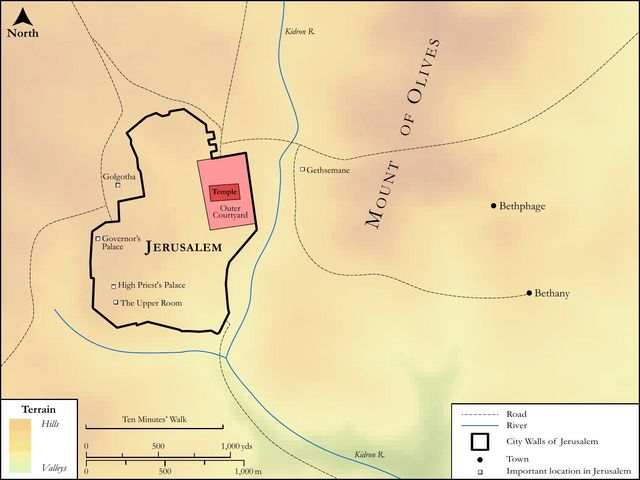
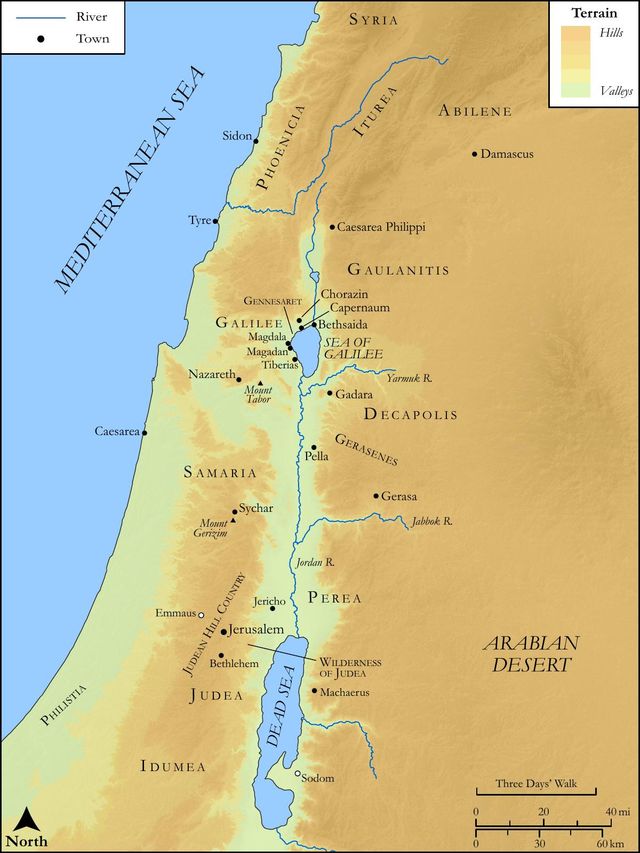
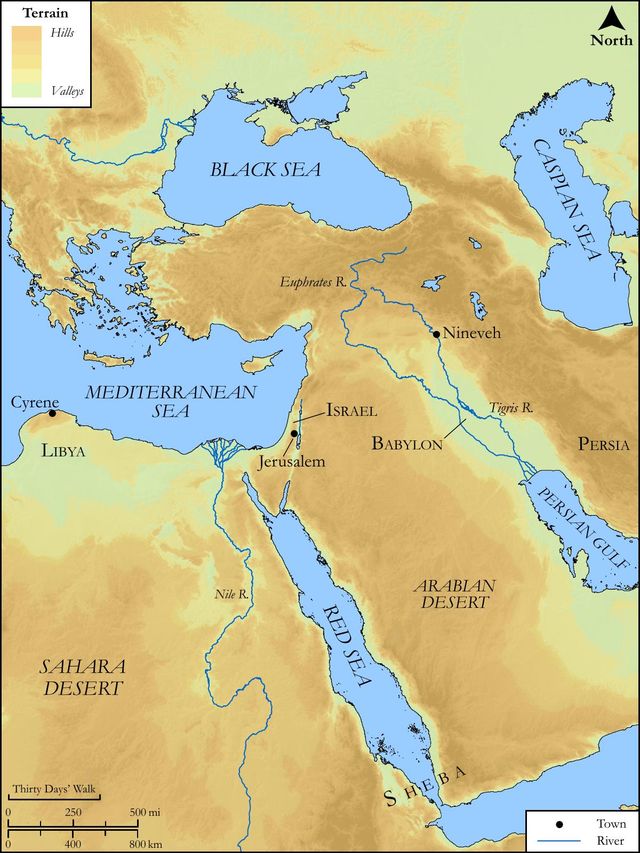
See on the biblical-era map
Study this verse
Public-domain commentary
Matthew Henry
From his Commentary on the Whole Bible. Henry comments on passages, not single verses — this entry covers Matthew 12:22–37. His four-level outline is real structure in the source text, so it is rendered as structure.
In these verses we have,
I.Christ's glorious conquest of Satan, in the gracious cure of one who, by the divine permission, was under his power, and in his possession, Mat 12:22. Here observe,
1.The man's case was very sad; he was possessed with a devil. More cases of this kind occurred in Christ's time than usual, that Christ's power might be the more magnified, and his purpose the more manifested, in opposing and dispossessing Satan; and that it might the more evidently appear, that he came to destroy the works of the devil. This poor man that was possessed was blind and dumb; a miserable case! he could neither see to help himself, nor speak to others to help him. A soul under Satan's power, and led captive by him, is blind in the things of God, and dumb at the throne of grace; sees nothing, and says nothing to the purpose. Satan blinds the eye of faith, and seals up the lips of prayer.
2.His cure was very strange, and the more so, because sudden; he healed him. Note, The conquering and dispossessing of Satan is the healing of souls. And the cause being removed, immediately the effect ceased; the blind and dumb both spake and saw. Note, Christ's mercy is directly opposite to Satan's malice; his favours, to the devil's mischiefs. When Satan's power is broken in the soul, the eyes are opened to see God's glory, and the lips opened to speak his praise.
II.The conviction which this gave to the people to all the people:
they were amazed. Christ had wrought divers miracles of this kind before; but his works are not the less wonderful, nor the less to be wondered at, for their being often repeated. They inferred from it, "Is not this the Son of David? The Messiah promised, that was to spring from the loins of David? Is not this he that should come?" We may take this, 1. As an enquiring question; they asked, Is not this the Son of David? But they did not stay for an answer: the impressions were cogent, but they were transient. It was a good question that they started; but, it should seem, it was soon lost, and was not prosecuted. Such convictions as these should be brought to a head, and then they are likely to be brought to the heart. Or, 2. as an affirming question; Is not this the Son of David? "Yes, certainly it is, it can be no other; such miracles as these plainly evince that the kingdom of the Messiah is now setting up." And they were the people, the vulgar sort of the spectators, that drew this inference from Christ's miracles. Atheists will say, "That was because they were less prying than the Pharisees;" no, the matter of fact was obvious, and required not much search: but it was because they were less prejudiced and biassed by worldly interest. So plain and easy was the way made to this great truth of Christ being the Messiah and Saviour of the world, that the common people could not miss it; the wayfaring men, though fools, could not err therein. See Isa 35:8. It was found of them that sought it. It is an instance of the condescensions of divine grace, that the things that were hid from the wise and prudent were revealed unto babes. The world by wisdom knew not God, and by the foolish things the wise were confounded.
III.The blasphemous cavil of the Pharisees, v.
24. The Pharisees were a sort of men that pretended to more knowledge in, and zeal for, the divine law, than other people; yet they were the most inveterate enemies to Christ and his doctrine. They were proud of the reputation they had among the people; that fed their pride, supported their power, and filled their purses; and when they heard the people say, Is not this the Son of David? they were extremely irritated, more at that than at the miracle itself; this made them jealous of our Lord Jesus, and apprehensive, that as his interest in the people's esteem increased, theirs must of course be eclipsed and diminished; therefore they envied him, as Saul did his father David, because of what the women sang of him, Sa1 18:7, Sa1 18:8. Note, Those who bind up their happiness in the praise and applause of men, expose themselves to a perpetual uneasiness upon every favourable word that they hear said of any other. The shadow of honour followed Christ, who fled from it, and fled from the Pharisees, who were eager in the pursuit of it. They said, "This fellow does not cast out devils, but by Beelzebub the prince of the devils, and therefore is not the Son of David." Observe,
1.How scornfully they speak of Christ, this fellow; as if that precious name of his, which is as ointment poured forth, were not worthy to be taken into their lips. It is an instance of their pride and superciliousness, and their diabolical envy, that the more people magnified Christ, the more industrious they were to vilify him. It is a bad thing to speak of good men with disdain because they are poor.
2.How blasphemously they speak of his miracles; they could not deny the matter of fact; it was as plain as the sun, that devils were cast out by the word of Christ; nor could they deny that it was an extraordinary thing, and supernatural. Being thus forced to grant the premises, they had no other way to avoid the conclusion, that this is the Son of David, than by suggesting that Christ cast out devils by Beelzebub; that there was a compact between Christ and the devil; pursuant to that, the devil was not cast out, but did voluntarily retire, and give back by consent and with design: or as if, by an agreement with the ruling devil, he had power to cast out the inferior devils. No surmise could be more palpably false and vile than this; that he, who is Truth itself, should be in combination with the father of lies, to cheat the world. This was the last refuge, or subterfuge rather, or an obstinate infidelity, that was resolved to stand it out against the clearest conviction. Observe, Among the devils there is a prince, the ringleader of the apostasy from God and rebellion against him; but this prince is Beelzebub - the god of a fly, or a dunghill god. How art thou fallen, O Lucifer! from an anger of light, to be a lord of flies! Yet this is the prince of the devils too, the chief of the gang of infernal spirits.
IV.Christ's reply to this base insinuation, Mat 12:25-30.
Jesus knew their thoughts. Note, Jesus Christ knows what we are thinking at any time, knows what is in man; he understands our thoughts afar off. It should seem that the Pharisees could not for shame speak it out, but kept it in their minds; they could not expect to satisfy the people with it; they therefore reserved it for the silencing of the convictions of their own consciences. Note, Many are kept off from their duty by that which they are ashamed to own, but which they cannot hide from Jesus Christ: yet it is probable that the Pharisees had whispered what they thought among themselves, to help to harden one another; but Christ's reply is said to be to their thoughts, because he knew with what mind, and from what principle, they said it; that they did not say it in their haste, but that it was the product of a rooted malignity.
Christ's reply to this imputation is copious and cogent, that every mouth may be stopped with sense and reason, before it be stopped with fire and brimstone. Here are three arguments by which he demonstrates the unreasonableness of this suggestion.
1.It would be very strange, and highly improbably, that Satan should be cast out by such a compact, because then Satan's kingdom would be divided against itself; which, considering his subtlety, is not a thing to be imagined, Mat 12:25, Mat 12:26.
(1.)Here is a known rule laid down, that in all societies a common ruin is the consequence of mutual quarrels: Every kingdom divided against itself is brought to desolation; and every family too: Quae enim domus tam stabilis est, quae tam firma civitas, quae non odiis atque dissidiis funditus everti possit? - For what family is so strong, what community so firm, as not to be overturned by enmity and dissension? Cic. Lael. 7. Divisions commonly end in desolations; if we clash, we break; if we divide one from another, we become an easy prey to a common enemy; much more if we bite and devour one another, shall we be consumed one of another, Gal 5:15. Churches and nations have known this by sad experience.
(2.)The application of it to the case in hand (Mat 12:26), If Satan cast out Satan; if the prince of the devils should be at variance with the inferior devils, the whole kingdom and interest would soon be broken; nay, if Satan should come into a compact with Christ, it must be to his own ruin; for the manifest design and tendency of Christ's preaching and miracles was to overthrow the kingdom of Satan, as a kingdom of darkness, wickedness, and enmity to God; and to set up, upon the ruins of it, a kingdom of light, holiness, and love. The works of the devil, as a rebel against God, and a tyrant over the souls of men, were destroyed by Christ; and therefore it was the most absurd thing imaginable, to think that Beelzebub should at all countenance such a design, or come into it: if he should fall in with Christ, how should then his kingdom stand? He would himself contribute to the overthrow of it. Note, The devil has a kingdom, a common interest, in opposition to God and Christ, which, to the utmost of his power, he will make to stand, and he will never come into Christ's interests; he must be conquered and broken by Christ, and therefore cannot submit and bend to him. What concord or communion can there be between light and darkness, Christ and Belial, Christ and Beelzebub? Christ will destroy the devil's kingdom, but he needs not do it by any such little arts and projects as that of a secret compact with Beelzebub; no, this victory must be obtained by nobler methods. Let the prince of the devils muster up all his forces, let him make use of all his powers and politics, and keep his interests in the closest confederacy, yet Christ will be too hard for his united force, and his kingdom shall not stand.
2.It was not at all strange, or improbable, that devils should be cast out by the Spirit of God; for,
(1.)How otherwise do your children cast them out? There were those among the Jews who, by invocation of the name of the most high God, or the God of Abraham, Isaac, and Jacob, did sometimes cast out devils. Josephus speaks of some in his time that did it; we read of Jewish exorcists (Act 19:13), and of some that in Christ's name cast out devils, though they did not follow him (Mar 9:38), or were not faithful to him, Mat 7:22. These the Pharisees condemned not, but imputed what they did to the Spirit of God, and valued themselves and their nation upon it. It was therefore merely from spite and envy to Christ, that they would own that others cast out devils by the Spirit of God, but suggest that he did it by compact with Beelzebub. Note, It is the way of malicious people, especially the malicious persecutors of Christ and Christianity, to condemn the same thing in those they hate, which they approve of and applaud in those they have a kindness for: the judgments of envy are made, not by things, but persons; not by reason, but prejudice. But those were very unfit to sit in Moses's seat, who knew faces, and knew nothing else in judgment: Therefore they shall be your judges; "This contradicting of yourselves will rise up in judgment against you at the last great day, and will condemn you." Note, In the last judgment, not only every sin, but every aggravation of it, will be brought into the account, and some of our notions that were right and good will be brought in evidence against us, to convict us of partiality.
(2.)This casting out of devils was a certain token and indication of the approach and appearance of the kingdom of God (Mat 7:28); "But if it be indeed that I cast out devils by the Spirit of God, as certainly I do, then you must conclude, that though you are unwilling to receive it, yet the kingdom of the Messiah is now about to be set up among you." Other miracles that Christ wrought proved him sent of God, but this proved him sent of God to destroy the devil's kingdom and his works. Now that great promise was evidently fulfilled, that the seed of the woman should break the serpent's head, Gen 3:15. "Therefore that glorious dispensation of the kingdom of God, which has been long expected, is now commenced; slight it at your peril." Note,
[1.]The destruction of the devil's power is wrought by the Spirit of God; that Spirit who works to the obedience of faith, overthrows the interest of that spirit who works in the children of unbelief and disobedience.
[2.]The casting out of devils is a certain introduction to the kingdom of God. If the devil's interest in a soul be not only checked by custom or external restraints, but sunk and broken by the Spirit of God, as a Sanctifier, no doubt but the kingdom of God is come to that soul, the kingdom of grace, a blessed earnest of the kingdom of the glory.
3.The comparing of Christ's miracles, particularly this of casting out devils, with his doctrine, and the design and tendency of his holy religion, evidenced that he was so far from being in league with Satan, that he was at open enmity and hostility against him (Mat 12:29); How can one enter into a strong man's house, and plunder his goods, and carry them away, except he first bind the strong man? And then he may do what he pleases with his goods. The world, that sat in darkness, and lay in wickedness, was in Satan's possession, and under his power, as a house in the possession and under the power of a strong man; so is every unregenerate soul; there Satan resides, there he rules. Now,
(1.)The design of Christ's gospel was to spoil the devil's house, which, as a strong man, he kept in the world; to turn the people from darkness to light, from sin to holiness, from this world to a better, from the power of Satan unto God (Act 26:18); to alter the property of souls.
(2.)Pursuant to this design, he bound the strong man, when he cast out unclean spirits by his word: thus he wrested the sword out of the devil's hand, that he might wrest the sceptre out of it. The doctrine of Christ teaches us how to construe his miracles, and when he showed how easily and effectually he could cast the devil out of people's bodies, he encouraged all believers to hope that, whatever power Satan might usurp and exercise in the souls of men, Christ by his grace would break it: he will spoil him, for it appears that he can bind him. When nations were turned from the service of idols to serve the living God, when some of the worst of sinners were sanctified and justified, and became the best of saints, then Christ spoiled the devil's house, and will spoil it more and more.
4.It is here intimated, that this holy war, which Christ was carrying on with vigour against the devil and his kingdom, was such as would not admit of a neutrality (Mat 12:30), He that is not with me is against me. In the little differences that may arise between the disciples of Christ among themselves, we are taught to lessen the matters in variance, and to seek peace, by accounting those who are not against us, to be with us (Luk 9:50); but in the great quarrel between Christ and the devil, no peace is to be sought, nor any such favourable construction to be made of any indifference in the matter; he that is not hearty for Christ, will be reckoned with as really against him: he that is cold in the cause, is looked upon as an enemy. When the dispute is between God and Baal, there is no halting between two (Kg1 18:21), there is no trimming between Christ and Belial; for the kingdom of Christ, as it is eternally opposite to, so it will be eternally victorious over, the devil's kingdom; and therefore in this cause there is no sitting still with Gilead beyond Jordan, or Asher on the sea-shore, (Jdg 4:16, Jdg 4:17), we must be entirely, faithfully, and immovably, on Christ's side; it is the right side, and will at last be the rising side. See Exo 32:26.
The latter clause is to the same purport: He that gathereth not with me scattereth. Note, (1.) Christ's errand into the world was to gather, to gather in his harvest, to gather in those whom the Father had given him, Joh 11:52; Eph 1:10. (2.) Christ expects and requires from those who are with him, that they gather with him; that they not only gather to him themselves, but do all they can in their places to gather others to him, and so to strengthen his interest. (3.) Those who will not appear, and act, as furtherers of Christ's kingdom, will be looked upon, and dealt with, as hinderers of it; if we gather not with Christ, we scatter; it is not enough, not to do hurt, but we must do good. Thus is the breach widened between Christ and Satan, to show that there was no such compact between them as the Pharisees whispered.
V.Here is a discourse of Christ's upon this occasion, concerning tongue-sins; Wherefore I say unto you.
He seems to turn from the Pharisees to the people, from disputing to instructing; and from the sin of the Pharisees he warns the people concerning three sorts of tongue-sins; for others' harms are admonitions to us.
1.Blasphemous words against the Holy Ghost are the worst kind of tongue-sins, and unpardonable, Mat 12:31, Mat 12:32.
(1.)Here is a gracious assurance of the pardon of all sin upon gospel terms: this Christ says to us, and it is a comfortable saying, that the greatness of sin shall be no bar to our acceptance with God, if we truly repent and believe the gospel: All manner of sin and blasphemy shall be forgiven unto men. Though the sin has been as scarlet and crimson (Isa 1:18), though ever so heinous in its nature, ever so much aggravated by its circumstances, and ever so often repeated, though it reach up to the heavens, yet with the Lord there is mercy, that reacheth beyond the heavens; mercy will be extended even to blasphemy, a sin immediately touching God's name and honour. Paul obtained mercy, who had been a blasphemer, Ti1 1:13. Well may we say, Who is a God like unto thee, pardoning iniquity? Mic 7:18. Even words spoken against the Son of man shall be forgiven; as theirs were who reviled him at his death, many of whom repented and found mercy. Christ herein has set an example to all the sons of men, to be ready to forgive words spoken against them: I, as a deaf man, heard not. Observe, They shall be forgiven unto men, not to devils; this is love to the whole world of mankind, above the world of fallen angels, that all sin is pardonable to them.
(2.)Here is an exception of the blasphemy against the Holy Ghost, which is here declared to be the only unpardonable sin. See here,
[1.]What this sin; it is speaking against the Holy Ghost. See what malignity there is in tongue-sins, when the only unpardonable sin is so. But Jesus knew their thoughts, Mat 12:25. It is not all speaking against the person or essence of the Holy Ghost, or some of his more private operations, or merely the resisting of his internal working in the sinner himself, that is here meant; for who then should be saved? It is adjudged in our law, that an act of indemnity shall always be construed in favour of that grace and clemency which is the intention of the act; and therefore the exceptions in the act are not to be extended further than needs must. The gospel is an act of indemnity; none are excepted by name, nor any by description, but those only that blaspheme the Holy Ghost; which therefore must be construed in the narrowest sense: all presuming sinners are effectually cut off by the conditions of the indemnity, faith and repentance; and therefore the other exceptions must not be stretched far: and this blasphemy is excepted, not for any defect of mercy in God or merit in Christ, but because it inevitably leaves the sinner in infidelity and impenitency. We have reason to think that none are guilty of this sin, who believe that Christ is the Son of God, and sincerely desire to have part in his merit and mercy: and those who fear they have committed this sin, give a good sign that they have not. The learned Dr. Whitby very well observes, that Christ speaks not of what should be (Mar 3:28; Luk 12:10); Whosoever shall blaspheme. As for those who blasphemed Christ when he was here upon earth, and called him a Winebibber, a Deceiver, a Blasphemer, and the like, they had some colour of excuse, because of the meanness of his appearance, and the prejudices of the nation against him; and the proof of his divine mission was not perfected till after his ascension; and therefore, upon their repentance, they shall be pardoned: and it is hoped that they may be convinced by the pouring out of the Spirit, as many of them were, who had been his betrayers and murderers. But if, when the Holy Ghost is given, in his inward gifts of revelation, speaking with tongues, and the like, such as were the distributions of the Spirit among the apostles, if they continue to blaspheme the Spirit likewise, as an evil spirit, there is no hope of them that they will ever be brought to believe in Christ; for First, Those gifts of the Holy Ghost in the apostles were the last proof that God designed to make use of for the confirming of the gospel, and were still kept in reserve, when other methods preceded. Secondly, This was the most powerful evidence, and more apt to convince than miracles themselves. Thirdly, Those therefore who blaspheme this dispensation of the Spirit, cannot possibly be brought to believe in Christ; those who shall impute them to a collusion with Satan, as the Pharisees did the miracles, what can convince them? This is such a strong hold of infidelity as a man can never be beaten out of, and is therefore unpardonable, because hereby repentance is hid from the sinner's eyes.
[2.]What the sentence is that is passed upon it; It shall not be forgiven, neither in this world, nor in the world to come. As in the then present state of the Jewish church, there was no sacrifice of expiation for the soul that sinned presumptuously; so neither under the dispensation of gospel grace, which is often in scripture called the world to come, shall there be any pardon to such as tread underfoot the blood of the covenant, and do despite to the Spirit of grace: there is no cure for a sin so directly against the remedy. It was a rule in our old law, No sanctuary for sacrilege. Or, It shall be forgiven neither now, in the sinner's own conscience, nor in the great day, when the pardon shall be published. Or, this is a sin that exposes the sinner both to temporal and eternal punishment, both to present wrath and the wrath to come.
2.Christ speaks here concerning other wicked words, the products of corruption reigning in the heart, and breaking out thence, Mat 12:33-35. It was said (Mat 12:25) that Jesus knew their thoughts, and here he spoke with an eye to them, showing that it was not strange that they should speak so ill, when their hearts were so full of enmity and malice; which yet they often endeavoured to cloak and cover, by feigning themselves just men. Our Lord Jesus therefore points to the springs and heals them; let the heart be sanctified and it will appear in our words.
(1.)The heart is the root, the language is the fruit (Mat 12:33); if the nature of the tree be good, it will bring forth fruit accordingly. Where grace is the reigning principle in the heart, the language will be the language of Canaan; and, on the contrary, whatever lust reigns in the heart it will break out; diseased lungs make an offensive breath: men's language discovers what country they are of, so likewise what manner of spirit they are of: "Either make the tree good, and then the fruit will be good; get pure hearts and then you will have pure lips and pure lives; or else the tree will be corrupt, and the fruit accordingly. you may make a crab-stock to become a good tree, by grafting into it a shoot from a good tree, and then the fruit will be good; but if the tree be still the same, plant it where you will, and water it how you will, the fruit will be still corrupt." Note, Unless the heart be transformed, the life will never be thoroughly reformed. These Pharisees were shy of speaking out their wicked thoughts of Jesus Christ; but Christ here intimates, how vain it was for them to seek to hide that root of bitterness in them, that bore this gall and wormwood, when they never sought to mortify it. Note, It should be more our care to be good really, than to seem good outwardly.
(2.)The heart is the fountain, the words are the streams (Mat 12:34); Out of the abundance of the heart the mouth speaks, as the streams are the overflowings of the spring. A wicked heart is said to send forth wickedness, as a fountain casts forth her waters, Jer 6:7. A troubled fountain, and a corrupt spring, such as Solomon speaks of (Pro 25:26), must needs send forth muddy and unpleasant streams. Evil words are the natural, genuine product of an evil heart. Nothing but the salt of grace, cast into the spring, will heal the waters, season the speech, and purify the corrupt communications. This they wanted, they were evil; and how can ye, being evil, speak good things? They were a generation of vipers; John Baptist had called them so (Mat 3:7), and they were still the same; for can the Ethiopian change his skin? The people looked upon the Pharisees as a generation of saints, but Christ calls them a generation of vipers, the seed of the serpent, that had an enmity to Christ and his gospel. Now what could be expected from a generation of vipers, but that which is poisonous and malignant? Can the viper be otherwise than venomous? Note, Bad things may be expected from bad people, as said the proverb of the ancients, Wickedness proceedeth from the wicked, Sa1 24:13. The vile person will speak villany, Isa 32:6. Those who are themselves evil, have neither skill nor will to speak good things, as they should be spoken. Christ would have his disciples know what sort of men they were to live among, that they might know what to look for. They are as Ezekiel among scorpions (Eze 2:6), and must not think it strange if they be stung and bitten.
(3.)The heart is the treasury, the words are the things brought out of that treasury (Mat 12:35); and from hence men's characters may be drawn, and may be judged of.
[1.]It is the character of a good man, that he has a good treasure in his heart, and from thence brings forth good things, as there is occasion. Graces, comforts, experiences, good knowledge, good affections, good resolutions, these are a good treasure in the heart; the word of God hidden there, the law of God written there, divine truths dwelling and ruling thee, are a treasure there, valuable and suitable, kept safe and kept secret, as the stores of the good householder, but ready for use upon all occasions. A good man, thus furnished, will bring forth, as Joseph out of his stores; will be speaking and doing that which is good, for God's glory, and the edification of others. See Pro 10:11, Pro 10:13, Pro 10:14, Pro 10:20, Pro 10:21, Pro 10:31, Pro 10:32. This is bringing forth good things. Some pretend to good expenses that have not a good treasure - such will soon be bankrupts: some pretend to have a good treasure within, but give no proof of it: they hope they have it in them, and thank God, whatever their words and actions are, they have good hearts; but faith without works is dead: and some have a good treasure of wisdom and knowledge, but they are not communicative, they do not bring forth out of it: they have a talent, but know not how to trade with it. The complete Christian in this bears the image of God, that he both is good, and does good.
[2.]It is the character of an evil man, that he has an evil treasure in his heart, and out of it bringeth forth evil things. Lusts and corruptions dwelling and reigning in the heart are an evil treasure, out of which the sinner brings forth bad words and actions, to the dishonour of God, and the hurt of others. See Gen 6:5, Gen 6:12; Mat 15:18-20; Jam 1:15. But treasures of wickedness (Pro 10:2) will be treasures of wrath.
3.Christ speaks here concerning idle words, and shows what evil there is in them (Mat 12:36, Mat 12:37); much more is there in such wicked words as the Pharisees spoke. It concerns us to think much of the day of judgment, that that may be a check upon our tongues; and let us consider,
(1.)How particular the account will be of tongue-sins in that day: even for every idle words, or discourse, that men speak, they shall give account. This intimates,
[1.]That God takes notice of every word we say, even that which we ourselves do not notice. See Psa 139:4. Not a word in my tongue but thou knowest it: though spoken without regard or design, God takes cognizance of it.
[2.]That vain, idle, impertinent talk is displeasing to God, which tends not to any good purpose, is not good to any use of edifying; it is the product of a vain and trifling heart. These idle words are the same with that foolish talking and jesting which is forbidden, Eph 5:4. This is that sin which is seldom wanting in the multitude of words, unprofitable talk, Job 15:3.
[3.]We must shortly account for these idle words; they will be produced in evidence against us, to prove us unprofitable servants, that have not improved the faculties of reason and speech, which are part of the talents we are entrusted with. If we repent not of our idle words, and our account for them be not balanced by the blood of Christ, we are undone.
(2.)How strict the judgment will be upon that account (Mat 12:37); By thy words thou shall be justified or condemned; a common rule in men's judgments, and here applied to God's. Note, The constant tenour of our discourse, according as it is gracious or not gracious, will be an evidence for us, or against us, at the great day. Those who seemed to be religious, but bridled not their tongue, will then be found to have put a cheat upon themselves with a vain religion, Jam 1:26. Some think that Christ here refers to that of Eliphaz (Job 15:6), Thine own mouth condemneth thee, and not I; or, rather, to that of Solomon (Pro 18:21), Death and life are in the power of the tongue.
Historical interpretation
Nine Centuries of Reception
10 surviving comments on this verse. Each one is dated, so this reads as a timeline rather than a list.
Select a marker to jump to its quote. Markers stagger vertically where authors wrote within a few decades of each other.
And they are worthily appointed judges over them, to whom Christ is found to have given that power over the dæmons, which it was denied that He had.
If then the disciples work by Christ, and Christ by the Spirit of God, already is the kingdom of God transferred to the Apostles through the office of the Mediator.
Again, his ability “to cast out demons” in the Spirit was something which, as man, he had been made able to do, according to the divine economy. And if the work of the Spirit is the kingdom of God, we should in no way regard the Spirit as something added to the Godhead, as if brought in from the servile creation in order to prepare for the divine kingdom.
This then being the first refutation, the next after it is that which relates to the disciples. For not always in one way only, but also in a second and third, He solves their objections, being minded most abundantly to silence their shamelessness. Which sort of thing He did also with respect to the Sabbath, bringing forward David, the priests, the testimony that saith, "I will have mercy, and not sacrifice," the cause of the Sabbath, for which it was ordained; "for the Sabbath," saith He," was for man." This then He doth in the present case also: where after the first He proceeds to a second refutation, plainer than the former.
"For if I," saith He, "by Belezebub cast out devils, by whom do your sons cast them out?"
See here too His gentleness. For He said not, "my disciples," nor, "the apostles," but "your sons;" to the end that if indeed they were minded to return to the same nobleness with them, they might derive hence a powerful spring that way; but if they were uncandid, and continued in the same course, they might not thenceforth be able to allege any plea, though ever so shameless.
But what He saith is like this, "By whom do the apostles cast them out?" For in fact they were doing so already, because they had received authority from Him, and these men brought no charge against them; their quarrel not being with the acts, but with the person only. As then it was His will to show that their sayings arose only from their envy against Him, He brings forward the apostles; thus: If I so cast them out, much more those, who have received their authority from me. Nevertheless, no such thing have ye said to them. How then bring ye these charges against me, the author of their doings, while acquitting them of the accusations? This, however, will not free you from your punishment, rather it will condemn you the more. Therefore also He added, "They shall be your judges." For when persons from among you, and having been practised in these things, both believe me and obey, it is most clear that they will also condemn those who are against me both in deed and word.
"But if I cast out devils by the Spirit of God, then the Kingdom of God is come unto you."
What means "the Kingdom"? "My coming." See how again He conciliates and soothes them, and draws them to the knowledge of Himself, and signifies that they are warring with their own good, and contentious against their own salvation. "For whereas ye ought to rejoice," saith He, "and leap for joy, that One is come bestowing those great and unutterable blessings, hymned of old by the prophets, and that the time of your prosperity is at hand; ye do the contrary; so far from receiving the blessings, you do even speak ill of them, and frame accusations that have no real being."
Now Matthew indeed saith, "If I by the Spirit of God cast out"; but Luke, "If I by the finger of God cast out the devils:" implying that to cast out devils is a work of the greatest power, and not of any ordinary grace. And He means indeed that from these things they should infer and say, If this be so, then the Son of God is come. This, however, He saith not, but in a reserved way, and so as not to be galling to them, He darkly intimates it by saying, "Then the kingdom of God is Come unto you."
Seest thou exceeding wisdom? By the very things which they were blaming, He showed His presence shining forth.
Then, to conciliate them, He said not simply, "The Kingdom is come," but, "unto you," as though He had said, To you the good things are come; wherefore then feel displeased at your proper blessings? why war against your own salvation? This is that time, which the prophets long ago foretold: this, the sign of that advent which was celebrated by them, even these things being wrought by divine power. For the fact indeed, that they are wrought, yourselves know; but that they are wrought by divine power, the deeds themselves cry out. Yea, and it is impossible that Satan should be stronger now; rather he must of absolute necessity be weak. But it cannot be, that he who is weak should, as though he were strong, cast out the strong devil.
Now thus speaking He signified the power of charity, and the weakness of separation and contentiousness. Wherefore He was Himself also continually charging His disciples, on every occasion, concerning charity, and teaching them that the devil, to subvert it, leaves nothing undone.
After the first answer, He comes to a second more plain than the first, saying, And if I by Beelzebub cast out dæmons, by whom do your sons cast them out? Therefore shall they be your judges.
Yet He said not, My disciples, or Apostles, but your children; that if they chose to return again to their own privileges, they might take occasion hence; but if they should be ungrateful, they might not have even an impudent excuse. And the Apostles cast out dæmons by virtue of power which they had from Him, and yet the Pharisees made no such charge against them; for it was not the actions themselves, but the person of Christ to which they were opposed. Desiring then to show that the things which were said against Him were only jealous suspicions, He brings forward the Apostles. And also He leads them to a knowledge of Himself, showing how they stood in the way of their own good, and resisted their own salvation; whereas they ought to be joyful because He had come to bestow great goods upon them; If I by the Spirit of God cast out dæmons, then is the kingdom of God come upon you. This also shows that it is a matter of great power to cast out dæmons, and not an ordinary grace. And thus it is He reasons, Therefore is the kingdom of God come upon you, as much as to say, If this indeed be so, then is the Son of God come upon you. But this He hints darkly, that it may not seem hard to them. Also to draw their attention, He said not merely, The kingdom hath come, but, upon you; that is to say, These good things are coming for you; why do you oppose your own salvation; for this is the very sign given by the Prophets of the presence of the Son of God, that such works as these should be wrought by Divine power.
But if ye think, ye Scribes and Pharisees, that the dæmons depart out of the possessed in obedience to their Prince, that men may be imposed upon by a concerted fraud, what can ye say to the healing of diseases which the Lord also wrought? It is something more if ye assign to the dæmons even bodily infirmities, and the signs of spiritual virtues.
He alludes, as is His manner, under the name children of the Jews, either to the exorcists of that race, or to the Apostles who are by race of that nation. If He means the exorcists who by the invocation of God cast out dæmons, He thus constrains the Pharisees by a wise enquiry to confess that their work was of the Holy Spirit. If, He would say, the casting out of the dæmons by your children is imputed to God, and not to dæmons, why should the same work wrought by Me not have the same cause? Therefore shall they be your judges, not by authority but by comparison, they ascribe the casting out of the dæmons to God, you to the Prince of the dæmons. But if it is of the Apostles also that this is said, (and so we should rather take it,) then they shall be their judges, for they shall sit on twelve thrones judging the twelve tribes of Israel.
For the kingdom of God denotes Himself, of whom it is written in another place, The kingdom of God is among you; (Luke 17:21) and, There standeth one in the midst of you whom ye know not. (John 1:26) Or surely that kingdom which both John and the Lord Himself had preached above, Repent ye, for the kingdom of heaven is at hand. (Mat. 3:2 4:17.) There is also a third kingdom of the Holy Scripture which shall be taken from the Jews, and be given to a nation that brings forth the fruit thereof.
(Verse 28.) But if it is by the Spirit of God that I cast out demons, then the kingdom of God has come upon you. In Luke, we read this passage as follows: But if it is by the finger of God that I cast out demons, then the kingdom of God has come upon you (Luke 11:20). This is the finger that the Magi confessed, who were making signs against Moses and Aaron, saying: This is the finger of God (Exodus 8:19). By this finger, the stone tablets were written on Mount Sinai (Deuteronomy 9). Therefore, if the hand and arm of God is the Son, and his finger is the Holy Spirit, then the Father, Son, and Holy Spirit are of one substance: let the inequality of the members not scandalize you, for the unity of the body builds it.
Therefore, the kingdom of God has come upon you. It signifies either himself, about whom it is written in another place: The kingdom of God is within you (Luke 17:21). And: One stands among you, whom you do not know (John 26). Or certainly that kingdom which both John and the Lord himself preached: Repent, for the kingdom of heaven is at hand (Matthew 3:2). There is also a third kingdom of Holy Scripture, which is taken away from the Jews and will be given to a nation producing its fruits (Matthew 21).
(Quæst. Ev. i. 5.) Whence the sense might be this, If I by Beelzebub vast out dæmons, then, according to your own opinion, the kingdom of God is come upon you, for the kingdom of the Devil, being thus divided against itself, cannot stand. Thus calling that the kingdom of God, in which the wicked are condemned, and are separated from the faithful, who are now doing penitence for their sins.
Or, because the Apostles well knew within their own conscience that they had learnt no evil art from Him.
This means, if it is by divine power that I cast out demons, then I am the Son of God, and I have come for your sake, to do good to you. So, then, I have come unto you, and this is the kingdom of God. Why do you slander My coming which is for your sake?
(ap Anselm.) For the weakening of the kingdom of the Devil is the increase of the kingdom of God.
Continue studying Matthew 12:28 across the web’s major study libraries — every link below opens this exact verse, chapter, or book on the destination site.
Read & Compare
 BibleGatewayThis verse in more than 200 translations and 70 languages.
 Bible.comThe YouVersion reader — hundreds of translations, reading plans, and highlights.
 ESV.orgCrossway's official English Standard Version reader.
 NET BibleThe NET translation with 60,000+ translators' notes on every rendering decision.
 STEP BibleTyndale House's free study tool — original text, vocabulary, and scholarly resources.
 BibliaLogos Bible Software's free web reader.
 USCCBThe New American Bible (Revised Edition) with the U.S. bishops' study notes.
Commentaries
 BibleHub CommentariesDozens of classic commentaries on this verse, gathered on one page.
 StudyLightMore than 100 commentary sets — the largest collection on the web.
 BibleRefPlain-English commentary on what this verse means, verse by verse.
 Enduring WordDavid Guzik's free commentary on this chapter, widely used by Bible teachers.
 Bible Study ToolsVerse commentary alongside Greek and Hebrew study aids.
Original Language & Research
- BibleHub InterlinearThe verse word by word — original language, transliteration, and English.
- BibleHub LexiconEvery word's original-language definition and Strong's entry.
 Blue Letter BibleDeep-study tools — Strong's numbers, concordance, and word studies.
 CNTR CollationThe earliest Greek manuscripts of this verse, collated letter by letter.
Sermons, Hymns & Audio


TrulyRandomVerse is not affiliated with these sites and doesn’t control their content. They’re linked because they’re genuinely useful.
Summary
Matthew 12:28 stands as a profound declaration by Jesus, serving as the climactic point in His rebuttal to the Pharisees' blasphemous accusation that His power to cast out demons originated from Satan. In this pivotal statement, Jesus unequivocally asserts that His exorcisms are not merely acts of power, but undeniable evidence that the long-anticipated reign of God has decisively broken into human history through His ministry, presenting a direct challenge to the dominion of evil and signaling the dawn of a new era.
Context
ShowHideLiterary Context
This verse is situated within a critical confrontation in Jesus' public ministry, immediately following His healing of a demon-possessed man who was blind and mute, an act that prompted the crowds to wonder if He was the promised Son of David (Matthew 12:22). The Pharisees, threatened by Jesus' growing influence and miraculous power, responded with a grave accusation: "This fellow doth not cast out devils, but by Beelzebub the prince of the devils" (Matthew 12:24). Jesus masterfully refutes their illogical argument by demonstrating the absurdity of a kingdom divided against itself, stating that "every kingdom divided against itself is brought to desolation; and every city or house divided against itself shall not stand" (Matthew 12:25). He then challenges them, asking how Satan could cast out Satan, concluding that such an act would dismantle Satan's own kingdom (Matthew 12:26). Matthew 12:28 serves as the powerful counter-assertion, shifting from refutation to declaration: if His power is indeed from God's Spirit, then the Kingdom of God is not just near, but has arrived.
Historical & Cultural Context
First-century Judaism was deeply steeped in messianic expectation, anticipating a time when God would decisively intervene in history to establish His sovereign rule, often envisioned as a political kingdom that would overthrow Roman oppression. Exorcism was recognized as a legitimate practice, often associated with spiritual power and divine authority, though Jewish exorcists typically invoked God's name or the names of patriarchs. The Pharisees, as religious leaders, held significant authority and were guardians of the Mosaic Law and oral traditions. Their accusation against Jesus was not merely a theological disagreement but a strategic attempt to discredit His divine claims and undermine His authority by associating Him with demonic forces, a charge that was both scandalous and blasphemous in their cultural framework. Jesus' claim that the Kingdom of God had "come unto you" would have resonated with their messianic hopes, yet simultaneously challenged their preconceived notions of how that Kingdom would arrive, particularly through a figure who did not conform to their political or religious expectations.
Key Themes
ShowHideMatthew 12:28 powerfully contributes to several overarching themes within Matthew's Gospel and broader biblical theology. Firstly, it underscores The Inauguration of the Kingdom of God, asserting that God's sovereign reign, long prophesied and awaited, is actively breaking into the present world through Jesus' ministry. This is a central message of Jesus, who proclaimed, "The time is fulfilled, and the kingdom of God is at hand: repent ye, and believe the gospel" (Mark 1:15). Secondly, the verse highlights Jesus' Divine Authority Over Evil. His ability to cast out demons by the Spirit of God demonstrates God's ultimate triumph over the forces of darkness, positioning Jesus as the strong man who binds Satan to plunder his house (Matthew 12:29). This theme is crucial for understanding Jesus' mission to destroy the works of the devil (1 John 3:8). Finally, it emphasizes The Indispensable Role of the Holy Spirit in Jesus' ministry. The phrase "by the Spirit of God" reveals that Jesus' miraculous power is not merely human but divinely enabled, a truth evident from His baptism when the Spirit descended upon Him (Matthew 3:16). This highlights the Trinitarian nature of God's redemptive work.
Exposition and Analysis
ShowHideKey Word Analysis
ShowHideThis term refers to a demonic being, often translated as "demon." In the New Testament, these are malevolent spiritual entities subject to Satan, who oppose God and afflict humanity. Jesus' power over them signifies His authority over the entire realm of evil.
Denotes a current of air, breath, or wind, but in this context, it refers to a spirit, specifically the divine Spirit of God, the Holy Spirit. This highlights the divine source of Jesus' power, distinguishing it from any human or demonic origin.
Properly, "royalty" or "rule," but concretely, a "realm." Here, it signifies the sovereign reign or rule of God. It is not merely a geographical territory but the active exercise of God's kingly authority, breaking into human affairs.
This verb means "to be beforehand," "anticipate," or "to have arrived at." It conveys the sense of something having already reached its destination or having arrived sooner than expected. In this verse, it emphasizes the present, decisive arrival of God's Kingdom, not merely its future expectation.
Verse Breakdown
ShowHide"But if I cast out devils by the Spirit of God,"
This clause presents a conditional premise, directly addressing the Pharisees' accusation. Jesus contrasts their claim of Beelzebul's power with the true source of His authority: the Spirit of God. The act of casting out demons is presented as a tangible, observable sign. The "if" here is not an expression of doubt but a logical premise for an argument, akin to "since I am casting out demons..." It underscores that His exorcisms are not random acts but divinely empowered demonstrations.
"then the kingdom of God is come unto you."
This is the profound conclusion drawn from the premise. If Jesus' power over demons is indeed by the Spirit of God, then it serves as irrefutable proof that the long-awaited Kingdom of God has not merely drawn near, but has decisively "arrived" or "come upon" them. The phrase "unto you" emphasizes that this divine reign is not a distant, abstract concept, but a present reality actively manifesting in their midst through Jesus' ministry, challenging their existing spiritual and political order.
Literary Devices
ShowHideMatthew 12:28 employs several significant literary devices. The primary device is a Conditional Statement ("If... then..."), which functions as a logical argument. Jesus presents a premise (His exorcisms by the Spirit of God) and draws an inescapable conclusion (the Kingdom of God has arrived). This structure is a powerful form of Deductive Reasoning, compelling His audience to acknowledge the implication of His actions. There is also a strong element of Contrast at play, as Jesus juxtaposes the Pharisees' false accusation of demonic power with the true, divine source of His authority, thereby highlighting the fundamental difference between the kingdom of darkness and the Kingdom of God. Furthermore, the act of exorcism itself functions as Symbolism, representing God's active invasion of Satan's domain and the triumph of divine authority over evil, making the invisible reality of God's reign visible through tangible acts.
Theological and Thematic Connections
ShowHideMatthew 12:28 is a theological cornerstone, asserting that the Kingdom of God is not merely a future hope but a present reality inaugurated through Jesus' ministry. It reveals that God's sovereign rule is actively breaking into the world, directly confronting and overcoming the dominion of evil. Jesus' exorcisms, empowered by the Holy Spirit, are tangible signs of this divine invasion, demonstrating God's ultimate authority over all spiritual forces. This verse links the spiritual power of the Holy Spirit directly to the advancement of God's reign, showing that where the Spirit is at work, God's kingly power is manifesting, bringing liberation and light. It fundamentally redefines the nature of the Kingdom, not as a political or military conquest, but as a spiritual reality that establishes God's will on earth.
Reflection and Application
ShowHideMatthew 12:28 offers profound encouragement and challenge for believers today. It calls us to recognize that the Kingdom of God is not a distant, ethereal concept, but a dynamic, present reality that continues to advance wherever the Spirit of God is at work. This means that we are not living in a world abandoned to evil, but one where God's sovereign rule is actively being established, bringing light, healing, and freedom. For us, this implies a call to spiritual discernment, to recognize the signs of God's Kingdom breaking forth in our lives and in the world around us, and to align ourselves with His purposes. It also reminds us that our spiritual battles are fought from a position of victory, as the "strong man" (Satan) has already been bound by Christ. As recipients of the Holy Spirit, we are empowered to participate in the ongoing work of the Kingdom, confronting darkness with truth, love, and the power of God. This verse compels us to live with Kingdom intentionality, knowing that God's reign is here, and we are His agents.
Questions for Reflection
ShowHideFAQ
ShowHideWhat does Jesus mean by "the kingdom of God is come unto you"?
ShowHideWhen Jesus says "the kingdom of God is come unto you," He is declaring that God's sovereign reign, which was long anticipated in Old Testament prophecy, is no longer merely a future expectation but has decisively broken into human history through His own person and ministry. His ability to cast out demons by the Spirit of God is presented as undeniable proof of this reality. It signifies that God's kingly rule is actively manifesting on earth, challenging the dominion of evil and bringing about His redemptive purposes. It means that God's authority and power are present and available, not just in a distant heaven, but "unto you"—among and accessible to the people He is addressing. This is a central theme of Jesus' preaching, as seen in passages like Luke 17:20-21.
Why is casting out demons by the Spirit of God so significant in this context?
ShowHideCasting out demons by the Spirit of God is profoundly significant because it directly refutes the Pharisees' blasphemous accusation that Jesus was operating by the power of Satan (Matthew 12:24). Jesus' argument is logical: Satan would not cast out his own demons, as that would divide his kingdom. Therefore, the source of His power must be divine. If His power is from the Spirit of God, then His exorcisms are not just miracles, but concrete demonstrations that God's Kingdom is actively invading and overcoming Satan's domain. It proves that a "stronger man" has come to bind the "strong man" (Satan) and plunder his house (Matthew 12:29). This act signifies the inauguration of God's reign, where evil is being defeated, and God's will is being established on earth.
Christ-Centered Fulfillment
ShowHideMatthew 12:28 finds its ultimate fulfillment in the person and work of Jesus Christ, who is the very embodiment and inaugurator of the Kingdom of God. As the promised Messiah, Jesus did not merely announce the Kingdom; He brought it into present reality through His life, ministry, death, and resurrection. His power to cast out demons by the Spirit of God was a tangible demonstration of His divine authority and His mission to destroy the works of the devil (1 John 3:8). Every exorcism was a skirmish in the larger war, signaling God's decisive victory over the forces of darkness through His Son. The "kingdom of God is come unto you" because the King Himself, Jesus, had arrived, bringing with Him God's sovereign rule. His victory on the cross and resurrection cemented this triumph, establishing His eternal reign and empowering His followers with the same Spirit to continue His work of advancing the Kingdom until its glorious consummation (Colossians 1:13 and Revelation 11:15).