


Judges 4:17
Bible text: King James Version (1769 Blayney text) · Public domain
Bible text: King James Version with Strong's numbers · Public domain
Bible text: Berean Standard Bible · Public domain
Bible text: American Standard Version (1901) · Public domain
Bible text: World English Bible, Messianic edition · Public domain
Bible text: Geneva Bible (1599) · Public domain
Bible text: Young's Literal Translation · Public domain
- וְסִיסְרָאve·si·se·Ra'and SiseraH5516Conj-w ¦ N-proper-mNoun Proper MasculineוְandסִיסְרָאSisera
- נָסnashe fledH5127V-Qal-Perf-3msVerb Qal Perfect 3rd Singular Masculine
- בְּרַגְלָיוbe·rag·Lavon his feetH7272Prep-b ¦ N-fdc ¦ 3msNoun Dual Feminine Constructבְּonרַגְלָיfeetוhis
- אֶל'eltoH413PrepPreposition
- אֹהֶל'O·hel[the] tent ofH168N-mscNoun Singular Masculine Construct
- יָעֵלya·'ElJaelH3278N-proper-fNoun Proper Feminine
- אֵשֶּׁת'E·shet[the] wife ofH802N-fscNoun Singular Feminine Construct
- חֶבֶרChe·verHeberH2268N-proper-mNoun Proper Masculine
- הַקֵּינִיha·kei·Nithe KeniteH7017Art ¦ N-msNoun Gentilic Singular Masculine AbsoluteהַtheקֵּינִיKenite
- כִּיkiforH3588PrtParticle Conditional
- שָׁלוֹםsha·LompeaceH7965N-msNoun Singular Masculine Absolute
- בֵּיןbein[was] betweenH996Adj-mscAdjective Numerical Singular Masculine Construct
- יָבִיןya·VinJabinH2985N-proper-mNoun Proper Masculine
- מֶלֶךְMe·lekh[the] king ofH4428N-mscNoun Singular Masculine Construct
- חָצוֹרcha·TzorHazorH2674N-properNoun Proper Location
- וּבֵיןu·Veinand betweenH996Conj-w ¦ Adj-mscAdjective Numerical Singular Masculine Constructוּandבֵיןbetween
- בֵּיתbeit[the] house ofH1004N-mscNoun Singular Masculine Construct
- חֶבֶרChe·verHeberH2268N-proper-mNoun Proper Masculine
- הַקֵּינִיha·kei·Nithe KeniteH7017Art ¦ N-msNoun Gentilic Singular Masculine AbsoluteהַtheקֵּינִיKenite
English is a literal word-by-word gloss of the Hebrew, not the KJV's wording. Why?
This is the original text the KJV's translators worked from — each Hebrew word with its own literal English meaning in this verse, prepared by scholars at Tyndale House, Cambridge. The KJV translates whole sentences, not word by word, so its wording differs: one Hebrew word can become several English words, and the KJV may choose “the LORD” where the gloss reads “Yahweh”. Both are faithful — they answer different questions. For the KJV's own rendering, switch to the KJV text.
Details
See on the biblical-era maps
Study this verse
Public-domain commentary
Matthew Henry
From his Commentary on the Whole Bible. Henry comments on passages, not single verses — this entry covers Judges 4:17–24. His four-level outline is real structure in the source text, so it is rendered as structure.
We have seen the army of the Canaanites totally routed. It is said (Psa 83:9, Psa 83:10, where the defeat of this army is pleaded as a precedent for God's doing the like in after times) that they became as dung for the earth. Now here we have,
I.The fall of their general, Sisera, captain of the host, in whom, it is likely, Jabin their king put an entire confidence, and therefore was not himself present in the action. Let us trace the steps of this mighty man's fall.
1.He quitted his chariot, and took to his feet, Jdg 4:15, Jdg 4:17. His chariots had been his pride and his confidence; and we may suppose he had therefore despised and defied the armies of the living God, because they were all on foot, and had neither chariot nor horse, as he had. Justly therefore is he thus made ashamed of his confidence, and forced to quit it, and thinks himself then most safe and easy when he has got clear of his chariot, though we may well suppose it the best made, and best drawn, of any of them. Thus are those disappointed who rest on the creature; like a broken reed, it not only breaks under them, but runs into their hand, and pierceth them with many sorrows. The idol may quickly become a burden (Isa 46:1), and what we were sick for God can make us sick of. How miserable doth Sisera look now he is dismounted! It is hard to say whether he blusheth or trembleth more. Put not your trust in princes, if they may so soon be brought to this, if he who but lately trusted to his arms with so much assurance must now trust to his heels only with so little.
2.He fled for shelter to the tents of the Kenites, having no strong-hold, nor any place of is own in reach to retire to. The mean and solitary way of the Kenites' living, perhaps, he had formerly despised and ridiculed, and the more because religion was kept up among them; yet now he is glad to put himself under the protection of one of these tents: and he chooses the wife's tent or apartment, either because less suspected, or because it happened to be next to him, and the first he came to, Jdg 4:17. And that which encouraged him to go thither was that at this time there was peace between his master and the house of Heber: not that there was any league offensive and defensive between them, only at present there were no indications of hostility. Jabin did them no harm, did not oppress them as he did the Israelites, their plain, quiet, harmless way of living making them not suspected nor feared, and perhaps God so ordering it as a recompence for their constant adherence to the true religion. Sisera thought he might therefore be safe among them; not considering that, though they themselves suffered not by Jabin's power, they heartily sympathized with the Israel of God that did.
3.Jael invited him in, and bade him very welcome. Probably she stood at the tent door, to enquire what news from the army, and what the success of the battle which was fought not far off.
(1.)She invited him in. Perhaps she stood waiting for an opportunity to show kindness to any distressed Israelite, if there should be occasion for it; but seeing Sisera come in great haste, panting and out of breath, she invited him to come and repose himself in her tent, in which, while she seemed to design the relieving of his fatigue, perhaps she really intended the retarding of his flight, that he might fall into the hands of Barak, who was not in a hot chase after him (Jdg 4:18), and it may well questioned whether she had at first any thought of taking away his life, but rather God afterwards put it into her heart.
(2.)She made very much of him, and seemed mighty careful to have him easy, as her invited guest. Was he weary? she finds him a very convenient place to repose himself in, and recruit his strength. Was he thirsty? well he might. Did he want a little water to cool his tongue? the best liquor her tent afforded was at his service, and that was milk (Jdg 4:19), which, we may suppose, he drank heartily of, and, being refreshed with it, was the better disposed to sleep. Was he cold, or afraid of catching cold? or did he desire to be hid from the pursuers, if they should search that tent? she covered him with a mantle, Jdg 4:18. All expressions of care for his safety. Only when he desired her to tell a lie for him, and to say he was not there, she declined making any such promise, Jdg 4:20. We must not sin against God, no, not to oblige those we would show ourselves most observant of. Lastly, We must suppose she kept her tent as quiet as she could, and free from noise, that he might sleep the sooner and the faster. And now was Sisera least safe when he was most secure. How uncertain and precarious is human life! and what assurance can we have of it, when it may so easily be betrayed by those with whom it is trusted, and those may prove its destroyers who we hoped would be its protectors! It is best making God our friend, for he will not deceive us.
4.When he lay fast asleep she drove a long nail through his temples, so fastened his head to the ground, and killed him, Jdg 4:21. And, though this was enough to do the business, yet, to make sure work (if we translate it rightly, Jdg 5:26), she cut off his head, and left it nailed there. Whether she designed this or no when she invited him into her tent does not appear; probably the thought was darted into her mind when she saw him lie so conveniently to receive such a fatal blow; and, doubtless, the thought brought with it evidence sufficient that it came not from Satan as a murderer and destroyer, but from God as a righteous judge and avenger, so much of brightness and heavenly light did she perceive in the inducements to it that offered themselves, the honour of God and the deliverance of Israel, and nothing of the blackness of malice, hatred, or personal revenge.
(1.)It was a divine power that enabled her to do it, and inspired her with a more than manly courage. What if her hand should shake, and she should miss her blow? What if he should awake when she was attempting it? Or suppose some of his own attendants should follow him, and surprise her in the face, how dearly would she and all hers be made to pay for it? Yet, obtaining help of God, she did it effectually.
(2.)It was a divine warrant that justified her in the doing of it; and therefore, since no such extraordinary commissions can now be pretended, it ought not in any case to be imitated. The laws of friendship and hospitality must be religiously observed, and we must abhor the thought of betraying any whom we have invited and encouraged to put a confidence in us. And, as to this act of Jael (like that of Ehud in the chapter before), we have reason to think she was conscious of such a divine impulse upon her spirit to do it as did abundantly satisfy herself (and it ought therefore to satisfy us) that it was well done. God's judgments are a great deep. The instrument of this execution was a nail of the tent, that is, one of the great pins with which the tent, or the stakes of it, were fastened. They often removing their tents, she had been used to drive these nails, and therefore knew how to do it the more dexterously on this great occasion. he that thought to destroy Israel with his many iron chariots is himself destroyed with one iron nail. Thus do the weak things of the world confound the mighty. See here Jael's glory and Sisera's shame. The great commander dies,
[1.]In his sleep, fast asleep, and weary. It comes in as a reason why he stirred not, to make resistance. So fettered was he in the chains of sleep that he could not find his hands. Thus the stout-hearted are spoiled at thy rebuke, O God of Jacob! they are cast into a dead sleep, and so are made to sleep their last, Psa 76:5, Psa 76:6. Let not the strong man then glory in his strength; for when he sleeps where is it? It is weak, and he can do nothing; a child may insult him then, and steal his life from him; and yet if he sleep not he is soon spent and weary, and can do nothing either. Those words which we here put in a parenthesis (for he was weary) all the ancient versions read otherwise: he struggled (or started, as we say) and died, so the Syriac and Arabic, Exagitans ses mortuus est. He fainted and died, so the lxx. Consocians morte soporem, so the vulgar Latin, joining sleep and death together, seeing they are so near akin. He fainted and died. He dies,
[2.]With his head nailed to the ground, an emblem of his earthly-mindedness. O curve in terram animoe! His ear (says bishop Hall) was fastened close to the earth, as if his body had been listening what had become of his soul. He dies,
[3.]By the hand of a woman. This added to the shame of his death before men; and had he but known it, as Abimelech (Jdg 9:54), we may well imagine how much it would have added to the vexation of his own heart.
II.The glory and joy of Israel hereupon.
1.Barak their leader finds his enemy dead, (Jdg 4:22), and no doubt, he was very well pleased to find his work done so well to his hand, and so much to the glory of God and the confusion of his enemies. had he stood too nicely upon a point of honour, he would have resented it as an affront to have the general slain by any hand but his; but now he remembered that this diminution of his honour he was sentenced to undergo, for insisting upon Deborah's going with him (the Lord shall sell Sisera into the hand of a woman), though then it was little thought that the prediction would be fulfilled in such a way as this.
2.Israel is completely delivered out of the hands of Jabin king of Canaan, Jdg 4:23, Jdg 4:24. They not only shook off his yoke by this day's victory, but they afterwards prosecuted the war against him, till they had destroyed him, he and his nation being by the divine appointment devoted to ruin and not to be spared. The Israelites, having soundly smarted for their foolish pity in not doing it before, resolved now it is in their power to indulge them no longer, but to make a thorough riddance of them, as a people to whom to show mercy was as contrary to their own interest as it was to God's command; and probably it is with an eye to the sentence they were under that this enemy is named three times here in these last two verses, and called king of Canaan; for as such he was to be destroyed; and so thoroughly was he destroyed that I do not remember to read of the kings of Canaan any more after this. The children of Israel would have prevented a great deal of mischief if they had sooner destroyed these Canaanites, as God had both commanded and enabled them; but better be wise late, and buy wisdom by experience, than never wise.
Continue studying Judges 4:17 across the web’s major study libraries — every link below opens this exact verse, chapter, or book on the destination site.
Read & Compare
 BibleGatewayThis verse in more than 200 translations and 70 languages.
 Bible.comThe YouVersion reader — hundreds of translations, reading plans, and highlights.
 ESV.orgCrossway's official English Standard Version reader.
 NET BibleThe NET translation with 60,000+ translators' notes on every rendering decision.
 STEP BibleTyndale House's free study tool — original text, vocabulary, and scholarly resources.
 BibliaLogos Bible Software's free web reader.
 USCCBThe New American Bible (Revised Edition) with the U.S. bishops' study notes.
Commentaries
 BibleHub CommentariesDozens of classic commentaries on this verse, gathered on one page.
 StudyLightMore than 100 commentary sets — the largest collection on the web.
 BibleRefPlain-English commentary on what this verse means, verse by verse.
 Enduring WordDavid Guzik's free commentary on this chapter, widely used by Bible teachers.
 Bible Study ToolsVerse commentary alongside Greek and Hebrew study aids.
Original Language & Research
- BibleHub InterlinearThe verse word by word — original language, transliteration, and English.
- BibleHub LexiconEvery word's original-language definition and Strong's entry.
 Blue Letter BibleDeep-study tools — Strong's numbers, concordance, and word studies.
 SefariaThe Hebrew text with Rashi and centuries of Jewish commentary.
Sermons, Hymns & Audio


TrulyRandomVerse is not affiliated with these sites and doesn’t control their content. They’re linked because they’re genuinely useful.
Summary
Judges 4:17 meticulously records the desperate flight of Sisera, the vanquished Canaanite military commander, following the decisive defeat of his forces by the Israelites under the leadership of Deborah and Barak. Having abandoned his formidable chariots, Sisera seeks a perilous refuge on foot within the domestic sanctuary of Jael, the wife of Heber the Kenite. His choice of asylum is strategically predicated on a perceived peace treaty existing between his overlord, King Jabin of Hazor, and the Kenite clan, a detail that profoundly underscores the complex political dynamics of the era and Sisera's critical miscalculation of his precarious situation, ultimately setting the stage for his dramatic and unexpected demise.
Context
ShowHideLiterary Context
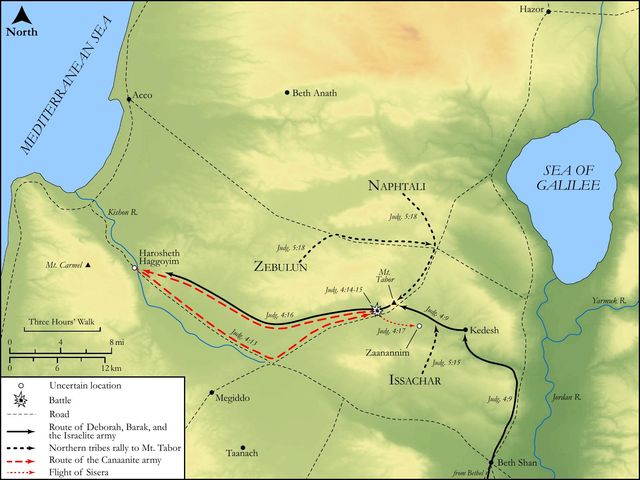
This pivotal verse immediately follows the climactic and divinely orchestrated rout of Sisera's army, as vividly recounted in Judges 4:15-16. There, the Lord's intervention threw Sisera and his formidable chariots into utter confusion, leading to a complete and devastating defeat at the hands of Barak's Israelite forces. Sisera, once the emblem of Canaanite military might and oppression, is now reduced to a desperate, solitary fugitive. His flight to Jael's tent is not merely an act of survival but a direct fulfillment of Deborah's prophetic declaration in Judges 4:9, where she foretold that the Lord would deliver Sisera into the hand of a woman. The narrative expertly builds tension, as the reader is aware of Sisera's impending doom, but the specific, unexpected means of his death remains veiled, generating intense anticipation for Jael's decisive and shocking action detailed in the subsequent verses, particularly Judges 4:18-22.
Historical & Cultural Context
The Kenites were a distinct nomadic clan, often associated with the Midianites, who maintained a long-standing, albeit sometimes complex, relationship with the Israelites. Notably, Moses' father-in-law, Jethro, was a Kenite, establishing a historical precedent for their interaction with Israel, as seen in Exodus 3:1. While generally maintaining friendly ties with the Israelites, certain Kenite factions, such as the house of Heber, also forged pragmatic alliances or peace treaties with surrounding regional powers. The mention of "peace between Jabin the king of Hazor and the house of Heber the Kenite" in Judges 4:17 exemplifies such a treaty, a common diplomatic practice, as when Hiram and Solomon "made a league together," designed to facilitate coexistence and trade between diverse groups. Sisera's decision to seek refuge with the Kenites was, therefore, a calculated strategic move, relying on these established diplomatic relations and the deeply ingrained cultural expectation of hospitality within a tent, which was traditionally regarded as a sacred space of inviolable refuge. This cultural norm, however, was about to be dramatically subverted.
Key Themes
ShowHideJudges 4:17 powerfully encapsulates several profound biblical themes, most notably divine reversal and the concept of unexpected instrumentality. Sisera, the embodiment of oppressive Canaanite power, is utterly humiliated and forced into ignominious flight, a stark and dramatic contrast to his earlier military dominance and overconfidence. His desperate reliance on a human peace treaty for his security profoundly underscores the theme of false security, as this very alliance paradoxically becomes the conduit for his ultimate destruction. The verse also subtly but profoundly highlights God's sovereignty over all human affairs and alliances, demonstrating His unparalleled ability to utilize seemingly neutral or even allied parties—and, remarkably, a woman operating within her domestic sphere—to meticulously accomplish His divine purposes and deliver His people. This narrative detail directly fulfills the prophecy given to Barak in Judges 4:9, where the Lord declared that Sisera would be delivered into the hand of a woman. This foreshadows the dramatic turn of events where a domestic setting, typically associated with peace, becomes the unexpected scene of a decisive military victory and divine judgment.
Exposition and Analysis
ShowHideKey Word Analysis
ShowHideThis verb, derived from a primitive root, signifies a hasty, desperate escape, often conveying a sense of panic, disarray, and a complete loss of control. The mighty Sisera, commander of a vast chariot army, is here reduced to fleeing "on his feet," a profound and public humiliation. The use of nûwç emphasizes his utter defeat, the complete collapse of his military power, and the stripping away of his dignity and authority, transforming him from a formidable general into a desperate, hunted man.
The "tent" is a quintessential symbol of nomadic life, as lived in the tents of the patriarchs, representing home, family, and, crucially, hospitality. It was traditionally regarded as a sacred space of refuge and security for travelers, guests, and those seeking asylum. For Sisera, it was intended to be a sanctuary, a place where he could find rest and safety from his pursuers. The profound irony, which the narrative immediately begins to establish, is that this very symbol of domestic peace and protection becomes the site of his violent and unexpected death, transforming a perceived haven into a cunningly laid trap.
The word shâlôwm in this context refers specifically to a treaty or covenant of non-aggression and friendly, stable relations between parties. It implies a state of wholeness, well-being, and mutual respect. Sisera's trust in this shâlôwm with the Kenites was his calculated strategic gamble for survival, believing it would guarantee his safety. The profound irony and tragic miscalculation lie in the fact that this very "peace" was precisely what led him directly into the hands of his executioner, making his end all the more shocking and demonstrating the inherent fragility and ultimate futility of human alliances when they inadvertently align with or are confronted by divine purpose.
Verse Breakdown
ShowHide"Howbeit Sisera fled away on his feet"
This opening clause immediately establishes Sisera's desperate and utterly humiliated state. Having abandoned his technologically superior military equipment—his chariots, as implied by the preceding narrative in Judges 4:15—he is reduced to the most basic and undignified form of escape. This vividly emphasizes his complete defeat and profound loss of power, a stark and humiliating contrast to his previously formidable status as a military commander.
"to the tent of Jael the wife of Heber the Kenite"
This clause precisely identifies Sisera's chosen destination, a seemingly safe haven. The explicit mention of Jael by name, even before her pivotal action, subtly yet powerfully introduces the key figure in the narrative's upcoming, dramatic climax. The "tent" signifies a private, domestic space, traditionally associated with hospitality, protection, and safety, thereby setting up the dramatic subversion and reversal of these deeply ingrained cultural expectations.
"for [there was] peace between Jabin the king of Hazor and the house of Heber the Kenite"
This concluding clause provides the crucial strategic and political justification for Sisera's choice of refuge. The existence of a formal peace treaty or alliance between his king, Jabin, and Heber's Kenite clan meant that the Kenite encampment was considered neutral, if not allied, territory. Sisera, therefore, perceived a guarantee of safety and protection from his Israelite pursuers. This vital detail highlights Sisera's profound reliance on human political arrangements and his ultimately fatal miscalculation regarding the unfolding divine plan and the true loyalties of Jael.
Literary Devices
ShowHideJudges 4:17 masterfully employs several potent literary devices, primarily Irony, Foreshadowing, and Contrast. The most prominent is Irony, specifically dramatic irony, as Sisera desperately seeks "peace" (shalom) in the very place where he will meet his violent and unexpected end. His reliance on a treaty designed for safety and non-aggression becomes the precise instrument of his destruction, transforming a perceived sanctuary into a fatal trap. This ironic twist also functions as powerful Foreshadowing, subtly hinting at the unexpected and dramatic turn of events that will unfold and building intense narrative tension for Jael's subsequent, decisive actions. The specific mention of Jael and her tent, coupled with the "peace" treaty, meticulously sets the stage for the dramatic reversal where a domestic woman, operating within the traditional bounds of hospitality, will become the surprising and divinely appointed agent of God's judgment. Furthermore, the verse presents a stark Contrast between Sisera's former military might and his current state of desperate, undignified flight, powerfully emphasizing the completeness of his defeat. The "peace" between King Jabin and the Kenites also stands in sharp contrast to the brutal war raging between Jabin and Israel, highlighting the complex, often deceptive, and ultimately fragile nature of ancient alliances in the face of divine purpose.
Theological and Thematic Connections
ShowHideJudges 4:17 profoundly underscores the biblical principle that God frequently employs unexpected individuals and unconventional circumstances to accomplish His sovereign will, consistently overturning human expectations and defying conventional wisdom. Sisera's desperate flight to Jael's tent, predicated on a seemingly secure political alliance, stands as a stark testament to the ultimate futility of human plans and strategies when they stand in opposition to God's immutable purposes. This narrative powerfully demonstrates that divine providence can meticulously orchestrate events through the most unlikely and seemingly insignificant channels, transforming a domestic setting and a woman into potent instruments of national deliverance and divine judgment. It serves as a timeless reminder that God's ways are infinitely higher than our ways, and His omnipotent power is never limited by human strength, military might, or the most carefully constructed strategic alliances.
Reflection and Application
ShowHideThis verse serves as a potent and sobering reminder that our perceived sources of security—be they strategic alliances, accumulated wealth, professional achievements, or personal influence—can often prove profoundly deceptive and ultimately unreliable. Sisera, in his desperation, placed his trust in a human peace treaty, a calculated tactical move that, unbeknownst to him, directly led to his dramatic downfall. In our own lives, we are perpetually tempted to seek refuge, assurance, and ultimate safety in things other than God. This narrative challenges us to critically examine the foundations of our trust, especially when we face overwhelming challenges, uncertainties, or the allure of worldly solutions. It urges us to recognize that God frequently works through surprising means and unexpected individuals, demonstrating His boundless power and unquestionable sovereignty in ways that often defy our logical expectations and conventional wisdom. True, enduring security is found not in meticulously crafted human arrangements or fleeting worldly stability, but solely in aligning ourselves with God's perfect will and trusting implicitly in His unfailing, all-encompassing providence, even when His methods appear unconventional or counterintuitive.
Questions for Reflection
ShowHideFAQ
ShowHideWhy did Sisera choose Jael's tent specifically?
ShowHideSisera chose Jael's tent primarily because there was an established peace treaty, or shalom, between his overlord, Jabin the king of Hazor, and the clan of Heber the Kenite, Jael's husband. This treaty meant that the Kenites were considered neutral territory, if not outright allies, in the broader conflict between Jabin and Israel. Sisera, desperate and fleeing for his life, would have perceived Heber's encampment as a safe haven where he could reasonably expect hospitality and protection from his pursuers, based on the diplomatic understanding between their respective parties. The deeply ingrained nomadic custom of offering sanctuary within a tent, which was traditionally a sacred space of refuge, would have further reinforced this expectation of safety and inviolability, making it a seemingly logical and secure choice for a fugitive.
What was the historical relationship between the Kenites and Israel?
ShowHideThe Kenites had a long, intricate, and often friendly relationship with Israel throughout their history. They were descendants of Jethro, Moses' father-in-law, as explicitly stated in Exodus 3:1, and some Kenite groups even accompanied Israel during their wilderness wanderings, offering guidance and support, as recorded in Numbers 10:29-32. While they generally maintained a distinct identity and nomadic lifestyle, they often lived among or alongside the Israelites in various regions. However, as vividly illustrated in Judges 4:17, some Kenite factions, like the house of Heber, also maintained separate and independent alliances with other regional powers, such as King Jabin of Hazor. This created a nuanced position of neutrality, or even dual allegiance, that could be strategically exploited by either side in the complex conflicts between Israel and the kings of Canaan.
Christ-Centered Fulfillment
ShowHideSisera's desperate flight to a place of perceived peace and security that ultimately becomes the very instrument of his undoing serves as a profound Old Testament shadow of humanity's inherent futility in attempting to find true refuge and lasting peace apart from God. Just as Sisera sought shalom in a human political alliance that proved tragically deceptive, so too does fallen humanity perpetually seek security, salvation, and meaning in worldly systems, fleeting philosophies, self-reliance, or false gods, all of which ultimately lead to spiritual death and eternal separation. The true and lasting peace, the ultimate and unshakeable refuge, is found only in the person and work of Jesus Christ. He is the preeminent Prince of Peace who, through His perfect life, atoning sacrifice, and glorious resurrection, defeated our ultimate spiritual enemies—sin, death, and the devil—not by fleeing from them, but by confronting and conquering them head-on at the cross (Colossians 2:15). Where Sisera found a domestic tent that tragically betrayed his trust, believers find in Christ an unshakeable refuge and an eternal covenant of peace that endures forever. He offers a profound and supernatural peace that the world cannot give, nor can it take away (John 14:27), a true and comprehensive shalom that reconciles us to God and provides eternal security, thereby fulfilling the deepest longings for safety and wholeness that Sisera tragically sought in vain.