


Judges 4:15
Bible text: King James Version (1769 Blayney text) · Public domain
Bible text: King James Version with Strong's numbers · Public domain
Bible text: Berean Standard Bible · Public domain
Bible text: American Standard Version (1901) · Public domain
Bible text: World English Bible, Messianic edition · Public domain
Bible text: Geneva Bible (1599) · Public domain
Bible text: Young's Literal Translation · Public domain
- וַיָּהָםvai·Ya·homand he routedH2000Conj-w ¦ V-Qal-ConsecImperf-3msVerb Qal Consecutive Imperfect 3rd Singular Masculineוַandיָּהָםhe routed
- יְהוָהYah·wehYahwehH3068N-properNoun Proper Title
- אֶת'et<obj.>H853DirObjMParticle Object Indicator
- סִיסְרָאsis·Ra'SiseraH5516N-proper-mNoun Proper Masculine
- וְאֶתve·'Etand <obj.>H853Conj-w ¦ DirObjMParticle Object Indicatorוְandאֶת<obj.>
- כָּלkolallH3605N-mscNoun Singular Masculine Construct
- הָרֶכֶבha·Re·khevthe chariotryH7393Art ¦ N-msNoun Singular Masculine Absoluteהָtheרֶכֶבchariotry
- וְאֶתve·'Etand <obj.>H853Conj-w ¦ DirObjMParticle Object Indicatorוְandאֶת<obj.>
- כָּלkolallH3605N-mscNoun Singular Masculine Construct
- הַמַּחֲנֶהha·ma·cha·Nehthe armyH4264Art ¦ N-fsNoun Singular Feminine Absoluteהַtheמַּחֲנֶהarmy
- לְפִיle·fito [the] mouth ofH6310Prep-l ¦ N-mscNoun Singular Masculine Constructלְtoפִי[the] mouth of
- חֶרֶבChe·rev[the] swordH2719N-fsNoun Singular Feminine Absolute
- לִפְנֵיlif·Nei<to> beforeH6440Prep-l ¦ N-mpcNoun Plural Masculine Constructלִ<to>פְנֵיbefore
- בָרָקva·RakBarakH1301N-proper-mNoun Proper Masculine
- וַיֵּרֶדvai·Ye·redand he went downH3381Conj-w ¦ V-Qal-ConsecImperf-3msVerb Qal Consecutive Imperfect 3rd Singular Masculineוַandיֵּרֶדhe went down
- סִיסְרָאsis·Ra'SiseraH5516N-proper-mNoun Proper Masculine
- מֵעַלme·'Alfrom onH5921Prep-m ¦ PrepPrepositionמֵfromעַלon
- הַמֶּרְכָּבָהha·mer·ka·Vahthe chariotH4818Art ¦ N-fsNoun Singular Feminine Absoluteהַtheמֶּרְכָּבָהchariot
- וַיָּנָסvai·Ya·nosand he fledH5127Conj-w ¦ V-Qal-ConsecImperf-3msVerb Qal Consecutive Imperfect 3rd Singular Masculineוַandיָּנָסhe fled
- בְּרַגְלָיוbe·rag·Lavon his feetH7272Prep-b ¦ N-fdc ¦ 3msNoun Dual Feminine Constructבְּonרַגְלָיfeetוhis
English is a literal word-by-word gloss of the Hebrew, not the KJV's wording. Why?
This is the original text the KJV's translators worked from — each Hebrew word with its own literal English meaning in this verse, prepared by scholars at Tyndale House, Cambridge. The KJV translates whole sentences, not word by word, so its wording differs: one Hebrew word can become several English words, and the KJV may choose “the LORD” where the gloss reads “Yahweh”. Both are faithful — they answer different questions. For the KJV's own rendering, switch to the KJV text.
Details
See on the biblical-era maps
Study this verse
Public-domain commentary
Matthew Henry
From his Commentary on the Whole Bible. Henry comments on passages, not single verses — this entry covers Judges 4:10–16. His three-level outline is real structure in the source text, so it is rendered as structure.
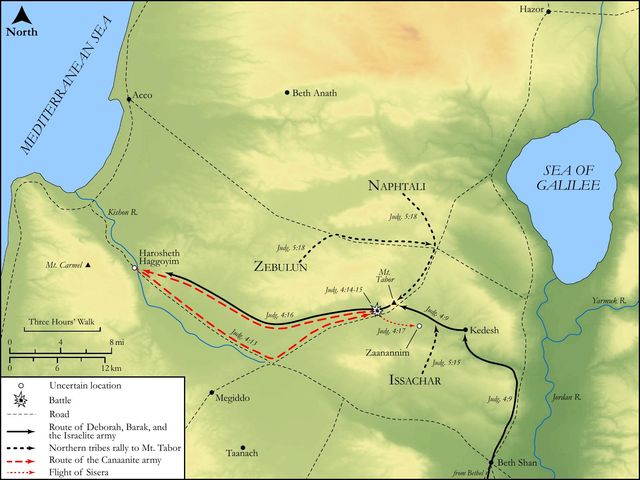
Here, I. Barak beats up for volunteers, and soon has his quota of men ready, Jdg 4:10. Deborah had appointed him to raise an army of 10,000 men (Jdg 4:6), and so many he has presently at his feet, following him, and subject to his command. God is said to call us to his feet (Isa 41:2), that is, into obedience to him. Some think it intimates that they were all footmen, and so the armies of the Jews generally were, which made the disproportion of strength between them and the enemy (who had horses and chariots) very great, and the victory the more illustrious; but the presence of God and his prophetess was abundantly sufficient to balance that disproportion. Barak had his men at his feet, which intimates their cheerfulness and readiness to attend him whithersoever he went, Rev 14:4. Though the tribes of Zebulun and Naphtali were chiefly depended on, yet it appears by Deborah's song that some had come in to him from other tribes (Manasseh and Issachar), and more were expected that came not, from Reuben, Dan, and Asher, Jdg 5:14-17. But these are overlooked here; and we are only told that to make his 10,000 men effective indeed Deborah went up with him. The Jdg 4:11, concerning the removal of Heber, one of the families of the Kenites, out of the wilderness of Judah, in the south, where those families had fixed themselves (Jdg 1:16), into the northern country, comes in for the sake of what was to follow concerning the exploit of Jael, a wife of that family.
II.Sisera, upon notice of Barak's motions, takes the field with a very numerous and powerful army (Jdg 4:12, Jdg 4:13):
They showed Sisera, that is, it was shown to him. Yet some think it refers to the Kenites, mentioned immediately before, Jdg 4:11. They gave Sisera notice of Barak's rendezvous, there being peace at this time between Jabin and that family, Jdg 4:17. Whether they intended it as a kindness to him or no, it served to accomplish what God had said by Deborah (Jdg 4:7): I will draw unto thee Sisera. Sisera's confidence was chiefly in his chariots; therefore particular notice is taken of them, 900 chariots of iron, which, with the scythes fastened to their axle-trees, when they were driven into an army of footmen, did terrible execution. So ingenious have men been in inventing methods of destroying one another, to gratify those lusts from which come wars and fightings.
III.Deborah gives orders to engage the enemy, Jdg 4:14.
Josephus says that when Barak saw Sisera's army drawn up, and attempting to surround the mountain on the top of which he and his forces lay encamped, his heart quite failed him, and he determined to retire to a place of greater safety; but Deborah animated him to make a descent upon Sisera, assuring him that this was the day marked out in the divine counsels for his defeat. "Now they appear most threatening they are ripe for ruin. The thing is as sure to be done as if it were done already: The Lord hath delivered Sisera into thy hand." See how the work and honour of this great action are divided between Deborah and Barak; she, as the head, gives the word, he, as the hand, does the work. Thus does God dispense his gifts variously, Co1 12:4, etc. But, though ordinarily the head of the woman is the man (Co1 11:3), he that has the residue of the Spirit was pleased to cross hands, and to put the head upon the woman's shoulders, choosing the weak things of the world to shame the mighty, that no flesh might glory in his presence. It was well for Barak that he had Deborah with him; for she made up what was defective,
1.In his conduct, by telling him, This is the day.
2.In his courage, by assuring him of God's presence: "Has not the Lord gone out before thee? Darest not thou follow when thou hast God himself for thy leader?" Note,
(1.)In every undertaking it is good to be satisfied that God goes before us, that we are in the way of our duty and under his direction.
(2.)If we have ground to hope that God goes before us, we ought to go on with courage and cheerfulness. Be not dismayed at the difficulties thou meetest with in resisting Satan, in serving God, or suffering for him; for has not the Lord gone out before thee? Follow him fully then.
IV.God himself routs the enemy's army, Jdg 4:15.
Barak, in obedience to Deborah's orders, went down into the valley, though there upon the plain the iron chariots would have so much the more advantage against him, quitting his fastnesses upon the mountain in dependence upon the divine power; for in vain is salvation hoped for from hills and mountains; in the Lord alone is the salvation of his people, Jer 3:23. And he was not deceived in his confidence: The Lord discomfited Sisera. It was not so much the bold and surprising alarm which Barak gave their camp that dispirited and dispersed them, but God's terror seized their spirits and put them into an unaccountable confusion. The stars, it seems, fought against them, Jdg 5:20. Josephus says that a violent storm of hail which beat in their faces gave them this rout, disabled them, and drove them back; so that they became a very easy prey to the army of Israel, and Deborah's words were made good: "The Lord has delivered them into thy hand; it is now in thy power to do what thou wilt with them."
V.Barak bravely improves his advantage, follows the blow with undaunted resolution and unwearied diligence, prosecutes the victory, pursues the scattered forces, even to their general's head-quarters at Harosheth (Jdg 4:16), and spares none whom God had delivered into his hand to be destroyed: There was not a man left. When God goes before us in our spiritual conflicts we must bestir ourselves; and, when by grace he gives us some success against the enemies of our souls, we must improve it by watchfulness and resolution, and carry on the holy war with vigour.
Continue studying Judges 4:15 across the web’s major study libraries — every link below opens this exact verse, chapter, or book on the destination site.
Read & Compare
 BibleGatewayThis verse in more than 200 translations and 70 languages.
 Bible.comThe YouVersion reader — hundreds of translations, reading plans, and highlights.
 ESV.orgCrossway's official English Standard Version reader.
 NET BibleThe NET translation with 60,000+ translators' notes on every rendering decision.
 STEP BibleTyndale House's free study tool — original text, vocabulary, and scholarly resources.
 BibliaLogos Bible Software's free web reader.
 USCCBThe New American Bible (Revised Edition) with the U.S. bishops' study notes.
Commentaries
 BibleHub CommentariesDozens of classic commentaries on this verse, gathered on one page.
 StudyLightMore than 100 commentary sets — the largest collection on the web.
 BibleRefPlain-English commentary on what this verse means, verse by verse.
 Enduring WordDavid Guzik's free commentary on this chapter, widely used by Bible teachers.
 Bible Study ToolsVerse commentary alongside Greek and Hebrew study aids.
Original Language & Research
- BibleHub InterlinearThe verse word by word — original language, transliteration, and English.
- BibleHub LexiconEvery word's original-language definition and Strong's entry.
 Blue Letter BibleDeep-study tools — Strong's numbers, concordance, and word studies.
 SefariaThe Hebrew text with Rashi and centuries of Jewish commentary.
Sermons, Hymns & Audio


TrulyRandomVerse is not affiliated with these sites and doesn’t control their content. They’re linked because they’re genuinely useful.
Summary
Judges 4:15 vividly portrays the decisive and miraculous intervention of the LORD in the battle between Israel and the Canaanites, marking the turning point of the conflict. Through a divinely orchestrated panic, God utterly routed Sisera's formidable army and his feared iron chariots, compelling the proud general to abandon his symbol of power and flee ignominiously on foot. This verse powerfully underscores God's sovereign control over human events, His ability to overcome overwhelming odds, and His unwavering faithfulness in delivering His people from oppression.
Context
ShowHideLiterary Context
Judges 4:15 serves as the dramatic climax of the battle narrative that commenced in Judges 4:1-14. Following two decades of severe oppression under King Jabin of Hazor and his formidable general Sisera, the prophetess Deborah called Barak to lead Israel's forces, assuring him of a divine victory against the technologically superior Canaanite army (Judges 4:6-7). Barak's reluctance to go without Deborah's presence led to the prophecy that the ultimate glory of the victory would be given to a woman (Judges 4:9). This verse describes the immediate and overwhelming fulfillment of God's promise, as the divine hand directly causes the enemy's collapse. It immediately precedes Sisera's desperate flight and his eventual, ignominious death at the hands of Jael, detailed in Judges 4:16-22, thus establishing the pivotal moment where God's power decisively shatters the enemy's might.
Historical & Cultural Context
The period of the Judges (approximately 1375-1050 BC) was a turbulent era in Israel's history, characterized by a recurring cycle of disobedience, foreign oppression as divine judgment, the Israelites' cry for deliverance, and God raising up a "judge" (a military and spiritual leader) to save them. The Canaanites, particularly under King Jabin and his general Sisera, posed a significant military threat, primarily due to their "nine hundred chariots of iron" (Judges 4:3). These chariots were the equivalent in that day of modern armored vehicles, providing a decisive advantage in open warfare. The battle itself took place near the Kishon River in the Jezreel Valley, a strategic location. While often a modest stream, the Kishon is notoriously prone to sudden, torrential flooding during heavy rains. Such conditions would have transformed the flat, chariot-friendly terrain into a treacherous, muddy quagmire, rendering Sisera's chariots ineffective and potentially trapping them, as vividly described in Judges 5:21. This natural phenomenon was unequivocally interpreted by the Israelites as a direct and miraculous act of divine intervention, demonstrating God's control over creation to fulfill His purposes.
Key Themes
ShowHideJudges 4:15 profoundly illustrates several foundational themes central to the book of Judges and the broader biblical narrative. Foremost is Divine Sovereignty and Intervention, emphasizing that the LORD Himself actively fights for His people, not merely assisting human efforts but directly "discomfiting" the enemy. This echoes earlier narratives where God fought for Israel, such as against Pharaoh's chariots at the Red Sea (Exodus 14:14). Another critical theme is Overcoming Superior Odds, as the militarily inferior Israelites triumph over a technologically advanced and numerically superior foe. This highlights that human strength, military might, or advanced weaponry are no match for God's power (Psalm 20:7). The Humiliation of the Enemy is also prominently displayed, as Sisera, the proud general, is reduced to abandoning his symbol of power and fleeing on foot, foreshadowing his ignominious death at the hands of a woman (Judges 4:21). Finally, the verse powerfully affirms God's Covenant Faithfulness, demonstrating His steadfast love and commitment to His people, delivering Israel despite their repeated cycles of disobedience and apostasy, whenever they cry out to Him.
Exposition and Analysis
ShowHideKey Word Analysis
ShowHideThe Hebrew verb הָמַם (hâmam) signifies "to put in commotion; by implication, to disturb, drive, destroy; break, consume, crush, destroy, discomfit, trouble, vex." In this context, it denotes a divinely induced terror, panic, and utter confusion that seized Sisera's forces. This was not simply a military defeat but a supernatural act of God, causing the enemy to lose cohesion, become disoriented, and flee in disarray. This same powerful verb is used in Exodus 14:24 to describe how the LORD "confused" the Egyptian army before their destruction in the Red Sea, establishing a consistent pattern of divine intervention against overwhelming odds.
The Hebrew term רֶכֶב (rekeb) refers specifically to "a vehicle; by implication, a team; by extension, cavalry." Here, it denotes the formidable iron chariots that constituted the backbone of Sisera's military might and the primary symbol of Canaanite technological superiority (Judges 4:3). In the days of the judges, chariots represented speed, overwhelming power, and military invincibility. The text's explicit mention of these chariots being "discomfited" highlights the miraculous nature of the victory: the very symbol of Sisera's strength became a liability, likely bogged down by the divinely influenced weather and terrain, turning their decisive advantage into an overwhelming hindrance.
The Hebrew verb יָרַד (yârad) means "to descend (literally, to go downwards; or conventionally to a lower region... or figuratively, to fall); causatively, to bring down... to light (down), put down (off)." Sisera's act of "lighting down off his chariot" is a profoundly symbolic and humiliating action. For a general to abandon his chariot, the most prestigious and effective mode of transport and combat, and resort to fleeing on foot, was the ultimate sign of desperation and complete defeat. It signifies the total collapse of his authority and military prowess, reducing him from a fearsome commander to a vulnerable, fleeing individual. This ignominious descent sets the stage for his ultimate demise at the hands of Jael, fulfilling Deborah's prophecy.
Verse Breakdown
ShowHide"And the LORD discomfited Sisera, and all [his] chariots, and all [his] host, with the edge of the sword before Barak;"
This opening clause unequivocally attributes the victory to the direct and sovereign action of the LORD. It was not Barak's military genius or Israel's strength, but God Himself who initiated the rout. The "discomfiture" was comprehensive, affecting Sisera personally, his elite chariots (the pride of his army), and his entire military force ("all his host"). The phrase "with the edge of the sword before Barak" indicates that while God caused the supernatural panic and chaos, the Israelite forces, under Barak's leadership, were the instruments of God's judgment, carrying out the physical defeat. This suggests a divinely empowered and effective pursuit, capitalizing on the chaos God had sown.
"so that Sisera lighted down off [his] chariot, and fled away on his feet."
This clause describes the immediate, profound, and humiliating consequence of God's decisive action. Sisera's forced descent from his chariot is a powerful visual representation of his utter defeat and loss of status. The chariot, once his symbol of power and an instrument of terror, became a burden or an impediment in the divinely-induced chaos, compelling him to abandon it. His subsequent flight on foot underscores his vulnerability, desperation, and the completeness of God's victory, highlighting the dramatic reversal of fortunes for the once-mighty Canaanite general.
Literary Devices
ShowHideJudges 4:15 is rich in literary devices that amplify its theological and narrative impact. Divine Intervention is the paramount theme, with the LORD explicitly named as the sole agent of Sisera's defeat, underscoring God's active and direct role in human history and warfare. Irony is powerfully employed, as Sisera's formidable iron chariots, the very symbol of his military superiority and invincibility, become a hindrance and a cause of his downfall, likely bogged down by the divinely orchestrated weather and terrain. This creates a stark Contrast between Sisera's initial position of power and his subsequent ignominious flight on foot. The vivid image of Sisera abandoning his chariot and fleeing "on his feet" serves as potent Foreshadowing, hinting at his ultimate undignified death at the hands of Jael, a woman, further compounding his humiliation. The phrase "edge of the sword" can be seen as Metonymy, representing the totality of the Israelite rout and the comprehensive nature of the divine judgment, rather than merely literal sword combat, encompassing the entire destructive force unleashed upon Sisera's army.
Theological and Thematic Connections
ShowHideJudges 4:15 stands as a profound testament to the absolute sovereignty and limitless power of God, particularly in the face of human weakness and seemingly insurmountable odds. It teaches that true victory belongs solely to the Lord, and His methods often defy human expectation, military logic, and conventional strength. The miraculous defeat of Sisera's iron chariots, which were symbols of invincibility in that era, powerfully illustrates that no human power, technological advancement, or military might can withstand the direct and intentional intervention of the Almighty. This pivotal event reinforces the covenantal faithfulness of God, who, despite Israel's recurring cycles of disobedience and spiritual decline, consistently responds to their cries for deliverance and acts decisively on their behalf. It serves as a timeless reminder that God delights in using the weak, the unexpected, and even natural phenomena to accomplish His purposes, ensuring that all glory redounds to Him alone, rather than to human ingenuity or strength.
Reflection and Application
ShowHideJudges 4:15 offers profound and enduring encouragement for believers facing seemingly insurmountable challenges in their own lives. Just as God "discomfited" Sisera's formidable chariots and army, He is capable of dismantling the most entrenched and imposing obstacles that stand in our way, whether they are personal struggles, spiritual battles, or societal injustices. This verse calls us to shift our focus from the apparent strength of our adversaries or the inadequacy of our own resources to the limitless power and unwavering faithfulness of God. It reminds us that our ultimate victory does not depend on our strategic brilliance, physical might, or accumulated wisdom, but on the Lord's willingness and ability to fight on our behalf. When we encounter situations that seem hopeless, we are invited to trust that God can, and often does, work in unexpected and miraculous ways, turning the enemy's perceived strengths into weaknesses and bringing about deliverance through means we could never anticipate. Our response should be one of humble reliance, confident expectation, and joyful praise, giving God all the glory for His mighty acts.
Questions for Reflection
ShowHideFAQ
ShowHideWhat does "discomfited" mean in this context, and how did God achieve it?
ShowHideThe Hebrew word translated "discomfited" is hāmām (הָמַם), which means "to throw into confusion, rout, panic, or destroy." In Judges 4:15, it signifies a divinely induced panic and chaos that seized Sisera's army, rendering their superior military organization and weaponry utterly ineffective. While the text in this specific verse attributes the action directly to the LORD without detailing the mechanism, the Song of Deborah in Judges 5:20-21 provides further insight, stating that "the stars fought from heaven; from their courses they fought against Sisera. The torrent of Kishon swept them away." This strongly suggests that God achieved this "discomfiture" through a combination of celestial phenomena (likely a torrential downpour) and the resulting flash flood of the Kishon River, which would have turned the battlefield into a muddy swamp, immobilizing Sisera's iron chariots and throwing his forces into disarray and panic. God used natural elements, interpreted as direct divine intervention, to achieve this supernatural rout.
Why is Sisera's act of "lighting down off his chariot and fleeing away on his feet" significant?
ShowHideThis act is profoundly significant because it symbolizes Sisera's complete and utter defeat, humiliation, and loss of status. In that day, chariots were the epitome of military power, speed, and prestige; a general riding in a chariot was a formidable and imposing figure, a symbol of authority and invincibility. To abandon one's chariot and resort to fleeing on foot was the ultimate act of desperation and ignominy, signifying that the battle was irrevocably lost and that personal survival was the only remaining objective. It stripped Sisera of his military status and dignity, reducing him from a mighty commander to a vulnerable, fleeing fugitive. This dramatic reversal of fortune also powerfully foreshadows his ultimate ignominious death, not in battle, but at the hands of Jael, a woman, further compounding the humiliation of the once-proud general (Judges 4:21).
Christ-Centered Fulfillment
ShowHideJudges 4:15, with its powerful portrayal of divine intervention against overwhelming odds, finds its ultimate and most profound fulfillment in the person and redemptive work of Jesus Christ. Just as the LORD "discomfited" Sisera's formidable army and rendered his iron chariots impotent, so too did Christ, through His sacrificial death on the cross and triumphant resurrection, utterly discomfit and decisively triumph over the spiritual forces of darkness that held humanity captive. The "chariots of iron" that symbolized Sisera's earthly power and terror pale in comparison to the spiritual principalities and powers, the oppressive weight of sin, and the ultimate enemy of death that enslaved humanity. Yet, on the cross, Christ "disarmed the rulers and authorities and put them to open shame, by triumphing over them in him" (Colossians 2:15). He did not merely defeat them; He exposed their impotence and rendered them powerless. Furthermore, just as Sisera was forced to abandon his symbol of power and flee in humiliation, so too was the devil, who held the power of death, defeated and rendered ineffective by Christ's victory over the grave (Hebrews 2:14-15). Through Christ, believers are given the ultimate victory over sin, death, and the forces of evil, allowing us to declare with unwavering confidence, "Thanks be to God, who gives us the victory through our Lord Jesus Christ!" (1 Corinthians 15:57). The victory at the Kishon River was a historical shadow, pointing forward to the ultimate and eternal triumph secured by the Lamb of God.