


Psalms 83:10
Bible text: King James Version (1769 Blayney text) · Public domain
Bible text: Berean Standard Bible · Public domain
Bible text: American Standard Version (1901) · Public domain
Bible text: World English Bible, Messianic edition · Public domain
Bible text: Geneva Bible (1599) · Public domain
Bible text: Young's Literal Translation · Public domain
- נִשְׁמְדוּnish·me·Duthey were destroyedH8045V-Niphal-Perf-3cpVerb Niphal Perfect 3rd Plural common gender
- בְעֵיןve·'einat En-H5874Prep-b ¦ N-properNoun Proper LocationבְatעֵיןEn-
- דֹּארDor-dorH5874N-properNoun Proper Location
- הָיוּHa·yuthey becameH1961V-Qal-Perf-3cpVerb Qal Perfect 3rd Plural common gender
- דֹּמֶןDo·mendungH1828N-msNoun Singular Masculine Absolute
- לָאֲדָמָהla·'a·da·Mahfor the groundH127Prep-l ¦ N-fsNoun Singular Feminine Absoluteלָfor theאֲדָמָהground
English is a literal word-by-word gloss of the Hebrew, not the KJV's wording. Why?
This is the original text the KJV's translators worked from — each Hebrew word with its own literal English meaning in this verse, prepared by scholars at Tyndale House, Cambridge. The KJV translates whole sentences, not word by word, so its wording differs: one Hebrew word can become several English words, and the KJV may choose “the LORD” where the gloss reads “Yahweh”. Both are faithful — they answer different questions. For the KJV's own rendering, switch to the KJV text.
Details
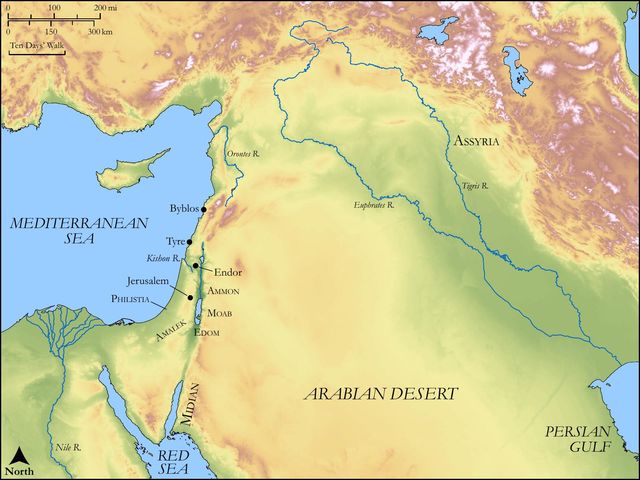
See on the biblical-era map
Study this verse
Public-domain commentary
Matthew Henry
From his Commentary on the Whole Bible. Henry comments on passages, not single verses — this entry covers Psalms 83:9–18. His three-level outline is real structure in the source text, so it is rendered as structure.
The psalmist here, in the name of the church, prays for the destruction of those confederate forces, and, in God's name, foretels it; for this prayer that it might be so amounts to a prophecy that it shall be so, and this prophecy reaches to all the enemies of the gospel-church; whoever they be that oppose the kingdom of Christ, here they may read their doom. The prayer is, in short, that these enemies, who were confederate against Israel, might be defeated in all their attempts, and that they might prove their own ruin, and so God's Israel might be preserved and perpetuated. Now this is here illustrated,
I.By some precedents.
Let that be their punishment which has been the fate of others who have formerly set themselves against God's Israel. The defeat and discomfiture of former combinations may be pleaded in prayer to God and improved for the encouragement of our own faith and hope, because God is the same still that ever he was, the same to his people and the same against his and their enemies; with him is no variableness.
1.He prays that their armies might be destroyed as the armies of former enemies had been (Psa 83:9, Psa 83:10): Do to them as to the Midianites; let them be routed by their own fears, for so the Midianites were, more than by Gideon's 300 men. Do to them as to the army under the command of Sisera (who was general under Jabin king of Canaan) which God discomfited (Jdg 4:15) at the brook Kishon, near to which was Endor. They became as dung on the earth; their dead bodies were thrown like dung laid in heaps, or spread, to fatten the ground; they were trodden to dirt by Barak's small but victorious army; and this was fitly made a precedent here, because Deborah made it so to aftertimes when it was fresh. Jdg 5:31, So let all thy enemies perish, O Lord! that is, So they shall perish.
2.He prays that their leaders might be destroyed as they had been formerly. The common people would not have been so mischievous if their princes had not set them on, and therefore they are particularly prayed against, Psa 83:11, Psa 83:12. Observe,
(1.)What their malice was against the Israel of God. They said, Let us take to ourselves the houses of God in possession (Psa 83:12), the pleasant places of God (so the word is), by which we may understand the land of Canaan, which was a pleasant land and was Immanuel's land, or the temple, which was indeed God's pleasant place (Isa 64:11), or (as Dr. Hammond suggests) the pleasant pastures, which these Arabians, who traded in cattle, did in a particular manner seek after. The princes and nobles aimed to enrich themselves by this war; and their armies must be made as dung for the earth, to serve their covetousness and their ambition.
(2.)What their lot should be. They shall be made like Oreb and Zeeb (two princes of the Midianites, who, when their forces were routed, were taken in their flight by the Ephraimites and slain, Jdg 7:25), and like Zeba and Zalmunna, whom Gideon himself slew, Jdg 8:21. "Let these enemies of ours be made as easy a prey to us as they were to the conquerors then." We may not prescribe to God, but we may pray to God that he will deal with the enemies of his church in our days as he did with those in the days of our fathers.
II.He illustrates it by some similitudes, and prays,
1.That God would make them like a wheel (Psa 83:13), that they might be in continual motion, unquiet, unsettled, and giddy in all their counsels and resolves, that they might roll down easily and speedily to their own ruin. Or, as some think, that they might be broken by the judgments of God, as the corn is broken, or beaten out, by the wheel which was then used in threshing. Thus, when a wise king scatters the wicked, he is said to bring the wheel over them, Pro 20:26. Those that trust in God have their hearts fixed; those that fight against him are unfixed, like a wheel.
2.That they might be chased as stubble, or chaff, before the fierce wind. "The wheel, though it continually turn round, is fixed on its own axis; but let them have no more fixation than the light stubble has, which the wind hurries away, and nobody desires to save it, but is willing it should go," Psa 1:4. Thus shall the wicked be driven away in his wickedness, and chased out of the world.
3.That they might be consumed, as wood by the fire, or as briers and thorns, as fern or furze, upon the mountains, by the flames, Psa 83:14. When the stubble is driven by the wind it will rest, at last, under some hedge, in some ditch or other; but he prays that they might not only be driven away as stubble, but burnt up as stubble. And this will be the end of wicked men (Heb 6:8) and particularly of all the enemies of God's church. The application of these comparisons we have (Psa 83:15): So persecute them with thy tempest, persecute them to their utter ruin, and make them afraid with thy storm. See how sinners are made miserable; the storm of God's wrath raises terrors in their own hearts, and so they are made completely miserable. God can deal with the proudest and most daring sinner that has bidden defiance to his justice, and can make him afraid as a grasshopper. It is the torment of devils that they tremble.
III.He illustrates it by the good consequences of their confusion, Psa 83:16-18.
He prays here that God, having filled their hearts with terror, would thereby fill their faces with shame, that they might be ashamed of their enmity to the people of God (Isa 26:11), ashamed of their folly in acting both against Omnipotence itself and their own true interest. They did what they could to put God's people to shame, but the shame will at length return upon themselves. Now,
1.The beginning of this shame might be a means of their conversion: "Let them be broken and baffled in their attempts, that they may seek thy name, O Lord! Let them be put to a stand, that they may have both leisure and reason to pause a little, and consider who it is that they are fighting against and what an unequal match they are for him, and may therefore humble and submit themselves and desire conditions of peace. Let them be made to fear thy name, and perhaps that will bring them to seek thy name." Note, That which we should earnestly desire and beg of God for our enemies and persecutors is that God would bring them to repentance, and we should desire their abasement in order to this, no other confusion to them than what may be a step towards their conversion.
2.If it did not prove a means of their conversion, the perfecting of it would redound greatly to the honour of God. If they will not be ashamed and repent, let them be put to shame and perish; if they will not be troubled and turned, which would soon put an end to all their trouble, a happy end, let them be troubled for ever, and never have peace: this will be for God's glory (Psa 83:18), that other men may know and own, if they themselves will not, that thou, whose name alone is JEHOVAH (that incommunicable, though not ineffable name) art the Most High over all the earth. God's triumphs over his and his church's enemies will be incontestable proofs,
(1.)That he is, according to his name JEHOVAH, a self-existent self-sufficient Being, that has all power and perfection in himself.
(2.)That he is the most high God, sovereign Lord of all, above all gods, above all kings, above all that exalt themselves and pretend to be high.
(3.)That he is so, not only over the land of Israel, but over all the earth, even those nations of the earth that do not know him or own him; for his kingdom rules over all. These are great and unquestionable truths, but men will hardly be persuaded to know and believe them; therefore the psalmist prays that the destruction of some might be the conviction of others. The final ruin of all God's enemies, in the great day, will be the effectual proof of this, before angels and men, when the everlasting shame and contempt to which sinners shall rise (Dan 12:2) shall redound to the everlasting honour and praise of that God to whom vengeance belongs.
Historical interpretation
Historical reception
1 surviving comment on this verse from the historical church.
Now let us see what the prophetic spirit prays may fall upon them, rather foretelling than cursing. "Do thou to them," he says, "as unto Madian and Sisera, as unto Jabin at the brook of Kishon" [Psalm 83:9]. "They perished at Endor, they became as the dung of the earth" [Psalm 83:10]. All these, the history relates, were subdued and conquered by Israel, which then was the people of God: as was the case also with those whom he next mentions: "Make their princes like Oreb and Zeb, and Zebee and Salmana" [Psalm 83:11]. The meaning of these names is as follows: Madian is explained a perverted judgment: Sisera, shutting out of joy: Jabin, wise. [Judges 4:7-8] But in these enemies conquered by God's people is to be understood that wise man of whom the Apostle speaks, "Where is the wise? Where is the scribe? Where is the disputer of this world?" [1 Corinthians 1:20] Oreb is dryness, Zeb, wolf, Zebee, a victim, namely of the wolf; for he too has his victims; Salmana, shadow of commotion. All these agree to the evils which the people of God conquer by good. Moreover Kishon, the torrent in which they were conquered, is explained, their hardness. Endor, where they perished, is explained, the Fountain of generation, but of the carnal generation namely, to which they were given up, and therefore perished, not heeding the regeneration which leads unto life, where they shall neither marry nor be given in marriage, [Luke 20:35] for they shall die no more. Rightly then it is said of these: "they became as the dung of the earth," in that nothing was produced of them but fruitfulness of the earth. As then all these were in figure conquered by the people of God, as figures, so he prays that those other enemies may be conquered in truth.
Continue studying Psalms 83:10 across the web’s major study libraries — every link below opens this exact verse, chapter, or book on the destination site.
Read & Compare
 BibleGatewayThis verse in more than 200 translations and 70 languages.
 Bible.comThe YouVersion reader — hundreds of translations, reading plans, and highlights.
 ESV.orgCrossway's official English Standard Version reader.
 NET BibleThe NET translation with 60,000+ translators' notes on every rendering decision.
 STEP BibleTyndale House's free study tool — original text, vocabulary, and scholarly resources.
 BibliaLogos Bible Software's free web reader.
 USCCBThe New American Bible (Revised Edition) with the U.S. bishops' study notes.
Commentaries
 BibleHub CommentariesDozens of classic commentaries on this verse, gathered on one page.
 StudyLightMore than 100 commentary sets — the largest collection on the web.
 BibleRefPlain-English commentary on what this verse means, verse by verse.
 Enduring WordDavid Guzik's free commentary on this chapter, widely used by Bible teachers.
 Bible Study ToolsVerse commentary alongside Greek and Hebrew study aids.
Original Language & Research
- BibleHub InterlinearThe verse word by word — original language, transliteration, and English.
- BibleHub LexiconEvery word's original-language definition and Strong's entry.
 Blue Letter BibleDeep-study tools — Strong's numbers, concordance, and word studies.
 SefariaThe Hebrew text with Rashi and centuries of Jewish commentary.
Sermons, Hymns & Audio


TrulyRandomVerse is not affiliated with these sites and doesn’t control their content. They’re linked because they’re genuinely useful.
Summary
Psalms 83:10 powerfully depicts the complete and ignominious destruction of God's enemies, drawing upon a specific historical act of divine judgment. The verse serves as a stark and visceral reminder of God's sovereign power to decisively defeat those who conspire against His people and purposes, reducing their might and pride to utter worthlessness. It underscores the futility of human strength when arrayed against the Almighty, promising ultimate vindication and deliverance for God's chosen.
Context
ShowHideLiterary Context
Psalm 83 is a fervent communal lament and a desperate prayer for divine intervention against a formidable confederacy of nations that have united to threaten Israel's very existence and to blot out God's name from the earth. The psalmist, Asaph, implores God to break His silence and act decisively in the face of this existential threat. Verses 9-11 form a specific and urgent appeal to God's past acts of deliverance, recalling historical victories where God decisively defeated Israel's adversaries. Verse 10, therefore, functions as a powerful historical precedent, invoking the specific defeat of Sisera and Jabin's armies as a model for the judgment the psalmist desires upon the current enemies. This appeal grounds the present plea in God's proven faithfulness and omnipotence, reinforcing the expectation that He will act similarly again to preserve His people and His glory.
Historical & Cultural Context
The reference to "Endor" in Psalms 83:10 alludes to a pivotal historical event recounted in the book of Judges. While Endor itself was a town, the battle it references occurred nearby, specifically near the Kishon River, where the Israelite forces, under the leadership of the prophetess Deborah and commander Barak, achieved a miraculous victory over the Canaanite army of King Jabin of Hazor, commanded by Sisera. This decisive defeat is detailed in Judges 4 and celebrated with poetic fervor in the Song of Deborah in Judges 5. The phrase "they became as dung for the earth" carries profound cultural weight in Israel. To be left unburied was a catastrophic disgrace and a severe curse, signifying the complete obliteration of one's honor, legacy, and even spiritual well-being. Bodies left exposed to decompose on the ground were reduced to the lowest form of refuse, indistinguishable from common waste, emphasizing the utter contempt and degradation of the vanquished, a fate far worse than death itself.
Key Themes
ShowHideThis verse powerfully contributes to several overarching themes within Psalm 83 and the broader biblical narrative. Foremost is the theme of Divine Judgment and Humiliation, where God actively intervenes to bring about the utter destruction and disgrace of those who oppose His people and His divine will. It highlights God's Sovereign Power and Deliverance, serving as a testament to His ability to protect His covenant people and execute justice against formidable adversaries, regardless of their perceived strength. Furthermore, it underscores the Transient Nature of Opposing Power, demonstrating that all human alliances, military might, and schemes, no matter how formidable, are ultimately rendered worthless and brought to naught when they stand in defiance of the Almighty. The fate of those at Endor serves as a chilling reminder that God alone is supreme, and His purposes will prevail, as seen in His consistent intervention on behalf of His people throughout history, from the miraculous deliverance at the Red Sea to the numerous victories in the Promised Land.
Exposition and Analysis
ShowHideKey Word Analysis
ShowHideThis primitive root signifies to desolate, destroy, bring to nought, overthrow, or utterly perish. In this context, it emphasizes the completeness and finality of the defeat of God's enemies. It is not merely a setback or a retreat, but a total annihilation of their military force and, by extension, their power, influence, and very existence as a threat.
This powerful and visceral term refers specifically to manure or refuse. Its use here is not merely descriptive but highly contemptuous, conveying extreme worthlessness, degradation, and abject humiliation. To become "dung for the earth" means to be utterly despised, dishonored, and reduced to the lowest possible state, serving as a stark symbol of God's judgment and the enemy's complete disgrace, their bodies becoming indistinguishable from common waste.
Derived from the word for "red," this term refers to soil, ground, or land. In this context, it underscores the fate of the perished enemies: their bodies are not granted a proper burial but are left to decompose on the very ground they sought to conquer, becoming literally part of the soil, stripped of all dignity and memory.
Verse Breakdown
ShowHide"[Which] perished at Endor"
This clause directly references the historical defeat of Sisera's Canaanite army by the Israelites, as recorded in Judges 4. The location "Endor" serves as a metonymy for the battle that took place nearby, emphasizing a specific, well-known instance of God's decisive intervention and judgment against Israel's enemies. The use of "perished" highlights the complete and irreversible destruction of the opposing forces, signifying their utter demise.
"they became [as] dung for the earth"
This vivid and graphic simile describes the ultimate, humiliating fate of the defeated enemies. Their bodies were left unburied on the battlefield, not only signifying a profound cultural disgrace but also depicting their utter worthlessness and degradation. Reduced to fertilizer for the ground, this imagery underscores the severity of God's judgment, stripping the enemies of all dignity, honor, and lasting memory, reducing them to mere refuse and a part of the soil they once stood upon.
Literary Devices
ShowHidePsalms 83:10 employs several potent literary devices to convey its message of divine judgment and the utter humiliation of God's enemies. The most striking is the simile "they became as dung for the earth," which uses a direct, vivid, and repulsive comparison to emphasize the utter worthlessness and degradation of the vanquished. This is closely related to powerful imagery, as the verse evokes a visceral and grotesque picture of bodies left unburied and decomposing, transforming into common waste. This imagery functions as a powerful metaphor for the complete annihilation of the enemy's power, pride, and legacy, reducing them to nothingness. The verse also utilizes allusion, referencing the specific historical event of Sisera's defeat near Endor (as recounted in Judges 4 and celebrated in Judges 5). This allusion grounds the psalmist's prayer in God's proven historical faithfulness and power, establishing a precedent for future divine intervention. Furthermore, the language carries an element of hyperbole, exaggerating the extent of the humiliation to underscore the severity and finality of God's judgment, ensuring the audience grasps the totality of the defeat.
Theological and Thematic Connections
ShowHidePsalms 83:10 powerfully articulates the theological truth that God is sovereign over all nations and their schemes, and He will ultimately execute righteous judgment against those who oppose His divine purposes and His covenant people. This verse serves as a profound reminder that human power, no matter how formidable or arrogant, is ultimately fleeting and subject to God's supreme authority. The graphic imagery of enemies becoming "dung for the earth" underscores the complete and utter humiliation that awaits those who defy the Almighty, demonstrating that God not only defeats His adversaries but also strips them of all dignity, legacy, and lasting memory. It assures believers that God is actively involved in history, protecting His own and bringing justice to bear, even when circumstances appear dire and the forces arrayed against them seem overwhelming. This divine intervention ensures that God's name and glory are vindicated among the nations.
Reflection and Application
ShowHidePsalms 83:10 offers both profound reassurance and a sober warning for believers today. In a world often marked by injustice, conflict, and opposition to God's truth, this verse reminds us that God remains on His throne, actively involved in human history, and holds ultimate control over nations and their schemes. When faced with spiritual battles, personal adversaries, or societal challenges that seem overwhelming, we can draw immense comfort from the knowledge that God has a track record of decisively defeating His enemies and delivering His people. Just as He delivered Israel from powerful foes in the past, He remains faithful to protect and vindicate those who trust in Him. This verse calls us to place our hope not in human strength or political alliances, but in the unfailing power and justice of God alone. Conversely, it serves as a stark warning to all who would oppose God or His purposes, reminding us that ultimately, all human power that stands against God's will is destined for humiliation and destruction. It compels us to align our lives with God's will, recognizing that true flourishing and lasting significance come only from submission to His righteous reign.
Questions for Reflection
ShowHideFAQ
ShowHideWhy does the psalmist ask for such a harsh judgment on God's enemies?
ShowHideThe psalmist's plea for harsh judgment, as seen in Psalms 83:10, stems from a deep-seated desire for God's glory and the vindication of His holy name, not merely personal revenge. The enemies listed in Psalm 83 were not just Israel's adversaries; they were seen as conspiring against God Himself, seeking to "blot out the name of Israel" (Psalms 83:4), which was intrinsically linked to God's covenant and reputation on earth. The psalmist appeals to God's past acts of judgment (like the defeat at Endor) as precedents, asking God to display His power and justice once more so that "they may know that You alone, whose name is the LORD, are the Most High over all the earth" (Psalms 83:18). This is a prayer for divine justice to be manifest, for God's sovereignty to be recognized by all nations, and for His people to be protected from existential threat. It reflects the ancient understanding of warfare as often having a profound theological dimension, where the defeat of an enemy demonstrated the superiority and power of one's deity.
Christ-Centered Fulfillment
ShowHidePsalms 83:10, with its vivid portrayal of the utter defeat and humiliation of God's enemies, finds its ultimate and most profound fulfillment in the person and work of Jesus Christ. While the psalmist prayed for a temporal victory over earthly foes, Christ's victory is eternal and extends over all things, triumphing over the spiritual adversaries of humanity: sin, death, and the devil. Just as the enemies at Endor "perished" and were reduced to "dung for the earth," so too did Jesus, through His crucifixion and resurrection, decisively defeat the powers of darkness. Colossians 2:15 declares that He disarmed the spiritual rulers and authorities, triumphing over them by the cross, making a public spectacle of them. The imagery of utter degradation for God's enemies foreshadows the final judgment where all who oppose Christ will be cast into eternal destruction, their power and pride reduced to nothing before the glory of the Lamb. Christ is the true King who will ultimately put all enemies under His feet (1 Corinthians 15:25-26), establishing His eternal kingdom where righteousness dwells. His glorious return will bring about the final and complete humiliation of all who have set themselves against God, as depicted in Revelation 19:11-21, ensuring that His name alone is exalted as "King of kings and Lord of lords" forevermore.