


Zephaniah 1:17
Bible text: King James Version (1769 Blayney text) · Public domain
Bible text: King James Version with Strong's numbers · Public domain
Bible text: Berean Standard Bible · Public domain
Bible text: American Standard Version (1901) · Public domain
Bible text: World English Bible, Messianic edition · Public domain
Bible text: Geneva Bible (1599) · Public domain
Bible text: Young's Literal Translation · Public domain
- וַהֲצֵרֹתִיva·ha·tze·Ro·tiand I will cause distressH6887Conj-w ¦ V-Hiphil-ConsecPerf-1csVerb Hiphil Consecutive Perfect 1st Singular common genderוַandהֲצֵרֹתִיI will cause distress
- לָאָדָםla·'a·Damto <the> humankindH120Prep-l ¦ N-msNoun Singular Masculine Absoluteלָto <the>אָדָםhumankind
- וְהָלְכוּve·ha·le·Khuand they will walkH1980Conj-w ¦ V-Qal-ConsecPerf-3cpVerb Qal Consecutive Perfect 3rd Plural common genderוְandהָלְכוּthey will walk
- כַּעִוְרִיםka·'iv·Rimlike <the> blind [people]H5787Prep-k ¦ Adj-mpAdjective Plural Masculine Absoluteכַּlike <the>עִוְרִיםblind [people]
- כִּיkiforH3588PrtParticle Conditional
- לַיהוָהla·Yah·wehto YahwehH3068Prep-l ¦ N-properNoun Proper TitleלַtoיהוָהYahweh
- חָטָאוּcha·Ta·'uthey have sinnedH2398V-Qal-Perf-3cpVerb Qal Perfect 3rd Plural common gender
- וְשֻׁפַּךְve·shu·Pakhand it will be poured outH8210Conj-w ¦ V-Pual-ConsecPerf-3msVerb Pual Consecutive Perfect 3rd Singular Masculineוְandשֻׁפַּךְit will be poured out
- דָּמָםda·Mamtheir bloodH1818N-msc ¦ 3mpNoun Singular Masculine Constructדָּמָbloodםtheir
- כֶּעָפָרke·'a·Farlike <the> dustH6083Prep-k ¦ N-msNoun Singular Masculine Absoluteכֶּlike <the>עָפָרdust
- וּלְחֻמָםu·le·chu·Mamand their bowel[s]H3894Conj-w ¦ N-msc ¦ 3mpNoun Singular Masculine Constructוּandלְחֻמָbowel[s]םtheir
- כַּגְּלָלִיםka·ge·la·Limlike <the> dung<s>H1557Prep-k ¦ N-mpNoun Plural Masculine Absoluteכַּlike <the>גְּלָלִיםdung<s>
English is a literal word-by-word gloss of the Hebrew, not the KJV's wording. Why?
This is the original text the KJV's translators worked from — each Hebrew word with its own literal English meaning in this verse, prepared by scholars at Tyndale House, Cambridge. The KJV translates whole sentences, not word by word, so its wording differs: one Hebrew word can become several English words, and the KJV may choose “the LORD” where the gloss reads “Yahweh”. Both are faithful — they answer different questions. For the KJV's own rendering, switch to the KJV text.
Details
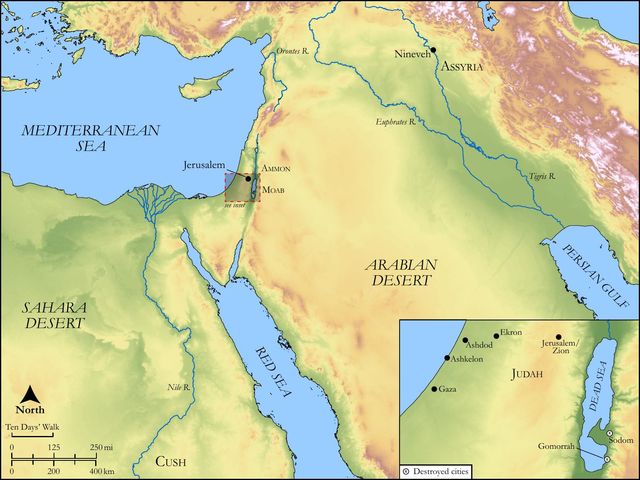
See on the biblical-era map
Study this verse
Public-domain commentary
Matthew Henry
From his Commentary on the Whole Bible. Henry comments on passages, not single verses — this entry covers Zephaniah 1:14–18. His two-level outline is real structure in the source text, so it is rendered as structure.
Nothing could be expressed with more spirit and life, nor in words more proper to startle and awaken a secure and careless people, than the warning here given to Judah and Jerusalem of the approaching destruction by the Chaldeans. That is enough to make the sinners in Zion tremble - that it is the day of the Lord, the day in which he will manifest himself by taking vengeance on them. It is the great day of the Lord, a specimen of the day of judgment, a kind of doom's-day, as the last destruction of Jerusalem by the Romans is represented to be in our Saviour's prediction concerning it, Mat 24:27.
I.This day of the Lord is here spoken of as very near.
The vision is not for a great while to come, as those imagine who put the evil day far from them. Those deceive themselves who look upon it as a thing at a distance, for it is near - it is near - it hastens greatly. The prophet gives the alarm like one that is in earnest, like one that awakens a family with the cry of Fire! fire! when it is at the next door that the danger is: "It is near! it is near! and therefore it is high time to bestir yourselves, and do what you can for your own safety before it be too late." It is madness for those to slumber whose damnation slumbers not, and to linger when it hastens.
II.It is spoken of as a very dreadful day.
The very voice of this day of the Lord, the noise of it, when it is coming, shall be so terrible as to make the mighty men cry there bitterly, cry for fear as children do. It shall be a vexation to hear the report of it. In the last great day of the Lord the mighty men shall cry bitterly to rocks and mountains to shelter them; but in vain. Observe how emphatically the prophet speaks of this day approaching (Zep 1:15): It is a day of wrath, God's wrath, wrath in perfection, wrath to the utmost. It will be a day of trouble and distress to the sinners; they shall be in pain, and shall see no ways of easing or helping themselves. The miseries of the damned are summed up (perhaps with reference to this) in the indignation and wrath of God, which are the cause, and the tribulation and anguish of the sinner's soul, which are the effect, Rom 2:8, Rom 2:9. It will be a day of trouble and distress to the inhabitants, and a day of wasteness and desolation to the whole land; that fruitful land shall be turned into a wilderness. It shall be a day of darkness and gloominess; every thing shall look dismal, and there shall not be the least gleam of comfort, or glimpse of hope; look round, and it is all black. It is a day of clouds and thick darkness; there is not only nothing encouraging, but every thing threatening; the thick clouds are big with storms and tempests.
III.It is spoken of as a destroying day, Zep 1:16, Zep 1:17. It shall be destroying,
1.To places, even the strongest and best fortified: A day of the trumpet and alarm against the fenced cities, to break into them, and against the high towers, to bring them down; for what forts, what fences, can hold out against the wrath of God?
2.To persons (Zep 1:17): "I will bring distress upon men, the strongest and stoutest of men; their hearts and hands shall fail them; they shall walk like blind men, wandering endlessly, because they have sinned against the Lord." Note, Those that walk as bad men will justly be left to walk as blind men, always in the dark, in doubt and danger, without any guide or comfort, and falling at length into the ditch. Because they have sinned against the Lord he will deliver them into the hands of cruel enemies, that shall pour out their blood as dust, so profusely, and with as little regret, and their flesh shall be thrown as dung upon the dunghill.
IV.The destruction of that day will be unavoidable and universal, Zep 1:18.
1.There shall be no escaping it by ransom: Neither their silver nor their gold, which they have hoarded up so covetously against the evil day, or which they have spent so prodigally to make friends for such a time, shall be able to deliver them in the day of the Lord's wrath. Another prophet borrowed these words from this, with reference to the same event, Eze 7:19. Note, Riches profit not in the day of wrath, Pro 11:4. Nay, riches expose to the wrath of men (Ecc 5:13.), and riches abused to the wrath of God.
2.There shall be no escaping it by flight or concealment; for the whole land shall be devoured by the fire of his jealousy, and where then can a hiding-place be found? See what the fire of God's jealousy is, and what the force of it; it will devour whole lands; how then can particular persons stand before it? He shall make riddance, a speedy riddance, of all those that dwell in the land, as the husbandman, when he rids his ground, cuts up all the briers and thorns for the fire. Note, Sometimes the judgments of God make riddance, even utter riddance, with sinful nations, a speedy riddance; their destruction is effected, is completed, in a little time. Let not sinners be laid asleep by the patience of God, for when the measure of their iniquity is full his justice will both overtake and overcome, will make quick work and thorough work.
Historical interpretation
Historical reception
1 surviving comment on this verse from the historical church.
(Verse 17, 18.) And I will trouble the people, and they shall walk as blind, because they have sinned against the Lord: and their blood shall be poured out like dust, and their bodies like dung; but their silver and gold shall not be able to save them in the day of the Lord's wrath, and all the earth shall be devoured by the fire of his zeal: for he will make a speedy consumption of all the inhabitants of the earth. LXX: And I will trouble the people, and they shall walk as blind, because they have sinned against the Lord, and he shall pour out their blood like dust, and their flesh like the dung of oxen; and their silver and their gold shall not be able to deliver them in the day of the Lord's anger, and all the earth shall be consumed by the fire of his zeal: for he will make a speedy and complete destruction upon all the inhabitants of the earth. It is not difficult to say, according to the previous meaning, that Jerusalem, which endured because of the cross of the Lord, has suffered: for the visitation of the Lord has departed from it, and all men in Judea have been troubled, and because of the greatness of the affliction they have walked like blind men, not knowing what to do. And they have suffered this because they have sinned against the Lord, that is, against the Son of God. For because they have shed the blood of the prophets and the blood of Christ, their blood has been poured out like the earth in the whole region, and their bodies have remained unburied, like dung upon the face of the earth. Those who amassed great wealth through excessive greed, hoarding silver and gold, were unable to free themselves from the wrath of the Lord on the day of judgment. For the fire of the Lord's zeal burned against them and consumed the entire province. And there was no respite in their midst, for forty-two years after the crucifixion of the Lord, Jerusalem was surrounded by an army and its downfall came swiftly, not only for Jerusalem but also for all the inhabitants of the land of Judaea. But in the end, whether of the world or of each individual, all men who remained as men will be troubled, and the dead will be like men. And they will walk as blind, for they have lost the light of virtues, and they will not have a place for repentance: and they will suffer these things because they have sinned against the Lord. For if the Lord is justice, truth, holiness, and other virtues, whoever has acted unjustly, lied, and pursued vice and sins, has sinned against the Lord. But what follows, 'And their blood will be poured out like the earth, and their bodies like the dung of bulls,' seems absurd, that in the resurrection of the dead and in the consummation of the world and judgement, we should say that blood is poured out and bodies lie like dung. Therefore, what is said to Noah, 'And I will require the blood of your lives from the hand of every beast, and from the hand of man, and from the hand of his brother I will require the life of man, who sheds the blood of man: by man shall his blood be shed' (Gen. IX, 5, 6), it is ridiculous to believe this in the resurrection, and it cannot hold true in this life. For how many have shed blood, and their blood has not been shed? And others have killed a man with poison or hanging, and yet when the man is dead, no blood has been shed? Therefore, how is the Lord going to shed their blood in vengeance when the one who kills has not shed blood? Therefore, the blood of man, which is the vital principle by which he is nourished, sustained, and lives, must be understood: whoever sheds it, either through scandal or perverse doctrine, will be poured out by him on the day of judgment, that is, what he seemed to have as vital, he will be forced to lose. According to this kind of blood, and flesh is understood, of which Isaiah says: All flesh is grass (Isa. XL, 6). And in Genesis the Lord said: My spirit shall not remain in these men, because they are flesh (Gen. VI, 3). And the Apostle, speaking of both: Flesh and blood cannot possess the kingdom of God: neither will corruption inherit incorruption of God (Al. God is silent) (I Cor. XV, 50). Therefore, on the day of consummation, whether general or specific, all blood that has been shed will cry out to the Lord, and it will appear in the midst, and the works of blood and earthly things will lie as dust and filth, and the rich, with their silver and gold, will not be able to free themselves on the day of wrath, with him who is dying hearing: Fool, this night your soul will be taken from you; and what you have prepared, whose will it be (Luke XII, 20)? Not that we deny that the rich can be saved from death by gold and silver; for the redemption of a man's soul is his own wealth (Prov. XIII, 8); but rather that they cannot be saved at that time when they must forsake their riches out of necessity. For all the earth and everything that is earthly will be devoured by the zeal of the Lord. And when he says 'zeal,' understand that he is still speaking of one who loves the Lord. For if he did not love the human soul, he would never be zealous for it; and, in the likeness of a husband, he would avenge the sin of his wife, whom he would not be angry with if he did not love her. And the Lord will do this with haste for all the inhabitants of the earth, those who have completely devoted themselves to the earth and are not strangers or foreigners, as the righteous one who speaks: I am a stranger in the land, and a foreigner like all my ancestors (Ps. XXXVIII, 13). And again, elsewhere, not wanting to dwell any longer in the tent of the flesh, he testifies with tearful voice, saying: Woe is me, for my journey has been prolonged (Ps. CXIX, 5). For we who are in this body's tabernacle, groan and lament: Miserable wretch that I am, who will deliver me from this body of death? (Rom. VII, 24)?
Continue studying Zephaniah 1:17 across the web’s major study libraries — every link below opens this exact verse, chapter, or book on the destination site.
Read & Compare
 BibleGatewayThis verse in more than 200 translations and 70 languages.
 Bible.comThe YouVersion reader — hundreds of translations, reading plans, and highlights.
 ESV.orgCrossway's official English Standard Version reader.
 NET BibleThe NET translation with 60,000+ translators' notes on every rendering decision.
 STEP BibleTyndale House's free study tool — original text, vocabulary, and scholarly resources.
 BibliaLogos Bible Software's free web reader.
 USCCBThe New American Bible (Revised Edition) with the U.S. bishops' study notes.
Commentaries
 BibleHub CommentariesDozens of classic commentaries on this verse, gathered on one page.
 StudyLightMore than 100 commentary sets — the largest collection on the web.
 BibleRefPlain-English commentary on what this verse means, verse by verse.
 Enduring WordDavid Guzik's free commentary on this chapter, widely used by Bible teachers.
 Bible Study ToolsVerse commentary alongside Greek and Hebrew study aids.
Original Language & Research
- BibleHub InterlinearThe verse word by word — original language, transliteration, and English.
- BibleHub LexiconEvery word's original-language definition and Strong's entry.
 Blue Letter BibleDeep-study tools — Strong's numbers, concordance, and word studies.
 SefariaThe Hebrew text with Rashi and centuries of Jewish commentary.
Sermons, Hymns & Audio


TrulyRandomVerse is not affiliated with these sites and doesn’t control their content. They’re linked because they’re genuinely useful.
Summary
Zephaniah 1:17 vividly portrays the severe and inescapable judgment of God upon Judah, declaring that He will bring profound distress upon its inhabitants, causing them to wander aimlessly like the blind. This devastating consequence is explicitly attributed to their persistent sin against the LORD, culminating in a gruesome depiction of widespread death where their bodies are utterly desecrated, their blood spilled like dust, and their flesh treated as worthless refuse. The verse underscores the comprehensive nature of divine wrath against unrepentant rebellion, highlighting both the spiritual disorientation and the physical annihilation that awaits.
Context
ShowHideLiterary Context
Zephaniah 1:17 is situated within the prophet's opening oracle of judgment against Judah and Jerusalem, which dominates the first chapter. Following a sweeping declaration of universal destruction in Zephaniah 1:2-3, the prophet narrows his focus to specific targets within Judah, including idolaters, those who turn away from the LORD, and the complacent (Zephaniah 1:4-6). The preceding verses, Zephaniah 1:14-16, describe the "great Day of the LORD" as a day of wrath, trouble, distress, desolation, darkness, and thick clouds, accompanied by the sound of a trumpet and battle cry against fortified cities. Verse 17 serves as a direct consequence and graphic illustration of the "distress and anguish" mentioned in Zephaniah 1:15, detailing the specific horrors that will befall the people due to their sin, thus intensifying the urgency and severity of the prophetic warning.
Historical & Cultural Context
Zephaniah prophesied during the reign of King Josiah (c. 640-609 BC), a period characterized by a brief but significant religious reform movement. However, despite Josiah's efforts to purge idolatry and restore covenant faithfulness, deep-seated corruption and syncretism persisted among the populace, a legacy from the long, wicked reigns of Manasseh and Amon. Jerusalem was a hub of idolatrous practices, including Baal worship, the worship of the host of heaven, and Molech worship (Zephaniah 1:4-5), alongside oppression and spiritual apathy. The prophet's message reflects the imminent threat of invasion, likely from the Scythians or, more definitively, the rising Babylonian empire, which God would use as His instrument of judgment. The imagery of bodies being treated as "dust" and "dung" speaks to a profound cultural disgrace, as proper burial was crucial for dignity and honor in ancient Israelite society, emphasizing the utter contempt and desolation of the judgment.
Key Themes
ShowHideThis verse powerfully contributes to several overarching themes in Zephaniah and broader prophetic literature. Firstly, it highlights the Sovereignty and Justice of God, demonstrating His active role in bringing judgment upon sin ("And I will bring distress upon men"). Secondly, it underscores the Gravity and Consequences of Sin, explicitly stating "because they have sinned against the LORD," reinforcing the biblical principle that rebellion against God leads to severe repercussions. This is a recurring motif, as seen in the warnings throughout Deuteronomy. Thirdly, the imagery of "walking like blind men" emphasizes Spiritual Blindness and Helplessness, illustrating how sin distorts perception and renders individuals incapable of discerning truth or finding a way out of impending doom, a theme also explored in Isaiah 59:10. Finally, the vivid depiction of "blood... as dust, and their flesh as the dung" emphasizes Utter Desolation and Degradation, portraying a scene of complete societal collapse and the dehumanization of the unrepentant, echoing the dire warnings of widespread death found in Jeremiah 25:33.
Exposition and Analysis
ShowHideKey Word Analysis
ShowHideThis word means to cramp, afflict, besiege, bind up, distress, oppress, or be in a strait. It conveys a sense of being hemmed in, constricted, or under severe pressure, emphasizing the inescapable and overwhelming nature of the calamity God will bring upon the people. It is not merely discomfort but a profound, suffocating anguish.
This term refers to someone literally or figuratively blind. In this context, it powerfully describes a state of utter disorientation, confusion, and helplessness. Like physically blind individuals unable to navigate their surroundings, the people will be unable to find escape, direction, or understanding in the face of God's judgment, symbolizing both their spiritual inability to see God's truth and their physical inability to evade destruction.
This word specifically refers to animal dung, often found in balls or refuse. Its use here is profoundly graphic and shocking, signifying the complete dehumanization and worthlessness of the dead. Their bodies will not receive proper burial but will be treated as utterly vile and contemptible waste, highlighting the extreme severity of God's wrath and the complete degradation of those who have sinned against Him.
Verse Breakdown
ShowHide"And I will bring distress upon men"
This opening clause immediately establishes the divine agency behind the impending suffering. It is not a random calamity but a deliberate act of God's judgment. The "distress" (H6887, tsârar) signifies a profound, inescapable anguish and constriction, emphasizing the severity and comprehensive nature of the affliction that will be imposed upon all people (H120, ʼâdâm).
"that they shall walk like blind men"
This vivid simile illustrates the immediate consequence of the "distress." The people will be utterly disoriented, unable to find direction, escape, or understanding. Their spiritual blindness, which led them to sin, will now manifest in a physical and existential helplessness, symbolizing their inability to navigate the unfolding disaster or discern a path to safety.
"because they have sinned against the LORD"
This crucial clause provides the explicit theological justification for the judgment. The suffering is not arbitrary but a direct, righteous consequence of their rebellion and disobedience (H2398, châṭâʼ) against the covenant God (H3068, Yᵉhôvâh). It underscores God's justice and His unwavering commitment to hold humanity accountable for its actions.
"and their blood shall be poured out as dust"
This gruesome imagery depicts widespread slaughter and a complete lack of dignity in death. "Blood" (H1818, dâm), representing life itself, will be shed profusely, becoming as common and worthless as "dust" (H6083, ʻâphâr). This signifies a massive loss of life, with no reverence or respect for the dead, emphasizing the overwhelming scale of the judgment.
"and their flesh as the dung"
This final, shocking simile intensifies the picture of desecration and utter worthlessness. "Flesh" (H3894, lâchûwm), representing the physical body, will be treated with the same contempt as "dung" (H1561, gêlel), animal waste. This indicates that bodies will be left unburied, exposed, and utterly defiled, serving as a powerful testament to the complete degradation and abject state of those upon whom God's wrath is poured out.
Literary Devices
ShowHideZephaniah 1:17 employs several powerful literary devices to convey the horror and certainty of God's judgment. The most prominent is Simile, used three times to create vivid and disturbing comparisons: "walk like blind men," "blood shall be poured out as dust," and "flesh as the dung." These comparisons are not merely descriptive; they are designed to evoke a visceral reaction, emphasizing the complete disorientation, worthlessness, and degradation that awaits the unrepentant. The use of Hyperbole in comparing human remains to dust and dung serves to exaggerate the extent of the destruction and the contempt with which the dead will be treated, underscoring the absolute severity of God's wrath. Furthermore, the verse demonstrates Divine Anthropomorphism and Divine Agency, with God explicitly stating, "I will bring distress," portraying Him as the active, intentional agent of this judgment, not a passive observer. The repeated emphasis on the consequences of sin and the graphic imagery also creates a strong sense of Foreshadowing, hinting at the comprehensive and devastating nature of the "Day of the LORD" described throughout the book.
Theological and Thematic Connections
ShowHideZephaniah 1:17 profoundly articulates the unwavering justice of God, demonstrating that His character demands a response to human sin. The distress and degradation described are not arbitrary acts but direct, divinely orchestrated consequences for rebellion against His covenant. This verse highlights the inseparable link between human action and divine reaction, revealing that while God is merciful, He is also righteous and will not tolerate persistent idolatry, injustice, and spiritual apathy indefinitely. It serves as a stark reminder that God's holiness necessitates judgment, ensuring that His moral order is upheld and that sin, left unaddressed, leads to ultimate devastation.
Reflection and Application
ShowHideZephaniah 1:17, while depicting a historical judgment, carries timeless principles for reflection and application. It compels us to confront the seriousness of sin in our own lives and in society. The "blindness" described is a powerful metaphor for spiritual apathy, for failing to see God's truth, or for intentionally ignoring the consequences of our actions. When we walk in spiritual blindness, we inevitably stray from God's path, leading to distress and ultimately, spiritual degradation. This verse urges us to cultivate spiritual discernment, to actively seek God's wisdom, and to recognize that our choices have profound, eternal implications. It calls for genuine repentance, a turning away from anything that offends God, and a turning towards Him in humility and obedience. Understanding the gravity of God's justice should not lead to despair, but to a profound appreciation for His grace and a renewed commitment to living a life that honors Him.
Questions for Reflection
ShowHideFAQ
ShowHideWhat is the "distress" mentioned in Zephaniah 1:17?
ShowHideThe "distress" (Hebrew: tsârar) refers to a profound, inescapable anguish, trouble, and constriction that God Himself will bring upon the people of Judah. It signifies an overwhelming calamity, a state of being hemmed in with no escape, leading to utter helplessness and disorientation, causing them to "walk like blind men." This distress is a direct consequence of their sin against the LORD.
Why are the people described as "walking like blind men"?
ShowHideThe phrase "walk like blind men" is a powerful simile that illustrates the complete disorientation, confusion, and helplessness that will befall the people during God's judgment. It suggests both a physical inability to navigate or escape the unfolding disaster and, more profoundly, a spiritual blindness. Their persistent sin had already rendered them spiritually unable to discern God's will or the impending danger, and now this spiritual state manifests in their physical experience of judgment, as seen in other prophetic warnings like those in Isaiah 59:10.
What is the significance of "blood shall be poured out as dust, and their flesh as the dung"?
ShowHideThis imagery is extremely graphic and serves to emphasize the utter devastation, widespread death, and complete lack of dignity that will accompany God's judgment. "Blood as dust" signifies a massive loss of life, where human life becomes as common and worthless as dirt. "Flesh as the dung" further intensifies this, indicating that bodies will be left unburied, exposed, and treated as vile, contemptible waste. In Israel, proper burial was crucial for honor, so this depiction highlights the extreme contempt and degradation of those upon whom God's wrath is poured out, echoing the severe warnings found in Jeremiah 25:33.
Christ-Centered Fulfillment
ShowHideWhile Zephaniah 1:17 vividly describes the dire consequences of sin under the Old Covenant, it ultimately points to the profound need for a Savior and foreshadows the ultimate solution to humanity's spiritual blindness and the problem of sin. The "distress" and "blindness" of Judah underscore humanity's inherent inability to save itself from the righteous judgment of God. This desperate state of being lost and without direction finds its answer in Jesus Christ, who declared Himself to be the Light of the World, coming to open the eyes of the spiritually blind (John 9:39-41). The horrific imagery of blood and flesh treated as worthless refuse highlights the ultimate penalty for sin, which is death and utter degradation. Yet, in a profound reversal, Christ's own "blood was poured out" not as worthless dust, but as the precious, atoning sacrifice for the sins of the world (1 Peter 1:18-19). His body, though broken and buried, was not left to decay as "dung," but was gloriously resurrected, conquering death and offering hope for eternal life (1 Corinthians 15:3-4). Thus, Zephaniah's terrifying prophecy of judgment, while a stark warning, ultimately magnifies the redemptive work of Christ, who delivers us from the distress and degradation of sin by becoming our substitute and our spiritual sight. Through Him, those who were once blind can now see, and those destined for judgment can find life and dignity (Ephesians 5:14).