


Zephaniah 1:16
Bible text: King James Version (1769 Blayney text) · Public domain
Bible text: Berean Standard Bible · Public domain
Bible text: American Standard Version (1901) · Public domain
Bible text: World English Bible, Messianic edition · Public domain
Bible text: Geneva Bible (1599) · Public domain
Bible text: Young's Literal Translation · Public domain
- יוֹםYoma day ofH3117N-mscNoun Singular Masculine Construct
- שׁוֹפָרsho·FartrumpetH7782N-msNoun Singular Masculine Absolute
- וּתְרוּעָהu·te·ru·'Ahand battle-cryH8643Conj-w ¦ N-fsNoun Singular Feminine Absoluteוּandתְרוּעָהbattle-cry
- עַל'alonH5921PrepPreposition
- הֶעָרִיםhe·'a·Rimthe citiesH5892Art ¦ N-mpNoun Plural Masculine Absoluteהֶtheעָרִיםcities
- הַבְּצֻרוֹתha·be·tzu·Rot<the> fortifiedH1219Art ¦ Adj-fpAdjective Plural Feminine Absoluteהַ<the>בְּצֻרוֹתfortified
- וְעַלve·'Aland onH5921Conj-w ¦ PrepPrepositionוְandעַלon
- הַפִּנּוֹתha·pi·Notthe cornersH6438Art ¦ N-fpNoun Plural Feminine Absoluteהַtheפִּנּוֹתcorners
- הַגְּבֹהוֹתha·ge·vo·Hot<the> highH1364Art ¦ Adj-fpAdjective Plural Feminine Absoluteהַ<the>גְּבֹהוֹתhigh
English is a literal word-by-word gloss of the Hebrew, not the KJV's wording. Why?
This is the original text the KJV's translators worked from — each Hebrew word with its own literal English meaning in this verse, prepared by scholars at Tyndale House, Cambridge. The KJV translates whole sentences, not word by word, so its wording differs: one Hebrew word can become several English words, and the KJV may choose “the LORD” where the gloss reads “Yahweh”. Both are faithful — they answer different questions. For the KJV's own rendering, switch to the KJV text.
Details
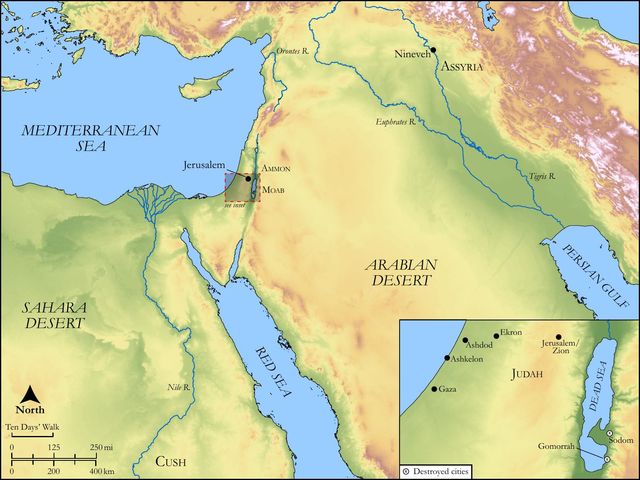
See on the biblical-era map
Study this verse
Public-domain commentary
Matthew Henry
From his Commentary on the Whole Bible. Henry comments on passages, not single verses — this entry covers Zephaniah 1:14–18. His two-level outline is real structure in the source text, so it is rendered as structure.
Nothing could be expressed with more spirit and life, nor in words more proper to startle and awaken a secure and careless people, than the warning here given to Judah and Jerusalem of the approaching destruction by the Chaldeans. That is enough to make the sinners in Zion tremble - that it is the day of the Lord, the day in which he will manifest himself by taking vengeance on them. It is the great day of the Lord, a specimen of the day of judgment, a kind of doom's-day, as the last destruction of Jerusalem by the Romans is represented to be in our Saviour's prediction concerning it, Mat 24:27.
I.This day of the Lord is here spoken of as very near.
The vision is not for a great while to come, as those imagine who put the evil day far from them. Those deceive themselves who look upon it as a thing at a distance, for it is near - it is near - it hastens greatly. The prophet gives the alarm like one that is in earnest, like one that awakens a family with the cry of Fire! fire! when it is at the next door that the danger is: "It is near! it is near! and therefore it is high time to bestir yourselves, and do what you can for your own safety before it be too late." It is madness for those to slumber whose damnation slumbers not, and to linger when it hastens.
II.It is spoken of as a very dreadful day.
The very voice of this day of the Lord, the noise of it, when it is coming, shall be so terrible as to make the mighty men cry there bitterly, cry for fear as children do. It shall be a vexation to hear the report of it. In the last great day of the Lord the mighty men shall cry bitterly to rocks and mountains to shelter them; but in vain. Observe how emphatically the prophet speaks of this day approaching (Zep 1:15): It is a day of wrath, God's wrath, wrath in perfection, wrath to the utmost. It will be a day of trouble and distress to the sinners; they shall be in pain, and shall see no ways of easing or helping themselves. The miseries of the damned are summed up (perhaps with reference to this) in the indignation and wrath of God, which are the cause, and the tribulation and anguish of the sinner's soul, which are the effect, Rom 2:8, Rom 2:9. It will be a day of trouble and distress to the inhabitants, and a day of wasteness and desolation to the whole land; that fruitful land shall be turned into a wilderness. It shall be a day of darkness and gloominess; every thing shall look dismal, and there shall not be the least gleam of comfort, or glimpse of hope; look round, and it is all black. It is a day of clouds and thick darkness; there is not only nothing encouraging, but every thing threatening; the thick clouds are big with storms and tempests.
III.It is spoken of as a destroying day, Zep 1:16, Zep 1:17. It shall be destroying,
1.To places, even the strongest and best fortified: A day of the trumpet and alarm against the fenced cities, to break into them, and against the high towers, to bring them down; for what forts, what fences, can hold out against the wrath of God?
2.To persons (Zep 1:17): "I will bring distress upon men, the strongest and stoutest of men; their hearts and hands shall fail them; they shall walk like blind men, wandering endlessly, because they have sinned against the Lord." Note, Those that walk as bad men will justly be left to walk as blind men, always in the dark, in doubt and danger, without any guide or comfort, and falling at length into the ditch. Because they have sinned against the Lord he will deliver them into the hands of cruel enemies, that shall pour out their blood as dust, so profusely, and with as little regret, and their flesh shall be thrown as dung upon the dunghill.
IV.The destruction of that day will be unavoidable and universal, Zep 1:18.
1.There shall be no escaping it by ransom: Neither their silver nor their gold, which they have hoarded up so covetously against the evil day, or which they have spent so prodigally to make friends for such a time, shall be able to deliver them in the day of the Lord's wrath. Another prophet borrowed these words from this, with reference to the same event, Eze 7:19. Note, Riches profit not in the day of wrath, Pro 11:4. Nay, riches expose to the wrath of men (Ecc 5:13.), and riches abused to the wrath of God.
2.There shall be no escaping it by flight or concealment; for the whole land shall be devoured by the fire of his jealousy, and where then can a hiding-place be found? See what the fire of God's jealousy is, and what the force of it; it will devour whole lands; how then can particular persons stand before it? He shall make riddance, a speedy riddance, of all those that dwell in the land, as the husbandman, when he rids his ground, cuts up all the briers and thorns for the fire. Note, Sometimes the judgments of God make riddance, even utter riddance, with sinful nations, a speedy riddance; their destruction is effected, is completed, in a little time. Let not sinners be laid asleep by the patience of God, for when the measure of their iniquity is full his justice will both overtake and overcome, will make quick work and thorough work.
Historical interpretation
Two Centuries of Reception
2 surviving comments on this verse. Each one is dated, so this reads as a timeline rather than a list.
Select a marker to jump to its quote. Markers stagger vertically where authors wrote within a few decades of each other.
(Verse 15, 16.) The voice of the day of the Lord is bitter: there the strong shall be troubled: the day of wrath, that day shall be a day of tribulation and distress, a day of calamity and wretchedness, a day of darkness and gloominess, a day of clouds and whirlwinds, a day of the trumpet and the cry against fortified cities, and against the high corners. LXX: The voice of the day of the Lord is bitter and harshly appointed: there the strong shall be troubled: the day of wrath, that day shall be a day of tribulation and necessity, a day of wretchedness and perdition, a day of darkness and whirlwinds, a day of clouds and gloominess, a day of the trumpet and the cry against fortified cities, and against the high corners. According to the above, either take from the Babylonian captivity or from the extreme sufferings they endured from the Romans, over which the Lord wept for Jerusalem, saying: Jerusalem, Jerusalem, who kills the prophets and stones those who are sent to you (Matthew 23:37), and so on. Truly, a preferred vengeance has been sought from the blood of Abel the just to the blood of Zechariah, whom they killed between the temple and the altar (2 Chronicles 24); and finally, concerning the Son of God, saying: His blood be on us and on our children, they experienced a bitter day, because they had provoked the Lord to bitterness; a day appointed by the Lord, on which not just anyone, but the strongest men are humbled, and wrath will come upon them in the end. For often, indeed, they had endured the anger of the Lord before, but that anger had not been the consummation and end (Matthew 27:25). Why now is it necessary to describe the great calamities they endured in each captivity, and how those who rejected the light of the Lord were cast into darkness and gloom, and those who refused to listen to the trumpets of the solemn days heard the clamor (or clangor) of warriors? But as for the fortified cities and high corners of Judea, which have been completely destroyed, I think that it is a judgment of the eyes rather than the ears: especially for us who now live in this province, we can see, we can prove what has been written. We can hardly see small traces of ruins in once great cities. In Shiloh, where the tabernacle and the ark of the Lord's Covenant were, we can barely see the foundations of the altar. That city of Gibeah, Saul's city, is completely destroyed to its foundations (Joshua 18). Ramah and Bethoron and the other noble cities built by Solomon are now just small villages. Let us read Josephus and the prophecy of Zephaniah, and we will see his ((Al. we will see)) history: and this is not only about the captivity, but until the present day, the treacherous colonizers, after killing the servants and finally the Son of God, except for mourning, are prohibited from entering Jerusalem, and in order to be allowed to mourn the ruin of their city, they buy it at a price, those who once bought the blood of Christ now buy their own tears: and not even their weeping is free for them. Do you see on the day when Jerusalem was captured and demolished by the Romans, the mournful people coming together, the decrepit old women and men covered in rags and years, demonstrating the anger of the Lord in their bodies and appearance? The crowd of miserable people gathers, and with the Lord's shining and radiant resurrection, with the flag of the cross also shining from the Mount of Olives, they lament the ruins of their temple, the miserable people, and yet it is not to be pitied: still there are tears on their cheeks, and livid arms, and scattered hair, and a soldier demands his reward, so that they may be allowed to weep more; and does anyone doubt, when they see these things, about the day of tribulation and distress, the day of calamity and misery, the day of darkness and gloom, the day of clouds and whirlwinds, the day of the trumpet and clangor? For they have trumpets even in mourning, and, according to the prophecy, the voice of solemnity has turned into lamentation. They wail over the ashes of the Sanctuary, and over the destroyed altar, and over once fortified cities, and over the lofty corners of the temple, from which they once cast James, the brother of the Lord. These things have been said about the captivity of the Jews. Furthermore, if we apply the day of the Lord, as mentioned above, to the end of the world or to the end of each person's life, the interpretation will be clear, that the voice of the day of the Lord is bitter, full of necessity and anger, and the strong will be troubled there, for even the holy ones will be saved, but as if through fire. That day will be a day of tribulation, distress, and calamity, a day of misery when they will declare: Woe to us, for we have become miserable. It will be a day of darkness: For everyone who does evil hates the light and does not come to the light (John 3:20); and it is necessary that those who hate the light will be enveloped in darkness. It will be a day of fog and whirlwind; for the storm of the Lord will come upon them, and the sound of the trumpet, as the Apostle indicates, saying: In the last trumpet (1 Corinthians 15:52). For there will be a day of trumpet and the sound of shouting over fortified cities, which they had built for themselves in the multitude of sins, just as Cain had. And over the high corners, wicked works and those deviating from the straight path of the Lord (or deviating from the straight path). Therefore, the hypocrites, the Pharisees, are also accused by the Savior, because they pray in the street corners (Matthew VI). For the straight and narrow path that leads to paradise is narrow and difficult, and it leads to life. But the path is narrow and crooked, wide, and spacious, which leads to death (Matt. VII). At the same time, amidst the words of the severity of the Lord, perceive His mercy, that for this reason the days are bitter, and the days of wrath, and the days of tribulation, and the days of trumpet and clamor, so that poorly fortified cities and perverse angles may be destroyed.
But let them hear how the prophet Zephaniah holds out over them the power of divine rebuke, saying, “Behold, the Day of the Lord comes, great and horrible, the day of wrath, that day; a day of darkness and gloominess, a day of cloud and whirlwind, a day of trumpet and clamor, upon all fenced cities, and upon all lofty corners.” For what is expressed by fenced cities but minds suspected and surrounded ever with a fallacious defense; minds which, as often as their fault is attacked, suffer not the darts of truth to reach them? And what is signified by lofty corners (a wall being always double in corners) but insincere hearts; which, while they shun the simplicity of truth, are in a manner doubled back on themselves in the crookedness of duplicity, and, what is worse, from their fault of insincerity lift themselves in their thoughts with the pride of prudence? Therefore the Day of the Lord comes full of vengeance and rebuke upon fenced cities and lofty corners, because the wrath of the last judgment both destroys human hearts that have been closed by defenses against the truth and unfolds such as have been folded up in duplicities. For then the fenced cities fall. For souls that God has not penetrated will be damned. Then the lofty corners tumble, because hearts which erect themselves in the prudence of insincerity are prostrated by the sentence of righteousness.
Continue studying Zephaniah 1:16 across the web’s major study libraries — every link below opens this exact verse, chapter, or book on the destination site.
Read & Compare
 BibleGatewayThis verse in more than 200 translations and 70 languages.
 Bible.comThe YouVersion reader — hundreds of translations, reading plans, and highlights.
 ESV.orgCrossway's official English Standard Version reader.
 NET BibleThe NET translation with 60,000+ translators' notes on every rendering decision.
 STEP BibleTyndale House's free study tool — original text, vocabulary, and scholarly resources.
 BibliaLogos Bible Software's free web reader.
 USCCBThe New American Bible (Revised Edition) with the U.S. bishops' study notes.
Commentaries
 BibleHub CommentariesDozens of classic commentaries on this verse, gathered on one page.
 StudyLightMore than 100 commentary sets — the largest collection on the web.
 BibleRefPlain-English commentary on what this verse means, verse by verse.
 Enduring WordDavid Guzik's free commentary on this chapter, widely used by Bible teachers.
 Bible Study ToolsVerse commentary alongside Greek and Hebrew study aids.
Original Language & Research
- BibleHub InterlinearThe verse word by word — original language, transliteration, and English.
- BibleHub LexiconEvery word's original-language definition and Strong's entry.
 Blue Letter BibleDeep-study tools — Strong's numbers, concordance, and word studies.
 SefariaThe Hebrew text with Rashi and centuries of Jewish commentary.
Sermons, Hymns & Audio


TrulyRandomVerse is not affiliated with these sites and doesn’t control their content. They’re linked because they’re genuinely useful.
Summary
Zephaniah 1:16 vividly describes the "Day of the Lord" as a time of overwhelming military devastation, characterized by the sounds of war and the collapse of human defenses. This verse underscores the inescapable nature of God's judgment against Judah, portraying it as a sudden, cataclysmic event where even the most formidable cities and towers, symbols of human strength and security, will offer no refuge from divine wrath. It serves as a stark warning of the consequences of unrepentant sin and idolatry.
Context
ShowHideLiterary Context
Zephaniah 1:16 is situated within the prophet's sweeping declaration of the impending "Day of the Lord," which begins in Zephaniah 1:14. The preceding verses emphasize the swiftness and bitterness of this day, while the verses immediately following (e.g., Zephaniah 1:17-18) detail its comprehensive destruction, including the suffering of the inhabitants and the consumption of the land by God's fiery wrath. Verse 16 specifically contributes to this escalating imagery by focusing on the auditory and visual aspects of a military assault, highlighting the futility of human fortifications against divine judgment. It paints a picture of total war, where the sounds of conflict permeate the air, and no stronghold can withstand the onslaught.
Historical & Cultural Context
Zephaniah prophesied during the reign of King Josiah (c. 640-609 BC), a period marked by Judah's deep spiritual apostasy despite Josiah's later efforts at religious reform. The nation had embraced idolatry, oppression, and spiritual apathy, provoking God's righteous anger. Culturally, fortified cities and high towers were the primary means of defense in Judah's day, representing national security and strength. Jerusalem, in particular, was considered impregnable due to its natural defenses and fortifications. The prophecy of a "day of the trumpet and alarm against the fenced cities, and against the high towers" would have evoked terrifying images of an invading army, likely the Babylonians, who would serve as God's instrument of judgment, laying siege to and conquering even the most secure urban centers, shattering the people's false sense of security.
Key Themes
ShowHideThis verse powerfully contributes to several key themes within Zephaniah and the broader prophetic tradition. Foremost is the Severity of Divine Judgment, illustrating that God's wrath is comprehensive and inescapable, targeting even the most fortified human strongholds, which symbolize human self-reliance and pride. Another theme is the Imminence and Inevitability of Destruction, conveyed by the urgent sounds of "trumpet and alarm," signaling a sudden and overwhelming catastrophe that cannot be averted. This judgment is a direct Consequence of Rebellion and Unfaithfulness against the Lord, as seen throughout Zephaniah 1. The futility of human defenses against God's decree is a stark reminder that true security lies only in seeking the Lord, as exhorted in Zephaniah 2:3.
Exposition and Analysis
ShowHideKey Word Analysis
ShowHideThis word, derived from a root meaning "to be hot," signifies a specific period, often with an associated quality. Here, it refers not merely to a literal 24-hour period but to a defined "space of time" marked by intense judgment and divine action. It is the "Day of the Lord," a theological concept denoting God's direct intervention in history to judge sin and establish His righteous rule.
This term refers to a cornet or curved horn, specifically a ram's horn. In ancient Israel, the shofar was used for various purposes, including assembling the people, signaling a new moon, and most significantly, sounding the alarm for war or announcing a significant divine event. Its presence here immediately evokes the martial context of an impending battle and the urgency of a military invasion.
This word denotes a loud clamor, acclamation, or battle-cry. It specifically refers to the clangor of trumpets as an alarm, a shout of distress, or a war cry. Coupled with shôwphâr, it intensifies the auditory imagery, painting a vivid picture of the terrifying sounds of a full-scale military assault—the blare of horns, the shouts of soldiers, and the cries of the besieged.
Verse Breakdown
ShowHide"A day of the trumpet and alarm"
This clause immediately establishes the nature of the "Day of the Lord" as one of intense military conflict and overwhelming sound. The "trumpet" (shofar) signals the commencement of war, while "alarm" (teru'ah) describes the piercing, chaotic sounds of battle—war cries, shouts of distress, and the continuous blare of trumpets. Together, they create an auditory landscape of terror, indicating that this day will be characterized by sudden, inescapable, and violent confrontation.
"against the fenced cities, and against the high towers"
This second clause specifies the targets of this "day" and highlights the futility of human defenses. "Fenced cities" (cities that are fortified or inaccessible) and "high towers" (pinnacles or strongholds) represent the pinnacle of human security and military might in that day. By directing the judgment "against" them, the prophet emphasizes that no human strength, strategic location, or defensive structure will be able to withstand the divine wrath, underscoring the absolute sovereignty of God over all earthly powers.
Literary Devices
ShowHideZephaniah 1:16 employs powerful literary devices to convey its message. Imagery is central, particularly auditory and visual imagery. The "trumpet and alarm" create a vivid soundscape of war, allowing the reader to "hear" the impending catastrophe. The "fenced cities" and "high towers" provide visual imagery of human strongholds, which are then juxtaposed with their ultimate vulnerability. Metonymy is present in "trumpet and alarm," where the instruments and sounds of war stand for the war itself and the judgment it brings. The "fenced cities" and "high towers" function as Symbolism, representing human attempts at security, self-reliance, and pride. Their targeting signifies that no human endeavor or strength can ultimately withstand divine judgment. The comprehensive nature of the attack against all such structures might also suggest an element of Hyperbole, emphasizing the totality and inescapability of the destruction.
Theological and Thematic Connections
ShowHideZephaniah 1:16 powerfully articulates the biblical truth that God's judgment is both righteous and inescapable, particularly for those who persist in rebellion and idolatry. It underscores the futility of relying on human strength, military might, or material security when faced with divine wrath. The "Day of the Lord" is a recurring motif throughout the Old Testament, signifying a time when God intervenes decisively in history to judge His enemies and vindicate His people, though in Zephaniah's immediate context, it is primarily a day of wrath for Judah due to their unfaithfulness. This verse reminds us that true security is found not in physical fortifications but in spiritual alignment with God's will and in humble repentance.
Reflection and Application
ShowHideZephaniah 1:16 serves as a timeless reminder of God's absolute sovereignty and the ultimate futility of human defenses against His righteous judgment. In an age where we often place our trust in technological advancements, economic stability, or national security, this verse calls us to profound humility. It challenges us to examine where our true security lies—is it in our "fenced cities" and "high towers" of wealth, power, or self-sufficiency, or in the unfailing refuge of God? The "day of the trumpet and alarm" may manifest in various forms in our lives—personal crises, societal upheavals, or the ultimate return of Christ—and it compels us to live with spiritual vigilance, recognizing that all earthly systems are temporary. It is a powerful call to repentance, urging us to turn from anything that separates us from God and to seek His mercy and righteousness, for only then can we find true and lasting peace.
Questions for Reflection
ShowHideFAQ
ShowHideWhat is the "Day of the Lord" that Zephaniah 1:16 refers to?
ShowHideThe "Day of the Lord" is a significant theological concept found throughout the Old Testament prophets, including Zephaniah. It refers to a specific time when God decisively intervenes in human history to execute judgment upon His enemies and to deliver His people. While it often has a near-term historical fulfillment (like the Babylonian invasion for Judah, as implied in Zephaniah's context), it also points to a future, ultimate day of divine reckoning. In Zephaniah 1, it is depicted as a day of wrath, desolation, and darkness, a terrifying time of military invasion and destruction, as described in Zephaniah 1:14-18.
Why does Zephaniah specifically mention "fenced cities" and "high towers"?
ShowHideIn that day, "fenced cities" (fortified cities) and "high towers" (watchtowers, battlements, or citadels) represented the pinnacle of human security, military strength, and national pride. They were designed to protect inhabitants from invaders and symbolize a nation's invincibility. By stating that the "day of the trumpet and alarm" would be "against" these very structures, Zephaniah emphasizes the absolute and comprehensive nature of God's judgment. It communicates that no human defense, no matter how formidable or strategically built, can withstand the divine wrath when God chooses to act. It underscores the futility of trusting in human constructs over the power and sovereignty of God, a theme echoed in passages like Psalm 33:16-17.
Christ-Centered Fulfillment
ShowHideWhile Zephaniah 1:16 primarily describes a historical judgment upon Judah, its themes find ultimate fulfillment and profound meaning in the person and work of Jesus Christ. The "Day of the Lord" that Zephaniah prophesies is a precursor to the final, ultimate Day of the Lord, which culminates in Christ's return. Just as Zephaniah's prophecy speaks of an inescapable judgment marked by the trumpet and alarm, the New Testament describes Christ's second coming with similar imagery, as seen in Matthew 24:30-31 and 1 Thessalonians 4:16-17. On that day, all human "fenced cities" and "high towers"—every system, ideology, and stronghold built apart from God—will crumble before the Lamb of God, who is also the Lion of Judah (Revelation 5:5-6). Christ's first coming, however, offers the only true escape from this impending judgment. He became the ultimate "fenced city" and "high tower" for those who trust in Him, bearing the full wrath of God on the cross, thereby offering refuge from the "alarm" of divine judgment (Romans 5:9). Thus, Zephaniah's warning of inescapable judgment points to the crucial need for the salvation found only in Christ, who delivers us from the wrath to come (1 Thessalonians 1:10).