


Hosea 8:1
Bible text: King James Version (1769 Blayney text) · Public domain
Bible text: King James Version with Strong's numbers · Public domain
Bible text: Berean Standard Bible · Public domain
Bible text: American Standard Version (1901) · Public domain
Bible text: World English Bible, Messianic edition · Public domain
Bible text: Geneva Bible (1599) · Public domain
Bible text: Young's Literal Translation · Public domain
- אֶל'eltoH413PrepPreposition
- חִכְּךָchi·ke·Khayour mouthH2441N-msc ¦ 2msNoun Singular Masculine Constructחִכְּmouthךָyour
- שֹׁפָרsho·Fara hornH7782N-msNoun Singular Masculine Absolute
- כַּנֶּשֶׁרka·Ne·sherlike <the> eagleH5404Prep-k ¦ N-msNoun Singular Masculine Absoluteכַּlike <the>נֶּשֶׁרeagle
- עַל'aloverH5921PrepPreposition
- בֵּיתbeit[the] house ofH1004N-mscNoun Singular Masculine Construct
- יְהוָהYah·wehYahwehH3068N-properNoun Proper Title
- יַעַןYa·'anbecauseH3282ConjConjunction
- עָבְרוּ'a·ve·Ruthey have transgressedH5674V-Qal-Perf-3cpVerb Qal Perfect 3rd Plural common gender
- בְרִיתִיve·ri·Timy covenantH1285N-fsc ¦ 1csNoun Singular Feminine Constructבְרִיתִcovenantיmy
- וְעַלve·'aland onH5921Conj-w ¦ PrepPrepositionוְandעַלon
- תּוֹרָתִיto·ra·Timy lawH8451N-fsc ¦ 1csNoun Singular Feminine Constructתּוֹרָתִlawיmy
- פָּשָׁעוּpa·Sha·'uthey have rebelledH6586V-Qal-Perf-3cpVerb Qal Perfect 3rd Plural common gender
English is a literal word-by-word gloss of the Hebrew, not the KJV's wording. Why?
This is the original text the KJV's translators worked from — each Hebrew word with its own literal English meaning in this verse, prepared by scholars at Tyndale House, Cambridge. The KJV translates whole sentences, not word by word, so its wording differs: one Hebrew word can become several English words, and the KJV may choose “the LORD” where the gloss reads “Yahweh”. Both are faithful — they answer different questions. For the KJV's own rendering, switch to the KJV text.
Details
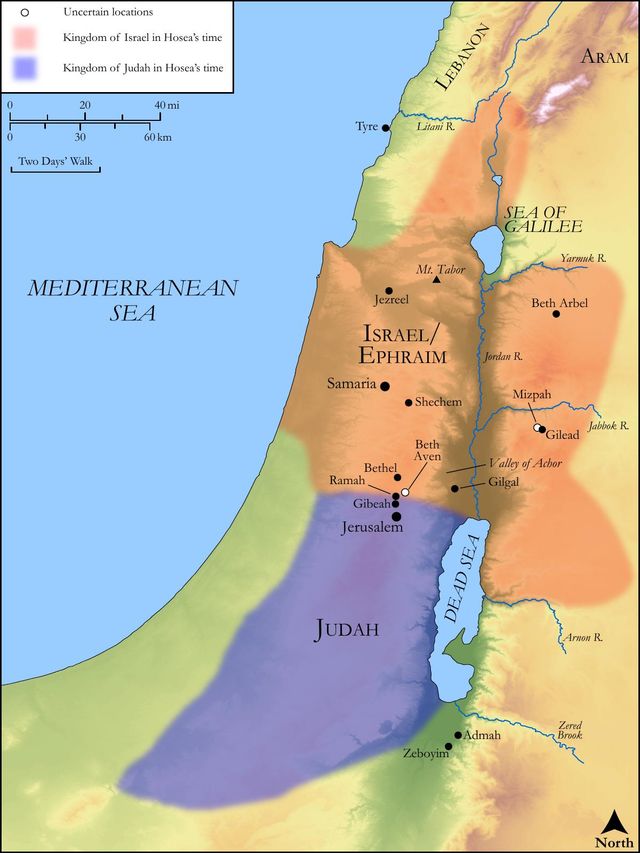
See on the biblical-era map
Study this verse
Public-domain commentary
Matthew Henry
From his Commentary on the Whole Bible. Henry comments on passages, not single verses — this entry covers Hosea 8:1–7. His four-level outline is real structure in the source text, so it is rendered as structure.
The reproofs and threatenings here are introduced with an order to the prophet to set the trumpet to his mouth (Hos 8:1), thus to call a solemn assembly, that all might take notice of what he had to deliver and take warning by it. He must sound an alarm, must, in God's name, proclaim war with this rebellious nation. An enemy is coming with speed and fury to seize their land, and he must awaken them to expect it. Thus the prophet must do the part of a watchman, that was by sound of trumpet to call the besieged to stand to their arms, when he saw the besiegers making their attack, Eze 33:3. The prophet must lift up his voice like a trumpet (Isa 58:1), and the people must hearken to the sound of the trumpet, Jer 6:17. Now,
I.Here is a general charge drawn up against them as sinners, as rebels and traitors against their sovereign Lord.
1.They have transgressed my covenant, Hos 8:1. They have not only transgressed the command (every sin does that), but they have transgressed the covenant; they have been guilty of such sins as break the original contract; they have revolted from their allegiance, and violated the marriage-covenant by their spiritual whoredom; they have, in effect, declared that they will be no longer God's people, nor take him for their God; that is transgressing the covenant. They have not only done foolishly, but have dealt deceitfully.
2.They have trespassed against my law in many particular instances. God's law is the rule by which we are to walk; and this is the malignity of sin, that it trespasses upon the bounds set us by that law.
3.They have cast off the thing that is good. They have put away and rejected good, that is, God himself; so some understand it, and very fitly. He is good, and does good, and is our goodness. There is none good but one, that is God, the fountain of all good. They have cast him off, as not desiring to have any thing more to do with him. God was abandoning them to ruin, and here gives the reason for it. Note, God never casts off any till they first cast him off. Or, as we read it, They have cast off the thing that is good; they have cast off the service and worship of God, which is, in effect, casting God off. They have cast off that which denominates men good; they have cast off the fear of God, and the regard of man, and all sense of virtue and honesty. Observe, They have transgressed my covenant; it has come to this at last; for they trespassed against my law. Breaking the command made way for breaking the covenant; and they did that, for they cast off that which was good; there it began first. They left off to be wise and to do good, and then they went all to naught, Psa 36:3. See the method of apostasy; men first cast off that which is good; then those omissions make way for commissions; and frequent actual transgressions of God's law bring men at length to an habitual renunciation of his covenant. When men cast off praying, and hearing, and sabbath-sanctification, and other things that are good, they are in the high road to a total forsaking of God.
II.Here are general threatenings of wrath and ruin for their sin:
The enemy shall come as an eagle against the house of the Lord, and (Hos 8:3) shall pursue him. If by the house of the Lord we understand the temple at Jerusalem, by the eagle that comes against it we must suppose to be meant either Sennacherib, who had taken all the fenced cities of Judah, laid siege to Jerusalem (and, no doubt, aimed at the house of the Lord, to lay that waste, as he had done the temples of the gods of other nations), or Nebuchadnezzar, who burnt the temple and made a prey of the vessels of the temple. But, if we make it to point at the destruction of the kingdom of the ten tribes by the king of Assyria, we must reckon it is the body of that people which as Israelites, to whom pertained the adoption, the glory, and the covenants, is here called the house of the Lord. They thought their being so would be their protection; but the prophet is directed to tell them that now they had lost the life and spirit of their religion, though they still retained the name and form of it, they were but as a carcase to which the eagles and other birds of prey should be gathered together. The enemy shall pursue them as an eagle, so swiftly, so strongly, so furiously. Note, Those who break their covenant of friendship with God expose themselves to the enmity of all about them, to whom they make themselves a cheap and easy prey; and their having been the house of the Lord, and his living temples, will be no excuse nor refuge to them. See Amo 3:2.
III.Here is the people's hypocritical claim of relation to God, when they were in trouble and distress (Hos 8:2):
Israel shall cry unto me; when either they are threatened with these judgments, and would plead an exemption, or when the judgments are inflicted on them and they apply to God for relief, pouring out a prayer when God's chastening is upon them, they will plead that among them God is known and his name is great (Psa 76:1) and in their distress will pretend to that knowledge of God's ways which in their prosperity they desired not, but despised. They will then cry unto God, will call him their God, and (as impudent beggars) will tell him they are well acquainted with him, and have known him long. Note, There are many who in works deny God, and disown him, yet, to serve a turn, will profess that they know him, that they know more of him than some of their neighbours do. But what stead will it stand a man in to be able to say, My God, I know thee, when he cannot say, "My God, I love thee," and "My God, I serve thee, and cleave to thee only?"
IV.Here is the prophet's expostulation with them, in God's name (Hos 8:5):
How long will it be ere they attain to innocency? It is not meant of absolute innocency (that is what the guilty can never attain to); but how long will it be ere they repent and reform, ere they become innocent in this matter, and free from the sin of idolatry? They are wedded to their idols; how long will it be ere they are weaned from them, ere they are able to get clear of them? so it might be rendered. This intimates that custom in sin makes it very difficult for men to part with it. It is hard to cleanse from that filthiness, either of flesh or spirit, which has been long wallowed in. But God speaks as if he thought the time long till sinners cast away their iniquities and come to live a new life. He complains of their obstinacy; it is that which keeps his anger against them burning, which would soon be turned away if they did but attain to innocency from those sins that kindled it. They in trouble cry, How long will it be ere God return to us in a way of mercy? but they do not hear him ask, How long will it be ere they return to God in a way of duty?
V.Here are some particular sins which they are charged with, are convicted of the folly of, and warned of the fatal consequences of, and for which God's anger is kindled against them.
1.In their civil affairs. They set up kings without God, and in contempt of him, Hos 8:4. So they did when they rejected Samuel, in whom the Lord was their king, and chose Saul, that they might be like the nations. So they did when they revolted from their allegiance to the house of David, and set up Jeroboam, wherein, though they fulfilled God's secret counsel, yet they aimed not at his glory, nor consulted his oracle, nor applied to him by prayer for direction, nor had any regard to his providence, but were led by their own humour and hurried on by the impetus of their own passions. So they did now about the time when Hosea prophesied, when it seems to have grown fashionable to set up kings, and depose them again, according as the contenders for the crown could make an interest, Kg2 15:8, etc. Note, We cannot expect comfort and success in our affairs when we go about them, and go on in them, without consulting God and acknowledge not him in all our ways: "They set up kings, and I knew it not, that is, I did not know it from them, they did not ask counsel at my mouth, whether they might lawfully do it or whether it would be best for them to do it, though they had prophets and oracles with whom they might have advised." They looked not to the Holy One of Israel, Isa 31:1. Nor did the princes do as Jephthah, who, before he took upon him the government, uttered all his words before the Lord in Mizpeh, Jdg 11:11. Note, Those that are entrusted with public concerns, and particularly with the election and nomination of magistrates, ought to take God along with them therein, by desiring his direction and designing his honour.
2.In their religious matters they did much worse; for they set up calves against God, in competition with him and contradiction to him. "Of their silver and their gold which God gave them, and multiplied to them, that they might serve and honour him with them, they have made them idols." They called them gods (Kg1 12:28, Behold thy gods, O Israel!) but God calls them idols; the word signifies griefs, or troubles, because they are offensive to God and will be ruining to those that worship them. Their silver and their gold they have made to them idols; so the words are, referring primarily to the images of their gods, which they made of gold and silver, especially the golden calves at Dan and Bethel. Idolaters spare no cost in worshipping their idols. But they are very applicable to the spiritual idolatry of the covetous: Their silver and their gold are the gods they place their happiness in, set their hearts upon, to which they pay their homage, and in which they put their confidence. Now, to show them the folly of their idolatry, he tells them,
(1.)Whence their gods came. Trace them to their original, and they will be found the creatures of their own fancies and the work of their own hands, Hos 8:6. The calf they worshipped is here called the calf of Samaria, because it is probable that when Samaria, in Ahab's time, became the metropolis of the kingdom, a calf was set up there to be near the court, besides those at Dan and Bethel, or perhaps one of those was removed thither; for those that are for new gods will still be for newer. Now let them consider what this god of theirs owed its rise and being to.
[1.]To their own invention and institution: From Israel was it also, not from the God of Israel (he expressly forbade it), but from Israel; it was a device of their own (some think), not borrowed from any of their neighbours, no, not from the Egyptians, for, though they worshipped Apis in a living cow, they never worshipped a golden calf; that was from Israel; it was their own iniquity. Now could that be worthy of their worship which was a contrivance of their own? It was from Israel, that is, the gold and silver of which it was made were collected from the people of Israel by a brief: it was a poor god that was framed by contribution.
[2.]It was owing to the skill and labour of the craftsman, Deu 27:15. The workmen made it, therefore it is not God, Hos 8:6. This is a very cogent conclusive argument, and the inference so very plain that one would think their own thoughts should have suggested it to them, so as to make them ashamed of their idolatry. What can be more absurd than for men to worship that as a god, giving being and good to them, which they themselves gave being to (both matter and form), but could not give life to? A made god is no God. This is a self-evident truth; and yet St. Paul was accused as a criminal for preaching that those are no gods which are made with hands, Act 19:26. And, here, this which should have turned them from their idols comes in as a reason why they were inseparably wedded to them; therefore they could not attain to innocency because it was from themselves; they were willing to have gods of their own to do what they pleased with, that they themselves might do what they pleased.
(2.)What their gods would come to. If they are not gods, they will not last; nay, if they pretend to be gods, they will be reckoned with: The calf of Samaria shall be broken to pieces, and those that would not yield to the force of the former argument shall be convinced by this that it is not God, but an unprofitable idol, as the Chaldee calls it. It shall be broken to shivers, like a potter's vessel, though it be a golden calf. It shall be chips or saw-dust; it shall be a spider's web; so St. Jerome. It seems to allude to Moses's grinding to powder the golden calf that was in his time. This shall be served as that was. Sennacherib boasted what he had done to Samaria and her idols, Isa 10:11. Note, Deifying any creature makes way for the destruction of it. If they had made vessels and ornaments for themselves of their silver and gold, they might have remained; but, if they make gods of them, they shall be broken to pieces.
(3.)What their gods would bring them to. The breaking of them to pieces would be a disappointment to those who trusted in them. But that was not all: They have made to themselves idols, that they may be cut off (Hos 8:4), that their gold and silver, which they so abused, may be cut off (so some take it), nay, that they may themselves be cut off from God, from their own land, from the land of the living. Their idolatry will as certainly end in their extirpation as if they had purposely designed it. And, when this proves to be the effect of their sin, what relief will they have from the gods wherein they trusted? None at all: "Thy calf, O Samaria! has cast thee off; it cannot give thee any help in thy distress, and the pleasure thou now takest in it will vanish, and be no pleasure to thee." Those that were justly sent to the gods whom they had chosen found them miserable comforters, Jdg 10:14. If men will not quit the love and service of sin, yet they shall certainly lose all the delights and profits of it. If Samaria had continued firm and faithful to the God of Israel, he would have been a present powerful help to her; but the calf she preferred before him was a broken reed. The case will be the same with those that make their silver and their gold their god. It will cast them off, and not profit them in the day of wrath, Eze 7:12. Note, Those that suffer themselves to be deceived into any idolatries will certainly find themselves deceived in them. Cardinal Wolsey owned that if he had served his God as faithfully as he had served his prince he would not have cast him off, as his prince did, in his old age. Their disappointment in their idols is illustrated (Hos 8:7) by a similitude which intimates both that and the destruction which God brought upon them for their idolatry.
[1.]They got no good to themselves by worshipping idols: They have sown the wind. They have put themselves to a great deal of trouble and expense to make and worship their idols, have made a business of it as much as the husbandman does of sowing his corn, in expectation of reaping some mighty advantage from it, and that they should be as prosperous and victorious as the neighbouring nations were, that worshipped idols. But it is all a cheat; it is like sowing the wind, which can yield no increase; they labour in vain, labour for the wind, Ecc 5:16. They take great pains to no purpose, and weary themselves for very vanity, Hab 2:13. Those that make an idol of this world do so; they set their eyes on that which is not, which, like the wind, makes a great noise, but has nothing substantial in it.
[2.]They brought ruin upon themselves by it: They shall reap the whirlwind, a great whirlwind (so the word signifies), which shall hurry them away and dash them to pieces. They not only have not their false gods for them but they set the true God against them; their favour will stand them in no more stead than the wind, but his wrath will do them more mischief than a whirlwind. As a man sows, so shall he reap. "If it may be supposed that a man should sow the wind, and cover it with earth, or keep it there for a while penned up, what could he expect but that it should be forced by its being shut up, and the accession of what might increase its strength, to break forth again in greater quantities with greater violence?" So Dr. Pocock. They promise themselves plenty, peace, and victory, by worshipping idols, but their expectations come to nothing. What they sow never comes up; it has no stalk, no blade, or, if it have, the bud shall yield no meal; it shall be as the thin ears in Pharaoh's dream, that were blasted with the east wind, and there was nothing in them. Or if it yield, if they do prosper for a while in their idolatrous courses, the strangers shall swallow it up; it shall be so far from doing them any service that it shall be but as a bait to invite strangers to invade them, and as a spoil to enrich those strangers and enable them to do so much the more mischief. Note, The service of idols is an unprofitable service, and the works of darkness are unfruitful; nay, in the end they will be pernicious. Rom 6:21, The end of those things is death. Those that sow iniquity reap vanity: nay, those that sow to the flesh, reap corruption. The hopes of sinners will be cheats, and their gains will be snares.
Historical interpretation
Historical reception
1 surviving comment on this verse from the historical church.
Let the trumpet be in your throat, like an eagle over the house of the Lord: because they have transgressed my covenant, and violated my law. They will call upon me, (or "They called upon me") my God, we have known you, Israel. Israel has rejected the good, the enemy will pursue him. They themselves have reigned, and not by me; principalities have arisen, and I have not known them. They made for themselves idols of their silver and gold, so that they should be destroyed. In their bosom they are like the earth, like an eagle over the house of the Lord: because they have transgressed my covenant, and acted wickedly against my law. They called upon me (or "They will call upon me"), God, we have known you, because Israel has rejected the good; they persecuted the enemy, they themselves have reigned, and not by me; principalities have arisen, and have not declared it to me: they have made idols for themselves with their silver and gold, so that they may perish. This which we have interpreted as "let the trumpet be in your throat," is what is written in Hebrew. Aquila, Symmachus, and Theodotion have similarly translated it as Alechchac Sophar. Only the seventy said, "Like the earth in their bosom", and what this means is uncertain. For some people, bosom is understood in two ways: the lower part of the clothing from the genitals to the feet, or the gulf of the sea, that is, the bosom, for example, of the Adriatic and Ionian Seas and the Propontis, as well as the false teachers who followed the blasphemy of Egypt, keeping all things serving their lusts and earthly desires in their bosom; or indeed in the port and refuge of their navigation, nothing of precious merchandise, but acquiring earthly things. But we, following the Hebrew truth, weave the order of the begun explanation together. It is commanded to the prophet, and it is said to him: "Let the trumpet be in your throat," that is, so elevate your voice, as if it were like a trumpet: so that most may hear, because most have sinned. And when you have lifted up your voice, say this with a shout, like an eagle over the house of the Lord, and the meaning is: Nebuchadnezzar will come with his entire army so swiftly, so quickly, that it imitates the flight of an eagle, hastening to prey; and he will come not to another place, but to Jerusalem, where the temple of God is located, so that he may destroy and subvert it. Of this, the eagle and Ezekiel speaks more fully (Ezek. 17): the great wings, feathers, and talons, which have the direction of entering into Lebanon, that is, into the temple of God. According to the prophet Zachariah, in which it is written: "Open, Lebanon, thy gates, and let fire devour thy cedars" (Zach. 11: 1). But this, O prophet, what I tell you and command: "Let there be a trumpet in your throat," so that you may shout and say, like an eagle upon the house of the Lord, the king is coming of the Chaldeans, I order for no other reason, except that they have violated my covenant, and have left my ceremonies. At the time of necessity and distress, when captivity will come, they will call upon me and say: 'My God, we know you, Israel;' we who are called Israel, we know and recognize you, and we keep the ancient name of Jacob, which pleased you, so that we may be called Israel." To which the Lord responds: "How can you be called Israel, when Israel has rejected the good, that is, the Lord God, whom Israel was named after? Therefore, because Israel has rejected the good, the enemy, that is, the Assyrian, will pursue him and capture him: they who, with me as their deserted ruler, have sought a king for themselves, as have the other nations, and they have acted against my ((or "his")) will. Finally, Samuel therefore exposes to them the harsh commands of the king, and says that their sons and daughters will serve the kings, so that they may be converted to the Lord, the most merciful king (1 Kings 18). But they became rulers without God's will. And this crime did not satisfy them, they doubled the sin with greater impiety, converting the silver and gold which they had received into idols for wealth and decoration. Therefore, Saul was made king not by God's will, but by the error of the people. And because he had no root of piety, as soon as he began to reign, he was filled with impiety. It may be that what he says, 'They reigned, and not by me; the princes existed, and I did not know them,' may also be accepted of Jeroboam the son of Nebat and of the other princes who succeeded him in the empire. And not immediately, because God was angry with Solomon, did Israel receive him as king. For according to the precepts of the law he ought to have asked the Lord whether he wished this to be done. For it is said of the Savior: Indeed, woe to him by whom the Son of Man is betrayed (Matt. XXVI). We frequently read that the devil, who desires to place his nest above the stars of heaven, is like an eagle: 'If you are exalted as an eagle, thence I will draw you down,' saith the Lord (Obadiah 1:4). Also, the eye which mocks father and despises the old age of the mother, shall be rooted out by the ravens of the valley, and shall be eaten by the younglings of eagles (Proverbs 30): through the devil and demons, losing the clear light of his vision. Therefore, it is commanded in the Law, that we do not eat the eagle (Leviticus 11). Therefore, this eagle comes upon the councils of heretics which formerly were the homes of the Lord. And thus, she comes because they have violated His covenant and abandoned the law of God. And they call upon him without cause and say: You are my God, and we have known you, we who are called Israel, seeing God and we are called by the name Christian. They do these things in vain, he says, since they themselves have appointed their own kings and have acted against my will; they have princes who are my adversaries, whom I do not know, for they do not deserve my knowledge. They also turned their silver, and gold, and whatever they were able to have naturally, into idols of speech and thought, which they fashioned out of their own hearts; And they turned, not that they might perish, but because they turned, therefore they perished. For they did not do this in order to perish, but because they did this, therefore they perished.
Continue studying Hosea 8:1 across the web’s major study libraries — every link below opens this exact verse, chapter, or book on the destination site.
Read & Compare
 BibleGatewayThis verse in more than 200 translations and 70 languages.
 Bible.comThe YouVersion reader — hundreds of translations, reading plans, and highlights.
 ESV.orgCrossway's official English Standard Version reader.
 NET BibleThe NET translation with 60,000+ translators' notes on every rendering decision.
 STEP BibleTyndale House's free study tool — original text, vocabulary, and scholarly resources.
 BibliaLogos Bible Software's free web reader.
 USCCBThe New American Bible (Revised Edition) with the U.S. bishops' study notes.
Commentaries
 BibleHub CommentariesDozens of classic commentaries on this verse, gathered on one page.
 StudyLightMore than 100 commentary sets — the largest collection on the web.
 BibleRefPlain-English commentary on what this verse means, verse by verse.
 Enduring WordDavid Guzik's free commentary on this chapter, widely used by Bible teachers.
 Bible Study ToolsVerse commentary alongside Greek and Hebrew study aids.
Original Language & Research
- BibleHub InterlinearThe verse word by word — original language, transliteration, and English.
- BibleHub LexiconEvery word's original-language definition and Strong's entry.
 Blue Letter BibleDeep-study tools — Strong's numbers, concordance, and word studies.
 SefariaThe Hebrew text with Rashi and centuries of Jewish commentary.
Sermons, Hymns & Audio


TrulyRandomVerse is not affiliated with these sites and doesn’t control their content. They’re linked because they’re genuinely useful.
Summary
Hosea 8:1 issues a severe prophetic warning to the Northern Kingdom of Israel, commanding the immediate sounding of an alarm to announce swift and devastating divine judgment. This impending catastrophe, likened to an eagle's predatory descent, is declared as a direct consequence of Israel's profound and repeated transgression of God's covenant and law, highlighting their deep spiritual unfaithfulness and the inevitable repercussions of their rebellion against Yahweh.
Context
ShowHideLiterary Context
Hosea 8:1 stands as a stark declaration within a section of Hosea (chapters 7-10) that intensifies the prophecies of judgment against Israel. Following earlier chapters that detail Israel's spiritual adultery and political instability, this verse marks a pivotal shift, moving from lament and detailed accusation to an urgent pronouncement of impending doom. The command to "Set the trumpet to thy mouth" serves as an immediate, dramatic opening, signaling that the time for repentance has passed and the consequences of their unfaithfulness are at hand. It sets the stage for the detailed descriptions of Israel's fall and exile that follow in subsequent chapters, emphasizing the direct link between their covenant violations and the coming destruction.
Historical & Cultural Context
Hosea prophesied during the tumultuous final decades of the Northern Kingdom of Israel, a period marked by political assassinations, unstable kings, and a desperate reliance on foreign alliances (Egypt and Assyria) rather than God. Spiritually, the nation was deeply entrenched in idolatry, particularly the worship of Baal and the golden calves at Bethel and Dan, directly violating the Mosaic covenant. The "trumpet" (shofar) was a crucial instrument in ancient Israel, used not only for religious festivals but primarily as an alarm for war, a call to assembly, or a warning of danger. The imagery of an "eagle" immediately conjured the terrifying speed, power, and predatory nature of an invading army, a common biblical metaphor for swift judgment, notably seen in Deuteronomy 28:49. Historically, this eagle-like adversary was the Assyrian Empire, which would eventually conquer Samaria in 722 BCE, fulfilling Hosea's prophecy.
Key Themes
ShowHideThis verse powerfully encapsulates several core themes prevalent throughout Hosea and the prophetic books. Foremost is the theme of Divine Judgment, where God, in His righteousness, responds to His people's persistent sin. This judgment is presented as Inevitable Consequence of Covenant Breach, underscoring that Israel's rejection of God's explicit laws and commands directly leads to their downfall. The "house of the LORD" refers to the nation of Israel, specifically the Northern Kingdom, highlighting God's direct dealings with His chosen people. The imagery also emphasizes God's Sovereignty, as He orchestrates even pagan nations like Assyria to fulfill His purposes of judgment against His disobedient people, demonstrating that no nation, not even His own, is exempt from the consequences of violating His holy covenant.
Exposition and Analysis
ShowHideKey Word Analysis
ShowHideFrom an unused root meaning "to incise," this word refers to a cornet or curved horn, specifically a ram's horn. It was used to produce a clear, piercing sound, serving as a signal for war, assembly, or an alarm. In this context, it signifies an urgent, unmistakable warning of imminent danger and divine judgment, a call to attention before a devastating event.
From an unused root meaning "to lacerate," this term denotes a large bird of prey, typically an eagle. In biblical imagery, the eagle is renowned for its swiftness, powerful flight, keen eyesight, and predatory nature. Here, it symbolizes the rapid, overwhelming, and destructive force of the invading enemy—the Assyrian army—that will descend upon Israel with devastating effect, leaving no escape.
Derived from a root meaning "to cut" (referencing the ancient practice of cutting animals in two to seal a covenant, with parties passing between the pieces), this word signifies a compact, confederacy, or league. It refers to the solemn, binding agreement established by God with Israel at Mount Sinai, outlining their relationship and the reciprocal obligations. Israel's "transgression" of this covenant is the fundamental reason for the impending judgment, highlighting their betrayal of their relationship with Yahweh.
A primitive root meaning "to cross over," used broadly for any transition, literal or figurative. In this context, it specifically means to "transgress" or "pass over" a boundary or command. It implies a deliberate crossing of the line God has drawn, a violation of His established order and laws, indicating a willful act of disobedience against the divine will.
A primitive root meaning "to break away (from just authority)," "trespass," "apostasize," or "rebel." This term carries a stronger connotation than ʻâbar, suggesting a deliberate act of rebellion, unfaithfulness, or even sacrilege, particularly in a religious context. It emphasizes Israel's profound betrayal of trust and their active revolt against God's authority and His sacred law.
Verse Breakdown
ShowHide"Set the trumpet to thy mouth."
This is a direct, urgent command, likely addressed to the prophet Hosea himself or to a prophetic watchman, to sound an immediate and piercing alarm. The trumpet (shofar) is not for celebration but for signaling impending war and danger, indicating that the time for warning is now, and the judgment is at the very threshold.
"He shall come as an eagle against the house of the LORD,"
This clause introduces the instrument of divine judgment. "He" refers to the invading enemy, historically the Assyrians. The simile "as an eagle" vividly portrays the enemy's swiftness, power, and predatory nature, emphasizing the overwhelming and inescapable force with which they will descend upon Israel ("the house of the LORD," meaning the nation of Israel).
"because they have transgressed my covenant,"
This provides the primary theological justification for the impending judgment. Israel's "transgression" (crossing over the boundary) of God's covenant, specifically the Mosaic Covenant established at Sinai, signifies their fundamental breach of the foundational agreement that defined their relationship with Yahweh. This refers to their widespread idolatry and disobedience to God's commands.
"and trespassed against my law."
This second reason reinforces and deepens the first. "Trespassed" (rebelled, acted unfaithfully) against God's "law" (Torah) underscores the deliberate and pervasive nature of Israel's rebellion. It highlights their active defiance and betrayal of the divine instructions and statutes that were meant to guide their lives and maintain their covenant fidelity.
Literary Devices
ShowHideHosea 8:1 is rich in Symbolism and Metaphor, powerfully conveying its message of imminent judgment. The trumpet (shofar) serves as a potent symbol of alarm and war, immediately signaling urgency and impending catastrophe. Its sound is not merely a call but a prophetic declaration of doom. The eagle is a striking metaphor for the invading enemy. This imagery evokes the bird's speed, its keen predatory instincts, and its overwhelming power as it swoops down on its prey. The "eagle" here represents the Assyrian army, a swift and destructive force that will descend upon Israel without mercy, fulfilling God's judgment. The phrase "house of the LORD" employs Metonymy, where "house" stands for the entire nation of Israel, emphasizing that the judgment is against the people who were meant to be God's dwelling place. The verse also functions as a Prophetic Oracle, a direct divine utterance delivered through the prophet, characterized by its declarative and authoritative tone, announcing future events as certainties due to past actions.
Theological and Thematic Connections
ShowHideHosea 8:1 profoundly connects to the biblical themes of divine justice, covenant fidelity, and the consequences of sin. God, as the righteous sovereign, holds His people accountable for their covenant obligations. Israel's persistent idolatry and moral corruption represented a direct betrayal of the covenant established at Sinai, a sacred bond that demanded exclusive loyalty and obedience. This verse demonstrates that God's warnings are not empty threats but expressions of His unwavering character, where His love for His people is intertwined with His demand for holiness and His commitment to upholding His own righteous standards. The swift and devastating judgment, though severe, underscores God's ultimate control over history and His use of even pagan nations to accomplish His purposes, ensuring that His covenant people understand the gravity of their rebellion.
Reflection and Application
ShowHideHosea 8:1 serves as a timeless and sobering reminder that spiritual disobedience carries profound consequences. For believers today, it underscores the critical importance of upholding our covenant relationship with God, not merely through outward conformity but through genuine faithfulness of heart. Just as Israel was called to obey God's law, we are called to live in accordance with the principles of the New Covenant established through Christ. This verse prompts us to examine our own lives for areas where we might be "transgressing" or "trespassing" against God's revealed will, whether through idolatry of possessions, relationships, or self, or through neglecting His Word and commands. God's warnings, though often uncomfortable, are ultimately expressions of His justice and His desire for His people to repent and return to Him. We are called to heed His voice, to remain spiritually watchful, and to proclaim His truth to a world that often disregards His righteous law, understanding that true security lies only in faithful obedience to Him.
Questions for Reflection
ShowHideFAQ
ShowHideWhat is the significance of the "trumpet" in this verse?
ShowHideThe "trumpet" (Hebrew: shôwphâr) in Hosea 8:1 is not a call to celebration or worship, but a dire warning. It signifies an urgent alarm, a signal for war, or an announcement of impending disaster. In this context, it dramatically underscores the immediacy and severity of the divine judgment about to be unleashed upon Israel. It's a command to sound the alarm because the enemy is at the gates, a direct consequence of Israel's unfaithfulness. The sound of the shofar was meant to pierce the air and the hearts of the people, demanding immediate attention to the coming catastrophe.
Who is the "He" that "shall come as an eagle"?
ShowHideThe "He" refers to the instrument of God's judgment, which historically was the Assyrian Empire. The Assyrians were known for their brutal military efficiency, swift campaigns, and overwhelming power, making the "eagle" a fitting metaphor for their destructive advance. This imagery echoes warnings found elsewhere in scripture, such as Deuteronomy 28:49, where an eagle-like nation is prophesied as a sign of divine judgment for disobedience. God, in His sovereignty, uses even pagan nations to execute His righteous will and bring His disobedient people to account.
What does it mean that Israel "transgressed my covenant, and trespassed against my law"?
ShowHideThis phrase highlights the core reason for God's judgment. "Transgressed my covenant" refers to Israel's violation of the Mosaic Covenant, the solemn agreement God made with them at Mount Sinai (see Exodus 19-24). This covenant outlined their relationship with God, demanding exclusive worship and obedience to His commands. Israel broke this covenant through widespread idolatry (worship of Baal and golden calves), oppression, and reliance on foreign alliances instead of God. "Trespassed against my law" reinforces this, emphasizing their active rebellion and unfaithfulness (often implying sacrilege or betrayal of trust) against the specific statutes and ordinances (Torah) that comprised God's revealed will for their lives. Together, these phrases underscore the depth of their spiritual rebellion and betrayal of their divine relationship.
Christ-Centered Fulfillment
ShowHideHosea 8:1, with its pronouncement of judgment for a broken covenant, finds its ultimate fulfillment and resolution in Jesus Christ. Israel's failure to uphold the Old Covenant, leading to the "eagle" of judgment, points to the profound human inability to perfectly keep God's law. This highlights the necessity of a new and better covenant, prophesied in Jeremiah 31:31-34, which Jesus inaugurated through His sacrificial death and resurrection. Christ perfectly fulfilled the law that Israel continually transgressed, becoming the Lamb of God whose spotless obedience and atoning sacrifice paid the penalty for humanity's covenant breaches and trespasses. Through His blood, He established the New Covenant, by which believers are not judged according to their own failed attempts at law-keeping, but are granted forgiveness and righteousness through faith in Him. The terrifying "eagle" of judgment that descended upon Israel for their sin was ultimately borne by Christ on the cross, where He became sin for us, allowing those who believe to escape the wrath to come and enter into an unbreakable, grace-based relationship with God, sealed by the Holy Spirit. Thus, the warning in Hosea 8:1, while historically fulfilled in Assyria, ultimately points to the greater salvation offered in Christ, who delivers us from the ultimate judgment of our covenant unfaithfulness.