


Zephaniah 2:3
Bible text: King James Version (1769 Blayney text) · Public domain
Bible text: King James Version with Strong's numbers · Public domain
Bible text: Berean Standard Bible · Public domain
Bible text: American Standard Version (1901) · Public domain
Bible text: World English Bible, Messianic edition · Public domain
Bible text: Geneva Bible (1599) · Public domain
Bible text: Young's Literal Translation · Public domain
- בַּקְּשׁוּba·ke·ShuseekH1245V-Piel-Imp-2mpVerb Piel Imperative 2nd Plural Masculine
- אֶת'et<obj.>H853DirObjMParticle Object Indicator
- יְהוָהYah·wehYahwehH3068N-properNoun Proper Title
- כָּלkolO allH3605N-mscNoun Singular Masculine Construct
- עַנְוֵי'an·Vei[the] humble [people] ofH6035Adj-mpcAdjective Plural Masculine Construct
- הָאָרֶץha·'A·retzthe landH776Art ¦ N-fsNoun Singular Feminine Absoluteהָtheאָרֶץland
- אֲשֶׁר'a·SherwhoH834RelParticle Relative
- מִשְׁפָּטוֹmish·pa·Tohis judgmentH4941N-msc ¦ 3msNoun Singular Masculine Constructמִשְׁפָּטjudgmentוֹhis
- פָּעָלוּpa·'A·luthey have doneH6466V-Qal-Perf-3cpVerb Qal Perfect 3rd Plural common gender
- בַּקְּשׁוּba·ke·shuseekH1245V-Piel-Imp-2mpVerb Piel Imperative 2nd Plural Masculine
- צֶדֶקtze·dekrighteousnessH6664N-msNoun Singular Masculine Absolute
- בַּקְּשׁוּba·ke·ShuseekH1245V-Piel-Imp-2mpVerb Piel Imperative 2nd Plural Masculine
- עֲנָוָה'a·na·VahhumilityH6038N-fsNoun Singular Feminine Absolute
- אוּלַי'u·LaiperhapsH194AdvAdverb
- תִּסָּתְרוּti·Sa·te·Ruyou will be hiddenH5641V-Niphal-Imperf-2mpVerb Niphal Imperfect 2nd Plural Masculine
- בְּיוֹםbe·Yomon [the] day ofH3117Prep-b ¦ N-mscNoun Singular Masculine Constructבְּonיוֹם[the] day of
- אַף'af[the] anger ofH639N-mscNoun Singular Masculine Construct
- יְהוָהYah·wehYahwehH3068N-properNoun Proper Title
English is a literal word-by-word gloss of the Hebrew, not the KJV's wording. Why?
This is the original text the KJV's translators worked from — each Hebrew word with its own literal English meaning in this verse, prepared by scholars at Tyndale House, Cambridge. The KJV translates whole sentences, not word by word, so its wording differs: one Hebrew word can become several English words, and the KJV may choose “the LORD” where the gloss reads “Yahweh”. Both are faithful — they answer different questions. For the KJV's own rendering, switch to the KJV text.
Details
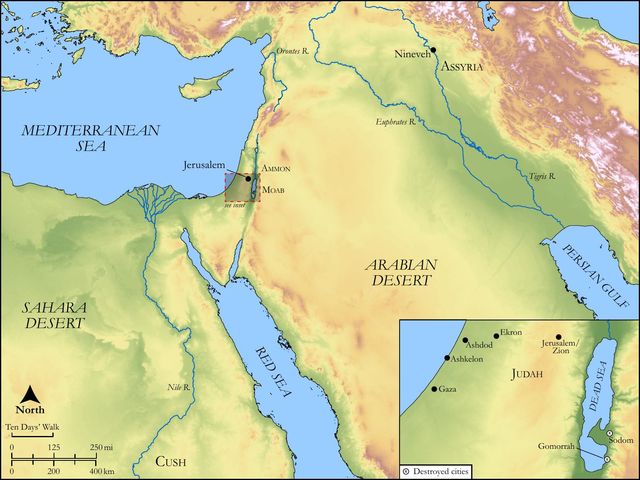
See on the biblical-era map
Study this verse
Public-domain commentary
Matthew Henry
From his Commentary on the Whole Bible. Henry comments on passages, not single verses — this entry covers Zephaniah 2:1–3. His three-level outline is real structure in the source text, so it is rendered as structure.
Here we see what the prophet meant in that terrible description of the approaching judgments which we had in the foregoing chapter. From first to last his design was, not to drive the people to despair, but to drive them to God and to their duty - not to frighten them out of their wits, but to frighten them out of their sins. In pursuance of that he here calls them to repentance, national repentance, as the only way to prevent national ruin. Observe,
I.The summons given them to a national assembly (Zep 2:1):
Gather yourselves together. He had told them, in the last words of the foregoing chapter, that God would make a speedy riddance of all that dwelt in the land, upon which, one would think, it should follow, "Disperse yourselves, and flee for shelter where you can find a place." When the decree had absolutely gone forth for the last destruction of Jerusalem by the Romans, that was the advice given (Mat 24:16), Then let those who are in Judea flee into the mountains; but here it is otherwise. God warns, that he may not wound, threatens, that he may not strike, and therefore calls to the people to use means for the turning away of his wrath. The summons is given to a nation not desired. The word signifies either,
1.Not desiring, that has not any desires towards God or the remembrance of his name, is not desirous of his favour or grace, but very indifferent to it, has no mind to repent and reform. "Yet come together, and see if you can stir up desires in one another." Thus God is often found of those that sought him not, nor asked for him, Isa 65:1. Or,
2.Not desirable, no ways lovely, nor having any thing in them amiable, or which might recommend them to God. The land of Israel had been a pleasant land, a land of delight (Dan 11:41); but now it is unlovely, it is a nation not desired, to which God might justly say, Depart from me; but he says, "Gather together to me, and let us see if any expedient can be found out for the preventing of the ruin. Gather together, that you may in a body humble yourselves before God, may fast, and pray, and seek his face. Gather together, to consult among yourselves what is to be done in this critical juncture, that every one may consider of it, may give and take advice, and speak his mind, and that what is done may be done by consent and so may be a national act." Some read it, "Enquire into yourselves, yea, enquire into yourselves; examine your consciences; look into your hearts; search and try your ways; enquire into yourselves, that you may find out the sin by which God has been provoked to this displeasure against you, and may find out the way of returning to him." Note, When God is contending with us it concerns us to enquire into ourselves.
II.Arguments urged to press them to the utmost seriousness and expedition herein (Zep 2:2):
"Do it in earnest; do it with all speed before it is too late, before the decree bring forth, before the day pass." The manner of speaking here is very lively and awakening, designed to make them apprehensive, as all sinners are concerned to be, 1. That their danger is very great, that their all lies at stake, that it is a matter of life and death, which therefore well requires and well deserves the closest application of mind that can be. It is not a trifle, and therefore is not a thing to be trifled about. It is the fierce anger of the Lord that is kindled against them, and is just ready to kindle upon them, that devouring fire which none can dwell with, which none can make head against or hold up their head under. "It is the day of the Lord's anger, the day set for the pouring out of the full vials of it, that you are threatened with, that great day of the Lord" spoken of, Zep 1:14. "Are you not concerned to prepare for that day?" 2. That it is very imminent: "Bestir yourselves now quickly, before the decree bring forth, and then it will be too late, the opportunity will be lost and never retrieved. The decree is as it were big with child, and it will bring forth the day, the terrible day, which shall pass as chaff, which shall hurry you away into captivity as chaff before the wind." We know not what a day may bring forth (Pro 27:1), but we do know what the decree will bring forth against impenitent sinners, whom therefore it highly concerns to repent in time, in the accepted time. Note, It is the wisdom of those whom God has a controversy with to agree with him quickly, while they are in the way, before his fierce anger comes upon them, not to be turned away. In a case of this nature delays are highly dangerous and may be fatal; they will be so if by them the heart is hardened. How solicitous should we all be to make our peace with God before the Spirit withdraw from us, or cease to strive with us, before the day of grace be over or the day of life, before our everlasting state shall be determined on the other side of the great gulf fixed!
III.Directions prescribed for the doing of this effectually.
It is not enough to gather together in a consternation, but they must seriously and calmly apply to the duty of the day (Zep 2:3): Seek you the Lord. That they might find mercy with God, they are here put upon seeking; for so is the rule - Seek, and you shall find. A general call was given to the whole nation to gather together, but little good is to be expected from the far greater part of them; if the land be saved, it must be by the interest and intercession of the pious few, and therefore to them the exhortation here is particularly directed. And observe,
1.How they are described - they are the meek of the earth, or of the land. It is the distinguishing character of the people of God that they are the meek ones of the earth; this is their badge; it is their livery. They are modest, and humble, and low in their own eyes; they are mild, and gentle, and yielding to others, not soon angry, not very angry, not long angry; they are the quiet in the land, Psa 35:20. And they are subject and submissive to their God, to all his precepts and all his providences. Actuated by this principle and disposition, they have wrought his judgments, that is, have obeyed his laws, observed his institutions, have made conscience of their duty to him, and have laid out themselves for the advancement of his honour and interest in the world.
2.What they are required to do; they must seek, which denotes both a careful enquiry and a constant endeavour, that they may know and do their duty.
(1.)They must seek the Lord, seek his favour and grace, address him upon all occasions, ask of him what they need, seek him early, seek him diligently, and continue seeking him.
(2.)They must seek righteousness. "Seek to God for the performance of his promises to you, and see to it that you abound yet more in duty to him; seek for the righteousness of Christ to be imputed to you, for the graces of God's Spirit to be implanted in you; hunger and thirst after them." (3.) They must seek meekness. This is a grace they were so eminent for that they were denominated the meek of the land, and yet this they must seek. Note, Those that are ever so good must still strive to be better, those that have ever so much grace must be still praying and labouring for more. Nay, those that excel in any particular grace must still seek to excel yet more in that, because in that most assaults will be made upon them by their enemies, in that most is expected from them by their friends, and in that they are most apt to be themselves secure. Si dixisti, Sufficit, periisti - Say but, I am all that I ought to be, and you are undone. In the difficult trying times approaching, the meek will find exercise for all the meekness they have, and all little enough, and therefore should seek it earnestly, and pray that when God in his providence gives them occasion for it he would by his grace enable them to exercise it, to show all meekness to all men, in all instances, that, as the day is, so may the strength be.
IV.Encouragements given to take these directions:
It may be, you shall be hid in the day of the Lord's anger. 1. "You particularly that are the meek of the earth. Though the day of the Lord's anger do come upon the land, yet you shall be safe, you shall be taken under special protection. Verily it shall be well with thy remnant, Jer 15:11. Thy life will I give unto thee for a prey, Jer 45:5. I will deliver thee in that day, Jer 39:17. It may be, you shall be hid; if any be hid, you shall." Good men cannot be sure of temporal preservation, for all things come alike to all, but they are most likely to be hid, and stand fairest for a distinguishing care of Providence. It is expressed thus doubtfully to try if they will trust the goodness of God's nature, though they have but the it may be of a promise, and to keep up in them a holy fear and watchfulness lest they should seem to come short, and should do any thing to throw themselves out of the divine protection. Note, those that hold fast their integrity, in times of common iniquity, have reason to hope that God will find out a hiding-place for them, where they shall be safe and easy, in times of common calamity. They shall be hid (as Luther says) aut in coelo, aut sub coelo - either in heaven or under heaven, either in the possession of heaven or under the protection of heaven. Or, 2. "You of this nation, though it be a nation not desired, yet, in the day of the Lord's anger with the neighbouring nations, when his judgments are abroad, you shall be hid; your land shall be preserved for the sake of those few meek ones that stand in the gap to turn away the wrath of God." It concerns us all to make it sure to ourselves that we shall be hid in the great day of God's wrath; and, if we hide ourselves in the chambers of duty, God will hide us in chambers of safety, Isa 26:20. If we prepare an ark, that shall be our hiding-place, Gen 7:1.
Historical interpretation
Historical reception
1 surviving comment on this verse from the historical church.
(Verse 3, 4) Seek the Lord, all you meek of the earth, who have practiced His judgment; seek justice, seek meekness, perhaps you shall be hidden in the day of the Lord's fury. For Gaza shall be deserted, and Ashkelon shall become a desolation. Ashdod shall be driven out at noon, and Ekron shall be uprooted. LXX: Seek the Lord, all you lowly of the earth; do justice, seek righteousness, and answer it, that you may be protected in the day of the Lord's wrath. For Gaza shall be plundered, and Ashkelon shall become a desolation; and Ashdod shall be cast out at noon, and Ekron shall be uprooted. He is called humble of the earth, who, not by humility, which signifies virtue, but by sins, has been humiliated, and cannot say with Christ: Learn from me, for I am gentle and humble of heart (Matt. XI, 29). For everyone who humbles himself will be exalted. And in another place, a sermon is directed to the saint: the greater you are, the more humble yourself, and you will find favor before God (Eccl. III). But he who is humiliated by sins, and burdened with the consciousness of offenses, and says: Like a heavy burden, burdens are upon me (Psalm XXXVII, 5), must hear: Come to me all you who labor and are burdened, and I will refresh you (Matt. XI, 28). Let this saying be in the beginning according to the 70 interpreters. However, according to the Hebrew, there is another sense. For it is said to the saints: O you, who keep my commandments, who are placed in the land, and knowing that everyone who humbles himself will be exalted, you have imitated my meekness, and you have acted in judgment, seek the Lord in your meekness. And if you want to know who this Lord is, seek the just, seek the meek: For the Father has given all judgment to the Son (John 5:22), who will judge justly. And since you are gentle, seek a gentle one, so that whatever is lacking in your gentleness may be fulfilled by the one who is the source of gentleness. But I say this to you: If you hide on the day of the Lord's fury, that is, if you are able to escape the wrath of the coming day and the captivity that is to be inflicted by either Nebuchadnezzar or the Romans on the people of Judah, because you have sought the Lord and have acted justly. But if they doubt (others say) who have made his judgments, saying (others say). If you wonder how you will hide on the day of the Lord's wrath, what will happen to the sinners? For such a great devastation will come to the land of Judah, and such a high-ranking Babylonian army will ascend here, that even the most powerful cities of the Philistines, which have always resisted you in fair combat, will be captured. Gaza will be destroyed, and Ascalon will be reduced to a wasteland, and Ashdod, not by theft but by war, that is, by open light and victory, will be taken captive; and Ekron, which means uprooting, will endure what it signifies in its name, that is, it will be uprooted. This is according to the literal and Hebrew truth. According to the Septuagint, however, it is commanded to the humble of the earth, of whom it was said above, that they should work for justice and seek righteousness, which I believe is none other than Christ. And because everyone who seeks will find (Mat. VII, 8), what they have found, let them respond to others, that is, let them teach others: for hidden wisdom and a treasure not appearing, what usefulness is there in both (Eccl. XX, 32)? And this, he says, I command you, that on the day of the Lord's wrath you may be protected, either at the end of the world or at the departure of each one from the world, for Gaza, Ashkelon, Ashdod, and Ekron will suffer different punishments: for Gaza means his strength. Therefore, all those who applaud themselves in bodily strength and worldly power, and say with the devil, by my own strength I will do it, will be plundered on the day of the Lord's wrath, and brought to nothing. Ascalon also, which is called weighted or murderous fire, when the day of the Lord's anger comes, will experience the measure of its wickedness, and by the same weight with which it operated, it will be depressed. And because it burned to shed blood, and scandalized many souls, and it was fulfilled in it: The Lord will abhor the bloodthirsty and deceitful man (Psalm 5:7), it will not be plundered like Gaza, but reduced to solitude, it will be consumed by the fires of Gehenna until it turns to dust. And also Azotus, which in Hebrew is called Esdod, and in our language means the fire of generation, will be laid waste by bright light. For it burned with desire, and was consumed by the fire of generation. And because all who commit adultery are like an oven whose hearts are burning (Hosea VII), and are wounded by burning arrows, not in darkness, not in hidden judgment; but at noon, that is, when the saints receive full clarity, they will be cast into darkness, and will not have the fellowship of the saints. But Accaron, which is interpreted as sterility or eradication, because it has produced no fruit and by the perversity of its teaching has eradicated many, it itself will also be eradicated. But all these various things understand in the vices and sins of the souls, and because what each one's work is like will be tested by the fire of judgment on the day (I Cor. III).
Continue studying Zephaniah 2:3 across the web’s major study libraries — every link below opens this exact verse, chapter, or book on the destination site.
Read & Compare
 BibleGatewayThis verse in more than 200 translations and 70 languages.
 Bible.comThe YouVersion reader — hundreds of translations, reading plans, and highlights.
 ESV.orgCrossway's official English Standard Version reader.
 NET BibleThe NET translation with 60,000+ translators' notes on every rendering decision.
 STEP BibleTyndale House's free study tool — original text, vocabulary, and scholarly resources.
 BibliaLogos Bible Software's free web reader.
 USCCBThe New American Bible (Revised Edition) with the U.S. bishops' study notes.
Commentaries
 BibleHub CommentariesDozens of classic commentaries on this verse, gathered on one page.
 StudyLightMore than 100 commentary sets — the largest collection on the web.
 BibleRefPlain-English commentary on what this verse means, verse by verse.
 Enduring WordDavid Guzik's free commentary on this chapter, widely used by Bible teachers.
 Bible Study ToolsVerse commentary alongside Greek and Hebrew study aids.
Original Language & Research
- BibleHub InterlinearThe verse word by word — original language, transliteration, and English.
- BibleHub LexiconEvery word's original-language definition and Strong's entry.
 Blue Letter BibleDeep-study tools — Strong's numbers, concordance, and word studies.
 SefariaThe Hebrew text with Rashi and centuries of Jewish commentary.
Sermons, Hymns & Audio


TrulyRandomVerse is not affiliated with these sites and doesn’t control their content. They’re linked because they’re genuinely useful.
Summary
Zephaniah 2:3 issues a profound call to repentance and humility for the remnant of Judah, urging them to diligently seek the Lord, righteousness, and meekness. Amidst the prophet's severe warnings of impending divine judgment, this verse offers a conditional promise of refuge and preservation for those who have already demonstrated obedience to God's decrees and who earnestly pursue a life aligned with His character, providing a beacon of hope in the face of the terrifying "Day of the LORD'S anger."
Context
ShowHideLiterary Context
Zephaniah 2:3 serves as a pivotal invitation within a broader prophetic oracle of judgment. The preceding verses (Zephaniah 2:1-2) issue a stark warning to the unrepentant nation of Judah, urging them to "gather yourselves together" before the "fierce anger of the LORD" comes upon them. This verse, therefore, acts as a specific, hopeful appeal to a particular group—the "meek of the earth"—offering a potential path to deliverance from the widespread destruction described in the surrounding chapters. It stands in contrast to the universal condemnation, providing a glimpse of God's mercy amidst His righteous wrath, and sets the stage for the subsequent prophecies against surrounding nations (Zephaniah 2:4-15) before returning to Judah's ultimate restoration.
Historical & Cultural Context
Zephaniah prophesied during the reign of King Josiah (c. 640-609 BC), a period marked by a brief revival of Yahweh worship following decades of idolatry and syncretism under Manasseh and Amon. However, deep-seated corruption and pagan practices persisted, particularly in Jerusalem. The "Day of the LORD" concept, central to Zephaniah's message, was a well-established prophetic theme in ancient Israel, typically referring to a time of divine intervention, judgment, and vindication. Culturally, the "meek" (anawim) were often the poor, oppressed, or overlooked segments of society who, despite their circumstances, maintained a humble trust in God, contrasting sharply with the proud and arrogant elite who dominated the nation.
Key Themes
ShowHideThis verse powerfully encapsulates several overarching themes found throughout Zephaniah and the broader prophetic literature. The central theme of the book is the impending Day of the LORD, a cataclysmic event of divine judgment and purification that will affect both Judah and the surrounding nations, as seen in Zephaniah 1:14-18. The call to Repentance and Seeking God is paramount, emphasizing an active and urgent turning away from sin and towards Yahweh, a theme echoed in Isaiah 55:6-7. The emphasis on Meekness and Humility highlights a spiritual disposition that God favors, contrasting with the pride that leads to judgment, a concept foundational to the blessings in Psalm 37:11. Finally, the promise of Divine Preservation and Refuge for the faithful remnant underscores God's justice and mercy, offering hope that some will be spared or protected during the time of wrath, as also found in Psalm 91:1-2.
Exposition and Analysis
ShowHideKey Word Analysis
ShowHideThis verb (H1245) is a primitive root meaning "to search out," often implying an earnest, diligent, and active pursuit. In a spiritual context, as here, it signifies a fervent striving after God, His will, or His favor, often through worship, prayer, or obedience. It is not a passive desire but an intentional, continuous effort to find and align with the divine.
This noun (H6035) describes someone who is "depressed (figuratively), in mind (gentle) or circumstances (needy, especially saintly)." It denotes humility, lowliness, and a humble submission to God's will, often in the face of affliction or oppression. The "meek of the earth" are those who, despite their social or economic standing, maintain a spiritual posture of dependence on God, rather than relying on their own strength or worldly power.
This verb (H5641) means "to hide (by covering), literally or figuratively." In this context, it conveys the idea of divine protection and concealment from the impending judgment. It suggests a secure refuge or shelter provided by God for those who obey His call, implying not necessarily an escape from all hardship, but a preservation through it, under God's sovereign care.
Verse Breakdown
ShowHide"Seek ye the LORD, all ye meek of the earth, which have wrought his judgment;"
This opening clause is a direct, urgent command (imperative plural) to a specific group—the "meek of the earth." It calls them to an active, earnest pursuit of God Himself, not just His blessings. The phrase "which have wrought his judgment" identifies this group as those who have already demonstrated a measure of obedience to God's righteous decrees and laws, indicating a prior commitment to His will. This suggests that their current seeking is a deepening of an existing relationship, not a first-time conversion.
"seek righteousness, seek meekness:"
The command to "seek" is repeated three times in this verse, emphasizing the intensity and importance of this pursuit. Here, the objects of their seeking are specific virtues: "righteousness" (moral uprightness, living in accordance with God's standards, acting justly) and "meekness" (humility, gentleness, submission to God). This highlights that true seeking of God is inseparable from the pursuit of a transformed character that reflects His own attributes. It's a call to embody these virtues actively.
"it may be ye shall be hid in the day of the LORD'S anger."
This final clause presents a conditional promise of divine protection. The phrase "it may be" (ûwlay) indicates that while God's judgment is certain, the possibility of refuge is offered to those who respond to the call. It is not an absolute guarantee of physical escape from all tribulation, but a strong assurance of God's sovereign preservation and shelter for His faithful ones during the terrifying "Day of the LORD'S anger"—a period of intense divine wrath and judgment.
Literary Devices
ShowHideZephaniah 2:3 employs several powerful literary devices. The most prominent is Anaphora, the repetition of the word "seek" at the beginning of successive clauses ("Seek ye the LORD... seek righteousness, seek meekness"). This repetition creates a sense of urgency and emphasizes the paramount importance of this diligent pursuit. The phrase "Day of the LORD'S anger" utilizes Personification, attributing the human emotion of "anger" to the abstract concept of the "Day of the LORD," thereby intensifying the sense of divine wrath and the severity of the impending judgment. Furthermore, the verse uses Conditional Language with the phrase "it may be," which highlights God's sovereignty and the necessity of human response, while still offering a glimmer of hope. This conditional promise serves as a strong motivation for obedience and a testament to God's mercy extended to those who humble themselves.
Theological and Thematic Connections
ShowHideZephaniah 2:3 profoundly illustrates God's character as both just and merciful. While the broader context of Zephaniah emphasizes the certainty and severity of God's judgment against sin, this verse reveals His gracious provision of a path to refuge for those who humble themselves and diligently pursue righteousness. It underscores the biblical truth that God always preserves a remnant, a faithful few who respond to His call, even amidst widespread apostasy and impending wrath. The emphasis on seeking God, righteousness, and meekness highlights the inseparable nature of true faith and transformed living. This pursuit is not merely for personal gain but is a necessary response to God's holiness and a condition for experiencing His protective hand during times of divine visitation.
Reflection and Application
ShowHideZephaniah 2:3 offers a timeless and urgent call to believers today, echoing the enduring principles of faith, humility, and righteous living. In a world often characterized by pride, self-sufficiency, and a departure from divine standards, this verse reminds us that our ultimate security and well-being are found not in worldly power or possessions, but in a humble and diligent pursuit of God. To "seek the LORD" means to prioritize His presence, His will, and His glory above all else, engaging in prayer, studying His Word, and living in active obedience. Cultivating "meekness" is a counter-cultural act, requiring us to surrender our pride, acknowledge our dependence on God, and adopt a gentle spirit towards others. Likewise, "seeking righteousness" compels us to live justly, ethically, and morally upright, reflecting God's character in every sphere of our lives. While we may not face the exact "Day of the LORD'S anger" as ancient Judah, we live in a world prone to various forms of judgment, trials, and spiritual battles. This verse assures us that God provides refuge and strength for those who are faithful, offering a deep spiritual security that transcends external circumstances. It encourages us to live with an eternal perspective, trusting in God's sovereign protection and ultimate deliverance.
Questions for Reflection
ShowHideFAQ
ShowHideWhat does it mean to "wrought his judgment" in this verse?
ShowHideTo "wrought his judgment" means to have practiced or carried out God's decrees, ordinances, or justice. It refers to those who have already demonstrated a measure of obedience to God's laws and righteous standards. This phrase identifies the "meek of the earth" not just as those who are humble in spirit, but also as those whose lives reflect a prior commitment to living according to God's will, distinguishing them from the unrepentant masses. It suggests a history of faithfulness and alignment with divine justice.
Is the promise of being "hid" an absolute guarantee of physical safety?
ShowHideThe phrase "it may be ye shall be hid" (Hebrew: ûwlay) indicates a conditional promise, not an absolute guarantee of complete physical immunity from all hardship or suffering. While God often provides miraculous physical protection for His people, the primary emphasis is on spiritual preservation and finding refuge in God's sovereign care amidst judgment. It speaks to God's provision of shelter and strength, whether physical or spiritual, enabling His faithful ones to endure and be sustained through times of divine wrath or severe trial. This concept aligns with passages like Psalm 91:1-4, which speaks of finding refuge under God's wings.
Christ-Centered Fulfillment
ShowHideZephaniah 2:3, with its call to seek the Lord, righteousness, and meekness for refuge in the "Day of the LORD'S anger," finds its ultimate and most profound fulfillment in Jesus Christ. He is the perfect embodiment of the "meek of the earth," who, though divine, humbled Himself to take on human form and perfectly "wrought His judgment" by living a life of absolute righteousness and obedience to the Father's will (Philippians 2:6-8). Jesus Himself declared, "Blessed are the meek, for they shall inherit the earth" (Matthew 5:5), identifying with and elevating the very quality Zephaniah commands. Furthermore, Jesus is the one we are commanded to "seek first His kingdom and His righteousness" (Matthew 6:33), for in Him dwells all the fullness of God. The "Day of the LORD'S anger" ultimately points to the final judgment, and it is through faith in Christ that believers are "hid" from the wrath to come (Romans 5:9). He is our refuge, our hiding place, and the one who delivers us from the coming judgment, not by our own merit, but by His perfect sacrifice on the cross, which satisfied divine justice and secured our eternal salvation (John 3:16-18). Thus, the call to seek, the pursuit of meekness and righteousness, and the promise of being hid all converge in Christ, who is our only hope and ultimate deliverer.