


Zephaniah 2:4
Bible text: King James Version (1769 Blayney text) · Public domain
Bible text: Berean Standard Bible · Public domain
Bible text: American Standard Version (1901) · Public domain
Bible text: World English Bible, Messianic edition · Public domain
Bible text: Geneva Bible (1599) · Public domain
Bible text: Young's Literal Translation · Public domain
- כִּיkiforH3588PrtParticle Conditional
- עַזָּה'a·ZahGazaH5804N-properNoun Proper Location
- עֲזוּבָה'a·zu·VahabandonedH5800V-Qal-PassPrtcpl-fsVerb Qal Participle Passive Singular Feminine Absolute
- תִהְיֶהtih·Yehit will beH1961V-Qal-Imperf-3fsVerb Qal Imperfect 3rd Singular Feminine
- וְאַשְׁקְלוֹןve·'ash·ke·Lonand AshkelonH831Conj-w ¦ N-properNoun Proper LocationוְandאַשְׁקְלוֹןAshkelon
- לִשְׁמָמָהlish·ma·Mah[will become] <into> a desolationH8077Prep-l ¦ N-fsNoun Singular Feminine Absoluteלִ[will become] <into>שְׁמָמָהa desolation
- אַשְׁדּוֹד'ash·DodAshdodH795N-properNoun Proper Location
- בַּצָּהֳרַיִםba·tzo·ho·Ra·yimat the noontide<s>H6672Prep-b ¦ N-mdNoun Dual Masculine Absoluteבַּat theצָּהֳרַיִםnoontide<s>
- יְגָרְשׁוּהָye·Ga·re·Shu·hapeople will drive out itH1644V-Piel-Imperf-3mp ¦ 3fsVerb Piel Imperfect 3rd Plural Masculineיְגָרְשׁוּpeople will drive outהָit
- וְעֶקְרוֹןve·'ek·Ronand EkronH6138Conj-w ¦ N-properNoun Proper LocationוְandעֶקְרוֹןEkron
- תֵּעָקֵרte·'a·Kerit will be plucked upH6131V-Niphal-Imperf-3fsVerb Niphal Imperfect 3rd Singular Feminine
English is a literal word-by-word gloss of the Hebrew, not the KJV's wording. Why?
This is the original text the KJV's translators worked from — each Hebrew word with its own literal English meaning in this verse, prepared by scholars at Tyndale House, Cambridge. The KJV translates whole sentences, not word by word, so its wording differs: one Hebrew word can become several English words, and the KJV may choose “the LORD” where the gloss reads “Yahweh”. Both are faithful — they answer different questions. For the KJV's own rendering, switch to the KJV text.
Details
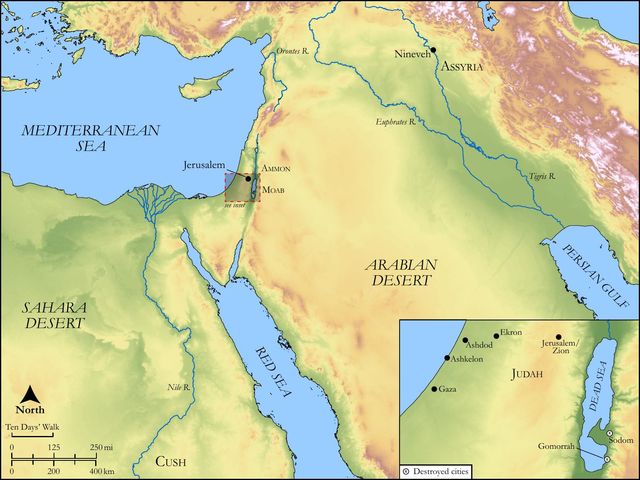
See on the biblical-era map
Study this verse
Public-domain commentary
Matthew Henry
From his Commentary on the Whole Bible. Henry comments on passages, not single verses — this entry covers Zephaniah 2:4–7.
The prophet here comes to foretel what share the neighbouring nations should have in the destruction made upon those parts of the world by Nebuchadnezzar and his victorious Chaldees, as others of the prophets did at that time, which is designed, 1. To awaken the people of the Jews, by making them sensible how strong, how deep, how large, the inundation of calamities should be, that the day of the Lord, which was near, might appear the more dreadful, and they might thereby be quickened to prepare for it as for a general deluge. 2. To comfort them with this thought, that their case, though sad, should not be singular (Solamen miseris socios habuisse doloris - The wretched find it consolatory to have companions of their woe), and much more with this, that though God had seemed to be their enemy, and to fight against them, yet he was still so far their friend, and an enemy to their enemies, that he resented, and would revenge, the indignities done them.
In these verses we have the doom of the Philistines, who were near neighbours, and old enemies, to the people of Israel. Five lordships there were in that country; only four are here named - Gaza and Ashkelon, Ashdod and Ekron; Gath, the fifth, is not named, some think because it was now subject to Judah. They were the inhabitants of the sea-coasts (Zep 2:5), for their country lay upon the Great Sea. The nation of the Cherethites is here joined with them, which bordered upon them (Sa1 30:14) and fell with them, as is foretold also, Eze 25:16. The Philistines' land is here called Canaan, for it belonged to that country which God gave to his people Israel, and was inserted in the grant made to them, Jos 13:3. This land is yet to be possessed (five lords of the Philistines), so that they wrongfully kept Israel out of the possession of it (Jdg 3:3), which is now remembered against them. For, though the rights of others may be long detained unjustly, the righteous God will at length avenge the wrong.
I.It is here foretold that the Philistines, the usurpers, shall be dispossessed and quite extirpated.
In general, here is a woe to them (Zep 2:5), which, coming from God, denotes all misery: The word of the Lord is against them - the word of the former prophets, which, though not yet accomplished, will be in its season, Isa 14:31. This word, now by this prophet, is against them. Note, Those are really in a woeful condition that have the word of the Lord against them, for no word of his shall fall to the ground. Those that rebel against the precepts of God's word shall have the threatenings of the word against them. The effect will be no less than their destruction, 1. God himself will be the author of it: "I will even destroy thee, who can make good what I say and will." 2. It shall be a universal destruction; it shall extend itself to all parts of the land, both city and country: Gaza shall be forsaken, though now a populous city. It was foretold (Jer 47:6) that baldness should come upon Gaza; Alexander the Great razed that city, and we find (Act 8:26) that Gaza was a desert. Ashkelon shall be a desolation, a pattern of desolation. Ashdod shall be driven out at noon-day; in the extremity of the scorching heat they shall have no shade, no shelter to protect them; but then, when most incommoded by the weather, they shall be forced away into captivity, which will be an aggravating circumstance of it. Ekron likewise shall be rooted up, that had been long taking root. The land of the Philistines shall be dispeopled; there shall be no inhabitant, Zep 2:5. God made the earth to be inhabited (Isa 45:18), otherwise he would have made it in vain; but, if men do not answer the end of their creation in serving God, it is just with God that the earth should not answer the end of its creation in serving them for a habitation; man's sin has sometimes subjected it to this vanity. 3. It shall be an utter destruction. The sea-coast, which used to be a harbour for ships and a habitation for merchants, shall now be deserted, and be only cottages for shepherds and folds for flocks (Zep 2:6), and then perhaps put to better use than when it was possessed by the lords of the Philistines.
II.It is here foretold that the house of Judah, the rightful owners, shall recover the possession of it, Zep 2:7.
The remnant of those that shall return out of captivity, when God visits them, shall be made to lie down in safety in the houses of Ashkelon, to lie down in the evening, when they are weary and sleepy. There they shall feed themselves and their flocks. Note, God will at length restore his people to their rights, though they may be long kept out from them.
Historical interpretation
Historical reception
1 surviving comment on this verse from the historical church.
(Verse 3, 4) Seek the Lord, all you meek of the earth, who have practiced His judgment; seek justice, seek meekness, perhaps you shall be hidden in the day of the Lord's fury. For Gaza shall be deserted, and Ashkelon shall become a desolation. Ashdod shall be driven out at noon, and Ekron shall be uprooted. LXX: Seek the Lord, all you lowly of the earth; do justice, seek righteousness, and answer it, that you may be protected in the day of the Lord's wrath. For Gaza shall be plundered, and Ashkelon shall become a desolation; and Ashdod shall be cast out at noon, and Ekron shall be uprooted. He is called humble of the earth, who, not by humility, which signifies virtue, but by sins, has been humiliated, and cannot say with Christ: Learn from me, for I am gentle and humble of heart (Matt. XI, 29). For everyone who humbles himself will be exalted. And in another place, a sermon is directed to the saint: the greater you are, the more humble yourself, and you will find favor before God (Eccl. III). But he who is humiliated by sins, and burdened with the consciousness of offenses, and says: Like a heavy burden, burdens are upon me (Psalm XXXVII, 5), must hear: Come to me all you who labor and are burdened, and I will refresh you (Matt. XI, 28). Let this saying be in the beginning according to the 70 interpreters. However, according to the Hebrew, there is another sense. For it is said to the saints: O you, who keep my commandments, who are placed in the land, and knowing that everyone who humbles himself will be exalted, you have imitated my meekness, and you have acted in judgment, seek the Lord in your meekness. And if you want to know who this Lord is, seek the just, seek the meek: For the Father has given all judgment to the Son (John 5:22), who will judge justly. And since you are gentle, seek a gentle one, so that whatever is lacking in your gentleness may be fulfilled by the one who is the source of gentleness. But I say this to you: If you hide on the day of the Lord's fury, that is, if you are able to escape the wrath of the coming day and the captivity that is to be inflicted by either Nebuchadnezzar or the Romans on the people of Judah, because you have sought the Lord and have acted justly. But if they doubt (others say) who have made his judgments, saying (others say). If you wonder how you will hide on the day of the Lord's wrath, what will happen to the sinners? For such a great devastation will come to the land of Judah, and such a high-ranking Babylonian army will ascend here, that even the most powerful cities of the Philistines, which have always resisted you in fair combat, will be captured. Gaza will be destroyed, and Ascalon will be reduced to a wasteland, and Ashdod, not by theft but by war, that is, by open light and victory, will be taken captive; and Ekron, which means uprooting, will endure what it signifies in its name, that is, it will be uprooted. This is according to the literal and Hebrew truth. According to the Septuagint, however, it is commanded to the humble of the earth, of whom it was said above, that they should work for justice and seek righteousness, which I believe is none other than Christ. And because everyone who seeks will find (Mat. VII, 8), what they have found, let them respond to others, that is, let them teach others: for hidden wisdom and a treasure not appearing, what usefulness is there in both (Eccl. XX, 32)? And this, he says, I command you, that on the day of the Lord's wrath you may be protected, either at the end of the world or at the departure of each one from the world, for Gaza, Ashkelon, Ashdod, and Ekron will suffer different punishments: for Gaza means his strength. Therefore, all those who applaud themselves in bodily strength and worldly power, and say with the devil, by my own strength I will do it, will be plundered on the day of the Lord's wrath, and brought to nothing. Ascalon also, which is called weighted or murderous fire, when the day of the Lord's anger comes, will experience the measure of its wickedness, and by the same weight with which it operated, it will be depressed. And because it burned to shed blood, and scandalized many souls, and it was fulfilled in it: The Lord will abhor the bloodthirsty and deceitful man (Psalm 5:7), it will not be plundered like Gaza, but reduced to solitude, it will be consumed by the fires of Gehenna until it turns to dust. And also Azotus, which in Hebrew is called Esdod, and in our language means the fire of generation, will be laid waste by bright light. For it burned with desire, and was consumed by the fire of generation. And because all who commit adultery are like an oven whose hearts are burning (Hosea VII), and are wounded by burning arrows, not in darkness, not in hidden judgment; but at noon, that is, when the saints receive full clarity, they will be cast into darkness, and will not have the fellowship of the saints. But Accaron, which is interpreted as sterility or eradication, because it has produced no fruit and by the perversity of its teaching has eradicated many, it itself will also be eradicated. But all these various things understand in the vices and sins of the souls, and because what each one's work is like will be tested by the fire of judgment on the day (I Cor. III).
Continue studying Zephaniah 2:4 across the web’s major study libraries — every link below opens this exact verse, chapter, or book on the destination site.
Read & Compare
 BibleGatewayThis verse in more than 200 translations and 70 languages.
 Bible.comThe YouVersion reader — hundreds of translations, reading plans, and highlights.
 ESV.orgCrossway's official English Standard Version reader.
 NET BibleThe NET translation with 60,000+ translators' notes on every rendering decision.
 STEP BibleTyndale House's free study tool — original text, vocabulary, and scholarly resources.
 BibliaLogos Bible Software's free web reader.
 USCCBThe New American Bible (Revised Edition) with the U.S. bishops' study notes.
Commentaries
 BibleHub CommentariesDozens of classic commentaries on this verse, gathered on one page.
 StudyLightMore than 100 commentary sets — the largest collection on the web.
 BibleRefPlain-English commentary on what this verse means, verse by verse.
 Enduring WordDavid Guzik's free commentary on this chapter, widely used by Bible teachers.
 Bible Study ToolsVerse commentary alongside Greek and Hebrew study aids.
Original Language & Research
- BibleHub InterlinearThe verse word by word — original language, transliteration, and English.
- BibleHub LexiconEvery word's original-language definition and Strong's entry.
 Blue Letter BibleDeep-study tools — Strong's numbers, concordance, and word studies.
 SefariaThe Hebrew text with Rashi and centuries of Jewish commentary.
Sermons, Hymns & Audio


TrulyRandomVerse is not affiliated with these sites and doesn’t control their content. They’re linked because they’re genuinely useful.
Summary
Zephaniah 2:4 delivers a stark prophecy of divine judgment against the major Philistine cities of Gaza, Ashkelon, Ashdod, and Ekron. This verse, part of a broader declaration of God's impending wrath upon surrounding nations, underscores His absolute sovereignty over all peoples and their destinies. It vividly portrays the complete desolation and eradication awaiting these long-standing adversaries of Israel, serving as a powerful testament to the certainty of God's word and the severe consequences of persistent rebellion against His righteous order.
Context
ShowHideLiterary Context
Zephaniah 2:4 immediately follows a fervent call to repentance for Judah in Zephaniah 2:1-3. The prophet urges the humble of the land to seek the Lord, righteousness, and humility, hoping they might be "hidden in the day of the LORD's anger." This plea for Judah's spiritual renewal sets the stage for the subsequent pronouncements of judgment against surrounding nations, beginning with Philistia. The judgment on Philistia in Zephaniah 2:4-7 is then followed by similar prophecies against Moab and Ammon (Zephaniah 2:8-11), Cush (Zephaniah 2:12), and Assyria (Zephaniah 2:13-15), thereby establishing a universal scope for God's judgment that extends beyond His covenant people. This structure emphasizes that no nation, regardless of its power or perceived security, stands outside the purview of God's justice.
Historical & Cultural Context
The Philistines were an ancient people who migrated from the Aegean region (likely Crete or the Mycenaean world) and settled along the southwestern coast of Canaan around the 12th century BC. Their five primary city-states—Gaza, Ashkelon, Ashdod, Ekron, and Gath—formed a powerful confederacy that frequently clashed with Israel throughout the periods of the Judges and Monarchy. Known for their advanced iron technology and military prowess, they were perennial adversaries, often oppressing Israel and engaging in idolatrous practices, particularly the worship of Dagon. Zephaniah delivered this prophecy during the reign of King Josiah of Judah (c. 640-609 BC), a time of significant political upheaval among the nations round about Judah. The Assyrian Empire, which had long dominated the region, was in decline, creating a power vacuum that various regional powers, including Egypt and Babylon, sought to fill. The Philistine cities, strategically located on major trade routes, were often caught in the crossfire of these larger empires. The prophecy in Zephaniah 2:4 foretells the historical devastations these cities would indeed suffer at the hands of successive conquerors, including the Assyrians, Babylonians (under Nebuchadnezzar), and later, Alexander the Great, confirming the accuracy of God's prophetic word.
Key Themes
ShowHideThis verse powerfully contributes to several overarching themes within the book of Zephaniah and the broader prophetic literature. Foremost is the theme of Divine Judgment, illustrating God's absolute authority and righteous wrath over all nations, not just Israel. The Philistines' long history of idolatry, pride, and hostility towards God's people brought about this severe decree. This judgment is also inextricably linked to the Certainty of Prophecy; the definitive, active language ("shall be forsaken," "a desolation," "shall drive out," "shall be rooted up") underscores the unwavering reliability of God's word and the inevitability of its fulfillment, a theme echoed in other prophetic declarations like those found in Isaiah 13:1-22 or Jeremiah 25:15-38. Furthermore, the destruction of these Philistine strongholds serves as a stark warning about the Consequences of Rebellion against God and His moral order. It highlights that persistent wickedness, even among powerful nations, ultimately leads to divine retribution, a principle consistently taught throughout the Old Testament, as seen in the warnings given to nations in Amos 1:3-15 and Amos 2:1-3.
Exposition and Analysis
ShowHideKey Word Analysis
ShowHideThis primitive root signifies to loosen, relinquish, or permit, but in this context, it carries the strong connotation of abandonment and desertion. Gaza will be utterly left behind, emptied of its inhabitants and its former glory, implying a complete and irreversible state of neglect and ruin. It suggests a divine withdrawal of favor and protection, leading to its downfall.
Meaning to expel, cast out, or expatriate, this verb emphasizes the forceful removal of Ashdod's inhabitants. The action is decisive and complete, indicating that the people will be violently dispossessed from their homes and land. This is not a gradual decline but a swift, forceful expulsion by an external power, leaving the city desolate.
This powerful primitive root means to pluck up, especially by the roots, or to exterminate. Applied to Ekron, it employs an agricultural metaphor, likening the city to a plant that is completely pulled out from its very foundations. This signifies total destruction, leaving nothing behind, no remnant or possibility of regrowth. It conveys an image of absolute obliteration, ensuring the city's complete demise.
Verse Breakdown
ShowHide"For Gaza shall be forsaken,"
This opening clause immediately targets Gaza, one of the most prominent Philistine cities. The passive voice "shall be forsaken" indicates that the action will be carried out by an external force, implying divine decree and execution, whether directly or through agents of judgment. It conveys a sense of abandonment and desolation, a complete emptying of its inhabitants and vitality.
"and Ashkelon a desolation:"
Ashkelon, another significant Philistine city, is similarly marked for ruin. The term "desolation" (Hebrew: shᵉmâmâh) paints a picture of utter waste and ruin, a place left desolate and uninhabited. This reinforces the theme of complete destruction and loss of its former status and population.
"they shall drive out Ashdod at the noon day,"
This phrase introduces Ashdod and a striking detail about the timing of its judgment. "They shall drive out" refers to the agents of God's judgment—likely invading armies—who will forcefully expel the inhabitants. The phrase "at the noon day" is particularly vivid; ancient battles typically avoided the intense midday heat. An attack at noon suggests an overwhelming, unstoppable force that allows no time for preparation, escape, or even the cover of darkness. It signifies a swift, sudden, and inescapable judgment, highlighting the inevitability and severity of Ashdod's downfall.
"and Ekron shall be rooted up."
The final city, Ekron, is prophesied to be "rooted up." This strong agricultural metaphor signifies total and complete destruction, as if a plant is pulled out from its very roots, leaving nothing behind. It denotes an absolute eradication, ensuring that Ekron will not merely be damaged or depopulated, but utterly removed from its foundations, signifying a final and irreversible end to its existence as a significant city.
Literary Devices
ShowHideZephaniah 2:4 employs several potent literary devices to convey the certainty and severity of God's judgment. Parallelism is evident in the listing of the four Philistine cities, each followed by a declaration of its specific fate, creating a rhythmic and emphatic pronouncement of doom. This structure reinforces the comprehensive nature of the judgment across the Philistine confederacy. The phrase "Ekron shall be rooted up" utilizes a powerful Metaphor, comparing the city's destruction to the uprooting of a plant. This vivid imagery conveys total annihilation, suggesting that nothing will remain of Ekron, not even its foundations, emphasizing the irreversible and complete nature of its demise. Furthermore, the detail "they shall drive out Ashdod at the noon day" can be seen as a form of Hyperbole or intense imagery. Attacking at midday was highly unusual in ancient warfare due to the extreme heat, making this detail signify an overwhelming, irresistible force that operates without conventional constraints, allowing no respite or escape for the inhabitants. This emphasizes the suddenness, inevitability, and utter lack of mercy in the impending judgment.
Theological and Thematic Connections
ShowHideZephaniah 2:4 is a profound declaration of God's universal sovereignty and His unwavering commitment to justice. It demonstrates that the Lord is not merely the God of Israel, but the supreme ruler over all nations, holding them accountable for their actions, particularly their idolatry, pride, and oppression of His people. The prophecy underscores the biblical principle that sin, especially persistent rebellion against divine truth and moral order, inevitably leads to severe consequences. This serves as a stark reminder that no earthly power, however formidable, can defy the Creator without facing His righteous judgment. The detailed and definitive pronouncements against these Philistine cities reinforce the absolute certainty of God's prophetic word; what He declares will assuredly come to pass, providing both a warning to the unrepentant and a foundation of trust for those who align themselves with His will.
Reflection and Application
ShowHideThe vivid prophecy against Philistia in Zephaniah 2:4, while historically fulfilled, carries timeless spiritual and practical implications for believers today. It powerfully reminds us that God is sovereign over all earthly powers and nations; no empire, government, or individual stands outside His ultimate authority and scrutiny. This truth should inspire both awe and comfort: awe at His immense power and justice, and comfort in knowing that He is ultimately in control, even amidst global turmoil. Furthermore, the fate of the Philistine cities serves as a sobering reminder that sin, particularly pride, idolatry, and oppression, carries severe and inevitable consequences. This should prompt us, as individuals and as communities, to examine our own hearts and actions, seeking righteousness, humility, and repentance before the Lord. The steadfastness of God's word, demonstrated by the fulfillment of this prophecy, provides a firm foundation for our faith; what He declares, whether blessing or judgment, will surely come to pass. Therefore, we are called to live in light of His revealed truth, trusting in His promises and heeding His warnings, recognizing that true security and flourishing are found only in obedience to Him, as opposed to relying on worldly strength or fleeting pleasures.
Questions for Reflection
ShowHideFAQ
ShowHideWhy does the prophecy mention "noon day" for Ashdod's expulsion? What is the significance of this detail?
ShowHideThe mention of "noon day" (Hebrew: tsôhar) in Zephaniah 2:4 regarding Ashdod's expulsion is highly significant. In ancient warfare, it was highly unusual to launch a major attack or execute a large-scale military operation at midday due to the intense heat, which would exhaust soldiers and make combat extremely difficult. Therefore, an attack at "noon day" signifies an overwhelming, unstoppable force that operates without conventional constraints or regard for typical military strategy. It suggests that the judgment would be so swift, sudden, and decisive that it would catch the inhabitants completely off guard, allowing no time for preparation, resistance, or escape. It emphasizes the inevitability and severity of Ashdod's downfall, highlighting the absolute power and efficiency of God's judgment, whether executed directly or through His chosen agents. This detail underscores the total lack of mercy and the inescapable nature of the coming destruction.
Christ-Centered Fulfillment
ShowHideWhile Zephaniah 2:4 pronounces a specific historical judgment on the Philistine cities, its theological undercurrents find ultimate fulfillment and transformation in Christ. The relentless pursuit of justice against sin and rebellion, so vividly portrayed here, points to the perfect righteousness embodied in Jesus Christ. Humanity's persistent rebellion, far exceeding that of the Philistines, necessitated a divine intervention that would both satisfy justice and offer redemption. Jesus, the Lamb of God who takes away the sin of the world, bore the full weight of God's righteous judgment on the cross, becoming "forsaken" (Matthew 27:46) so that those who believe in Him might never be abandoned. His victory over sin and death "drove out" the powers of darkness and "rooted up" the very foundations of Satan's dominion (Colossians 2:15). The judgment foretold in Zephaniah, though severe, was temporal and localized; Christ's work, however, offers eternal salvation and the promise of a new creation where righteousness dwells (2 Peter 3:13). Thus, the prophecy of desolation against God's enemies foreshadows the ultimate triumph of Christ's kingdom, where all forms of rebellion will be utterly abolished, and true peace and justice will reign under the King of kings and Lord of lords.