


Zephaniah 1:18
Bible text: King James Version (1769 Blayney text) · Public domain
Bible text: King James Version with Strong's numbers · Public domain
Bible text: Berean Standard Bible · Public domain
Bible text: American Standard Version (1901) · Public domain
Bible text: World English Bible, Messianic edition · Public domain
Bible text: Geneva Bible (1599) · Public domain
Bible text: Young's Literal Translation · Public domain
- גַּםgamneitherH1571AdvAdverb
- כַּסְפָּםkas·Pamtheir silverH3701N-msc ¦ 3mpNoun Singular Masculine Constructכַּסְפָּsilverםtheir
- גַּםgamnorH1571AdvAdverb
- זְהָבָםze·ha·Vamtheir goldH2091N-msc ¦ 3mpNoun Singular Masculine Constructזְהָבָgoldםtheir
- לֹאlo'notH3808NegParticle Negative
- יוּכַלyu·Khalit will be ableH3201V-Qal-Imperf-3msVerb Qal Imperfect 3rd Singular Masculine
- לְהַצִּילָםle·ha·tzi·Lamto deliver themH5337Prep-l ¦ V-Hiphil-Inf ¦ 3mpVerb Hiphil Infinitive Constructלְtoהַצִּילָdeliverםthem
- בְּיוֹםbe·yOmon [the] day ofH3117Prep-b ¦ N-mscNoun Singular Masculine Constructבְּonיוֹם[the] day of
- עֶבְרַת'ev·Rat[the] fury ofH5678N-fscNoun Singular Feminine Construct
- יְהוָהYah·wehYahwehH3068N-properNoun Proper Title
- וּבְאֵשׁu·ve·'Eshand in [the] fire ofH784Conj-w ¦ Prep-b ¦ N-cscNoun Singular common gender Constructוּandבְinאֵשׁ[the] fire of
- קִנְאָתוֹkin·'a·Tohis jealousyH7068N-fsc ¦ 3msNoun Singular Feminine Constructקִנְאָתjealousyוֹhis
- תֵּאָכֵלte·'a·Khelit will be consumedH398V-Niphal-Imperf-3fsVerb Niphal Imperfect 3rd Singular Feminine
- כָּלkolallH3605N-mscNoun Singular Masculine Construct
- הָאָרֶץha·'A·retzthe earthH776Art ¦ N-fsNoun Singular Feminine Absoluteהָtheאָרֶץearth
- כִּיkiforH3588PrtParticle Conditional
- כָלָהkha·Lahcomplete destructionH3617N-fsNoun Singular Feminine Absolute
- אַךְ'akhsurelyH389AdvAdverb
- נִבְהָלָהniv·ha·Laha terrible [thing]H926V-Niphal-Prtcpl-fsVerb Niphal Participle Singular Feminine Absolute
- יַעֲשֶׂהya·'a·Sehhe will makeH6213V-Qal-Imperf-3msVerb Qal Imperfect 3rd Singular Masculine
- אֵת'etwithH854PrepPreposition
- כָּלkolallH3605N-mscNoun Singular Masculine Construct
- יֹשְׁבֵיyo·she·Vei[the] inhabitants ofH3427V-Qal-Prtcpl-mpVerb Qal Participle Plural Masculine Construct
- הָאָרֶץha·'A·retzthe earthH776Art ¦ N-fsNoun Singular Feminine Absoluteהָtheאָרֶץearth
English is a literal word-by-word gloss of the Hebrew, not the KJV's wording. Why?
This is the original text the KJV's translators worked from — each Hebrew word with its own literal English meaning in this verse, prepared by scholars at Tyndale House, Cambridge. The KJV translates whole sentences, not word by word, so its wording differs: one Hebrew word can become several English words, and the KJV may choose “the LORD” where the gloss reads “Yahweh”. Both are faithful — they answer different questions. For the KJV's own rendering, switch to the KJV text.
Details
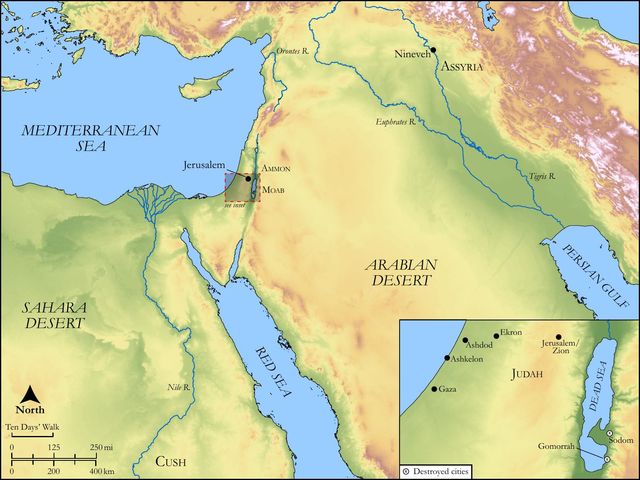
See on the biblical-era map
Study this verse
Public-domain commentary
Matthew Henry
From his Commentary on the Whole Bible. Henry comments on passages, not single verses — this entry covers Zephaniah 1:14–18. His two-level outline is real structure in the source text, so it is rendered as structure.
Nothing could be expressed with more spirit and life, nor in words more proper to startle and awaken a secure and careless people, than the warning here given to Judah and Jerusalem of the approaching destruction by the Chaldeans. That is enough to make the sinners in Zion tremble - that it is the day of the Lord, the day in which he will manifest himself by taking vengeance on them. It is the great day of the Lord, a specimen of the day of judgment, a kind of doom's-day, as the last destruction of Jerusalem by the Romans is represented to be in our Saviour's prediction concerning it, Mat 24:27.
I.This day of the Lord is here spoken of as very near.
The vision is not for a great while to come, as those imagine who put the evil day far from them. Those deceive themselves who look upon it as a thing at a distance, for it is near - it is near - it hastens greatly. The prophet gives the alarm like one that is in earnest, like one that awakens a family with the cry of Fire! fire! when it is at the next door that the danger is: "It is near! it is near! and therefore it is high time to bestir yourselves, and do what you can for your own safety before it be too late." It is madness for those to slumber whose damnation slumbers not, and to linger when it hastens.
II.It is spoken of as a very dreadful day.
The very voice of this day of the Lord, the noise of it, when it is coming, shall be so terrible as to make the mighty men cry there bitterly, cry for fear as children do. It shall be a vexation to hear the report of it. In the last great day of the Lord the mighty men shall cry bitterly to rocks and mountains to shelter them; but in vain. Observe how emphatically the prophet speaks of this day approaching (Zep 1:15): It is a day of wrath, God's wrath, wrath in perfection, wrath to the utmost. It will be a day of trouble and distress to the sinners; they shall be in pain, and shall see no ways of easing or helping themselves. The miseries of the damned are summed up (perhaps with reference to this) in the indignation and wrath of God, which are the cause, and the tribulation and anguish of the sinner's soul, which are the effect, Rom 2:8, Rom 2:9. It will be a day of trouble and distress to the inhabitants, and a day of wasteness and desolation to the whole land; that fruitful land shall be turned into a wilderness. It shall be a day of darkness and gloominess; every thing shall look dismal, and there shall not be the least gleam of comfort, or glimpse of hope; look round, and it is all black. It is a day of clouds and thick darkness; there is not only nothing encouraging, but every thing threatening; the thick clouds are big with storms and tempests.
III.It is spoken of as a destroying day, Zep 1:16, Zep 1:17. It shall be destroying,
1.To places, even the strongest and best fortified: A day of the trumpet and alarm against the fenced cities, to break into them, and against the high towers, to bring them down; for what forts, what fences, can hold out against the wrath of God?
2.To persons (Zep 1:17): "I will bring distress upon men, the strongest and stoutest of men; their hearts and hands shall fail them; they shall walk like blind men, wandering endlessly, because they have sinned against the Lord." Note, Those that walk as bad men will justly be left to walk as blind men, always in the dark, in doubt and danger, without any guide or comfort, and falling at length into the ditch. Because they have sinned against the Lord he will deliver them into the hands of cruel enemies, that shall pour out their blood as dust, so profusely, and with as little regret, and their flesh shall be thrown as dung upon the dunghill.
IV.The destruction of that day will be unavoidable and universal, Zep 1:18.
1.There shall be no escaping it by ransom: Neither their silver nor their gold, which they have hoarded up so covetously against the evil day, or which they have spent so prodigally to make friends for such a time, shall be able to deliver them in the day of the Lord's wrath. Another prophet borrowed these words from this, with reference to the same event, Eze 7:19. Note, Riches profit not in the day of wrath, Pro 11:4. Nay, riches expose to the wrath of men (Ecc 5:13.), and riches abused to the wrath of God.
2.There shall be no escaping it by flight or concealment; for the whole land shall be devoured by the fire of his jealousy, and where then can a hiding-place be found? See what the fire of God's jealousy is, and what the force of it; it will devour whole lands; how then can particular persons stand before it? He shall make riddance, a speedy riddance, of all those that dwell in the land, as the husbandman, when he rids his ground, cuts up all the briers and thorns for the fire. Note, Sometimes the judgments of God make riddance, even utter riddance, with sinful nations, a speedy riddance; their destruction is effected, is completed, in a little time. Let not sinners be laid asleep by the patience of God, for when the measure of their iniquity is full his justice will both overtake and overcome, will make quick work and thorough work.
Historical interpretation
Two Centuries of Reception
2 surviving comments on this verse. Each one is dated, so this reads as a timeline rather than a list.
Select a marker to jump to its quote. Markers stagger vertically where authors wrote within a few decades of each other.
I am weary and vexed at enumerating the multitude of ornaments, and I am compelled to wonder how those who bear such a burden are not worried to death. O foolish trouble! O silly craze for display! They squander meretriciously wealth on what is disgraceful and in their love for ostentation disfigure God’s gifts, emulating the art of the evil one. The rich man hoarding up in his barns and saying to himself, “You have many goods laid up for many years; eat, drink be merry,” the Lord in the Gospels plainly called “fool.” “For this night they shall take your soul; whose then shall those things which you have prepared be?” Apelles, the painter, seeing one of his pupils painting a figure loaded with gold color to represent Helen, said to him, “Boy, being incapable of painting her beautiful, you have made her rich.” Such Helens are the ladies of the present day, not truly beautiful but richly got up. To these the Spirit prophesies by Zephaniah: “And their silver and their gold shall not be able to deliver them in the Day of the Lord’s anger.” But for those women who have been trained under Christ, it is suitable to adorn themselves not with gold but with the Word, through whom alone the gold comes to light.
(Verse 17, 18.) And I will trouble the people, and they shall walk as blind, because they have sinned against the Lord: and their blood shall be poured out like dust, and their bodies like dung; but their silver and gold shall not be able to save them in the day of the Lord's wrath, and all the earth shall be devoured by the fire of his zeal: for he will make a speedy consumption of all the inhabitants of the earth. LXX: And I will trouble the people, and they shall walk as blind, because they have sinned against the Lord, and he shall pour out their blood like dust, and their flesh like the dung of oxen; and their silver and their gold shall not be able to deliver them in the day of the Lord's anger, and all the earth shall be consumed by the fire of his zeal: for he will make a speedy and complete destruction upon all the inhabitants of the earth. It is not difficult to say, according to the previous meaning, that Jerusalem, which endured because of the cross of the Lord, has suffered: for the visitation of the Lord has departed from it, and all men in Judea have been troubled, and because of the greatness of the affliction they have walked like blind men, not knowing what to do. And they have suffered this because they have sinned against the Lord, that is, against the Son of God. For because they have shed the blood of the prophets and the blood of Christ, their blood has been poured out like the earth in the whole region, and their bodies have remained unburied, like dung upon the face of the earth. Those who amassed great wealth through excessive greed, hoarding silver and gold, were unable to free themselves from the wrath of the Lord on the day of judgment. For the fire of the Lord's zeal burned against them and consumed the entire province. And there was no respite in their midst, for forty-two years after the crucifixion of the Lord, Jerusalem was surrounded by an army and its downfall came swiftly, not only for Jerusalem but also for all the inhabitants of the land of Judaea. But in the end, whether of the world or of each individual, all men who remained as men will be troubled, and the dead will be like men. And they will walk as blind, for they have lost the light of virtues, and they will not have a place for repentance: and they will suffer these things because they have sinned against the Lord. For if the Lord is justice, truth, holiness, and other virtues, whoever has acted unjustly, lied, and pursued vice and sins, has sinned against the Lord. But what follows, 'And their blood will be poured out like the earth, and their bodies like the dung of bulls,' seems absurd, that in the resurrection of the dead and in the consummation of the world and judgement, we should say that blood is poured out and bodies lie like dung. Therefore, what is said to Noah, 'And I will require the blood of your lives from the hand of every beast, and from the hand of man, and from the hand of his brother I will require the life of man, who sheds the blood of man: by man shall his blood be shed' (Gen. IX, 5, 6), it is ridiculous to believe this in the resurrection, and it cannot hold true in this life. For how many have shed blood, and their blood has not been shed? And others have killed a man with poison or hanging, and yet when the man is dead, no blood has been shed? Therefore, how is the Lord going to shed their blood in vengeance when the one who kills has not shed blood? Therefore, the blood of man, which is the vital principle by which he is nourished, sustained, and lives, must be understood: whoever sheds it, either through scandal or perverse doctrine, will be poured out by him on the day of judgment, that is, what he seemed to have as vital, he will be forced to lose. According to this kind of blood, and flesh is understood, of which Isaiah says: All flesh is grass (Isa. XL, 6). And in Genesis the Lord said: My spirit shall not remain in these men, because they are flesh (Gen. VI, 3). And the Apostle, speaking of both: Flesh and blood cannot possess the kingdom of God: neither will corruption inherit incorruption of God (Al. God is silent) (I Cor. XV, 50). Therefore, on the day of consummation, whether general or specific, all blood that has been shed will cry out to the Lord, and it will appear in the midst, and the works of blood and earthly things will lie as dust and filth, and the rich, with their silver and gold, will not be able to free themselves on the day of wrath, with him who is dying hearing: Fool, this night your soul will be taken from you; and what you have prepared, whose will it be (Luke XII, 20)? Not that we deny that the rich can be saved from death by gold and silver; for the redemption of a man's soul is his own wealth (Prov. XIII, 8); but rather that they cannot be saved at that time when they must forsake their riches out of necessity. For all the earth and everything that is earthly will be devoured by the zeal of the Lord. And when he says 'zeal,' understand that he is still speaking of one who loves the Lord. For if he did not love the human soul, he would never be zealous for it; and, in the likeness of a husband, he would avenge the sin of his wife, whom he would not be angry with if he did not love her. And the Lord will do this with haste for all the inhabitants of the earth, those who have completely devoted themselves to the earth and are not strangers or foreigners, as the righteous one who speaks: I am a stranger in the land, and a foreigner like all my ancestors (Ps. XXXVIII, 13). And again, elsewhere, not wanting to dwell any longer in the tent of the flesh, he testifies with tearful voice, saying: Woe is me, for my journey has been prolonged (Ps. CXIX, 5). For we who are in this body's tabernacle, groan and lament: Miserable wretch that I am, who will deliver me from this body of death? (Rom. VII, 24)?
Continue studying Zephaniah 1:18 across the web’s major study libraries — every link below opens this exact verse, chapter, or book on the destination site.
Read & Compare
 BibleGatewayThis verse in more than 200 translations and 70 languages.
 Bible.comThe YouVersion reader — hundreds of translations, reading plans, and highlights.
 ESV.orgCrossway's official English Standard Version reader.
 NET BibleThe NET translation with 60,000+ translators' notes on every rendering decision.
 STEP BibleTyndale House's free study tool — original text, vocabulary, and scholarly resources.
 BibliaLogos Bible Software's free web reader.
 USCCBThe New American Bible (Revised Edition) with the U.S. bishops' study notes.
Commentaries
 BibleHub CommentariesDozens of classic commentaries on this verse, gathered on one page.
 StudyLightMore than 100 commentary sets — the largest collection on the web.
 BibleRefPlain-English commentary on what this verse means, verse by verse.
 Enduring WordDavid Guzik's free commentary on this chapter, widely used by Bible teachers.
 Bible Study ToolsVerse commentary alongside Greek and Hebrew study aids.
Original Language & Research
- BibleHub InterlinearThe verse word by word — original language, transliteration, and English.
- BibleHub LexiconEvery word's original-language definition and Strong's entry.
 Blue Letter BibleDeep-study tools — Strong's numbers, concordance, and word studies.
 SefariaThe Hebrew text with Rashi and centuries of Jewish commentary.
Sermons, Hymns & Audio


TrulyRandomVerse is not affiliated with these sites and doesn’t control their content. They’re linked because they’re genuinely useful.
Summary
Zephaniah 1:18 delivers a stark and unyielding pronouncement of divine judgment, emphasizing the absolute inability of material wealth—silver or gold—to provide deliverance in the face of God's impending wrath. The verse vividly portrays a comprehensive and consuming judgment, where the entire land will be devoured by the fire of God's zealous jealousy, culminating in a swift and decisive eradication of all its inhabitants. It underscores the futility of human reliance on worldly possessions when confronted with the holy and righteous indignation of the Almighty.
Context
ShowHideLiterary Context
Zephaniah 1:18 concludes the first major section of Zephaniah's prophecy (Zephaniah 1:2-18), which is a sweeping declaration of the coming "Day of the LORD." This section meticulously details the universal scope and devastating nature of God's judgment, beginning with a promise to "utterly consume all things from off the land" (Zephaniah 1:2) and progressively narrowing its focus to Judah and Jerusalem. Verses 14-16 graphically describe the Day as "a day of wrath, a day of trouble and distress, a day of wasteness and desolation, a day of darkness and gloominess, a day of clouds and thick darkness, a day of the trumpet and alarm against the fenced cities, and against the high towers." Verse 17 then explains why this judgment is coming: "I will bring distress upon men, that they shall walk like blind men, because they have sinned against the LORD." Thus, verse 18 serves as a powerful climax, definitively stating the futility of any human attempt to escape this divinely ordained catastrophe, specifically highlighting the uselessness of wealth.
Historical & Cultural Context
Zephaniah prophesied during the reign of King Josiah (c. 640-609 BC), a period marked by profound spiritual decline in Judah despite Josiah's later efforts at religious reform. The nation was steeped in idolatry, syncretism, and oppression, having adopted pagan practices from surrounding nations and even within the temple precincts (Zephaniah 1:4-6). Material wealth, often accumulated through unjust means, was highly valued, and people likely trusted in their riches and fortified cities for security. Zephaniah's message directly confronts this misplaced trust, warning a people who had become complacent in their sin, believing their economic prosperity or political alliances would protect them from divine reckoning. The prophet's urgent tone reflects the imminent threat of invasion, likely from the Scythians or the rising Babylonian empire, which God would use as instruments of His judgment.
Key Themes
ShowHideThis verse powerfully contributes to several overarching themes in Zephaniah and the broader prophetic literature. Foremost is the theme of The Day of the LORD, which Zephaniah emphasizes more intensely than almost any other prophet. It is portrayed as a day of unparalleled divine intervention, bringing both judgment and, eventually, restoration. The verse also highlights the Futility of Idolatry and Materialism, asserting that neither pagan gods nor earthly riches can deliver from God's righteous anger, contrasting sharply with the false security offered by wealth, a theme also explored in Proverbs 11:4. Furthermore, it underscores God's Sovereignty and Justice, demonstrating His absolute control over human affairs and His unwavering commitment to punish sin. Finally, the mention of God's "jealousy" (H7068, qinʼâh) introduces the theme of God's Zealous Holiness, indicating His passionate intolerance for anything that compromises His glory or His covenant relationship with His people, a characteristic seen from Deuteronomy 4:24 onwards.
Exposition and Analysis
ShowHideKey Word Analysis
ShowHideA primitive root meaning "to snatch away, whether in a good or a bad sense." Here, it signifies the inability of silver or gold to rescue, preserve, or save the people from the impending judgment. It implies a forceful removal from danger, which material possessions are utterly incapable of providing against divine wrath.
A feminine noun meaning "an outburst of passion; anger, rage, wrath." This term describes the intense, overflowing indignation of God, indicating a righteous and consuming anger against sin and rebellion. It is not a capricious human emotion but a holy response to unholiness.
Meaning "jealousy or envy; zeal." In the context of God, this is not a negative emotion of insecurity but a zealous passion for His own honor, holiness, and exclusive right to the worship and devotion of His people. It is a protective, covenantal jealousy that burns against anything that would defile His relationship with His chosen nation, leading to a consuming judgment against idolatry and unfaithfulness.
Verse Breakdown
ShowHide"Neither their silver nor their gold shall be able to deliver them in the day of the LORD'S wrath;"
This opening clause immediately establishes the central message: material wealth, despite its perceived power and security in human society, is utterly impotent against the coming divine judgment. "The day of the LORD'S wrath" refers to a specific, decisive period of God's intervention, characterized by His righteous indignation and punishment of sin. The phrase "shall be able to deliver them" (using H3201 yâkôl "to be able" and H5337 nâtsal "to deliver") underscores the complete lack of capacity for human resources to avert or mitigate this divine reckoning.
"but the whole land shall be devoured by the fire of his jealousy:"
This clause shifts from what cannot deliver to what will happen. The judgment is portrayed as comprehensive ("the whole land," H776 ʼerets), indicating its widespread and inescapable nature. The imagery of being "devoured" (H398 ʼâkal, meaning to eat or consume) by "fire" (H784 ʼêsh) emphasizes the destructive and consuming power of God's judgment. This destructive fire is explicitly linked to God's "jealousy" (H7068 qinʼâh), revealing the divine motivation behind the judgment: His passionate commitment to His own holiness and His intolerance for the idolatry and unfaithfulness of His people.
"for he shall make even a speedy riddance of all them that dwell in the land."
This final clause provides the reason ("for") and further details the nature of the judgment. God Himself is the active agent ("he shall make," H6213 ʻâsâh). The phrase "speedy riddance" (H926 bâhal "to hasten anxiously" and H3617 kâlâh "completion, destruction") conveys both the swiftness and the totality of the divine action. It signifies a decisive and complete end, leaving no survivors among those who "dwell in the land" (H3427 yâshab), implying a thorough purging of the unrighteous inhabitants.
Literary Devices
ShowHideZephaniah 1:18 is rich in literary devices that amplify its urgent and severe message. Metaphor is prominently used in "the fire of his jealousy," where God's intense, righteous indignation is likened to a consuming fire, emphasizing its destructive and purifying power. This fire also employs Personification, as "jealousy" is given an active, consuming quality, acting as an agent of judgment. The phrase "the whole land shall be devoured" uses Hyperbole to underscore the comprehensive and inescapable nature of the impending judgment, suggesting a devastation so widespread that it affects every part of the territory. Furthermore, there is a stark Antithesis presented between the perceived power of "silver nor their gold" and the ultimate, irresistible power of "the LORD'S wrath" and "his jealousy," highlighting the futility of human resources against divine decree. The cumulative effect of these devices is to create a vivid and terrifying picture of God's unyielding justice.
Theological and Thematic Connections
ShowHideZephaniah 1:18 stands as a profound theological statement on the nature of divine judgment and the utter inadequacy of human efforts or material possessions to withstand it. It reveals God's absolute sovereignty and His unwavering commitment to justice and holiness. The "Day of the LORD'S wrath" is not merely a historical event but a recurring biblical motif signifying a time when God intervenes decisively in human history to judge sin and establish His righteousness. This verse emphasizes that God's "jealousy" is not a flaw but an attribute of His holy character—a zealous love for His covenant people that demands exclusive devotion and reacts with righteous indignation against idolatry and unfaithfulness. It serves as a timeless warning against placing ultimate trust in anything other than God Himself, reminding humanity that true security and deliverance are found only in Him.
Reflection and Application
ShowHideZephaniah 1:18 confronts us with a timeless truth that resonates deeply in every generation: the ultimate futility of placing our security and hope in material wealth or any earthly power when confronted with the reality of divine judgment. In a world that often measures success and security by financial accumulation, this verse serves as a stark and necessary corrective. It challenges us to honestly assess where our true trust lies. Do we subtly believe that our savings, investments, or possessions will protect us from life's ultimate challenges or even from divine accountability? The "Day of the LORD" can be understood not only as a specific historical judgment on Judah but also as a prophetic archetype for future divine reckonings, culminating in the final judgment described in the New Testament. Therefore, the practical application is profoundly spiritual: it calls for a reorientation of our priorities, a radical shift from earthly treasures to eternal ones, and a humble acknowledgment of God's absolute sovereignty and holiness. It compels us to live in a manner that reflects our understanding that only God can deliver, and only His mercy can save.
Questions for Reflection
ShowHideFAQ
ShowHideWhat is "the day of the LORD'S wrath" mentioned in Zephaniah 1:18?
ShowHide"The Day of the LORD" is a recurring and significant theological concept throughout the Old Testament prophets, particularly emphasized in Zephaniah. It refers to a specific time when God decisively intervenes in human history to execute judgment upon His enemies and bring about His righteous purposes. In Zephaniah's context, it primarily refers to the imminent judgment upon Judah and Jerusalem for their idolatry and sin, often executed through foreign invaders. However, it also carries eschatological implications, foreshadowing a future, ultimate day of divine reckoning for all humanity, as seen in passages like Joel 2:31. It is characterized by divine wrath, destruction, and the vindication of God's holiness, often described with imagery of the heavens darkened.
Why is God described as having "jealousy" in this verse, and what does it mean?
ShowHideWhen the Bible describes God as "jealous" (Hebrew: qinʼâh), it is crucial to understand this attribute in a theological sense, distinct from human envy or insecurity. God's jealousy is a holy and righteous passion for His own glory, His covenant relationship with His people, and His exclusive right to worship. It signifies His intolerance for idolatry, spiritual unfaithfulness, and anything that infringes upon His unique divine authority. In Zephaniah 1:18, God's "jealousy" is the driving force behind His consuming judgment; it is His zealous commitment to His own holiness that compels Him to act against the sin that defiles His people and dishonors His name. This attribute is foundational to His character, as declared in Exodus 34:14, "for the LORD, whose name is Jealous, is a jealous God."
Christ-Centered Fulfillment
ShowHideZephaniah 1:18, with its stark warning of a comprehensive judgment from which no earthly wealth can deliver, finds its ultimate fulfillment and profound counterpoint in the person and work of Jesus Christ. The "Day of the LORD'S wrath" that Zephaniah prophesied points forward to the greater, final judgment that all humanity will face. However, unlike the futility of silver and gold in Zephaniah's day, God has provided the perfect and eternal means of deliverance through His Son. Jesus, as the Lamb of God who takes away the sin of the world, bore the full "fire of his jealousy" and "wrath" on the cross, becoming the propitiation for our sins (see Romans 3:25 and 1 John 4:10). Through His sacrifice, those who trust in Him are "delivered from the wrath to come" (1 Thessalonians 1:10). The "speedy riddance of all them that dwell in the land" for the unrighteous is transformed into the promise of eternal life and deliverance for those who are "in Christ Jesus" (Romans 8:1). Thus, Zephaniah 1:18, while a terrifying prophecy of judgment, ultimately magnifies the unparalleled grace and power of Christ, who alone is able to deliver us from the wrath of God and secure for us an eternal inheritance that no earthly treasure could ever buy, urging us to store up treasures in heaven where they are safe from any earthly destruction or divine judgment.