


Zephaniah 1:3
Bible text: King James Version (1769 Blayney text) · Public domain
Bible text: King James Version with Strong's numbers · Public domain
Bible text: Berean Standard Bible · Public domain
Bible text: American Standard Version (1901) · Public domain
Bible text: World English Bible, Messianic edition · Public domain
Bible text: Geneva Bible (1599) · Public domain
Bible text: Young's Literal Translation · Public domain
- אָסֵף'a·SefI will bring to an endH5486V-Qal-Prtcpl-msVerb Qal Participle Singular Masculine Absolute
- אָדָם'a·Damhuman beingH120N-msNoun Singular Masculine Absolute
- וּבְהֵמָהu·ve·he·Mahand animalH929Conj-w ¦ N-fsNoun Singular Feminine Absoluteוּandבְהֵמָהanimal
- אָסֵף'a·SefI will bring to an endH5486V-Qal-Prtcpl-msVerb Qal Participle Singular Masculine Absolute
- עוֹף'of[the] bird[s] ofH5775N-mscNoun Singular Masculine Construct
- הַשָּׁמַיִםha·sha·Ma·yimthe heavensH8064Art ¦ N-mpNoun Plural Masculine Absoluteהַtheשָּׁמַיִםheavens
- וּדְגֵיu·de·Geiand [the] fish<es> ofH1709Conj-w ¦ N-mpcNoun Plural Masculine Constructוּandדְגֵי[the] fish<es> of
- הַיָּםhai·Yamthe seaH3220Art ¦ N-msNoun Singular Masculine Absoluteהַtheיָּםsea
- וְהַמַּכְשֵׁלוֹתve·ha·makh·she·Lotand the stumbling-blocksH4384Conj-w ¦ Art ¦ N-fpNoun Plural Feminine Absoluteוְandהַtheמַּכְשֵׁלוֹתstumbling-blocks
- אֶת'etwithH854PrepPreposition
- הָרְשָׁעִיםha·re·sha·'Imthe wicked [people]H7563Art ¦ N-mpNoun Plural Masculine Absoluteהָtheרְשָׁעִיםwicked [people]
- וְהִכְרַתִּיve·hikh·ra·Tiand I will cut offH3772Conj-w ¦ V-Hiphil-ConsecPerf-1csVerb Hiphil Consecutive Perfect 1st Singular common genderוְandהִכְרַתִּיI will cut off
- אֶת'et<obj.>H853DirObjMParticle Object Indicator
- הָאָדָםha·'a·Dam<the> humankindH120Art ¦ N-msNoun Singular Masculine Absoluteהָ<the>אָדָםhumankind
- מֵעַלme·'Alfrom onH5921Prep-m ¦ PrepPrepositionמֵfromעַלon
- פְּנֵיpe·Nei[the] surface ofH6440N-mpcNoun Plural Masculine Construct
- הָאֲדָמָהha·'a·da·Mahthe groundH127Art ¦ N-fsNoun Singular Feminine Absoluteהָtheאֲדָמָהground
- נְאֻםne·'um[the] utterance ofH5002N-mscNoun Singular Masculine Construct
- יְהוָהYah·wehYahwehH3068N-properNoun Proper Title
English is a literal word-by-word gloss of the Hebrew, not the KJV's wording. Why?
This is the original text the KJV's translators worked from — each Hebrew word with its own literal English meaning in this verse, prepared by scholars at Tyndale House, Cambridge. The KJV translates whole sentences, not word by word, so its wording differs: one Hebrew word can become several English words, and the KJV may choose “the LORD” where the gloss reads “Yahweh”. Both are faithful — they answer different questions. For the KJV's own rendering, switch to the KJV text.
Details
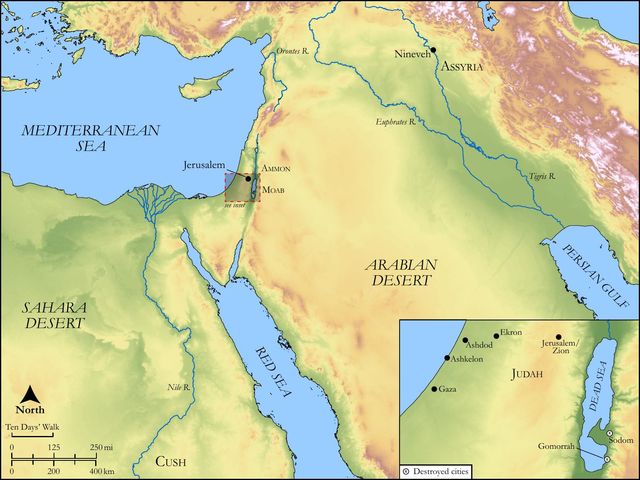
See on the biblical-era map
Study this verse
Public-domain commentary
Matthew Henry
From his Commentary on the Whole Bible. Henry comments on passages, not single verses — this entry covers Zephaniah 1:1–6. His four-level outline is real structure in the source text, so it is rendered as structure.
Here is, I. The title-page of this book (Zep 1:1), in which we observe, 1. What authority it has, and who gave it that authority; it is from heaven, and not of men: It is the word of the Lord. 2. Who was the instrument of conveying it to the church. His name was Zephaniah, which signifies the servant of the Lord, for God revealed his secrets to his servants the prophets. The pedigree of other prophets, whose extraction we have an account of, goes no further back than their father, except Zecharias, whose grandfather also is named. But this of Zephaniah goes back four generations, and the highest mentioned is Hizkiah; it is the very same name in the original with that of Hezekiah king of Judah (Kg2 18:1), and refers probably to him; if so, our prophet, being lineally descended from that pious prince, and being of the royal family, could with the better grace reprove the folly of the king's children as he does, Zep 1:8. 3. When this prophet prophesied - in the days of Josiah king of Judah, who reigned well, and in the twelfth year of his reign began vigorously, and carried on a work of reformation, in which he destroyed idols and idolatry. Now it does not appear whether Zephaniah prophesied in the beginning of his reign; if so, we may suppose his prophesying had a great and good influence on that reformation. When he, as God's messenger, reproved the idolatries of Jerusalem, Josiah, as God's vice-regent, removed them; and reformation is likely to go on and prosper when both magistrates and ministers do their part towards it. If it were towards the latter end of his reign that he prophesied, we sadly see how a corrupt people relapse into their former distempers. The idolatries Josiah had abolished, it should seem, returned in his own time, when the heat of the reformation began a little to abate and wear off. What good can the best reformers do with a people that hate to be reformed, as if they longed to be ruined?
II.The summary, or contents, of this book.
The general proposition contained in it is, That utter destruction is coming apace upon Judah and Jerusalem for sin. Without preamble, or apology, he begins abruptly (Zep 1:2): By taking away I will make an end of all things from off the face of the land, Saith the Lord. Ruin is coming, utter ruin, destruction from the Almighty. He has said it who can, and will, make good what he has said: "I will utterly consume all things. I will gather all things" (so some); "I will recall all the blessings I have bestowed, because they have abused them and so forfeited them." The consumption determined shall take away,
1.The inferior creatures: I will consume the beasts, the fowls of the heaven, and the fishes of the sea (Zep 1:3), as, in the deluge, every living substance was destroyed that was upon the face of the ground, Gen 7:23. The creatures were made for man's use, and therefore when he has perverted the use of them, and made them subject to vanity, God, to show the greatness of his displeasure against the sin of man, involves them in his punishment. The expressions are figurative, denoting universal desolation. Those that fly ever so high, as the fowls of heaven, and think themselves out of the reach of the enemies' hand - those that hide ever so close, as the fishes of the sea, and think themselves out of the reach of the enemies' eye - shall yet become a prey to them, and be utterly consumed.
2.The children of men: "I will consume man; I will cut off man from the land. The land shall be dispeopled and left uninhabited; I will destroy, not only Israel, but man. The land shall enjoy her sabbaths. I will cut off, not only the wicked men, but all men; even the few among them that are good shall be involved in this common calamity. Though they shall not be cut off from the Lord, yet they shall be cut off from the land." It is with Judah and Jerusalem that God has this quarrel, both city and country, and upon them he will stretch out his hand, the hand of his power, the hand of his wrath; and who knows the power of his anger? Zep 1:4. Those that will not humble themselves under God's mighty hand shall be humbled and brought down by it. Note, Even Judah, where God is known, and Jerusalem, where his dwelling-place is, if they revolt from him and rebel against him, shall have his hand stretched out against them.
3.All wicked people, and all those things that are the matter of their wickedness (Zep 1:3): "I will consume the stumbling-blocks with the wicked, the idols with the idolaters, the offences with the offenders." Josiah had taken away the stumbling-blocks, and, as far as he could, had purged the land of the monuments of idolatry, hoping that there would be no more idolatry; but the wicked will do wickedly, the dog will return to his vomit, and therefore, since the sin will not otherwise be cured, the sinners must themselves be consumed, even the wicked with the stumbling-blocks of their iniquity, Eze 14:3. Since it was not done by the sword of justice, it shall be done by the sword of war. See who the sinners are that shall be consumed.
(1.)The professed idolaters, who avowed idolatry, and were wedded to it. The remnant of Baal shall be cut off, the images of Baal, and the worshippers of those images. Josiah cut off a great deal of Baal; but that which was so close as to escape the eye, or so bold as to escape the hand, of his justice, God will cut off, even all the remains of it. The Chaldeans would spare none of the images of Baal, or the worshippers of those images. The Chemarim shall be cut off; we read of them in the history of Josiah's reformation. Kg2 23:5, He put down the idolatrous priests: the word is the Chemarim. The word signifies black men, some think because they wore black clothes, affecting to appear grave, others because their faces were black with attending the altars, or the fires in which they burnt their children to Moloch. They seem to have been immediate attendants upon the service of Baal. They shall be cut off with the priests, the regulars with the seculars. The very name of them shall be cut off; the order shall be quite abolished, so as to be forgotten, or remembered with detestation. And, among other idolaters, the worshippers of the host of heaven upon the house-tops shall be cut off (Zep 1:5), who justified themselves in their idolatry with those that did not worship images, the work of their own hands, but offered their sacrifices and burnt their incense to the sun, moon, and stars, immediately upon the tops of their houses. But God will let them know that he is a jealous God, and will not endure any rival; and, though some have thought that the most specious and plausible idolatry, yet it will appear as great an offence to God to give divine honours to a star as to give them to a stone or a stock. Even the worshippers of the host of heaven shall be consumed as well as the worshippers of the beasts of the earth or the fiends of hell. The sin of the adulteress is not the less sinful for the gaiety of the adulterer.
(2.)Those also shall be consumed that think to compound the matter between God and idols, and keep an even hand between them, that halt between God and Baal, and worship between Jehovah and Moloch, and swear by both; or, as it might better be read, swear to the Lord and to Malcham. They bind themselves by oath and covenant to the service both of God and idols. They have a good opinion of the worship of the God of Israel; it is the religion of their country, and has been long so, and therefore they will by no means quit it; but they think it will be very much improved and beautified if they join with it the worship of Moloch, for that also is much used in other countries, and travellers admire it; there is a great deal of good fancy and strong flame in it. They cannot keep always to the worship of a God whom they have no visible representation of, and therefore they must have an image; and what better than the image of Moloch - a king? They think they shall effectually atone for their sin if they swear to Moloch, and, pursuant to that oath, burn their children in sacrifice to that idol; and yet, if they do amiss in that, they hope to atone for it in worshipping the God of Israel too. Note, Those that think to divide their affections and adorations between God and idols will not only come short of acceptance with God, but will have their doom with the worst of idolaters; for what communion can there be between light and darkness, Christ and Belial, God and mammon? She whose own the child is not pleads for the dividing of it, for, if Satan have half, he will have all; but the true mother says, Divide it not, for, if God have but half, he will have none. Such waters will not be long sweet, if they come from a fountain that sends forth bitter water too; what have those to do to swear by the Lord that swear by Malcham?
(3.)Those also shall be consumed that have apostatized from God, together with those that never gave up their names to him, Zep 1:6. I will cut off,
[1.]Those that are turned back from the Lord, that were well taught, and began well, that had given up their names to him, and set out at first in the worship of him, but have flown off, and turned aside, and fallen in with idolaters, and deserted those good ways of God which they were brought up in, and despised them. Those God will be sure to reckon with who are renegadoes from his service, who began in the Spirit and ended in the flesh; they shall be treated as deserters, to whom no mercy is shown.
[2.]Those that have not sought the Lord, nor ever enquired for him, never made any profession of religion, and think to excuse themselves with that, shall find that this will not excuse them; nay, this is the thing laid to their charge; they are atheistical careless people, that live without God in the world; and those that do so are certainly unworthy to live upon God in the world.
Historical interpretation
Historical reception
1 surviving comment on this verse from the historical church.
(Verse 2, 3.) Gathering I will gather all from the face of the earth, says the Lord, gathering man and beast, gathering the birds of the sky, and the fish of the sea: and the ruins of the wicked will be, and I will destroy men from the face of the earth, says the Lord. LXX: They will fail from the face of the earth, says the Lord: man and beast will fail: the birds of the sky and the fish of the sea will fail ÷ and the wicked will be weakened, and I will remove the unjust from the face of the earth, says the Lord. What we have placed in the Septuagint, and the wicked will be weakened, was added from Theodotion's translation: for which Symmachus interpreted, and the stumbling blocks with the wicked, so that it is understood, will be gathered, or will fail. But the fifth edition, the weakness will fail with the wicked. Therefore, following our custom, we must first relate the history, and afterwards debate about the higher things. For it is beyond doubt that the final kingdom of the two tribes, which were called Judah and Benjamin, was under Josiah. For, with him being killed, his sons who later reigned and his grandsons should not be believed to have ruled so much as to have been mocked by the Egyptian king and the Chaldeans and various captivities and tortures. Therefore, because the people were able to excuse themselves in the face of wicked kings and say, 'We want to serve God, but we are prohibited by the kings,' a just king is given, who zealously seeks the zeal of the Lord, and yet the people persist in the worship of idols. Thus, a just cause for anger is brought forth by the Lord, and the destruction of Jerusalem and the captivity of Judah and the victory of Nebuchadnezzar are prophesied. And the Lord said through the prophet: I will no longer show mercy; instead I will consume everything on the face of the earth: no man, no beast, no bird, no fish of the sea will remain. For even the animals feel the anger of the Lord; and with cities destroyed and people killed, a desolation and scarcity of beasts, birds, and fish also occurs, as witness is Illyricum, witness is Thrace, witness is where I was born, a land where everything, except the sky and the earth and the growing thorns, and the thickets of the forests, has perished. However, as the prophet says, this will happen because there was an excessive multitude of the wicked. Therefore, the wicked will fall and people will be scattered, and there will be desolation upon the face of the earth. But we can also understand this as referring to the end of the world: both humans, animals, birds, fish of the sea, and everything will fail and weaken, and the wicked will be weakened, and iniquity will be removed from the face of the earth. And if we want to understand something deeper (because it is also said in the Septuagint, 'Defection will fail from the face of the earth'), we can take the defection in a positive sense according to this: 'And Abraham died in a good old age, an old man and full of days, and was gathered to his people' (Genesis 25:8), and we see how those who are of the descendants of Isaac and Jacob fulfill this by defection from the world, in accordance with the command: 'For our conversation is in heaven; from whence also we look for the Saviour, the Lord Jesus Christ' (Philippians 3:20). But if someone opposes this which we have accepted in a positive way, let him perish by defection from the face of the earth, that which is written about Ishmael: These are the years of the life of Ishmael, one hundred and thirty-seven, and he died in defection, and he was assigned to his own tribe (Gen. XXV, 17): we will first respond to him that Ishmael is the son of Abraham, and he received gifts and portions from his father, according to his measure: then, it is absolutely written, he died in defection, and it is not added (as it is written about Abraham) in a good old age, an old man and full of days, and he was assigned to his people. Concerning Isaac: Now the days of Isaac's life were one hundred and eighty-five years. And Isaac grew weak and died, and he was gathered to his people, an old man and full of days (Genesis 35:28-29). Also concerning Jacob: And Jacob ceased commanding his sons, and drawing up his feet onto the bed, he grew weak and was gathered to his people (Genesis 49:33). From this we understand that there is a difference between simply growing weak and having many virtues together with weakness. But what he had first said in a general way, let man fall away from the face of the earth; afterwards scripture divided it into parts, let man fall away, and let the beasts, let the birds of the sky fall away, and let the fish of the sea. There are four things which are commanded to fall away, first rational man, then the three things which are subject to man, the beasts, and the birds, and the fish which I think are also mentioned in the eighth psalm: Also the animals of the field, the birds of the sky and the fish of the sea, which travel the paths of the sea (Psalm VIII, 8). But that which he first said, he separated all the sheep and cattle, as if they were the principal of the livestock, and he did not want to count the remaining livestock with them. Let man fail, let the livestock fail, let the birds of the sky fail, let the fish fail; and he did not say, let the beasts fail, let the reptiles of the earth fail. For these should not fail, but perish; but let those things fail which can have correction. How the feminine qualities of Sarah failed, and Abraham is commanded to listen to whatever Sarah commands. Who fails as a human, if he despises human things, and does not die anymore as a human, and listens: I said, you are gods. Another fails as an animal, who, when ascending to higher things, is not accused in prophetic speech: Man, when he was in honor, did not understand, he was compared to foolish animals, and became like them. He departs like the fleeting heaven, who makes wings for himself like an eagle, and returns to the house of his rich teacher, leaving all poverty behind (Prov. XXIII). He departs like a fish of the sea, who, caught in the nets of the Lord, is separated from the good fishes (Matt. XIII). When these things are done according to the commandment of the Lord, the wicked will be weakened, not having as much strength as before. And the unjust will be removed, not said to be killed, but removed, so that, having been converted to better things, from impiety and injustice, they may begin to be what they were not before: pious and just. This is according to allegory. For we must also include the interpretation of the Ancients. Now it will be in the reader's discretion whether they wish to convey severity or clemency in what has been said.
Continue studying Zephaniah 1:3 across the web’s major study libraries — every link below opens this exact verse, chapter, or book on the destination site.
Read & Compare
 BibleGatewayThis verse in more than 200 translations and 70 languages.
 Bible.comThe YouVersion reader — hundreds of translations, reading plans, and highlights.
 ESV.orgCrossway's official English Standard Version reader.
 NET BibleThe NET translation with 60,000+ translators' notes on every rendering decision.
 STEP BibleTyndale House's free study tool — original text, vocabulary, and scholarly resources.
 BibliaLogos Bible Software's free web reader.
 USCCBThe New American Bible (Revised Edition) with the U.S. bishops' study notes.
Commentaries
 BibleHub CommentariesDozens of classic commentaries on this verse, gathered on one page.
 StudyLightMore than 100 commentary sets — the largest collection on the web.
 BibleRefPlain-English commentary on what this verse means, verse by verse.
 Enduring WordDavid Guzik's free commentary on this chapter, widely used by Bible teachers.
 Bible Study ToolsVerse commentary alongside Greek and Hebrew study aids.
Original Language & Research
- BibleHub InterlinearThe verse word by word — original language, transliteration, and English.
- BibleHub LexiconEvery word's original-language definition and Strong's entry.
 Blue Letter BibleDeep-study tools — Strong's numbers, concordance, and word studies.
 SefariaThe Hebrew text with Rashi and centuries of Jewish commentary.
Sermons, Hymns & Audio


TrulyRandomVerse is not affiliated with these sites and doesn’t control their content. They’re linked because they’re genuinely useful.
Summary
Zephaniah 1:3 is a stark prophetic declaration of God's comprehensive and devastating judgment upon Judah and the entire creation, signifying a radical reversal of the created order due to widespread idolatry and wickedness. This verse, part of Zephaniah's "Day of the Lord" prophecy, emphasizes the totality of divine wrath, extending beyond humanity to consume animals, birds, and fish, and crucially, to remove the "stumblingblocks" of sin alongside the wicked themselves, underscoring the Lord's absolute sovereignty and commitment to a thorough cleansing of the land.
Context
ShowHideLiterary Context
Zephaniah 1:3 stands at the very beginning of the prophet's message, immediately following the superscription and an initial, sweeping declaration of judgment in Zephaniah 1:2. This verse amplifies and specifies the comprehensive nature of the "utter consumption" previously announced. It sets the tone for the entire book, which is dominated by the theme of the "Day of the Lord" – a recurring prophetic motif signifying a time of divine intervention, judgment for the wicked, and salvation for the righteous remnant. The imagery in Zephaniah 1:3 evokes a return to primeval chaos, reminiscent of the pre-creation state or the judgment of the Flood, serving as a powerful literary device to convey the severity and scope of God's impending wrath. It serves as a foundational statement, establishing the absolute necessity of the subsequent calls to repentance and the eventual promises of restoration found later in the book.
Historical & Cultural Context
Zephaniah prophesied during the reign of King Josiah (c. 640-609 BC), a period immediately following the long, idolatrous reigns of Manasseh and Amon. Despite Josiah's later reforms (begun around 622 BC, after Zephaniah's initial prophecies), Judah was steeped in religious syncretism and moral decay. The people had adopted foreign cults, worshipped Baal, Molech, and the host of heaven, and practiced various forms of divination, directly violating the Mosaic covenant. Jerusalem, in particular, was a hub of this spiritual corruption, with altars to pagan gods even within the temple precincts. Zephaniah's prophecy, delivered before the full impact of Josiah's reforms, reflects the deep-seated spiritual sickness of the nation. The "stumblingblocks" mentioned in the verse likely refer to these idols, pagan altars, and the systems that facilitated such worship, which had become deeply embedded in the cultural fabric of Judah. The judgment described is a divine response to this profound apostasy and the oppression that often accompanied it.
Key Themes
ShowHideZephaniah 1:3 powerfully introduces several key themes that permeate the book. Firstly, the Universal Scope of Judgment is paramount; the judgment is not limited to humans but extends to "man and beast," "fowls of the heaven," and "fishes of the sea," signifying the undoing of creation itself, mirroring the comprehensive judgment of the Genesis Flood. Secondly, the verse highlights Divine Sovereignty and Wrath, emphasizing that this is God's decree ("saith the LORD") and a demonstration of His righteous indignation against sin. Thirdly, the removal of "stumblingblocks with the wicked" underscores God's commitment to Thorough Cleansing and Purification. This is not merely punitive but purificatory, aiming to eradicate the very instruments and systems of idolatry and sin that led the people astray, echoing the commands in the Law to destroy idols (e.g., Deuteronomy 7:25). Finally, the imagery of consumption and cutting off points to the Irreversibility and Severity of God's Justice, setting the stage for the book's subsequent calls to repentance and the ultimate hope for a faithful remnant.
Exposition and Analysis
ShowHideKey Word Analysis
ShowHideThis primitive root means "to snatch away, i.e., terminate." In Zephaniah 1:3, its repetition emphasizes the totality and finality of the impending destruction. It's not merely a reduction but a complete sweeping away, implying that nothing will remain untouched by God's judgment. This verb conveys a sense of utter annihilation, leaving no trace of what was.
This feminine noun refers to "a stumbling-block, but only figuratively (fall, enticement (idol)); ruin." In this context, it specifically denotes idols, false gods, or practices that cause spiritual falling and lead people into sin. The inclusion of "stumblingblocks with the wicked" highlights that God's judgment targets not only the perpetrators of sin but also the very instruments and systems of idolatry and evil that facilitate transgression, indicating a thorough cleansing of the land from spiritual corruption.
A primitive root meaning "to cut (off, down or asunder); by implication, to destroy or consume; specifically, to covenant." While often used in the context of covenant-making (where pieces of flesh were cut), here it signifies a complete severing or eradication. When applied to "man from off the land" (H120 from H127), it speaks of an absolute removal, a disinheritance from the promised land, or even an extermination, leaving the land desolate. This reinforces the comprehensive and decisive nature of the divine judgment.
Verse Breakdown
ShowHide"I will consume man and beast"
This opening clause immediately establishes the universal scope of the impending judgment. It signifies that God's wrath will not be limited to human beings, but will extend to the animal kingdom, indicating a disruption of the natural order and a profound reversal of the created world. This is a deliberate echo of the comprehensive judgment seen in the Flood narrative, where both humanity and land animals were destroyed.
"I will consume the fowls of the heaven, and the fishes of the sea"
This expands on the previous clause, further emphasizing the all-encompassing nature of God's judgment. By including creatures of the air and sea, the prophet paints a picture of total devastation that leaves no part of creation untouched. This merism (a literary device using two contrasting parts to represent a whole) underlines that judgment will reach every domain of life, from the highest heavens to the deepest parts of the sea, leaving no refuge.
"and the stumblingblocks with the wicked"
This crucial phrase specifies the moral and spiritual targets of God's judgment. "Stumblingblocks" (H4384, makshêlâh') refers to idols, pagan altars, and any practices that lead people into sin. God's judgment is not merely against the individuals ("the wicked," H7563, râshâʻ') but also against the very instruments and systems of idolatry that facilitated their rebellion. This signifies a purificatory act, where God removes the sources of corruption alongside those who indulged in them, ensuring a thorough cleansing of the land.
"and I will cut off man from off the land"
This clause reiterates and intensifies the judgment on humanity. "Cut off" (H3772, kârath') implies a complete severing or extermination, a disinheritance from the land (H127, ʼădâmâh'). This is a direct consequence of breaking the covenant, where continued disobedience would lead to expulsion from the land God had given them. It speaks to a profound loss of identity, security, and divine favor, culminating in exile or destruction.
"saith the LORD"
This concluding phrase, using the divine name "LORD" (H3068, Yᵉhôvâh') and the prophetic formula "saith" (H5002, nᵉʼum'), serves as an emphatic declaration of divine authority and certainty. It underscores that this is not a human prediction or a mere threat, but an unchangeable decree from the sovereign God of Israel. It lends absolute weight and inevitability to the preceding pronouncements of judgment, highlighting God's faithfulness to His covenant, both in blessing and in judgment.
Literary Devices
ShowHideZephaniah 1:3 employs several powerful Literary Devices to convey its message of comprehensive judgment. The most prominent is Hyperbole, where the prophet uses exaggerated language – the consumption of "man and beast," "fowls of the heaven," and "fishes of the sea" – to emphasize the extreme and all-encompassing nature of God's wrath, rather than a literal annihilation of all life. This is further reinforced by Merism, a figure of speech where two contrasting parts represent a whole (e.g., "heaven" and "sea" encompassing all creation), underscoring the universality of the judgment. The repeated phrase "I will consume" at the beginning of clauses demonstrates Anaphora, creating a rhythmic, emphatic declaration that builds intensity and highlights the divine agency behind the destruction. Furthermore, the mention of "stumblingblocks" uses Symbolism, where these physical objects (idols, altars) represent the spiritual apostasy and moral corruption that have plagued Judah. Finally, the concluding phrase "saith the LORD" is a classic example of Divine Speech, asserting the absolute authority and certainty of the prophecy, transforming it from a mere human utterance into an unalterable divine decree.
Theological and Thematic Connections
ShowHideZephaniah 1:3 profoundly articulates the biblical truth of God's absolute sovereignty and His unwavering commitment to justice in the face of human sin. The comprehensive nature of the judgment, extending to all creation, underscores the reach of humanity's rebellion across all creation and the pervasive defilement that sin brings. It reveals that God's holiness demands a thorough cleansing, not just of individuals, but of the very systems and instruments of wickedness that lead people astray. This verse serves as a stark reminder that God is not indifferent to idolatry and injustice; His righteous wrath is a necessary expression of His character, ensuring that His creation will ultimately be purified and His glory vindicated. The "Day of the Lord" is thus presented as a time of radical divine intervention that will undo the effects of sin and prepare the way for a new order.
Reflection and Application
ShowHideZephaniah 1:3, while a terrifying depiction of judgment, offers profound insights for contemporary believers. It compels us to confront the seriousness of sin and its far-reaching consequences, reminding us that our actions have ripple effects that can defile not only ourselves but also our communities and even the world around us. God's comprehensive judgment serves as a powerful call to examine our own lives for "stumblingblocks"—anything that hinders our walk with God, leads us into temptation, or distracts us from His will. This might include idols of success, comfort, material possessions, or even relationships that compromise our faith. The verse challenges us to actively participate in the ongoing purification that God desires, both personally and within the church, by renouncing all forms of idolatry and injustice. It also cultivates a healthy fear of the Lord, not a paralyzing dread, but a reverential awe that inspires obedience and a deep desire to live in alignment with His holy character, knowing that His justice will ultimately prevail.
Questions for Reflection
ShowHideFAQ
ShowHideWhat does "stumblingblocks with the wicked" specifically refer to?
ShowHideIn Zephaniah 1:3, "stumblingblocks" (Hebrew: makshêlâh') primarily refers to anything that causes one to fall or stumble, especially in a spiritual sense. In the context of ancient Judah, this would have included the numerous idols, pagan altars, and foreign religious practices that the people had adopted, which led them away from the worship of Yahweh. It encompasses not just the physical objects of idolatry but also the systems, customs, and temptations that enticed the people into sin and spiritual apostasy. God's promise to consume these "stumblingblocks with the wicked" signifies a thorough cleansing, removing both the perpetrators of sin and the instruments that facilitated their wickedness, aiming to purify the land completely. This highlights God's intolerance for anything that corrupts His people and defiles His creation, as seen in other passages like Deuteronomy 7:25.
Why does God's judgment extend to "man and beast," "fowls of the heaven, and the fishes of the sea"?
ShowHideThe extension of God's judgment to all living creatures—man, beast, fowls, and fish—emphasizes the comprehensive scope of His wrath over all creation. This imagery is not necessarily a literal prediction of the complete annihilation of all life, but rather a powerful prophetic hyperbole and merism (using parts to represent the whole) to convey the utter devastation and the radical reversal of the created order that sin has caused. It evokes the judgment of the Genesis Flood. This demonstrates that sin has profound consequences that defile not only humanity but also the very fabric of creation. God's judgment is so pervasive that it touches every sphere of existence, underscoring the depth of human rebellion and the severity of divine justice. It signifies a return to a state of chaos, undoing the order established at creation, before God, in His sovereignty, re-establishes a new order.
Christ-Centered Fulfillment
ShowHideWhile Zephaniah 1:3 graphically portrays a devastating judgment, its ultimate fulfillment and theological trajectory point towards Christ. The comprehensive judgment described here, where God consumes all that is wicked and all that causes stumbling, foreshadows the ultimate and final judgment that Christ will execute. Jesus himself spoke of a future day when He would separate the righteous from the wicked, casting out "everything that causes sin and all who do evil" (Matthew 13:41). The "Day of the Lord" in Zephaniah, a day of wrath and destruction, finds its perfect and just culmination in the eschatological judgment of Christ, who is appointed by the Father to be the judge of the living and the dead (Acts 10:42). Moreover, the removal of "stumblingblocks" points to Christ's work on the cross, where He became the ultimate "stumbling block" for those who reject Him (1 Peter 2:8), yet through His sacrifice, He removes the true stumbling block of sin for all who believe, offering forgiveness and reconciliation. The comprehensive cleansing envisioned by Zephaniah is fully realized in the new heavens and new earth, where righteousness dwells and "nothing impure will ever enter it, nor will anyone who does what is shameful or deceitful" (Revelation 21:27). Thus, Zephaniah's prophecy of judgment, while terrifying, ultimately magnifies the redemptive work of Christ, who bears the judgment for His people and ushers in a purified creation.