


Zephaniah 1:5
Bible text: King James Version (1769 Blayney text) · Public domain
Bible text: Berean Standard Bible · Public domain
Bible text: American Standard Version (1901) · Public domain
Bible text: World English Bible, Messianic edition · Public domain
Bible text: Geneva Bible (1599) · Public domain
Bible text: Young's Literal Translation · Public domain
- וְאֶתve·'Etand <obj.>H853Conj-w ¦ DirObjMParticle Object Indicatorוְandאֶת<obj.>
- הַמִּשְׁתַּחֲוִיםha·mish·ta·cha·Vimthose [who] bow downH7812Art ¦ V-Hithpael-Prtcpl-mpVerb Hithpael Participle Plural Masculine Absoluteהַthoseמִּשְׁתַּחֲוִים[who] bow down
- עַל'alonH5921PrepPreposition
- הַגַּגּוֹתha·ga·Gotthe roofsH1406Art ¦ N-fpNoun Plural Feminine Absoluteהַtheגַּגּוֹתroofs
- לִצְבָאlitz·Va'to [the] host ofH6635Prep-l ¦ N-mscNoun Singular Masculine Constructלִtoצְבָא[the] host of
- הַשָּׁמָיִםha·sha·Ma·yimthe heavensH8064Art ¦ N-mpNoun Plural Masculine Absoluteהַtheשָּׁמָיִםheavens
- וְאֶתve·'Etand <obj.>H853Conj-w ¦ DirObjMParticle Object Indicatorוְandאֶת<obj.>
- הַמִּשְׁתַּחֲוִיםha·mish·ta·cha·Vimthose [who] bow downH7812Art ¦ V-Hithpael-Prtcpl-mpVerb Hithpael Participle Plural Masculine Absoluteהַthoseמִּשְׁתַּחֲוִים[who] bow down
- הַנִּשְׁבָּעִיםha·nish·ba·'Imthose [who] swear an oathH7650Art ¦ V-Niphal-Prtcpl-mpVerb Niphal Participle Plural Masculine Absoluteהַthoseנִּשְׁבָּעִים[who] swear an oath
- לַיהוָהla·Yah·wehto YahwehH3068Prep-l ¦ N-properNoun Proper TitleלַtoיהוָהYahweh
- וְהַנִּשְׁבָּעִיםve·ha·nish·ba·'Imand those [who] swear an oathH7650Conj-w ¦ Art ¦ V-Niphal-Prtcpl-mpVerb Niphal Participle Plural Masculine Absoluteוְandהַthoseנִּשְׁבָּעִים[who] swear an oath
- בְּמַלְכָּםbe·mal·Kamby MilcomH4428Prep-b ¦ N-properNoun Proper TitleבְּbyמַלְכָּםMilcom
English is a literal word-by-word gloss of the Hebrew, not the KJV's wording. Why?
This is the original text the KJV's translators worked from — each Hebrew word with its own literal English meaning in this verse, prepared by scholars at Tyndale House, Cambridge. The KJV translates whole sentences, not word by word, so its wording differs: one Hebrew word can become several English words, and the KJV may choose “the LORD” where the gloss reads “Yahweh”. Both are faithful — they answer different questions. For the KJV's own rendering, switch to the KJV text.
Details
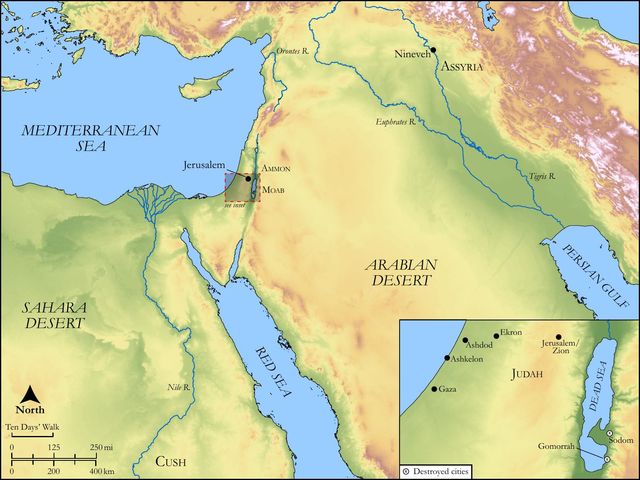
See on the biblical-era map
Study this verse
Public-domain commentary
Matthew Henry
From his Commentary on the Whole Bible. Henry comments on passages, not single verses — this entry covers Zephaniah 1:1–6. His four-level outline is real structure in the source text, so it is rendered as structure.
Here is, I. The title-page of this book (Zep 1:1), in which we observe, 1. What authority it has, and who gave it that authority; it is from heaven, and not of men: It is the word of the Lord. 2. Who was the instrument of conveying it to the church. His name was Zephaniah, which signifies the servant of the Lord, for God revealed his secrets to his servants the prophets. The pedigree of other prophets, whose extraction we have an account of, goes no further back than their father, except Zecharias, whose grandfather also is named. But this of Zephaniah goes back four generations, and the highest mentioned is Hizkiah; it is the very same name in the original with that of Hezekiah king of Judah (Kg2 18:1), and refers probably to him; if so, our prophet, being lineally descended from that pious prince, and being of the royal family, could with the better grace reprove the folly of the king's children as he does, Zep 1:8. 3. When this prophet prophesied - in the days of Josiah king of Judah, who reigned well, and in the twelfth year of his reign began vigorously, and carried on a work of reformation, in which he destroyed idols and idolatry. Now it does not appear whether Zephaniah prophesied in the beginning of his reign; if so, we may suppose his prophesying had a great and good influence on that reformation. When he, as God's messenger, reproved the idolatries of Jerusalem, Josiah, as God's vice-regent, removed them; and reformation is likely to go on and prosper when both magistrates and ministers do their part towards it. If it were towards the latter end of his reign that he prophesied, we sadly see how a corrupt people relapse into their former distempers. The idolatries Josiah had abolished, it should seem, returned in his own time, when the heat of the reformation began a little to abate and wear off. What good can the best reformers do with a people that hate to be reformed, as if they longed to be ruined?
II.The summary, or contents, of this book.
The general proposition contained in it is, That utter destruction is coming apace upon Judah and Jerusalem for sin. Without preamble, or apology, he begins abruptly (Zep 1:2): By taking away I will make an end of all things from off the face of the land, Saith the Lord. Ruin is coming, utter ruin, destruction from the Almighty. He has said it who can, and will, make good what he has said: "I will utterly consume all things. I will gather all things" (so some); "I will recall all the blessings I have bestowed, because they have abused them and so forfeited them." The consumption determined shall take away,
1.The inferior creatures: I will consume the beasts, the fowls of the heaven, and the fishes of the sea (Zep 1:3), as, in the deluge, every living substance was destroyed that was upon the face of the ground, Gen 7:23. The creatures were made for man's use, and therefore when he has perverted the use of them, and made them subject to vanity, God, to show the greatness of his displeasure against the sin of man, involves them in his punishment. The expressions are figurative, denoting universal desolation. Those that fly ever so high, as the fowls of heaven, and think themselves out of the reach of the enemies' hand - those that hide ever so close, as the fishes of the sea, and think themselves out of the reach of the enemies' eye - shall yet become a prey to them, and be utterly consumed.
2.The children of men: "I will consume man; I will cut off man from the land. The land shall be dispeopled and left uninhabited; I will destroy, not only Israel, but man. The land shall enjoy her sabbaths. I will cut off, not only the wicked men, but all men; even the few among them that are good shall be involved in this common calamity. Though they shall not be cut off from the Lord, yet they shall be cut off from the land." It is with Judah and Jerusalem that God has this quarrel, both city and country, and upon them he will stretch out his hand, the hand of his power, the hand of his wrath; and who knows the power of his anger? Zep 1:4. Those that will not humble themselves under God's mighty hand shall be humbled and brought down by it. Note, Even Judah, where God is known, and Jerusalem, where his dwelling-place is, if they revolt from him and rebel against him, shall have his hand stretched out against them.
3.All wicked people, and all those things that are the matter of their wickedness (Zep 1:3): "I will consume the stumbling-blocks with the wicked, the idols with the idolaters, the offences with the offenders." Josiah had taken away the stumbling-blocks, and, as far as he could, had purged the land of the monuments of idolatry, hoping that there would be no more idolatry; but the wicked will do wickedly, the dog will return to his vomit, and therefore, since the sin will not otherwise be cured, the sinners must themselves be consumed, even the wicked with the stumbling-blocks of their iniquity, Eze 14:3. Since it was not done by the sword of justice, it shall be done by the sword of war. See who the sinners are that shall be consumed.
(1.)The professed idolaters, who avowed idolatry, and were wedded to it. The remnant of Baal shall be cut off, the images of Baal, and the worshippers of those images. Josiah cut off a great deal of Baal; but that which was so close as to escape the eye, or so bold as to escape the hand, of his justice, God will cut off, even all the remains of it. The Chaldeans would spare none of the images of Baal, or the worshippers of those images. The Chemarim shall be cut off; we read of them in the history of Josiah's reformation. Kg2 23:5, He put down the idolatrous priests: the word is the Chemarim. The word signifies black men, some think because they wore black clothes, affecting to appear grave, others because their faces were black with attending the altars, or the fires in which they burnt their children to Moloch. They seem to have been immediate attendants upon the service of Baal. They shall be cut off with the priests, the regulars with the seculars. The very name of them shall be cut off; the order shall be quite abolished, so as to be forgotten, or remembered with detestation. And, among other idolaters, the worshippers of the host of heaven upon the house-tops shall be cut off (Zep 1:5), who justified themselves in their idolatry with those that did not worship images, the work of their own hands, but offered their sacrifices and burnt their incense to the sun, moon, and stars, immediately upon the tops of their houses. But God will let them know that he is a jealous God, and will not endure any rival; and, though some have thought that the most specious and plausible idolatry, yet it will appear as great an offence to God to give divine honours to a star as to give them to a stone or a stock. Even the worshippers of the host of heaven shall be consumed as well as the worshippers of the beasts of the earth or the fiends of hell. The sin of the adulteress is not the less sinful for the gaiety of the adulterer.
(2.)Those also shall be consumed that think to compound the matter between God and idols, and keep an even hand between them, that halt between God and Baal, and worship between Jehovah and Moloch, and swear by both; or, as it might better be read, swear to the Lord and to Malcham. They bind themselves by oath and covenant to the service both of God and idols. They have a good opinion of the worship of the God of Israel; it is the religion of their country, and has been long so, and therefore they will by no means quit it; but they think it will be very much improved and beautified if they join with it the worship of Moloch, for that also is much used in other countries, and travellers admire it; there is a great deal of good fancy and strong flame in it. They cannot keep always to the worship of a God whom they have no visible representation of, and therefore they must have an image; and what better than the image of Moloch - a king? They think they shall effectually atone for their sin if they swear to Moloch, and, pursuant to that oath, burn their children in sacrifice to that idol; and yet, if they do amiss in that, they hope to atone for it in worshipping the God of Israel too. Note, Those that think to divide their affections and adorations between God and idols will not only come short of acceptance with God, but will have their doom with the worst of idolaters; for what communion can there be between light and darkness, Christ and Belial, God and mammon? She whose own the child is not pleads for the dividing of it, for, if Satan have half, he will have all; but the true mother says, Divide it not, for, if God have but half, he will have none. Such waters will not be long sweet, if they come from a fountain that sends forth bitter water too; what have those to do to swear by the Lord that swear by Malcham?
(3.)Those also shall be consumed that have apostatized from God, together with those that never gave up their names to him, Zep 1:6. I will cut off,
[1.]Those that are turned back from the Lord, that were well taught, and began well, that had given up their names to him, and set out at first in the worship of him, but have flown off, and turned aside, and fallen in with idolaters, and deserted those good ways of God which they were brought up in, and despised them. Those God will be sure to reckon with who are renegadoes from his service, who began in the Spirit and ended in the flesh; they shall be treated as deserters, to whom no mercy is shown.
[2.]Those that have not sought the Lord, nor ever enquired for him, never made any profession of religion, and think to excuse themselves with that, shall find that this will not excuse them; nay, this is the thing laid to their charge; they are atheistical careless people, that live without God in the world; and those that do so are certainly unworthy to live upon God in the world.
Historical interpretation
Fourteen Centuries of Reception
2 surviving comments on this verse. Each one is dated, so this reads as a timeline rather than a list.
Select a marker to jump to its quote. Markers stagger vertically where authors wrote within a few decades of each other.
(Verse 4 and following) And I will stretch out my hand over Judah and over all the inhabitants of Jerusalem, and I will destroy from this place the remnants of Baal, and the names of the idolatrous priests together with the priests, and those who worship on the rooftops the host of heaven, and those who worship and swear by the Lord, and swear by Melchom; and those who turn away from the Lord, and those who have not sought the Lord or inquired of him. LXX: And I will stretch out my hand over Judah, and over all who dwell in Jerusalem, and I will remove from this place the names of the Baals, and the names of the priests with the priests, and those who worship on the rooftops the host of heaven, and those who swear by the Lord, and swear by their king, and those who turn away from the Lord, and those who do not seek the Lord, and those who do not retain the Lord. After the downfall of the impious and the removal of the wicked from the face of the earth, consequently, regarding Judah and Jerusalem, it is said in the person of the Lord: 'And I will stretch out my hand over Judah and over all the inhabitants of Jerusalem' (for the stretching out of the hand indicates the gesture of striking); 'and I will destroy from this place the remnants of Baal' (not that the names of the Baals according to the Septuagint are to be completely eradicated, but rather that the worshippers of Baal, who remained few in number from the slaughter of the enemies in Judah and Jerusalem, are to be removed). The names of the priests, as well as the temple attendants, were also mentioned. Judas and Benjamin had fallen into such great impiety that they set up a statue of Baal in the Temple of the Lord, as Ezekiel writes and the fourth book of Kings shows. This statue, which the Lord calls the image of jealousy, and the idols in the same sanctuary were worshipped both by priests and the Lord (Ezekiel VIII). Hence, the priests of the idols were specifically called not priests, but 'temple attendants' or fanatics, which in Hebrew is called Acchumarim (4 Kings X and XVII). So the Lord will remove from Jerusalem the judges and priests who once served him, as well as those who worshiped the army of heaven—the sun and the moon and the stars—and those who swore allegiance to the Lord but also worshiped Molech, the detestable idol of the Ammonites. The Lord will sweep them away and erase even the memory of them from Israel. He will destroy the leftovers of Baal worship and the names of the pagan priests. Those who worship on the rooftops, those who swear oaths by the Lord and also by Molech, those who turn back from following the Lord and neither seek nor ask for his guidance will be cut off as well. But the people of Israel turn their backs on the Lord, abandoning his worship and swearing by Melchom, and worshiping the host of heaven and bowing down to the idol of the Sidonians, Baal. So far the meaning of the story has been explained; now let us consider the moral sense. Because of the Lord who came from the tribe of Judah, and because of Jerusalem where Judas reigned, that is, the Lord and Savior, let us say that when wickedness has multiplied and the love of many has grown cold, and when the Lord comes, faith will be rare on earth to the extent that God's chosen ones will even be tested (Matthew 24, Luke 18). Then the Lord will stretch out his hand in punishment for sins upon Judas, who seems to confess the name of the Lord, and upon Jerusalem, the Church which has received its name from peace, and will remove the names of the Baals from the Church, which is interpreted in higher things. But the Lord will take away the names of empty glory and false admiration, which are found in the Church, in which, according to James, a golden ring is honored, and the poor is despised, when at the coming of the judge and senator, and in the common gathering of all the rich, the whole people rise up, and the holy poor is not even given a place to stand among the ranks of the powerful, and their privileges are not granted; but also the names of the priests with the priests who applaud themselves in vain in the name of bishop, and in the dignity of the presbytery, and not in work (James 2). Where he particularly says, that the works of the priests with other priests are not necessary, but only for show they assume false titles of dignity, and by evil works they destroy their own names, and those who worship the celestial host above the roofs, who rise up against the knowledge of God; and everything that is done in the world, they falsely claim to possess knowledge about, and they attribute it to the movements of the stars and the rising and setting, and they follow the errors of the mathematicians, and those who worship the Lord and Melchom, who think they can serve both the world and the Lord, and satisfy two masters, God and mammon: they, while claiming to be soldiers of Christ, bind themselves to worldly affairs, and offer the same image to God and Caesar, and although they claim to be priests of Christ, they consecrate their sons to Melchom, that is, to their king (2 Timothy 2). For they are right who have a king for a man, who have lost the Lord as their king, and who turn away from the Lord through wicked works, and do not seek him, holding onto their sins as they flee. But if anyone wishes to understand this according to the interpretation of the names of Judah and Jerusalem upon the soul of each person, he will not err, that the Lord may take away all that we have said, either at the consummation of the world, or at the departure of each individual, when they will hear: 'Fool, tonight your soul will be taken from you.' (Luke 12) And may He stretch out His hand upon him who does not confess the Lord, and upon him who boasts of having the sense of peace, so as to remove and destroy from such Jerusalem all pride, and false worship of God, and errors of doctrines, and servitude to God and the world alike, and through daily sins, turning away from the Lord and neglecting God.
Melchom: The idol of the Ammonites.
Continue studying Zephaniah 1:5 across the web’s major study libraries — every link below opens this exact verse, chapter, or book on the destination site.
Read & Compare
 BibleGatewayThis verse in more than 200 translations and 70 languages.
 Bible.comThe YouVersion reader — hundreds of translations, reading plans, and highlights.
 ESV.orgCrossway's official English Standard Version reader.
 NET BibleThe NET translation with 60,000+ translators' notes on every rendering decision.
 STEP BibleTyndale House's free study tool — original text, vocabulary, and scholarly resources.
 BibliaLogos Bible Software's free web reader.
 USCCBThe New American Bible (Revised Edition) with the U.S. bishops' study notes.
Commentaries
 BibleHub CommentariesDozens of classic commentaries on this verse, gathered on one page.
 StudyLightMore than 100 commentary sets — the largest collection on the web.
 BibleRefPlain-English commentary on what this verse means, verse by verse.
 Enduring WordDavid Guzik's free commentary on this chapter, widely used by Bible teachers.
 Bible Study ToolsVerse commentary alongside Greek and Hebrew study aids.
Original Language & Research
- BibleHub InterlinearThe verse word by word — original language, transliteration, and English.
- BibleHub LexiconEvery word's original-language definition and Strong's entry.
 Blue Letter BibleDeep-study tools — Strong's numbers, concordance, and word studies.
 SefariaThe Hebrew text with Rashi and centuries of Jewish commentary.
Sermons, Hymns & Audio


TrulyRandomVerse is not affiliated with these sites and doesn’t control their content. They’re linked because they’re genuinely useful.
Summary
Zephaniah 1:5 exposes the profound spiritual apostasy of Judah during the reign of King Josiah, condemning those who engaged in syncretistic worship practices. The verse specifically targets individuals who simultaneously worshipped the celestial bodies ("host of heaven") on their rooftops, a common pagan ritual, while also professing allegiance to the LORD, even swearing oaths by Him. The indictment deepens with the mention of swearing by Malcham, a variant of Molech, highlighting the nation's egregious embrace of abhorrent foreign deities alongside the true God, thereby provoking divine judgment.
Context
ShowHideLiterary Context
Zephaniah 1:5 is situated within the opening chapter of the book, which serves as a sweeping declaration of the impending "Day of the LORD." Following a universal judgment against all creation (Zephaniah 1:2-3), the prophet narrows his focus to Judah and Jerusalem, detailing the specific sins that necessitate such severe divine wrath. Verses 4-6 list various categories of idolaters and apostates who will be cut off, with verse 5 specifically addressing the syncretistic practices of those who attempted to blend Yahwistic worship with paganism. This verse sets the stage for the comprehensive judgment described in the subsequent verses, culminating in the terrifying description of the "great day of the LORD" (Zephaniah 1:14-18).
Historical & Cultural Context
Zephaniah prophesied during the early years of King Josiah's reign (c. 640-609 BC), before the widespread reforms initiated by the discovery of the Book of the Law in the temple (2 Kings 22-23). At this time, Judah was deeply steeped in the idolatrous practices introduced by previous kings, particularly Manasseh, who had erected altars to the "host of heaven" within the temple precincts and promoted child sacrifice (2 Kings 21:3-7). The worship of celestial bodies was prevalent among the nations round about Judah, often associated with fertility cults and divination. "Housetops" were common sites for altars and religious rituals, offering an elevated and public space for such practices. Malcham, a variant of Molech or Milcom, was the national deity of Ammon, whose worship notoriously involved child sacrifice, a practice vehemently condemned by the Mosaic Law. The syncretism described in Zephaniah 1:5 reflects a society where paganism had infiltrated even those who ostensibly claimed allegiance to Yahweh.
Key Themes
ShowHideThis verse powerfully illustrates several key themes prevalent in Zephaniah and broader prophetic literature. Foremost is Syncretism and Divided Loyalty, where the people of Judah attempted to serve both the true God and pagan deities, a practice utterly abhorrent to Yahweh, who demands exclusive worship. This divided allegiance is a recurring indictment against Israel throughout its history, as seen in the warnings of Deuteronomy 6:14-15. The specific mention of the Idolatry of the "Host of Heaven" highlights a widespread idolatry of the heavens, explicitly forbidden in the Law (e.g., Deuteronomy 4:19), yet openly practiced "upon the housetops." Furthermore, the inclusion of Worship of Malcham (Molech) underscores the depth of Judah's spiritual depravity, embracing a deity associated with the horrific practice of child sacrifice, an abomination to God (e.g., Leviticus 18:21). Ultimately, Zephaniah 1:5 serves as a clear Indictment for Apostasy, explaining the profound spiritual unfaithfulness that necessitates the Divine Judgment soon to be unleashed in the "Day of the LORD" (e.g., Zephaniah 1:7).
Exposition and Analysis
ShowHideKey Word Analysis
ShowHideMeaning to depress, i.e., prostrate oneself, especially in homage to royalty or God. In this context, it describes the act of bowing down or showing reverence. The repetition of this word underscores the duality of their devotion: prostrating themselves before pagan deities while also attempting to show reverence to the LORD. This highlights the insincerity and unacceptability of their divided loyalty.
Meaning to seven oneself, i.e., to swear (as if by repeating a declaration seven times). This refers to taking an oath, a solemn declaration invoking a divine witness. The act of swearing by both the LORD and Malcham demonstrates a profound spiritual compromise, treating Yahweh as merely one deity among many, rather than the exclusive, sovereign God.
Meaning a king or royal. While the KJV uses "Malcham," this is a variant or pejorative spelling of Molech (or Milcom), the Ammonite national deity. The root "melek" signifies "king," which was a common title for the gods of the nations. The prophet's use of this term, alongside the LORD, emphasizes the direct competition and spiritual rebellion against Yahweh's sole claim to kingship and authority over Judah.
Verse Breakdown
ShowHide"And them that worship the host of heaven upon the housetops;"
This clause identifies the first group of idolaters: those who prostrate themselves before celestial bodies—the sun, moon, and stars. This practice, explicitly forbidden in Mosaic Law, was a common form of astral worship among the nations round about, often associated with divination and fertility cults. The phrase "upon the housetops" indicates that this idolatry was not hidden but openly practiced in a public and visible manner, signifying a defiant rejection of God's commands.
"and them that worship [and] that swear by the LORD,"
This part of the verse highlights the syncretistic nature of Judah's apostasy. It refers to those who outwardly professed allegiance to Yahweh, even engaging in acts of worship and taking solemn oaths in His name. The inclusion of "worship" here, alongside "swear," emphasizes that their devotion to the LORD was not entirely abandoned, but it was compromised by their simultaneous pagan practices.
"and that swear by Malcham;"
This final clause reveals the depth of their spiritual depravity. The same individuals who worshipped and swore by the LORD also swore by Malcham (Molech/Milcom). This demonstrates a profound spiritual schizophrenia, treating the holy and sovereign God of Israel as interchangeable with, or subservient to, a pagan deity whose worship involved horrific child sacrifice. This divided allegiance was an abomination, signifying a complete failure to uphold the covenantal demand for exclusive loyalty to Yahweh.
Literary Devices
ShowHideZephaniah 1:5 employs several potent literary devices to underscore Judah's spiritual corruption. Juxtaposition is central, placing the worship of the "host of heaven" and "Malcham" directly alongside the worship of "the LORD." This stark contrast highlights the nation's divided loyalty and the abhorrent nature of their syncretism. The Repetition of "worship" and "swear" emphasizes the pervasive and intentional nature of their dual allegiance, reinforcing the idea that these were not isolated incidents but characteristic practices. The phrase "upon the housetops" serves as Symbolism, representing the public and brazen nature of their idolatry, a defiant act against God's commands rather than a private transgression. Furthermore, the use of "Malcham" (a variant of Molech) can be seen as a form of Dysphemism or Pejorative Language, subtly diminishing the pagan deity while simultaneously condemning the heinousness of its worship.
Theological and Thematic Connections
ShowHideZephaniah 1:5 serves as a powerful theological statement on the nature of God's demand for exclusive worship and His intolerance for spiritual syncretism. The verse underscores that Yahweh is not merely one god among many, to be worshipped alongside other deities; He is the sovereign, unique God who demands total allegiance. This truth is foundational to the Mosaic covenant, which explicitly prohibits idolatry and foreign gods. The spiritual compromise evident in Judah's willingness to swear by both the LORD and Malcham reveals a profound misunderstanding of God's character and a blatant violation of His covenant. This divided heart is an abomination, leading inevitably to divine judgment, as God cannot share His glory with idols. The passage thus reinforces the biblical principle that true worship must be singular, wholehearted, and unadulterated.
Reflection and Application
ShowHideThe ancient sin of Zephaniah 1:5, though rooted in literal idolatry, carries profound relevance for contemporary believers. While we may not bow to carved images or celestial bodies, the human heart remains prone to idolatry—anything that competes for God's rightful place of ultimate devotion in our lives. This could manifest as an inordinate pursuit of wealth, career success, social status, comfort, pleasure, or even self-righteousness. The "housetops" of our lives might be our social media platforms, our public personas, or the visible priorities we display. Zephaniah's indictment against syncretism warns us against attempting to blend Christian faith with worldly values, creating a diluted and ineffective spirituality. God desires a whole heart, an undivided allegiance. We must regularly examine our lives to identify any "Malchams"—any subtle idols or competing loyalties—that we might be serving alongside the Lord, consciously or unconsciously. Our worship must be pure, exclusive, and centered solely on the one true God, ensuring that our actions and allegiances reflect His supreme sovereignty.
Questions for Reflection
ShowHideFAQ
ShowHideWhat is the "host of heaven" and why was its worship condemned?
ShowHideThe "host of heaven" (Hebrew: tzva hashshamayim) refers to the celestial bodies—the sun, moon, and stars. Among the nations round about, these heavenly bodies were often deified and worshipped as gods or divine powers, associated with fate, fertility, and the order of the seasons. Their worship was explicitly condemned in the Mosaic Law (e.g., Deuteronomy 4:19 and Deuteronomy 17:3), because it diverted worship from the one true Creator God, Yahweh, to His creation. It was a grave affront to God's sovereignty and a violation of the first commandment.
Who was Malcham, and what was the significance of swearing by him?
ShowHide"Malcham" is a variant spelling of Molech (or Milcom), the national deity of the Ammonites, a neighboring people to Israel. The worship of Molech was particularly abhorrent because it involved child sacrifice, burning children as offerings to the idol (e.g., Leviticus 18:21 and 2 Kings 23:10). Swearing by Malcham meant taking an oath in his name, invoking him as a divine witness to one's promise or truthfulness. For the people of Judah to swear by Malcham alongside the LORD demonstrated a profound and blasphemous syncretism, treating the holy God of Israel as merely one among many gods, even associating Him with a deity demanding such horrific sacrifices. This act underscored their deep spiritual depravity and covenant unfaithfulness.
Christ-Centered Fulfillment
ShowHideZephaniah 1:5's condemnation of syncretistic idolatry finds its ultimate fulfillment in the person and work of Jesus Christ, who perfectly embodies God's demand for exclusive worship and provides the means for true, unadulterated devotion. The "host of heaven" and "Malcham" represent all rival gods and earthly powers that vie for humanity's allegiance. Christ, as the true God incarnate, declares that no one can serve two masters (e.g., Matthew 6:24), demanding total and undivided loyalty. He is the one through whom all things were created (e.g., Colossians 1:16), thus rendering the worship of creation, like the "host of heaven," utterly futile. Furthermore, Christ's sacrifice on the cross is the ultimate atonement for the very sins of idolatry and spiritual adultery condemned by Zephaniah. He delivers us from the dominion of darkness and transfers us into His kingdom (e.g., Colossians 1:13-14), enabling us to worship God "in spirit and truth" (e.g., John 4:24). The "Day of the LORD" that Zephaniah prophesied, a day of judgment against all who reject God, ultimately points to Christ's final judgment and the establishment of His eternal kingdom, where He alone is worshipped as King of kings and Lord of lords (e.g., Revelation 19:16).