


Amos 5:26
Bible text: King James Version (1769 Blayney text) · Public domain
Bible text: Berean Standard Bible · Public domain
Bible text: American Standard Version (1901) · Public domain
Bible text: World English Bible, Messianic edition · Public domain
Bible text: Geneva Bible (1599) · Public domain
Bible text: Young's Literal Translation · Public domain
- וּנְשָׂאתֶםu·ne·sa·Temand you will lift upH5375Conj-w ¦ V-Qal-ConsecPerf-2mpVerb Qal Consecutive Perfect 2nd Plural Masculineוּandנְשָׂאתֶםyou will lift up
- אֵת'et<obj.>H853DirObjMParticle Object Indicator
- סִכּוּתsi·KutSikkuthH5522N-proper-mNoun Proper Masculine
- מַלְכְּכֶםmal·ke·Khemyour kingH4428N-msc ¦ 2mpNoun Singular Masculine Constructמַלְכְּkingכֶםyour
- וְאֵתve·'Etand <obj.>H853Conj-w ¦ DirObjMParticle Object Indicatorוְandאֵת<obj.>
- כִּיּוּןki·YunKiyyunH3594N-properNoun Proper Title
- צַלְמֵיכֶםtzal·mei·Khemyour imagesH6754N-mpc ¦ 2mpNoun Plural Masculine Constructצַלְמֵיimagesכֶםyour
- כּוֹכַבko·Khav[the] star ofH3556N-mscNoun Singular Masculine Construct
- אֱלֹהֵיכֶם'e·Lo·hei·Khemyour godsH430N-mpc ¦ 2mpNoun Plural Masculine Constructאֱלֹהֵיgodsכֶםyour
- אֲשֶׁר'a·SherwhichH834RelParticle Relative
- עֲשִׂיתֶם'a·si·Temyou madeH6213V-Qal-Perf-2mpVerb Qal Perfect 2nd Plural Masculine
- לָכֶםla·Khemfor yourselvesPrep-l ¦ 2mpSuffix Personal 2nd Plural Masculineלָforכֶםyourselves
English is a literal word-by-word gloss of the Hebrew, not the KJV's wording. Why?
This is the original text the KJV's translators worked from — each Hebrew word with its own literal English meaning in this verse, prepared by scholars at Tyndale House, Cambridge. The KJV translates whole sentences, not word by word, so its wording differs: one Hebrew word can become several English words, and the KJV may choose “the LORD” where the gloss reads “Yahweh”. Both are faithful — they answer different questions. For the KJV's own rendering, switch to the KJV text.
Details
See on the biblical-era map
Study this verse
Public-domain commentary
Matthew Henry
From his Commentary on the Whole Bible. Henry comments on passages, not single verses — this entry covers Amos 5:21–27. His two-level outline is real structure in the source text, so it is rendered as structure.
The scope of these verses is to show how little God valued their shows of devotion, nay, how much he detested them, while they went on in their sins. Observe,
I.How unpleasing, nay, how displeasing, their hypocritical services were to God.
They had their feast-days at Bethel, in imitation of those at Jerusalem, in which they pretended to rejoice before God. They had their solemn assemblies for religious worship, in which they put on the gravity of those who come before God as his people come, and sit before him as his people sit. They offered to God burnt-offerings, to the honour of God, together with the meat-offerings which by the law were to be offered with them; they offered the peace-offerings, to implore the favour of God, and they offered them of the fat beasts that they had, Amo 5:21, Amo 5:22. In imitation likewise of the temple-music, they had the noise of their songs and the melody of their viols (Amo 5:23), vocal and instrumental music, with which they praised God. With these services they hoped to make God amends for the sins they had committed, and to obtain leave to go on in sin; and therefore they were so far from being acceptable to God that they were abominable. He hated, he despised, their feast-days, not only despised them as no valuable services done to him, but hated them as an affront and provocation to him, as we hate to see men dissemble with us, pretend a respect for us when really they have none. Nothing more hateful, more despicable, than hypocrisy. He that blesseth his friend with a loud voice, it shall be counted a curse, when it appears that his heart is not with him. God will not smell in their solemn assemblies, for there is nothing in them that is grateful to him, but a great deal that is offensive. Their sacrifices are not to him of a sweet smelling savour, as Noah's was, Gen 8:21. He will not accept them; he will not regard them, will not take any notice of them; he will not hear the melody of their viols; for, when sin is a jar in the harmony, it grates in his ears: "Take it away," says God, "I cannot bear it." Now this intimates,
1.That sacrifice itself is of small account with God in comparison with moral duties; to love God and our neighbour is better than all burnt offering and sacrifice.
2.That the sacrifice of the wicked is really an abomination to him, Pro 15:8. Dissembled piety is double iniquity, and so it will be found when, if any place in hell be hotter than another, that will be the hypocrite's portion.
II.What it was that he required in order to the acceptableness of their sacrifices and without which no sacrifice would be acceptable (Amo 5:24): Let judgment run down as waters, among you, and righteousness as a mighty stream, that is 1. "Let there be a general reformation of manners among you; let religion (God's judgment) and righteousness have their due influence upon you; let your land be watered with it, and let it bear down all the opposition of vice and profaneness; let it run wide as overflowing waters, and yet run strong as might stream." (2.) "In particular, let justice be duly administered by magistrates and rulers; let not the current of it be stopped by partiality and bribery, but let it come freely as waters do, in the natural course; let it be pure as running waters, not muddied with corruption or whatever may pervert justice; let it run like a might stream, and not suffer itself to be obstructed, or its course retarded, by the fear of man; let all have free access to it as a common stream, and have benefit by it as trees planted by the rivers of waters." The great thing laid to Israel's charge was turning judgment into wormwood (Amo 5:7); in that matter therefore they must reform, Zac 7:9. This was what God desired more than sacrifices, Hos 6:6; Sa1 15:22.
III.What little stress God had laid upon the law of sacrifices, though it was his own law, in comparison with the moral precepts (Amo 5:25):
"Did you offer unto me sacrifices in the wilderness forty years? No, you did not." For the greatest part of that time sacrifice was very much neglected, because of the unsettledness of their state; after the second year, the passover was not kept till they came into Canaan, and other institutions were in like manner intermitted; and yet, because God will have mercy and not sacrifice, he never imputed the omission to them as their fault, but continued his care of them and kindness to them: it was not that, but their murmuring and unbelief, for which God was displeased with them. He that so owned his people, though they did not sacrifice, when in other things they kept close to him, will certainly disown them, though they do sacrifice, if in other things they depart from him. But, though ritual sacrifices may thus be dispensed with, spiritual sacrifices will not; even justice and honesty will not excuse for the want of prayer and praise, a broken heart and the love of God. Stephen quotes this passage (Act 7:42), to show the Jews that they ought not to think it strange that ceremonial law was repealed when from the beginning it was comparatively made light of. Compare Jer 7:22, Jer 7:23.
II.What little reason they had to expect that their sacrifices should be acceptable to God, when they and their fathers had been all along addicted to the worship of other gods. So some take Amo 5:25, "Did you offer to me sacrifices, that is, to me only? No, and therefore not at all to me acceptably;" for the law of worshipping the Lord our God is, Him only we must serve. "But you have borne the tabernacle of your Moloch (Amo 5:26), little shrines that you made to carry about with you, pocket-idols for your private superstition, when you durst not be seen to do it publicly. You have had the images of your Moloch - your king" (probably representing the sun, that sits king among the heavenly bodies), "and Chiun, or Remphan" (as Stephen calls it, Act 7:43, after the Septuagint), which it is supposed, represented Saturn, the highest of the seven planets. The worship of the sun, moon, and stars, was the most ancient, most general, and most plausible idolatry. They made to themselves the star of their God, some particular star which they took to be their god, or the name of which they gave to their god. This idolatry Israel was from the beginning prone to (Deu 4:19); and those that retain an affection for false gods cannot expect the favour of the true God.
V.What punishment God would inflict upon them for their persisting in idolatry (Amo 5:27):
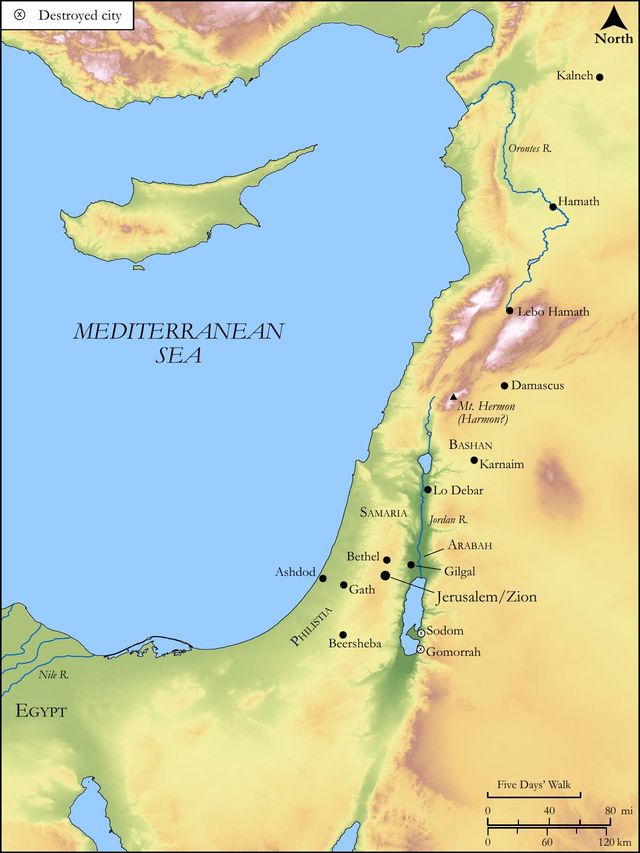
I will cause you to go into captivity beyond Damascus. They were led captive by Satan into idolatry, and therefore God caused them to go into captivity among idolaters, and hurried them into a strange land, since they were so fond of strange gods. They were carried beyond Damascus. Their captivity by the Assyrians was far beyond that by the Syrians; for, if less judgments do not work that for which they were sent, God will send greater. Or the captivity of Israel under Shalmaneser was far beyond that of Damascus under Tiglath-pileser, and much more grievous and destructive, which was foretold Amo 1:5. For, as the sins of God's professing people are greater than the sins of others, so it may be expected that their punishments will be proportionable. We find the spoil of Damascus and that of Samaria carried off together by the king of Assyria, Isa 8:4. Stephen reads it, I will carry you away beyond Babylon (Act 7:43), further than Judah shall be carried, so far further as not to return. And, to make this sentence appear both the more certain and the more dreadful, he that passes it calls himself the Lord, whose name is, The God of hosts, and who is therefore able to execute the sentence, having hosts at command.
Historical interpretation
Seventeen Centuries of Reception
3 surviving comments on this verse. Each one is dated, so this reads as a timeline rather than a list.
Select a marker to jump to its quote. Markers stagger vertically where authors wrote within a few decades of each other.
This Moses whom they refused, saying, Who made thee a ruler and a judge? the same did God send to be a ruler and a deliverer by the hand of the angel which appeared to him in the bush. He brought them out, after that he had showed wonders and signs in the land of Egypt, and in the Red sea, and in the wilderness forty years. This is that Moses, which said unto the children of Israel, A prophet shall the Lord your God raise up unto you of your brethren, like unto me; him shall ye hear. This is he, that was in the church in the wilderness with the angel which spake to him in the mount Sina, and with our fathers: who received the lively oracles to give unto us: To whom our fathers would not obey, but thrust him from them, and in their hearts turned back again into Egypt, Saying unto Aaron, Make us gods to go before us: for as for this Moses, which brought us out of the land of Egypt, we wot not what is become of him. And they made a calf in those days, and offered sacrifice unto the idol, and rejoiced in the works of their own hands. Then God turned, and gave them up to worship the host of heaven; as it is written in the book of the prophets, O ye house of Israel, have ye offered to me slain beasts and sacrifices by the space of forty years in the wilderness? Yea, ye took up the tabernacle of Moloch, and the star of your god Remphan, figures which ye made to worship them: and I will carry you away beyond Babylon. [Amos 5:25-27]
(Verse 25 and following) Did you offer to Me sacrifices and offerings in the wilderness for forty years, O house of Israel? You also took along the tabernacle of Moloch and the star of your god Rephan, the images which you made for yourselves. Therefore I will exile you beyond Damascus, says the Lord, whose name is the God of hosts. LXX: Did you offer to Me sacrifices and victims in the desert for forty years, O house of Israel, and take up the tabernacle of Melchom and the star of your god Repham, the figures of them which you made for yourselves. And I will transfer you beyond Damascus, says the Lord: God almighty is his name. From this place we learn that all the sacrifices and offerings that Israel made in the desert were not offered to God, but to their king Moloch, whose tabernacles they carried and worshiped the image of their idols and statues. And in the following statement, it shows what this image or idol is: The star of your God, which is called Chocab in Hebrew, that is, Lucifer, whom the Saracens have been worshiping until now. For what reason did the Lord make them migrate across Damascus, that is, to the Assyrians and Chaldeans: his omnipotence is demonstrated by the fact that he is the Lord God of hosts. We ask why they did not offer sacrifices and offerings to God in the desert; but to their king, whom they call Lucifer? From the time they transformed gold into the head of a calf, saying: These are your gods, Israel, who brought you out of the land of Egypt (Exod. III, 24), it is shown that everything they did was not for God, but for idols. And what we read afterwards that they offered certain things to the Lord, they did not do so willingly but out of fear of punishment, and by the killing of those who fell because of idols. But the Lord does not look at what is offered, but at the will of the one offering. Finally, wherever the opportunity arose, they always turned back in their hearts to Egypt, desiring garlic and onions, and cucumbers and Egyptian meat, and despising the manna that was given from heaven (Numbers 11). To understand this, let us turn to the story told by the first martyr of the Gospel, Stephen, worthy of his name, in the Acts of the Apostles: 'And they made a calf in those days, and offered a sacrifice to the idol, and rejoiced in the works of their hands. But God turned and delivered them up to serve the host of heaven, as it is written in the book of the Prophets: Did you offer victims and sacrifices to me for forty years in the desert, O house of Israel?' And you took up the tent of Moloch and the star of your god Rephan, the figures that you made to worship; and I will send you into exile beyond Babylon. It should not be thought that the first martyr erred, who, because it is written in the prophet: 'Beyond Damascus,' said 'beyond Babylon.' For he placed more emphasis on understanding than on the exact word, because they were led from Damascus to Babylon, or beyond Babylon. But in that place where Luke put Μολὸχ, and it is written in Hebrew as Melchechem (): Aquila and LXX translated Μολχὸμ: Symmachus and Theodotio, for your kings. Also, for what is read in the Septuagint as Rephan; Aquila and Symmachus translating the Hebrew itself, they put Chion (), Theodotio 'amaŭrōsin', that is, darkness. Again, for Sochoth (), Aquila 'syskiasmoùs', that is, tabernacles: Symmachus and Septuagint, tabernacle: Theodotio translated it as vision. And this is to be observed in all holy Scriptures, that the apostles and apostolic men, in laying down testimonies from the Old Testament, do not consider the words but the meaning: nor do they follow the same paths of words, as long as they do not depart from the intended sense. But whatever is said literally against the Jewish people, all of this is to be referred to those who worship idols under the name of Christ, and who fabricate corrupt doctrines for themselves, carrying the tabernacle of their king, the devil, and the image of their statues and idols. For they do not worship one idol; but for the variety of teaching, they worship different gods, and the star of their god (2 Corinthians XI). He, being the angel of Satan, transforms himself into an angel of light, and falls from heaven like lightning (Luke X), and Antichrist imitates Christ. And he beautifully introduced what you have made for yourselves. For they have not received these things from God, but have imagined them in their own minds. Therefore, the Lord will cause them to migrate across Damascus, so that they do not drink the blood of the Lord, but go to Babylon, and listen to the prophet: A golden cup Babylon, intoxicating all nations (Jeremiah LI, 7). For Damascus, as we have often said, signifies drinking blood, or the blood of Cilicia, so that through penance we may be moved to drink the blood of the Lord.
A tabernacle: All this alludes to the idolatry which they committed, when they were drawn away by the daughters of Moab to the worship of their gods. Num. 25.
Continue studying Amos 5:26 across the web’s major study libraries — every link below opens this exact verse, chapter, or book on the destination site.
Read & Compare
 BibleGatewayThis verse in more than 200 translations and 70 languages.
 Bible.comThe YouVersion reader — hundreds of translations, reading plans, and highlights.
 ESV.orgCrossway's official English Standard Version reader.
 NET BibleThe NET translation with 60,000+ translators' notes on every rendering decision.
 STEP BibleTyndale House's free study tool — original text, vocabulary, and scholarly resources.
 BibliaLogos Bible Software's free web reader.
 USCCBThe New American Bible (Revised Edition) with the U.S. bishops' study notes.
Commentaries
 BibleHub CommentariesDozens of classic commentaries on this verse, gathered on one page.
 StudyLightMore than 100 commentary sets — the largest collection on the web.
 BibleRefPlain-English commentary on what this verse means, verse by verse.
 Enduring WordDavid Guzik's free commentary on this chapter, widely used by Bible teachers.
 Bible Study ToolsVerse commentary alongside Greek and Hebrew study aids.
Original Language & Research
- BibleHub InterlinearThe verse word by word — original language, transliteration, and English.
- BibleHub LexiconEvery word's original-language definition and Strong's entry.
 Blue Letter BibleDeep-study tools — Strong's numbers, concordance, and word studies.
 SefariaThe Hebrew text with Rashi and centuries of Jewish commentary.
Sermons, Hymns & Audio


TrulyRandomVerse is not affiliated with these sites and doesn’t control their content. They’re linked because they’re genuinely useful.
Summary
Amos 5:26 delivers a profound divine indictment against the Northern Kingdom of Israel, exposing their deep-seated and persistent idolatry despite their outward religious observances. The prophet reveals that alongside their worship of Yahweh, the Israelites secretly or overtly carried and revered "tabernacles" and "images" dedicated to pagan deities like Moloch and Chiun, a star god, which they had crafted for themselves. This verse underscores the pervasive spiritual hypocrisy of the nation, highlighting that their hearts were far from God, leading inevitably to His righteous judgment.
Context
ShowHideLiterary Context
This verse is situated within a powerful section of Amos's prophecy where God expresses His profound displeasure with Israel's religious hypocrisy and oppression. Immediately preceding Amos 5:26, the Lord explicitly rejects their elaborate festivals, solemn assemblies, burnt offerings, and peace offerings, declaring that He will not accept them because their hearts are not right and justice does not flow like a river (Amos 5:21-24). Instead of truly seeking the Lord, as commanded earlier in the chapter (Amos 5:4), they had turned to foreign gods. This verse, therefore, serves as a crucial revelation of the underlying spiritual unfaithfulness that fueled God's rejection and justified the impending judgment of exile declared in the subsequent verse (Amos 5:27).
Historical & Cultural Context
Amos prophesied to the Northern Kingdom of Israel during the prosperous reign of Jeroboam II (c. 793–753 BC). Despite economic flourishing, this period was marked by severe oppression, moral decay, and rampant religious syncretism. The Israelites, particularly in the north, frequently blended the worship of Yahweh with the cultic practices of the surrounding Canaanite and Ammonite religions. Moloch was a notorious Ammonite or Canaanite deity associated with child sacrifice, a practice explicitly forbidden by the Mosaic Law (Leviticus 18:21). Chiun, often identified with the planet Saturn or a star god, points to astral worship, another form of idolatry among the nations round about. The mention of "tabernacle" and "images" suggests portable shrines or cultic objects, indicating that this idolatry might have been practiced privately or during specific pagan rituals, perhaps even alongside official Yahweh worship, demonstrating a deep-seated spiritual compromise.
Key Themes
ShowHideAmos 5:26 powerfully contributes to several key themes within the book of Amos and the broader prophetic tradition. The most prominent is Idolatry and Syncretism, highlighting Israel's grave sin of worshipping foreign deities, Moloch and Chiun, alongside or in place of Yahweh, a direct violation of the first two commandments of the Decalogue (Exodus 20:3-5). Another crucial theme is Hidden Sin and Divine Exposure, as God, through Amos, reveals the covert or outwardly disguised unfaithfulness of His people, demonstrating His omniscience and judgment that penetrates beyond superficial religious performance. The phrase "which ye made to yourselves" underscores the theme of Man-Made Religion, emphasizing that this worship was a deliberate choice by the people, born of human desire and pagan influence, rather than divine command. This stands in stark contrast to the true worship of Yahweh, which is based on His revealed word and covenant, further emphasizing Israel's Covenant Unfaithfulness.
Exposition and Analysis
ShowHideKey Word Analysis
ShowHideFrom the root meaning "to reign" or "king." While the word itself means "king," in this context, it refers to the Ammonite deity notorious for demanding child sacrifice. The use of "Moloch" here highlights the specific, abhorrent nature of one of the pagan cults Israel had embraced, contrasting sharply with the righteous demands of the true King, Yahweh.
This term, derived from a root meaning "to establish" or "to set up," properly refers to a "statue" or "idol." However, it is used euphemistically for a heathen deity, often identified with the planet Saturn or a star god. This identification is reinforced by the subsequent phrase "the star of your god," linking Chiun directly to astral worship, a common form of idolatry among the nations.
This feminine noun refers to an "(idolatrous) booth" or "shrine." Unlike the sacred Tabernacle of Yahweh (mishkan), this term denotes a small, portable shrine or tent used for pagan worship. Its presence suggests that the Israelites carried these cultic objects with them, indicating a deep, personal commitment to these false gods, perhaps even in a clandestine manner, alongside their public religious duties to Yahweh.
Verse Breakdown
ShowHide"But ye have borne the tabernacle of your Moloch"
This clause reveals Israel's active participation in idolatry. The verb "borne" (nâsâʼ, H5375) implies carrying or lifting, suggesting that the Israelites physically transported these idolatrous shrines, perhaps in processions or for private worship. The "tabernacle of your Moloch" refers to a portable shrine or booth dedicated to the pagan deity Moloch, indicating a deep and personal commitment to this cult, despite its abhorrent practices (like child sacrifice).
"and Chiun your images"
This expands the indictment to include another specific deity, Chiun, and "your images" (tselem, H6754), which are representative figures or idols. This indicates that alongside the portable shrine for Moloch, they also possessed and revered physical representations of Chiun, likely statues or figurines. The plural "images" suggests a multiplicity of such objects or a general practice of image worship.
"the star of your god"
This phrase directly identifies Chiun with a celestial deity, specifically a "star god" (kôwkâb, H3556). This points to astral worship, a common form of idolatry among the nations, where celestial bodies were deified and worshipped. It clarifies the nature of Chiun as a deity associated with the heavens, possibly the planet Saturn, as understood by later interpreters.
"which ye made to yourselves"
This concluding phrase powerfully emphasizes the human agency and self-will involved in this idolatry (ʻâsâh, H6213). It highlights that these gods and their worship were not divinely commanded or revealed by Yahweh, but were entirely human constructs, chosen and fashioned by the Israelites themselves. This underscores their rebellion against God's exclusive claim on their worship and their deliberate turning away from the covenant.
Literary Devices
ShowHideAmos 5:26 employs several potent literary devices to convey its sharp indictment. Irony is prominent, as the people, who should have been "borne" by God's faithfulness and carried His covenant, instead "borne" the physical burdens of their self-made idols, a symbol of their spiritual burden and apostasy. The phrase "tabernacle of your Moloch" uses Metonymy, where "tabernacle" (a container or dwelling place) stands for the entire cultic system and the presence of the idol itself, symbolizing the deep embrace of pagan practices. Similarly, "the star of your god" is a Symbol for the deity Chiun, representing the astral worship associated with this idol. The entire verse functions as a direct and severe Indictment or Accusation, with the prophet (speaking for God) directly confronting the people ("ye have borne") with their hidden and blatant idolatry, exposing their spiritual unfaithfulness in stark terms.
Theological and Thematic Connections
ShowHideAmos 5:26 stands as a stark reminder of the persistent human propensity for idolatry, a theme woven throughout biblical history. Theologically, it underscores God's absolute sovereignty and His demand for exclusive worship, as articulated in the first commandment. Idolatry, whether in the form of physical images or the worship of created things, is a profound affront to God's unique glory and a betrayal of the covenant relationship. It represents a turning from the living God to dead, man-made substitutes, leading to spiritual barrenness and divine judgment. The prophet Amos reveals that Israel's outward religious performance was a hollow shell, masking a heart deeply committed to rival deities, demonstrating that God sees beyond external rituals into the true affections of the heart. This passage serves as a timeless warning against syncretism and the dangers of allowing anything to usurp God's rightful place in our lives.
Reflection and Application
ShowHideAmos 5:26 serves as a piercing mirror for contemporary believers, challenging us to examine the true objects of our devotion. While we may not carry physical "tabernacles of Moloch" or "images of Chiun," the human heart remains fertile ground for idolatry. Modern idols are often more subtle, manifesting as an inordinate pursuit of wealth, power, comfort, social approval, career success, or even self-reliance and personal autonomy. Anything that consumes our primary affection, dictates our decisions, or provides our ultimate security and meaning apart from God can become an idol. This verse calls us to a radical self-assessment, asking if our outward religious expressions are matched by an undivided heart devoted solely to the Lord. It warns against the spiritual compromise of syncretism, where we attempt to blend Christian faith with worldly values or pursuits, effectively creating a "god which ye made to yourselves." True worship demands wholehearted allegiance and a willingness to dismantle any shrine, visible or invisible, that competes with God's rightful supremacy in our lives.
Questions for Reflection
ShowHideFAQ
ShowHideWhat is the significance of "Moloch" and "Chiun" in this verse?
ShowHide"Moloch" (H4428) was a Canaanite or Ammonite deity, notoriously associated with child sacrifice, a practice vehemently condemned in the Mosaic Law (e.g., Leviticus 18:21). Its mention here highlights the extreme depravity of Israel's idolatry. "Chiun" (H3594) is less certainly identified but is widely understood as a star god, possibly representing the planet Saturn, as implied by the subsequent phrase "the star of your god." This connection to astral worship was common among the nations round about. The Septuagint (Greek Old Testament) translates Chiun as "Rephan," which is the name Stephen uses when quoting this verse in his sermon in Acts 7:43, confirming its historical reality as a foreign deity worshipped by the Israelites. Together, Moloch and Chiun represent the pervasive and diverse foreign idolatry that had infiltrated Israel, drawing them away from exclusive worship of Yahweh.
Why does Amos 5:26 use "tabernacle" for an idol?
ShowHideThe term "tabernacle" (çikkûwth, H5522) in this context refers to an "idolatrous booth" or "shrine," not the sacred Tabernacle of Yahweh. Its use here implies a small, portable structure or container designed to house or be associated with an idol. The act of "bearing" or carrying these tabernacles suggests that the idolatrous worship was not merely static or confined to specific pagan temples, but was actively carried about by the people, perhaps for private devotion, during specific pagan festivals, or even in a clandestine manner alongside their official worship of Yahweh. This indicates a deep, personal, and pervasive commitment to these false gods, highlighting the extent to which idolatry had become ingrained in the daily lives and practices of the Israelites, even if hidden from public view.
Christ-Centered Fulfillment
ShowHideAmos 5:26, with its stark indictment of Israel's idolatry, finds its profound Christ-centered fulfillment in several ways. First, Jesus Christ perfectly embodies the exclusive worship of God that Israel failed to render. He is the ultimate revelation of the true God, calling humanity to worship the Father "in spirit and truth" (John 4:24), thereby dismantling the need for man-made gods and their "tabernacles." He exposes the futility and emptiness of any worship directed towards created things or human constructs, contrasting sharply with the "star of your god, which ye made to yourselves." Second, Christ's atoning sacrifice on the cross provides the means for humanity to be purified from the idolatry that enslaved Israel. Through His blood, believers are redeemed from their vain ways and empowered by the Holy Spirit to turn "from idols to serve the living and true God" (1 Thessalonians 1:9-10). Finally, Jesus Himself is the "true light that gives light to everyone" (John 1:9), standing in stark contrast to the deceptive "star of your god" that led Israel astray. He calls His followers to a singular allegiance, reminding them that "no one can serve two masters" (Matthew 6:24), thus fulfilling the divine demand for exclusive devotion that Amos's prophecy so powerfully underscored.