


Acts 7:43
Bible text: King James Version (1769 Blayney text) · Public domain
Bible text: King James Version with Strong's numbers · Public domain
Bible text: Berean Standard Bible · Public domain
Bible text: American Standard Version (1901) · Public domain
Bible text: World English Bible, Messianic edition · Public domain
Bible text: Geneva Bible (1599) · Public domain
Bible text: Young's Literal Translation · Public domain
- καὶkaiAndG2532CONJConjunction
- ἀνελάβετεanelabeteYou took upG353V-2AAI-2PVerb 2nd Aorist Active Indicative 2nd Plural
- τὴνtēntheG3588T-ASFDefinite article Accusative Singular Feminine
- σκηνὴνskēnēntabernacleG4633N-ASFNoun Accusative Singular Feminine
- τοῦtou<the>G3588T-GSMDefinite article Genitive Singular Masculine
- ΜολὸχMolochof MolochG3434N-GSM-TNoun Genitive Singular Masculine Title
- καὶkaiandG2532CONJConjunction
- τὸtotheG3588T-ASNDefinite article Accusative Singular Neuter
- ἄστρονastronstarG798N-ASNNoun Accusative Singular Neuter
- τοῦtouof theG3588T-GSMDefinite article Genitive Singular Masculine
- θεοῦtheougodG2316N-GSMNoun Genitive Singular Masculine
- ὑμῶνhumōnof youG4771P-2GPPersonal pronoun Genitive 2nd Plural
- ῬαιφάνRhaiphanRephanG4481N-GSM-TNoun Genitive Singular Masculine Title
- τοὺςtoustheG3588T-APMDefinite article Accusative Plural Masculine
- τύπουςtupousimagesG5179N-APMNoun Accusative Plural Masculine
- οὓςhousthatG3739R-APMRelative pronoun Accusative Plural Masculine
- ἐποιήσατεepoiēsateyou madeG4160V-AAI-2PVerb Aorist Active Indicative 2nd Plural
- προσκυνεῖνproskuneinto worshipG4352V-PANVerb Present Active Infinitive
- αὐτοῖς·autoisthemG846P-DPMPersonal pronoun Dative Plural Masculine
- καὶkaiandG2532CONJConjunction
- μετοικιῶmetoikiōI will removeG3351V-FAI-1SVerb Future Active Indicative 1st Singular
- ὑμᾶςhumasyouG4771P-2APPersonal pronoun Accusative 2nd Plural
- ἐπέκειναepekeinabeyondG1900PREPPreposition
- ΒαβυλῶνοςBabulōnosBabylon.’G897N-GSF-LNoun Genitive Singular Feminine Location
English is a literal word-by-word gloss of the Greek, not the KJV's wording. Why?
This is the original text the KJV's translators worked from — each Greek word with its own literal English meaning in this verse, prepared by scholars at Tyndale House, Cambridge. The KJV translates whole sentences, not word by word, so its wording differs: one Greek word can become several English words, and the KJV may choose “charity” where the gloss reads “love”. Both are faithful — they answer different questions. For the KJV's own rendering, switch to the KJV text.
Details
See on the biblical-era maps
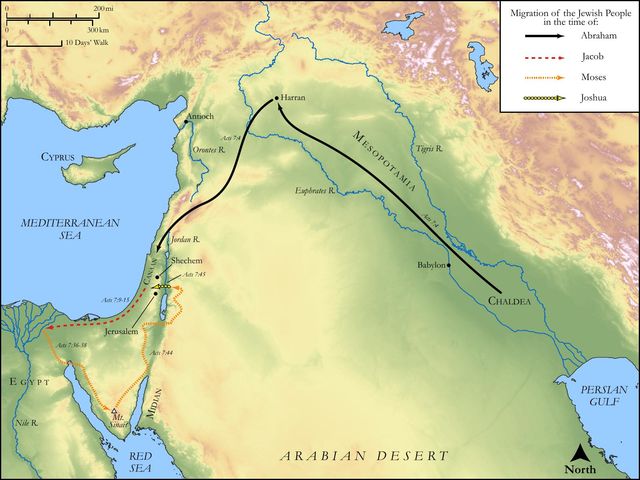
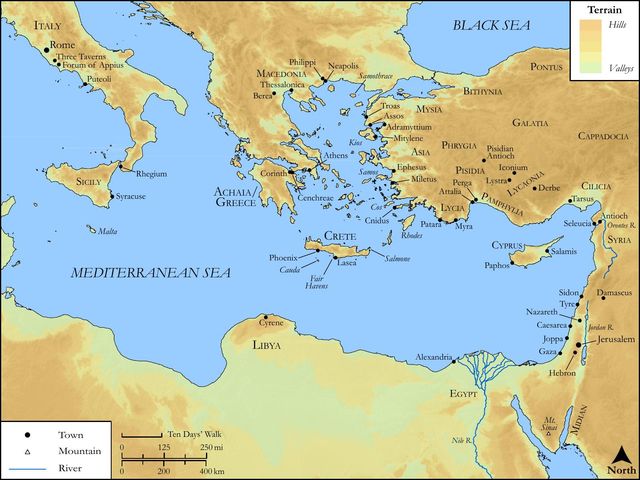
Study this verse
Public-domain commentary
Matthew Henry
From his Commentary on the Whole Bible. Henry comments on passages, not single verses — this entry covers Acts 7:42–50. His two-level outline is real structure in the source text, so it is rendered as structure.
Two things we have in these verses: -
I.Stephen upbraids them with the idolatry of their fathers, which God gave them up to, as a punishment for their early forsaking him in worshipping the golden calf; and this was the saddest punishment of all for that sin, as it was of the idolatry of the Gentile world that God gave them up to a reprobate mind. When Israel was joined to idols, joined to the golden calf, and not long after to Baal-peor, God said, Let them alone; let them go on (Act 7:42): Then God turned, and gave them up to worship the host of heaven. He particularly cautioned them not to do it, at their peril, and gave them reasons why they should not; but, when they were bent upon it, he gave them up to their own hearts; lust, withdrew his restraining grace, and then they walked in their own counsels, and were so scandalously mad upon their idols as never any people were. Compare Deu 4:19 with Jer 8:2. For this he quotes a passage out of Amo 5:25. For it would be less invidious to tell them their own [character and doom] from an Old Testament prophet, who upbraids them,
1.For not sacrificing to their own God in the wilderness (Act 7:42): Have you offered to me slain beasts, and sacrifices, by the space of forty years in the wilderness? No; during all that time sacrifices to God were intermitted; they did not so much as keep the passover after the second year. It was God's condescension to them that he did not insist upon it during their unsettled state; but then let them consider how ill they requited him in offering sacrifices to idols, when God dispensed with their offering them to him. This is also a check to their zeal for the customs that Moses delivered to them, and their fear of having them changed by this Jesus, that immediately after they were delivered these customs were for forty years together disused as needless things.
2.For sacrificing to other gods after they came to Canaan (Act 7:43): You took up the tabernacle of Moloch. Moloch was the idol of the children of Ammon, to which they barbarously offered their own children in sacrifice, which they could not do without great terror and grief to themselves and their families; yet this unnatural idolatry they arrived at, when God gave them up to worship the host of heaven. See Ch2 28:3. It was surely the strongest delusion that ever people were given up to, and the greatest instance of the power of Satan in the children of disobedience, and therefore it is here spoken of emphatically: Yea, you took up the tabernacle of Moloch, you submitted even to that, and to the worship of the star of your god Remphan. Some think Remphan signifies the moon, as Moloch does the sun; others take it for Saturn, for that planet is called Remphan in the Syriac and Persian languages. The Septuagint puts it for Chiun, as being a name more commonly known. They had images representing the star, like the silver shrines for Diana, here called the figures which they made to worship. Dr. Lightfoot thinks they had figures representing the whole starry firmament, with all the constellations, and the planets, and these are called Remphan - "the high representation," like the celestial globe: a poor thing to make an idol of, and yet better than a golden calf! Now for this it is threatened, I will carry you away beyond Babylon. In Amos it is beyond Damascus, meaning to Babylon, the land of the north. But Stephen changes it, with an eye to the captivity of the ten tribes, who were carried away beyond Babylon, by the river of Gozan, and in the cities of the Medes, Kg2 17:6. Let it not therefore seem strange to them to hear of the destruction of this place, for they had heard of it many a time from the prophets of the Old Testament, who were not therefore accused as blasphemers by any but the wicked rulers. It was observed, in the debate on Jeremiah's case, that Micah was not called to an account though he prophesied, saying, Zion shall be ploughed as a field, Jer 26:18, Jer 26:19.
II.He gives an answer particularly to the charge exhibited against him relating to the temple, that he spoke blasphemous words against that holy place, Act 7:44-50. He was accused for saying that Jesus would destroy this holy place: "And what if I did say so?" (saith Stephen) "the glory of the holy God is not bound up in the glory of this holy place, but that may be preserved untouched, though this be laid in the dust;" for, 1. "It was not till our fathers came into the wilderness, in their way to Canaan, that they had any fixed place of worship; and yet the patriarchs, many ages before, worshipped God acceptably at the altars they had adjoining to their own tents in the open air - sub dio; and he that was worshipped without a holy place in the first, and best, and purest ages of the Old Testament church, may and will be so when this holy place is destroyed, without any diminution to his glory." 2. The holy place was at first but a tabernacle, mean and movable, showing itself to be short-lived, and not designed to continue always. Why might not this holy place, though built of stones, be decently brought to its end, and give place to its betters, as well as that though framed of curtains? As it was no dishonour, but an honour to God, that the tabernacle gave way to the temple, so it is now that the material temple gives way to the spiritual one, and so it will be when, at last, the spiritual temple shall give way to the eternal one. 3. That tabernacle was a tabernacle of witness, or of testimony, a figure of good things to come, of the true tabernacle which the Lord pitched, and not men, Heb 8:2. This was the glory both of the tabernacle and temple, that they were erected for a testimony of that temple of God which in the latter days should be opened in heaven (Rev 11:19), and of Christ's tabernacling on earth (as the word is, Joh 1:14), and of the temple of his body. 4. That tabernacle was framed just as God appointed, and according to the fashion which Moses saw in the mount, which plainly intimates that it had reference to good things to come. Its rise being heavenly, its meaning and tendency were so; and therefore it was no diminution at all to its glory to say that this temple made with hands should be destroyed, in order to the building of another made without hands, which was Christ's crime (Mar 14:58), and Stephen's. 5. That tabernacle was pitched first in the wilderness; it was not a native of this land of yours (to which you think it must for ever be confined), but was brought in in the next age, by our fathers, who came after those who first erected it, into the possession of the Gentiles, into the land of Canaan, which had long been in the possession of the devoted nations whom God drove out before the face of our fathers. And why may not God set up his spiritual temple, as he had done the material tabernacle, in those countries that were now the possession of the Gentiles? That tabernacle was brought in by those who came with Jesus, that is, Joshua. And I think, for distinction sake, and to prevent mistakes, it ought to be so read, both here and Heb 4:8. Yet in naming Joshua here, which in Greek is Jesus, there may be a tacit intimation that as the Old Testament Joshua brought in that typical tabernacle, so the New Testament Joshua should bring in the true tabernacle into the possession of the Gentiles. 6. That tabernacle continued for many ages, even to the days of David, above four hundred years, before there was any thought of building a temple, Act 7:45. David, having found favour before God, did indeed desire this further favour, to have leave to build God a house, to be a constant settled tabernacle, or dwelling-place, for the Shechinah, or the tokens of the presence of the God of Jacob, Act 7:46. Those who have found favour with God should show themselves forward to advance the interests of his kingdom among men. 7. God had his heart so little upon a temple, or such a holy place as they were so jealous for, that, when David desired to build one, he was forbidden to do it; God was in no haste for one, as he told David (Sa2 7:7), and therefore it was not he, but his son Solomon, some years after, that built him a house. David had all that sweet communion with God in public worship which we read of in his Psalms before there was any temple built. 8. God often declared that temples made with hands were not his delight, nor could add any thing to the perfection of his rest and joy. Solomon, when he dedicated the temple, acknowledged that God dwelleth not in temples made with hands; he has not need of them, is not benefited by them, cannot be confined to them. The whole world is his temple, in which he is every where present, and fills it with his glory; and what occasion has he for a temple then to manifest himself in? Indeed the pretended deities of the heathen needed temples made with hands, for they were gods made with hands (Act 7:41), and had no other place to manifest themselves in than in their own temples; but the one only true and living God needs no temple, for the heaven is his throne, in which he rests, and the earth is his footstool, over which he rules (Act 7:49, Act 7:50), and therefore, What house will you build me, comparable to this which I have already? Or, what is the place of my rest? What need have I of a house, either to repose myself in or to show myself? Hath not my hand made all these things? And these show his eternal power and Godhead (Rom 1:20); they so show themselves to all mankind that those who worship other gods are without excuse. And as the world is thus God's temple, wherein he is manifested, so it is God's temple in which he will be worshipped. As the earth is full of his glory, and is therefore his temple (Isa 6:3), so the earth is, or shall be, full of his praise (Hab 3:3), and all the ends of the earth shall fear him (Psa 67:7), and upon this account it is his temple. It was therefore no reflection at all upon this holy place, however they might take it, to say that Jesus should destroy this temple, and set up another, into which all nations should be admitted, Act 15:16, Act 15:17. And it would not seem strange to those who considered that scripture which Stephen here quotes (Isa 66:1-3), which, as it expressed God's comparative contempt of the external part of his service, so it plainly foretold the rejection of the unbelieving Jews, and the welcome of the Gentiles that were of a contrite spirit into the church.
Historical interpretation
Three Centuries of Reception
5 surviving comments on this verse. Each one is dated, so this reads as a timeline rather than a list.
Select a marker to jump to its quote. Markers stagger vertically where authors wrote within a few decades of each other.
"Yea, ye took up the tabernacle of Moloch, and the star of your god Remphan: images which ye made to worship them." The cause of sacrifices! "And I will carry you away beyond Babylon." Even the captivity, an impeachment of their wickedness!
And you took up the tabernacle of Moloch. Although, he says, you appeared to bring victims and sacrifices to the tabernacle of the Lord, yet in your whole intention of heart, you embraced the shrine of Moloch. But Moloch, or Melchom, as it is often read, is the idol of the Ammonites, which is interpreted as your king.
The figures which you have made to worship them. It is understood, you have adopted them conjointly.
And the star of your god Remphan. You have forsaken (he says) the true and living God, and you have taken the star of Remphan, that is, your own creation, as God. But it signifies Lucifer, to whose worship the Saracen people were enslaved in honor of Venus. And because Remphan (as I said) means either your creation or your rest, the prophet subsequently added, and said:
And I will carry you beyond Babylon. Because of these (he says) sacrileges, you will be taken captive not only into Babylon but also beyond Babylon. Nor is the first martyr to be thought erring because he said beyond Babylon instead of beyond Damascus, as written in the prophet (Amos V). He considered the understanding more than the word, because they were led into Babylon beyond Damascus, just as beyond Babylon.
Continue studying Acts 7:43 across the web’s major study libraries — every link below opens this exact verse, chapter, or book on the destination site.
Read & Compare
 BibleGatewayThis verse in more than 200 translations and 70 languages.
 Bible.comThe YouVersion reader — hundreds of translations, reading plans, and highlights.
 ESV.orgCrossway's official English Standard Version reader.
 NET BibleThe NET translation with 60,000+ translators' notes on every rendering decision.
 STEP BibleTyndale House's free study tool — original text, vocabulary, and scholarly resources.
 BibliaLogos Bible Software's free web reader.
 USCCBThe New American Bible (Revised Edition) with the U.S. bishops' study notes.
Commentaries
 BibleHub CommentariesDozens of classic commentaries on this verse, gathered on one page.
 StudyLightMore than 100 commentary sets — the largest collection on the web.
 BibleRefPlain-English commentary on what this verse means, verse by verse.
 Enduring WordDavid Guzik's free commentary on this chapter, widely used by Bible teachers.
 Bible Study ToolsVerse commentary alongside Greek and Hebrew study aids.
Original Language & Research
- BibleHub InterlinearThe verse word by word — original language, transliteration, and English.
- BibleHub LexiconEvery word's original-language definition and Strong's entry.
 Blue Letter BibleDeep-study tools — Strong's numbers, concordance, and word studies.
 CNTR CollationThe earliest Greek manuscripts of this verse, collated letter by letter.
Sermons, Hymns & Audio


TrulyRandomVerse is not affiliated with these sites and doesn’t control their content. They’re linked because they’re genuinely useful.
Summary
Acts 7:43, a pivotal verse in Stephen's defense before the Sanhedrin, serves as a searing indictment of ancient Israel's persistent idolatry and rebellion against God. Quoting from the prophet Amos, Stephen highlights how the Israelites, despite miraculous deliverance and divine guidance, repeatedly turned to the worship of pagan deities like Moloch and Remphan, constructing physical representations for their devotion. This deep-seated unfaithfulness ultimately provoked God's righteous judgment, leading to their exile "beyond Babylon," a historical consequence that underscored the severe spiritual implications of their misplaced worship.
Context
ShowHideLiterary Context
Acts 7:43 is embedded within Stephen's lengthy and climactic sermon (Acts 7:1-53), which is a sweeping historical recounting of Israel's relationship with God from Abraham to Solomon. Stephen meticulously traces a recurring pattern: God's gracious initiatives, Israel's subsequent rebellion and rejection of His appointed leaders (like Moses, and implicitly, Jesus), and the resulting divine judgment. This specific verse, a direct quotation from Amos 5:26-27, comes at the sermon's crescendo, where Stephen directly confronts the Sanhedrin with their ancestors', and by extension their own, spiritual stubbornness and idolatry, culminating in their rejection of the Messiah. It functions as a historical proof text for Stephen's argument that Israel, despite possessing the Law and the Temple, consistently failed to truly worship God.
Historical & Cultural Context
The historical backdrop for Stephen's quotation from Amos is the pre-exilic period of Israel, specifically the Northern Kingdom, which was deeply entrenched in syncretistic worship. Moloch was a Canaanite deity, often associated with child sacrifice, a practice vehemently condemned in the Mosaic Law (e.g., Leviticus 18:21). Remphan, identified with the Assyrian/Babylonian god Kaiwan or the Egyptian god Saturn (Chiun in the Hebrew of Amos), represented astral worship, another form of idolatry prevalent among the nations round about. Stephen's use of these specific deities underscores the pervasive nature of pagan influence on Israelite religion. The "tabernacle of Moloch" and "star of Remphan" likely refer to portable shrines or cultic emblems used in their worship. The prophetic threat "I will carry you away beyond Babylon" refers to the Assyrian and Babylonian exiles, God's severe judgment for Israel's persistent unfaithfulness, which served as a stark historical warning to Stephen's audience.
Key Themes
ShowHideThis verse powerfully contributes to several overarching themes within Acts and the broader biblical narrative. Firstly, it highlights the theme of Persistent Idolatry, demonstrating Israel's recurring struggle to maintain exclusive devotion to Yahweh, despite repeated warnings and covenant obligations (e.g., Exodus 20:3-5). Secondly, it underscores the theme of Divine Judgment and Exile, illustrating God's righteous response to unfaithfulness, where the consequences of sin are severe and lead to separation from the promised land and divine favor. The exile "beyond Babylon" is a concrete example of this judgment. Finally, Stephen employs this historical pattern to emphasize the theme of Rejection of God's Messengers, implying that just as Israel rejected Moses and the prophets, they are now rejecting Jesus, the ultimate prophet and Messiah, thereby inviting a similar, if not greater, judgment (Luke 11:49-51).
Exposition and Analysis
ShowHideKey Word Analysis
ShowHideThis refers to an Ammonite deity (G3434) whose worship involved horrific child sacrifice, a practice explicitly forbidden and abhorrent to Yahweh. Stephen's mention of Moloch immediately evokes the most egregious forms of Israelite apostasy.
This is an incorrect transliteration (G4481) for the Hebrew "Chiun" (כִּיּוּן), identified as an Egyptian idol, likely a star-god or Saturn. Its inclusion alongside Moloch illustrates the widespread and diverse nature of Israel's syncretistic worship, encompassing various pagan cults.
Derived from a word meaning "to kiss, like a dog licking his master's hand," this term (G4352) signifies prostrating oneself in homage, doing reverence to, or adoring. Stephen uses it to highlight that Israel's actions were not mere cultural appropriation but a direct act of devotion and adoration toward false gods, diverting the worship due only to Yahweh.
Verse Breakdown
ShowHide"Yea, ye took up the tabernacle of Moloch,"
Stephen asserts that the Israelites actively embraced and carried cultic objects dedicated to Moloch, indicating a deliberate and public commitment to this pagan deity. The "tabernacle" (G4633, skēnḗ) here refers to a portable shrine or tent, contrasting sharply with the legitimate tabernacle of God, which was meant to be the sole dwelling place of divine presence among them.
"and the star of your god Remphan, figures which ye made to worship them:"
This clause further details the extent of their idolatry, specifying the "star" (G798, ástron), likely an emblem or symbol associated with Remphan, a deity of astral worship. The phrase "figures which ye made to worship them" (G5179, týpos - "figures"; G4160, poiéō - "made"; G4352, proskynéō - "worship") emphasizes their active, intentional creation and adoration of these idols, highlighting their culpability in turning away from the one true God.
"and I will carry you away beyond Babylon."
This is the divine pronouncement of judgment. "Carry you away" (G3351, metoikízō) signifies forced removal or exile. The phrase "beyond Babylon" (G1900, epékeina - "beyond"; G897, Babylṓn) refers to the historical exiles (Assyrian and Babylonian) that scattered Israel far from their homeland, illustrating the severe and far-reaching consequences of their persistent idolatry and disobedience.
Literary Devices
ShowHideStephen's use of Allusion is central to this verse, as it is a direct quotation from Amos 5:26-27. This strategic citation lends prophetic authority to Stephen's condemnation, demonstrating that Israel's idolatry was not a new phenomenon but a deep-seated historical pattern. There is also potent Symbolism at play: the "tabernacle of Moloch" and the "star of Remphan" are not merely physical objects but potent symbols of Israel's spiritual adultery and their rejection of the exclusive covenant relationship with Yahweh. The phrase "beyond Babylon" serves as a powerful Prophetic Judgment, not just a historical recounting, but a reminder that God's justice is sure and that disobedience leads to severe consequences, echoing the historical exiles and foreshadowing the judgment Stephen implies for his current audience.
Theological and Thematic Connections
ShowHideActs 7:43 profoundly illustrates the biblical truth that idolatry, in any form, is a direct affront to God's sovereignty and a betrayal of the covenant relationship. It reveals the human heart's propensity to create and worship gods of its own making, rather than submitting to the one true God. This historical example from Israel's past serves as a timeless warning that spiritual unfaithfulness inevitably leads to spiritual and often physical consequences, as God, in His holiness and justice, cannot tolerate rivals to His rightful place in the hearts of His people. The divine judgment of exile was not arbitrary but a just response to a sustained pattern of rebellion and a profound failure to worship God alone.
Reflection and Application
ShowHideActs 7:43 is a stark reminder that the human heart is an idol factory, constantly prone to creating and worshipping substitutes for God. While modern idolatry may not involve physical statues of Moloch or Remphan, it manifests in anything that competes for our ultimate loyalty, affection, and trust—be it money, career, power, possessions, relationships, self-image, or even intellectual pursuits. Stephen's historical indictment challenges us to deeply examine our own lives: What "figures" or desires have we "made to worship"? Where do we seek our ultimate security, identity, or satisfaction? This verse calls us to a radical reorientation of our lives, to dismantle any spiritual shrines we have erected, and to return to wholehearted devotion to the one true God, understanding that true freedom and blessing come only from worshipping Him exclusively. The consequences of misplaced worship, though perhaps not literal exile, can still be spiritual barrenness, brokenness, and a profound disconnect from the life-giving presence of God.
Questions for Reflection
ShowHideFAQ
ShowHideWhat is the significance of Stephen quoting Amos 5:26-27 in Acts 7:43?
ShowHideStephen's quotation of Amos 5:26-27 is highly significant. It serves as a powerful rhetorical device to demonstrate that Israel's history was consistently marked by rebellion and idolatry, despite God's covenant faithfulness. By quoting a prophet from centuries before, Stephen underscores that the problem of unfaithfulness was not new, but a deep-seated pattern. He uses this historical precedent to indict his contemporary audience, the Sanhedrin, implying that their rejection of Jesus, the Messiah, is merely the latest manifestation of their ancestors' long-standing spiritual rebellion and idolatry against God and His appointed messengers. It validates his argument that the Jewish leaders, despite their outward piety, were spiritually no different from their idol-worshipping forefathers.
Who were Moloch and Remphan, and why were they worshipped by the Israelites?
ShowHideMoloch was a Canaanite deity, often associated with the Ammonites, whose worship involved the horrific practice of child sacrifice, explicitly forbidden by God in the Mosaic Law (e.g., Leviticus 18:21). Remphan is the Greek transliteration of the Hebrew "Chiun" (כִּיּוּן) from Amos 5:26, identified with the Assyrian/Babylonian god Kaiwan, or the Egyptian god Saturn, representing astral worship. The Israelites, despite God's clear commands for exclusive worship, repeatedly fell into syncretism, adopting the religious practices of the surrounding pagan nations. This was often driven by a desire for perceived fertility, prosperity, or power, or simply by the cultural pressures of their neighbors. Their worship of these deities was a profound betrayal of their covenant with Yahweh, who had delivered them from Egypt and established them as His unique people (Deuteronomy 6:14).
What does "I will carry you away beyond Babylon" signify?
ShowHideThe phrase "I will carry you away beyond Babylon" is a prophetic declaration of divine judgment, directly referencing the historical exiles of Israel. While the immediate context in Amos refers to the Assyrian exile (which occurred before the Babylonian exile), Stephen's broader statement "beyond Babylon" (G1900, epékeina) emphasizes a more distant and complete dispersion. It signifies that God's judgment for their idolatry would be severe and would lead to their removal from the Promised Land, scattering them far into foreign lands. This served as a stark historical warning of the consequences of unfaithfulness, demonstrating that God would indeed fulfill His covenant curses for disobedience, just as He fulfilled His blessings for obedience (Deuteronomy 28:64).
Christ-Centered Fulfillment
ShowHideActs 7:43, with its scathing indictment of Israel's idolatry and the resultant judgment of exile, finds profound Christ-centered fulfillment in several ways. Firstly, Jesus Christ is the ultimate and true object of worship, the one to whom all genuine adoration and devotion is due. Unlike the false gods Moloch and Remphan, who demanded human sacrifice and led to spiritual death, Jesus is the Lamb of God who takes away the sin of the world, offering Himself as the perfect, once-for-all sacrifice, thereby freeing humanity from the spiritual slavery of idolatry and sin (Hebrews 9:26). Secondly, the judgment of exile "beyond Babylon" foreshadows the spiritual exile of humanity from God due to sin, a separation that only Christ can bridge. Through His atoning work, Jesus brings us out of spiritual bondage and into His glorious kingdom, offering true spiritual freedom and reconciliation with God (Colossians 1:13-14). Finally, Stephen's sermon, culminating in this verse, implicitly argues that the Jewish leaders, by rejecting Jesus, were repeating their ancestors' pattern of rejecting God's ultimate messenger. Christ, as the true prophet greater than Moses, is the one through whom God now speaks definitively (Hebrews 1:1-2), calling all people, Jew and Gentile, to turn from all forms of idolatry—whether overt or subtle—and to worship Him alone in spirit and truth (John 4:23-24). In Christ, the cycle of idolatry and judgment is broken for all who believe, as He delivers us from the worship of created things to the worship of the Creator.