


Zephaniah 1:1
Bible text: King James Version (1769 Blayney text) · Public domain
Bible text: King James Version with Strong's numbers · Public domain
Bible text: Berean Standard Bible · Public domain
Bible text: American Standard Version (1901) · Public domain
Bible text: World English Bible, Messianic edition · Public domain
Bible text: Geneva Bible (1599) · Public domain
Bible text: Young's Literal Translation · Public domain
- דְּבַרde·var[the] word ofH1697N-mscNoun Singular Masculine Construct
- יְהוָהYah·wehYahwehH3068N-properNoun Proper Title
- אֲשֶׁר'a·SherwhichH834RelParticle Relative
- הָיָהha·Yahit cameH1961V-Qal-Perf-3msVerb Qal Perfect 3rd Singular Masculine
- אֶל'eltoH413PrepPreposition
- צְפַנְיָהtze·fan·YahZephaniahH6846N-proper-mNoun Proper Masculine
- בֶּןben[the] son ofH1121N-mscNoun Singular Masculine Construct
- כּוּשִׁיku·ShiCushiH3569N-proper-mNoun Proper Masculine
- בֶןven[the] son ofH1121N-mscNoun Singular Masculine Construct
- גְּדַלְיָהge·dal·YahGedaliahH1436N-proper-mNoun Proper Masculine
- בֶּןben[the] son ofH1121N-mscNoun Singular Masculine Construct
- אֲמַרְיָה'a·mar·YahAmariahH568N-proper-mNoun Proper Masculine
- בֶּןben[the] son ofH1121N-mscNoun Singular Masculine Construct
- חִזְקִיָּהchiz·ki·YahHezekiahH2396N-proper-mNoun Proper Masculine
- בִּימֵיbi·Meiin [the] days ofH3117Prep-b ¦ N-mpcNoun Plural Masculine Constructבִּinימֵי[the] days of
- יֹאשִׁיָּהוּyo·shi·Ya·huJosiahH2977N-proper-mNoun Proper Masculine
- בֶןven[the] son ofH1121N-mscNoun Singular Masculine Construct
- אָמוֹן'a·MonAmonH526N-proper-mNoun Proper Masculine
- מֶלֶךְMe·lekh[the] king ofH4428N-mscNoun Singular Masculine Construct
- יְהוּדָהye·hu·DahJudahH3063N-properNoun Proper Location
English is a literal word-by-word gloss of the Hebrew, not the KJV's wording. Why?
This is the original text the KJV's translators worked from — each Hebrew word with its own literal English meaning in this verse, prepared by scholars at Tyndale House, Cambridge. The KJV translates whole sentences, not word by word, so its wording differs: one Hebrew word can become several English words, and the KJV may choose “the LORD” where the gloss reads “Yahweh”. Both are faithful — they answer different questions. For the KJV's own rendering, switch to the KJV text.
Details
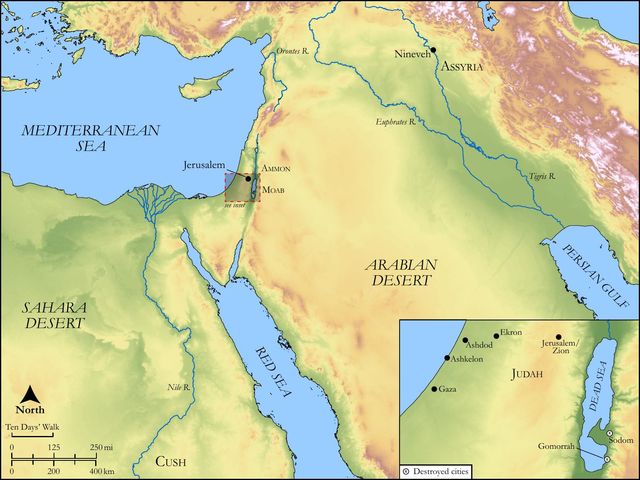
See on the biblical-era map
Study this verse
Public-domain commentary
Matthew Henry
From his Commentary on the Whole Bible. Henry comments on passages, not single verses — this entry covers Zephaniah 1:1–6. His four-level outline is real structure in the source text, so it is rendered as structure.
Here is, I. The title-page of this book (Zep 1:1), in which we observe, 1. What authority it has, and who gave it that authority; it is from heaven, and not of men: It is the word of the Lord. 2. Who was the instrument of conveying it to the church. His name was Zephaniah, which signifies the servant of the Lord, for God revealed his secrets to his servants the prophets. The pedigree of other prophets, whose extraction we have an account of, goes no further back than their father, except Zecharias, whose grandfather also is named. But this of Zephaniah goes back four generations, and the highest mentioned is Hizkiah; it is the very same name in the original with that of Hezekiah king of Judah (Kg2 18:1), and refers probably to him; if so, our prophet, being lineally descended from that pious prince, and being of the royal family, could with the better grace reprove the folly of the king's children as he does, Zep 1:8. 3. When this prophet prophesied - in the days of Josiah king of Judah, who reigned well, and in the twelfth year of his reign began vigorously, and carried on a work of reformation, in which he destroyed idols and idolatry. Now it does not appear whether Zephaniah prophesied in the beginning of his reign; if so, we may suppose his prophesying had a great and good influence on that reformation. When he, as God's messenger, reproved the idolatries of Jerusalem, Josiah, as God's vice-regent, removed them; and reformation is likely to go on and prosper when both magistrates and ministers do their part towards it. If it were towards the latter end of his reign that he prophesied, we sadly see how a corrupt people relapse into their former distempers. The idolatries Josiah had abolished, it should seem, returned in his own time, when the heat of the reformation began a little to abate and wear off. What good can the best reformers do with a people that hate to be reformed, as if they longed to be ruined?
II.The summary, or contents, of this book.
The general proposition contained in it is, That utter destruction is coming apace upon Judah and Jerusalem for sin. Without preamble, or apology, he begins abruptly (Zep 1:2): By taking away I will make an end of all things from off the face of the land, Saith the Lord. Ruin is coming, utter ruin, destruction from the Almighty. He has said it who can, and will, make good what he has said: "I will utterly consume all things. I will gather all things" (so some); "I will recall all the blessings I have bestowed, because they have abused them and so forfeited them." The consumption determined shall take away,
1.The inferior creatures: I will consume the beasts, the fowls of the heaven, and the fishes of the sea (Zep 1:3), as, in the deluge, every living substance was destroyed that was upon the face of the ground, Gen 7:23. The creatures were made for man's use, and therefore when he has perverted the use of them, and made them subject to vanity, God, to show the greatness of his displeasure against the sin of man, involves them in his punishment. The expressions are figurative, denoting universal desolation. Those that fly ever so high, as the fowls of heaven, and think themselves out of the reach of the enemies' hand - those that hide ever so close, as the fishes of the sea, and think themselves out of the reach of the enemies' eye - shall yet become a prey to them, and be utterly consumed.
2.The children of men: "I will consume man; I will cut off man from the land. The land shall be dispeopled and left uninhabited; I will destroy, not only Israel, but man. The land shall enjoy her sabbaths. I will cut off, not only the wicked men, but all men; even the few among them that are good shall be involved in this common calamity. Though they shall not be cut off from the Lord, yet they shall be cut off from the land." It is with Judah and Jerusalem that God has this quarrel, both city and country, and upon them he will stretch out his hand, the hand of his power, the hand of his wrath; and who knows the power of his anger? Zep 1:4. Those that will not humble themselves under God's mighty hand shall be humbled and brought down by it. Note, Even Judah, where God is known, and Jerusalem, where his dwelling-place is, if they revolt from him and rebel against him, shall have his hand stretched out against them.
3.All wicked people, and all those things that are the matter of their wickedness (Zep 1:3): "I will consume the stumbling-blocks with the wicked, the idols with the idolaters, the offences with the offenders." Josiah had taken away the stumbling-blocks, and, as far as he could, had purged the land of the monuments of idolatry, hoping that there would be no more idolatry; but the wicked will do wickedly, the dog will return to his vomit, and therefore, since the sin will not otherwise be cured, the sinners must themselves be consumed, even the wicked with the stumbling-blocks of their iniquity, Eze 14:3. Since it was not done by the sword of justice, it shall be done by the sword of war. See who the sinners are that shall be consumed.
(1.)The professed idolaters, who avowed idolatry, and were wedded to it. The remnant of Baal shall be cut off, the images of Baal, and the worshippers of those images. Josiah cut off a great deal of Baal; but that which was so close as to escape the eye, or so bold as to escape the hand, of his justice, God will cut off, even all the remains of it. The Chaldeans would spare none of the images of Baal, or the worshippers of those images. The Chemarim shall be cut off; we read of them in the history of Josiah's reformation. Kg2 23:5, He put down the idolatrous priests: the word is the Chemarim. The word signifies black men, some think because they wore black clothes, affecting to appear grave, others because their faces were black with attending the altars, or the fires in which they burnt their children to Moloch. They seem to have been immediate attendants upon the service of Baal. They shall be cut off with the priests, the regulars with the seculars. The very name of them shall be cut off; the order shall be quite abolished, so as to be forgotten, or remembered with detestation. And, among other idolaters, the worshippers of the host of heaven upon the house-tops shall be cut off (Zep 1:5), who justified themselves in their idolatry with those that did not worship images, the work of their own hands, but offered their sacrifices and burnt their incense to the sun, moon, and stars, immediately upon the tops of their houses. But God will let them know that he is a jealous God, and will not endure any rival; and, though some have thought that the most specious and plausible idolatry, yet it will appear as great an offence to God to give divine honours to a star as to give them to a stone or a stock. Even the worshippers of the host of heaven shall be consumed as well as the worshippers of the beasts of the earth or the fiends of hell. The sin of the adulteress is not the less sinful for the gaiety of the adulterer.
(2.)Those also shall be consumed that think to compound the matter between God and idols, and keep an even hand between them, that halt between God and Baal, and worship between Jehovah and Moloch, and swear by both; or, as it might better be read, swear to the Lord and to Malcham. They bind themselves by oath and covenant to the service both of God and idols. They have a good opinion of the worship of the God of Israel; it is the religion of their country, and has been long so, and therefore they will by no means quit it; but they think it will be very much improved and beautified if they join with it the worship of Moloch, for that also is much used in other countries, and travellers admire it; there is a great deal of good fancy and strong flame in it. They cannot keep always to the worship of a God whom they have no visible representation of, and therefore they must have an image; and what better than the image of Moloch - a king? They think they shall effectually atone for their sin if they swear to Moloch, and, pursuant to that oath, burn their children in sacrifice to that idol; and yet, if they do amiss in that, they hope to atone for it in worshipping the God of Israel too. Note, Those that think to divide their affections and adorations between God and idols will not only come short of acceptance with God, but will have their doom with the worst of idolaters; for what communion can there be between light and darkness, Christ and Belial, God and mammon? She whose own the child is not pleads for the dividing of it, for, if Satan have half, he will have all; but the true mother says, Divide it not, for, if God have but half, he will have none. Such waters will not be long sweet, if they come from a fountain that sends forth bitter water too; what have those to do to swear by the Lord that swear by Malcham?
(3.)Those also shall be consumed that have apostatized from God, together with those that never gave up their names to him, Zep 1:6. I will cut off,
[1.]Those that are turned back from the Lord, that were well taught, and began well, that had given up their names to him, and set out at first in the worship of him, but have flown off, and turned aside, and fallen in with idolaters, and deserted those good ways of God which they were brought up in, and despised them. Those God will be sure to reckon with who are renegadoes from his service, who began in the Spirit and ended in the flesh; they shall be treated as deserters, to whom no mercy is shown.
[2.]Those that have not sought the Lord, nor ever enquired for him, never made any profession of religion, and think to excuse themselves with that, shall find that this will not excuse them; nay, this is the thing laid to their charge; they are atheistical careless people, that live without God in the world; and those that do so are certainly unworthy to live upon God in the world.
Historical interpretation
Fourteen Centuries of Reception
2 surviving comments on this verse. Each one is dated, so this reads as a timeline rather than a list.
Select a marker to jump to its quote. Markers stagger vertically where authors wrote within a few decades of each other.
(Chapter I, Verse 1) The word of the Lord that came to Zephaniah, the son of Cushi, the son of Gedaliah, the son of Amariah, the son of Hezekiah, in the days of Josiah, the son of Ammon, king of Judah. The Septuagint similarly. The Hebrews report that the father or grandfather of any prophet is mentioned in the title, indicating that they themselves were also prophets. Therefore, Amos, one of the twelve prophets, who said, 'I am not a prophet, nor am I the son of a prophet, but I am a herdsman and a gatherer of sycamore fruit' (Amos 7:14), does not have his father's name mentioned in the title. If this is true, Sophonias the prophet, whom we are now attempting to explain, received a prophetic name, so to speak, and was born from the glorious lineage of his ancestors; for he had Chusi as his father, Godolias as his grandfather, Amarias as his great-grandfather, and Ezechias as his great-great-grandfather: and he himself completed such a team of horses as the last charioteer. Some have translated the name Sophonias as "watchtower," others as "hidden by the Lord." Therefore, whether it is interpreted as a watchtower or as hidden by the Lord, both meanings apply to the prophet. For it is said also to Ezekiel: Son of man, I have made you a watchman for the house of Israel (Ezek. III, 17). And in another place: The Lord does nothing unless he reveals his secret to his servants, the prophets. And the title of the ninth psalm is interpreted as for the hidden things of the son. Therefore, this prophet, who was in the watchtower and stationed on high, and knew the mysteries of the Lord, was the son of Cush (which is interpreted as humility, or my Ethiopian, about whom we will discuss later), and he also had a grandfather named Godoliah, who is called the greatness of the Lord, and a great-grandfather named Amariah, who also turns into the word of the Lord: and a great-great-grandfather named Hezekiah, which means the strength of the Lord. About the strength of the Lord, the word of the Lord was born. And from the word of the Lord, the magnitude of the Lord was born. And from the magnitude of the Lord, humility was born, so that when someone reaches perfection, they may say: I am not worthy to be called an apostle (I Corinthians 9). And that in the Psalms: Lord, my heart is not exalted, nor are my eyes lofty (Psalm 130:1). Up until now, we have stumbled like one in a downward slide, and running on level ground, in what Chusi, even my Ethiopian, interprets. For after so many virtues, how can the name of the Ethiopian sound in praise? And indeed, if the Scripture had said 'Chus', that is, Ethiopian, the question seemed unsolvable; for Chus was born of Cham. But in what he says, 'Chusi', that is, my Ethiopian, it seems to sound a mystery: that he who was once an Ethiopian, turned to repentance (according to what is said: 'Ethiopia shall stretch out her hands to God' (Ps. 68:32)). And in another place (Ps. 71, 9): Ethiopians shall fall before him. Let the bride say in the Song of Songs: I am black, but beautiful, O daughters of Jerusalem (Song of Songs 1, 4). We also read in Jeremiah that Abdimelech, an Ethiopian eunuch, pleased God (Jer. 38). And in the Acts of the Apostles, we learn that the Ethiopian eunuch of the queen Candace had such a devotion to the Scriptures and the Law of God that he would read them in his chariot, and came to Jerusalem to worship the Lord in his temple (Acts 8, 9). Where such faith is crowned with fitting reward, and Philip the evangelist is sent to him, and immediately he is taught, believes, is baptized, and is saved. And not only is he a eunuch, but with the additional descriptor of man, he is an Ethiopian eunuch. For because he was a eunuch for Christ's sake, and had castrated himself for the sake of the kingdom of heaven, therefore he had not lost the label of man. And rightly also does Zephaniah, like the son of Cush, that is, the Ethiopian, in the later books write of the repentance of the Ethiopians: Through the rivers, he says, of Ethiopia, they shall bring my offerings from there. This is about the genealogy of Zephaniah, who prophesied in the days of Josiah. However, the days are also called of Elijah those who were enlightened by him: just as the days of Josiah, who had risen to the Lord (for Josiah means the lifting up of the Lord) and he was a righteous man. The history also writes about his praises, as well as the Chronicles and the Book of Kings (2 Kings 23 and 2 Chronicles 34). And he had a father named Ammon and a grandfather named Manasseh (2 Kings 21). We read that Manasseh, after many crimes and after the captivity in Babylon, repented and obtained the mercy of the Lord, who turned him to better things. And because of his faith, by which he believed in God, he called his son ἐπώνυμον, that is, Ammon: since Ammon () means faith. At the same time, consider that the ten tribes, that is, the kings of Israel, are not mentioned above, but only the kings of Judah. For indeed, the ten tribes had been taken into captivity by the Assyrians under King Hezekiah, the father of Manasseh (2 Kings 17). This is in the prologue and in the title of the book of Zephaniah, concerning the generation and time. Now let us see what the prophecy itself contains.
SOPHONIAS, whose name, saith St. Jerome, signifies The Watchman of the Lord, or The hidden of the Lord, prophesied in the beginning of the reign of Josias. He was a native of Sarabatha, and of the tribe of Simeon, according to the more general opinion. He prophesied the punishments of the Jews, for their idolatry and other crimes; also the punishments that were to come on divers nations; the coming of Christ, the conversion of the Gentiles, the blindness of the Jews, and their conversion towards the end of the world.
Continue studying Zephaniah 1:1 across the web’s major study libraries — every link below opens this exact verse, chapter, or book on the destination site.
Read & Compare
 BibleGatewayThis verse in more than 200 translations and 70 languages.
 Bible.comThe YouVersion reader — hundreds of translations, reading plans, and highlights.
 ESV.orgCrossway's official English Standard Version reader.
 NET BibleThe NET translation with 60,000+ translators' notes on every rendering decision.
 STEP BibleTyndale House's free study tool — original text, vocabulary, and scholarly resources.
 BibliaLogos Bible Software's free web reader.
 USCCBThe New American Bible (Revised Edition) with the U.S. bishops' study notes.
Commentaries
 BibleHub CommentariesDozens of classic commentaries on this verse, gathered on one page.
 StudyLightMore than 100 commentary sets — the largest collection on the web.
 BibleRefPlain-English commentary on what this verse means, verse by verse.
 Enduring WordDavid Guzik's free commentary on this chapter, widely used by Bible teachers.
 Bible Study ToolsVerse commentary alongside Greek and Hebrew study aids.
Original Language & Research
- BibleHub InterlinearThe verse word by word — original language, transliteration, and English.
- BibleHub LexiconEvery word's original-language definition and Strong's entry.
 Blue Letter BibleDeep-study tools — Strong's numbers, concordance, and word studies.
 SefariaThe Hebrew text with Rashi and centuries of Jewish commentary.
Sermons, Hymns & Audio


TrulyRandomVerse is not affiliated with these sites and doesn’t control their content. They’re linked because they’re genuinely useful.
Summary
Zephaniah 1:1 serves as the authoritative superscription to the book, meticulously introducing the prophet Zephaniah by name and an unusually extensive four-generation lineage, which likely connects him to King Hezekiah. This verse precisely anchors the prophetic message within a specific historical period, "in the days of Josiah the son of Amon, king of Judah," thereby establishing the divine origin and historical context for the pronouncements of judgment and hope that follow.
Context
ShowHideLiterary Context
As the opening verse of a prophetic book, Zephaniah 1:1 functions as a foundational superscription, a common literary device found in many prophetic works (e.g., Isaiah 1:1, Jeremiah 1:1-3, Hosea 1:1). Its primary purpose is to establish the divine authority of the message and the human agency through which it was delivered. The detailed genealogy of Zephaniah, extending four generations, is notably more extensive than typical prophetic introductions, lending additional weight and credibility to his person and message. This specificity immediately grounds the ensuing prophecies in a concrete historical reality, preparing the reader for a message directly relevant to Judah in the late 7th century BCE.
Historical & Cultural Context
Zephaniah's ministry is explicitly dated to the reign of King Josiah (640-609 BCE). This period followed the long, idolatrous reigns of Manasseh and Amon, during which Judah had deeply entrenched itself in pagan practices, including Baal worship, astral cults, and even child sacrifice. Josiah initiated significant religious reforms, beginning around 622 BCE with the discovery of the Book of the Law (2 Kings 22 and 2 Chronicles 34). Zephaniah's prophecies, particularly their stern warnings against idolatry and oppression, suggest his ministry likely began in the earlier part of Josiah's reign, perhaps before the full impact of these reforms had taken hold, or at least while the deep-seated corruption still necessitated divine warning. The geopolitical landscape was also shifting, with the Assyrian Empire in decline and the rising power of Babylon, creating an unstable environment for Judah.
Key Themes
ShowHideThis introductory verse immediately introduces several key themes that permeate the book of Zephaniah. Firstly, the theme of Divine Revelation and Authority is paramount, as the "word of the LORD" underscores that the subsequent pronouncements are not human opinions but direct, authoritative messages from God. Secondly, the detailed lineage and historical dating establish the Legitimacy and Authenticity of the Prophet, affirming Zephaniah as a true messenger in the prophetic tradition. Lastly, the mention of Josiah's reign and Judah highlights the theme of God's Engagement with History, demonstrating that divine judgment and salvation are not abstract concepts but are intricately woven into the specific historical circumstances of His people, setting the stage for the coming "Day of the Lord" which is a central motif of the book (Zephaniah 1:7).
Exposition and Analysis
ShowHideKey Word Analysis
ShowHideFrom the root meaning "to speak," this term signifies more than just an utterance; it denotes a message, a matter, a thing, or an affair. In the context of "the word of the LORD," it carries the weight of divine decree, authoritative pronouncement, and active power. It is not merely information but a potent reality that brings about what it declares.
This is the covenant name of God, often transliterated as Yahweh, signifying "the self-Existent or Eternal." Its use here emphasizes that the message originates from the sovereign, unchanging God who is in covenant relationship with Israel. It underscores His absolute authority and faithfulness, even when delivering messages of judgment.
This name means "Jah has secreted" or "the LORD has hidden/treasured." This meaning is profoundly significant for the book's message. While much of Zephaniah details widespread judgment and destruction, the name subtly foreshadows the preservation of a remnant—those whom the LORD will hide or treasure from the coming wrath, offering a glimmer of hope amidst the declarations of doom.
Verse Breakdown
ShowHide"The word of the LORD which came unto Zephaniah"
This opening phrase immediately establishes the divine origin and prophetic nature of the book. It indicates that the message is not Zephaniah's own thoughts or opinions, but a direct, authoritative revelation from Yahweh. The verb "came" (הָיָה, hayah) implies a dynamic, active reception of the divine message by the prophet, highlighting his role as a recipient and conveyor of God's truth.
"the son of Cushi, the son of Gedaliah, the son of Amariah, the son of Hizkiah"
This unusually extensive four-generation genealogy serves multiple purposes. Firstly, it authenticates Zephaniah's identity and lineage, lending credibility to his prophetic office. Secondly, the tracing back to "Hizkiah" (Hebrew, Chizqîyâh), widely believed to be King Hezekiah, suggests a royal lineage for Zephaniah. This connection would have given his message significant weight and perhaps even access to the royal court, underscoring the gravity of his pronouncements to the people and leadership of Judah.
"in the days of Josiah the son of Amon, king of Judah"
This precise historical dating anchors the prophecy to a specific time in Judah's history. Josiah's reign was marked by efforts at religious reform following periods of intense idolatry. By dating the prophecy to this period, the verse sets the stage for understanding the socio-religious conditions that necessitated Zephaniah's stern warnings against persistent syncretism, injustice, and spiritual apathy, even amidst a reforming king's efforts. It highlights the deep-seated corruption that still plagued Judah.
Literary Devices
ShowHideZephaniah 1:1 primarily employs Superscription and Genealogy as key literary devices. The entire verse functions as a superscription, which is a common feature in prophetic literature, serving to introduce the prophet, the source of the message, and its historical context. This device immediately establishes the Authority of the text as divinely inspired, rather than merely human opinion. The detailed genealogy, tracing Zephaniah's lineage back four generations, is a form of Authentication, providing a robust background for the prophet. This extended lineage, particularly the implied connection to King Hezekiah, also serves as a subtle form of Ethos or credibility, suggesting that the prophet's words carry not only divine weight but also a certain social or political gravitas within Judah. The specific dating to King Josiah's reign functions as a form of Historical Anchoring, firmly placing the prophecy within a known historical epoch, allowing readers to understand the socio-political and religious landscape that forms the backdrop for God's message.
Theological and Thematic Connections
ShowHideZephaniah 1:1 lays the theological groundwork for the entire book by emphasizing the sovereignty and communicative nature of God. The phrase "the word of the LORD came" asserts that God is not a distant deity but one who actively intervenes in human history, revealing His will and purpose. This divine initiative underscores the seriousness of the message, whether it be one of impending judgment or future restoration. The emphasis on Zephaniah's lineage and the specific historical dating further highlights God's engagement with particular people in specific times, demonstrating that His prophetic word is always relevant to the lived realities of His covenant people. This foundational verse thus establishes the divine authority and historical specificity through which God's justice and mercy will be unfolded.
Reflection and Application
ShowHideZephaniah 1:1, though a simple introductory verse, offers profound truths for contemporary reflection. It reminds us that God is a speaking God, actively communicating His will and truth to humanity. The authority of His "word" is paramount, transcending human opinion or cultural trends. Just as Zephaniah was called to deliver a message relevant to his specific historical context, God's Word continues to speak powerfully into our present circumstances, calling us to listen, understand, and obey. The detailed historical anchoring encourages us to engage with Scripture not as abstract principles but as living narratives deeply intertwined with human history, prompting us to seek God's truth within our own historical moment. Ultimately, this verse challenges us to consider the source of truth we rely upon and to recognize the enduring relevance and transformative power of God's revealed Word in our lives.
Questions for Reflection
ShowHideFAQ
ShowHideWhy is Zephaniah's genealogy so detailed compared to other prophets?
ShowHideThe detailed four-generation genealogy of Zephaniah, tracing back to "Hizkiah," is notably more extensive than most prophetic introductions (e.g., Isaiah 1:1 or Amos 1:1). Scholars widely believe this "Hizkiah" refers to King Hezekiah, making Zephaniah a descendant of royalty. This extensive lineage serves to significantly enhance the prophet's credibility and authority, perhaps granting him a unique standing or access within the royal court of Judah, thereby adding weight to his pronouncements of divine judgment and hope.
What was the significance of Josiah's reign for Zephaniah's prophecy?
ShowHideKing Josiah's reign (640-609 BCE) was a pivotal period in Judah's history, marked by significant religious reforms aimed at eradicating idolatry and restoring pure worship of Yahweh, as detailed in 2 Kings 22-23 and 2 Chronicles 34-35. Zephaniah's ministry likely occurred early in Josiah's reign, before the full implementation of these reforms. His prophecies, with their strong condemnations of idolatry, oppression, and syncretism, highlight that despite the king's efforts, deep-seated corruption and spiritual apathy persisted among the people. This timing underscores the divine imperative for genuine heart-change and repentance, rather than mere outward religious observance.
Does Zephaniah's name, "The LORD has hidden," have any special meaning for the book's message?
ShowHideYes, the meaning of Zephaniah's name, "Jah has secreted" or "the LORD has hidden/treasured," carries profound thematic significance for the book. While much of the prophecy focuses on the impending "Day of the LORD" and widespread judgment, the name subtly foreshadows the concept of a preserved remnant. Amidst the universal destruction, God promises to "hide" or "treasure" a faithful few who will survive the judgment and form the basis for future restoration (Zephaniah 2:3 and Zephaniah 3:12-13). Thus, the prophet's name itself contains a glimmer of hope and grace within a message predominantly focused on divine wrath.
Christ-Centered Fulfillment
ShowHideWhile Zephaniah 1:1 primarily serves as an introductory superscription, its emphasis on "the word of the LORD" coming to a specific prophet in a particular historical context points forward to the ultimate and final Word of God, Jesus Christ. In the Old Testament, God spoke "at various times and in various ways by the prophets" (Hebrews 1:1), but in the "last days," He has spoken to us "by His Son" (Hebrews 1:2). Jesus is not merely a messenger of the Word, but He is the Word made flesh (John 1:14), the full and complete revelation of God's character and will. Just as Zephaniah's message was anchored in the historical reality of Judah under Josiah, so too is Christ's advent and redemptive work firmly rooted in human history, fulfilling the prophetic promises. The authority established in Zephaniah 1:1 finds its ultimate and perfect embodiment in Christ, through whom God's final and saving word has been delivered to humanity (John 1:18).