


2 Chronicles 34:33
Bible text: King James Version (1769 Blayney text) · Public domain
Bible text: King James Version with Strong's numbers · Public domain
Bible text: Berean Standard Bible · Public domain
Bible text: American Standard Version (1901) · Public domain
Bible text: World English Bible, Messianic edition · Public domain
Bible text: Geneva Bible (1599) · Public domain
Bible text: Young's Literal Translation · Public domain
- וַיָּסַרvai·Ya·sarand he removedH5493Conj-w ¦ V-Hiphil-ConsecImperf-3msVerb Hiphil Consecutive Imperfect 3rd Singular Masculineוַandיָּסַרhe removed
- יֹאשִׁיָּהוּyo·shi·Ya·huJosiahH2977N-proper-mNoun Proper Masculine
- אֶת'et<obj.>H853DirObjMParticle Object Indicator
- כָּלkolallH3605N-mscNoun Singular Masculine Construct
- הַתּוֹעֵבוֹתha·to·'e·Votthe abominationsH8441Art ¦ N-fpNoun Plural Feminine Absoluteהַtheתּוֹעֵבוֹתabominations
- מִכָּלmi·kolfrom allH3605Prep-m ¦ N-mscNoun Singular Masculine Constructמִfromכָּלall
- הָאֲרָצוֹתha·'a·ra·tzOtthe landsH776Art ¦ N-fpNoun Plural Feminine Absoluteהָtheאֲרָצוֹתlands
- אֲשֶׁר'a·SherwhichH834RelParticle Relative
- לִבְנֵיliv·Nei[belonged] to [the] people ofH1121Prep-l ¦ N-mpcNoun Plural Masculine Constructלִ[belonged] toבְנֵי[the] people of
- יִשְׂרָאֵלYis·ra·'ElIsraelH3478N-properNoun Proper Location
- וַיַּעֲבֵדvai·ya·'a·Vedand he made to serveH5647Conj-w ¦ V-Hiphil-ConsecImperf-3msVerb Hiphil Consecutive Imperfect 3rd Singular Masculineוַandיַּעֲבֵדhe made to serve
- אֵת'et<obj.>H853DirObjMParticle Object Indicator
- כָּלkoleveryH3605N-msNoun Singular Masculine Absolute
- הַנִּמְצָאha·nim·Tza'<the> [one who] was foundH4672Art ¦ V-Niphal-Prtcpl-msVerb Niphal Participle Singular Masculine Absoluteהַ<the>נִּמְצָא[one who] was found
- בְּיִשְׂרָאֵלbe·Yis·ra·'Elin IsraelH3478Prep-b ¦ N-properNoun Proper LocationבְּinיִשְׂרָאֵלIsrael
- לַעֲבוֹדla·'a·Vodto serveH5647Prep-l ¦ V-Qal-InfVerb Qal Infinitive Constructלַtoעֲבוֹדserve
- אֶת'et<obj.>H853DirObjMParticle Object Indicator
- יְהוָהYah·wehYahwehH3068N-properNoun Proper Title
- אֱלֹהֵיהֶם'e·lo·hei·Hemtheir GodH430N-mpc ¦ 3mpNoun Plural Masculine ConstructאֱלֹהֵיGodהֶםtheir
- כָּלkolallH3605N-mscNoun Singular Masculine Construct
- יָמָיוya·Mavhis daysH3117N-mpc ¦ 3msNoun Plural Masculine Constructיָמָיdaysוhis
- לֹאlo'notH3808NegParticle Negative
- סָרוּSa·ruthey turned asideH5493V-Qal-Perf-3cpVerb Qal Perfect 3rd Plural common gender
- מֵאַחֲרֵיme·'a·cha·Reifrom afterH310Prep-m ¦ Adj-mpcAdjective Numerical Plural Masculine Constructמֵfromאַחֲרֵיafter
- יְהוָהYah·wehYahwehH3068N-properNoun Proper Title
- אֱלֹהֵי'e·lo·Hei[the] God ofH430N-mpcNoun Plural Masculine Construct
- אֲבוֹתֵיהֶם'a·vo·tei·Hemtheir ancestorsH1N-fpc ¦ 3mpNoun Plural Feminine Constructאֲבוֹתֵיancestorsהֶםtheir
English is a literal word-by-word gloss of the Hebrew, not the KJV's wording. Why?
This is the original text the KJV's translators worked from — each Hebrew word with its own literal English meaning in this verse, prepared by scholars at Tyndale House, Cambridge. The KJV translates whole sentences, not word by word, so its wording differs: one Hebrew word can become several English words, and the KJV may choose “the LORD” where the gloss reads “Yahweh”. Both are faithful — they answer different questions. For the KJV's own rendering, switch to the KJV text.
Details
See on the biblical-era map
Study this verse
Public-domain commentary
Matthew Henry
From his Commentary on the Whole Bible. Henry comments on passages, not single verses — this entry covers 2 Chronicles 34:29–33.
We have here an account of the further advances which Josiah made towards the reformation of his kingdom upon the hearing of the law read and the receipt of the message God sent him by the prophetess. Happy the people that had such a king; for here we find that, 1. They were well taught. He did not go about to force them to do their duty, till he had first instructed them in it. He called all the people together, great and small, young and old, rich and poor, high and low. He that hath ears to hear, let him hear the words of the book of the covenant; for they are all concerned in those words. To put an honour upon the service, and to engage attention the more, though there were priests and Levites present, the king himself read the book to the people (Ch2 34:30), and he read it, no doubt, in such a manner as to show that he was himself affected with it, which would be a means of affecting the hearers. 2. They were well fixed. The articles of agreement between God and Israel being read, that they might intelligently covenant with God, both king and people with great solemnity did as it were subscribe the articles. The king in his place covenanted to keep God's commandments with all his heart and soul, according to what was written in the book (Ch2 34:31), and urged the people to declare their consent likewise to this covenant, and solemnly to promise that they would faithfully perform, fulfil, and keep, all and every thing that was on their part to be done, according to this covenant: this they did; they could not for shame do otherwise. He caused all that were present to stand to it (Ch2 34:32), and made them all to serve, even to serve the Lord their God (Ch2 34:33), to do it and to make a business of it. he did all he could to bring them to it - to serve, even to serve; the repetition denotes that this was the only thing his heart was set on; he aimed at nothing else in what he did but to engage them to God and their duty. 3. They were well tended, were honest with good looking to. All his days they departed not from following the Lord; he kept them, with much ado, from running into idolatry again. All his days were days of restraint upon them; but this intimated that there was in them a bent to backslide, a strong inclination to idolatry. Many of them wanted nothing but to have him out of the way, and then they would have their high places and their images up again. And therefore we find that in the days of Josiah (Jer 3:6) God charged it upon treacherous Judah that she had not returned to him with all her heart, but feignedly (Ch2 34:10), nay, had played the harlot (Ch2 34:8) and thereby had even justified backsliding Israel, Ch2 34:11. In the twenty-third year of this reign, four or five years after this, they had gone on to provoke God to anger with the works of their hands (Jer 25:3-7); and, which is very observable, it is from the beginning of Josiah's reformation, his twelfth or thirteenth year, that the iniquity of the house of Judah, which brought ruin upon them, and which the prophet was to bear lying on his right side, was dated (Eze 4:6), for thence to the destruction of Jerusalem was just forty years. Josiah was sincere in what he did, but the generality of the people were averse to it and hankered after their idols still; so that the reformation, though well designed and well prosecuted by the prince, had little or no effect upon the people. It was with reluctancy that they parted with their idols; still they were in heart joined to them, and wished for them again. This God saw, and therefore from that time, when one would have thought the foundations had been laid for a perpetual security and peace, from that very time did the decree go forth for their destruction. Nothing hastens the ruin of a people nor ripens them for it more than the baffling of hopeful attempts for reformation and a hypocritical return to God. Be not deceived, God is not mocked.
Continue studying 2 Chronicles 34:33 across the web’s major study libraries — every link below opens this exact verse, chapter, or book on the destination site.
Read & Compare
 BibleGatewayThis verse in more than 200 translations and 70 languages.
 Bible.comThe YouVersion reader — hundreds of translations, reading plans, and highlights.
 ESV.orgCrossway's official English Standard Version reader.
 NET BibleThe NET translation with 60,000+ translators' notes on every rendering decision.
 STEP BibleTyndale House's free study tool — original text, vocabulary, and scholarly resources.
 BibliaLogos Bible Software's free web reader.
 USCCBThe New American Bible (Revised Edition) with the U.S. bishops' study notes.
Commentaries
 BibleHub CommentariesDozens of classic commentaries on this verse, gathered on one page.
 StudyLightMore than 100 commentary sets — the largest collection on the web.
 BibleRefPlain-English commentary on what this verse means, verse by verse.
 Enduring WordDavid Guzik's free commentary on this chapter, widely used by Bible teachers.
 Bible Study ToolsVerse commentary alongside Greek and Hebrew study aids.
Original Language & Research
- BibleHub InterlinearThe verse word by word — original language, transliteration, and English.
- BibleHub LexiconEvery word's original-language definition and Strong's entry.
 Blue Letter BibleDeep-study tools — Strong's numbers, concordance, and word studies.
 SefariaThe Hebrew text with Rashi and centuries of Jewish commentary.
Sermons, Hymns & Audio


TrulyRandomVerse is not affiliated with these sites and doesn’t control their content. They’re linked because they’re genuinely useful.
Summary
Second Chronicles 34:33 serves as a pivotal summary of King Josiah's unparalleled religious reforms in Judah. This verse meticulously details his comprehensive and zealous removal of all idolatrous practices and pagan elements, not only from the traditional territories of Judah but also from the regions formerly occupied by the northern kingdom of Israel. Beyond merely purging the land of spiritual corruption, Josiah actively compelled every inhabitant of Israel to return to the exclusive worship and devoted service of the LORD their God. The verse concludes by underscoring the profound and enduring impact of his righteous leadership, affirming that throughout his entire reign, the people remained steadfast in their allegiance to the God of their ancestors.
Context
ShowHideLiterary Context
This verse acts as the climactic summation of Josiah's extensive spiritual reforms, which were initiated early in his reign, as detailed in 2 Chronicles 34:3. It immediately follows the transformative discovery of the Book of the Law during the temple repairs, an event that profoundly impacted Josiah, leading to his personal repentance and a national covenant renewal ceremony described in 2 Chronicles 34:29-32. Verse 33 encapsulates the practical and far-reaching implementation of this renewed commitment, demonstrating the thoroughness with which Josiah enforced the rediscovered divine commands. It sets the stage for the grand Passover celebration in the subsequent chapter, 2 Chronicles 35, which further highlights the restoration of proper, covenantal worship.
Historical & Cultural Context
Josiah's reign (640-609 BC) occurred during a unique geopolitical window. The once-dominant Assyrian Empire was in decline, providing Judah with a rare opportunity to assert its independence and undertake significant internal reforms without immediate foreign interference. Culturally, Judah had been deeply steeped in rampant idolatry for decades, particularly under Josiah's grandfather Manasseh, who had introduced a plethora of pagan practices, including Baal worship, Asherah poles, astral worship, and even the horrific practice of child sacrifice, as recorded in 2 Chronicles 33:1-9. These "abominations" were deeply ingrained in the societal fabric. Josiah's reforms, extending into the former northern kingdom territories, not only showcased his fervent religious zeal but also revealed a political aspiration to reunite the divided people of Israel under the exclusive worship of Yahweh, echoing the ideals of the united monarchy under David.
Key Themes
ShowHideThe verse powerfully illustrates several key themes central to the Chronicler's theological agenda and broader biblical theology. The theme of Thorough Reformation and Purification is paramount, as Josiah's actions go beyond superficial cleansing to a radical purge of all detestable practices, reflecting God's unwavering demand for holiness and exclusive worship, as articulated in passages like Deuteronomy 12:29-31. The theme of Mandated Service and Covenant Fidelity is vividly evident in Josiah's compulsion for the people to "serve the LORD their God," signifying a decisive return to their covenant obligations outlined in the Torah. This was not merely the absence of evil but the active, positive practice of righteousness. Finally, the verse highlights the Lasting Impact of Godly Leadership, demonstrating how a righteous king's personal devotion and zeal, profoundly fueled by God's Word, could foster a period of national spiritual health and sustained adherence to the LORD, as seen in the phrase "all his days they departed not from following the LORD."
Exposition and Analysis
ShowHideKey Word Analysis
ShowHideThis term (H8441) refers to practices, objects, or behaviors that are utterly detestable, repugnant, and morally offensive to God. In the context of Israel, it primarily denotes idolatry, pagan rituals, sexual perversions, and child sacrifice, all of which were strictly prohibited by the Mosaic Law. Josiah's removal of "all the abominations" signifies a comprehensive and uncompromising spiritual cleansing, aimed at restoring the purity of worship and the covenant relationship between God and His people. It implies a deep-seated revulsion to practices that defile God's holiness.
The Hebrew word 'âbad (H5647) encompasses a broad semantic range, including to work, labor, minister, or be a slave. In a covenantal context, as used here, it implies active obedience, devoted worship, and humble submission to God's will in all aspects of life. Josiah "made" the people serve, indicating a compelled return to their covenantal duty. This emphasizes that true worship involves active commitment and diligent obedience, not merely passive belief or the absence of overt sin. It speaks to the totality of one's life being dedicated to God.
The verb çûwr (H5493) means "to turn off," "to remove," or "to depart." When combined with "not" (loʾ), as in "departed not," it signifies a sustained and consistent adherence, not merely a temporary compliance or a brief cessation of evil. This phrase suggests that throughout Josiah's lifetime, the people, at least outwardly and collectively, maintained their commitment to following the LORD. This testifies to the profound and enduring influence of Josiah's leadership and the power of the covenant renewal he initiated, which kept the nation on a path of fidelity for the duration of his reign.
Verse Breakdown
ShowHide"And Josiah took away all the abominations out of all the countries that [pertained] to the children of Israel"
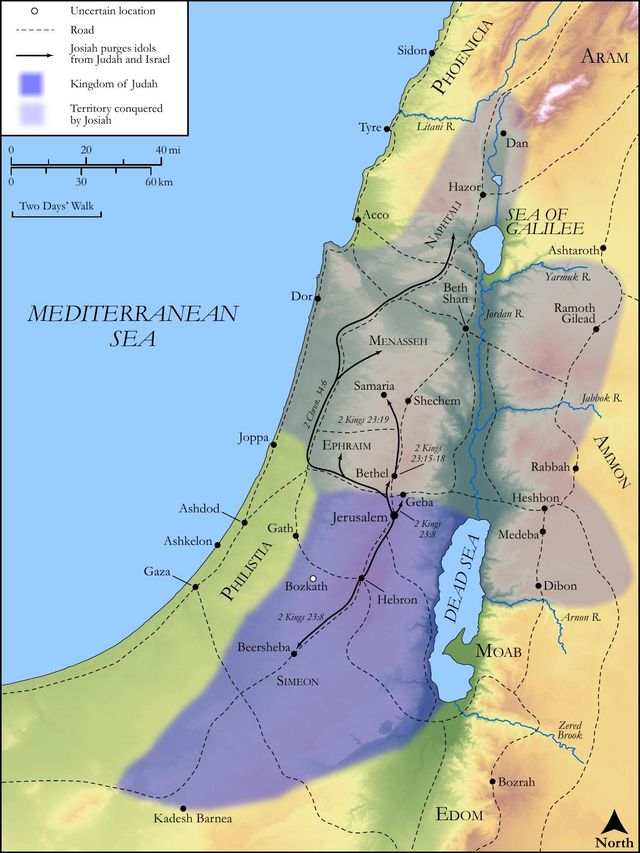
This clause highlights the thoroughness and extensive geographical scope of Josiah's reform. "All the abominations" indicates a complete purge of every form of idolatry and pagan practice, including altars, idols, and high places. The phrase "all the countries that pertained to the children of Israel" signifies that his reforms extended beyond the traditional borders of Judah, reaching into the former territories of the northern kingdom, demonstrating his zeal for a pan-Israelite spiritual restoration and a desire to see all God's people return to Him.
"and made all that were present in Israel to serve, [even] to serve the LORD their God"
This emphasizes the active and compulsory nature of Josiah's reform. It wasn't enough to simply remove evil; he actively compelled the people to engage in the worship and obedience of Yahweh. The repetition "to serve, even to serve" underscores the singular and exclusive focus on the LORD, emphasizing that true spiritual renewal involves a positive, active commitment to God, not just the passive absence of sin. It speaks to a reorientation of the nation's collective life towards God.
"[And] all his days they departed not from following the LORD, the God of their fathers"
This final clause speaks to the lasting impact of Josiah's leadership. For the duration of his reign, the nation, as a whole, maintained a posture of fidelity to the LORD. The reference to "the God of their fathers" roots this renewed allegiance in the historical covenant relationship God had established with Israel through Abraham, Isaac, and Jacob, underscoring a return to foundational truths and the ancestral faith of the patriarchs and the Mosaic covenant. This period stands as a unique testament to the power of righteous leadership.
Literary Devices
ShowHideThe Chronicler employs several potent Literary Devices in 2 Chronicles 34:33 to underscore the significance and impact of Josiah's reign. Hyperbole or Exaggeration is prominently featured through the repeated use of the intensifier "all" ("all the abominations," "all the countries," "all his days"). This rhetorical device emphasizes the comprehensive nature of Josiah's reforms and their pervasive, sustained impact, highlighting the unparalleled thoroughness of his spiritual cleansing compared to previous kings. There is a clear Contrast established between the widespread idolatry and spiritual apostasy that preceded Josiah's reign and the enforced, active service to the LORD that characterized his era, showcasing a radical and dramatic shift in national allegiance. The Repetition of the phrase "to serve, even to serve the LORD" functions as an emphatic device, drawing the reader's attention to the singular and exclusive devotion demanded by Yahweh, reinforcing the idea of total commitment. Finally, the verse itself acts as a powerful Summary Statement, encapsulating the culmination of Josiah's life's work and the spiritual state of the nation under his righteous leadership, serving as a concluding thought before the account of his final Passover and death.
Theological and Thematic Connections
ShowHideJosiah's actions in 2 Chronicles 34:33 provide a profound theological statement on the nature of true worship, the necessity of radical repentance, and the transformative power of godly leadership rooted in God's Word. His comprehensive purge of "abominations" illustrates God's absolute intolerance for idolatry and sin, demanding exclusive devotion from His covenant people. The compulsion to "serve the LORD" underscores that faith is not merely intellectual assent but active obedience and wholehearted commitment to God's commands. While the text notes the people's outward compliance "all his days," it also subtly hints at the tension between genuine, heart-deep transformation and enforced obedience, a tension that would tragically manifest after Josiah's death. Nevertheless, his reign stands as a powerful testament to the potential for national spiritual revival when a leader wholeheartedly pursues God's will and faithfully implements His law, setting a standard for future generations.
Reflection and Application
ShowHideJosiah's unwavering commitment to purge idolatry and compel true worship offers a timeless blueprint for spiritual vitality, both individually and corporately. Just as he meticulously removed "all the abominations" from the land, believers are called to a radical and uncompromising purification of their own lives. This involves identifying and dismantling any "idols"—whether tangible objects, sinful habits, misplaced affections, or even self-reliance—that compete for God's rightful and exclusive place in their hearts. This isn't merely about avoiding evil but actively, intentionally, and consistently "serving the LORD our God" with our whole being. Our service should be characterized by obedience, devotion, and a proactive pursuit of righteousness, fueled by diligent engagement with God's Word, much like Josiah's zeal was ignited by the rediscovered Law. Furthermore, Josiah's lasting influence reminds us that our personal commitment to God, when genuine and zealous, can profoundly impact those around us, fostering environments where others are encouraged and enabled to follow the Lord, even if true heart change remains a personal choice.
Questions for Reflection
ShowHideFAQ
ShowHideWas the people's service to the LORD truly from the heart, or was it forced?
ShowHideThe text states that Josiah "made" the people serve, implying a degree of royal compulsion or strong decree. While this ensured outward compliance and a national return to covenant practices, the rapid spiritual decline of Judah immediately after Josiah's death, as seen in the reigns of his successors like Jehoahaz (2 Kings 23:31-32), suggests that for many, this obedience may have been superficial or politically expedient rather than a deep, genuine heart transformation. However, the profound impact of the discovery of the Book of the Law and the subsequent covenant renewal ceremony undoubtedly led to genuine repentance and revival for a significant portion of the population, even if not universally sustained.
Why is Josiah's reform considered so significant compared to other kings?
ShowHideJosiah's reform stands out as the most comprehensive and thorough in Judah's history. Unlike previous righteous kings who often only removed some idols or high places (e.g., Asa in 1 Kings 15:14), Josiah purged "all the abominations" and extended his cleansing efforts beyond Judah into the former territories of the northern kingdom, as described in 2 Chronicles 34:6, demonstrating an unprecedented zeal. His reforms were directly fueled by the rediscovered Book of the Law, leading to a national covenant renewal (2 Chronicles 34:29-32) and a profound return to the foundational principles of the Mosaic covenant. It was the last major spiritual revival before the Babylonian exile, representing Judah's final, yet ultimately unheeded, opportunity to avert divine judgment.
What happened to Judah's spiritual state after Josiah's death?
ShowHideTragically, the spiritual revival under Josiah proved to be short-lived. Following Josiah's death in battle (2 Chronicles 35:20-24), his successors quickly reverted to idolatry and evil practices, leading Judah into a rapid spiritual decline that culminated in the Babylonian exile. Kings like Jehoahaz (2 Kings 23:31-32), Jehoiakim (2 Kings 24:1-4), and Zedekiah (2 Chronicles 36:11-16) did evil in the sight of the LORD, demonstrating that while Josiah's leadership was powerful, true and lasting heart transformation must be individual and sustained, not merely enforced by a righteous king or limited to a single generation.
Christ-Centered Fulfillment
ShowHideJosiah's thorough purging of "abominations" and his compulsion for the people to "serve the LORD" powerfully foreshadow the ultimate and perfect work of Jesus Christ. While Josiah, as an earthly king, could only remove the outward manifestations of sin and enforce temporary, often superficial, obedience, Christ came to deal with the very root of sin in the human heart. He is the true and perfect King who does not merely compel outward service but transforms hearts from within, enabling a genuine, willing, and lasting devotion to God. Through His atoning sacrifice and the power of His Spirit, Jesus purifies His people from all defilement, making them truly capable of serving the living God with a clear conscience (Hebrews 9:14). Unlike Josiah's reign, where the people "departed not" only "all his days," Christ's spiritual reign is eternal, and those He sets free from sin become willing slaves of righteousness, serving Him out of love and a transformed nature (John 8:34-36; Romans 6:17-18). He fulfills the prophetic promise of a new covenant where God's law is written on hearts, ensuring a lasting and internal commitment to follow the LORD, the God of their fathers, forever (Jeremiah 31:33). Jesus is the ultimate King who saves His people from their sins, not just their idols (Matthew 1:21), establishing a kingdom of righteousness that will never end and whose subjects serve Him with eternal devotion.