


2 Chronicles 34:3
Bible text: King James Version (1769 Blayney text) · Public domain
Bible text: King James Version with Strong's numbers · Public domain
Bible text: Berean Standard Bible · Public domain
Bible text: American Standard Version (1901) · Public domain
Bible text: World English Bible, Messianic edition · Public domain
Bible text: Geneva Bible (1599) · Public domain
Bible text: Young's Literal Translation · Public domain
- וּבִשְׁמוֹנֶהu·vish·mo·Nehand in eightH8083Conj-w ¦ Prep-b ¦ N-csNoun Singular common gender Absoluteוּandבִinשְׁמוֹנֶהeight
- שָׁנִיםsha·NimyearsH8141N-mpNoun Plural Masculine Absolute
- לְמָלְכוֹle·ma·le·Khoof reigning hisH4427Prep-l ¦ V-Qal-Inf ¦ 3msVerb Qal Infinitive Constructלְofמָלְכreigningוֹhis
- וְהוּאve·Hu'and heH1931Conj-w ¦ Pro-3msPronoun Personal 3rd Singular Masculineוְandהוּאhe
- עוֹדֶנּוּo·De·nustill heH5750Adj-msc ¦ 3msAdjective Numerical Singular Masculine Constructעוֹדֶstillנּוּhe
- נַעַרNa·'ar[was] a youthH5288N-msNoun Singular Masculine Absolute
- הֵחֵלhe·Chelhe beganH2490V-Hiphil-Perf-3msVerb Hiphil Perfect 3rd Singular Masculine
- לִדְרוֹשׁlid·Ro·oshto seekH1875Prep-l ¦ V-Qal-InfVerb Qal Infinitive Constructלִtoדְרוֹשׁseek
- לֵאלֹהֵיle·lo·Hei<to> [the] God ofH430Prep-l ¦ N-mpcNoun Plural Masculine Constructלֵ<to>אלֹהֵי[the] God of
- דָּוִידda·VidDavidH1732N-proper-mNoun Proper Masculine
- אָבִיו'a·Vivhis ancestorH1N-msc ¦ 3msNoun Singular Masculine Constructאָבִיancestorוhis
- וּבִשְׁתֵּיםu·vish·Teimand in two [plus]H8147Conj-w ¦ Prep-b ¦ N-fdNoun Dual Feminine Absoluteוּandבִinשְׁתֵּיםtwo [plus]
- עֶשְׂרֵה'es·RehtenH6240N-csNoun Singular common gender Absolute
- שָׁנָהsha·NahyearH8141N-fsNoun Singular Feminine Absolute
- הֵחֵלhe·Chelhe beganH2490V-Hiphil-Perf-3msVerb Hiphil Perfect 3rd Singular Masculine
- לְטַהֵרle·ta·Herto cleanseH2891Prep-l ¦ V-Piel-InfVerb Piel Infinitive Constructלְtoטַהֵרcleanse
- אֶת'et<obj.>H853DirObjMParticle Object Indicator
- יְהוּדָהye·hu·DahJudahH3063N-properNoun Proper Location
- וִירוּשָׁלִַםvi·Ru·sha·Limand JerusalemH3389Conj-w ¦ N-properNoun Proper LocationוִandירוּשָׁלִַםJerusalem
- מִןminfromH4480PrepPreposition
- הַבָּמוֹתha·ba·mOtthe high placesH1116Art ¦ N-fpNoun Plural Feminine Absoluteהַtheבָּמוֹתhigh places
- וְהָאֲשֵׁרִיםve·Ha·'a·she·Rimand the Asherah polesH842Conj-w ¦ Art ¦ N-mpNoun Title Plural Masculine AbsoluteוְandהָtheאֲשֵׁרִיםAsherah poles
- וְהַפְּסִלִיםve·ha·pe·si·Limand the idolsH6456Conj-w ¦ Art ¦ N-mpNoun Plural Masculine Absoluteוְandהַtheפְּסִלִיםidols
- וְהַמַּסֵּכוֹתve·ham·ma·se·Khotand the molten imagesH4541Conj-w ¦ Art ¦ N-fpNoun Plural Feminine Absoluteוְandהַtheמַּסֵּכוֹתmolten images
English is a literal word-by-word gloss of the Hebrew, not the KJV's wording. Why?
This is the original text the KJV's translators worked from — each Hebrew word with its own literal English meaning in this verse, prepared by scholars at Tyndale House, Cambridge. The KJV translates whole sentences, not word by word, so its wording differs: one Hebrew word can become several English words, and the KJV may choose “the LORD” where the gloss reads “Yahweh”. Both are faithful — they answer different questions. For the KJV's own rendering, switch to the KJV text.
Details
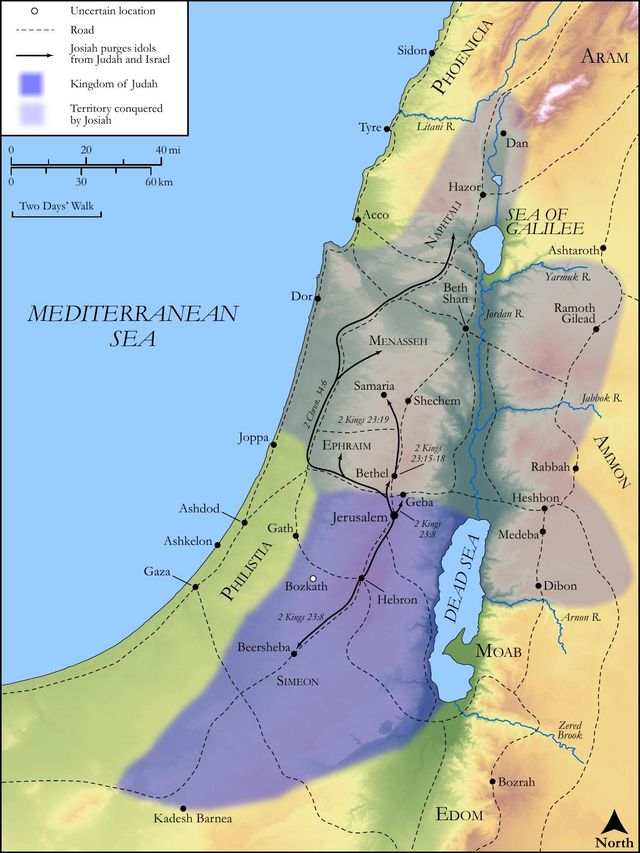
See on the biblical-era map
Study this verse
Public-domain commentary
Matthew Henry
From his Commentary on the Whole Bible. Henry comments on passages, not single verses — this entry covers 2 Chronicles 34:1–7.
Concerning Josiah we are here told, 1. That he came to the crown when he was very young, only eight years old (yet his infancy did not debar him from his right), and he reigned thirty-one years (Ch2 34:1), a considerable time. I fear, however, that in the beginning of his reign things went much as they had done in his father's time, because, being a child, he must have left the management of them to others; so that it was not till his twelfth year, which goes far in the number of his years, that the reformation began, Ch2 34:3. He could not, as Hezekiah did, fall about it immediately. 2. That he reigned very well (Ch2 34:2), approved himself to God, trod in the steps of David, and did not decline either to the right hand of to the left: for there are errors on both hands. 3. That while he was young, about sixteen years old, he began to seek after God, Ch2 34:3. We have reason to think he had not so good an education as Manasseh had (it is well if those about him did not endeavour to corrupt and debauch him); yet he thus sought God when he was young. It is the duty and interest of young people, and will particularly be the honour of young gentlemen, as soon as they come to years of understanding, to begin to seek God; for those that seek him early shall find him. 4. That in the twelfth year of his reign, when it is probable he took the administration of the government entirely into his own hands, he began to purge his kingdom from the remains of idolatry; he destroyed the high places, groves, images, altars, all the utensils of idolatry, v. 3, 4. He not only cast them out as Manasseh did, but broke them to pieces, and made dust of them. This destruction of idolatry is here said to be in his twelfth year, but it was said (Kg2 23:23) to be in his eighteenth year. Something was probably done towards it in his twelfth year; then he began to purge out idolatry, but that good work met with opposition, so that it was not thoroughly done till they had found the book of the law six years afterwards. But here the whole work is laid together briefly which was much more largely and particularly related in the Kings. His zeal carried him out to do this, not only in Judah and Jerusalem, but in the cities of Israel too, as far as he had any influence upon them.
Historical interpretation
Historical reception
1 surviving comment on this verse from the historical church.
With zeal immense, Josiah,
Himself a prince, acted in such a way
As no one before or after him had ever done!—Idols he
Dethroned; destroyed unhallowed temples; burned
With fire priests on their altars; all the bones
Of false prophets were dug up; the altars burned,
The carcasses to be consumed did serve
For fuel!
Continue studying 2 Chronicles 34:3 across the web’s major study libraries — every link below opens this exact verse, chapter, or book on the destination site.
Read & Compare
 BibleGatewayThis verse in more than 200 translations and 70 languages.
 Bible.comThe YouVersion reader — hundreds of translations, reading plans, and highlights.
 ESV.orgCrossway's official English Standard Version reader.
 NET BibleThe NET translation with 60,000+ translators' notes on every rendering decision.
 STEP BibleTyndale House's free study tool — original text, vocabulary, and scholarly resources.
 BibliaLogos Bible Software's free web reader.
 USCCBThe New American Bible (Revised Edition) with the U.S. bishops' study notes.
Commentaries
 BibleHub CommentariesDozens of classic commentaries on this verse, gathered on one page.
 StudyLightMore than 100 commentary sets — the largest collection on the web.
 BibleRefPlain-English commentary on what this verse means, verse by verse.
 Enduring WordDavid Guzik's free commentary on this chapter, widely used by Bible teachers.
 Bible Study ToolsVerse commentary alongside Greek and Hebrew study aids.
Original Language & Research
- BibleHub InterlinearThe verse word by word — original language, transliteration, and English.
- BibleHub LexiconEvery word's original-language definition and Strong's entry.
 Blue Letter BibleDeep-study tools — Strong's numbers, concordance, and word studies.
 SefariaThe Hebrew text with Rashi and centuries of Jewish commentary.
Sermons, Hymns & Audio


TrulyRandomVerse is not affiliated with these sites and doesn’t control their content. They’re linked because they’re genuinely useful.
Summary
2 Chronicles 34:3 vividly portrays the transformative early years of King Josiah's reign, marking the initial phase of Judah's most profound spiritual revival. Despite ascending the throne amidst widespread idolatry and national apostasy, the young monarch demonstrated extraordinary devotion by earnestly seeking the Lord in his eighth regnal year. This personal commitment swiftly translated into decisive national action, as in his twelfth year, he began a comprehensive and systematic purge of all pagan worship sites and symbols from Judah and Jerusalem. This pivotal verse establishes Josiah as a righteous king, whose deep personal faith catalyzed radical reform, setting the stage for a national covenant renewal that would reshape the spiritual landscape of his kingdom.
Context
ShowHideLiterary Context
This verse is strategically positioned to elaborate on the Chronicler's initial assessment of Josiah's reign in 2 Chronicles 34:2, where he is declared to have "done that which was right in the sight of the LORD, and walked in the ways of David his father, and turned not aside to the right hand, or to the left." Verse 3 then provides the concrete actions that substantiate this commendation, detailing the precise timing and nature of Josiah's early spiritual awakening and subsequent reforms. The preceding chapter, 2 Chronicles 33, serves as a stark contrast, depicting the extreme wickedness of Josiah's grandfather Manasseh and father Amon, whose reigns plunged Judah into deep idolatry and spiritual depravity. Thus, 2 Chronicles 34:3 highlights a dramatic and divinely orchestrated reversal, emphasizing Josiah's personal initiative and God's grace in raising a righteous king from such a corrupt lineage. This early reform also lays the essential groundwork for the later discovery of the Book of the Law in 2 Chronicles 34:14-21, which would further intensify and deepen the national revival.
Historical & Cultural Context
Josiah's reign (640-609 BC) unfolded during a period of significant geopolitical flux in the ancient Near East. The once-dominant Assyrian Empire, which had long exerted considerable influence and often imposed its cults on Judah, was in a state of terminal decline. This weakening of Assyrian power created a crucial window of opportunity for Judah to assert its political and religious independence, enabling Josiah to undertake internal religious reforms without the immediate threat of foreign intervention or the pressure to adopt Assyrian deities. Culturally, Judah had become deeply syncretistic, blending the worship of Yahweh with the veneration of Canaanite deities like Baal and Asherah, alongside astral worship. "High places" (local altars) were ubiquitous, and "groves" (Asherah poles) were common features of the landscape, often associated with immoral fertility rites. The "carved images" and "molten images" represented a direct violation of the Second Commandment, indicating the pervasive nature of idolatry that had infiltrated every aspect of Judahite society, from royal patronage to popular practice. Josiah's actions were therefore not merely religious but also a powerful statement of national identity and sovereignty, reclaiming Judah's covenantal allegiance to Yahweh.
Key Themes
ShowHideThis verse introduces several profound themes central to the Chronicler's theological narrative. Firstly, it underscores the theme of early piety and personal seeking of God, demonstrating that genuine spiritual commitment can emerge at a remarkably young age, independent of one's upbringing or surrounding environment. Josiah's decision to "seek after the God of David his father" (at approximately age 16) highlights a conscious alignment with the covenant faithfulness and righteous kingship of Israel's greatest monarch, emphasizing the importance of a godly lineage and the potential for a return to foundational truths. Secondly, it powerfully illustrates the theme of radical reform and uncompromising zeal against idolatry. Josiah's comprehensive purge was not a superficial act but a systematic destruction of the physical manifestations of pagan worship, reflecting an uncompromising commitment to Yahweh's exclusive sovereignty. This radical cleansing foreshadows the deeper spiritual renewal that would follow. Finally, the verse sets the stage for national revival and covenant renewal, showing how a king's personal devotion and decisive action can catalyze widespread transformation, preparing the nation for a renewed relationship with God, as seen later in the grand Passover celebration described in 2 Chronicles 35.
Exposition and Analysis
ShowHideKey Word Analysis
ShowHideThis verb (H1875) signifies an earnest, diligent, and intentional pursuit, often with the connotation of inquiry, consultation, or worship. It implies more than a casual interest; it is a profound turning toward God, a deliberate effort to understand His will and draw near to Him. In the context of Josiah, it means he actively pursued a relationship with Yahweh, not merely a superficial acknowledgment, but a deep spiritual quest that informed his subsequent actions. This contrasts sharply with his predecessors who "sought not the LORD" or "forsook the LORD."
This verb (H2891) means "to be bright," and by implication, "to be pure" or "to cleanse." When applied to the removal of idolatry, it denotes a thorough and purifying action, leaving no trace of defilement. Josiah did not merely hide or store the idols; he utterly destroyed them, often by burning, grinding to powder, and scattering, as detailed later in the chapter. This signifies a commitment to total separation from pagan practices, leaving no room for their return and aiming for a state of ritual and moral purity.
These (H1116) were elevated cultic sites, often on hills or artificial mounds, where sacrifices and worship (both Yahwistic and pagan) were performed. While some "high places" may have been used for legitimate worship before the centralization of worship in Jerusalem, by Josiah's time, they were overwhelmingly associated with syncretistic or purely pagan practices, serving as centers for idolatry and often involving child sacrifice or ritual prostitution. Their destruction was crucial for restoring pure, exclusive worship of Yahweh.
Verse Breakdown
ShowHide"For in the eighth year of his reign, while he was yet young,"
This clause establishes the timeframe and emphasizes Josiah's remarkable youth. Ascending the throne at age eight, his "eighth year" means he was approximately sixteen years old. The phrase "while he was yet young" highlights the extraordinary nature of his spiritual awakening and initiative, especially given the corrupt examples of his father and grandfather. It suggests a divine prompting and a personal conviction that defied the prevailing cultural and familial norms, marking him as uniquely devoted from an early age.
"he began to seek after the God of David his father:"
This is the pivotal spiritual turning point. "The God of David his father" explicitly links Josiah's pursuit to the covenantal faithfulness and righteous kingship of David, Judah's ideal monarch. This seeking implies a personal commitment to Yahweh, a desire to understand and obey His laws, and a turning away from the pervasive idolatry that had plagued previous reigns. It was the internal spiritual transformation that laid the essential groundwork for all subsequent external reforms, demonstrating that true national change begins with individual spiritual devotion.
"and in the twelfth year he began to purge Judah and Jerusalem"
This clause marks the transition from personal seeking to public, national action. Four years after his personal spiritual commitment, at approximately age twenty, Josiah initiated a systematic, kingdom-wide cleansing. The mention of "Judah and Jerusalem" indicates the extensive scope of the reform, starting from the capital city and extending throughout the entire territory under his control. This was not a passive or symbolic act but an aggressive, organized campaign to eradicate idolatry from the land.
"from the high places, and the groves, and the carved images, and the molten images."
This final clause enumerates the specific objects of Josiah's purge, detailing the pervasive nature of the idolatry he confronted. "High places" were illicit altars, "groves" were Asherah poles (symbols of the Canaanite fertility goddess), and "carved images" (פסילים, pesilim) and "molten images" (מסכות, massekhot) were various forms of idols made from wood, stone, or metal. This comprehensive list underscores the thoroughness of Josiah's reform, targeting every physical manifestation of false worship and demonstrating his uncompromising commitment to Yahweh's exclusive sovereignty.
Literary Devices
ShowHideThe Chronicler employs several literary devices to emphasize the profound significance of Josiah's early reign. Chronological Progression is evident in the precise dating ("eighth year," "twelfth year"), which highlights the sequential development of Josiah's spiritual journey from personal seeking to public action. This progression underscores the deliberate and sustained nature of his commitment and the strategic planning behind his reforms. Contrast is powerfully used by juxtaposing Josiah's righteous actions with the extreme wickedness of his immediate predecessors, Manasseh and Amon, who had plunged Judah into deep idolatry. This stark contrast magnifies Josiah's piety and suggests divine intervention in raising such a king from a corrupt lineage, emphasizing God's ability to work righteousness even in the most unlikely circumstances. Finally, Enumeration is employed in the detailed listing of the idolatrous objects ("high places, and the groves, and the carved images, and the molten images"). This specific and comprehensive list emphasizes the thoroughness and radical nature of Josiah's purge, leaving no form of idolatry untouched and conveying the depth of the spiritual corruption he sought to eradicate from the land.
Theological and Thematic Connections
ShowHide2 Chronicles 34:3 stands as a profound testament to the powerful interplay of divine grace and human responsiveness. It reveals God's enduring faithfulness to His covenant people, even when they are deeply steeped in sin, by raising up a righteous leader. Josiah's story underscores that true reform begins with a personal, earnest seeking of God, which then naturally overflows into tangible actions of obedience and purification. The radical nature of his purge illustrates the uncompromising demand for holiness and exclusive worship that God requires from His people. It teaches that genuine revival is not merely about emotional fervor but involves the systematic removal of anything that competes for God's rightful place in individual hearts and national life. This verse also implicitly highlights the enduring significance of the Davidic covenant, showcasing a king who, unlike many of his predecessors, genuinely walked in the ways of David, thereby providing a glimmer of hope for the promised righteous king.
Reflection and Application
ShowHideJosiah's early and decisive actions in 2 Chronicles 34:3 offer profound lessons for believers today. His story challenges us to consider the age at which we begin to earnestly "seek after the God" and to recognize that youth is not a barrier to profound spiritual commitment or impactful leadership. His immediate translation of personal devotion into public action against idolatry serves as a powerful call to active faith. Just as Josiah physically purged the land of idols, we are called to identify and eliminate the "idols" in our own lives—anything that takes God's rightful place in our affections, time, or priorities. This might include materialism, self-reliance, comfort, or even good things that have become ultimate things. The comprehensive nature of Josiah's reform encourages us to pursue holiness with similar zeal, not settling for superficial changes but seeking a thorough cleansing of our hearts and lives. His example reminds us that one person's genuine pursuit of God, empowered by the Spirit, can indeed spark significant transformation within families, communities, and even nations, demonstrating the ripple effect of a devoted heart.
Questions for Reflection
ShowHideFAQ
ShowHideWhat does it mean for Josiah to "seek after the God of David his father"?
ShowHideThis phrase signifies a profound spiritual commitment and intentional alignment with the covenantal relationship God established with David. It means Josiah deliberately turned away from the pervasive idolatry of his immediate predecessors (Amon and Manasseh) and actively pursued a personal, obedient relationship with Yahweh, the God of Israel, in the tradition of his righteous ancestor, King David. It implies a deep desire to understand God's will, to worship Him exclusively, and to lead the nation back to covenant faithfulness, as exemplified by David. This seeking was not merely intellectual but involved a deep spiritual yearning and a practical commitment to living according to God's commands, as outlined in the Law, even before the full discovery of the Book of the Law.
Why is Josiah's age emphasized in this verse?
ShowHideThe emphasis on Josiah's youth ("in the eighth year of his reign, while he was yet young") highlights the extraordinary nature of his spiritual awakening and subsequent actions. He became king at age eight, so in his eighth regnal year, he was about sixteen years old when he began to seek God. By his twelfth year, he was around twenty when he initiated the national purge. This is remarkable because he grew up surrounded by the pervasive idolatry and wickedness of his father Amon and grandfather Manasseh, who were among Judah's most corrupt kings. His decision to pursue God and reform the nation at such a young age, despite his upbringing, underscores his unique character, divine favor, and the power of God to work through unexpected individuals. It serves as an encouragement that age is no barrier to spiritual maturity or significant impact, and that God can raise up righteous leaders even in the most corrupt environments.
What exactly were the "high places, and the groves, and the carved images, and the molten images" that Josiah purged?
ShowHideThese terms refer to the various manifestations of idolatry that had become deeply entrenched in Judah. "High places" (Hebrew: bamot) were elevated outdoor altars or shrines, often on hills, used for pagan worship or syncretistic worship of Yahweh alongside other gods, contrary to God's command for centralized worship in Jerusalem (Deuteronomy 12:5-14). "Groves" (Hebrew: asherim) were wooden poles or trees dedicated to Asherah, the Canaanite goddess of fertility, often associated with immoral cultic practices. "Carved images" (Hebrew: pesilim) were idols sculpted from wood or stone, while "molten images" (Hebrew: massekhot) were idols cast from metal. All these represented direct violations of the Second Commandment, which forbids the making and worship of graven images. Josiah's comprehensive purge aimed to physically remove every trace of these forbidden objects and sites, signaling a thorough and uncompromising return to exclusive worship of Yahweh.
Christ-Centered Fulfillment
ShowHideJosiah's early piety and radical purge of idolatry serve as a powerful type and shadow of the ultimate King, Jesus Christ. Just as Josiah, a descendant of David, initiated a sweeping reform to restore Judah to its covenantal relationship with God, so Christ, the true Son of David, came to establish a new and greater covenant, purifying His people not merely from physical idols but from the very root of sin and spiritual idolatry in the human heart. Josiah's zeal to "purge" the land foreshadows Christ's cleansing of the Temple (e.g., Matthew 21:12-13), demonstrating His divine authority and uncompromising commitment to pure worship. More profoundly, Christ's sacrifice on the cross provides the ultimate "purge" for humanity, cleansing us from the defilement of sin and idolatry by His own blood, as Hebrews 9:14 declares: "How much more shall the blood of Christ, who through the eternal Spirit offered himself without spot to God, purge your conscience from dead works to serve the living God?" Unlike Josiah's temporary and external reform, Christ's work brings about an eternal and internal transformation, writing God's law on our hearts (Jeremiah 31:33) and making all things new (Revelation 21:5). He is the true King who not only removes the outward signs of sin but empowers His followers to truly "seek after the God of David" in spirit and truth, leading them into a life of genuine worship and obedience.