


1 Kings 15:14
Bible text: King James Version (1769 Blayney text) · Public domain
Bible text: Berean Standard Bible · Public domain
Bible text: American Standard Version (1901) · Public domain
Bible text: World English Bible, Messianic edition · Public domain
Bible text: Geneva Bible (1599) · Public domain
Bible text: Young's Literal Translation · Public domain
- וְהַבָּמוֹתve·ha·ba·Motand the high placesH1116Conj-w ¦ Art ¦ N-fpNoun Plural Feminine Absoluteוְandהַtheבָּמוֹתhigh places
- לֹאlo'notH3808NegParticle Negative
- סָרוּSa·ruthey were removedH5493V-Qal-Perf-3cpVerb Qal Perfect 3rd Plural common gender
- רַקrakonlyH7535AdvAdverb
- לְבַבle·vav[the] heart ofH3824N-mscNoun Singular Masculine Construct
- אָסָא'a·Sa'AsaH609N-proper-mNoun Proper Masculine
- הָיָהha·Yahit wasH1961V-Qal-Perf-3msVerb Qal Perfect 3rd Singular Masculine
- שָׁלֵםsha·LemcompleteH8003Adj-msAdjective Singular Masculine Absolute
- עִם'imwithH5973PrepPreposition
- יְהוָהYah·wehYahwehH3068N-properNoun Proper Title
- כָּלkolallH3605N-mscNoun Singular Masculine Construct
- יָמָיוya·Mavhis daysH3117N-mpc ¦ 3msNoun Plural Masculine Constructיָמָיdaysוhis
English is a literal word-by-word gloss of the Hebrew, not the KJV's wording. Why?
This is the original text the KJV's translators worked from — each Hebrew word with its own literal English meaning in this verse, prepared by scholars at Tyndale House, Cambridge. The KJV translates whole sentences, not word by word, so its wording differs: one Hebrew word can become several English words, and the KJV may choose “the LORD” where the gloss reads “Yahweh”. Both are faithful — they answer different questions. For the KJV's own rendering, switch to the KJV text.
Details
See on the biblical-era maps
Study this verse
Public-domain commentary
Matthew Henry
From his Commentary on the Whole Bible. Henry comments on passages, not single verses — this entry covers 1 Kings 15:9–24. His three-level outline is real structure in the source text, so it is rendered as structure.
We have here a short account of the reign of Asa; we shall find a more copious history of it Ch2 14:1-15, 15, and Ch2 16:1-14. Here is,
I.The length of it:
He reigned forty-one years in Jerusalem, Kg1 15:10. In the account we have of the kings of Judah we find the number of the good kings and the bad ones nearly equal; but then we may observe, to our comfort, that the reign of the good kings was generally long, but that of the bad kings short, the consideration of which will make the state of God's church not altogether so bad within that period as it appears at first sight. Length of days is in Wisdom's right hand. Honour thy father, much more thy heavenly Father, that thy days may be long.
II.The general good character of it (Kg1 15:11):
Asa did that which was right in the eyes of the Lord, and that is right indeed which is so in God's eyes; those are approved whom he commends. He did as did David his father, kept close to God, and to his instituted worship, was hearty and zealous for that, which gave him this honourable character, that he was like David, though he was not a prophet, or psalmist, as David was. If we come up to the graces of those that have gone before us it will be our praise with God, though we come short of their gifts. Asa was like David, though he was neither such a conqueror nor such an author; for his heart was perfect with the Lord all his days (Kg1 15:14), that is, he was both cordial and constant in his religion. What he did for God he was sincere in, steady and uniform, and did it from a good principle, with a single eye to the glory of God.
III.The particular instances of Asa's piety. His times were times of reformation. For,
1.He removed that which was evil. There reformation begins; and a great deal of work of that kind his hand found to do. For, though it was but twenty years after the death of Solomon that he began to reign, yet very gross corruption had spread far and taken deep root. Immorality he first struck at: He took away the sodomites out of the land, suppressed the brothels; for how can either prince or people prosper while those cages of unclean and filthy birds, more dangerous than pest-houses, are suffered to remain? Then he proceeded against idolatry: He removed all the idols, even those that his father had made, Kg1 15:12. His father having made them, he was the more concerned to remove them, that he might cut off the entail of the curse, and prevent the visiting of that iniquity upon him and his. Nay (which redounds much to his honour, and shows his heart was perfect with God), when he found idolatry in the court, he rooted it out thence, Kg1 15:13. When it appeared that Maachah his mother, or rather his grandmother (but called his mother because she had the educating of him in his childhood), had an idol in a grove, though she was his mother, his grandmother, - though, it is likely, she had a particular fondness for it, - though, being old, she could not live long to patronise it, - though she kept it for her own use only, yet he would by no means connive at her idolatry. Reformation must begin at home. Bad practices will never be suppressed in the country while they are supported in the court. Asa, in every thing else, will honour and respect his mother; he loves her well, but he loves God better, and (like the Levite, Deu 33:9) readily forgets the relation when it comes in competition with his duty. If she be an idolater,
(1.)Her idol shall be destroyed, publicly exposed to contempt, defaced, and burnt to ashes by the brook Kidron, on which, it is probable, he strewed the ashes, in imitation of Moses (Exo 32:20) and in token of his detestation of idolatry and his indignation at it wherever he found it. Let no remains of a court-idol appear.
(2.)She shall be deposed, He removed her from being queen, or from the queen, that is, from conversing with his wife; he banished her from the court, and confined her to an obscure and private life. Those that have power are happy when thus they have hearts to use it well.
2.He re-established that which was good (Kg1 15:15): He brought into the house of God the dedicated things which he himself had vowed out of the spoils of the Ethiopians he had conquered, and which his father had vowed, but lived not to bring in pursuant to his vow. We must not only cease to do evil, but learn to do well, not only cast away the idols of our iniquity, but dedicate ourselves and our all to God's honour and glory. When those who, in their infancy, were by baptism devoted to God, make it their own act and deed to join themselves to him and vigorously employ themselves in his service, this is bringing in the dedicated things which they and their fathers have dedicated: it is necessary justice - rendering to God the things that are his.
VI.The policy of his reign.
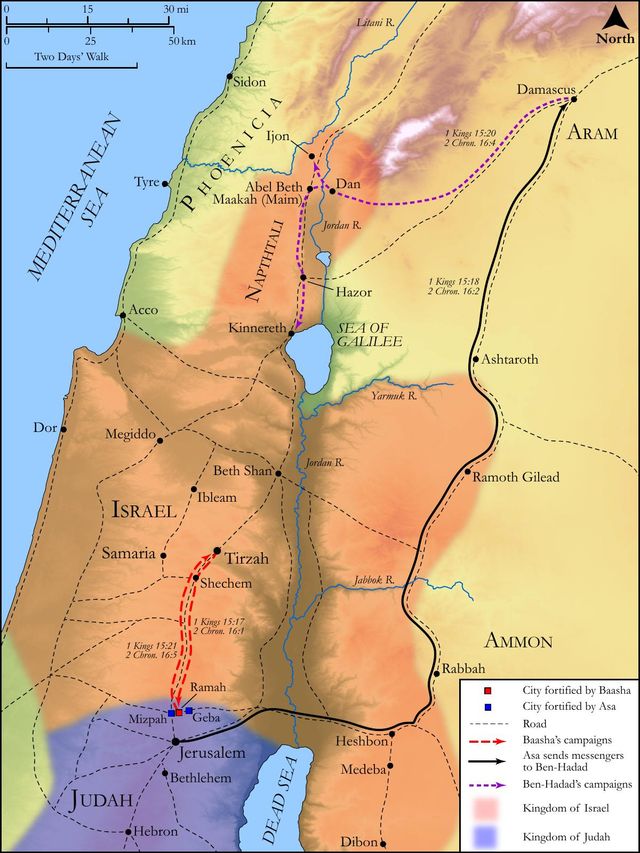
He built cities himself, to encourage the increase of his people (Kg1 15:23) and to invite others to him by the conveniences of habitation; and he was very zealous to hinder Baasha from building Ramah, because he designed it for the cutting off of communication between his people and Jerusalem and to hinder those who in obedience to God would come to worship there. An enemy must by no means be suffered to fortify a frontier town.
V.The faults of his reign.
In both the things for which he was praised he was found defective. The fairest characters are not without some but or other in them.
1.Did he take away the idols? That was well; but the high places were not removed (Kg1 15:14); therein his reformation fell short. He removed all images which were rivals with the true God or false representations of him; but the altars which were set up in high places, and to which those sacrifices were brought which should have been offered on the altar in the temple, those he suffered to stand, thinking there was no great harm in them, they having been used by good men before the temple was built, and being loth to disoblige the people, who had a kindness to them and were wedded to them both by custom and convenience; whereas in Judah and Benjamin, the only tribes under Asa's government which lay so near Jerusalem and the altars there, there was less pretence for them than in those tribes which lay more remote. They were against the law, which obliged them to worship at one place, Deu 12:11. They lessened men's esteem of the temple and the altars there, and were an open gap for idolatry to enter in at, while the people were so much addicted to it. It was not well that Asa, when his hand was in, did not remove these. Nevertheless his heart was perfect with the Lord. This affords us a comfortable note, That those may be found honest and upright with God, and be accepted of him, who yet, in some instances, come short of doing the good they might and should do. The perfection which is made the indispensable condition of the new covenant is not to be understood of sinlessness (then we were all undone), but sincerity.
2.Did he bring in the dedicated things? That was well; but he afterwards alienated the dedicated things, when he took the gold and silver out of the house of God and sent them as a bribe to Benhadad, to hire him to break his league with Baasha, and, by making an inroad upon his country, to give him a diversion from the building of Ramah, Kg1 15:18, Kg1 15:19. Here he sinned,
(1.)In tempting Benhadad to break his league, and so to violate the public faith. If he did wrong in doing it, as certainly he did, Asa did wrong in persuading him to do it.
(2.)In that he could not trust God, who had done so much for him, to free him out of this strait, without using such indirect means to help himself.
(3.)In taking the gold out of the treasury of the temple, which was not to be made use of but on extraordinary occasions. The project succeeded. Benhadad made a descent upon the land of Israel, which obliged Baasha to retire with his whole force from Ramah (Kg1 15:20, Kg1 15:21), which gave Asa a fair opportunity to demolish his works there, and the timber and stones served him for the building of some cities of his own, Kg1 15:22. But, though the design prospered, we find it was displeasing to God; and though Asa valued himself upon the policy of it, and promised himself that it would effectually secure his peace, he was told by the prophet that he had done foolishly, and that thenceforth he should have wars; see Ch2 16:7-9.
VI.The troubles of his reign. For the most part he prospered; but,
1.Baasha king of Israel was a very troublesome neighbour to him. He reigned twenty-four years, and all his days had war, more or less, with Asa, Kg1 15:16. This was the effect of the division of the kingdoms, that they were continually vexing one another, and so weakened one another, which made them both an easier prey to the common enemy.
2.In his old age he was himself afflicted with the gout: He was diseased in his feet, which made him less fit for business and peevish towards those about him.
VII.The conclusion of his reign.
The acts of it were more largely recorded in the common history (to which reference is here had, Kg1 15:23) than in this sacred one. He reigned long, but finished at last with honour, and left his throne to a successor no way inferior to him.
Historical interpretation
Fourteen Centuries of Reception
4 surviving comments on this verse. Each one is dated, so this reads as a timeline rather than a list.
Select a marker to jump to its quote. Markers stagger vertically where authors wrote within a few decades of each other.
Regarding many kings of the line of David, we read that they were saved not through their own merit but through the virtues of their father, David, who did that which was pleasing in the sight of God. And we come to Asa, the king of Judah, of whom it is written: “Asa did that which was right in the sight of the Lord, as did David, his father.” And after a lengthy account of his many virtues, the story is concluded with these words: “But the high places he did not take away. Nevertheless, the heart of Asa was perfect with God all the days of his life.” You see that he, too, is referred to as just, and his heart, indeed, was perfect with God, and yet he erred in that he did not take away the high places, as, we read, Hezekiah and Josiah had done.
“High places” refers to the altars that had been erected for the true God. This means that sacrifices were offered to God in any place, just like Solomon offered a thousand holocausts to God in Gibeon. Therefore the words “the high places were not taken away [by Asa]” mean that they did not worship or sacrifice before a single altar according to the commandment of God, that is, in Jerusalem, as is prescribed by the Law. [The Scripture] does not speak here about the altars [consecrated] to idols but about those consecrated to the true God.
The high places: There were excelsa or high places of two different kinds. Some were set up, and dedicated to the worship of idols, or strange gods; and these Asa removed, 2 Par. 14. 2; others were only altars of the true God, but were erected contrary to the law, which allowed of no sacrifices but in the temple; and these were not removed by Asa.-- Ibid.
Perfect with the Lord: Asa had his faults; but never forsook the worship of the Lord.
Continue studying 1 Kings 15:14 across the web’s major study libraries — every link below opens this exact verse, chapter, or book on the destination site.
Read & Compare
 BibleGatewayThis verse in more than 200 translations and 70 languages.
 Bible.comThe YouVersion reader — hundreds of translations, reading plans, and highlights.
 ESV.orgCrossway's official English Standard Version reader.
 NET BibleThe NET translation with 60,000+ translators' notes on every rendering decision.
 STEP BibleTyndale House's free study tool — original text, vocabulary, and scholarly resources.
 BibliaLogos Bible Software's free web reader.
 USCCBThe New American Bible (Revised Edition) with the U.S. bishops' study notes.
Commentaries
 BibleHub CommentariesDozens of classic commentaries on this verse, gathered on one page.
 StudyLightMore than 100 commentary sets — the largest collection on the web.
 BibleRefPlain-English commentary on what this verse means, verse by verse.
 Enduring WordDavid Guzik's free commentary on this chapter, widely used by Bible teachers.
 Bible Study ToolsVerse commentary alongside Greek and Hebrew study aids.
Original Language & Research
- BibleHub InterlinearThe verse word by word — original language, transliteration, and English.
- BibleHub LexiconEvery word's original-language definition and Strong's entry.
 Blue Letter BibleDeep-study tools — Strong's numbers, concordance, and word studies.
 SefariaThe Hebrew text with Rashi and centuries of Jewish commentary.
Sermons, Hymns & Audio


TrulyRandomVerse is not affiliated with these sites and doesn’t control their content. They’re linked because they’re genuinely useful.
Summary
First Kings 15:14 offers a profound theological assessment of King Asa's reign, capturing the central tension between his commendable personal devotion to Yahweh and the incomplete nature of his religious reforms in Judah. While Asa's heart is unequivocally declared "perfect" in its loyalty to the LORD throughout his life, the verse concurrently acknowledges a significant lingering issue: the persistent presence of the "high places," which remained unremoved, symbolizing a partial obedience despite a sincere core commitment.
Context
ShowHideLiterary Context
This verse serves as a pivotal summary statement within the broader narrative of King Asa's reign, which spans 1 Kings 15:9-24. It follows a detailed account of Asa's initial, zealous reforms, including his purging of male cult prostitutes, the removal of idols, and even the deposition of his idolatrous grandmother, Maachah (1 Kings 15:12-13). The preceding verses laud his efforts to restore proper worship. However, verse 14 introduces a crucial qualification, setting the stage for a nuanced understanding of his piety and foreshadowing the later challenges and inconsistencies that would emerge in his life, particularly his reliance on human alliances rather than the LORD in his later years, as detailed in 2 Chronicles 16:7-10. This verse effectively encapsulates the spiritual high point and a persistent flaw of his otherwise largely righteous rule.
Historical & Cultural Context
King Asa ruled the Southern Kingdom of Judah for 41 years (c. 913-873 BC). His reign followed a period of significant spiritual decline under his predecessors, Rehoboam and Abijam, who had largely tolerated or even promoted idolatry. The "high places" (Hebrew: bamot) were localized cultic sites, often on elevated ground, used for worship. While many were dedicated to pagan deities like Baal or Asherah and were rightly targeted for destruction, some may have been used for Yahweh worship, albeit in a manner inconsistent with the Deuteronomic command for centralized worship at the Temple in Jerusalem (see Deuteronomy 12:2-5). The continued existence of these high places, even those ostensibly dedicated to Yahweh, represented a compromise with God's prescribed worship and a lingering potential for syncretism, reflecting the deep-seated nature of these practices within Israelite society.
Key Themes
ShowHideThe verse profoundly contributes to several key themes within the book of Kings and the broader Old Testament. It highlights the theme of Incomplete Reform, illustrating the persistent difficulty of fully eradicating deeply ingrained religious practices, even under a committed leader. Despite Asa's significant efforts, a full return to God's prescribed, centralized worship was not achieved, underscoring the challenge of holistic obedience. Furthermore, it introduces the critical theme of Heart Devotion vs. External Action, emphasizing that "Asa's heart was perfect with the LORD all his days." This suggests that God's primary evaluation is often of the sincerity and totality of one's inner commitment, even when outward actions are not entirely flawless. This divine perspective on the heart is a recurring motif, as seen in 2 Chronicles 16:9, where the LORD's eyes search the earth for those whose hearts are fully committed to Him. Finally, the verse subtly points to the Persistent Spiritual Battle against compromise and syncretism that Israel faced, a struggle that often required successive generations to address and which ultimately contributed to the nation's downfall.
Exposition and Analysis
ShowHideKey Word Analysis
ShowHideFrom an unused root (meaning to be high), referring to an elevation or cultic site. These were localized places of worship, often on hills, which, even if ostensibly used for Yahweh worship, represented a deviation from the divinely ordained central sanctuary in Jerusalem. Their continued presence symbolized a compromise with God's prescribed worship and a lingering potential for syncretism, despite Asa's broader reforms.
A primitive root meaning "to turn off" or "to take away." The text's declaration that the high places "were not removed" signifies a specific failure on Asa's part to fully eradicate these unauthorized worship sites. It indicates a deliberate omission or an inability to complete the comprehensive religious purge expected of a righteous king, highlighting an area where his reform efforts fell short of God's ideal.
From the root meaning "to be complete" or "sound." In this context, it describes Asa's heart as "whole," "complete," or "sincere" in its devotion to the LORD. This term does not imply sinless perfection but rather an undivided loyalty and singular focus on Yahweh, indicating that his inner commitment was genuine and uncompromised by idolatry, despite the acknowledged external flaw of the unremoved high places.
Verse Breakdown
ShowHide"But the high places were not removed:"
This initial clause presents a significant qualification to Asa's otherwise positive assessment. It highlights a glaring omission in his otherwise commendable religious reforms. Despite his zeal for Yahweh, he failed to eradicate these local cultic sites, which represented a deviation from the prescribed central worship and a persistent spiritual vulnerability for the nation. This clause introduces a note of imperfection into an otherwise glowing report.
"nevertheless Asa's heart was perfect with the LORD all his days."
This second clause offers a powerful counterpoint and commendation. The conjunction "nevertheless" underscores the surprising and significant truth that, despite the failure to remove the high places, Asa's core spiritual disposition was one of complete and undivided loyalty to Yahweh. This statement emphasizes the sincerity and steadfastness of his personal devotion, indicating that God evaluated his inner commitment as genuine and wholehearted throughout his entire reign, even with the acknowledged external flaw.
Literary Devices
ShowHideThe verse effectively employs Juxtaposition and Concession to convey a nuanced assessment of King Asa. The opening clause, "But the high places were not removed," presents a clear negative, highlighting an incomplete aspect of his reforms. This is immediately followed by the contrasting positive affirmation, "nevertheless Asa's heart was perfect with the LORD all his days." The use of "But" and "nevertheless" creates a powerful Antithesis, setting up a tension between outward action and inward disposition. This literary technique allows the narrator to offer a complex portrait of Asa, acknowledging both his significant spiritual achievements and a persistent flaw, while ultimately prioritizing the purity of his heart. The verse functions as a concise Summary Statement, encapsulating the spiritual trajectory and primary characteristic of Asa's reign.
Theological and Thematic Connections
ShowHideThis verse offers profound insights into God's assessment of human faithfulness. It reveals that while God desires complete obedience and the eradication of all forms of idolatry and compromise, He also deeply values the sincerity and undivided loyalty of the human heart. Asa's failure to remove the high places represents a significant lapse in comprehensive obedience, yet his internal devotion is affirmed as "perfect." This highlights a tension often present in the lives of believers: the struggle between ideal obedience and the reality of incomplete sanctification. It suggests that while external actions are important, the purity and singular focus of one's heart toward God are paramount in His eyes. This theological principle underscores the importance of internal transformation as the wellspring of true worship and obedience, even as we strive for outward conformity to God's will.
Reflection and Application
ShowHideThe narrative of King Asa challenges us to examine the depth and sincerity of our own devotion to God. While we are called to pursue holiness in every area of our lives, Asa's example reminds us that God looks beyond mere external performance to the condition of our hearts. Do we have "high places" in our lives—areas of compromise, lingering sin, or divided loyalties that we have not fully surrendered or removed? These might be subtle forms of idolatry, unaddressed habits, or areas where we rely on self-sufficiency rather than God. The verse encourages us to cultivate a heart that is "perfect" (whole, undivided) in its commitment to the LORD, even as we diligently work to align our actions and environments with His will. It's a call to honest self-assessment and continuous spiritual purging, recognizing that true piety involves both inner devotion and outward obedience, even if the journey towards complete sanctification is a lifelong process.
Questions for Reflection
ShowHideFAQ
ShowHideWhat exactly were the "high places" and why were they a problem?
ShowHideThe "high places" (Hebrew: bamot) were elevated sites, often natural hilltops or artificial mounds, used for religious worship. They were a problem for several reasons:
Christ-Centered Fulfillment
ShowHideKing Asa's "perfect heart" yet incomplete reform finds its ultimate resolution and fulfillment in Jesus Christ. Asa's struggle with the "high places" represents humanity's perpetual challenge with partial obedience and the lingering effects of sin. In contrast, Jesus' heart was not merely "perfect" in loyalty, but perfectly obedient in every action, without any "high places" of sin or compromise. He perfectly fulfilled the Law, not just in spirit but in every detail, as He declared in Matthew 5:17. Through His atoning sacrifice on the cross, Christ effectively "removed" all the "high places" of sin and false worship from our lives, not just externally but fundamentally, by cleansing our consciences and empowering us to worship God in spirit and truth (John 4:23-24). The New Covenant, inaugurated by His blood, establishes a new "temple" not of stone, but of believers, where the Holy Spirit indwells, enabling a holistic and undivided devotion that Asa could only strive for (1 Corinthians 6:19-20). Thus, what was an ongoing struggle for Asa becomes a completed work in Christ, allowing those who believe in Him to truly have a "perfect heart" in God's sight, not based on their own flawed obedience, but on the imputed righteousness of the One who was truly whole and complete.