


1 Kings 15:21
Bible text: King James Version (1769 Blayney text) · Public domain
Bible text: Berean Standard Bible · Public domain
Bible text: American Standard Version (1901) · Public domain
Bible text: World English Bible, Messianic edition · Public domain
Bible text: Geneva Bible (1599) · Public domain
Bible text: Young's Literal Translation · Public domain
- וַיְהִיvay·Hiand it wasH1961Conj-w ¦ V-Qal-ConsecImperf-3msVerb Qal Consecutive Imperfect 3rd Singular Masculineוַandיְהִיit was
- כִּשְׁמֹעַkish·Mo·a'when heardH8085Prep-k ¦ V-Qal-InfVerb Qal Infinitive Constructכִּwhenשְׁמֹעַheard
- בַּעְשָׁאba'·Sha'BaashaH1201N-proper-mNoun Proper Masculine
- וַיֶּחְדַּלvai·yech·Daland he ceasedH2308Conj-w ¦ V-Qal-ConsecImperf-3msVerb Qal Consecutive Imperfect 3rd Singular Masculineוַandיֶּחְדַּלhe ceased
- מִבְּנוֹתmi·be·Notfrom buildingH1129Prep-m ¦ V-Qal-InfVerb Qal Infinitive Constructמִfromבְּנוֹתbuilding
- אֶת'et<obj.>H853DirObjMParticle Object Indicator
- הָרָמָהha·ra·Mah<the> RamahH7414Art ¦ N-properNoun Proper Locationהָ<the>רָמָהRamah
- וַיֵּשֶׁבvai·Ye·shevand he remainedH3427Conj-w ¦ V-Qal-ConsecImperf-3msVerb Qal Consecutive Imperfect 3rd Singular Masculineוַandיֵּשֶׁבhe remained
- בְּתִרְצָהbe·tir·Tzahin TirzahH8656Prep-b ¦ N-properNoun Proper LocationבְּinתִרְצָהTirzah
English is a literal word-by-word gloss of the Hebrew, not the KJV's wording. Why?
This is the original text the KJV's translators worked from — each Hebrew word with its own literal English meaning in this verse, prepared by scholars at Tyndale House, Cambridge. The KJV translates whole sentences, not word by word, so its wording differs: one Hebrew word can become several English words, and the KJV may choose “the LORD” where the gloss reads “Yahweh”. Both are faithful — they answer different questions. For the KJV's own rendering, switch to the KJV text.
Details
See on the biblical-era maps
Study this verse
Public-domain commentary
Matthew Henry
From his Commentary on the Whole Bible. Henry comments on passages, not single verses — this entry covers 1 Kings 15:9–24. His three-level outline is real structure in the source text, so it is rendered as structure.
We have here a short account of the reign of Asa; we shall find a more copious history of it Ch2 14:1-15, 15, and Ch2 16:1-14. Here is,
I.The length of it:
He reigned forty-one years in Jerusalem, Kg1 15:10. In the account we have of the kings of Judah we find the number of the good kings and the bad ones nearly equal; but then we may observe, to our comfort, that the reign of the good kings was generally long, but that of the bad kings short, the consideration of which will make the state of God's church not altogether so bad within that period as it appears at first sight. Length of days is in Wisdom's right hand. Honour thy father, much more thy heavenly Father, that thy days may be long.
II.The general good character of it (Kg1 15:11):
Asa did that which was right in the eyes of the Lord, and that is right indeed which is so in God's eyes; those are approved whom he commends. He did as did David his father, kept close to God, and to his instituted worship, was hearty and zealous for that, which gave him this honourable character, that he was like David, though he was not a prophet, or psalmist, as David was. If we come up to the graces of those that have gone before us it will be our praise with God, though we come short of their gifts. Asa was like David, though he was neither such a conqueror nor such an author; for his heart was perfect with the Lord all his days (Kg1 15:14), that is, he was both cordial and constant in his religion. What he did for God he was sincere in, steady and uniform, and did it from a good principle, with a single eye to the glory of God.
III.The particular instances of Asa's piety. His times were times of reformation. For,
1.He removed that which was evil. There reformation begins; and a great deal of work of that kind his hand found to do. For, though it was but twenty years after the death of Solomon that he began to reign, yet very gross corruption had spread far and taken deep root. Immorality he first struck at: He took away the sodomites out of the land, suppressed the brothels; for how can either prince or people prosper while those cages of unclean and filthy birds, more dangerous than pest-houses, are suffered to remain? Then he proceeded against idolatry: He removed all the idols, even those that his father had made, Kg1 15:12. His father having made them, he was the more concerned to remove them, that he might cut off the entail of the curse, and prevent the visiting of that iniquity upon him and his. Nay (which redounds much to his honour, and shows his heart was perfect with God), when he found idolatry in the court, he rooted it out thence, Kg1 15:13. When it appeared that Maachah his mother, or rather his grandmother (but called his mother because she had the educating of him in his childhood), had an idol in a grove, though she was his mother, his grandmother, - though, it is likely, she had a particular fondness for it, - though, being old, she could not live long to patronise it, - though she kept it for her own use only, yet he would by no means connive at her idolatry. Reformation must begin at home. Bad practices will never be suppressed in the country while they are supported in the court. Asa, in every thing else, will honour and respect his mother; he loves her well, but he loves God better, and (like the Levite, Deu 33:9) readily forgets the relation when it comes in competition with his duty. If she be an idolater,
(1.)Her idol shall be destroyed, publicly exposed to contempt, defaced, and burnt to ashes by the brook Kidron, on which, it is probable, he strewed the ashes, in imitation of Moses (Exo 32:20) and in token of his detestation of idolatry and his indignation at it wherever he found it. Let no remains of a court-idol appear.
(2.)She shall be deposed, He removed her from being queen, or from the queen, that is, from conversing with his wife; he banished her from the court, and confined her to an obscure and private life. Those that have power are happy when thus they have hearts to use it well.
2.He re-established that which was good (Kg1 15:15): He brought into the house of God the dedicated things which he himself had vowed out of the spoils of the Ethiopians he had conquered, and which his father had vowed, but lived not to bring in pursuant to his vow. We must not only cease to do evil, but learn to do well, not only cast away the idols of our iniquity, but dedicate ourselves and our all to God's honour and glory. When those who, in their infancy, were by baptism devoted to God, make it their own act and deed to join themselves to him and vigorously employ themselves in his service, this is bringing in the dedicated things which they and their fathers have dedicated: it is necessary justice - rendering to God the things that are his.
VI.The policy of his reign.
He built cities himself, to encourage the increase of his people (Kg1 15:23) and to invite others to him by the conveniences of habitation; and he was very zealous to hinder Baasha from building Ramah, because he designed it for the cutting off of communication between his people and Jerusalem and to hinder those who in obedience to God would come to worship there. An enemy must by no means be suffered to fortify a frontier town.
V.The faults of his reign.
In both the things for which he was praised he was found defective. The fairest characters are not without some but or other in them.
1.Did he take away the idols? That was well; but the high places were not removed (Kg1 15:14); therein his reformation fell short. He removed all images which were rivals with the true God or false representations of him; but the altars which were set up in high places, and to which those sacrifices were brought which should have been offered on the altar in the temple, those he suffered to stand, thinking there was no great harm in them, they having been used by good men before the temple was built, and being loth to disoblige the people, who had a kindness to them and were wedded to them both by custom and convenience; whereas in Judah and Benjamin, the only tribes under Asa's government which lay so near Jerusalem and the altars there, there was less pretence for them than in those tribes which lay more remote. They were against the law, which obliged them to worship at one place, Deu 12:11. They lessened men's esteem of the temple and the altars there, and were an open gap for idolatry to enter in at, while the people were so much addicted to it. It was not well that Asa, when his hand was in, did not remove these. Nevertheless his heart was perfect with the Lord. This affords us a comfortable note, That those may be found honest and upright with God, and be accepted of him, who yet, in some instances, come short of doing the good they might and should do. The perfection which is made the indispensable condition of the new covenant is not to be understood of sinlessness (then we were all undone), but sincerity.
2.Did he bring in the dedicated things? That was well; but he afterwards alienated the dedicated things, when he took the gold and silver out of the house of God and sent them as a bribe to Benhadad, to hire him to break his league with Baasha, and, by making an inroad upon his country, to give him a diversion from the building of Ramah, Kg1 15:18, Kg1 15:19. Here he sinned,
(1.)In tempting Benhadad to break his league, and so to violate the public faith. If he did wrong in doing it, as certainly he did, Asa did wrong in persuading him to do it.
(2.)In that he could not trust God, who had done so much for him, to free him out of this strait, without using such indirect means to help himself.
(3.)In taking the gold out of the treasury of the temple, which was not to be made use of but on extraordinary occasions. The project succeeded. Benhadad made a descent upon the land of Israel, which obliged Baasha to retire with his whole force from Ramah (Kg1 15:20, Kg1 15:21), which gave Asa a fair opportunity to demolish his works there, and the timber and stones served him for the building of some cities of his own, Kg1 15:22. But, though the design prospered, we find it was displeasing to God; and though Asa valued himself upon the policy of it, and promised himself that it would effectually secure his peace, he was told by the prophet that he had done foolishly, and that thenceforth he should have wars; see Ch2 16:7-9.
VI.The troubles of his reign. For the most part he prospered; but,
1.Baasha king of Israel was a very troublesome neighbour to him. He reigned twenty-four years, and all his days had war, more or less, with Asa, Kg1 15:16. This was the effect of the division of the kingdoms, that they were continually vexing one another, and so weakened one another, which made them both an easier prey to the common enemy.
2.In his old age he was himself afflicted with the gout: He was diseased in his feet, which made him less fit for business and peevish towards those about him.
VII.The conclusion of his reign.
The acts of it were more largely recorded in the common history (to which reference is here had, Kg1 15:23) than in this sacred one. He reigned long, but finished at last with honour, and left his throne to a successor no way inferior to him.
Continue studying 1 Kings 15:21 across the web’s major study libraries — every link below opens this exact verse, chapter, or book on the destination site.
Read & Compare
 BibleGatewayThis verse in more than 200 translations and 70 languages.
 Bible.comThe YouVersion reader — hundreds of translations, reading plans, and highlights.
 ESV.orgCrossway's official English Standard Version reader.
 NET BibleThe NET translation with 60,000+ translators' notes on every rendering decision.
 STEP BibleTyndale House's free study tool — original text, vocabulary, and scholarly resources.
 BibliaLogos Bible Software's free web reader.
 USCCBThe New American Bible (Revised Edition) with the U.S. bishops' study notes.
Commentaries
 BibleHub CommentariesDozens of classic commentaries on this verse, gathered on one page.
 StudyLightMore than 100 commentary sets — the largest collection on the web.
 BibleRefPlain-English commentary on what this verse means, verse by verse.
 Enduring WordDavid Guzik's free commentary on this chapter, widely used by Bible teachers.
 Bible Study ToolsVerse commentary alongside Greek and Hebrew study aids.
Original Language & Research
- BibleHub InterlinearThe verse word by word — original language, transliteration, and English.
- BibleHub LexiconEvery word's original-language definition and Strong's entry.
 Blue Letter BibleDeep-study tools — Strong's numbers, concordance, and word studies.
 SefariaThe Hebrew text with Rashi and centuries of Jewish commentary.
Sermons, Hymns & Audio


TrulyRandomVerse is not affiliated with these sites and doesn’t control their content. They’re linked because they’re genuinely useful.
Summary
1 Kings 15:21 records a pivotal strategic shift in the protracted conflict between the Northern Kingdom of Israel, under King Baasha, and the Southern Kingdom of Judah, led by King Asa. Faced with an unexpected and severe incursion by the Arameans (Syrians) into his northern territories, Baasha was compelled to abruptly cease his fortification efforts at Ramah, a critical choke point aimed at blockading Judah. Instead, he withdrew his forces and relocated his focus to Tirzah, his capital city, to address the more immediate and existential threat, thereby highlighting the dynamic and often unpredictable nature of the contest between Israel, Judah and Syria and the swift adaptations required of their leaders.
Context
ShowHideLiterary Context
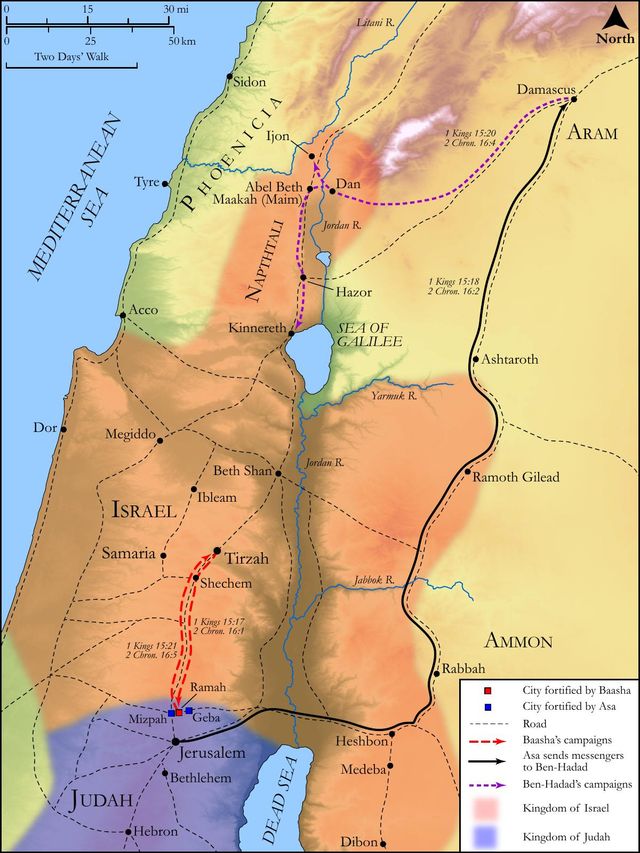
This verse is deeply embedded within the historical narrative of the divided monarchy, specifically detailing the reigns of King Asa of Judah and King Baasha of Israel. The immediate preceding verses meticulously set the stage for Baasha's forced strategic retreat. 1 Kings 15:16 establishes the relentless state of war between these two rival kingdoms. Baasha's aggressive and calculated move to fortify Ramah, a strategically vital location just north of Jerusalem, is detailed in 1 Kings 15:17. King Asa's ingenious counter-strategy, involving a desperate alliance with Ben-hadad of Aram, secured by depleting the temple and palace treasuries, is fully recounted in 1 Kings 15:18-19. The direct and devastating consequence of this alliance—Ben-hadad's swift and destructive attack on Israel's northern cities—is vividly described in 1 Kings 15:20. Therefore, 1 Kings 15:21 serves as the immediate, direct, and unavoidable reaction to this northern incursion, unequivocally demonstrating the success of Asa's cunning plan and the inherent vulnerability of Baasha's kingdom.
Historical & Cultural Context
The era of the divided monarchy was perpetually characterized by intense military skirmishes, intricate political maneuvering, and a complex web of shifting alliances with surrounding regional powers like Aram (Syria). Ramah, situated approximately five miles north of Jerusalem, lay directly on the primary north-south arterial road, making it an exceptionally critical strategic point. Baasha's fortification of Ramah was a deliberate attempt to impose a comprehensive economic and military blockade on Judah, effectively cutting off vital trade routes and restricting the movement of people. This tactic was a widely employed and effective strategy in ancient warfare to exert overwhelming pressure and establish control. Tirzah, conversely, functioned as the capital of the Northern Kingdom of Israel for several decades, prior to Omri's relocation of the capital to Samaria (1 Kings 16:23-24). Its more northern and easterly location offered a significantly more defensible position, distanced from the immediate southern border conflict. The cultural norm of forming pragmatic alliances, even with foreign powers, to gain a tactical advantage against a rival was deeply ingrained, as evidenced by Asa's willingness to sacrifice valuable temple and palace treasures to secure Ben-hadad's crucial military assistance.
Key Themes
ShowHideThis concise verse profoundly contributes to several overarching themes within the book of Kings. Firstly, it vividly illustrates the perpetual conflict and political instability that defined the divided monarchy, driven relentlessly by human ambition, strategic rivalry, and a lack of unified purpose. Secondly, it powerfully underscores the far-reaching consequences of human alliances and foreign policy, demonstrating how external forces and the actions of seemingly unrelated parties could drastically alter internal conflicts and meticulously laid strategic plans. Asa's alliance with Aram, while pragmatically effective, implicitly raises profound theological questions about reliance on foreign powers versus steadfast reliance on God, a recurring and critical theological motif throughout Kings. Thirdly, the verse exemplifies strategic adaptation and the critical necessity of prioritizing immediate threats. Baasha's decisive action to abandon a significant, long-term offensive project at Ramah for the immediate and urgent defense of his heartland reflects a leader's vital need for flexibility, discernment, and the capacity to shift resources in the face of rapidly changing circumstances. Ultimately, though not explicitly stated, the narrative subtly points to the overarching sovereignty of God working meticulously through human actions and reactions, shaping the destinies of nations and kings according to His divine purposes.
Exposition and Analysis
ShowHideKey Word Analysis
ShowHideThis verb (H8085) signifies far more than mere passive reception of sound; it implies an intelligent and attentive hearing, often with the connotation of understanding and a readiness to respond. In this context, Baasha's "hearing" refers to the receipt of critical intelligence or news regarding Ben-hadad's devastating attacks on his northern cities. This was information that demanded immediate and decisive attention, fundamentally altering his strategic calculus and compelling a swift, reactive course of action.
The verb châdal (H2308) means "to cease, desist, stop, abandon." When coupled with the infinitive "to build" (H1129, bânâh), it conveys an immediate, complete, and forced cessation of the construction project. This was not a temporary pause or a tactical withdrawal, but an absolute abandonment, indicating the extreme severity of the new threat. It underscores the sudden, non-negotiable, and compulsory nature of Baasha's strategic pivot, as he was compelled to redirect all resources and attention.
While literally meaning "to sit" (H3427) or "to reside," in this specific context, yâšab carries the profound implication of establishing residence, and by extension, the seat of government, military command, and administrative focus. Baasha's "dwelling" in Tirzah signifies a comprehensive strategic repositioning of his entire operational and personal focus to his capital. This was a critical tactical retreat from the southern front, designed to consolidate forces, organize a defense, and manage the crisis from the core of his kingdom against the northern invasion.
Verse Breakdown
ShowHide"And it came to pass, when Baasha heard [thereof]"
This opening clause establishes a clear and direct cause-and-effect relationship. Baasha's subsequent actions are a reactive response to intelligence he received. The "thereof" directly refers to the news of Ben-hadad's devastating and disruptive attacks on Israel's northern cities, as explicitly detailed in the preceding verse (1 Kings 15:20). This highlights the immediate, compelling, and urgent nature of the threat that necessitated a drastic change in strategy.
"that he left off building of Ramah"
This is the immediate and dramatic consequence of the intelligence Baasha received. His ambitious and strategically significant project to fortify Ramah, which was intended to impose a crippling blockade on Judah, was abruptly and completely halted. This signifies a fundamental shift in his military priorities, an acknowledgment that the immediate and severe threat to his northern territories was far more pressing and existential than his ongoing offensive against the Southern Kingdom.
"and dwelt in Tirzah"
This final clause precisely describes Baasha's strategic repositioning. He initiated a full withdrawal from the southern border and relocated his military, administrative, and personal focus to Tirzah, which served as his capital. This decisive move was absolutely essential for defending his heartland, consolidating his remaining forces, and organizing an effective response to the Aramean invasion, demonstrating a pragmatic and necessary adaptation to a rapidly and unpredictably changing geopolitical landscape.
Literary Devices
ShowHideThe verse effectively employs Cause and Effect to illustrate the direct and unavoidable consequence of Asa's strategic maneuver on Baasha's actions. Ben-hadad's devastating attack on Israel's northern cities (the cause) directly compels Baasha's abrupt abandonment of the Ramah project and his strategic retreat to Tirzah (the effect). There is also a clear depiction of Strategic Shift: Baasha's military and political posture transforms dramatically from an offensive blockade at Ramah to a defensive consolidation at his capital, Tirzah. This abrupt shift powerfully highlights the dynamic, unpredictable, and often reactive nature of ancient warfare and leadership. Furthermore, a subtle but potent Irony is present, as Baasha's aggressive and well-planned offensive against Judah ultimately backfires due to Asa's counter-strategy, forcing Baasha to abandon his initial objective and instead defend his own territory from an external threat he inadvertently provoked.
Theological and Thematic Connections
ShowHideWhile 1 Kings 15:21 primarily describes a military and political maneuver, it carries significant theological weight by demonstrating the inherent limits of human strategy and the unpredictable nature of geopolitics, which are often subtly undergirded by divine providence. Baasha's meticulously planned blockade of Judah was decisively thwarted not by Judah's direct military might, but by a cunning alliance that shifted the battleground entirely. This powerfully illustrates that even the most well-conceived and ambitious human plans can be disrupted by unforeseen circumstances or the actions of others, subtly pointing to a higher power that can frustrate the designs of nations and kings. It serves as a profound reminder that ultimate control and sovereignty do not reside in human rulers or their formidable armies, but in the sovereign hand of God, who can use even the intricate machinations of rival kingdoms to achieve His overarching purposes, whether to protect His covenant people or to bring about judgment.
Reflection and Application
ShowHide1 Kings 15:21 offers profound and enduring lessons in leadership, adaptability, and the critical discernment of priorities, lessons that extend far beyond the ancient battlefields of the divided monarchy. Baasha's forced pivot from an aggressive, offensive building project to an urgent, defensive retreat underscores a fundamental reality of life: we are often called to abandon cherished plans, ongoing projects, or even comfortable routines when more critical, immediate threats or opportunities arise. This demands not only practical flexibility but, more importantly, deep spiritual discernment. We must regularly and honestly evaluate our "Ramahs"—the pursuits, habits, relationships, or even ambitions we are diligently "building" that, while seemingly productive or important, might inadvertently be distracting us from a more vital calling, a more pressing spiritual battle, or a more urgent divine assignment. Wise living involves the courage to re-evaluate our course, the humility to admit that a change of direction is needed, and the disciplined resolve to reallocate our finite time, energy, and resources to what truly matters most in the present moment. Just as Baasha had to prioritize the very survival of his kingdom, we are called to prioritize our spiritual health, the well-being of our families, and our mission in Christ, even if it means courageously letting go of lesser things or abandoning long-held plans.
Questions for Reflection
ShowHideFAQ
ShowHideWhy was Ramah so strategically important?
ShowHideRamah was strategically vital due to its critical location approximately five miles north of Jerusalem, positioned directly on the main north-south road that served as a primary artery connecting the Northern and Southern Kingdoms. By fortifying Ramah, King Baasha of Israel aimed to establish a formidable choke point that would effectively blockade Judah. This maneuver was designed to prevent the free flow of trade, communication, and the movement of people in and out of Jerusalem, thereby economically and militarily isolating the Southern Kingdom. It represented a classic and highly effective ancient military tactic to exert overwhelming pressure and establish control over a rival.
Why did Baasha retreat to Tirzah, and what was its significance?
ShowHideBaasha retreated to Tirzah because it served as the established capital of the Northern Kingdom of Israel at that specific time. When Ben-hadad, the king of Aram, launched devastating attacks on Israel's northern cities (as detailed in 1 Kings 15:20), Baasha's immediate and paramount priority shifted from blockading Judah to defending his own heartland and capital. Retreating to Tirzah allowed him to consolidate his remaining forces, organize a comprehensive defense, and manage the unfolding crisis from the administrative and military center of his kingdom. It was a necessary and pragmatic strategic move to address the more immediate and severe existential threat to his core territories.
What was the ultimate outcome of this specific conflict between Asa and Baasha?
ShowHideThe immediate outcome, as precisely detailed in 1 Kings 15:21, was that Baasha's aggressive offensive against Judah was decisively thwarted, and he was compelled to abandon his significant fortification project at Ramah. King Asa, demonstrating shrewd opportunism, then utilized the very building materials that Baasha had left behind at Ramah to fortify two of his own strategically important border towns, Geba and Mizpah (1 Kings 15:22). This effectively transformed Baasha's abandoned project into a significant defensive advantage for Judah. While the broader war between Asa and Baasha continued throughout their respective reigns, this particular strategic maneuver by Asa provided a crucial and lasting tactical victory for Judah.
Christ-Centered Fulfillment
ShowHideThe strategic maneuvers and shifting alliances depicted in 1 Kings 15:21, though rooted in the ancient geopolitics of the divided monarchy, ultimately serve to highlight the profound futility of human efforts and plans when undertaken apart from God's sovereign will, and they powerfully foreshadow the ultimate, unyielding, and eternal victory of Jesus Christ. Baasha's meticulously crafted plan to blockade Judah was decisively thwarted by an unexpected turn of events, vividly demonstrating that "Many are the plans in a person's heart, but it is the Lord's purpose that prevails" (Proverbs 19:21). In stark contrast to Baasha's forced retreat and the abandonment of his strategic objective, Jesus Christ never retreats, never abandons His divine mission, and His eternal kingdom can never be thwarted by any earthly or spiritual power. He unequivocally declared, "I will build my church, and the gates of hell shall not prevail against it" (Matthew 16:18). While human kings like Asa and Baasha relied on precarious alliances and fleeting military might, Christ's ultimate victory was secured not through earthly power, but through His perfect, self-sacrificial act on the cross, where He disarmed the spiritual powers and authorities, triumphing over them decisively (Colossians 2:15). The temporary relief Judah experienced from Baasha's blockade foreshadows the eternal peace, security, and unshakeable refuge found exclusively in Christ, who is our true "Ramah" – a spiritual fortress that can never be breached, and a divine deliverer who never abandons His people. His eternal kingdom is not built on the shifting sands of human strategy or fleeting alliances, but on the unshakeable and eternal foundation of His divine power, faithfulness, and unwavering purpose, ensuring that all His redemptive plans will be perfectly fulfilled (Hebrews 12:2).