


2 Chronicles 16:5
- וַיְהִיvay·Hiand it wasH1961Conj-w ¦ V-Qal-ConsecImperf-3msVerb Qal Consecutive Imperfect 3rd Singular Masculineוַandיְהִיit was
- כִּשְׁמֹעַkish·Mo·a'when heardH8085Prep-k ¦ V-Qal-InfVerb Qal Infinitive Constructכִּwhenשְׁמֹעַheard
- בַּעְשָׁאba'·Sha'BaashaH1201N-proper-mNoun Proper Masculine
- וַיֶּחְדַּלvai·yech·Daland he ceasedH2308Conj-w ¦ V-Qal-ConsecImperf-3msVerb Qal Consecutive Imperfect 3rd Singular Masculineוַandיֶּחְדַּלhe ceased
- מִבְּנוֹתmi·be·Notfrom buildingH1129Prep-m ¦ V-Qal-InfVerb Qal Infinitive Constructמִfromבְּנוֹתbuilding
- אֶת'et<obj.>H853DirObjMParticle Object Indicator
- הָרָמָהha·ra·Mah<the> RamahH7414Art ¦ N-properNoun Proper Locationהָ<the>רָמָהRamah
- וַיַּשְׁבֵּתvai·yash·Betand he caused to ceaseH7673Conj-w ¦ V-Hiphil-ConsecImperf-3msVerb Hiphil Consecutive Imperfect 3rd Singular Masculineוַandיַּשְׁבֵּתhe caused to cease
- אֶת'et<obj.>H853DirObjMParticle Object Indicator
- מְלַאכְתּוֹme·lakh·Tohis workH4399N-fsc ¦ 3msNoun Singular Feminine Constructמְלַאכְתּworkוֹhis
English is a literal word-by-word gloss of the Hebrew, not the KJV's wording. Why?
This is the original text the KJV's translators worked from — each Hebrew word with its own literal English meaning in this verse, prepared by scholars at Tyndale House, Cambridge. The KJV translates whole sentences, not word by word, so its wording differs: one Hebrew word can become several English words, and the KJV may choose “the LORD” where the gloss reads “Yahweh”. Both are faithful — they answer different questions. For the KJV's own rendering, switch to the KJV text.
Details
See on the biblical-era map
Study this verse
Public-domain commentary
Matthew Henry
From his Commentary on the Whole Bible. Henry comments on passages, not single verses — this entry covers 2 Chronicles 16:1–6.
How to reconcile the date of this event with the history of the kings I am quite at a loss. Baasha died in the twenty-sixth year of Asa, Kg1 16:8. How then could this be done in his thirty-sixth year, when Baasha's family was quite cut off, and Omri was upon the throne? It is generally said to be meant of the thirty-sixth year of the kingdom of Asa, namely, that of Judah, beginning from the first of Rehoboam, and so it coincides with the sixteenth of Asa's reign; but then Ch2 15:19 must be so understood; and how could it be spoken of as a great thing that there was no more war till the fifteenth year of Asa, when that passage immediately before was in his fifteenth year? (Ch2 15:10), and after this miscarriage of his, here recorded, he had wars, Ch2 16:9. Josephus places it in his twenty-sixth year, and then we must suppose a mistake in the transcriber here and Ch2 15:19, the admission of which renders the computation easy. This passage we had before (Kg1 15:17, etc.) and Asa was in several ways faulty in it. 1. He did not do well to make a league with Benhadad, a heathen king, and to value himself so much upon it as he seems to have done, Ch2 16:3. Had he relied more upon his covenant, and his father's, with God, he would not have boasted so much of his league, and his father's, with the royal family of Syria. 2. If he had had a due regard to the honour of Israel in general, he would have found some other expedient to give Baasha a diversion than by calling in a foreign force, and inviting into the country a common enemy, who, in process of time, might be a plague to Judah too. 3. It was doubtless a sin in Benhadad to break his league with Baasha upon no provocation, but merely through the influence of a bribe; and, if so, certainly it was a sin in Asa to move him to it, especially to hire him to do it. The public faith of kings and kingdoms must not be made so cheap a thing. 4. To take silver and gold out of the house of the Lord for this purpose was a great aggravation of the sin, Ch2 16:2. Must the temple be plundered to serve his carnal politics? He had better have brought gifts and offerings with prayers and supplications, to the house of the Lord, that he might have engaged God on his side and made him his friend; then he would not have needed to be at this expense to make Benhadad his friend. 5. It was well if Asa had not to answer for all the mischief that the army of Benhadad did unjustly to the cities of Israel, all the blood they shed and all the spoil they made, Ch2 16:4. Perhaps Asa intended not that they should carry the matter so far. But those that draw others to sin know not what they do, nor where it will end. The beginning of sin is as the letting forth of water. However the project succeeded. Benhadad gave Baasha a powerful diversion, obliged him to leave off building Ramah and betake himself to the defence of his own country northward, which gave Asa an opportunity, not only to demolish his fortifications, but to seize the materials and convert them to his own use.
Continue studying 2 Chronicles 16:5 across the web’s major study libraries — every link below opens this exact verse, chapter, or book on the destination site.
Read & Compare
 BibleGatewayThis verse in more than 200 translations and 70 languages.
 Bible.comThe YouVersion reader — hundreds of translations, reading plans, and highlights.
 ESV.orgCrossway's official English Standard Version reader.
 NET BibleThe NET translation with 60,000+ translators' notes on every rendering decision.
 STEP BibleTyndale House's free study tool — original text, vocabulary, and scholarly resources.
 BibliaLogos Bible Software's free web reader.
 USCCBThe New American Bible (Revised Edition) with the U.S. bishops' study notes.
Commentaries
 BibleHub CommentariesDozens of classic commentaries on this verse, gathered on one page.
 StudyLightMore than 100 commentary sets — the largest collection on the web.
 BibleRefPlain-English commentary on what this verse means, verse by verse.
 Enduring WordDavid Guzik's free commentary on this chapter, widely used by Bible teachers.
 Bible Study ToolsVerse commentary alongside Greek and Hebrew study aids.
Original Language & Research
- BibleHub InterlinearThe verse word by word — original language, transliteration, and English.
- BibleHub LexiconEvery word's original-language definition and Strong's entry.
 Blue Letter BibleDeep-study tools — Strong's numbers, concordance, and word studies.
 SefariaThe Hebrew text with Rashi and centuries of Jewish commentary.
Sermons, Hymns & Audio


TrulyRandomVerse is not affiliated with these sites and doesn’t control their content. They’re linked because they’re genuinely useful.
Summary
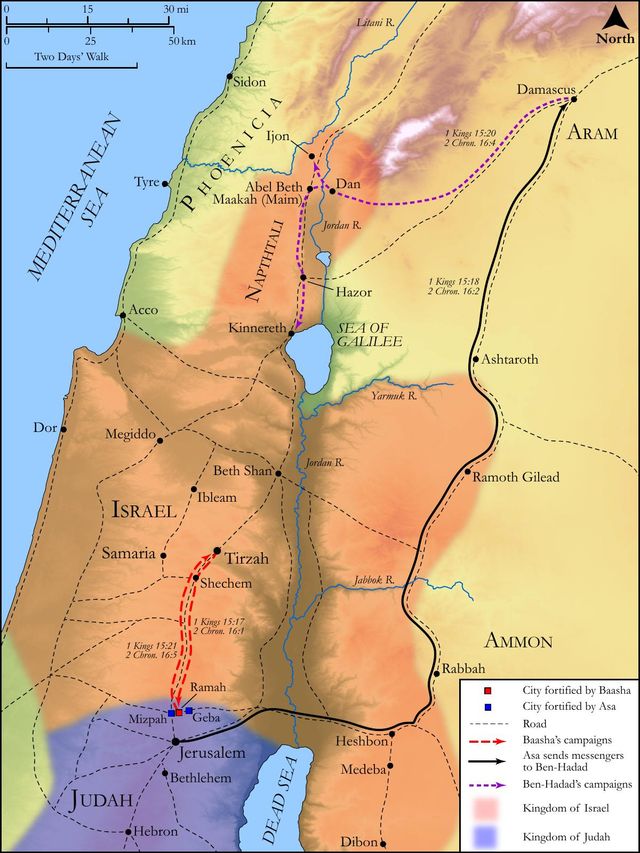
Second Chronicles 16:5 records the abrupt cessation of King Baasha of Israel's strategic building project at Ramah. This pivotal event was a direct consequence of King Asa of Judah's diplomatic maneuver, wherein he bribed Ben-hadad, King of Syria, to break his alliance with Baasha and attack Israelite territory. Upon hearing of the northern invasion, Baasha was compelled to abandon his fortification efforts at Ramah, a critical border city intended to exert pressure on Judah, thereby illustrating the immediate and far-reaching impact of shifting geopolitical alliances and divine orchestration in the affairs of nations.
Context
ShowHideLiterary Context
This verse is strategically placed within the narrative of King Asa's reign over Judah, specifically detailing a significant foreign policy decision and its immediate repercussions. It directly follows the account of Asa's alliance with Ben-hadad, King of Syria, against Baasha, King of Israel, as described in 2 Chronicles 16:1-4. Baasha had been actively fortifying Ramah, a highly strategic location, with the explicit purpose of blockading Judah and controlling access to Jerusalem. Asa, instead of relying on the Lord, took treasures from the temple and his own palace to secure Ben-hadad's loyalty. When Ben-hadad subsequently attacked Israelite cities in the north, Baasha was forced to divert his military resources and attention away from Judah, leading to the abandonment of his construction efforts at Ramah. The phrase "when Baasha heard it" directly refers to his receiving news of this surprise invasion, which served as the immediate catalyst for the events of this verse. This event sets the stage for the prophetic rebuke of Asa by Hanani the seer in 2 Chronicles 16:7-9, highlighting the theological implications of Asa's reliance on human alliances rather than divine faithfulness.
Historical & Cultural Context
The period described is one of persistent tension and open conflict between the divided kingdoms of Judah (south) and Israel (north) following the split of the united monarchy. Ramah, situated approximately five miles north of Jerusalem, was a critical border city controlling a major north-south artery. Its fortification by Baasha was a clear act of aggression, intended to exert economic and military pressure on Judah by controlling access to and from Jerusalem. The practice of forming alliances with neighboring powers, often sealed with substantial tribute or bribes, was a common geopolitical strategy in the ancient Near East. Asa's decision to use temple and palace treasures to sway Ben-hadad reflects the desperate measures kings would take to secure their borders and gain advantage over rivals. This incident underscores the precarious balance of power and the constant threat of regional warfare that characterized the period of the divided monarchy, where national security often hinged on shifting allegiances and military might.
Key Themes
ShowHideThe cessation of Baasha's building project at Ramah powerfully illustrates several key themes central to the Chronicler's narrative. Firstly, it highlights the disruption of human plans by external forces, often divinely orchestrated, demonstrating that even well-conceived human endeavors can be suddenly and completely thwarted. Baasha's ambitious project, aimed at strengthening his kingdom and pressing Judah, was brought to an immediate standstill, showcasing the fragility of human foresight. Secondly, the verse emphasizes the consequences of geopolitical strategy and the tangible impact of international relations and shifting alliances. Asa's strategic maneuver, though born of a lack of faith, directly led to Baasha's tactical retreat and the abandonment of his work, underscoring how actions on one front can have immediate and decisive effects on another. Thirdly, and most profoundly, it subtly introduces the overarching theme of divine sovereignty versus human agency, which becomes explicitly articulated in Hanani's subsequent rebuke of Asa in 2 Chronicles 16:7-9. Though Asa acted out of human cunning, the outcome served God's purpose in disrupting Baasha's aggression and revealing Asa's spiritual compromise, demonstrating that God's purposes prevail even through flawed human actions.
Exposition and Analysis
ShowHideKey Word Analysis
ShowHideFrom an unused root meaning "to stink," this name signifies "offensiveness." Baasha was the king of Israel who seized the throne through regicide and continued the idolatrous practices of Jeroboam. His name, with its negative connotation, subtly foreshadows the judgment pronounced against his house and highlights his character as an adversary to Judah and, by extension, to God's covenant people.
This primitive root signifies more than just auditory perception; it implies hearing intelligently, often with the implication of attention, comprehension, and even obedience. In this context, Baasha "heard" the news of Ben-hadad's invasion, meaning he received definite, actionable intelligence that he understood and was compelled to respond to immediately. It conveys the sudden and impactful nature of the information that forced his hand.
A primitive root meaning "to repose" or "to desist from exertion," this verb is used here in its causative Hiphil form, meaning "to cause to cease" or "to bring to an end." This is a strong term, emphasizing the definitive and forceful termination of the work. The use of "cease" (H7673) following "left off" (H2308) underscores the totality and finality of Baasha's abandonment of the project at Ramah, indicating a complete and irreversible halt.
Verse Breakdown
ShowHide"And it came to pass, when Baasha heard [it]"
This introductory clause establishes a clear cause-and-effect relationship, setting the stage for the dramatic shift in events. The "it" refers to the intelligence Baasha received regarding Ben-hadad's invasion of Israelite territory, specifically the cities mentioned in 2 Chronicles 16:4. Baasha's reception of this critical news serves as the immediate and undeniable catalyst for his subsequent actions, highlighting the suddenness of the geopolitical shift.
"that he left off building of Ramah"
Upon receiving the intelligence of the northern invasion, Baasha immediately abandoned his ambitious and ongoing construction project at Ramah. This was not merely a pause but a complete cessation of a significant strategic undertaking, designed to fortify a key border city and exert pressure on Judah. The abandonment signifies an urgent and drastic diversion of military and labor resources to address the new, more pressing threat to his kingdom's northern flank.
"and let his work cease"
This phrase serves as a powerful reiteration and emphasis on the complete and definitive termination of the building activities. It underscores the decisive and irreversible nature of Baasha's response to the invasion. The repetition of the idea of stopping ("left off" and "cease") highlights the totality and finality of Baasha's abandonment of the project, signifying that the work was not merely paused but brought to a definitive halt, as Baasha's strategic priorities shifted dramatically to defend his northern borders.
Literary Devices
ShowHideThe verse employs several literary devices to convey its message with striking clarity and impact. Cause and Effect is central to its structure, as Baasha's action of abandoning the building is presented as a direct, inevitable consequence of "when Baasha heard" the news of the Syrian invasion. This highlights the immediate and impactful nature of geopolitical shifts and the chain reaction they can trigger. Conciseness is also a notable feature; the verse is remarkably brief, yet it powerfully communicates a significant strategic reversal and the complete disruption of a major undertaking. This brevity underscores the suddenness and finality of Baasha's decision. Furthermore, within the broader narrative of 2 Chronicles 16, there is an element of Irony: Baasha's aggressive building project at Ramah, specifically intended to oppress and blockade Judah, is ultimately thwarted by Judah's king, Asa, albeit through a faithless alliance. This demonstrates how human plans, even those driven by hostility, can be unexpectedly disrupted by external forces, often serving a larger, unseen divine purpose.
Theological and Thematic Connections
ShowHideThe abrupt cessation of Baasha's building project at Ramah, though triggered by human political maneuvering, serves as a profound illustration of divine sovereignty over human endeavors. While King Asa's actions in bribing Ben-hadad were a display of human cunning and, as later revealed, a significant lack of faith in God, the outcome nevertheless aligned with God's overarching control of history. This event demonstrates that even the most determined and well-resourced human plans can be thwarted when they run contrary to God's purposes or when God chooses to intervene, whether directly or through the actions of other nations and rulers. It underscores a fundamental biblical truth: human plans are subject to the will of the Almighty, and true security and success are found not in strategic alliances or military might, but in faithful reliance upon God. The Chronicler consistently emphasizes that God is actively involved in the affairs of His people and the nations, orchestrating events to fulfill His purposes.
Reflection and Application
ShowHideFor the modern believer, 2 Chronicles 16:5 offers profound insights into the nature of human plans and divine sovereignty. It reminds us that even our most meticulously crafted strategies, whether personal, professional, or communal, are ultimately subject to forces beyond our immediate control. Just as Baasha's ambitious project was abruptly halted, so too can our endeavors be disrupted by unforeseen circumstances, shifting priorities, or external pressures. This verse calls us to cultivate a posture of humility and flexibility, recognizing that while diligent planning is wise, ultimate trust must be placed in God's sovereign hand. It challenges us to examine where we place our security—in our own efforts, our resources, or our strategic alliances—or in the unwavering faithfulness of God. When our plans are disrupted, this narrative invites us to seek God's perspective, understanding that such interruptions might be His way of redirecting us, protecting us, or revealing a greater purpose that aligns with His perfect will, even when it feels like a setback.
Questions for Reflection
ShowHideFAQ
ShowHideWhy was Ramah so important strategically?
ShowHideRamah was strategically vital because of its location approximately five miles north of Jerusalem, along a major north-south road that served as a primary artery for trade and military movement. By fortifying Ramah, Baasha intended to establish a choke-point, effectively cutting off Judah's access to the northern trade routes and controlling movement in and out of Jerusalem. This would have exerted significant economic and military pressure on King Asa and the kingdom of Judah, making its cessation a major strategic victory for Judah, albeit one achieved through questionable means. This strategic importance is further highlighted by its repeated mention in biblical history, such as in Jeremiah 31:15.
What was King Baasha's overall reign like in Israel?
ShowHideKing Baasha's reign (c. 909-886 BC) is primarily described in 1 Kings 15:16-22 and 2 Chronicles 16:1-6. He was a military man who seized the throne of Israel by assassinating King Nadab and subsequently wiped out the entire house of Jeroboam, fulfilling a prophecy (see 1 Kings 15:29). His reign was marked by continuous warfare with Judah, particularly against King Asa. Despite his military successes, the Bible condemns Baasha for continuing in the sins of Jeroboam, leading Israel astray with idolatry. The prophet Jehu later pronounced judgment against Baasha's house for his wickedness (see 1 Kings 16:1-4).
How does this event relate to King Asa's later actions and the broader message of 2 Chronicles?
ShowHideThis event, where Asa relies on Ben-hadad rather than God, is a critical turning point in Asa's reign. While Asa began his reign with strong faith and reliance on the Lord, leading to peace and victory (e.g., against Zerah the Cushite in 2 Chronicles 14:9-15), his decision to bribe Ben-hadad marks a significant shift away from that trust. The prophet Hanani rebukes Asa for this lack of faith in 2 Chronicles 16:7-9, reminding him that "the eyes of the Lord range throughout the earth to strengthen those whose hearts are fully committed to him." Asa's subsequent response to this rebuke, imprisoning Hanani and oppressing his people, reveals a hardening of his heart and a decline in his spiritual walk. This narrative serves as a cautionary tale within 2 Chronicles, emphasizing that even righteous kings can falter, and that consistent, unwavering trust in God is paramount for true security and blessing, highlighting the Chronicler's central theme of divine retribution and reward based on faithfulness.
Christ-Centered Fulfillment
ShowHideThe narrative of Baasha's thwarted building project at Ramah, orchestrated by divine providence through the actions of human kings, powerfully foreshadows the ultimate sovereignty of God in the person and work of Jesus Christ. Just as Baasha's plans were brought to a sudden halt, so too were the plans and schemes of humanity, sin, and even death ultimately rendered powerless in the face of God's redemptive purpose in Christ. The Old Testament repeatedly demonstrates that human efforts, whether for good or ill, are always subservient to God's grand design. In Jesus, this divine control reaches its zenith. No earthly king, no political alliance, no human opposition could thwart God's eternal plan to send His Son as the Lamb of God, who takes away the sin of the world. The "building" of God's kingdom, established by Christ, is one that "the gates of hell shall not prevail against" (Matthew 16:18). While human empires rise and fall, and their strategic projects are abandoned or completed, Christ's work on the cross and His resurrection secured an eternal kingdom that can never be shaken, for He is the cornerstone of God's new temple. He is the ultimate Builder, and His work of salvation and redemption stands eternally complete, a testament to God's unthwartable will and the triumph of His divine purpose over all human machinations, culminating in the establishment of a kingdom that will have no end (Luke 1:33).