


2 Chronicles 16:4
Bible text: King James Version (1769 Blayney text) · Public domain
Bible text: King James Version with Strong's numbers · Public domain
Bible text: Berean Standard Bible · Public domain
Bible text: American Standard Version (1901) · Public domain
Bible text: World English Bible, Messianic edition · Public domain
Bible text: Geneva Bible (1599) · Public domain
Bible text: Young's Literal Translation · Public domain
- וַיִּשְׁמַעvai·yish·Ma'and he listenedH8085Conj-w ¦ V-Qal-ConsecImperf-3msVerb Qal Consecutive Imperfect 3rd Singular Masculineוַandיִּשְׁמַעhe listened
- בֶּןbenBenH1130N-proper-mNoun Proper Masculine
- הֲדַדha·DadHadadH1130N-proper-mNoun Proper Masculine
- אֶל'eltoH413PrepPreposition
- הַמֶּלֶךְha·Me·lekhthe kingH4428Art ¦ N-msNoun Singular Masculine Absoluteהַtheמֶּלֶךְking
- אָסָא'a·Sa'AsaH609N-proper-mNoun Proper Masculine
- וַיִּשְׁלַחVai·yish·lachand he sentH7971Conj-w ¦ V-Qal-ConsecImperf-3msVerb Qal Consecutive Imperfect 3rd Singular Masculineוַandיִּשְׁלַחhe sent
- אֶת'et<obj.>H853DirObjMParticle Object Indicator
- שָׂרֵיsa·Rei[the] commanders ofH8269N-mpcNoun Plural Masculine Construct
- הַחֲיָלִיםha·cha·ya·Limthe armiesH2428Art ¦ N-mpNoun Plural Masculine Absoluteהַtheחֲיָלִיםarmies
- אֲשֶׁר'a·SherwhichH834RelParticle Relative
- לוֹlo[belonged] to <the> himPrep-l ¦ 3msSuffix Personal 3rd Singular Masculineל[belonged] to <the>וֹhim
- אֶל'elagainstH413PrepPreposition
- עָרֵי'a·Rei[the] cities ofH5892N-mpcNoun Plural Masculine Construct
- יִשְׂרָאֵלYis·ra·'ElIsraelH3478N-properNoun Proper Location
- וַיַּכּוּvai·ya·Kuand they struck downH5221Conj-w ¦ V-Hiphil-ConsecImperf-3mpVerb Hiphil Consecutive Imperfect 3rd Plural Masculineוַandיַּכּוּthey struck down
- אֶת'et<obj.>H853DirObjMParticle Object Indicator
- עִיּוֹןi·YonIjonH5859N-properNoun Proper Location
- וְאֶתve·'Etand <obj.>H853Conj-w ¦ DirObjMParticle Object Indicatorוְandאֶת<obj.>
- דָּןDanDanH1835N-properNoun Proper Location
- וְאֵתve·'Etand <obj.>H853Conj-w ¦ DirObjMParticle Object Indicatorוְandאֵת<obj.>
- אָבֵל'a·VelAbelH66N-properNoun Proper Location
- מָיִםMa·yimMaimH66N-properNoun Proper Location
- וְאֵתve·'Etand <obj.>H853Conj-w ¦ DirObjMParticle Object Indicatorוְandאֵת<obj.>
- כָּלkalallH3605N-mscNoun Singular Masculine Construct
- מִסְכְּנוֹתmis·ke·Not[the] stores ofH4543N-fpcNoun Plural Feminine Construct
- עָרֵי'a·Rei[the] cities ofH5892N-mpcNoun Plural Masculine Construct
- נַפְתָּלִיnaf·ta·LiNaphtaliH5321N-proper-mNoun Proper Masculine
English is a literal word-by-word gloss of the Hebrew, not the KJV's wording. Why?
This is the original text the KJV's translators worked from — each Hebrew word with its own literal English meaning in this verse, prepared by scholars at Tyndale House, Cambridge. The KJV translates whole sentences, not word by word, so its wording differs: one Hebrew word can become several English words, and the KJV may choose “the LORD” where the gloss reads “Yahweh”. Both are faithful — they answer different questions. For the KJV's own rendering, switch to the KJV text.
Details
See on the biblical-era map
Study this verse
Public-domain commentary
Matthew Henry
From his Commentary on the Whole Bible. Henry comments on passages, not single verses — this entry covers 2 Chronicles 16:1–6.
How to reconcile the date of this event with the history of the kings I am quite at a loss. Baasha died in the twenty-sixth year of Asa, Kg1 16:8. How then could this be done in his thirty-sixth year, when Baasha's family was quite cut off, and Omri was upon the throne? It is generally said to be meant of the thirty-sixth year of the kingdom of Asa, namely, that of Judah, beginning from the first of Rehoboam, and so it coincides with the sixteenth of Asa's reign; but then Ch2 15:19 must be so understood; and how could it be spoken of as a great thing that there was no more war till the fifteenth year of Asa, when that passage immediately before was in his fifteenth year? (Ch2 15:10), and after this miscarriage of his, here recorded, he had wars, Ch2 16:9. Josephus places it in his twenty-sixth year, and then we must suppose a mistake in the transcriber here and Ch2 15:19, the admission of which renders the computation easy. This passage we had before (Kg1 15:17, etc.) and Asa was in several ways faulty in it. 1. He did not do well to make a league with Benhadad, a heathen king, and to value himself so much upon it as he seems to have done, Ch2 16:3. Had he relied more upon his covenant, and his father's, with God, he would not have boasted so much of his league, and his father's, with the royal family of Syria. 2. If he had had a due regard to the honour of Israel in general, he would have found some other expedient to give Baasha a diversion than by calling in a foreign force, and inviting into the country a common enemy, who, in process of time, might be a plague to Judah too. 3. It was doubtless a sin in Benhadad to break his league with Baasha upon no provocation, but merely through the influence of a bribe; and, if so, certainly it was a sin in Asa to move him to it, especially to hire him to do it. The public faith of kings and kingdoms must not be made so cheap a thing. 4. To take silver and gold out of the house of the Lord for this purpose was a great aggravation of the sin, Ch2 16:2. Must the temple be plundered to serve his carnal politics? He had better have brought gifts and offerings with prayers and supplications, to the house of the Lord, that he might have engaged God on his side and made him his friend; then he would not have needed to be at this expense to make Benhadad his friend. 5. It was well if Asa had not to answer for all the mischief that the army of Benhadad did unjustly to the cities of Israel, all the blood they shed and all the spoil they made, Ch2 16:4. Perhaps Asa intended not that they should carry the matter so far. But those that draw others to sin know not what they do, nor where it will end. The beginning of sin is as the letting forth of water. However the project succeeded. Benhadad gave Baasha a powerful diversion, obliged him to leave off building Ramah and betake himself to the defence of his own country northward, which gave Asa an opportunity, not only to demolish his fortifications, but to seize the materials and convert them to his own use.
Continue studying 2 Chronicles 16:4 across the web’s major study libraries — every link below opens this exact verse, chapter, or book on the destination site.
Read & Compare
 BibleGatewayThis verse in more than 200 translations and 70 languages.
 Bible.comThe YouVersion reader — hundreds of translations, reading plans, and highlights.
 ESV.orgCrossway's official English Standard Version reader.
 NET BibleThe NET translation with 60,000+ translators' notes on every rendering decision.
 STEP BibleTyndale House's free study tool — original text, vocabulary, and scholarly resources.
 BibliaLogos Bible Software's free web reader.
 USCCBThe New American Bible (Revised Edition) with the U.S. bishops' study notes.
Commentaries
 BibleHub CommentariesDozens of classic commentaries on this verse, gathered on one page.
 StudyLightMore than 100 commentary sets — the largest collection on the web.
 BibleRefPlain-English commentary on what this verse means, verse by verse.
 Enduring WordDavid Guzik's free commentary on this chapter, widely used by Bible teachers.
 Bible Study ToolsVerse commentary alongside Greek and Hebrew study aids.
Original Language & Research
- BibleHub InterlinearThe verse word by word — original language, transliteration, and English.
- BibleHub LexiconEvery word's original-language definition and Strong's entry.
 Blue Letter BibleDeep-study tools — Strong's numbers, concordance, and word studies.
 SefariaThe Hebrew text with Rashi and centuries of Jewish commentary.
Sermons, Hymns & Audio


TrulyRandomVerse is not affiliated with these sites and doesn’t control their content. They’re linked because they’re genuinely useful.
Summary
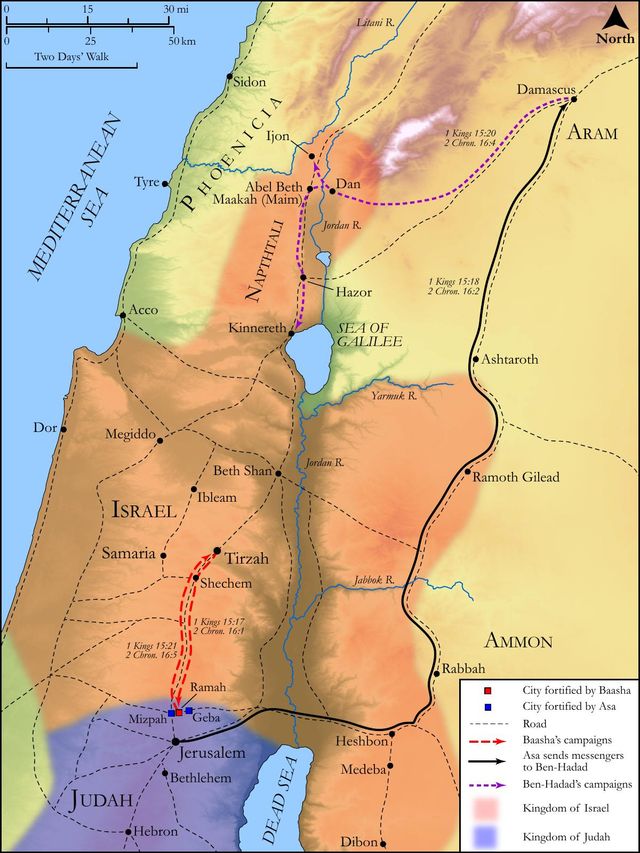
Second Chronicles 16:4 vividly recounts the immediate and devastating outcome of King Asa of Judah's unfaithful alliance with Ben-Hadad I, King of Aram (Syria). Faced with a threat from Baasha, King of Israel, Asa, instead of relying on God as he had previously, chose to bribe Ben-Hadad with sacred temple treasures to break his treaty with Israel and launch an attack. This verse details Ben-Hadad's swift and successful military campaign against key northern Israelite cities—Ijon, Dan, Abelmaim, and all the store cities of Naphtali—thereby forcing Baasha to abandon his fortifications at Ramah and providing temporary relief for Judah.
Context
ShowHideLiterary Context
This verse marks a pivotal and unfortunate turning point in the reign of King Asa, contrasting sharply with his earlier exemplary faith and obedience. Chapters 14-15 laud Asa's widespread religious reforms and his miraculous deliverance from the vast Cushite army, a victory explicitly attributed to his fervent prayer and unwavering trust in the Lord (2 Chronicles 14:11). However, as 2 Chronicles 16:1 opens, Baasha, King of Israel, begins fortifying Ramah, a strategically vital location that threatened Judah's northern access. Instead of seeking divine intervention once more, Asa, perhaps out of impatience or a lapse in spiritual discernment, opted for a purely political and military solution. He depleted the treasuries of both the temple and the royal palace to bribe Ben-Hadad of Syria to attack Israel. Verse 4 confirms Ben-Hadad's prompt compliance, leading to the swift devastation of northern Israelite cities. This military diversion successfully compelled Baasha to abandon his building efforts at Ramah, as detailed in 2 Chronicles 16:5-6. Despite the immediate tactical success, this act of reliance on human alliances immediately drew a severe prophetic rebuke from Hanani the seer, highlighting Asa's misplaced trust and foreshadowing future troubles for the king (2 Chronicles 16:7-9).
Historical & Cultural Context
The period of the divided monarchy, with the northern kingdom of Israel and the southern kingdom of Judah, was characterized by persistent internal strife and complex, often shifting, external alliances. Aram (Syria), with its capital at Damascus, emerged as a formidable regional power, frequently influencing the balance of power between Israel and Judah. Kings routinely engaged in strategic alliances, often solidified through treaties and the exchange of tribute, to gain military or political advantage over their rivals. Asa's decision to offer a substantial bribe to Ben-Hadad reflects a common geopolitical tactic of the era, where loyalty was often bought and sold. The cities specifically mentioned in the verse—Ijon, Dan, and Abelmaim (likely a variant of Abel-Beth-Maacah)—were situated in the extreme northern territories of Israel, particularly within the tribal inheritance of Naphtali. These were crucial "store cities," signifying their importance as administrative, logistical, and military hubs where provisions, weaponry, and other vital resources were accumulated and distributed. Their destruction would have severely compromised Israel's northern defenses and economic stability, underscoring the effectiveness and devastating impact of Ben-Hadad's military campaign.
Key Themes
ShowHideThis verse powerfully illustrates several enduring themes central to 2 Chronicles and the broader biblical narrative. Firstly, it highlights the Consequences of Misplaced Trust, demonstrating how even a monarch with a proven track record of faithfulness can succumb to the temptation to rely on human strength, political maneuvering, and worldly alliances rather than on divine intervention. Asa's choice, despite its immediate practical success in diverting Baasha, is presented as a profound spiritual failure that incurred God's displeasure. Secondly, the passage vividly portrays the realities of Geopolitical Maneuvering and Warfare in the days of the divided kingdoms, where alliances were fluid, and military force was a primary instrument for achieving political objectives. The detailed enumeration of the smitten cities emphasizes the tangible and destructive consequences of such conflicts on human lives and infrastructure. Lastly, the narrative subtly points to Divine Sovereignty Amidst Human Choices. While Asa's decision was a clear spiritual lapse, God still worked through these events to achieve a temporary outcome (Baasha's withdrawal), even if it came at a significant cost to Israel and led to a sharp prophetic rebuke for Asa, as seen in 2 Chronicles 16:7. This intricate tension between human agency and divine oversight is a recurring motif woven throughout the historical books of the Old Testament.
Exposition and Analysis
ShowHideKey Word Analysis
ShowHideThis verb (H8085), meaning "to hear intelligently," "to listen," or "to obey," carries profound implications in biblical contexts. Here, it denotes Ben-Hadad's active, positive, and compliant response to Asa's proposition. It signifies more than merely receiving a message; it implies that Ben-Hadad "listened attentively and consented" to the terms, leading to immediate and decisive action. This highlights the successful negotiation and Ben-Hadad's opportunistic willingness to break his existing treaty with Baasha in exchange for Asa's substantial tribute of silver and gold.
This noun (H2428) refers to a "force, whether of men, means or other resources," specifically denoting an "army," "host," or "band of men (soldiers)." Its use here emphasizes that Ben-Hadad did not send a mere raiding party but a substantial, organized military force. The deployment of "captains of his armies" underscores the seriousness and scale of the offensive, indicating a well-resourced and formidable military operation designed to achieve a decisive impact.
This primitive root verb (H5221) signifies "to strike (lightly or severely, literally or figuratively)," implying a decisive, often violent, military strike. The use of "smote" conveys the severity and destructive nature of Ben-Hadad's campaign. It indicates that these cities were not merely occupied but likely plundered, destroyed, or severely damaged, rendering them unusable as "store cities" and effectively crippling Israel's northern infrastructure and logistical capabilities.
Verse Breakdown
ShowHide"And Benhadad hearkened unto king Asa,"
This initial clause establishes the immediate success of Asa's diplomatic and financial maneuver. Ben-Hadad, the powerful King of Aram, readily accepted Asa's bribe, agreeing to breach his existing treaty with Baasha of Israel. This prompt compliance underscores the persuasive power of the wealth Asa offered and Ben-Hadad's strategic opportunism in exploiting the conflict between the two Israelite kingdoms for his own gain.
"and sent the captains of his armies against the cities of Israel;"
This segment details Ben-Hadad's swift and decisive military action. He dispatched his military commanders, along with their respective forces, indicating a full-scale, organized military operation rather than a minor border skirmish. The explicit target was "the cities of Israel," specifically the northern kingdom, thereby fulfilling Asa's request to divert Baasha's attention and resources away from his fortifications at Ramah.
"and they smote Ijon, and Dan, and Abelmaim, and all the store cities of Naphtali."
This concluding clause specifies the devastating impact and geographical scope of the Syrian attack. Ijon, Dan, and Abelmaim (likely Abel-Beth-Maacah) were strategically important cities located in the northern territory of Naphtali. The comprehensive phrase "all the store cities of Naphtali" emphasizes that the assault was not merely against isolated towns but targeted the logistical and economic heart of the region, including vital supply depots. This widespread destruction would have severely weakened Israel's northern frontier, compelling King Baasha to react and abandon his building project.
Literary Devices
ShowHideThe verse employs Geographic Specificity by meticulously listing the cities attacked (Ijon, Dan, Abelmaim, and the store cities of Naphtali). This precise detail lends historical verisimilitude to the account, grounding the narrative in a tangible reality and emphasizing the widespread and devastating impact of Ben-Hadad's campaign on northern Israel. It transforms a general statement of warfare into a concrete, impactful event. Furthermore, the narrative structure prominently features Cause-Effect, clearly demonstrating that Ben-Hadad's aggressive actions were a direct and immediate consequence of Asa's bribe and diplomatic request. This highlights the immediate, albeit spiritually problematic, effectiveness of Asa's human-centric strategy. There is also an underlying element of Narrative Irony at play; Asa, who had previously experienced miraculous deliverance by wholeheartedly trusting God, now achieves a similar tactical victory through a faithless, worldly alliance, thereby setting the stage for the severe prophetic rebuke that immediately follows in the broader narrative.
Theological and Thematic Connections
ShowHideThis verse, while narrating a seemingly successful military maneuver, serves as a profound theological warning about the dangers of misplaced trust. Asa's decision to rely on a pagan king and the sacred treasures of the temple rather than on the God who had previously delivered him from overwhelming odds (2 Chronicles 14:9-13) reveals a significant spiritual decline. It underscores the timeless biblical principle that true security, lasting peace, and ultimate victory are found in God alone, not in human alliances, material wealth, or military might. While the immediate outcome was favorable for Judah, the spiritual cost was immense, leading to a divine rebuke and a subsequent period of suffering and hardening of heart for Asa. This narrative highlights the consistent biblical call to wholehearted dependence on God, even when human solutions appear more expedient, pragmatic, or effective in the short term.
Reflection and Application
ShowHideKing Asa's actions in 2 Chronicles 16:4 offer a sobering and deeply relevant reflection for believers today. His initial, commendable reliance on God, which led to remarkable victories and abundant blessings, slowly eroded over time, giving way to a pragmatic, human-centric approach when faced with a new challenge. This verse serves as a powerful reminder that past faithfulness does not automatically guarantee future obedience, and even seasoned believers can succumb to the insidious temptation to rely on their own resources, accumulated wisdom, or worldly alliances instead of consistently seeking God's guidance and power. The immediate "success" of Asa's strategy—Baasha's withdrawal—can be deceptively appealing, as it came at the profound cost of spiritual integrity, divine displeasure, and ultimately led to personal suffering for Asa. For us, the lesson is unequivocally clear: in every trial, whether seemingly insignificant or overwhelmingly large, our first and ultimate recourse must be to God. We are called to cultivate a consistent, unwavering, and active trust in Him, recognizing that true security, lasting solutions, and genuine peace flow solely from His sovereign hand, not from our clever schemes, our accumulated wealth, or the fleeting strength of human connections. This passage challenges us to honestly examine where our trust truly lies when pressure mounts and to remember that God's ways, though sometimes appearing slower, less conventional, or more demanding, are always superior and ultimately lead to His glory and our true good.
Questions for Reflection
ShowHideFAQ
ShowHideWhy did Asa, who had previously trusted God, turn to Ben-Hadad?
ShowHideAsa's decision to turn to Ben-Hadad, despite his earlier profound trust in God that led to a miraculous victory against the Cushites (2 Chronicles 14:9-13), is a complex issue rooted in a lapse of faith. The text suggests a gradual spiritual decline, perhaps fueled by pride in his past successes, impatience with the current threat, or a subtle shift from complete dependence on God to self-reliance. When faced with Baasha's fortification of Ramah (2 Chronicles 16:1), Asa chose a pragmatic, human-centric solution—a political alliance and financial bribe—rather than seeking God's help through prayer and faith as he had before. This indicates a departure from his previous posture of total dependence on God to one of worldly wisdom and strategic maneuvering, which the prophet Hanani later directly rebukes (2 Chronicles 16:7-9).
What was the strategic importance of the cities attacked by Ben-Hadad?
ShowHideIjon, Dan, and Abelmaim (often identified with Abel-Beth-Maacah) were strategically vital cities located in the far northern territory of Israel, specifically within the tribal land of Naphtali. These cities, along with other "store cities" mentioned, served as key administrative, economic, and military centers. They were likely used for storing provisions, weapons, and other essential resources for the kingdom's operations and defense, making them crucial logistical hubs. By attacking and "smiting" these northern strongholds, Ben-Hadad effectively crippled Israel's ability to sustain its forces and operations in the north. This forced King Baasha to divert his attention and resources from his fortification project at Ramah, which was closer to Judah, thereby achieving Asa's immediate objective (2 Chronicles 16:5).
Did Asa's plan ultimately succeed?
ShowHideIn a purely tactical and immediate sense, Asa's plan did succeed in achieving its stated objective: Baasha was indeed forced to abandon his fortification efforts at Ramah, and Judah was temporarily relieved of that particular threat (2 Chronicles 16:5-6). However, from a spiritual and long-term perspective, it was a profound failure. Asa's reliance on human alliances and his own resources rather than God led to a severe prophetic rebuke from Hanani the seer (2 Chronicles 16:7-9), who predicted future wars and troubles for Judah. Furthermore, Asa's subsequent reaction to the rebuke—imprisoning Hanani and oppressing some of the people (2 Chronicles 16:10)—demonstrated a hardening of his heart. This spiritual decline culminated in his refusal to seek God for a severe foot disease in his later years, instead relying solely on physicians (2 Chronicles 16:12). Thus, while tactically effective, Asa's decision marked a significant spiritual turning point for the worse in his otherwise commendable reign.
Christ-Centered Fulfillment
ShowHideThe account of King Asa's misplaced trust in 2 Chronicles 16:4, where he relies on a pagan king and earthly treasures rather than the living God, powerfully foreshadows humanity's inherent need for a perfect King and a perfect, unbreakable covenant. Asa's failure, despite his earlier commendable faithfulness, highlights the inherent limitations, spiritual fragility, and ultimate insufficiency of even the best human leaders and earthly alliances. His attempt to secure peace and security through a worldly bribe and military maneuvering, though temporarily effective in a tactical sense, reveals a deep spiritual deficit and ultimately leads to divine displeasure and long-term consequences. This narrative points us directly to Jesus Christ, the King who never falters, whose reign is founded not on human wisdom or fleeting geopolitical alliances, but on perfect righteousness, divine power, and an eternal covenant. Unlike Asa, who sought security in silver and gold, Christ offers true and lasting peace, not through bribing earthly powers, but through His sacrificial death and glorious resurrection, establishing a new covenant secured by His own precious blood (Hebrews 9:11-14). Where human kings like Asa demonstrate the futility of trusting in chariots and horses (Psalm 20:7), Christ is the Lamb of God who takes away the sin of the world (John 1:29), the ultimate and only true source of deliverance, security, and salvation. His kingdom is not of this world (John 18:36), and His peace transcends all understanding, guarding our hearts and minds in Him (Philippians 4:7). Asa's story, therefore, serves as a poignant and enduring reminder that our ultimate trust, hope, and allegiance must be placed in Christ alone, the King who perfectly fulfills all the promises of God and provides eternal deliverance from all our enemies, both spiritual and physical.