


Judges 18:28
Bible text: King James Version (1769 Blayney text) · Public domain
Bible text: King James Version with Strong's numbers · Public domain
Bible text: Berean Standard Bible · Public domain
Bible text: American Standard Version (1901) · Public domain
Bible text: World English Bible, Messianic edition · Public domain
Bible text: Geneva Bible (1599) · Public domain
Bible text: Young's Literal Translation · Public domain
- וְאֵיןve·'Einand there notH369Conj-w ¦ N-mscNoun Singular Masculine Constructוְandאֵיןthere not
- מַצִּילma·Tzil[was] a delivererH5337V-Hiphil-Prtcpl-msVerb Hiphil Participle Singular Masculine Absolute
- כִּיkiforH3588PrtParticle Conditional
- רְחוֹקָהre·cho·kah[was] farH7350Adj-fsAdjective Singular Feminine Absolute
- הִיאhi'itH1931Pro-3fsPronoun Personal 3rd Singular Feminine
- מִצִּידוֹןmi·tzi·Donfrom SidonH6721Prep-m ¦ N-properNoun Proper LocationמִfromצִּידוֹןSidon
- וְדָבָרve·da·Varand anythingH1697Conj-w ¦ N-msNoun Singular Masculine Absoluteוְandדָבָרanything
- אֵין'einnotH369N-mscNoun Singular Masculine Construct
- לָהֶםla·Hem[belonged] to <the> themPrep-l ¦ 3mpSuffix Personal 3rd Plural Masculineלָ[belonged] to <the>הֶםthem
- עִם'imwithH5973PrepPreposition
- אָדָם'a·DamanyoneH120N-msNoun Singular Masculine Absolute
- וְהִיאve·Hi'and itH1931Conj-w ¦ Pro-3fsPronoun Personal 3rd Singular Feminineוְandהִיאit
- בָּעֵמֶקba·'E·mek[was] in the valleyH6010Prep-b ¦ N-msNoun Singular Masculine Absoluteבָּ[was] in theעֵמֶקvalley
- אֲשֶׁר'a·SherwhichH834RelParticle Relative
- לְבֵיתle·veit[belongs] to BethH1050Prep-l ¦ N-properNoun Proper Locationלְ[belongs] toבֵיתBeth
- רְחוֹבre·ChovRehobH1050N-properNoun Proper Location
- וַיִּבְנוּvai·yiv·Nuand they rebuiltH1129Conj-w ¦ V-Qal-ConsecImperf-3mpVerb Qal Consecutive Imperfect 3rd Plural Masculineוַandיִּבְנוּthey rebuilt
- אֶת'et<obj.>H853DirObjMParticle Object Indicator
- הָעִירha·'Irthe cityH5892Art ¦ N-fsNoun Singular Feminine Absoluteהָtheעִירcity
- וַיֵּשְׁבוּvai·Ye·she·vuand they dweltH3427Conj-w ¦ V-Qal-ConsecImperf-3mpVerb Qal Consecutive Imperfect 3rd Plural Masculineוַandיֵּשְׁבוּthey dwelt
- בָהּVahin <the> itPrep-b ¦ 3fsSuffix Personal 3rd Singular Feminineבָin <the>הּit
English is a literal word-by-word gloss of the Hebrew, not the KJV's wording. Why?
This is the original text the KJV's translators worked from — each Hebrew word with its own literal English meaning in this verse, prepared by scholars at Tyndale House, Cambridge. The KJV translates whole sentences, not word by word, so its wording differs: one Hebrew word can become several English words, and the KJV may choose “the LORD” where the gloss reads “Yahweh”. Both are faithful — they answer different questions. For the KJV's own rendering, switch to the KJV text.
Details
See on the biblical-era maps
Study this verse
Public-domain commentary
Matthew Henry
From his Commentary on the Whole Bible. Henry comments on passages, not single verses — this entry covers Judges 18:27–31. His two-level outline is real structure in the source text, so it is rendered as structure.
Here is, I. Laish conquered by the Danites. They proceeded on their march, and, because they met with no disaster, perhaps concluded they had not done amiss in robbing Micah. Many justify themselves in their impiety by their prosperity. Observe, 1. What posture they found the people of Laish in, both those of the city and those of the country about. They were quiet and secure, not jealous of the five spies that had been among them to search out the land, nor had they any intelligence of the approach of this enemy, which made them a very easy prey to this little handful of men that came upon them, Jdg 18:27. Note, Many are brought to destruction by their security. Satan gets advantage against us when we are careless and off our watch. Happy therefore is the man that feareth always. 2. What a complete victory they obtained over them: They put all the people to the sword, and burnt down so much of the city as they thought fit to rebuild (Jdg 18:27, Jdg 18:28), and, for aught that appears, herein they met with no resistance; for the measure of the iniquity of the Canaanites was full, that of the Danites was but beginning to fill. 3. How the conquerors settled themselves in their room, Jdg 18:28, Jdg 18:29. They built the city, or much of it, anew (the old buildings having gone to decay), and called the name of it Dan, to be a witness for them that, though separated so far off from their brethren, they were nevertheless Danites by birth, which might hereafter, by reason of their distance, be called in question. We should feel concerned not to lose the privilege of our relation to God's Israel, and therefore should take all occasions to own it and preserve the remembrance of it to ours after us.
II.Idolatry immediately set up there.
God had graciously performed his promise, in putting them in possession of that which fell to their lot, obliging them thereby to be faithful to him who had been so to them. They inherited the labour of the people, that they might observe his statues, Psa 105:44, Psa 105:45. But the first thing they do after they are settled is to break his statues. As soon as they began to settle themselves they set up the graven image (Jdg 18:30), perversely attributing their success to that idol which, if God had not been infinitely patient, would have been their ruin. Thus a prosperous idolater goes on to offend, imputing this his power unto his god, Hab 1:11. Their Levite, who officiated as priest, is at length named here - Jonathan, the son of Gershom, the son of Manasseh. The word Manasseh, in the original, has the letter n, set over the head, which, some of the Jewish rabbin say, is an intimation that it should be left out, and then Manasseh will be Moses, and this Levite, they say, was grandson to the famous Moses, who indeed had a son named Gershom; but, say they, the historian, in honour of Moses, by a half interposition of that letter, turned the name into Manasseh. The vulgar Latin reads it Moses. And if indeed Moses had a grandson that was rakish, and was picked up as a fit tool to be made use of in the setting up of idolatry, it is not the only instance (would to God it were!) of the unhappy degenerating of the posterity of great and good men. Children's children are not always the crown of old men. But the learned bishop Patrick takes this to be an idle conceit of the rabbin, and supposes this Jonathan to be of some other family of the Levites. How long these corruptions continued we are told in the close.
1.That the posterity of this Jonathan continued to act as priests to this family of Dan that was seated at Laish, and in the country about, till the captivity, Jdg 18:30. After Micah's image was removed this family retained the character of priests, and had respect paid them as such by that city, and it is very probable that Jeroboam had an eye to them when he set up one of his calves there (which they could welcome at Can, and put some reputation upon, when the priests of the Lord would have nothing to do with them), and that this family officiated as some of his priests.
2.That these images continued till Samuel's time, for so long the ark of God was at Shiloh; and it is probable that in him time effectual care was taken to suppress and abolish this idolatry. See how dangerous it is to admit an infection, for spiritual distempers are not so soon cured as caught.
Continue studying Judges 18:28 across the web’s major study libraries — every link below opens this exact verse, chapter, or book on the destination site.
Read & Compare
 BibleGatewayThis verse in more than 200 translations and 70 languages.
 Bible.comThe YouVersion reader — hundreds of translations, reading plans, and highlights.
 ESV.orgCrossway's official English Standard Version reader.
 NET BibleThe NET translation with 60,000+ translators' notes on every rendering decision.
 STEP BibleTyndale House's free study tool — original text, vocabulary, and scholarly resources.
 BibliaLogos Bible Software's free web reader.
 USCCBThe New American Bible (Revised Edition) with the U.S. bishops' study notes.
Commentaries
 BibleHub CommentariesDozens of classic commentaries on this verse, gathered on one page.
 StudyLightMore than 100 commentary sets — the largest collection on the web.
 BibleRefPlain-English commentary on what this verse means, verse by verse.
 Enduring WordDavid Guzik's free commentary on this chapter, widely used by Bible teachers.
 Bible Study ToolsVerse commentary alongside Greek and Hebrew study aids.
Original Language & Research
- BibleHub InterlinearThe verse word by word — original language, transliteration, and English.
- BibleHub LexiconEvery word's original-language definition and Strong's entry.
 Blue Letter BibleDeep-study tools — Strong's numbers, concordance, and word studies.
 SefariaThe Hebrew text with Rashi and centuries of Jewish commentary.
Sermons, Hymns & Audio


TrulyRandomVerse is not affiliated with these sites and doesn’t control their content. They’re linked because they’re genuinely useful.
Summary
Judges 18:28 vividly recounts the brutal conquest of the city of Laish by the migrating tribe of Dan, highlighting the complete vulnerability of its inhabitants. Isolated geographically and socially, Laish possessed no external allies or internal defense, rendering it utterly defenseless against the Danite assault. This verse marks the successful, albeit illicit, establishment of the tribe of Dan in Israel's far north, as they rebuilt and renamed the city "Dan," cementing a significant shift in the tribal landscape and further illustrating the chaotic and self-serving nature of the era of the Judges.
Context
ShowHideLiterary Context
The book of Judges chronicles a dark and turbulent period in Israel's history following the death of Joshua, characterized by cycles of apostasy, oppression, and deliverance, often summarized by the poignant refrain, "every man did that which was right in his own eyes" found in Judges 21:25. Chapter 18 specifically details the aggressive and unauthorized migration of the tribe of Dan. Having failed to dispossess the Philistines and Amorites from their original inheritance in the central coastal plain, as noted in Judges 1:34, a contingent of Danites sought new territory. Their spies discovered Laish, a city described as living "secure, quiet, and unsuspecting" in Judges 18:7, making it an attractive and easy target for conquest. Judges 18:28 stands near the close of the narrative of this conquest, emphasizing Laish's utter lack of defense and the subsequent establishment of the Danite presence in the far north, a move that significantly altered the tribal landscape of Israel.
Historical & Cultural Context
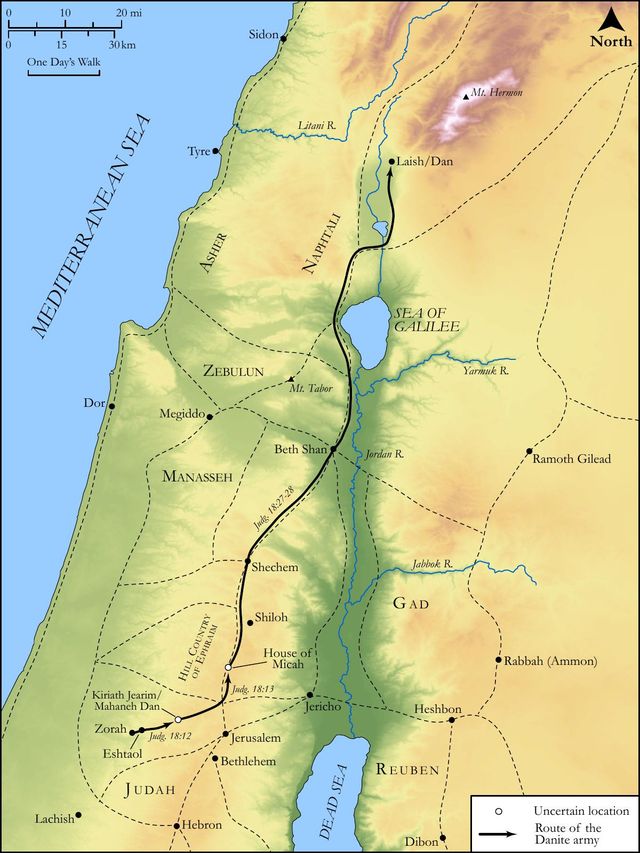
The reference to "Zidon" (Sidon) is crucial for understanding Laish's vulnerability. Sidon was a powerful Phoenician city-state located to the northwest, renowned for its maritime trade, military might, and cultural influence among the nations round about. Laish being "far from Zidon" meant it was beyond the protective sphere of Sidonian alliances or any regional network that might have offered deterrence or aid. The phrase "had no business with [any] man" further underscores their extreme social and political isolation, indicating a lack of treaties, trade agreements, or diplomatic relations with neighboring peoples. Geographically, Laish (later Dan) was situated "in the valley that [lieth] by Bethrehob," placing it in the fertile upper Jordan Valley, near the sources of the Jordan River. While agriculturally rich, this region was strategically exposed, bordering Aram (Syria) to the north and east, a vulnerability that would lead to future conflicts for Israel. This period of the Judges was marked by decentralized governance and a pervasive lack of unified tribal action, leaving individual communities or tribes to fend for themselves or act independently, often with violent and unauthorized consequences.
Key Themes
ShowHideThis verse powerfully contributes to several key themes within the book of Judges and the broader biblical narrative. Firstly, it highlights the vulnerability of isolation, demonstrating how Laish's detachment, both geographical and social, left it utterly exposed and defenseless against aggression. Secondly, it illustrates a false sense of security; the inhabitants of Laish lived in a state of perceived peace and quiet, as described in Judges 18:7, but this security was rooted in their remoteness rather than in strength, alliances, or divine protection, ultimately leading to their downfall. Thirdly, the phrase "had no business with any man" underscores the consequences of disconnection, emphasizing how a lack of external relationships for trade, defense, or social interaction meant no one had a vested interest in their survival or would intervene on their behalf. Finally, the verse marks a critical point in the Danite expansion and relocation, as they successfully established themselves in the northernmost part of Israel, far from their original inheritance detailed in Joshua 19:40-48. This relocation, achieved through violence and outside the bounds of their divinely appointed territory, further exemplifies the tribal disunity and moral decline prevalent in the era of the Judges.
Exposition and Analysis
ShowHideKey Word Analysis
ShowHideThe KJV phrase "no deliverer" (אֵין מַצִּיל) uses a participle derived from the root H5337 (nâtsal), meaning "to snatch away, whether in a good or a bad sense; defend, deliver (self), escape, preserve, rescue, save." Its use here emphasizes the absolute and utter lack of any external aid or internal capability for defense. Laish had no one to snatch them from the impending destruction, no one to come to their aid, whether a neighboring city-state, a tribal ally, or even a divinely appointed judge. Their isolation was complete, leading to their inevitable demise.
The phrase "no business" (וְאֵין דָּבָר) uses H1697 (dâbâr), which means "a word; by implication, a matter (as spoken of) or thing; adverbially, a cause; act, advice, affair, answer, business." In this context, it signifies a complete absence of social, political, or economic ties with other communities or peoples. This lack of "business" implies no treaties, no trade agreements, no alliances, and thus no reason for anyone to come to their defense. Their self-imposed or circumstantial isolation meant they were a community entirely unto themselves, without the protective network that often surrounded the cities of that day.
The word "built" (וַיִּבְנוּ) comes from H1129 (bânâh), a primitive root meaning "to build (literally and figuratively); (begin to) build(-er), make, repair, set (up)." This term highlights the constructive action of the Danites immediately following their destructive conquest. It signifies their intention to establish a permanent presence and transform the conquered territory into their own, marking the successful, albeit illicit, conclusion of their migration and the foundation of their new tribal center.
Verse Breakdown
ShowHide"And [there was] no deliverer"
This opening clause immediately establishes the dire predicament of Laish. It underscores their complete lack of external or internal capacity for defense against the encroaching Danites. They were utterly alone and helpless, devoid of any hope of rescue.
"because it [was] far from Zidon"
This clause provides the primary reason for Laish's vulnerability – its geographical isolation from Sidon. Sidon was a major Phoenician power, and its distance meant Laish was beyond its sphere of influence, protection, or potential military intervention. This physical remoteness contributed directly to their defenselessness.
"and they had no business with [any] man"
This phrase further elaborates on Laish's isolation, emphasizing their social and political detachment. It suggests an absence of alliances, trade agreements, or any form of diplomatic or economic interaction with neighboring peoples. This meant no one had a vested interest in their survival or would come to their aid when attacked.
"and it was in the valley that [lieth] by Bethrehob"
This clause precisely locates Laish (and subsequently Dan) in the fertile Upper Jordan Valley, near Bethrehob (H1050, Bêyth Rᵉchôwb). This geographical detail confirms its position in a relatively open and exposed region, making it susceptible to invasion, despite its inhabitants' perceived security.
"And they built a city, and dwelt therein"
This final clause shifts focus to the actions of the Danites, marking the successful conclusion of their conquest. After destroying Laish, they rebuilt the city, transforming it into their new tribal center, which they renamed "Dan." This act solidified their unauthorized relocation and established their presence in the northernmost reaches of Israel.
Literary Devices
ShowHideJudges 18:28 employs several potent literary devices to convey its message. The most prominent is Irony, as Laish's perceived peace and security, rooted in its isolation, ultimately become the very cause of its destruction. What they believed protected them actually made them vulnerable. There is also a strong element of Contrast between Laish's peaceful, unsuspecting existence (as described in Judges 18:7) and the brutal, unexpected violence unleashed upon them by the Danites. The verse's stark description of "no deliverer" and "no business with any man" serves as a form of Foreshadowing, hinting at the broader spiritual and political disunity that would plague Israel throughout the period of the Judges and beyond. The narrative also uses Descriptive Language to paint a clear picture of Laish's geographical and social isolation, emphasizing the factors that led to its downfall.
Theological and Thematic Connections
ShowHideJudges 18:28 serves as a stark commentary on the consequences of isolation and self-reliance, both for a community and for an individual. Theologically, Laish's fate highlights the dangers of a false sense of security that is not rooted in divine protection or covenant faithfulness. In a period where "every man did that which was right in his own eyes," the Danites' actions demonstrate a profound disregard for God's established order and the principles of justice, reflecting the spiritual decay of Israel. The absence of a "deliverer" for Laish stands in stark contrast to the recurring pattern in Judges where God raises up deliverers for His people when they cry out to Him, underscoring Laish's lack of a relationship with the God of Israel. This narrative implicitly warns against spiritual complacency and the illusion of self-sufficiency, reminding believers of the necessity of divine dependence and communal solidarity.
Reflection and Application
ShowHideThe tragic story of Laish in Judges 18:28 offers profound lessons for contemporary believers. Just as Laish's physical and social isolation led to its destruction, spiritual isolation can render individuals vulnerable to spiritual attack and complacency. The Christian life is designed to be lived in community, as part of the body of Christ, where members support, encourage, and protect one another. Relying solely on oneself, without connection to God's people or His divine protection, can leave one exposed to spiritual and practical challenges, much like Laish's "no business with any man" left them without allies. True security comes not from physical remoteness or self-sufficiency, but from active reliance on God and robust engagement within His established community, the Church. We are called to be interdependent, sharing burdens, offering accountability, and drawing strength from collective faith, ensuring we are not left without a "deliverer" in times of need.
Questions for Reflection
ShowHideFAQ
ShowHideWhy did the Danites choose Laish, and was their conquest justified?
ShowHideThe Danites chose Laish primarily because their spies reported it as an easy target: "a people secure, quiet, and unsuspecting" as detailed in Judges 18:7. Its isolation, lack of alliances, and distance from major powers like Sidon made it seem ripe for conquest. From a human perspective, it was a pragmatic choice for a tribe seeking new territory after failing to secure their original inheritance. However, from a biblical and theological standpoint, their conquest was not justified. It was an act of unprovoked aggression, undertaken outside of God's command, and driven by self-interest rather than obedience to the covenant. This event, like many others in the book of Judges, illustrates the moral and spiritual decline of Israel when "every man did what was right in his own eyes" instead of following God's law.
What is the significance of "Bethrehob" in this verse?
ShowHideBethrehob serves as a geographical marker, helping to pinpoint the location of Laish (which the Danites renamed Dan). It places the city in the Upper Jordan Valley, a fertile region near the sources of the Jordan River. While agriculturally rich, this area was also strategically exposed, bordering Aram (Syria) to the north and east. Its mention highlights the precise geographical context of the Danite settlement and underscores the vulnerability of the region, which would later become a frontier for Israel in conflicts with its northern neighbors.
How does this event reflect the overall spiritual state of Israel in Judges?
ShowHideThis event is a powerful microcosm of the spiritual and moral chaos that characterized the era of the Judges. The Danites, a tribe of Israel, acted independently and violently, disregarding God's previous allocation of land, as outlined in Joshua 19:40-48, and engaging in conquest without divine sanction. Their actions demonstrate a profound lack of central authority, tribal unity, and adherence to covenant principles. The narrative of Judges 18, including the theft of Micah's idols and priest (Judges 18:14-26), further highlights the widespread idolatry and moral relativism that permeated Israel, reinforcing the book's overarching theme that "there was no king in Israel; everyone did what was right in his own eyes" (Judges 21:25).
Christ-Centered Fulfillment
ShowHideThe plight of Laish, with "no deliverer" and "no business with any man," powerfully foreshadows humanity's desperate spiritual condition apart from Christ. In our fallen state, we are inherently isolated from God, without the capacity to rescue ourselves or establish a saving "business" with Him through our own efforts. The Old Testament's recurring need for a deliverer, whether a judge or a king, points forward to the ultimate and perfect Deliverer, Jesus Christ. Unlike the temporary and often flawed deliverers of Israel, Jesus is the one true "Lamb of God, who takes away the sin of the world!" as proclaimed in John 1:29. He came when humanity was "without strength," demonstrating God's love by dying for the ungodly, as Romans 5:6-8 beautifully articulates. Through His sacrifice, we are delivered "from the domain of darkness and transferred... to the kingdom of his beloved Son, in whom we have redemption, the forgiveness of sins" (Colossians 1:13-14). Moreover, Christ does not leave us in spiritual isolation; He brings us into His body, the Church, where we are no longer "strangers and aliens, but... fellow citizens with the saints and members of the household of God" (Ephesians 2:19-22), finding true security and belonging in Him.