


Daniel 3:15
- כְּעַןke·'AnnowH3705AdvAdverb
- הֵןhenifH2006ConjConjunction
- אִיתֵיכוֹן'i·tei·Khonare youH383N-csc ¦ 2mpNoun Singular common gender Constructאִיתֵיareכוֹןyou
- עֲתִידִין'a·ti·DinreadyH6263Adj-mpAdjective Plural Masculine Absolute
- דִּיdithatH1768ConjConjunction
- בְעִדָּנָאve·'i·da·Na'at time theH5732Prep-b ¦ N-cs ¦ ArtNoun Singular common gender Definiteבְatעִדָּנָtimeאthe
- דִּיdiwhichH1768ConjConjunction
- תִשְׁמְעוּןtish·me·'Unyou will hearH8086V-Peal-Imperf-2mpVerb Peal Imperfect 2nd Plural Masculine
- קָלkal[the] sound ofH7032N-cscNoun Singular common gender Construct
- קַרְנָאkar·Na'horn theH7162N-cs ¦ ArtNoun Singular common gender Definiteקַרְנָhornאthe
- מַשְׁרוֹקִיתָאmash·ro·ki·Ta'flute theH4953N-fs ¦ ArtNoun Singular Feminine Definiteמַשְׁרוֹקִיתָfluteאthe
- קַתְרוֹסki·ta·roszitherH7030N-csNoun Singular common gender Absolute
- שַׂבְּכָאsa·be·Kha'trigonH5443N-csNoun Singular common gender Absolute
- פְּסַנְתֵּרִיןpe·san·te·RinharpH6460N-csNoun Singular common gender Absolute
- וְסוּמְפֹּנְיָהve·su·me·Po·ne·Yahand pipeH5481Conj-w ¦ N-fsNoun Singular Feminine Absoluteוְandסוּמְפֹּנְיָהpipe
- וְכֹלve·Kholand allH3606Conj-w ¦ N-cscNoun Singular common gender Constructוְandכֹלall
- זְנֵיze·Nei<the> kinds ofH2178N-mpcNoun Plural Masculine Construct
- זְמָרָאze·ma·Ra'<the> musicH2170N-cs ¦ ArtNoun Singular common gender Definiteזְמָרָ<the>אmusic
- תִּפְּלוּןti·pe·Lunyou will fall downH5308V-Peal-Imperf-2mpVerb Peal Imperfect 2nd Plural Masculine
- וְתִסְגְּדוּןve·tis·ge·Dunso you may pay homageH5457Conj-w ¦ V-Qal-ConjImperf-2mpVerb Qal Conjunction+Imperfect 2nd Plural Masculineוְsoתִסְגְּדוּןyou may pay homage
- לְצַלְמָאle·tzal·Ma'to image theH6755Prep-l ¦ N-cs ¦ ArtNoun Singular common gender Definiteלְtoצַלְמָimageאthe
- דִיdiwhichH1768ConjConjunction
- עַבְדֵת'av·DetI have madeH5648V-Peal-Perf-1csVerb Peal Perfect 1st Singular common gender
- וְהֵןve·Henand ifH2006Conj-w ¦ ConjConjunctionוְandהֵןif
- לָאla'notH3809NegParticle Negative
- תִסְגְּדוּןtis·ge·Dunyou will pay homageH5457V-Peal-Imperf-2mpVerb Peal Imperfect 2nd Plural Masculine
- בַּהּbahat itPrep-b ¦ 3fsSuffix Personal 3rd Singular Feminineבַּatהּit
- שַׁעֲתָהsha·'a·Tah'moment theH8160N-fs ¦ ArtNoun Singular Feminine Definiteשַׁעֲתָmomentהthe
- תִתְרְמוֹןtit·re·Monyou will be thrownH7412V-Hitpael-Imperf-2mpVerb Hitpael Imperfect 2nd Plural Masculine
- לְגוֹאle·goy'to [the] midst ofH1459Prep-l ¦ N-cscNoun Singular common gender Constructלְtoגוֹא[the] midst of
- אַתּוּן'a·Tun[the] furnace ofH861N-cscNoun Singular common gender Construct
- נוּרָאnu·Ra'fire theH5135N-cs ¦ ArtNoun Singular common gender Definiteנוּרָfireאthe
- יָקִדְתָּאya·kid·Ta'<the> burningH3345V-Peal-Prtcpl-fs ¦ ArtVerb Peal Participle Singular Feminine Definiteיָקִדְתָּ<the>אburning
- וּמַןu·manand who?H4479Conj-w ¦ InterrogPronoun Interrogativeוּandמַןwho?
- הוּאhu'heH1932Pro-3msPronoun Personal 3rd Singular Masculine
- אֱלָהּ'e·Lah[is the] godH426N-csNoun Singular common gender Absolute
- דֵּיdeiwhoH1768ConjConjunction
- יְשֵׁיזְבִנְכוֹןye·shei·ze·vin·Khonhe will deliver youH7804V-Shaphel-Imperf-3ms ¦ 2mpVerb Shaphel Imperfect 3rd Singular Masculineיְשֵׁיזְבִנְhe will deliverכוֹןyou
- מִןminfromH4481PrepPreposition
- יְדָיye·Daimy handsH3028N-mpc ¦ 1csNoun Plural Masculine Constructיְדָhandsיmy
English is a literal word-by-word gloss of the Hebrew, not the KJV's wording. Why?
This is the original text the KJV's translators worked from — each Hebrew word with its own literal English meaning in this verse, prepared by scholars at Tyndale House, Cambridge. The KJV translates whole sentences, not word by word, so its wording differs: one Hebrew word can become several English words, and the KJV may choose “the LORD” where the gloss reads “Yahweh”. Both are faithful — they answer different questions. For the KJV's own rendering, switch to the KJV text.
Details
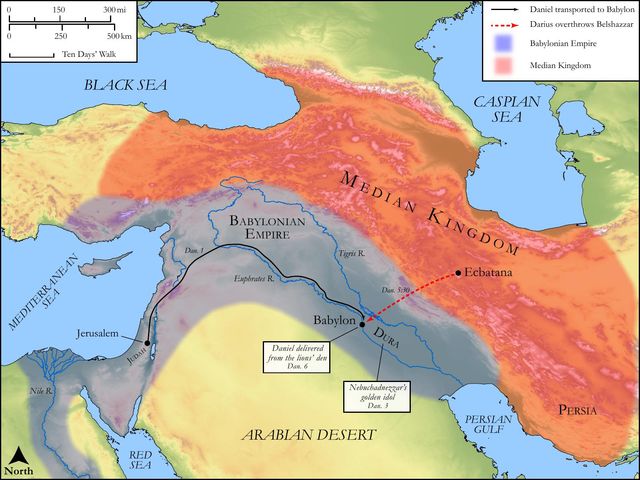
See on the biblical-era map
Study this verse
Public-domain commentary
Matthew Henry
From his Commentary on the Whole Bible. Henry comments on passages, not single verses — this entry covers Daniel 3:8–18. His three-level outline is real structure in the source text, so it is rendered as structure.
It was strange that Shadrach, Meshach, and Abednego, would be present at this assembly, when, it is likely, they knew for what intent it was called together. Daniel, we may suppose, was absent, either his business calling him away or having leave from the king to withdraw, unless we suppose that he stood so high in the king's favour that none durst complain of him for his noncompliance. But why did not his companions keep out of the way? Surely because they would obey the king's orders as far as they could, and would be ready to bear a public testimony against this gross idolatry. They did not think it enough not to bow down to the image, but, being in office, thought themselves obliged to stand up against it, though it was the image which the king their master set up, and would be a golden image to those that worshipped it. Now,
I.Information is brought to the king by certain Chaldeans against these three gentlemen that they did not obey the king's edict, Dan 3:8.
Perhaps these Chaldeans that accused them were some of those magicians or astrologers that were particularly called Chaldeans (Dan 2:2, Dan 2:4) who bore a grudge to Daniel's companions for his sake, because he had eclipsed them, and so had these companions. They by their prayers had obtained the mercy which saved the lives of these Chaldeans, and, behold, how they requite them evil for good! for their love they are their adversaries. Thus Jeremiah stood before God, to speak good for those who afterwards dug a pit for his life, Jer 18:20. We must not think it strange if we meet with such ungrateful men. Or perhaps they were such of the Chaldeans as expected the places to which they were advanced, and envied them their preferments; and who can stand before envy ? They appeal to the king himself concerning the edict, with all due respect to his majesty, and the usual compliment, O king! live forever (as if they aimed at nothing but his honour, and to serve his interest, when really they were putting him upon that which would endanger the ruin of him and his kingdom); they beg leave,
1.To put him in mind of the law he had lately made, That all manner of persons, without exception of nation or language, should fall down and worship this golden image; they put him in mind also of the penalty which by the law was to be inflicted upon recusants, that they were to be cast into the midst of the burning fiery furnace, Dan 3:10, Dan 3:11. It cannot be denied but that this was the law; whether a righteous law or no ought to be considered.
2.To inform him that these three men, Shadrach, Meshach, and Abednego, had not conformed to this edict, Dan 3:12. It is probable that Nebuchadnezzar had no particular design to ensnare them in making the law, for then he would himself have had his eye upon them, and would not have needed this information; but their enemies, that sought an occasion against them, laid hold on this, and were forward to accuse them. To aggravate the matter, and incense the king the more against them,
(1.)They put him in mind of the dignity to which the criminals had been preferred. Though they were Jews, foreigners, captives, men of a despised nation and religion, yet the king had set them over the affairs of the province of Babylon. It was therefore very ungrateful, and an insufferable piece of insolence, for them to disobey the king's command, when they had shared so much of the king's favour. And, besides, the high station they were in would make their refusal the more scandalous; it would be a bad example, and have a bad influence upon others; and therefore it was necessary that it should be severely animadverted upon. Thus princes that are incensed enough against innocent people commonly have but too many about them who do all they can to make them worse.
(2.)They suggest that it was done maliciously, contumaciously, and in contempt of him and his authority: "They have set no regard upon thee; for they serve not the gods which thou servest, and which thou requirest them to serve, nor worship the golden image which thou hast set up."
II.These three pious Jews are immediately brought before the king, and arraigned and examined upon this information.
Nebuchadnezzar fell into a great passion, and in his rage and fury commanded them to be seized, Dan 3:13. How little was it the honour of this mighty prince that he had rule over so many nations when at the same time he had no rule over his own spirit, that there were so many who were subjects and captives to him when he was himself a perfect slave to his own brutish passions and led captive by them! How unfit was he to rule reasonable men who could not himself be ruled by reason! It needed not be a surprise to him to hear that these three men did not now serve his gods, for he knew very well they never had served them, and that their religion, which they had always adhered to, forbade them to do it. Nor had he any reason to think that they designed any contempt of his authority, for they had in all instances shown themselves respectful and dutiful to him as their prince. But it was especially unseasonable at this time, when he was in the midst of his devotions, dedicating his golden image, to be in such a rage and fury, and so much to discompose himself. The discretion of a man, one would think, should at least have deferred this anger. True devotion calms the spirit, quiets and meekens it; but superstition, and a devotion to false gods, inflame men's passions, inspire them with rage, and fury, and turn them into brutes. The wrath of a king is as the roaring of a lion; so was the wrath of this king; and yet, when he was in such a heat, these three men were brought before him, and appeared with an undaunted courage, and unshaken constancy.
III.The case is laid before them in short, and it is put to them whether they will comply or no.
1.The king asked them whether it was true that they had not worshipped the golden image when others did, Dan 3:14. "Is it of purpose?" so some read it. "Was it designedly and deliberately done, or was it only through inadvertency, that you have not served my gods? What! you that I have nourished and brought up, that have been educated and maintained at my charge, that I have been so kind to and done so much for, you that have been in such reputation for wisdom, and therefore should better have known your duty to your prince; what! do not you serve my gods nor worship the golden image which I have set up?" Note, The faithfulness of God's servants to him has often been the wonder of their enemies and persecutors, who think it strange that they run not with them to the same excess of riot.
2.He was willing to admit them to a new trial; if they did on purpose not do it before, yet, it may be, upon second thoughts, they will change their minds; it is therefore repeated to them upon what terms they now stand, Dan 3:15.
(1.)The king is willing that music shall play again, only for their sakes, to soften them into a compliance; and if they will not, like the deaf adder, stop their ears, but will hearken to the voice of the charmers and will worship the golden image, well and good; their former omission shall be pardoned. But,
(2.)The king is resolved, if they persist in their refusal, that they shall immediately be cast into the fiery furnace, and shall not have so much as an hour's reprieve. Thus does the matter lie in a little compass - Turn, or burn; and, because he knew they buoyed themselves up in their refusal with a confidence in their God, he insolently set him a defiance: "And who is that God that shall deliver you out of my hands? Let him, if he can." Now he forgot what he himself once owned, that their God was a God of gods and a Lord of kings, Dan 2:47. Proud men are still ready to say, as Pharaoh, Who is the Lord that I should obey his voice? or, as Nebuchadnezzar, Who is the Lord, that I should fear his power?
IV.They give in their answer, which they all agree in, that they still adhere to their resolution not to worship the golden image, Dan 3:16-18.
We have here such an instance of fortitude and magnanimity as is scarcely to be paralleled. We call these the three children (and they were indeed young men), but we should rather call them the three champions, the first three of the worthies of God's kingdom among men. They did not break out into any intemperate heat or passion against those that did worship the golden image, did not insult or affront them; nor did they rashly thrust themselves upon the trial, or go out of their way to court martyrdom; but, when they were duly called to the fiery trial, they acquitted themselves bravely, with a conduct and courage that became sufferers for so good a cause. The king was not so daringly bad in making this idol, but they were as daringly good in witnessing against it. They keep their temper admirably well, do not call the king a tyrant or an idolater (the cause of God needs not the wrath of man), but, with an exemplary calmness and sedateness of mind, they deliberately give in their answer, which they resolve to abide by. Observe,
1.Their gracious and generous contempt of death, and the noble negligence with which they look upon the dilemma that they are put to: O Nebuchadnezzar! we are not careful to answer thee in this matter. They do not in sullenness deny him an answer, nor stand mute; but they tell him that they are in no care about it. There needs not an answer (so some read it); they are resolved not to comply, and the king is resolved they shall die if they do not; the matter therefore is determined, and why should it be disputed? But it is better read, "We want not an answer for thee, nor have it to seek, but come prepared." (1.) They needed no time to deliberate concerning the matter of their answer; for they did not in the least hesitate whether they should comply or no. It was a matter of life and death, and one would think they might have considered awhile before they had resolved; life is desirable, and death is dreadful. But when the sin and duty that were in the case were immediately determined by the letter of the second commandment, and no room was left to question what was right, the life and death that were in the case were not to be considered. Note, Those that would avoid sin must not parley with temptation. When that which we are allured or affrighted to is manifestly evil the motion is rather to be rejected with indignation and abhorrence than reasoned with; stand not to pause about it, but say, as Christ has taught us, Get thee behind me, Satan. (2.) They needed no time to contrive how they should word it. While they were advocates for God, and were called out to witness in his cause, they doubted not but it should be given them in that same hour what they should speak, Mat 10:19. They were not contriving an evasive answer, when a direct answer was expected from them; no, nor would they seem to court the king not to insist upon it. Here is nothing in their answer that looks like compliment; they begin not, as their accusers did, with, O king! live for ever, no artful insinuation, ad captandam benevolentiam - to put him into a good humour, but every thing that is plain and downright: O Nebuchadnezzar! we are not careful to answer thee. Note, Those that make their duty their main care need not be careful concerning the event.
2.Their believing confidence in God and their dependence upon him, Dan 3:17. It was this that enabled them to look with so much contempt upon death, death in pomp, death in all its terrors: they trusted in the living God, and by that faith chose rather to suffer than to sin; they therefore feared not the wrath of the king, but endured, because by faith they had an eye to him that is invisible (Heb 11:25, Heb 11:27): "If it be so, if we are brought to this strait, if we must be thrown into the fiery furnace unless we serve thy gods, know then," (1.) "That though we worship not thy gods yet we are not atheists; there is a God whom we can call ours, to whom we faithfully adhere." (2.) "That we serve this God; we have devoted ourselves to his honour; we employ ourselves in his work, and depend upon him to protect us, provide for us, and reward us." (3.) "That we are well assured that this God is able to deliver us from the burning fiery furnace; whether he will or no, we are sure that he can either prevent our being cast into the furnace or rescue us out of it." Note, The faithful servants of God will find him a Master able to bear them out in his service, and to control and overrule all the powers that are armed against them. Lord, if thou wilt, thou canst. (4.) "That we have reason to hope he will deliver us," partly because, in such a vast appearance of idolaters, it would be very much for the honour of his great name to deliver them, and partly because Nebuchadnezzar had defied him to do it - Who is that God that shall deliver you? God sometimes appears wonderfully for the silencing of the blasphemies of the enemy, as well as for the answering of the prayers of his people, Psa 74:18-22; Deu 32:27. "But, if he do not deliver us from the fiery furnace, he will deliver us out of thy hand." Nebuchadnezzar can but torment and kill the body, and after that, there is no more that he can do; then they are got out of his reach, delivered out of his hand. Note, Good thoughts of God, and a full assurance that he is with us while we are with him, will help very much to carry us through sufferings; and, if he be for us, we need not fear what man can do unto us; let him do his worst. God will deliver us either from death or in death.
3.Their firm resolution to adhere to their principles, whatever might be the consequence (Dan 3:18): "But, if not, though God should not think fit to deliver us from the fiery furnace (which yet we know he can do), if he should suffer us to fall into thy hand, and fall by thy hand, yet be it known unto thee, O king! we will not serve these gods, though they are thy gods, nor worship this golden image, though thou thyself hast set it up." They are neither ashamed nor afraid to own their religion, and tell the king to his face that they do not fear him, they will not yield to him; had they consulted with flesh and blood, much might have been said to bring them to a compliance, especially when there was no other way of avoiding death, so great a death.
(1.)They were not required to abjure their own God, or to renounce his worship, no, nor by any verbal profession or declaration to own this golden image to be a god, but only to bow down before it, which they might do with a secret reserve of their hearts for the God of Israel, inwardly detesting this idolatry, as Naaman bowed in the house of Rimmon.
(2.)They were not to fall into a course of idolatry; it was but one single act that was required of them, which would be done in a minute, and the danger was over, and they might afterwards declare their sorrow for it.
(3.)The king that commanded it had an absolute power; they were under it, not only as subjects, but as captives; and, if they did it, it was purely by coercion and duress, which would serve to excuse them.
(4.)He had been their benefactor, had educated and preferred them, and in gratitude to him they ought to go as far as they could, though it were to strain a point, a point of conscience.
(5.)They were now driven into a strange country, and to those that were so driven out it was, in effect, said, Go, and serve other gods, Sa1 26:19. It was taken for granted that in their disposition they would serve other gods, and it was made a part of the judgment, Deu 4:28. They might be excused if they should go down the stream, when it is so strong.
(6.)Did not their kings, and their princes, and their fathers, yea, and their priests too, set up idols even in God's temple, and worship them there, and not only bow down to them, but erect altars, burn incense, and offer sacrifices, even their own children, to them? Did not all the ten tribes, for many ages, worship gods of gold at Dan and Bethel? And shall they be more precise than their fathers? Communis error facit jus - What all do must be right.
(7.)If they should comply, they would save their lives and keep their places, and so be in a capacity to do a great deal of service to their brethren in Babylon, and to do it long; for they were young men, and rising men. But there is enough in that one word of God wherewith to answer and silence these and many more such like carnal reasonings: Thou shalt not bow down thyself to any images, nor worship them. They know they must obey God rather than man; they must rather suffer than sin, and must not do evil that good may come. And therefore none of these things move them; they are resolved rather to die in their integrity than live in their iniquity. While their brethren, who yet remained in their own land, were worshipping images by choice, they in Babylon would not be brought to it by constraint, but, as if they were good by antiperistasis, were most zealous against idolatry in an idolatrous country. And truly, all things considered, the saving of them from this sinful compliance was as great a miracle in the kingdom of grace as the saving of them out of the fiery furnace was in the kingdom of nature. These were those who formerly resolved not to defile themselves with the king's meat, and now they as bravely resolve not to defile themselves with his gods. Note, A stedfast self-denying adherence to God and duty in less instances will qualify and prepare us for the like in greater. And in this we must be resolute, never, under any pretence whatsoever, to worship images, or to say "A confederacy" with those that do so.
Historical interpretation
Historical reception
2 surviving comments on this verse. Each one is dated, so this reads as a timeline rather than a list.
Select a marker to jump to its quote. Markers stagger vertically where authors wrote within a few decades of each other.
But I say all this now, and select all the histories that contain trials and tribulations and the wrath of kings and their evil designs, in order that we may fear nothing except offending God. For then also was there a furnace burning; yet they derided it but feared sin. For they knew that if they were consumed in the fire, they should suffer nothing that was to be dreaded, but if they were guilty of impiety, they should undergo the extremes of misery. It is the greatest punishment to commit sin, though we may remain unpunished; … it is the greatest honor and repose to live virtuously, though we may be punished.
Verse 15. "Prostrate yourselves and worship the statue I have made." Although he had up to this point given the youths his orders in angry fashion, yet he gives them room for a change of heart, so that their previous guilt might be pardoned if only they should fall down and worship. But if they should not deign to offer worship, the punishment of the fiery furnace lay at hand.
"And what God is there who shall rescue you from my hand?..." Why naturally, that same God whose servant thou didst just recently worship and Whom thou didst assert to be truly God of gods and Lord of kings.
Continue studying Daniel 3:15 across the web’s major study libraries — every link below opens this exact verse, chapter, or book on the destination site.
Read & Compare
 BibleGatewayThis verse in more than 200 translations and 70 languages.
 Bible.comThe YouVersion reader — hundreds of translations, reading plans, and highlights.
 ESV.orgCrossway's official English Standard Version reader.
 NET BibleThe NET translation with 60,000+ translators' notes on every rendering decision.
 STEP BibleTyndale House's free study tool — original text, vocabulary, and scholarly resources.
 BibliaLogos Bible Software's free web reader.
 USCCBThe New American Bible (Revised Edition) with the U.S. bishops' study notes.
Commentaries
 BibleHub CommentariesDozens of classic commentaries on this verse, gathered on one page.
 StudyLightMore than 100 commentary sets — the largest collection on the web.
 BibleRefPlain-English commentary on what this verse means, verse by verse.
 Enduring WordDavid Guzik's free commentary on this chapter, widely used by Bible teachers.
 Bible Study ToolsVerse commentary alongside Greek and Hebrew study aids.
Original Language & Research
- BibleHub InterlinearThe verse word by word — original language, transliteration, and English.
- BibleHub LexiconEvery word's original-language definition and Strong's entry.
 Blue Letter BibleDeep-study tools — Strong's numbers, concordance, and word studies.
 SefariaThe Hebrew text with Rashi and centuries of Jewish commentary.
Sermons, Hymns & Audio


TrulyRandomVerse is not affiliated with these sites and doesn’t control their content. They’re linked because they’re genuinely useful.
Summary
Daniel 3:15 captures the climactic moment of King Nebuchadnezzar's furious ultimatum to Shadrach, Meshach, and Abednego, presenting them with an inescapable choice: upon hearing the designated symphony of instruments, they must immediately prostrate themselves and worship the golden image he has erected, or face instant execution by being cast into a superheated fiery furnace. The verse culminates in the king's arrogant challenge, questioning the very existence and power of any God capable of delivering them from his absolute dominion, thereby setting the stage for a profound confrontation between human pride and divine sovereignty.
Context
ShowHideLiterary Context
This verse serves as the dramatic turning point in Nebuchadnezzar's direct confrontation with the three Hebrew exiles. Following the accusations of the Chaldeans in Daniel 3:8-12 and the king's initial outburst of rage in Daniel 3:13, Daniel 3:15 represents Nebuchadnezzar's final, desperate attempt to coerce Shadrach, Meshach, and Abednego into submission. It is framed as a conditional "second chance," yet it is delivered with overwhelming intimidation and a clear, deadly consequence for refusal. The king's blasphemous challenge to God at the end of the verse directly foreshadows the miraculous divine intervention that will follow, culminating in God's vindication and the king's humbled acknowledgment of divine power in Daniel 3:24-27.
Historical & Cultural Context
The setting is the Neo-Babylonian Empire under Nebuchadnezzar II, a period characterized by imperial expansion, monumental building projects, and the consolidation of political and religious authority. The construction of a massive golden image on the plain of Dura, as described in Daniel 3:1, was likely a strategic move to unify the diverse peoples of the empire under a common, state-sanctioned cult, thereby reinforcing the king's absolute authority and potentially deifying himself. The elaborate musical orchestration was a common feature of ancient Near Eastern royal decrees, serving as an unmistakable signal for universal compliance. Fiery furnaces were indeed known instruments of capital punishment in the region, as evidenced by other biblical texts like Jeremiah 29:22. Nebuchadnezzar's question about God's ability to deliver them reflects the common ancient Near Eastern belief that a nation's god was only as powerful as its army or king, and that a defeated or exiled people's god was therefore inferior and incapable of intervention.
Key Themes
ShowHideThis verse powerfully encapsulates several overarching themes of the book of Daniel. Firstly, it highlights the conflict of worship, pitting compulsory idolatry against exclusive devotion to the one true God, a direct challenge to the First Commandment found in Exodus 20:3. Secondly, it underscores the theme of human arrogance versus divine sovereignty. Nebuchadnezzar's hubristic question, "who is that God that shall deliver you out of my hands?", reveals his belief in his own ultimate power and his contempt for any deity superior to him, setting up a dramatic test of God's ability to intervene against even the mightiest earthly ruler. Thirdly, it vividly portrays faith under pressure, as the three men face an immediate, public, and deadly threat, forcing a clear choice between personal safety and faithfulness to God, a theme echoed in Daniel 6:10. Finally, the verse clearly delineates the consequences of choice, emphasizing the dire outcome of disobedience (the fiery furnace) and the implied "well" for compliance, underscoring the high stakes involved in their decision.
Exposition and Analysis
ShowHideKey Word Analysis
ShowHideThis Aramaic word, corresponding to the Hebrew root meaning "to burn," emphasizes the active, intense, and destructive nature of the fire. It describes a state of fervent combustion, highlighting the terrifying and consuming reality of the punishment. The participle form suggests an ongoing, zealous state of burning.
This term refers to a large, enclosed oven or kiln, typically used for industrial purposes like smelting metals or baking bricks. Its design implies extreme, contained heat, making it a particularly dreadful instrument of execution. The choice of this word underscores the severity and the deliberate, calculated nature of the king's threat, indicating a place of intense and inescapable heat.
While literally referring to the physical appendage, in this context, "hands" is a powerful idiom for power, authority, control, and possession. Nebuchadnezzar's rhetorical question, "who is that God that shall deliver you out of my hands?", is a direct assertion of his perceived ultimate power and dominion, implying that nothing, not even a god, could wrest control or deliver from his grasp.
Verse Breakdown
ShowHide"Now if ye be ready that at what time ye hear the sound of the cornet, flute, harp, sackbut, psaltery, and dulcimer, and all kinds of musick, ye fall down and worship the image which I have made; [well]:"
This opening clause presents Nebuchadnezzar's conditional offer, cloaked in a veneer of magnanimity. The detailed enumeration of musical instruments serves as a precise, unmistakable trigger for the act of worship, ensuring no one could claim ignorance or misunderstanding of the command or the exact moment of its execution. The phrase "all kinds of musick" emphasizes the universal and overwhelming nature of the decree, designed to compel every subject. The king's assertion "which I have made" highlights his personal investment and proprietary claim over the idol, making defiance a direct affront to his authority. The implied "well" suggests a return to favor and safety for compliance.
"but if ye worship not, ye shall be cast the same hour into the midst of a burning fiery furnace;"
This clause starkly presents the alternative: immediate, severe, and inescapable punishment for non-compliance. The phrase "the same hour" conveys the urgency and lack of reprieve, emphasizing the king's absolute power and swift judgment. "Into the midst of a burning fiery furnace" graphically describes the terrifying fate awaiting them, leaving no doubt about the agonizing and consuming nature of the death. The repetition and intensity of "burning fiery" (from the same Aramaic root) intensifies the image of infernal heat and destruction, underscoring the horrific reality of the threat.
"and who [is] that God that shall deliver you out of my hands?"
This concluding rhetorical question is the epitome of Nebuchadnezzar's hubris and blasphemy. It is not a genuine inquiry but a boastful challenge, expressing his supreme confidence in his own power and his contempt for any deity, particularly the God of the exiled Hebrews, whom he believes to be inferior to his own might and incapable of intervention. This question directly sets up the miraculous demonstration of God's sovereignty that is about to unfold, serving as a direct challenge that God will powerfully answer.
Literary Devices
ShowHideDaniel 3:15 is rich with literary techniques that amplify its dramatic tension and thematic significance. The most prominent device is Ultimatum, as Nebuchadnezzar presents a stark, binary choice with immediate and severe consequences, leaving no room for negotiation or delay. This creates intense dramatic tension, highlighting the immense pressure on Shadrach, Meshach, and Abednego. The king employs a powerful Rhetorical Question at the verse's end ("and who is that God that shall deliver you out of my hands?"), which is not intended to elicit an answer but to assert his absolute power and mock the God of Israel. This device underscores his profound arrogance and sets the stage for God's ultimate vindication. The detailed listing of musical instruments ("cornet, flute, harp, sackbut, psaltery, and dulcimer") functions as a form of Enumeration, emphasizing the comprehensive and inescapable nature of the king's decree. This meticulous detail ensures that the signal for worship is universally understood and cannot be ignored. Furthermore, the description of the "burning fiery furnace" uses Hyperbole to convey the extreme and terrifying nature of the punishment, designed to instill maximum fear and compel obedience. Finally, the entire verse functions as a form of Foreshadowing, hinting at the divine intervention that will directly answer Nebuchadnezzar's blasphemous challenge, demonstrating God's supreme power over all earthly rulers.
Theological and Thematic Connections
ShowHideDaniel 3:15 stands as a profound theological statement on the nature of worship and divine sovereignty. It starkly contrasts the compulsory, fear-driven worship of a man-made idol with the free, Spirit-led devotion to the one true God. Nebuchadnezzar's demand for universal prostration before his image represents the pervasive human tendency to create and worship idols, whether they be physical objects, ideologies, or even self-aggrandizement. His ultimate challenge to God's power reveals the inherent arrogance of humanity when it seeks to usurp divine authority. The verse thus serves as a powerful reminder that true worship is an act of exclusive allegiance to God alone, a commitment that transcends earthly threats and human decrees. It underscores the biblical truth that God's sovereignty is absolute, extending even over the most powerful earthly rulers and their instruments of coercion, demonstrating His ability to deliver His faithful servants.
Reflection and Application
ShowHideDaniel 3:15 offers a timeless challenge to believers across generations. While we may not face a literal fiery furnace, the world continually presents its own "furnaces" of conformity, demanding our allegiance to cultural norms, societal pressures, or personal ambitions that conflict with God's commands. This verse calls us to examine where our ultimate loyalty lies. Are we prepared to stand firm in our convictions, even when faced with significant social, professional, or personal consequences? The unwavering resolve of Shadrach, Meshach, and Abednego serves as a powerful testament to the strength found in prioritizing faithfulness to God above all else. It encourages us to cultivate a deep trust in God's sovereign power to deliver, not always from the trial itself, but often through it, transforming our character and demonstrating His glory. Ultimately, this passage reminds us that our primary allegiance is to the King of Kings, and His authority supersedes any earthly power, empowering us to live lives of uncompromising devotion.
Questions for Reflection
ShowHideFAQ
ShowHideWhy did Nebuchadnezzar give Shadrach, Meshach, and Abednego a second chance?
ShowHideNebuchadnezzar's decision to offer a second chance, rather than immediate execution, likely stemmed from a complex mix of factors. Firstly, he was probably genuinely astonished and infuriated by their defiance, given their high positions and the absolute nature of his decree. He may have found it inconceivable that anyone would openly defy him, especially after his initial display of wrath. Secondly, their prior faithful service and demonstrated wisdom (as seen in Daniel 1:19-20) might have earned them a grudging respect, leading him to believe that a direct, personal ultimatum would bring them to their senses. Finally, his immense pride and desire for universal conformity meant he wanted their public submission, not just their death. He wanted to crush their will and demonstrate his absolute power, believing that no God could stand against him.
What was the significance of the detailed list of musical instruments in the king's decree?
ShowHideThe meticulous enumeration of "cornet, flute, harp, sackbut, psaltery, and dulcimer, and all kinds of musick" served several crucial purposes. Primarily, it established an unmistakable and universal signal for the act of worship. No one could claim ignorance of the command or the precise moment of its activation. This elaborate orchestration ensured that the act of prostration was a public, synchronized, and deliberate display of allegiance, reinforcing the king's absolute authority and the comprehensive nature of his decree across his diverse empire. It made any refusal a clear, undeniable act of defiance, leaving no room for ambiguity.
Was the fiery furnace a common method of execution in ancient Babylon?
ShowHideWhile not the sole method, historical and biblical evidence suggests that execution by fire, often in a furnace, was indeed a known and terrifying form of punishment in ancient Mesopotamia, particularly for severe offenses or acts of rebellion. The prophet Jeremiah, for instance, mentions Babylonian kings executing false prophets by fire in Jeremiah 29:22. This historical context underscores the very real and immediate danger faced by Shadrach, Meshach, and Abednego, making Nebuchadnezzar's threat not an idle boast but a credible and horrific reality, designed to instill maximum fear and compel obedience.
Christ-Centered Fulfillment
ShowHideDaniel 3:15, with its stark ultimatum and Nebuchadnezzar's blasphemous challenge, powerfully foreshadows the ultimate confrontation between human idolatry and divine authority, culminating in the person and work of Jesus Christ. Just as the three Hebrews faced immense pressure to worship a man-made image, humanity is perpetually tempted to bow before false gods—whether they be power, wealth, self, or worldly systems. Jesus, the true Son of God, faced similar temptations in the wilderness, refusing to bow to Satan's offer of worldly kingdoms in exchange for worship, declaring, "You shall worship the Lord your God, and Him only you shall serve" (Matthew 4:8-10). His life was a perfect embodiment of unwavering allegiance to the Father, even unto the "furnace" of the cross, where He willingly submitted to God's will and endured immense suffering (Philippians 2:8).
Nebuchadnezzar's arrogant question, "who is that God that shall deliver you out of my hands?", finds its ultimate answer in Christ. It is God Himself, in the person of Jesus, who delivers humanity not merely from a physical furnace, but from the eternal flames of sin and death. He is the ultimate Deliverer, the one who has "all authority in heaven and on earth" (Matthew 28:18). Through His resurrection, Christ demonstrated God's supreme power over death and all earthly dominion, proving that no one can snatch His sheep "out of my hand" or "out of my Father's hand" (John 10:28-29). Therefore, the call to worship God alone, so powerfully demonstrated by Shadrach, Meshach, and Abednego, finds its perfect fulfillment and enablement in Christ, who invites all to worship the Father "in spirit and truth" (John 4:23-24). He is the true Lamb of God who takes away the sin of the world, delivering us from a far greater judgment than any earthly furnace (John 1:29), offering eternal salvation to all who believe.