


2 Chronicles 32:15
Bible text: King James Version (1769 Blayney text) · Public domain
Bible text: King James Version with Strong's numbers · Public domain
Bible text: Berean Standard Bible · Public domain
Bible text: American Standard Version (1901) · Public domain
Bible text: World English Bible, Messianic edition · Public domain
Bible text: Geneva Bible (1599) · Public domain
Bible text: Young's Literal Translation · Public domain
- וְעַתָּהve·'a·Tahand thereforeH6258Conj-w ¦ AdvAdverbוְandעַתָּהtherefore
- אַל'almay notH408NegParticle Negative
- יַשִּׁיאya·Shi'he deceiveH5377V-Hiphil-Imperf-3msVerb Hiphil Imperfect 3rd Singular Masculine
- אֶתְכֶם'et·Khem<obj.> youH853DirObjM ¦ 2mpParticle Object Indicatorאֶתְ<obj.>כֶםyou
- חִזְקִיָּהוּchiz·ki·Ya·huHezekiahH2396N-proper-mNoun Proper Masculine
- וְאַלve·'aland may notH408Conj-w ¦ NegParticle Negativeוְandאַלmay not
- יַסִּיתya·Sithe misleadH5496V-Hiphil-Imperf-3msVerb Hiphil Imperfect 3rd Singular Masculine
- אֶתְכֶם'et·Khem<obj.> youH853DirObjM ¦ 2mpParticle Object Indicatorאֶתְ<obj.>כֶםyou
- כָּזֹאתka·zoTlike thisH2063Prep-k ¦ PrtParticle Demonstrativeכָּlikeזֹאתthis
- וְאַלve·'aland may notH408Conj-w ¦ NegParticle Negativeוְandאַלmay not
- תַּאֲמִינוּta·'a·Mi·nuyou believeH539V-Hiphil-Imperf-2mpVerb Hiphil Imperfect 2nd Plural Masculine
- לוֹlo<to> himPrep-l ¦ 3msSuffix Personal 3rd Singular Masculineל<to>וֹhim
- כִּיkiforH3588PrtParticle Conditional
- לֹאlo'notH3808NegParticle Negative
- יוּכַלyu·Khalit has been ableH3201V-Qal-Imperf-3msVerb Qal Imperfect 3rd Singular Masculine
- כָּלkolanyH3605N-mscNoun Singular Masculine Construct
- אֱלוֹהַ'e·Lo·hagod ofH433N-mscNoun Singular Masculine Construct
- כָּלkolanyH3605N-mscNoun Singular Masculine Construct
- גּוֹיGoynationH1471N-msNoun Singular Masculine Absolute
- וּמַמְלָכָהu·mam·la·Khahand kingdomH4467Conj-w ¦ N-fsNoun Singular Feminine Absoluteוּandמַמְלָכָהkingdom
- לְהַצִּילle·ha·Tzilto deliverH5337Prep-l ¦ V-Hiphil-InfVerb Hiphil Infinitive Constructלְtoהַצִּילdeliver
- עַמּוֹa·Moits peopleH5971N-msc ¦ 3msNoun Singular Masculine Constructעַמּpeopleוֹits
- מִיָּדִיmi·ya·Difrom my handH3027Prep-m ¦ N-csc ¦ 1csNoun Singular common gender Constructמִfromיָּדִhandיmy
- וּמִיַּדu·mi·Yadand from [the] hand ofH3027Conj-w ¦ Prep-m ¦ N-cscNoun Singular common gender Constructוּandמִfromיַּד[the] hand of
- אֲבוֹתָי'a·vo·Taimy fathersH1N-fpc ¦ 1csNoun Plural Feminine Constructאֲבוֹתָfathersיmy
- אַף'afindeed?H637PrtParticle Interjection
- כִּיkiforH3588PrtParticle Conditional
- אֱלֹהֵיכֶם'elo·hei·Khemyour godsH430N-mpc ¦ 2mpNoun Plural Masculine Constructאֱלֹהֵיgodsכֶםyour
- לֹאlo'notH3808NegParticle Negative
- יַצִּילוּya·Tzi·luthey will deliverH5337V-Hiphil-Imperf-3mpVerb Hiphil Imperfect 3rd Plural Masculine
- אֶתְכֶם'et·Khem<obj.> youH853DirObjM ¦ 2mpParticle Object Indicatorאֶתְ<obj.>כֶםyou
- מִיָּדִיmi·ya·Difrom my handH3027Prep-m ¦ N-csc ¦ 1csNoun Singular common gender Constructמִfromיָּדִhandיmy
English is a literal word-by-word gloss of the Hebrew, not the KJV's wording. Why?
This is the original text the KJV's translators worked from — each Hebrew word with its own literal English meaning in this verse, prepared by scholars at Tyndale House, Cambridge. The KJV translates whole sentences, not word by word, so its wording differs: one Hebrew word can become several English words, and the KJV may choose “the LORD” where the gloss reads “Yahweh”. Both are faithful — they answer different questions. For the KJV's own rendering, switch to the KJV text.
Details
See on the biblical-era maps
Study this verse
Public-domain commentary
Matthew Henry
From his Commentary on the Whole Bible. Henry comments on passages, not single verses — this entry covers 2 Chronicles 32:9–23. His three-level outline is real structure in the source text, so it is rendered as structure.
This story of the rage and blasphemy of Sennacherib, Hezekiah's prayer, and the deliverance of Jerusalem by the destruction of the Assyrian army, we had more at large in the book of Kings, 2 Kings 18 and 19. It is contracted here, yet large enough to show these three things: -
I.The impiety and malice of the church's enemies.
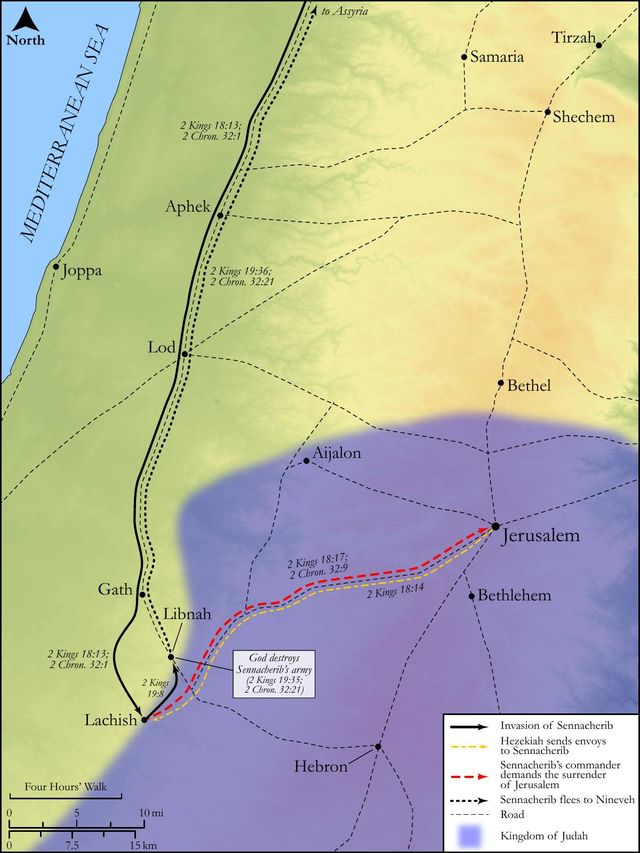
Sennacherib has his hands full in besieging Lachish (Ch2 32:9), but hears that Hezekiah is fortifying Jerusalem and encouraging his people to stand it out; and therefore, before he come in person to besiege it, he sends messengers to make speeches, and he himself writes letters to frighten Hezekiah and his people into a surrender of the city. See,
1.His great malice against the king of Judah, in endeavouring to withdraw his subjects from their allegiance to him. He did not treat with Hezekiah as a man of honour would have done, nor propose fair terms to him, but used mean and base artifices, unbecoming a crowned head, to terrify the common people and persuade them to desert him. he represented Hezekiah as one who designed to deceive his subjects into their ruin and betray them to famine and thirst (Ch2 32:11), as one who had done them great wrong and exposed them already to the divine displeasure by taking away the high places and altars (Ch2 32:12), and who, against the common interest of his people, held out against a force that would certainly be their ruin, Ch2 32:15.
2.His great impiety against the God of Israel, the God of Jerusalem he is called (Ch2 32:19), because that was the place he had chosen to put his name there, and because that was the place which was now threatened by the enemy and which the divine Providence had under its special protection. This proud blasphemer compared the great Jehovah, the Maker of heaven and earth, with the dunghill gods of the nations, the work of men's hands, and thought him no more able to deliver his worshippers than they were to deliver theirs (Ch2 32:19), as if an infinite and eternal Spirit had no more wisdom and power than a stone or the stock of a tree. He boasted of his triumphs over the gods of the nations, that they could none of them protect their people (Ch2 32:13-15), and thence inferred not only, How shall your God deliver you? (Ch2 32:14), but, as if he were inferior to them all, How much less shall your God deliver you? as if he were less able to help than any of them. Thus did they rail, rail in writing (which, being more deliberate, is so much the worse), on the Lord God of Israel, as if he were a cipher and an empty name, like all the rest, Ch2 32:17. Sennacherib, in the instructions he gave, said more than enough; but, as if his blasphemies had been too little, his servants, who learned insolence from their master, spoke yet more than he bade them against the Lord God and his servant Hezekiah, Ch2 32:16. And God resents what is said against his servants, and will reckon for it, as well as what is said against himself. All this was intended to frighten the people from their hope in God, which David's enemies sought to take him off from (Psa 11:1; Psa 42:10), saying, There is no help for him in God, Psa 3:2; Psa 71:11. Thus they hoped to take the city by weakening the hands of those that should defend it. Satan, in his temptations, aims to destroy our faith in God's all-sufficiency, knowing that he shall gain his point if he can do that; as we keep our ground if our faith fail not, Luk 22:32.
II.The duty as well as the interest of the church's friends, and that is in the day of distress to pray and cry to Heaven.
So Hezekiah did, and the prophet Isaiah, Ch2 32:20. It was a happy time when the king and the prophet joined thus in prayer. Is any troubled? Is any terrified? Let him pray. So we engage God for us; so we encourage ourselves in him. Praying to God is here called crying to Heaven, because we are, in prayer, to eye him as our Father in heaven, whence he beholds the children of men, and where he has prepared his throne.
III.The power and goodness of the church's God.
He is able both to control his enemies, be they ever so high, and to relieve his friends, be they ever so low.
1.As the blasphemies of his enemies engage him against them (Deu 32:27), so the prayers of his people engage him for them. They did so here.
(1.)The army of the Assyrians was cut off by the sword of an angel, which triumphed particularly in the slaughter of the mighty men of valour, and the leaders and captains, who defied the sword of any man. God delights to abase the proud and secure. The Targum says, The Word of the Lord (the eternal Word) sent Gabriel to do this execution, and that it was done with lightning, and in the passover night: that was the night in which the angel destroyed the first-born of Egypt. But that was not all.
(2.)The king of the Assyrians, having received this disgrace, was cut off by the sword of his own sons. Those that came forth of his own bowels slew him, Ch2 32:21. Thus was he mortified first, and then murdered - shamed first, and then slain. Evil pursues sinners; and, when they escape one mischief, they run upon another unseen.
2.By this work of wonder,
(1.)God was glorified, as the protector of his people. Thus he saved Jerusalem, not only from the hand of Sennacherib, but from the hand of all others, Ch2 32:22; for such a deliverance as this was an earnest of much mercy in store; and he guided them, that is, he guarded them, on every side. God defends his people by directing them, shows them what they should do, and so saves them from what is designed or done against them. For this many brought gifts unto the Lord, when they saw the great power of God in the defence of his people. Strangers were thereby induced to supplicate his favour and enemies to deprecate his wrath, and both brought gifts to his temple, in token of their care and desire.
(2.)Hezekiah was magnified as the favourite and particular care of Heaven. Many brought presents to him (Ch2 32:22, Ch2 32:23), in token of the honour they had for him, and to make an interest in him. By the favour of God enemies are lost and friends gained.
Continue studying 2 Chronicles 32:15 across the web’s major study libraries — every link below opens this exact verse, chapter, or book on the destination site.
Read & Compare
 BibleGatewayThis verse in more than 200 translations and 70 languages.
 Bible.comThe YouVersion reader — hundreds of translations, reading plans, and highlights.
 ESV.orgCrossway's official English Standard Version reader.
 NET BibleThe NET translation with 60,000+ translators' notes on every rendering decision.
 STEP BibleTyndale House's free study tool — original text, vocabulary, and scholarly resources.
 BibliaLogos Bible Software's free web reader.
 USCCBThe New American Bible (Revised Edition) with the U.S. bishops' study notes.
Commentaries
 BibleHub CommentariesDozens of classic commentaries on this verse, gathered on one page.
 StudyLightMore than 100 commentary sets — the largest collection on the web.
 BibleRefPlain-English commentary on what this verse means, verse by verse.
 Enduring WordDavid Guzik's free commentary on this chapter, widely used by Bible teachers.
 Bible Study ToolsVerse commentary alongside Greek and Hebrew study aids.
Original Language & Research
- BibleHub InterlinearThe verse word by word — original language, transliteration, and English.
- BibleHub LexiconEvery word's original-language definition and Strong's entry.
 Blue Letter BibleDeep-study tools — Strong's numbers, concordance, and word studies.
 SefariaThe Hebrew text with Rashi and centuries of Jewish commentary.
Sermons, Hymns & Audio


TrulyRandomVerse is not affiliated with these sites and doesn’t control their content. They’re linked because they’re genuinely useful.
Summary
In 2 Chronicles 32:15, Sennacherib, the arrogant king of Assyria, delivers a chilling message to the besieged people of Jerusalem, aiming to dismantle their faith and loyalty to King Hezekiah. He dismisses Hezekiah's encouragement as a deceptive ploy and asserts that just as no god of any other conquered nation or kingdom was able to deliver its people from the overwhelming might of Assyria, so too would Judah's God be utterly powerless to rescue them from his hand. This verse encapsulates Sennacherib's psychological warfare, designed to instill fear and despair by equating the unique, sovereign God of Israel with the impotent idols of the pagan world.
Context
ShowHideLiterary Context
This verse is a pivotal component of the taunting message delivered by Sennacherib's officials to the inhabitants of Jerusalem, as vividly recounted in 2 Chronicles 32:9-19. It immediately follows King Hezekiah's resolute efforts to fortify the city and bolster the morale of his people, reassuring them of God's unwavering presence and power for deliverance, as described in 2 Chronicles 32:1-8. Sennacherib's calculated speech, delivered through his emissaries, is a direct and insidious attempt to undermine Hezekiah's righteous leadership and erode the people's trust in YHWH, with the ultimate goal of securing a surrender without further military engagement. The speech escalates in its blasphemous tone, culminating in this verse's audacious and direct assault on the very character and omnipotence of the God of Israel. The narrative then dramatically shifts to the faithful and prayerful response of King Hezekiah and the prophet Isaiah, setting the stage for God's miraculous intervention and the decisive, supernatural defeat of the Assyrian army, detailed in 2 Chronicles 32:20-23.
Historical & Cultural Context
The events chronicled in 2 Chronicles 32 transpired in 701 BCE, during the joint reigns of King Hezekiah of Judah and Sennacherib of Assyria. At this period, the Assyrian Empire stood at the zenith of its power, universally feared for its brutal military campaigns, unparalleled efficiency in siege warfare, and ruthless policy of deporting conquered populations to prevent future rebellions. Sennacherib had already devastated much of Judah, capturing numerous fortified cities and laying siege to Jerusalem itself. Among the nations, military victory was commonly interpreted as irrefutable proof of the conquering nation's gods being superior to the defeated nation's deities. Sennacherib's boast in this verse was deeply rooted in this prevailing worldview, leveraging his past, undeniable successes against other nations and their impotent gods to intimidate and demoralize the besieged populace of Jerusalem. His strategic approach was not merely military but profoundly psychological, aiming to break the will of the people by convincing them that their God, like the gods of other nations, was utterly incapable of matching Assyrian might.
Key Themes
ShowHideThis verse powerfully contributes to several overarching themes woven throughout 2 Chronicles and the broader biblical narrative. Firstly, it starkly illuminates the arrogance of human power when it dares to stand in direct opposition to divine sovereignty. Sennacherib attributes all his victories solely to his own might and that of his ancestors, completely disregarding God's providential hand in the unfolding of history. Secondly, and perhaps most critically, it underscores the uniqueness and incomparable nature of YHWH when contrasted with the powerless idols of the nations. Sennacherib's audacious attempt to equate the one true God of Israel with pagan deities sets the stage for a dramatic and irrefutable demonstration of YHWH's absolute power and profound distinction, vividly seen in His miraculous deliverance of Jerusalem in 2 Chronicles 32:21. Thirdly, the verse exemplifies the perennial spiritual battle between faith and fear. Sennacherib's speech is meticulously designed to sow doubt, panic, and despair, challenging the people to abandon their trust in God. Hezekiah's steadfast faith and courageous encouragement, as meticulously described in 2 Chronicles 32:7-8, stands in stark contrast to the fear Sennacherib desperately attempts to instill. Ultimately, the narrative powerfully demonstrates God's unwavering commitment to His covenant people and His omnipotent power to deliver them from seemingly insurmountable odds, thereby reinforcing the profound theme of divine deliverance against all human boasts and limitations.
Exposition and Analysis
ShowHideKey Word Analysis
ShowHideKing Hezekiah (H2396) is identified as "strengthened of Jah" (YHWH). Sennacherib's direct attack on Hezekiah's credibility ("let not Hezekiah deceive you") is an attempt to undermine the very source of strength and hope for Jerusalem. By discrediting the king whose name signifies divine strengthening, Sennacherib aims to sever the people's trust in both their earthly leader and, by extension, the God who empowers him.
This term (H1471) refers to a foreign nation or Gentile people. Sennacherib's argument relies on the premise that YHWH is merely one among many "gods of any nation" whom he has already conquered. This word highlights the Assyrian king's polytheistic worldview, which fundamentally misunderstands the unique, universal sovereignty of YHWH, who is not limited to a single nation but is the God of all creation.
Appearing three times (H3027) in this verse, "hand" is used idiomatically to denote power, control, authority, and possession. Sennacherib's repeated assertion that no god could deliver people "out of mine hand" emphasizes his perceived absolute dominion and irresistible might. It paints a vivid picture of complete subjugation, where the conquered are entirely at his mercy, with no hope of escape from his grasp, setting up a direct challenge to God's ultimate power.
This verb (H5337) means "to snatch away," "to rescue," or "to set free." It is the central challenge Sennacherib poses to YHWH. He claims that no deity has been able to perform this act of liberation against his power, setting up the ultimate test of YHWH's ability to "deliver" His people from the Assyrian threat. The word highlights the critical nature of the conflict: whether God is truly able to save His people from the most formidable earthly power.
Verse Breakdown
ShowHide"Now therefore let not Hezekiah deceive you, nor persuade you on this manner, neither yet believe him:"
Sennacherib initiates his psychological assault by directly targeting King Hezekiah's credibility and the message of hope he has offered. He warns the people against Hezekiah's promises of divine protection and deliverance, framing them as a deliberate deception. This threefold injunction—"deceive," "persuade," "believe"—is a comprehensive rhetorical strategy designed to completely discredit Hezekiah in the eyes of his subjects, severing the bond of trust between king and people and leaving them vulnerable to despair and surrender.
"for no god of any nation or kingdom was able to deliver his people out of mine hand, and out of the hand of my fathers:"
This clause forms the empirical and historical basis of Sennacherib's arrogant argument. He appeals to his own (and his predecessors') undisputed military successes, particularly their conquests of numerous nations and the perceived defeat of their respective deities. Among the nations, the defeat of a nation implied the defeat or inferiority of its gods. Sennacherib boasts that no god, regardless of nation or kingdom, has ever proven capable of rescuing its people from Assyrian might, thus presenting a history of irresistible power as proof of his gods' (and by extension, his own) supremacy.
"how much less shall your God deliver you out of mine hand?"
This rhetorical question is the devastating climax of Sennacherib's blasphemous speech. It is designed not to elicit an answer, but to force a conclusion of utter hopelessness and despair upon the people of Jerusalem. Based on his flawed premise—that YHWH is merely another local deity comparable to the impotent idols he has already vanquished—he concludes that YHWH is even less likely to succeed where other gods have failed. This statement is a direct and profound blasphemy against the unique, incomparable, and sovereign God of Israel, intended to break the morale of the besieged city and compel their immediate surrender.
Literary Devices
ShowHideSennacherib's speech in 2 Chronicles 32:15 is replete with rhetorical and literary devices meticulously crafted to intimidate and demoralize the people of Jerusalem. The most prominent is the Rhetorical Question, "how much less shall your God deliver you out of mine hand?" This question is not posed to elicit an answer but to instill a specific, despairing conclusion in the minds of the listeners, implying the absolute futility of resistance. There is profound Irony in Sennacherib's boast; while he intends to diminish YHWH by comparing Him to pagan idols, his statement inadvertently highlights the very impotence of those idols, thereby setting the stage for YHWH's dramatic demonstration of His unique and incomparable power. The speech also employs Hyperbole and Boasting, as Sennacherib exaggerates his own power and that of his ancestors, presenting their conquests as absolute, irresistible, and divinely ordained by his own gods. Furthermore, Sennacherib engages in an Ad Hominem attack against King Hezekiah, attempting to discredit the king's message by portraying him as a deceiver, rather than addressing the inherent truth of Hezekiah's faith and the promises of God. Finally, the entire argument rests on a fundamental False Analogy, equating the one true, living God, YHWH, with the manufactured, powerless deities of other nations, demonstrating Sennacherib's profound spiritual ignorance and hubris.
Theological and Thematic Connections
ShowHideSennacherib's blasphemous challenge in 2 Chronicles 32:15 serves as a profound theological test, highlighting the stark contrast between human arrogance and divine sovereignty. His assertion that YHWH is no different from the vanquished gods of other nations directly confronts the biblical revelation of God's absolute uniqueness and omnipotence. The narrative immediately following this verse dramatically demonstrates that God is not merely a tribal deity, but the Creator and Sustainer of all things, whose power transcends all earthly kingdoms and their false gods. This encounter underscores the critical theological truth that YHWH alone is God, incomparable in His power to deliver and His unwavering faithfulness to His covenant people. It is a powerful reminder that worldly power, no matter how formidable or boastful, is ultimately subject to the sovereign will of the Almighty.
Reflection and Application
ShowHideSennacherib's boastful challenge to God's power in 2 Chronicles 32:15 resonates deeply with the spiritual battles believers often face today. Just as the Assyrian king sought to instill fear and doubt in the hearts of Jerusalem's inhabitants, so too does the world, and indeed the enemy of our souls, frequently present overwhelming challenges and voices that question God's ability or willingness to deliver us from difficult circumstances. Whether it's a seemingly insurmountable financial crisis, a devastating health diagnosis, relational breakdown, or widespread societal anxieties, these "Sennacheribs" of our age can whisper insidious lies, suggesting that our God is powerless against the "hand" of our problems. This verse calls us to remember that such boasts, when made against the Almighty God, are ultimately hollow and destined to fail. The subsequent miraculous deliverance of Jerusalem, as recorded in 2 Chronicles 32:21, serves as an eternal testament to God's unique power to save. When faced with seemingly insurmountable odds or voices that question God's sovereignty, we are called to emulate Hezekiah's faithful response: to turn to God in prayer, to trust in His unique and incomparable ability to deliver, and to steadfastly refuse to be deceived by the boasts of this world or the enemy. Our faith is not in a god among gods, but in the one true God who is above all, who reigns supreme, and who always keeps His promises.
Questions for Reflection
ShowHideFAQ
ShowHideWho was Sennacherib, and what was his significance in this narrative?
ShowHideSennacherib was the powerful king of Assyria (reigned 705-681 BCE), leading one of the most dominant and feared empires of his day. He is profoundly significant in this narrative as the primary antagonist, representing the epitome of human arrogance, military might, and blasphemous challenge to the sovereignty of God. His extensive military campaign against Judah, culminating in the siege of Jerusalem in 701 BCE, is a pivotal event in biblical history, serving as a dramatic backdrop for demonstrating God's unique power and unwavering faithfulness to His covenant people, as also recorded in 2 Kings 18-19 and Isaiah 36-37. His boast in 2 Chronicles 32:15 is a direct and audacious blasphemy against YHWH, setting the stage for God's miraculous and decisive intervention.
Why did Sennacherib compare the God of Israel to the gods of other nations?
ShowHideSennacherib's comparison stemmed directly from the polytheistic worldview of the nations he had conquered. In this cultural and religious context, military victories were almost universally attributed to the superior power of a nation's gods over the gods of the defeated. Having conquered numerous nations and their respective deities, Sennacherib genuinely believed that YHWH was simply another tribal god, no different from the impotent idols he had already overcome. His comparison was strategically intended to demoralize the people of Jerusalem by suggesting that their God was equally powerless against the overwhelming might of the Assyrian empire, thereby undermining their faith and encouraging their immediate surrender. He fundamentally failed to grasp the unique, incomparable nature of YHWH as the one true, sovereign God over all creation, not merely a local or regional deity.
Christ-Centered Fulfillment
ShowHideSennacherib's boastful challenge in 2 Chronicles 32:15, asserting his absolute power and the inability of any god to deliver from his "hand," finds its ultimate and profound Christ-centered fulfillment in the person and redemptive work of Jesus. Sennacherib, the mighty earthly king, serves as a type of the worldly powers and spiritual forces that stand in opposition to God and His people throughout history. His claim of irresistible dominion is ultimately shattered by God's miraculous intervention, powerfully foreshadowing the definitive and eternal victory achieved by Christ. In the New Testament, we witness Jesus confronting the ultimate "hands" of oppression: the power of sin, the sting of death, and the dominion of the devil. Unlike the pagan gods who were indeed powerless against Sennacherib, Jesus, the true God incarnate, fully entered the human condition and, through His sacrificial death on the cross and His glorious resurrection, decisively "delivered" humanity from the hand of darkness. Colossians 2:15 profoundly declares that Christ disarmed the spiritual rulers and authorities, triumphing over them by the cross. The "hand" of God's ultimate power is not seen in military conquest, but in the outstretched hands of Christ on the cross, accomplishing perfect salvation. The rhetorical question, "how much less shall your God deliver you out of mine hand?" is inverted and answered triumphantly by the Gospel: how much more has God delivered us through the mighty hand of His Son, Jesus, who has definitively overcome the world and secured eternal victory for all who believe, ensuring that absolutely nothing can separate us from the love of God in Christ Jesus our Lord.