


2 Chronicles 32:16
Bible text: King James Version (1769 Blayney text) · Public domain
Bible text: Berean Standard Bible · Public domain
Bible text: American Standard Version (1901) · Public domain
Bible text: World English Bible, Messianic edition · Public domain
Bible text: Geneva Bible (1599) · Public domain
Bible text: Young's Literal Translation · Public domain
- וְעוֹדve·'Odand againH5750Conj-w ¦ Adj-msAdjective Numerical Singular Masculine Absoluteוְandעוֹדagain
- דִּבְּרוּdi·be·Ruthey spokeH1696V-Piel-Perf-3cpVerb Piel Perfect 3rd Plural common gender
- עֲבָדָיו'a·va·Davhis servantsH5650N-mpc ¦ 3msNoun Plural Masculine Constructעֲבָדָיservantsוhis
- עַל'alonH5921PrepPreposition
- יְהוָהYah·wehYahwehH3068N-properNoun Proper Title
- הָאֱלֹהִיםha·'E·lo·Him<the> GodH430Art ¦ N-mpNoun Plural Masculine Absoluteהָ<the>אֱלֹהִיםGod
- וְעַלve·'Aland onH5921Conj-w ¦ PrepPrepositionוְandעַלon
- יְחִזְקִיָּהוּye·chiz·ki·Ya·huHezekiahH2396N-proper-mNoun Proper Masculine
- עַבְדּוֹav·Dohis servantH5650N-msc ¦ 3msNoun Singular Masculine Constructעַבְדּservantוֹhis
English is a literal word-by-word gloss of the Hebrew, not the KJV's wording. Why?
This is the original text the KJV's translators worked from — each Hebrew word with its own literal English meaning in this verse, prepared by scholars at Tyndale House, Cambridge. The KJV translates whole sentences, not word by word, so its wording differs: one Hebrew word can become several English words, and the KJV may choose “the LORD” where the gloss reads “Yahweh”. Both are faithful — they answer different questions. For the KJV's own rendering, switch to the KJV text.
Details
See on the biblical-era maps
Study this verse
Public-domain commentary
Matthew Henry
From his Commentary on the Whole Bible. Henry comments on passages, not single verses — this entry covers 2 Chronicles 32:9–23. His three-level outline is real structure in the source text, so it is rendered as structure.
This story of the rage and blasphemy of Sennacherib, Hezekiah's prayer, and the deliverance of Jerusalem by the destruction of the Assyrian army, we had more at large in the book of Kings, 2 Kings 18 and 19. It is contracted here, yet large enough to show these three things: -
I.The impiety and malice of the church's enemies.
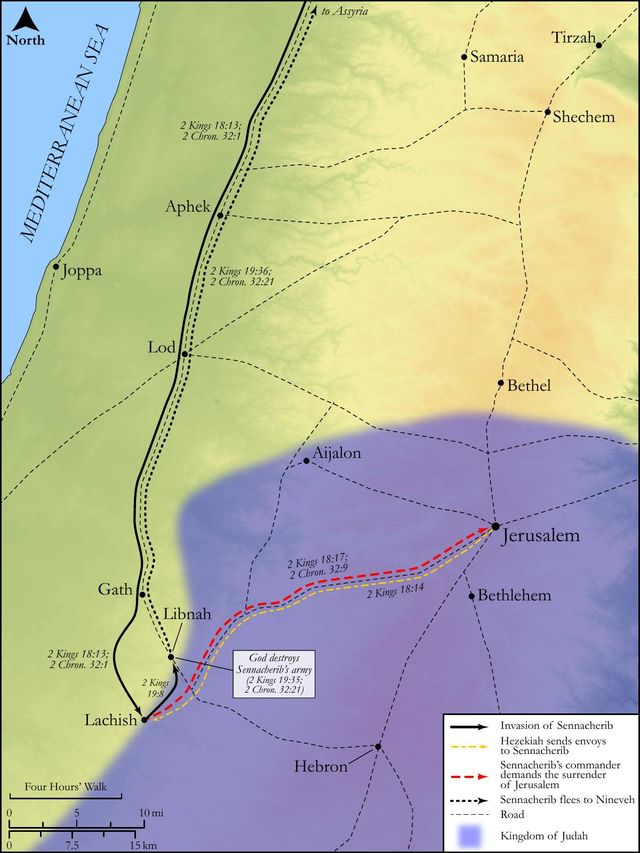
Sennacherib has his hands full in besieging Lachish (Ch2 32:9), but hears that Hezekiah is fortifying Jerusalem and encouraging his people to stand it out; and therefore, before he come in person to besiege it, he sends messengers to make speeches, and he himself writes letters to frighten Hezekiah and his people into a surrender of the city. See,
1.His great malice against the king of Judah, in endeavouring to withdraw his subjects from their allegiance to him. He did not treat with Hezekiah as a man of honour would have done, nor propose fair terms to him, but used mean and base artifices, unbecoming a crowned head, to terrify the common people and persuade them to desert him. he represented Hezekiah as one who designed to deceive his subjects into their ruin and betray them to famine and thirst (Ch2 32:11), as one who had done them great wrong and exposed them already to the divine displeasure by taking away the high places and altars (Ch2 32:12), and who, against the common interest of his people, held out against a force that would certainly be their ruin, Ch2 32:15.
2.His great impiety against the God of Israel, the God of Jerusalem he is called (Ch2 32:19), because that was the place he had chosen to put his name there, and because that was the place which was now threatened by the enemy and which the divine Providence had under its special protection. This proud blasphemer compared the great Jehovah, the Maker of heaven and earth, with the dunghill gods of the nations, the work of men's hands, and thought him no more able to deliver his worshippers than they were to deliver theirs (Ch2 32:19), as if an infinite and eternal Spirit had no more wisdom and power than a stone or the stock of a tree. He boasted of his triumphs over the gods of the nations, that they could none of them protect their people (Ch2 32:13-15), and thence inferred not only, How shall your God deliver you? (Ch2 32:14), but, as if he were inferior to them all, How much less shall your God deliver you? as if he were less able to help than any of them. Thus did they rail, rail in writing (which, being more deliberate, is so much the worse), on the Lord God of Israel, as if he were a cipher and an empty name, like all the rest, Ch2 32:17. Sennacherib, in the instructions he gave, said more than enough; but, as if his blasphemies had been too little, his servants, who learned insolence from their master, spoke yet more than he bade them against the Lord God and his servant Hezekiah, Ch2 32:16. And God resents what is said against his servants, and will reckon for it, as well as what is said against himself. All this was intended to frighten the people from their hope in God, which David's enemies sought to take him off from (Psa 11:1; Psa 42:10), saying, There is no help for him in God, Psa 3:2; Psa 71:11. Thus they hoped to take the city by weakening the hands of those that should defend it. Satan, in his temptations, aims to destroy our faith in God's all-sufficiency, knowing that he shall gain his point if he can do that; as we keep our ground if our faith fail not, Luk 22:32.
II.The duty as well as the interest of the church's friends, and that is in the day of distress to pray and cry to Heaven.
So Hezekiah did, and the prophet Isaiah, Ch2 32:20. It was a happy time when the king and the prophet joined thus in prayer. Is any troubled? Is any terrified? Let him pray. So we engage God for us; so we encourage ourselves in him. Praying to God is here called crying to Heaven, because we are, in prayer, to eye him as our Father in heaven, whence he beholds the children of men, and where he has prepared his throne.
III.The power and goodness of the church's God.
He is able both to control his enemies, be they ever so high, and to relieve his friends, be they ever so low.
1.As the blasphemies of his enemies engage him against them (Deu 32:27), so the prayers of his people engage him for them. They did so here.
(1.)The army of the Assyrians was cut off by the sword of an angel, which triumphed particularly in the slaughter of the mighty men of valour, and the leaders and captains, who defied the sword of any man. God delights to abase the proud and secure. The Targum says, The Word of the Lord (the eternal Word) sent Gabriel to do this execution, and that it was done with lightning, and in the passover night: that was the night in which the angel destroyed the first-born of Egypt. But that was not all.
(2.)The king of the Assyrians, having received this disgrace, was cut off by the sword of his own sons. Those that came forth of his own bowels slew him, Ch2 32:21. Thus was he mortified first, and then murdered - shamed first, and then slain. Evil pursues sinners; and, when they escape one mischief, they run upon another unseen.
2.By this work of wonder,
(1.)God was glorified, as the protector of his people. Thus he saved Jerusalem, not only from the hand of Sennacherib, but from the hand of all others, Ch2 32:22; for such a deliverance as this was an earnest of much mercy in store; and he guided them, that is, he guarded them, on every side. God defends his people by directing them, shows them what they should do, and so saves them from what is designed or done against them. For this many brought gifts unto the Lord, when they saw the great power of God in the defence of his people. Strangers were thereby induced to supplicate his favour and enemies to deprecate his wrath, and both brought gifts to his temple, in token of their care and desire.
(2.)Hezekiah was magnified as the favourite and particular care of Heaven. Many brought presents to him (Ch2 32:22, Ch2 32:23), in token of the honour they had for him, and to make an interest in him. By the favour of God enemies are lost and friends gained.
Continue studying 2 Chronicles 32:16 across the web’s major study libraries — every link below opens this exact verse, chapter, or book on the destination site.
Read & Compare
 BibleGatewayThis verse in more than 200 translations and 70 languages.
 Bible.comThe YouVersion reader — hundreds of translations, reading plans, and highlights.
 ESV.orgCrossway's official English Standard Version reader.
 NET BibleThe NET translation with 60,000+ translators' notes on every rendering decision.
 STEP BibleTyndale House's free study tool — original text, vocabulary, and scholarly resources.
 BibliaLogos Bible Software's free web reader.
 USCCBThe New American Bible (Revised Edition) with the U.S. bishops' study notes.
Commentaries
 BibleHub CommentariesDozens of classic commentaries on this verse, gathered on one page.
 StudyLightMore than 100 commentary sets — the largest collection on the web.
 BibleRefPlain-English commentary on what this verse means, verse by verse.
 Enduring WordDavid Guzik's free commentary on this chapter, widely used by Bible teachers.
 Bible Study ToolsVerse commentary alongside Greek and Hebrew study aids.
Original Language & Research
- BibleHub InterlinearThe verse word by word — original language, transliteration, and English.
- BibleHub LexiconEvery word's original-language definition and Strong's entry.
 Blue Letter BibleDeep-study tools — Strong's numbers, concordance, and word studies.
 SefariaThe Hebrew text with Rashi and centuries of Jewish commentary.
Sermons, Hymns & Audio


TrulyRandomVerse is not affiliated with these sites and doesn’t control their content. They’re linked because they’re genuinely useful.
Summary
Second Chronicles 32:16 records the intensifying and blasphemous verbal assault launched by King Sennacherib's officials against the LORD God and His faithful servant, King Hezekiah. This verse captures a critical moment in the Assyrian siege of Jerusalem, highlighting their calculated strategy of psychological warfare aimed at demoralizing the people, eroding their trust in divine protection, and coercing surrender without further military engagement. It sets the stage for God's dramatic intervention in defense of His name and His people.
Context
ShowHideLiterary Context
This verse is deeply embedded within the dramatic narrative of Sennacherib's invasion of Judah, detailed in 2 Chronicles 32. It follows Hezekiah's diligent preparations for the impending siege, including strengthening Jerusalem's defenses and, crucially, encouraging his people to trust in the LORD (as seen in 2 Chronicles 32:1-8). Sennacherib's initial campaign of intimidation, involving letters and taunts delivered by his officials, is recounted in 2 Chronicles 32:9-15. Verse 16 specifically emphasizes the continued and escalating nature of these blasphemous pronouncements, serving as the climax of the Assyrian verbal assault. This sustained defiance against God directly precedes Hezekiah's desperate prayer and God's miraculous and decisive intervention, which immediately follows in 2 Chronicles 32:20-21. Parallel accounts of these events are found in 2 Kings 18-19 and Isaiah 36-37.
Historical & Cultural Context
The events described in 2 Chronicles 32 transpired around 701 BC, during the reign of King Hezekiah of Judah. At this time, the Neo-Assyrian Empire, under King Sennacherib, represented the dominant superpower of that day, renowned for its military might and ruthless expansion. Assyrian military strategy was multifaceted, combining overwhelming force with sophisticated psychological warfare. Before or during a siege, it was common practice for their high-ranking officials, such as the Rabshakeh mentioned earlier in the chapter, to deliver speeches designed to break the morale of the besieged city. A key component of this tactic was to boast of their gods' superiority over the deities of conquered nations, thereby undermining the people's trust in their own gods and leaders. By equating the LORD God with the powerless idols of other lands they had overrun, the Assyrians aimed to instill profound fear and doubt, hoping to provoke surrender without the costly and time-consuming effort of a prolonged physical siege. This persistent verbal assault was a deliberate and calculated part of their comprehensive military campaign.
Key Themes
ShowHideThis verse profoundly contributes to several major themes within 2 Chronicles and the broader biblical narrative. Firstly, it highlights Blasphemy and Defiance, showcasing the audacious and escalating challenge against the one true God. The Assyrian officials did not merely threaten Judah; they directly questioned the LORD's power and faithfulness, claiming He was no different from the failed gods of other nations, as explicitly stated in 2 Chronicles 32:15. Secondly, it underscores the theme of Faith Under Pressure, as this intense psychological and spiritual assault sets the stage for Hezekiah's profound act of faith and prayer, demonstrating how a righteous leader responds to overwhelming odds, as seen in 2 Chronicles 32:20. Thirdly, it vividly illustrates Psychological Warfare, demonstrating how ancient empires employed verbal assaults to break an enemy's will, with the phrase "spake yet more" emphasizing the sustained and deliberate nature of these demoralizing efforts. Finally, and most significantly, it powerfully sets up the theme of God's Sovereignty and Honor, as the Assyrians' defiance against the LORD God ultimately leads to His dramatic intervention and vindication of His name, proving that He is indeed unlike the gods of the nations, as recorded in 2 Chronicles 32:21.
Exposition and Analysis
ShowHideKey Word Analysis
ShowHideThis primitive root means "to arrange" but is figuratively used to mean "to speak." While it can denote simple communication, in this context, coupled with "yet more," it implies deliberate, forceful, and repeated pronouncements. The Assyrian officials were not merely talking; they were systematically articulating a message designed to undermine and demoralize. This word, therefore, points to the intentional and strategic nature of their verbal assault, emphasizing that their words were carefully chosen weapons.
This is the sacred, covenantal name of God, often transliterated as Yahweh. It emphasizes God's self-existence, eternal nature, and His personal, covenant-keeping relationship with Israel. When the Assyrians spoke "against the LORD," they were not merely challenging a generic deity but directly assailing the unique, living God who had revealed Himself to Abraham, delivered Israel from Egypt, and established a covenant with His people. This made their words a profound act of blasphemy against the very core of Israel's faith and the God of their salvation.
This is a plural noun, often used with a singular meaning, referring to the supreme God. It signifies God's power, majesty, and universal sovereignty as the Creator and Ruler of all. While Yᵉhôvâh highlights His covenantal relationship, ʼĕlôhîym emphasizes His divine authority and might. The Assyrians' attack "against the LORD God" thus encompassed both God's personal faithfulness to His people and His supreme, incomparable power over all creation and all other supposed deities. Their defiance was total, challenging both His character and His dominion over all things.
This term refers to a bondman or servant. In the biblical context, being called God's "servant" is a profound honor, denoting one chosen and commissioned by God for a specific purpose, often involving leadership and faithfulness. Moses, David, and the prophets were called God's servants. Hezekiah, in this instance, is recognized as God's chosen instrument and representative. By speaking "against his servant Hezekiah," the Assyrians were not only attacking the king of Judah but, by extension, directly insulting and challenging the sovereign God whom Hezekiah faithfully served. This attack on the servant was an attack on the Master.
Verse Breakdown
ShowHide"And his servants spake yet [more]"
This opening clause immediately establishes the ongoing and intensifying nature of the Assyrian verbal assault. The phrase "yet more" (or "again and again") signifies that the taunts were not isolated incidents but a deliberate, sustained campaign of psychological warfare. It indicates the Assyrian officials' persistence in their efforts to demoralize the people of Jerusalem and break their will to resist, following their initial pronouncements. This relentless verbal barrage was designed to wear down the city's resolve.
"against the LORD God"
This is the core of the Assyrian offense, elevating the conflict beyond mere political or military maneuvering. Their words were not simply threats but direct blasphemy against the God of Israel, the living and true God. By challenging the LORD's power and ability to deliver His people, they were attempting to strip Him of His honor, authority, and unique status in the eyes of His worshipers. This direct assault on God's name and character transformed the conflict from a geopolitical struggle into a spiritual battle, demanding divine intervention for the vindication of His holy name.
"and against his servant Hezekiah"
The Assyrian officials also targeted King Hezekiah, recognizing his crucial role as Judah's leader and God's chosen representative. By undermining Hezekiah's authority, integrity, and his call for the people to trust in the LORD, they aimed to erode the people's confidence in their king. The phrase "his servant" implicitly acknowledges Hezekiah's divine appointment and loyal service, making the attack against him also an indirect, yet potent, attack on the God whom he served. This dual target—God directly and Hezekiah as His faithful representative—was designed to completely dismantle the morale and resistance of Jerusalem.
Literary Devices
ShowHideThe passage employs several potent literary devices that amplify its impact. The most prominent is Repetition, implied by the phrase "spake yet more," which underscores the persistent and relentless nature of the Assyrian taunts. This repetition serves to emphasize the psychological pressure being exerted on Jerusalem, highlighting the sustained effort to wear down their resolve and faith. There is also a strong element of Contrast at play: the Assyrian officials, representing a powerful earthly empire and its false gods, stand in stark opposition to the one true God, Yahweh, and His seemingly vulnerable servant Hezekiah. This contrast sets up the dramatic tension for God's eventual, miraculous intervention, demonstrating His incomparable power and the futility of human hubris against divine sovereignty. Furthermore, the Assyrian's boastful and blasphemous speech itself functions as Foreshadowing, hinting at the inevitable divine judgment that such audacious hubris will incur. The entire scenario is a vivid depiction of Psychological Warfare, where words are wielded as weapons to instill fear and doubt, a tactic that the biblical narrative exposes as ultimately futile against the sovereign will of God.
Theological and Thematic Connections
ShowHideThe continued blasphemy against the LORD God and His servant Hezekiah, as depicted in 2 Chronicles 32:16, profoundly underscores the biblical theme of divine honor and human defiance. This verse illustrates that attacks on God's people or His chosen leaders are often, at their root, attacks on God Himself. The Assyrians' taunts were not merely political maneuvering but a direct challenge to God's sovereignty, power, and faithfulness. Such defiance, common throughout Scripture, invariably provokes God's righteous response, demonstrating that He will not allow His name to be profaned indefinitely. This passage serves as a powerful reminder that God is zealous for His glory and will ultimately vindicate His name and His people against all who oppose Him, proving that His honor is paramount and His word is true.
Reflection and Application
ShowHideIn a world that increasingly questions, ridicules, or outright denies the existence and power of God, 2 Chronicles 32:16 offers a timeless lesson for believers. Just as Hezekiah and the people of Jerusalem faced persistent verbal assaults designed to undermine their faith and trust in God, so too do Christians today encounter voices of doubt, skepticism, and opposition. These "taunts" may come from secular ideologies, cultural pressures, personal struggles, or even spiritual adversaries, all aiming to demoralize and provoke surrender to fear or despair. This verse calls us to recognize such attacks for what they are—not just challenges to our beliefs, but often direct or indirect blasphemies against the very character and sovereignty of God. It encourages steadfastness in faith, reminding us that our God is not a powerless idol but the living, sovereign LORD, fully capable of defending His name and His people, even when circumstances seem overwhelmingly against us. Our response, like Hezekiah's, should be one of unwavering trust and fervent prayer, knowing that God will ultimately vindicate His honor and deliver His own, proving His faithfulness in every generation.
Questions for Reflection
ShowHideFAQ
ShowHideWhy did the Assyrians focus so much on verbal attacks, and why did they "speak yet more"?
ShowHideThe Assyrians, particularly under Sennacherib, were masters of psychological warfare. Their verbal attacks, often delivered by the Rabshakeh (a high-ranking official), were a calculated military strategy designed to demoralize the besieged population and break their will to resist without a costly and prolonged physical siege. They "spoke yet more" to emphasize the relentless and persistent nature of this psychological pressure. By repeatedly asserting the futility of resistance and comparing the LORD God to the defeated gods of other nations, they aimed to sow doubt and fear, hoping to provoke a surrender that would save them resources and time. This was a common tactic in ancient warfare, and its continuation highlights their determination to achieve victory through intimidation rather than solely through brute force.
What was the significance of the Assyrians speaking "against the LORD God" specifically, rather than just against Judah?
ShowHideThe Assyrians' blasphemy against the LORD God was highly significant because it elevated the conflict from a mere geopolitical struggle to a spiritual one. By directly challenging the God of Israel, they were not just undermining Judah's king or military, but attacking the very source of their identity, hope, and strength. Among the nations, the defeat of a nation was often seen as the defeat of its gods. The Assyrians, in their arrogance, believed their gods were superior to all others. Their taunts against the LORD God were an attempt to strip Him of His honor and demonstrate His supposed impotence, thereby justifying their conquests and breaking the spiritual resolve of Jerusalem. This direct affront to God's honor is what ultimately prompted His dramatic and decisive intervention, as seen in 2 Chronicles 32:21.
Christ-Centered Fulfillment
ShowHideThe relentless blasphemy against the LORD God and His servant Hezekiah in 2 Chronicles 32:16 finds its ultimate and profound fulfillment in the person and work of Jesus Christ. Just as Hezekiah, God's chosen king, faced the taunts and accusations of earthly powers, so too did Jesus, the true King of Israel and the ultimate Servant of the Lord, endure unparalleled hostility and blasphemy. From the very beginning of His ministry, Jesus was opposed and slandered, with His divine authority questioned and His claims to be God's Son dismissed as blasphemy by the religious leaders (Mark 2:7). On the cross, the taunts reached their zenith, as He was mocked and challenged to save Himself if He was truly the Son of God (Matthew 27:39-44). Yet, in His suffering, Jesus perfectly embodied the faithful servant, enduring all hostility for the joy set before Him (Hebrews 12:2-3). God's dramatic vindication of His name and His servant Hezekiah through the angelic slaughter of the Assyrian army foreshadows the ultimate vindication of Jesus. The resurrection of Christ from the dead is God's supreme declaration that Jesus is indeed the LORD, the true Son of God, triumphing over all the powers of darkness and all the taunts of humanity (Romans 1:4). Through Christ, the victory over spiritual forces that accuse and defy God is decisively won (Colossians 2:15), assuring believers that in Him, God's honor is eternally upheld, and His people are eternally secure.