


Mark 2:7
Bible text: King James Version (1769 Blayney text) · Public domain
Bible text: Berean Standard Bible · Public domain
Bible text: American Standard Version (1901) · Public domain
Bible text: World English Bible, Messianic edition · Public domain
Bible text: Geneva Bible (1599) · Public domain
Bible text: Young's Literal Translation · Public domain
- τίtiWhyG5101I-ASNInterrogative pronoun Accusative Singular Neuter
- οὗτοςhoutosthis [man]G3778D-NSMDemonstrative pronoun Nominative Singular Masculine
- οὕτωςhoutōsthusG3779ADVAdverb
- λαλεῖ;laleidoes speak?G2980V-PAI-3SVerb Present Active Indicative 3rd Singular
- βλασφημεῖ·blasphēmeiHe blasphemes!G987V-PAI-3SVerb Present Active Indicative 3rd Singular
- τίςtisWhoG5101I-NSMInterrogative pronoun Nominative Singular Masculine
- δύναταιdunataiis ableG1410V-PNI-3SVerb Present Middle Or Passive Deponent Indicative 3rd Singular
- ἀφιέναιaphienaito forgiveG863V-PANVerb Present Active Infinitive
- ἁμαρτίαςhamartiassinsG266N-APFNoun Accusative Plural Feminine
- εἰeionlyG1487CONDConjunction
- μὴmēexceptG3361PRT-NNegative Particle Negative
- εἷςheisoneG1520A-NSMAdjective Nominative Singular Masculine
- ὁho<the>G3588T-NSMDefinite article Nominative Singular Masculine
- θεός;theosGod?G2316N-NSM-TNoun Nominative Singular Masculine Title
English is a literal word-by-word gloss of the Greek, not the KJV's wording. Why?
This is the original text the KJV's translators worked from — each Greek word with its own literal English meaning in this verse, prepared by scholars at Tyndale House, Cambridge. The KJV translates whole sentences, not word by word, so its wording differs: one Greek word can become several English words, and the KJV may choose “charity” where the gloss reads “love”. Both are faithful — they answer different questions. For the KJV's own rendering, switch to the KJV text.
Details
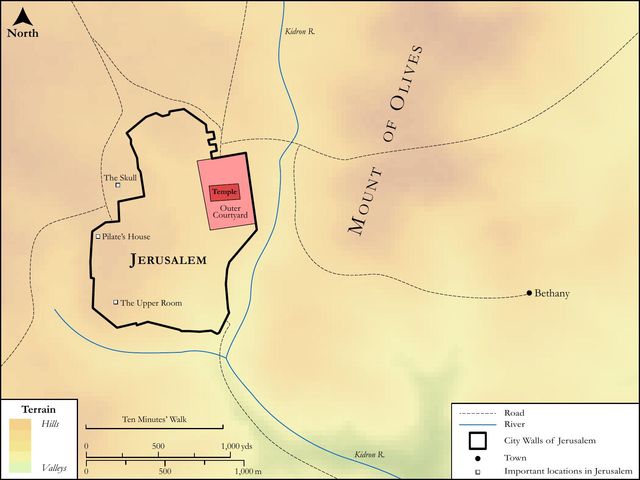
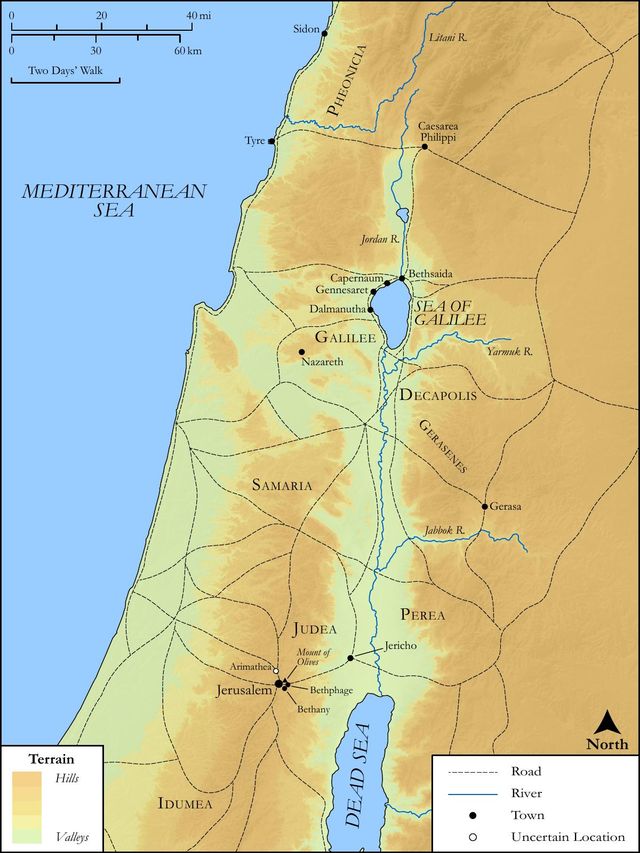
See on the biblical-era maps

Study this verse
Public-domain commentary
Matthew Henry
From his Commentary on the Whole Bible. Henry comments on passages, not single verses — this entry covers Mark 2:1–12. His two-level outline is real structure in the source text, so it is rendered as structure.
Christ, having been for some time preaching about in the country, here returns to Capernaum his head-quarters, and makes his appearance there, in hopes that by this time the talk and crowd would be somewhat abated. Now observe,
I.The great resort there was to him.
Though he was in the house, wither Peter's house, or some lodgings of his own which he had taken, yet people came to him as soon as it was noised that he was in town; they did not stay till he appeared in the synagogue, which they might be sure he would do on the sabbath day, but straightway many were gathered together to him. Where the king is, there is the court; where Shiloh is, there shall the gathering of the people be. In improving opportunities for our souls, we must take care not to lose time. One invited another (Come, let us go see Jesus), so that his house could not contain his visitants. There was no room to receive them, they were so numerous, no not so much as about the door. A blessed sight, to see people thus flying like a cloud to Christ's house, though it was but a poor one, and as the doves to their windows!
II.The good entertainment Christ gave them, the best his house would afford, and better than any other could; he preached the word unto them, Mar 2:2. Many of them perhaps came only for cures, and many perhaps only for curiosity, to get a sight of him; but when he had them together he preached to them. Though the synagogue-door was open to him at proper times, he thought it not at all amiss to preach in a house, on a week day; though some might reckon it both an improper place and an improper time. Blessed are ye that sow beside all waters, Isa 32:20.
III.The presenting of a poor cripple to him, to be helped by him.
The patient was one sick of the palsy, it should seem not as that, Mat 8:6, grievously tormented, but perfectly disabled, so that he was borne of four, was carried upon a bed, as if he had been upon a bier, by four persons. It was his misery, that he needed to be so carried, and bespeaks the calamitous state of human life; it was their charity, who did so carry him, and bespeaks the compassion that it is justly expected should be in the children of men toward their fellow-creatures in distress, because we know not how soon the distress may be our own. These kind relations or neighbours thought, if they could but carry this poor man once to Christ, they should not need to carry him any more; and therefore made hard shift to get him to him; and when they could not otherwise get to him, they uncovered the roof where he was, Mar 2:4. I see no necessity to conclude that Christ was preaching in an upper room, though in such the Jews that had stately houses, had their oratories; for then to what purpose should the crowd stand before the door, as wisdom's clients used to do? Pro 8:34. But I rather conjecture that the house he was in, was so little and mean (agreeable to his present state), that it had no upper room, but the ground-floor was open to the roof: and these petitioners for the poor paralytic, resolving not to be disappointed, when they could not get through the crowd at the door, got their friend by some means or other to the roof of the house, took off some of the tiles, and so let him down upon his bed with cords into the house where Christ was preaching. This bespoke both their faith and their fervency in this address to Christ. Hereby it appeared that they were in earnest, and would not go away, nor let Christ go without a blessing. Gen 32:26.
IV.The kind word Christ said to this poor patient; He saw their faith; perhaps not so much his, for his distemper hindered him from the exercise of faith, but theirs that brought him. In curing the centurion's servant, Christ took notice of it as an instance of his faith, that he did not bring him to Christ, but believed he could cure him at a distance; here he commended their faith, because they did bring their friend through so much difficulty. Note, True faith and strong faith may work variously, conquering sometimes the objections of reason, sometimes those of sense; but, however manifested, it shall be accepted and approved by Jesus Christ. Christ said, Son, thy sins be forgiven thee. The compellation is very tender-Son; intimating a fatherly care of him and concern for him. Christ owns true believers as his sons: a son, and yet sick of the palsy. Herein God deals with you as with sons. The cordial is very rich; Thy sins are forgiven thee. Note,
1.Sin is the procuring cause of all our pains and sicknesses. The word of Christ was to take his thoughts off from the disease, which was the effect, and to lead them to the sin, the cause, that he might be more concerned about that, to get that pardoned.
2.God doth then graciously take away the sting and malignity of sickness, when he forgives sin; recovery from sickness is then a mercy indeed, when way is made for it by the pardon of sin. See Isa 38:17; Psa 103:3. The way to remove the effect, is, to take away the cause. Pardon of sin strikes at the root of all diseases, and either cures them, or alters their property.
V.The cavil of the scribes at that which Christ said, and a demonstration of the unreasonableness of their cavil.
They were expositors of the law, and their doctrine was true - that it is blasphemy for any creature to undertake the pardon of sin, and that it is God's prerogative, Isa 43:25. But, as is usual with such teachers, their application was false, and was the effect of their ignorance and enmity to Christ. It is true, None can forgive sins but God only; but it is false that therefore Christ cannot, who had abundantly proved himself to have a divine power. But Christ perceived in his spirit that they so reasoned within themselves; this proves him to be God, and therefore confirmed what was to be proved, that he had authority to forgive sins; for he searched the heart, and knew what was in man, Rev 2:23. God's royalties are inseparable, and he that could know thoughts, could forgive sins. This magnifies the grace of Christ, in pardoning sin, that he knew men's thoughts, and therefore knows more than any other can know, both of the sinfulness of their sins and the particulars of them, and yet is ready to pardon. Now he proves his power to forgive sin, by demonstrating his power to cure the man sick of the palsy, Mar 2:9-11. He would not have pretended to do the one, if he could not have done the other; that ye may know that the Son of man, the Messiah, has power on earth to forgive sin, that I have that power, Thou that art sick of the palsy, arise, take up thy bed. Now,
1.This was a suitable argument in itself. He could not have cured the disease, which was the effect, if he could not have taken away the sin, which was the cause. And besides, his curing diseases was a figure of his pardoning sin, for sin is the disease of the soul; when it is pardoned, it is healed. He that could by a word accomplish the sign, could doubtless perform the thing signified,
2.It was suited to them. These carnal scribes would be more affected with such a suitable effect of a pardon as the cure of the disease, and be sooner convinced by it, than by any other more spiritual consequences; therefore it was proper enough to appeal, whether it is easier to say, Thy sins are forgiven thee, or to say, Arise, and walk? The removing of the punishment as such, was the remitting of the sin; he that could go so far in the cure, no doubt could perfect it. See Isa 33:24.
VI.The cure of the sick man, and the impression it made upon the people, Mar 2:12.
He not only arise out of his bed, perfectly well, but, to show that he had perfect strength restored to him, he took up his bed, because it lay in the way, and went forth before them all; and they were all amazed, as well they might, and glorified God, as indeed they ought; saying, "We never saw it on this fashion; never were such wonders as these done before in our time." Note, Christ's works were without precedent. When we see what he does in healing souls, we must own that we never saw the like.
Historical interpretation
Nine Centuries of Reception
11 surviving comments on this verse. Each one is dated, so this reads as a timeline rather than a list.
Select a marker to jump to its quote. Markers stagger vertically where authors wrote within a few decades of each other.
Again, the palsy is a type of the torpor, in which man lies slothful in the softness of the flesh, though desiring health.
How can sins be rightly remitted unless the very One against whom one has sinned grants the pardon?
Who, moreover, was able to forgive sins? This is His alone prerogative: for "who remitteth sins but God alone? " and, of course, (who but He can remit) mortal sins, such as have been committed against Himself, and against His temple? For, as far as you are concerned, such as are chargeable with offence against you personally, you are commanded, in the person of Peter, to forgive even seventy times sevenfold.
If Christ forgives sins, Christ must be truly God because no one can forgive sins but God alone.
In their ministry of the forgiveness of sin, pastors do not exercise the right of some independent power. For not in their own name but in the name of the Father and the Son and the Holy Spirit do they forgive sins. They ask, the Godhead forgives. The service is enabled by humans, but the gift comes from the Power on high.
They persecuted Jesus not only because he broke the Sabbath but also because he said that God was his Father, making himself equal with God, which is a far more drastic declaration. He confirmed this through his own actions.… The scribes themselves had devised this definition. They themselves had introduced the precept. They themselves had interpreted the law. But he proceeded to entangle them in their own words. In effect he said: It is you yourselves who have confessed that forgiveness of sins is given to God alone.
(non occ.) Further, He first healed by the remission of sins that which He had come to seek, that is, a soul, so that when they faithlessly doubted, then He might bring forward a work before them, and in this way His word might be confirmed by the work, and a hidden sign be proved by an open one, that is, the health of the soul by the healing of the body.
CYRIL OF ALEXANDRIA.a; Now they accuse Him of blasphemy, anticipating the sentence of His death: for there was a command in the Law, that whosoever blasphemed should be put to death. And this charge they laid upon Him, because He claimed for Himself the divine power of remitting sins: wherefore it is added, Who can forgive sin, save God only? For the Judge of all alone has power to forgive sin.
(Vict. Aut. e Cat. in Marc.) Or else, Matthew called Capernaum His city because He went there frequently, and there did many miracles. It goes on: And it was noised that he was in the house, &c. For the desire of hearing Him was stronger than the toil of approaching Him. After this, they introduce the paralytic, of whom Matthew and Luke speak; wherefore there follows: And they came unto him bearing one sick of the palsy, who was carried by four. Finding the door blocked up by the crowd, they could not by any means enter that way. Those who carried him, however, hoping that he could merit the grace of being healed, raising the bed with their burden, and uncovering the roof, lay him with his bed before the face of the Saviour. And this is that which is added: And when they could not lay him before him, &c. There follows: But when Jesus saw their faith, he said to the sick of the palsy, Son, thy sins be forgiven thee. He did not mean the faith of the sick man, but of his bearers; for it sometimes happens, that a man is healed by the faith of another.
(Vict. Ant. e Cat. in Marc.) And because it is easier to say than to do, there was still manifestly something to say in opposition, for the work was not yet manifested; wherefore He subjoins, But that ye may know, &c. as if He said, Since ye doubt my word, I will bring on a work which will confirm what was unseen. But He says in a marked manner, On earth to forgive sins, that He might show that He has joined the power of the divinity to the human nature by an inseparable union, because although He was made man, yet He remained the Word of God; and although by an economy He conversed on the earth with men, nevertheless He was not prevented from working miracles and from giving remission of sins. For His human nature did not in any thing take away from these things which essentially belonged to His Divinity, nor the Divinity hinder the Word of God from becoming on earth, according to the flesh, the Son of Man without change and in truth.
(in Marc. 1. 10) Because the compassion of God deserts not even carnal persons, He accords to them the grace of His presence, by which even they may be made spiritual. After the desert, the Lord returns into the city; wherefore it is said, And again he entered into Capernaum, &c.
(ubi sup.) It may indeed be seen, how much each person's own faith weighs with God, when that of another had such influence that the whole man at once rose up, healed body and soul, and by one man's merit, another should have his sins forgiven him.
(ubi sup.) Moreover, the Lord being about to cure the man of the palsy, first loosed the chains of his sins, in order to show that he was condemned to the loosening of his joints, because of the bonds of his sins, and could not be healed to the recovery of his limbs, unless these were first loosened. But Christ's wonderful humility calls this man, despised, weak, with all the joints of his limbs unstrung, a son, when the priests did not deign to touch him. Or at least, He therefore calls him a son, because his sins are forgiven him. It goes on: But there were certain of the scribes sitting there, and reasoning in their hearts, Why doth this man speak blasphemies?
(ubi sup.) Who remits sin by those also to whom He has assigned the power of remitting, and therefore Christ is proved to be very God, for He is able to remit sins as God. The Jews then are in error, who although they hold the Christ both to be God, and to be able to remit sins, do not however believe that Jesus is the Christ. But the Arians err much more madly, who although overwhelmed with the words of the Evangelist, so that they cannot deny that Jesus is the Christ, and can remit sin, nevertheless fear not to deny that He is God. But He Himself, desiring to shame the traitors both by His knowledge of things hidden and by the virtue of His works, manifests Himself to be God. For there follows: And immediately when Jesus perceived in his spirit that they so reasoned, he said unto them, Why reason ye these things in your hearts? In which He shows Himself to be God, since He can know the hidden things of the heart; and in a manner though silent He speaks thus, With the same power and majesty, by which I look upon your thoughts, I can forgive the sins of men.
(ubi sup.) A carnal sign therefore is given, that the spiritual sign may be proved, although it belongs to the same power to do away with the distempers of both soul and body; whence it follows: And immediately he arose, took up the bed, and went forth before them all.
(ubi sup.) We are also informed, that many sicknesses of body arise from sins, and therefore perhaps sins are first remitted, that the causes of sickness being taken away, health may be restored. For men are afflicted by fleshly troubles for five causes, in order to increase their merits, as Job and the Martyrs; or to preserve their lowliness, as Paul by the messenger of Satan; or that they may perceive and correct their sins, as Miriam, the sister of Moses, and this paralytic; or for the glory of God, as the man born blind and Lazarus; or as the beginnings of the pains of damnation, as Herod and Antiochus. But wonderful is the virtue of the Divine power, where without the least interval of time, by the command of the Saviour, a speedy health accompanies His words. Wherefore there follows: Insomuch that they were all amazed. Leaving the greater thing, that is, the remission of sins, they only wonder at that which is apparent, that is, the health of the body.
(ubi sup.) Moreover, whilst the Lord is preaching in the house, there is not room for them, not even at the door, because whilst Christ is preaching in Judæa, the Gentiles are not yet able to enter to hear Him, to whom, however, though placed without, he directed the words of His doctrine by His preachers.
Or else, because there are four virtues, by which a man is through an assured heart exalted so that he merits safety; which virtues some call prudence, fortitude, temperance, and justice. Again, they desire to bring the palsied man to Christ, but they are impeded on every side by the crowd which is between them, because often the soul desires to be renewed by the medicine of Divine grace, but through the sluggishness of the grovelling body is held back by the hindrance of old custom. Oftentimes amidst the very sweetnesses of secret prayer, and, as it may be called, the pleasant converse with God, a crowd of thoughts, cutting off the clear vision of the mind, shuts out Christ from its sight. Let us not then remain in the lowest ground, where the crowds are bustling, but aim at the roof of the house, that is, the sublimity of the Holy Scripture, and meditate on the law of the Lord.
(ubi sup.) Or else, the sick man is let down after the roof is opened, because, when the Scriptures are laid open to us, we arrive at the knowledge of Christ, that is, we descend to His lowliness, by the dutifulness of faith. But by the sick man being let down with his bed, it is meant that Christ should be known by man, whilst yet in the flesh. But by rising from the bed is meant the soul's rousing itself from carnal desires, in which it was lying in sickness. To take up the bed is to bridle the flesh itself by the bands of continence, and to separate it from earthly pleasures, through the hope of heavenly rewards. But to take up the bed and to go home is to return to paradise. Or else the man, now healed, who had been sick carries back home his bed, when the soul, after receiving remission of sins, returns, even though encompassed with the body, to its internal watch over itself.
He saw the faith of the sick man himself, since he would not have allowed himself to be carried, unless he had had faith to be healed.
But though their thoughts were laid bare, still they remain insensible, refusing to believe that He who knew their hearts could forgive sins, wherefore the Lord proves to them the cure of the soul by that of the body, showing the invisible by the visible, that which is more difficult by that which is easier, although they did not look upon it as such. For the Pharisees thought it more difficult to heal the body, as being more open to view; but the soul more easy to cure, because the cure is invisible; so that they reasoned thus, Lo, He does not now cure the body, but heals the unseen soul; if He had had more power, He would at once have cured the body, and not have fled for refuge to the unseen world. The Saviour, therefore, showing that He can do both, says, Which is the easier? as if He said, I indeed by the healing of the body, which is in reality more easy, but appears to you more difficult, will prove to you the health of the soul, which is really more difficult.
Again, He says, Take up thy bed, to prove the greater certainty of the miracle, showing that it is not a mere illusion; and at the same time to show that He not only healed, but gave strength; thus He not only turns away souls from sin, but gives them the power of working out the commandments.
This is not however the paralytic, whose cure is related by John, (John 5) for he had no man with him, this one had four; he is cured in the pool of the sheep market, but this one in a house. It is the same man, however, whose cure is related by Matthew (Matt. 9) and Mark. But mystically, Christ is still in Capernaum, in the house of consolation.
If therefore I, having the powers of my mind unstrung, remain, whenever I attempt any thing good without strength, as a palsied man, and if I be raised on high by the four Evangelists, and be brought to Christ, and there hear myself called son, then also are my sins quitted by me; for a man is called the son of God because he works the commandments.
But how should I be borne to Christ, if the roof be not opened. For the roof is the intellect, which is set above all those things which are within us; here it has much earth about it in the tiles which are made of clay, I mean, earthly things: but if these be taken away, the virtue of the intellect within us is freed from its load. After this let it be let down, that is, humbled. For it does not teach us to be puffed up, because our intellect has its load cleared away, but to be humbled still more.
It is necessary to take up also one's bed, that is the body, to the working of good. For then shall we be able to arrive at contemplation, so that our thoughts should say within us, never have we seen in this way before, that is never understood as we have done since we have been cured of the palsy; for he who is cleansed from sin, sees more purely.
Continue studying Mark 2:7 across the web’s major study libraries — every link below opens this exact verse, chapter, or book on the destination site.
Read & Compare
 BibleGatewayThis verse in more than 200 translations and 70 languages.
 Bible.comThe YouVersion reader — hundreds of translations, reading plans, and highlights.
 ESV.orgCrossway's official English Standard Version reader.
 NET BibleThe NET translation with 60,000+ translators' notes on every rendering decision.
 STEP BibleTyndale House's free study tool — original text, vocabulary, and scholarly resources.
 BibliaLogos Bible Software's free web reader.
 USCCBThe New American Bible (Revised Edition) with the U.S. bishops' study notes.
Commentaries
 BibleHub CommentariesDozens of classic commentaries on this verse, gathered on one page.
 StudyLightMore than 100 commentary sets — the largest collection on the web.
 BibleRefPlain-English commentary on what this verse means, verse by verse.
 Enduring WordDavid Guzik's free commentary on this chapter, widely used by Bible teachers.
 Bible Study ToolsVerse commentary alongside Greek and Hebrew study aids.
Original Language & Research
- BibleHub InterlinearThe verse word by word — original language, transliteration, and English.
- BibleHub LexiconEvery word's original-language definition and Strong's entry.
 Blue Letter BibleDeep-study tools — Strong's numbers, concordance, and word studies.
 CNTR CollationThe earliest Greek manuscripts of this verse, collated letter by letter.
Sermons, Hymns & Audio


TrulyRandomVerse is not affiliated with these sites and doesn’t control their content. They’re linked because they’re genuinely useful.
Summary
Mark 2:7 records the indignant reaction of the scribes to Jesus's declaration of forgiveness to a paralytic man. They perceive His words as a profound act of blasphemy, challenging His authority by asserting that only God possesses the power to forgive sins. This pivotal moment not only highlights the scribes' rigid theological understanding but also sets the stage for Jesus's subsequent demonstration of His divine prerogative, revealing His true identity as the Son of Man with authority on earth to forgive sins.
Context
ShowHideLiterary Context
Mark 2:7 is nestled within a series of five conflict stories (Mark 2:1-3:6) that showcase Jesus's authority and provoke opposition from religious leaders. Preceding this verse, Jesus is teaching in a crowded house in Capernaum when a paralytic man is lowered through the roof by his four friends, a testament to their extraordinary faith (Mark 2:1-4). Instead of immediately healing the man's physical ailment, Jesus first addresses his spiritual condition, declaring, "Son, thy sins be forgiven thee" (Mark 2:5). This unexpected pronouncement directly triggers the scribes' internal questioning and accusation in verse 7, which then leads to Jesus's public demonstration of His authority to both forgive sins and heal the body (Mark 2:8-12).
Historical & Cultural Context
The scribes were highly educated Jewish scholars and interpreters of the Mosaic Law, often associated with the Pharisees. They were experts in the Torah and oral traditions, serving as legal authorities and teachers. Their presence in Capernaum, a bustling town on the Sea of Galilee, indicates the widespread interest in Jesus's ministry. In Jewish theology, sin was understood as a transgression against God, and only God could ultimately forgive it, often through the divinely ordained sacrificial system or by direct divine decree (Leviticus 4). To claim the power to forgive sins was, therefore, to usurp a divine prerogative, which was considered blasphemy, a capital offense under Jewish law (Leviticus 24:16). The scribes' reaction reflects a deeply ingrained theological conviction about God's unique sovereignty.
Key Themes
ShowHideThis verse contributes significantly to several key themes in Mark's Gospel. Firstly, it underscores the Authority of Jesus, particularly His divine authority over sin, which is a far greater power than merely healing physical ailments. The scribes' accusation inadvertently highlights the profound claim Jesus is making by forgiving sins, a claim He then substantiates by commanding the paralytic to rise (Mark 2:10-12). Secondly, it reveals the Spiritual Blindness and Opposition of the religious elite. While the scribes correctly understood the theological principle that only God forgives sins, their rigid adherence to tradition and their preconceived notions about the Messiah prevented them from recognizing God's presence and power in Jesus. This theme of opposition from the religious establishment continues throughout Mark, culminating in Jesus's crucifixion. Lastly, it touches upon the Nature of Sin and Forgiveness, emphasizing that sin is fundamentally an offense against God, and true forgiveness must come from Him. Jesus's actions here demonstrate that He is the divine agent through whom this forgiveness is made possible, foreshadowing His ultimate atoning work.
Exposition and Analysis
ShowHideKey Word Analysis
ShowHideMeaning "vilification (especially against God)." In this context, it refers to impious or irreverent speech directed against God, or, as in this case, claiming attributes or powers that belong solely to God. The scribes accuse Jesus of blasphemy because they believe He is usurping God's exclusive right to forgive sins.
Meaning "to send forth, in various applications... to remit, suffer, yield up." Here, it specifically denotes the act of remitting or pardoning sins, releasing someone from the guilt and penalty associated with their transgressions. The scribes rightly understand this as a divine action.
G2316 refers to "a deity, especially (with ὁ) the supreme Divinity," and G1520 is "a primary numeral; one." The combination "God only" emphasizes the absolute exclusivity of this divine prerogative. The scribes' statement reflects a core monotheistic belief that the power to forgive sins belongs to God alone, reinforcing the gravity of their accusation against Jesus.
Verse Breakdown
ShowHide"Why doth this [man] thus speak blasphemies?"
This rhetorical question expresses the scribes' profound shock and indignation. They identify Jesus simply as "this man," deliberately withholding any recognition of His prophetic or messianic claims. Their use of "blasphemies" indicates their conviction that Jesus's claim to forgive sins is a direct and impious insult to God, an act that merits severe punishment.
"who can forgive sins but God only?"
This second rhetorical question articulates the theological foundation of their accusation. The scribes correctly assert a fundamental truth of Jewish theology: the authority to forgive sins belongs exclusively to God. They see no human, no matter how righteous, as possessing this divine prerogative. Their question is not seeking an answer but rather stating an irrefutable theological principle, which they believe Jesus has violated.
Literary Devices
ShowHideMark 2:7 primarily employs a Rhetorical Question to convey the scribes' outrage and their theological conviction. The questions "Why doth this [man] thus speak blasphemies?" and "who can forgive sins but God only?" are not posed to elicit information but to express a strong, self-evident point of view. They serve to highlight the clash between Jesus's actions and the scribes' understanding of divine authority. The phrase "this [man]" functions as a form of Understatement or Derogation, deliberately diminishing Jesus's status and implicitly denying any divine or even prophetic authority, contrasting sharply with the profound power He has just claimed. This verse also utilizes Irony, as the scribes, in their attempt to condemn Jesus for blasphemy, inadvertently underscore the very truth of His divine identity and authority, which He then proceeds to demonstrate.
Theological and Thematic Connections
ShowHideMark 2:7 is a pivotal verse that highlights the profound theological implications of Jesus's ministry. The scribes' accusation, while intended to condemn, inadvertently sets the stage for a critical revelation of Jesus's divine nature. Their correct assertion that only God can forgive sins forms the backdrop against which Jesus's subsequent actions—both forgiving and healing—demonstrate His unique authority. This passage forces the reader to confront the question of who Jesus truly is, moving beyond a mere prophet or teacher to recognize Him as the embodiment of divine power and the sole source of ultimate forgiveness. It underscores that the core issue is not merely the healing of a body, but the salvation of a soul, a power reserved for God alone.
Reflection and Application
ShowHideMark 2:7 challenges us to examine our own understanding of Jesus's identity and authority. Like the scribes, we may hold correct theological principles, yet fail to recognize God's work when it appears in unexpected forms or challenges our preconceived notions. This passage calls us to move beyond a superficial understanding of Jesus as merely a good teacher or healer, and to embrace the profound truth of His divine power to forgive sins—the deepest human need. It reminds us that true spiritual healing begins with the forgiveness of sins, and that this forgiveness is uniquely available through Christ. Our response to Jesus's claims reveals the true posture of our hearts: will we, like the scribes, be spiritually blind and resistant, or will we, like the paralytic's friends, demonstrate radical faith and receive His transformative power?
Questions for Reflection
ShowHideFAQ
ShowHideWhy was it considered blasphemy for Jesus to forgive sins?
ShowHideIn Jewish theology, sin was understood as a transgression against God, and therefore, only God had the ultimate authority to forgive sins. This belief is rooted in the Old Testament, where God is consistently portrayed as the one who pardons iniquity (Psalm 103:3). For any human to claim this power was seen as an act of usurpation, attributing to oneself a divine prerogative, which constituted blasphemy—a grave offense punishable by death under Jewish law (Leviticus 24:16). The scribes' reaction in Mark 2:7 was a direct consequence of this deeply held theological conviction.
Christ-Centered Fulfillment
ShowHideMark 2:7, with the scribes' indignant question, "who can forgive sins but God only?", powerfully sets the stage for the Christ-centered fulfillment of Old Testament prophecy. While the scribes correctly state a fundamental truth about God's unique power, they fail to recognize that God Himself is present in the person of Jesus. Jesus's subsequent declaration and healing of the paralytic in Mark 2:10-12 serve as a tangible demonstration that He, the Son of Man, possesses this divine authority on earth. This points directly to His unique identity as the incarnate God, who came not only to teach and heal but primarily to deal with the root problem of humanity: sin. His ability to forgive sins is a direct precursor to His atoning work on the cross, where He would become the ultimate sacrifice for sin, taking upon Himself the penalty due to humanity (2 Corinthians 5:21). Through His death and resurrection, Jesus, the Lamb of God, truly takes away the sin of the world (John 1:29), offering forgiveness and new life to all who believe, thereby fulfilling the divine prerogative the scribes so jealously guarded.