


Isaiah 33:24
Bible text: King James Version (1769 Blayney text) · Public domain
Bible text: Berean Standard Bible · Public domain
Bible text: American Standard Version (1901) · Public domain
Bible text: World English Bible, Messianic edition · Public domain
Bible text: Geneva Bible (1599) · Public domain
Bible text: Young's Literal Translation · Public domain
- וּבַלu·valand notH1077Conj-w ¦ NegParticle Negativeוּandבַלnot
- יֹאמַרyo·Marhe will sayH559V-Qal-Imperf-3msVerb Qal Imperfect 3rd Singular Masculine
- שָׁכֵןsha·Khenan inhabitantH7934N-msNoun Singular Masculine Absolute
- חָלִיתִיcha·Li·tiI am sickH2470V-Qal-Perf-1csVerb Qal Perfect 1st Singular common gender
- הָעָםha·'Amthe peopleH5971Art ¦ N-msNoun Singular Masculine Absoluteהָtheעָםpeople
- הַיֹּשֵׁבhai·yo·Shevwhich dwellsH3427Art ¦ V-Qal-Prtcpl-msVerb Qal Participle Singular Masculine Absoluteהַwhichיֹּשֵׁבdwells
- בָּהּbahin itPrep-b ¦ 3fsSuffix Personal 3rd Singular Feminineבָּinהּit
- נְשֻׂאne·Su'[will be] forgiven ofH5375V-Qal-PassPrtcpl-msVerb Qal Participle Passive Singular Masculine Construct
- עָוֹן'a·VoniniquityH5771N-msNoun Singular Masculine Absolute
English is a literal word-by-word gloss of the Hebrew, not the KJV's wording. Why?
This is the original text the KJV's translators worked from — each Hebrew word with its own literal English meaning in this verse, prepared by scholars at Tyndale House, Cambridge. The KJV translates whole sentences, not word by word, so its wording differs: one Hebrew word can become several English words, and the KJV may choose “the LORD” where the gloss reads “Yahweh”. Both are faithful — they answer different questions. For the KJV's own rendering, switch to the KJV text.
Details
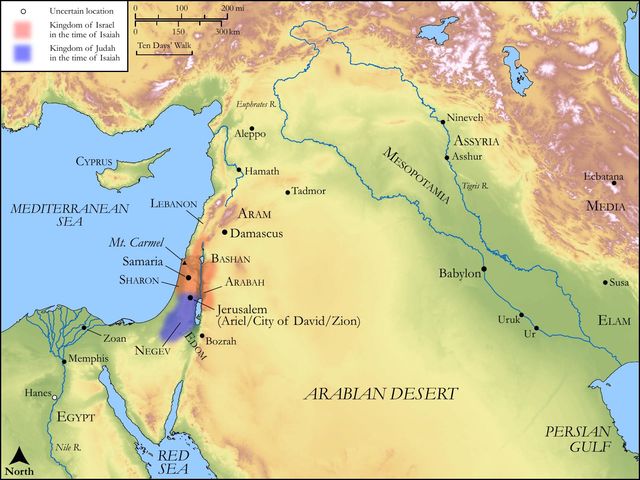
See on the biblical-era map
Study this verse
Public-domain commentary
Matthew Henry
From his Commentary on the Whole Bible. Henry comments on passages, not single verses — this entry covers Isaiah 33:13–24. His three-level outline is real structure in the source text, so it is rendered as structure.
Here is a preface that commands attention; and it is fit that all should attend, both near and afar off, to what God says and does (Isa 33:13): Hear, you that are afar off, whether in place or time. Let distant regions and future ages hear what God has done. They do so; they will do so from the scripture, with as much assurance as those that were near, the neighbouring nations and those that lived at that time. But whoever hears what God has done, whether near or afar off, let them acknowledge his might, that it is irresistible, and that he can do every thing. Those are very stupid who hear what God has done and yet will not acknowledge his might. Now what is it that God has done which we must take notice of, and in which we must acknowledge his might?
I.He has struck a terror upon the sinners in Zion (Isa 33:14):
Fearfulness has surprised the hypocrites. There are sinners in Zion, hypocrites, that enjoy Zion's privileges and concur in Zion's services, but their hearts are not right in the sight of God; they keep up secret haunts of sin under the cloak of a visible profession, which convicts them of hypocrisy. Sinners in Zion will have a great deal to answer for above other sinners; and their place in Zion will be so far from being their security that it will aggravate both their sin and their punishment. Now those sinners in Zion, though always subject to secret frights and terrors, were struck with a more than ordinary consternation from the convictions of their own consciences.
1.When they saw the Assyrian army besieging Jerusalem, and ready to set fire to it and lay it in ashes, and burn the wasps in the nest. Finding they could not make their escape to Egypt, as some had done, and distrusting the promises God had made by his prophets that he would deliver them, they were at their wits' end, and ran about like men distracted, crying, "Who among us shall dwell with devouring fire? Let us therefore abandon the city, and shift for ourselves elsewhere; one had as good live in everlasting burnings as live here." Who will stand up for us against this devouring fire? so some read it. See here how the sinners in Zion are affected when the judgments of God are abroad; while they were only threatened they slighted them and made nothing of them; but, when they come to be executed, they run into the other extreme, then they magnify them, and make the worst of them; they call them devouring fire and everlasting burnings, and despair of relief and succour. Those that rebel against the commands of the word cannot take the comforts of it in a time of need. Or, rather,
2.When they saw the Assyrian army destroyed; for the destruction of that is the fire spoken of immediately before, Isa 33:11, Isa 33:2. When the sinners in Zion saw what dreadful execution the wrath of God made they were in a great fright, being conscious to themselves that they had provoked this God by their secretly worshipping other gods; and therefore they cry out, Who among us shall dwell with this devouring fire, before which so vast an army is as thorns? Who among us shall dwell with these everlasting burnings, which have made the Assyrians as the burnings of lime? Isa 33:12. Thus they said, or should have said. Note, God's judgments upon the enemies of Zion should strike a terror upon the sinners in Zion, nay, David himself trembles at them, Psa 119:120. God himself is this devouring fire, Heb 12:29. Who is able to stand before him? Sa1 6:20. His wrath will burn those everlastingly that have made themselves fuel for it. It is a fire that shall never be quenched, nor will ever go out of itself; for it is the wrath of an everlasting God preying upon the conscience of an immortal soul. Nor can the most daring sinners bear up against it, so as to bear either the execution of it or the fearful expectation of it. Let this awaken us all to flee from the wrath to come, by fleeing to Christ as our refuge.
II.He has graciously provided for the security of his people that trust in him:
Hear this, and acknowledge his power in making those that walk righteously, and speak uprightly, to dwell on high, Isa 33:15, Isa 33:16. We have here,
1.The good man's character, which he preserves even in times of common iniquity, in divers instances.
(1.)He walks righteously. In the whole course of his conversation he acts by rules of equity, and makes conscience of rendering to all their due, to God his due, as well as to men theirs. His walk is righteousness itself; he would not for a world wilfully do an unjust thing.
(2.)He speaks uprightly, uprightnesses (so the word is); he speaks what is true and right, and with an honest intention. He cannot think one thing and speak another, nor look one way and row another. His word is to him as sacred as his oath, and is not yea and nay.
(3.)He is so far from coveting ill-gotten gain that he despises it. He thinks it a mean and sordid thing, and unbecoming a man of honour, to enrich himself by any hardship put upon his neighbour. He scorns to do a wrong thing, nay, to do a severe thing, though he might get by it. He does not over-value gain itself, and therefore easily abhors the gain that is not honestly come by.
(4.)If he have a bribe at any time thrust into his hand, to pervert justice, he shakes his hands from holding it, with the utmost detestation, taking it as an affront to have it offered him.
(5.)He stops his ears from hearing any thing that tends to cruelty or bloodshed, or any suggestions stirring him up to revenge, Job 31:31. He turns a deaf ear to those that delight in war and entice him to cast in his lot among them, Pro 1:14, Pro 1:16.
(6.)He shuts his eyes from seeing evil. He has such an abhorrence of sin that he cannot bear to see others commit it, and does himself watch against all the occasions of it. Those that would preserve the purity of their souls must keep a strict guard upon the senses of their bodies, must stop their ears to temptations, and turn away their eyes from beholding vanity.
2.The good man's comfort, which he may preserve even in times of common calamity, Isa 33:16.
(1.)He shall be safe; he shall escape the devouring fire and the everlasting burnings; he shall have access to, and communion with, that God who is a devouring fire, but shall be to him a rejoicing light. And, as to present troubles, he shall dwell on high, out of the reach of them, nay, out of the hearing of the noise of them; he shall not be really harmed by them, nay, he shall not be greatly frightened at them: The floods of great waters shall not come nigh him; or, if they should attack him, his place of defence shall be the munitions of rocks, strong and impregnable, fortified by nature as well as art. The divine power will keep him safe, and his faith in that power will keep him easy. God, the rock of ages, will be his high tower.
(2.)He shall be supplied; he shall want nothing that is necessary for him: Bread shall be given him, even when the siege is straitest and provisions are cut off; and his waters shall be sure, that is, he shall be sure of the continuance of them, so that he shall not drink his water by measure and with astonishment. Those that fear the Lord shall not want any thing that is good for them.
III.He will protect Jerusalem, and deliver it out of the hands of the invaders.
This storm that threatened them should blow over, and they should enjoy a prosperous state again. Many instances are here given of this prosperity.
1.Hezekiah shall put off his sackcloth and all the sadness of his countenance, and shall appear publicly in his beauty, in his royal robes and with a pleasing aspect (Isa 33:17), to the great joy of all his loving subjects. Those that walk uprightly shall not only have bread given them, and their water sure, but they shall with an eye of faith see the King of kings in his beauty, the beauty of holiness, and that beauty shall be upon them.
2.The siege being raised, by which they were kept close within the walls of Jerusalem, they shall now be at liberty to go abroad upon business or pleasure without danger of falling into the enemies' hand: They shall behold the land that is very far off; they shall visit the utmost corners of the nation, and take a prospect of the adjacent countries, which will be the more pleasant after so long a confinement. Thus believers behold the heavenly Canaan, that land that is very far off, and comfort themselves with the prospect of it in evil times.
3.The remembrance of the fright they were in shall add to the pleasure of their deliverance (Isa 33:18): Thy heart shall meditate terror, meditate it with pleasure when it is over. Thou shalt think thou still hearest the alarm in thy ears, when all the cry was, "Arm, arm, arm! every man to his post. Where is the scribe or secretary of war? Let him appear to draw up the muster-roll. Where is the receiver and pay-master of the army? Let him see what he had in bank, to defray the charge of a defence. Where is he that counted the towers? Let him bring in the account of them, that care may be taken to put a competent number of men in each." Or these words may be taken as Jerusalem's triumph over the vanquished army of the Assyrians, and the rather because the apostle alludes to them in his triumphs over the learning of this world, when it was baffled by the gospel of Christ, Co1 1:20. The virgin, the daughter of Zion, despises all their military preparations. Where is the scribe or muster-master of the Assyrian army? Where is their weigher (or treasurer), and where are their engineers that counted the towers? They are all either dead or fled. There is an end of them.
4.They shall no more be terrified with the sight of the Assyrians, who were a fierce people naturally, and were particularly fierce against the people of the Jews, and were of a strange language, that could understand neither their petitions nor their complaints, and therefore had a pretence for being deaf to them, nor could themselves be understood: "They are of a deeper speech than thou canst perceive, which will make them the more formidable, Isa 33:19. Thy eyes shall no more see them thus fierce, but their countenances changed when they shall all become dead corpses."
5.They shall no more be under apprehensions of the danger of Jerusalem-Zion, and the temple there (Isa 33:20): "Look upon Zion, the city of our solemnities, the city where our solemn sacred feasts are kept, where we used to meet to worship God in religious assemblies." The good people among them, in the time of their distress, were most in pain for Zion upon this account, that it was the city of their solemnities, that the conquerors would burn their temple and they should not have that to keep their solemn feasts in any more. In times of public danger our concern should be most about our religion, and the cities of our solemnities should be dearer to us than either our strong cities or our store-cities. It is with an eye to this that God will work deliverance for Jerusalem, because it is the city of religious solemnities: let those be conscientiously kept up, as the glory of a people, and we may depend upon God to create a defence upon that glory. Two things are here promised to Jerusalem: - (1.) A well-grounded security. It shall be a quiet habitation for the people of God; they shall not be molested and disturbed, as they have been, by the alarms of the sword either of war or persecution, Isa 29:20. It shall be a quiet habitation, as it is the city of our solemnities. It is desirable to be quiet in our own houses, but much more so to be quiet in God's house and have none to make us afraid there. Thus it shall be with Jerusalem; and the eyes shall see it, which will be a great satisfaction to a good man, Psa 128:5, Psa 128:6. "Thou shalt see the good of Jerusalem, and peace upon Israel; thou shalt live to see it and share in it." (2.) An unmoved stability. Jerusalem, the city of our solemnities, is indeed but a tabernacle, in comparison with the New Jerusalem. The present manifestations of the divine glory and grace are nothing in comparison with those that are reserved for the future state. But it is such a tabernacle as shall not be taken down. After this trouble is over Jerusalem shall long enjoy a confirmed peace; and her sacred privileges, which are the stakes and cords of her tabernacle, shall not be removed from her, nor any disturbance given to the course and circle of her religious services. God's church on earth is a tabernacle, which, though it may be shifted from one place to another, shall not be taken down while the world stands; for in every age Christ will have a seed to serve him. The promises of the covenant are its stakes, which shall never be removed, and the ordinances and institutions of the gospel are its cords, which shall never be broken. They are things which cannot be shaken, though heaven and earth be, but shall remain.
6.God himself will be their protector and Saviour, Isa 33:21, Isa 33:22. This the principal ground of their confidence: "He that is himself the glorious Lord will display his glory for us and be a glory to us, such as shall eclipse the rival-glory of the enemy." God, in being a gracious Lord, is a glorious Lord; for his goodness is his glory. God will be the Saviour of Jerusalem and her glorious Lord,
(1.)As a guard against their adversaries abroad. He will be a place of broad rivers and streams. Jerusalem had no considerable river running by it, as most great cities have, nothing but the brook Kidron, and so wanted one of the best natural fortifications, as well as one of the greatest advantages for trade and commerce, and upon this account their enemies despised them and doubted not but to make an easy prey of them; but the presence and power of God are sufficient at any time to make up to us the deficiencies of the creature and of its strength and beauty. We have all in God, all we need or can desire. Many external advantages Jerusalem has not which other places have, but in God there is more than an equivalent. But, if there be broad rivers and streams about Jerusalem, may not these yield an easy access to the fleet of an invader? No; these are rivers and streams in which shall go no galley with oars, no man of war or gallant ship. If God himself be the river, it must needs be inaccessible to the enemy; they can neither find nor force their way by it.
(2.)As a guide to their affairs at home: "For the Lord is our Judge, to whom we are accountable, to whose judgment we refer ourselves, by whose judgment we abide, and who therefore (we hope) will judge for us. He is our lawgiver; his word is a law to us, and to him every thought within us is brought into obedience. He is our King, to whom we pay homage and tribute, and an inviolable allegiance, and therefore he will save us." For, as protection draws allegiance, so allegiance may expect protection, and shall have it with God. By faith we take Christ for our prince and Saviour, and as such depend upon him and devote ourselves to him. Observe with what an air of triumph, and with what an emphasis laid upon the glorious name of God, they comfort themselves with this: Jehovah is our Judge, Jehovah is our Lawgiver, Jehovah is our King, who, being self-existent, is self-sufficient, and all-sufficient to us.
7.The enemies shall be quite infatuated, and all their powers and projects broken, like a ship at sea in stress of weather, that cannot ride out the storm, but having her tackle torn, her masts split, and nothing wherewith to repair them, is given up for a wreck, Isa 33:23. The tacklings of the Assyrian are loosed; they are like a ship whose tacklings are loose, or forsaken by the ship's crew, when they give it over for lost, finding that they cannot strengthen the mast, but it will come down. They thought themselves sure of Jerusalem; but when they were just entering the port as it were, and though all was their own, they were quite becalmed, and could not spread their sail, but lay wind-bound till God poured the fury of his wrath upon them. The enemies of God's church are often disarmed and unrigged when they think they have almost gained their point.
8.The wealth of their camp shall be a rich booty for the Jews: Then is the prey of a great spoil divided. When the greater part were slain the rest fled in confusion, and with such precipitation that (like the Syrians) they left their tents as they were, so that all the treasure in them fell into the hands of the besieged; and even the lame take the prey. Those that tarried at home did divide the spoil. It was so easy to come at that not only the strong man might make himself master of it, but even the lame man, whose hands were lame, that he could not fight, and his feet, that he could not pursue. As the victory shall cost them no peril, so the prey shall cost them no toil. And there was such abundance of it that when those who were forward, and came first, had carried off as much as they would, even the lame, who came late, found sufficient. Thus God brought good out of evil, and not only delivered Jerusalem, but enriched it, and abundantly recompensed the losses they had sustained. Thus comfortably and well do the frights and distresses of the people of God often end.
9.Both sickness and sin shall be taken away; and then sickness is taken away in mercy when this is all the fruit of it, and the recovery from it, even the taking away of sin.
(1.)The inhabitant shall not say, I am sick. As the lame shall take the prey, so shall the sick, notwithstanding their weakness, make a shift to get to the abandoned camp and seize something for themselves; or there shall be such a universal transport of joy upon this occasion that even the sick shall, for the present, forget their sickness and the sorrows of it, and join with the public in its rejoicings; the deliverance of their city shall be their cure. Or it intimates that, whereas infectious diseases are commonly the effect of long sieges, it shall not be so with Jerusalem, but the inhabitants of it with their victory and peace shall have health also, and there shall be no complaining upon the account of sickness within their gates. Or those that are sick shall bear their sickness without complaining as long as they see it goes well with Jerusalem. Our sense of private grievances should be drowned in our thanksgivings for public mercies.
(2.)The people that dwell therein shall be forgiven their iniquity, not only the body of the nation forgiven their national guilt in the removing of the national judgment, but particular persons, that dwell therein, shall repent, and reform, and have their sins pardoned. And this is promised as that which is at the bottom of all other favours; he will do so and so for them, for he will be merciful to their unrighteousness, Heb 8:12. Sin is the sickness of the soul. When God pardons the sin he heals the disease; and, when the diseases of sin are healed by pardoning mercy, the sting of bodily sickness is taken out and the cause of it removed; so that either the inhabitant shall not be sick or at least shall not say, I am sick. If iniquity be taken away, we have little reason to complain of outward affliction. Son, be of good cheer; thy sins are forgiven thee.
Historical interpretation
Historical reception
1 surviving comment on this verse from the historical church.
(Verse 20 and following) Look upon Zion, the city of our solemnity: your eyes shall see Jerusalem, a wealthy habitation: a tabernacle that cannot be moved, and its nails shall not be taken away forever, and all its cords shall not be broken. For our Lord is only magnificent there: a place of wide and open rivers, no ship of rowers shall pass through it: nor shall any great trireme pass over it. For the Lord is our judge, the Lord is our lawgiver, the Lord is our king, he will save us. Your ropes are loosened, and they will not prevail; so will be your evil, that you cannot extend your sign. Then the spoils of many spoils will be divided: the lame will plunder the prey. And the neighbor will not say: I am faint: the people who dwell in it will be taken away by iniquity. LXX: Behold, Zion is a city of our salvation: your eyes will see Jerusalem. A wealthy city, immovable dwellings: its tent pegs will not be taken away forever, and its cords will not be torn apart. For the name of the Lord is great for you: your place will be wide and spacious rivers and streams: no ship propelled by oars will enter through it. For my God, the Lord, is great: the Lord our judge will not pass over me, the Lord our leader, the Lord our king, the Lord Himself will save us. Your cables have been disrupted (or plundered), because they did not prevail: your evil is bent, to let out the sails: it will not raise the sign, until it is delivered into desolation. Therefore, many will make booty of the closed goods: and the people who inhabit them will not say, I will labor, their offense will be forgiven. O just one, to whom it has been said above: your heart will meditate fear; and you will not see the unwise (or impudent) people; and those whom you have heard before, your eyes will see the king in his beauty, contemplate the city of our solemnity, see the Church of Christ, in which the true solemnity is; your eyes will behold the vision of peace, and the unexpected riches, which the eye has not seen, nor the ear heard, nor have they ascended into the heart of man, and the tabernacle that cannot be transferred. For first the tabernacle which had the people of the Jews was translated and lifted up. Neither shall the nails thereof be moved forever, and all the cords thereof shall be strong; so that the Lord may dwell in it, who is the place of all flowing rivers and running streams, through which no one of the adverse party shall be able to sail: neither shall the great trireme, which is interpreted the devil, be able to pass over it: for the Lord himself is the judge, and prince, and king, and our Savior, and under his protection we shall fear no ambushes of any kind. These things are said about the city of our solemnity, about Jerusalem, the richest dwelling place, which the Lord himself will surround and fortify with his rivers. But now he speaks to earthly Jerusalem, because the cords of her tent have been loosened and they are unable to support the tent, and her mast, on which once hung the most beautiful sails, has fallen with the cords broken, so that she is not only unfit for sailing, but also marked by a mutilation. But after their ship has been destroyed and their tent scattered, so that the ropes are torn on both sides, the spoils will be divided to the victors: those who are so weak in their own strength that they are called cripples; and yet, with God's wrath giving them strength, they will not feel any weakness, nor will they say 'I have labored.' For whoever is among them, injustice and sin will be taken away from him, for he has carried out God's will.
Continue studying Isaiah 33:24 across the web’s major study libraries — every link below opens this exact verse, chapter, or book on the destination site.
Read & Compare
 BibleGatewayThis verse in more than 200 translations and 70 languages.
 Bible.comThe YouVersion reader — hundreds of translations, reading plans, and highlights.
 ESV.orgCrossway's official English Standard Version reader.
 NET BibleThe NET translation with 60,000+ translators' notes on every rendering decision.
 STEP BibleTyndale House's free study tool — original text, vocabulary, and scholarly resources.
 BibliaLogos Bible Software's free web reader.
 USCCBThe New American Bible (Revised Edition) with the U.S. bishops' study notes.
Commentaries
 BibleHub CommentariesDozens of classic commentaries on this verse, gathered on one page.
 StudyLightMore than 100 commentary sets — the largest collection on the web.
 BibleRefPlain-English commentary on what this verse means, verse by verse.
 Enduring WordDavid Guzik's free commentary on this chapter, widely used by Bible teachers.
 Bible Study ToolsVerse commentary alongside Greek and Hebrew study aids.
Original Language & Research
- BibleHub InterlinearThe verse word by word — original language, transliteration, and English.
- BibleHub LexiconEvery word's original-language definition and Strong's entry.
 Blue Letter BibleDeep-study tools — Strong's numbers, concordance, and word studies.
 SefariaThe Hebrew text with Rashi and centuries of Jewish commentary.
Sermons, Hymns & Audio


TrulyRandomVerse is not affiliated with these sites and doesn’t control their content. They’re linked because they’re genuinely useful.
Summary
Isaiah 33:24 delivers a profound prophetic vision of holistic restoration for God's people in the eschatological age. It declares a future state of complete well-being, where physical infirmity is entirely absent, and, most significantly, where spiritual iniquity is fully pardoned. This verse encapsulates the blessed conditions of Zion under divine rule, emphasizing that true health, peace, and security are inextricably linked to a reconciled and pardoned relationship with God, culminating in a comprehensive redemption that addresses both the physical and spiritual dimensions of human existence.
Context
ShowHideLiterary Context
Isaiah 33 is strategically placed within the book of Isaiah, marking a powerful transition from prophecies of impending judgment and divine wrath to glorious visions of God's ultimate deliverance and the establishment of His righteous kingdom. The chapter opens with a fervent lament and a "woe" against the treacherous Assyrian oppressor, reflecting the desperate situation of Judah. Following this, a prayer for divine intervention (verses 2-6) gives way to a magnificent affirmation of God's majestic power, His unwavering faithfulness, and His commitment to His covenant people (verses 7-16). Verses 17-23 vividly describe the future security and prosperity of Zion, portraying the king in his beauty, the expansive land, and the complete absence of any formidable enemy. This idyllic scene sets the stage for the culminating promise of holistic well-being in verse 24, which describes the perfect state of those dwelling securely in God's presence, finally free from the curses of sin and sickness that plague the present age. The verse functions as a capstone, summarizing the comprehensive nature of God's redemptive work.
Historical & Cultural Context
The prophecies in Isaiah, particularly those leading up to chapter 33, are deeply rooted in the historical realities of 8th-century BCE Judah, specifically during the reign of King Hezekiah. The nation faced immense existential pressure from the encroaching Assyrian Empire, most notably Sennacherib's invasion. Beyond external military threats, Judah also grappled with internal spiritual decay and unfaithfulness. In this context of fear and uncertainty, the promises of divine protection, healing, and forgiveness found in Isaiah 33:24 would have offered immense comfort and profound hope. In Israel and among the nations round about, sickness was frequently perceived as a direct consequence of divine displeasure or a manifestation of sin, while health and prosperity were understood as clear indicators of divine favor and blessing. Thus, the radical promise of freedom from sickness and the complete forgiveness of iniquity directly addresses the core anxieties and deeply held theological understandings of the time, pointing to a dramatic reversal of their current suffering and a restoration of their relationship with their covenant God.
Key Themes
ShowHideIsaiah 33:24 powerfully contributes to several overarching themes woven throughout the book of Isaiah. It highlights the theme of Divine Sovereignty and Deliverance, demonstrating God's ultimate control over history and His unparalleled power to redeem His people from all forms of oppression, both physical and spiritual, as evidenced by His mighty acts of salvation described earlier in the chapter (e.g., Isaiah 33:10-12). The verse also underscores the profound theme of Holistic Restoration and Wholeness (Shalom), portraying a future where God's people experience complete well-being, encompassing both physical health ("shall not say, I am sick") and spiritual reconciliation ("shall be forgiven their iniquity"). This vision of Eschatological Hope is central, pointing forward to a future Messianic age or the new creation, where the devastating effects of the Fall are fully undone, a hope echoed in passages like Isaiah 65:17-25 and Isaiah 25:8. Finally, the verse profoundly emphasizes the Primacy of Forgiveness, revealing that the eradication of sickness is presented as a direct consequence of the removal of sin, thereby establishing forgiveness as the foundational blessing from which all other forms of restoration flow, a concept deeply explored in Psalm 103:2-3.
Exposition and Analysis
ShowHideKey Word Analysis
ShowHideA primitive root meaning properly "to be rubbed or worn," and figuratively "to be weak, sick, afflicted." It can also denote grieving, being diseased, or experiencing infirmity. Its negation in this verse ("shall not say, I am sick") signifies a complete absence of physical weakness, illness, or distress. This points to a state of perfect health and vitality, free from the debilitating effects of disease that characterize the fallen world, implying a comprehensive restoration of physical well-being.
A primitive root meaning "to sit down," and by implication, "to dwell" or "to remain." It conveys a profound sense of settledness, permanence, and security. In the context of the verse, "the people that dwell therein" refers to those who are securely established in God's presence, indicating a permanent and blessed residency in His kingdom where these promises are fully realized. This suggests a stable and enduring relationship with God, free from displacement or fear.
A primitive root meaning "to lift," "to bear," or "to take away." In a theological sense, it signifies to "pardon" or "forgive." The passive voice "shall be forgiven" emphasizes that this is a divine act, God Himself lifting the burden of sin from His people. This forgiveness is not merely an overlooking of sin but a complete removal of its guilt and penalty, leading to a profound state of spiritual peace, reconciliation, and freedom from condemnation.
Meaning "perversity," "moral evil," "fault," or "sin." It also encompasses the punishment or consequences for sin. The promise that this "iniquity" shall be forgiven highlights the comprehensive nature of God's pardon, addressing the root cause of human suffering, alienation, and separation from God. It signifies the complete removal of guilt, condemnation, and the destructive consequences of moral transgression, leading to a state of pure righteousness before God.
Verse Breakdown
ShowHide"And the inhabitant shall not say, I am sick:"
This clause presents a radical and transformative vision of physical well-being. It speaks to a future state where physical infirmity, chronic disease, and the experience of pain are entirely absent. The active declaration "I am sick" is negated, indicating that the very concept or experience of sickness will be utterly foreign to those dwelling in this blessed state. It implies a complete and perfect restoration of the physical body, free from the debilitating effects of the Fall, signifying an end to all physical suffering.
"the people that dwell therein shall be forgiven their iniquity."
This second clause reveals the foundational and theological reason for the physical restoration promised in the first. The eradication of sickness is presented not as an isolated blessing but as a direct consequence of the complete forgiveness of sin. "Iniquity" (Hebrew: ʻâvôn) encompasses both the moral evil itself and its pervasive consequences. The passive voice "shall be forgiven" underscores that this is a divine act of sovereign grace; God Himself removes the guilt, penalty, and power of sin from His people. This spiritual pardon is the ultimate source of their holistic health and peace, establishing a reconciled relationship with God as the indispensable basis for all other blessings, including physical wholeness.
Literary Devices
ShowHideIsaiah 33:24 employs several powerful literary devices to convey its profound message of ultimate restoration and divine blessing. The most prominent is Parallelism, specifically Synthetic Parallelism, where the second clause ("the people that dwell therein shall be forgiven their iniquity") expands upon and explains the first ("And the inhabitant shall not say, I am sick"). This structure highlights the profound theological connection between spiritual forgiveness and physical well-being, indicating that the absence of sickness is a direct and necessary result of the removal of sin. The verse also utilizes Hyperbole or Idealization to depict a perfect future state, as the complete and utter absence of sickness is an ultimate, eschatological reality that transcends current human experience. Furthermore, the language is rich in Eschatological Language, pointing towards a future, ideal kingdom of God where the devastating effects of the Fall are fully undone, and humanity experiences complete shalom (peace, wholeness, flourishing) in His presence. The phrases "the inhabitant" and "the people that dwell therein" also serve as Synecdoche, where a part (the individual inhabitants) represents the whole (the community of God's redeemed people), emphasizing that this comprehensive blessing extends to every member of the covenant community.
Theological and Thematic Connections
ShowHideIsaiah 33:24 offers a profound theological statement about God's ultimate redemptive plan, presenting a future where the pervasive consequences of sin—both spiritual alienation and physical brokenness—are completely undone. It establishes an intrinsic and direct link between spiritual pardon and physical wholeness, asserting that true and lasting health and well-being flow fundamentally from a reconciled relationship with God. This vision anticipates a comprehensive restoration where God's active presence brings not only security and peace but also the complete eradication of suffering and the full, unreserved forgiveness of all iniquity. It speaks powerfully to the holistic nature of God's salvation, demonstrating His intent to address the human condition in its entirety, from the deepest spiritual brokenness to the most tangible physical ailments, culminating in a state of perfect shalom.
Reflection and Application
ShowHideIsaiah 33:24 serves as a brilliant beacon of hope and a profound source of comfort for believers navigating a world still profoundly marked by suffering, sickness, and sin. It reminds us that God's ultimate plan is one of complete and comprehensive restoration, addressing the deepest spiritual needs of forgiveness and the most tangible physical needs of healing. While we presently experience the brokenness of a fallen world, this verse assures us of a glorious future where all tears will be wiped away, all pain eradicated, and all iniquity pardoned. It challenges us to recognize that true and lasting well-being is fundamentally rooted in our relationship with God and His gracious, unmerited act of forgiveness. This powerful promise encourages us to live with eager anticipation for the day when God's kingdom is fully realized in its consummation, and to trust in His redemptive power even amidst present trials and afflictions, knowing that His ultimate victory includes our holistic healing and spiritual liberation from the bondage of sin. It cultivates a deep gratitude for the forgiveness we have now and a longing for the complete redemption to come.
Questions for Reflection
ShowHideFAQ
ShowHideDoes Isaiah 33:24 promise that believers will never get sick in this life?
ShowHideNo, Isaiah 33:24 is an eschatological promise, meaning it points to a future, ultimate fulfillment in God's perfected kingdom, often understood as the Messianic age or the new heavens and new earth. While God certainly can and does heal in the present age, and believers can experience divine healing, this verse describes a state of permanent, comprehensive well-being where sickness is entirely absent, which is not fully realized in our current fallen world. It is a prophetic vision of the ideal, perfected conditions that will prevail when God's redemptive work is complete, and the effects of sin are entirely undone. We still experience sickness and death in this life, but this verse assures us of a glorious future free from such afflictions, as described in Revelation 21:4.
What is the relationship between forgiveness and healing in this verse?
ShowHideIsaiah 33:24 establishes a profound and direct relationship between spiritual forgiveness and physical healing. The verse places the forgiveness of iniquity as the foundational blessing that leads to the absence of sickness. In biblical thought, particularly in the Old Testament, sickness was often seen as a consequence of sin or a sign of spiritual brokenness and alienation from God. Therefore, the promise that "the people that dwell therein shall be forgiven their iniquity" is presented as the prerequisite and ultimate cause for the declaration that "the inhabitant shall not say, I am sick." This highlights God's holistic approach to redemption, where spiritual reconciliation is the ultimate source of complete well-being, addressing the root cause of human suffering and separation from God. This intrinsic connection is also powerfully evident in passages like Psalm 103:3, which links forgiveness and healing directly.
Christ-Centered Fulfillment
ShowHideIsaiah 33:24 finds its ultimate and most profound fulfillment in the person and redemptive work of Jesus Christ. The prophetic promise of a future where "the inhabitant shall not say, I am sick" and where "the people that dwell therein shall be forgiven their iniquity" is inaugurated through Christ's atoning sacrifice and will be consummated in His glorious return and the establishment of His eternal kingdom. Jesus, the Lamb of God who takes away the sin of the world, bore our iniquities on the cross, making complete and perfect forgiveness possible for all who believe (1 Peter 2:24). His death and resurrection fundamentally broke the power of sin, which is the root cause of all human brokenness, including sickness, suffering, and death (Romans 6:23). Furthermore, Christ's earthly ministry was characterized by both the authoritative forgiveness of sins and miraculous physical healings, demonstrating His divine authority over both spiritual and physical ailments, as seen in the healing of the paralytic where He first declared, "Son, your sins are forgiven" before commanding him to walk. While the full eradication of sickness and death awaits His glorious return and the new heavens and new earth (Revelation 21:4), believers now experience the down payment and foretaste of this future reality through the indwelling Holy Spirit and the spiritual healing that comes from being declared righteous and reconciled to God in Christ (Ephesians 1:13-14). Thus, Isaiah 33:24 points directly to Jesus as the Messiah who brings ultimate forgiveness and, consequently, the sure promise of a future free from all sickness, sorrow, and the effects of sin, ushering in an era of perfect shalom.