


Revelation 2:23
- καὶkaiAndG2532CONJConjunction
- τὰtatheG3588T-APNDefinite article Accusative Plural Neuter
- τέκναteknachildrenG5043N-APNNoun Accusative Plural Neuter
- αὐτῆςautēsof herG846P-GSFPersonal pronoun Genitive Singular Feminine
- ἀποκτενῶapoktenōI will killG615V-FAI-1SVerb Future Active Indicative 1st Singular
- ἐνenwithG1722PREPPreposition
- θανάτῳthanatōdeathG2288N-DSMNoun Dative Singular Masculine
- καὶkaiandG2532CONJConjunction
- γνώσονταιgnōsontaiwill knowG1097V-FDI-3PVerb Future Middle Deponent Indicative 3rd Plural
- πᾶσαιpasaiallG3956A-NPFAdjective Nominative Plural Feminine
- αἱhaitheG3588T-NPFDefinite article Nominative Plural Feminine
- ἐκκλησίαιekklēsiaichurchesG1577N-NPFNoun Nominative Plural Feminine
- ὅτιhotithatG3754CONJConjunction
- ἐγώegōI myselfG1473P-1NSPersonal pronoun Nominative 1st Singular
- εἰμιeimiamG1510V-PAI-1SVerb Present Active Indicative 1st Singular
- ὁhothe [One]G3588T-NSMDefinite article Nominative Singular Masculine
- ἐραυνῶνeraunōnsearchingG2045V-PAP-NSMVerb Present Active Participle Nominative Singular Masculine
- νεφροὺςnephrousaffectionsG3510N-APMNoun Accusative Plural Masculine
- καὶkaiandG2532CONJConjunction
- καρδίαςkardiasheartsG2588N-APFNoun Accusative Plural Feminine
- καὶkaiandG2532CONJConjunction
- δώσωdōsōI will giveG1325V-FAI-1SVerb Future Active Indicative 1st Singular
- ὑμῖνhuminof youG4771P-2DPPersonal pronoun Dative 2nd Plural
- ἑκάστῳhekastōto eachG1538A-DSMAdjective Dative Singular Masculine
- κατὰkataaccording toG2596PREPPreposition
- τὰtatheG3588T-APNDefinite article Accusative Plural Neuter
- ἔργαergaworksG2041N-APNNoun Accusative Plural Neuter
- ὑμῶνhumōnof youG4771P-2GPPersonal pronoun Genitive 2nd Plural
English is a literal word-by-word gloss of the Greek, not the KJV's wording. Why?
This is the original text the KJV's translators worked from — each Greek word with its own literal English meaning in this verse, prepared by scholars at Tyndale House, Cambridge. The KJV translates whole sentences, not word by word, so its wording differs: one Greek word can become several English words, and the KJV may choose “charity” where the gloss reads “love”. Both are faithful — they answer different questions. For the KJV's own rendering, switch to the KJV text.
Details
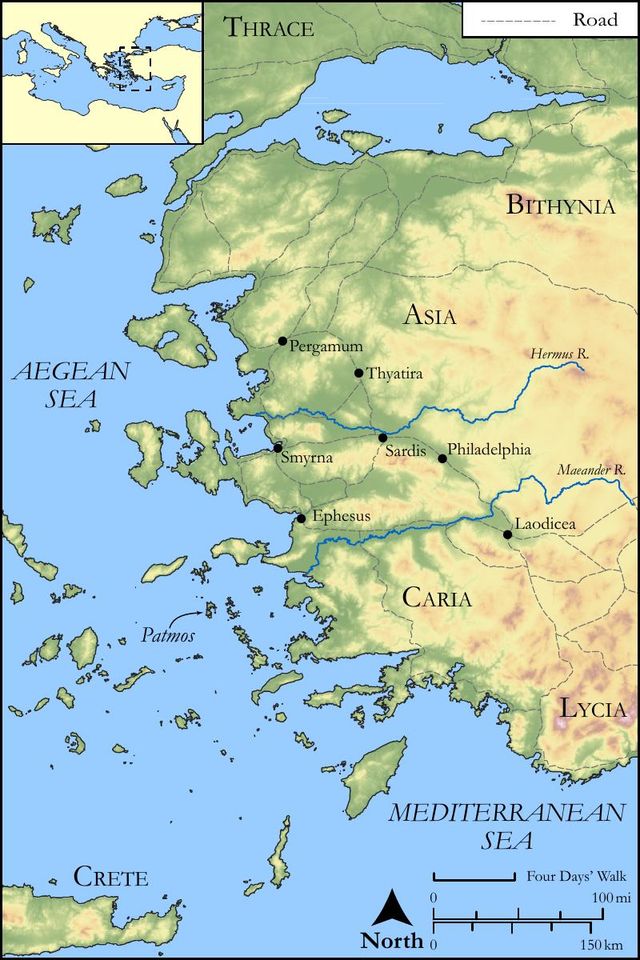
See on the biblical-era map

Study this verse
Public-domain commentary
Matthew Henry
From his Commentary on the Whole Bible. Henry comments on passages, not single verses — this entry covers Revelation 2:18–29. His three-level outline is real structure in the source text, so it is rendered as structure.
The form of each epistle is very much the same; and in this, as the rest, we have to consider the inscription, contents, and conclusion.
I.The inscription, telling us,
1.To whom it is directed: To the angel of the church of Thyatira, a city of the proconsular Asia, bordering upon Mysia on the north and Lydia on the south, a town of trade, whence came the woman named Lydia, a seller of purple, who, being at Philippi in Macedonia, probably about the business of her calling, heard Paul preach there, and God opened her heart, that she attended to the things that were spoken, and believed, and was baptized, and entertained Paul and Silas there. Whether it was by her means that the gospel was brought into her own city, Thyatira, is not certain; but that it was there, and successful to the forming of a gospel church, this epistle assures us.
2.By whom it was sent: by the Son of God, who is here described as having eyes like a flame of fire, and feet like as fine brass. His general title is here, the Son of God, that is, the eternal and only-begotten Son of God, which denotes that he has the same nature with the Father, but with a distinct and subordinate manner of subsistence. The description we have here of him is in two characters: - (1.) That his eyes are like a flame of fire, signifying his piercing, penetrating, perfect knowledge, a thorough insight into all persons and all things, one who searches the hearts and tries the reins of the children of men (Rev 2:23), and will make all the churches to know he does so. (2.) That his feet are like fine brass, that the outgoings of his providence are steady, awful, and all pure and holy. As he judges with perfect wisdom, so he acts with perfect strength and steadiness.
II.The contents or subject-matter of this epistle, which, as the rest, includes,
1.The honourable character and commendation Christ gives of this church, ministry, and people; and this given by one who was no stranger to them, but well acquainted with them and with the principles from which they acted. Now in this church Christ makes honourable mention,
(1.)Of their charity, either more general, a disposition to do good to all men, or more special, to the household of faith: there is no religion where there is no charity.
(2.)Their service, their ministration; this respects chiefly the officers of the church, who had laboured in the word and doctrine.
(3.)Their faith, which was the grace that actuated all the rest, both their charity and their service.
(4.)Their patience; for those that are most charitable to others, most diligent in their places, and most faithful, must yet expect to meet with that which will exercise their patience.
(5.)Their growing fruitfulness: their last works were better than the first. This is an excellent character; when others had left their first love, and lost their first zeal, these were growing wiser and better. It should be the ambition and earnest desire of all Christians that their last works may be their best works, that they may be better and better every day, and best at last.
2.A faithful reproof for what was amiss. This is not so directly charged upon the church itself as upon some wicked seducers who were among them; the church's fault was that she connived too much at them.
(1.)These wicked seducers were compared to Jezebel, and called by her name. Jezebel was a persecutor of the prophets of the Lord, and a great patroness of idolaters and false prophets. The sin of these seducers was that they attempted to draw the servants of God into fornication, and to offer sacrifices to idols; they called themselves prophets, and so would claim a superior authority and regard to the ministers of the church. Two things aggravated the sin of these seducers, who, being one in their spirit and design, are spoken of as one person: - [1.] They made use of the name of God to oppose the truth of his doctrine and worship; this very much aggravated their sin. [2.] They abused the patience of God to harden themselves in their wickedness. God gave them space for repentance, but they repented not. Observe, First, Repentance is necessary to prevent a sinner's ruin. Secondly, Repentance requires time, a course of time, and time convenient; it is a great work, and a work of time. Thirdly, Where God gives space for repentance, he expects fruits meet for repentance. Fourthly, Where the space for repentance is lost, the sinner perishes with a double destruction.
(2.)Now why should the wickedness of this Jezebel be charged upon the church of Thyatira? Because that church suffered her to seduce the people of that city. But how could the church help it? They had not, as a church, civil power to banish or imprison her; but they had ministerial power to censure and to excommunicate her: and it is probable that neglecting to use the power they had made them sharers in her sin.
3.The punishment of this seducer, this Jezebel, Rev 2:22, Rev 2:23, in which is couched a prediction of the fall of Babylon.
(1.)I will cast her into a bed, into a bed of pain, not of pleasure, into a bed of flames; and those who have sinned with her shall suffer with her; but this may yet be prevented by their repentance.
(2.)I will kill her children with death; that is, the second death, which does the work effectually, and leaves no hope of future life, no resurrection for those that are killed by the second death, but only to shame and everlasting contempt.
4.The design of Christ in the destruction of these wicked seducers, and this was the instruction of others, especially of his churches: All the churches shall know that I am he that searcheth the reins and the hearts; and I will give to every one of you according to your works. God is known by the judgments that he executes; and, by this revenge taken upon seducers, he would make known,
(1.)His infallible knowledge of the hearts of men, of their principles, designs, frame, and temper, their formality, their indifference, their secret inclinations to symbolize with idolaters.
(2.)His impartial justice, in giving every one according to his work, that the name of Christians should be no protection, their churches should be no sanctuaries for sin and sinners.
5.The encouragement given to those who keep themselves pure and undefiled: But to you I say, and unto the rest, etc., Rev 2:24. Observe,
(1.)What these seducers called their doctrines - depths, profound mysteries, amusing the people, and endeavouring to persuade them that they had a deeper insight into religion than their own ministers had attained to.
(2.)What Christ called them - depths of Satan, Satanical delusions and devices, diabolical mysteries; for there is a mystery of iniquity, as well and the great mystery of godliness. It is a dangerous thing to despise the mystery of God, and it is as dangerous to receive the mysteries of Satan.
(3.)How tender Christ is of his faithful servants: "I will lay upon you no other burden; but that which you have already hold fast till I come, Rev 2:24, Rev 2:25. I will not overburden your faith with any new mysteries, nor your consciences with any new laws. I only require your attention to what you have received. Hold that fast till I come, and I desire no more." Christ is coming to put an end to all the temptations of his people; and, if they hold fast faith and a good conscience till he come, all the difficulty and danger will be over.
III.We now come to the conclusion of this message, Rev 2:26-29. Here we have,
1.The promise of an ample reward to the persevering victorious believer, in two parts: - (1.) Very great power and dominion over the rest of the world: Power over the nations, which may refer either to the time when the empire should turn Christian, and the world be under the government of the Christian emperor, as in Constantine's time; or to the other world, when believers shall sit down with Christ on his throne of judgment, and join with him in trying, and condemning, and consigning over to punishment the enemies of Christ and the church. The upright shall have dominion in the morning. (2.) Knowledge and wisdom, suitable to such power and dominion: I will give him the morning-star. Christ is the morning-star. He brings day with him into the soul, the light of grace and of glory; and he will give his people that perfection of light and wisdom which is requisite to the state of dignity and dominion that they shall have in the morning of the resurrection.
2.This epistle ends with the usual demand of attention: He that hath an ear let him hear what the Spirit saith unto the churches. In the foregoing epistles, this demand of attention comes before the concluding promise; but in this, and all that follow, it comes after, and tells us that we should all attend to the promises as well as to the precepts that Christ delivers to the churches.
Historical interpretation
Seven Centuries of Reception
11 surviving comments on this verse. Each one is dated, so this reads as a timeline rather than a list.
Select a marker to jump to its quote. Markers stagger vertically where authors wrote within a few decades of each other.
That nothing that is done is hidden from God. In the Wisdom of Solomon: "In every place the eyes of God look upon the good and evil." Also in Jeremiah: "I am a God at hand, and not a God afar off. If a man should be hidden in the secret place, shall I not therefore see him? Do not I fill heaven and earth? saith the Lord." Also in the first of Kings: "Man looketh on the face, but God on the heart." Also in the Apocalypse: "And all the churches shall know that I am the searcher of the reins and heart; and I will give to every one of you according to his works." Also in the eighteenth Psalm: "Who understands his faults? Cleanse Thou me from my secret sins, O Lord." Also in the second Epistle of Paul to the Corinthians: "We must all be manifested before the tribunal of Christ, that every one may bear again the things which belong to his own body, according to what he hath done, whether good or evil."
One will not escape and avoid God as his judge, for the Holy Spirit says in the Psalms, “Thine eyes have seen my imperfection and all will be written in thy book,” and again, “Man looks upon the face, but God upon the heart.” Let the Lord himself also forewarn and instruct you with these words: “And all the churches shall know that I am he who searches the desires and hearts.” He perceives the concealed and the secret and considers the hidden, nor can anyone evade the eyes of God, who says, “Am I a God at hand, and not a God afar off? Shall a man be hid in secret places and I not see him?” He sees the hearts and breasts of each one, and, when about to pass judgment not only on our deeds but also on our words and thoughts, he looks into the minds and the wills conceived in the very recess of a still closed heart.
But if before the day of your contest, of the mercy of God, peace shall supervene, let there still remain to you the sound will and the glorious conscience. Nor let any one of you be saddened as if he were inferior to those who before you have suffered tortures, have overcome the world and trodden it under foot, and so have come to the Lord by a glorious road. For the Lord is the "searcher out of the reins and the hearts." He looks through secret things, and beholds that which is concealed. In order to merit the crown from Him, His own testimony alone is sufficient, who will judge us.
The fourth class intimates the nobility of the faithful, who labour daily, and do greater works. But even among them also He shows that there are men of an easy disposition to grant unlawful peace, and to listen to new forms of prophesying; and He reproves and warns the others to whom this is not pleasing, who know the wickedness opposed to them: for which evils He purposes to bring upon the head of the faithful both sorrows and dangers; and therefore He says:-
"I will not put upon you any other burden." That is, I have not given you laws, observances, and duties, which is another burden.
"But that which ye have, hold fast until I come; and he that overcometh, to him will I give power over all peoples." That is, him I will appoint as judge among the rest of the saints.
"And I will give him the morning star." To wit, the first resurrection. He promised the morning star, which drives away the night, and announces the light, that is, the beginning of day.
Nero said: Art thou not afraid, Peter, of Simon, who confirms his godhead by deeds? Peter said: Godhead is in Him who searcheth the hidden things of the heart.
How is it that before God hands over adulterers to death the churches do not know that God is he who searches mind and heart? How is it that the church is said to know at the end of things and not at the beginning of her faith that God knows all secrets? When he said, “all the churches will know,” he was not saying that the church would know only after the event but that the church knows from faith. For the words “I will kill” do not refer to that death that is visible but to spiritual death. Just as his revenge on the mother specifically would become visible, so he here promises that among all the churches it would become clear that the children of the woman, that is, those born of the same spirit, were subject to spiritual death, although they were not [visibly] delivered over to it. David also made this distinction between the particular and the general when he fought Goliath. He said, “I will kill you and all the earth will know that there is a God in Israel.” … Then he adds the particular when he says, “And all this assembly will know that the Lord saves his people not with sword and spear.” He said “all this assembly” because there were persons there who doubted that David could prevail against Goliath. To be sure, there were also spiritual persons who believed that he would defeat [Goliath] in the name of God. Those among whom this event occurred in their presence saw with their own eyes, not by faith. However, through faith we see God at work today, not as they did but in a marvelous way. And so, as with Goliath we see the children of Jezebel, who do not want to be subject to the truth, punished with death. We recognize from the phraseology [of the text] itself that in her children the Lord signifies the woman’s posterity. For he threatened the mother with a temporal punishment that he might hand her over to eternal sorrows. However, he did not say, “I kill the children with the sword” but “I will slay them with death.”
And I will give to each of you according to your works. Therefore, our works and words can be known to men, but only He who sees knows what each one thinks, what each one desires, and where each one wishes to arrive through them. By what consequence is he called the knower of hidden things, punishing fornication and idolatry, which are manifest crimes, unless because these can also be called offenses even in the smallest? "You will destroy all who commit fornication away from You" (Psalm LXII). And the same apostle John, who hears these things, concluded when discussing false brothers: "Little children," he said, "keep yourselves from idols" (1 John V).
And all the churches shall know that I am he who searches minds and hearts. In minds, he signifies desires; in hearts, thoughts.
And her children into death. Here he calls the posterity and works of the woman her children, threatening them with not the momentary death of the body but the eternal death of the soul.
Behold, I put her into a bed: and they that commit adultery with her shall be in very great tribulation, except they do penance from their deeds. And I will kill her children unto death. Jezabel, those who fornicate in her, and her children are one body, that of Satan, which is put in a bed not in order that it may rest, but that it may run into madness: for by the name of bed are meant the audacity and feeling of security to commit wrongs. She is said to be put in it by God not because he himself impels her, but because he does not snatch her away from this illusion of security by punishing her; and since increases of vices are like some kinds of torments, it is right for the bed to be called a great tribulation. The bed may also indicate eternal torment; it seems to me this is why another translator put “mourning” instead of bed. And the churches shall know that I am he that searcheth the reins and hearts. By the reins he wants us to understand the very perpetrated wickedness of physical lust, because the seed of human conception comes from the loins of men. By the word hearts he wants us to understand incitements to spiritual adultery. Whence the Psalmist: Burn my reins and my heart. [Ps. 25:2] But can it be that before the Lord publicly unmasks idolaters and fornicators and massacres them, the Church does not know that he is the Knower of secrets? Or how can it be called Church, if it gets to know it by this outcome of events rather than by faith? We should therefore hold the firm belief that, as far as the present state of things is concerned, they are punished with a hidden death, so that the meaning should be the following: When I condemn the reprobates hiddenly and secretly, even then the faithful do not doubt that I know the actions of everyone. And I will give to every one of you according to his works. He comes back from species to genus. There is nothing more to be explained here, but there is more to be feared. To you I say, to the rest who are at Thyatira: Whosoever have not this doctrine, and who have not known the depth of Satan. In this passage the discourse returns to the elect. By the depth of Satan we should understand his ruinous pride, because of which he was the first to carry himself high and swell with vanity against God. The elect are said not to know this pride, that is, not to agree to take it as an example to imitate; in the same way as the sacred Scripture says that unmarried women have not known men, which means that they have no experience whatsoever of the actions of men in sexual acts, and in the same way as we say that a truthful person knows nothing about lying. As they say, I will not put upon you any other burthen. Who are those who say this but the peoples of the Jews, who say that the observances of the old law are being put on the shoulders of believers? Whence Luke the evangelist: Some coming down from Judea, taught the brethren: That except you be circumcised after the manner of Moses, you cannot be saved. [Acts 15:1]
She who calls herself a prophetess; she teaches and leads many astray to practice sexual immorality and to eat food sacrificed to idols. This means either sensual fornication or the apostasy from God, according to what has been said: "and they committed fornication in their practices" (Ps. 106:39); and again "they committed adultery with the trees." (Jer. 3:9) But the Lord, not wishing the death of the sinner, but rather repentance and life, says that He has given her an opportunity for repentance. But if she refuses to repent, then I will do these things to her and those who commit adultery with her, so that all may know that I am God.
For God who searches mind and heart. For it is said, "For God searches the minds and hearts," (Jer. 17:10)
Continue studying Revelation 2:23 across the web’s major study libraries — every link below opens this exact verse, chapter, or book on the destination site.
Read & Compare
 BibleGatewayThis verse in more than 200 translations and 70 languages.
 Bible.comThe YouVersion reader — hundreds of translations, reading plans, and highlights.
 ESV.orgCrossway's official English Standard Version reader.
 NET BibleThe NET translation with 60,000+ translators' notes on every rendering decision.
 STEP BibleTyndale House's free study tool — original text, vocabulary, and scholarly resources.
 BibliaLogos Bible Software's free web reader.
 USCCBThe New American Bible (Revised Edition) with the U.S. bishops' study notes.
Commentaries
 BibleHub CommentariesDozens of classic commentaries on this verse, gathered on one page.
 StudyLightMore than 100 commentary sets — the largest collection on the web.
 BibleRefPlain-English commentary on what this verse means, verse by verse.
 Enduring WordDavid Guzik's free commentary on this chapter, widely used by Bible teachers.
 Bible Study ToolsVerse commentary alongside Greek and Hebrew study aids.
Original Language & Research
- BibleHub InterlinearThe verse word by word — original language, transliteration, and English.
- BibleHub LexiconEvery word's original-language definition and Strong's entry.
 Blue Letter BibleDeep-study tools — Strong's numbers, concordance, and word studies.
 CNTR CollationThe earliest Greek manuscripts of this verse, collated letter by letter.
Sermons, Hymns & Audio


TrulyRandomVerse is not affiliated with these sites and doesn’t control their content. They’re linked because they’re genuinely useful.
Summary
Revelation 2:23 delivers a stark declaration of divine judgment from the resurrected Christ to the church in Thyatira, specifically addressing those who tolerated and participated in the false teachings and immoral practices propagated by the self-proclaimed prophetess "Jezebel." This verse underscores Christ's absolute omniscience, revealing His ability to penetrate the deepest recesses of human motivations and intentions, and His unwavering commitment to righteous retribution, promising to recompense every individual according to their deeds.
Context
ShowHideLiterary Context
This verse is part of the fourth of seven letters dictated by the resurrected Christ to the churches in Asia Minor, found in Revelation chapters 2 and 3. Each letter follows a similar pattern, beginning with an address to the angel (messenger) of the church, a self-description of Christ, commendations, criticisms, warnings, and promises to the overcomers. The letter to Thyatira, spanning Revelation 2:18-29, is the longest and most complex. While the church is commended for its love, faith, service, and perseverance, it is severely rebuked for tolerating "Jezebel," who led believers into sexual immorality and idolatry, specifically eating food sacrificed to idols, as detailed in Revelation 2:20. Verse 23 specifies the severe judgment awaiting her and her unrepentant followers, serving as a climactic warning within the letter.
Historical & Cultural Context
Thyatira was a prosperous commercial city known for its trade guilds, particularly those involved in dyeing (Lydia, a convert in Acts 16:14, was from Thyatira and a seller of purple goods). These guilds often had pagan patron deities and required participation in feasts, which frequently involved eating meat sacrificed to idols and engaging in immoral activities. For Christians, membership in these guilds presented a significant challenge to their faith, forcing a choice between economic livelihood and spiritual purity. The "Jezebel" figure likely represents a real person or a faction within the church that advocated for compromise with these pagan practices, perhaps arguing that such participation was harmless or even a form of "deep knowledge" (gnosis), as implied by the phrase "the deep things of Satan" in Revelation 2:24. The warning in Revelation 2:23 highlights the immense pressure faced by believers to conform to societal norms and the spiritual dangers inherent in such compromise.
Key Themes
ShowHideThis verse powerfully contributes to several overarching themes within the book of Revelation and the broader biblical narrative. Firstly, it emphasizes Divine Judgment and Accountability, asserting that Christ, as the righteous judge, will indeed execute severe consequences for unrepentant sin, particularly spiritual adultery and idolatry. Secondly, it highlights Christ's Omniscience and Sovereignty, demonstrating His absolute knowledge of the hidden thoughts and motives of all people, a theme consistent with His portrayal as the one with "eyes like a flame of fire" in Revelation 2:18. This divine insight ensures that His judgment is perfectly just. Thirdly, the verse reinforces the principle of Retribution According to Works, a foundational biblical concept reiterated throughout Scripture, affirming that ultimate recompense will be based not merely on outward profession but on the true nature of one's deeds, which reflect the heart's condition. This theme is crucial for understanding the final judgment scenes depicted later in Revelation 20.
Exposition and Analysis
ShowHideKey Word Analysis
ShowHideFrom the provided Strong's data, this verb means "to seek, i.e. (figuratively) to investigate." In the context of Christ, it denotes a thorough, penetrating inquiry, not merely a superficial glance. It implies a deep, comprehensive examination that leaves no hidden corner unexplored, revealing the true nature of one's inner being.
Literally meaning "kidney" (plural), this term, according to the Strong's data, figuratively represents "the inmost mind." In ancient Hebrew and Hellenistic thought, the kidneys were often considered the seat of the deepest emotions, conscience, and innermost thoughts—the very core of one's being where motives and intentions reside. Christ's searching of the "reins" signifies His divine ability to discern these hidden, foundational aspects of human character.
As per the Strong's data, this refers to "the heart, i.e. (figuratively) the thoughts or feelings (mind); also (by analogy) the middle." The heart, in biblical anthropology, is the center of intellect, will, affection, and moral character. When paired with "reins," it completes the picture of Christ's total knowledge, encompassing not only the deepest, often unconscious, motivations but also the conscious thoughts, desires, and moral choices that emanate from one's core.
Verse Breakdown
ShowHide"And I will kill her children with death;"
This clause declares a severe and decisive judgment upon those who are spiritually aligned with "Jezebel" and her destructive teachings. The phrase "kill with death" is an intensifying Hebraism, emphasizing the certainty and totality of the destruction. It signifies not merely physical death but a profound spiritual and existential demise, a complete separation from God's life and favor, reserved for those who refuse to repent of their participation in spiritual adultery and idolatry.
"and all the churches shall know that I am he which searcheth the reins and hearts:"
This part reveals the purpose and scope of the judgment. The outcome of this judgment will serve as a public demonstration to "all the churches" of Christ's divine nature and omniscient power. The declaration "I am he" (Greek: egō eimi) echoes the divine self-designation of God in the Old Testament, asserting Christ's full deity. His ability to "search the reins and hearts" underscores His unique capacity to discern the innermost thoughts, motives, and moral character of every individual, ensuring that His judgment is perfectly just and based on absolute truth.
"and I will give unto every one of you according to your works."
This concluding statement articulates the principle of divine accountability. Christ's judgment is not arbitrary but is a righteous recompense based on the deeds—the "works" (Greek: érgon)—of each person. This applies to both the unrepentant followers of Jezebel, who will receive judgment commensurate with their evil deeds, and to the faithful, who will be rewarded for their perseverance and obedience. It establishes a universal principle of divine justice, where actions reveal the true condition of the heart and determine one's ultimate destiny.
Literary Devices
ShowHideRevelation 2:23 employs several potent literary devices to convey its message of divine judgment and omniscience. The phrase "kill her children with death" utilizes Hebraism, a Semitic idiom that intensifies the meaning, akin to "dying the death." This is a form of Hyperbole or emphatic language, stressing the absolute certainty and severity of the judgment. The description of Christ as one who "searcheth the reins and hearts" is a powerful use of Anthropomorphism, attributing human actions (searching) to God, while simultaneously employing profound Imagery. The "reins" (kidneys) and "hearts" are Metonymy or Synecdoche, where a part (organs) represents the whole (the innermost being, thoughts, motives, and moral character). This imagery vividly portrays Christ's penetrating Omniscience, emphasizing that nothing is hidden from His all-seeing gaze. The entire verse functions as a Warning and a Prophetic Declaration, designed to elicit repentance from the unfaithful and to reassure the righteous of Christ's just governance over His church.
Theological and Thematic Connections
ShowHideRevelation 2:23 profoundly articulates Christ's role as the righteous and omniscient Judge, a theme central to both Old and New Testaments. His declaration to "kill her children with death" is not an act of arbitrary cruelty but a just response to unrepentant spiritual rebellion and immorality, demonstrating the gravity with which God views sin within His covenant community. The assertion that Christ "searcheth the reins and hearts" reveals His divine attribute of knowing the deepest, most hidden aspects of human existence—our true motives, intentions, and moral character—a knowledge that transcends mere outward appearance. This divine scrutiny ensures that His judgment is perfectly equitable and that "all the churches shall know" His absolute authority and justice. The final promise to "give unto every one of you according to your works" reinforces the universal biblical principle of divine accountability, where deeds serve as the outward manifestation of one's inner spiritual condition and form the basis for ultimate recompense, whether for judgment or reward.
Reflection and Application
ShowHideRevelation 2:23 serves as a timeless and sobering reminder of the profound seriousness with which Christ regards spiritual purity and faithfulness within His church. It calls believers to a vigilant discernment, urging them to actively resist and expose false teachings and immoral practices, rather than tolerating them. The knowledge that Christ "searcheth the reins and hearts" should instill both a healthy fear of God and a profound comfort. It means that no hidden sin escapes His notice, prompting genuine repentance and a commitment to integrity in our private lives as well as our public walk. Conversely, it assures the faithful that their unseen struggles, pure motives, and quiet acts of obedience are fully known and valued by their Lord. This verse challenges us to examine our own "works"—not merely external actions, but the underlying intentions and motivations—and to live lives that genuinely reflect our allegiance to Christ, knowing that true spiritual health requires unwavering adherence to His truth and uncompromising moral purity. It encourages us to cultivate a heart that is fully devoted to Him, understanding that our ultimate reward or judgment will be perfectly aligned with the true condition of our inner being.
Questions for Reflection
ShowHideFAQ
ShowHideWho are "her children" whom Christ threatens to "kill with death"?
ShowHide"Her children" refers to those who have been spiritually begotten or influenced by "Jezebel's" false teachings and immoral practices, specifically those who have embraced her doctrines and participated in her spiritual adultery and idolatry, as described in Revelation 2:20. The phrase "kill with death" is an emphatic Hebraism, signifying not necessarily literal physical death for all, but a severe, decisive, and complete judgment leading to spiritual and possibly physical ruin. It represents a divine act of cutting off from God's favor and life, demonstrating the ultimate consequence for unrepentant rebellion against Christ's truth and holiness. This judgment is a public demonstration to "all the churches" of Christ's righteous authority and His penetrating knowledge of the true spiritual state of individuals, as stated in Revelation 2:23.
Christ-Centered Fulfillment
ShowHideRevelation 2:23, while a stern warning of judgment, finds its ultimate fulfillment and deepest meaning in the person and work of Jesus Christ. The declaration "I am he which searcheth the reins and hearts" powerfully reveals Christ's divine nature as the omniscient Son of God, who possesses the very attributes of Yahweh, the God of Israel, who alone knows the secrets of the heart (1 Kings 8:39). This profound insight into human motives and deeds is foundational to His role as the righteous judge of all humanity, a role He fully embraces as the one to whom "all judgment has been committed" by the Father (John 5:22). Yet, it is this same Christ, the one who judges according to works, who also offered Himself as the perfect sacrifice, bearing the judgment for sin on the cross, so that those who believe might be reconciled to God and receive eternal life, not according to their works, but according to His grace (Ephesians 2:8-9). Thus, the judgment threatened in Thyatira underscores the absolute necessity of repentance and faith in the Lamb of God, who alone can cleanse from sin and whose righteousness is imputed to believers, ensuring that on the day when "every one of you" is given "according to your works," those in Christ will be found blameless, covered by His perfect obedience and atoning blood (Romans 5:19; 2 Corinthians 5:21).