


2 Timothy 2:12
we will also rule with him
If we disown him,
he will also disown us.
- εἰeiifG1487CONDConjunction
- ὑπομένομενhupomenomenwe endureG5278V-PAI-1PVerb Present Active Indicative 1st Plural
- καὶkaialsoG2532CONJConjunction
- συμβασιλεύσομεν·sumbasileusomenwe will reign with [Him]G4821V-FAI-1PVerb Future Active Indicative 1st Plural
- εἰeiifG1487CONDConjunction
- ἀρνησόμεθαarnēsomethawe will deny [Him]G720V-FDI-1PVerb Future Middle Deponent Indicative 1st Plural
- κἀκεῖνοςkakeinosHe alsoG1565CONJ + G1565=D-NSM
- ἀρνήσεταιarnēsetaiwill denyG720V-FDI-3SVerb Future Middle Deponent Indicative 3rd Singular
- ἡμᾶς·hēmasusG3165P-1APPersonal pronoun Accusative 1st Plural
English is a literal word-by-word gloss of the Greek, not the KJV's wording. Why?
This is the original text the KJV's translators worked from — each Greek word with its own literal English meaning in this verse, prepared by scholars at Tyndale House, Cambridge. The KJV translates whole sentences, not word by word, so its wording differs: one Greek word can become several English words, and the KJV may choose “charity” where the gloss reads “love”. Both are faithful — they answer different questions. For the KJV's own rendering, switch to the KJV text.
Details
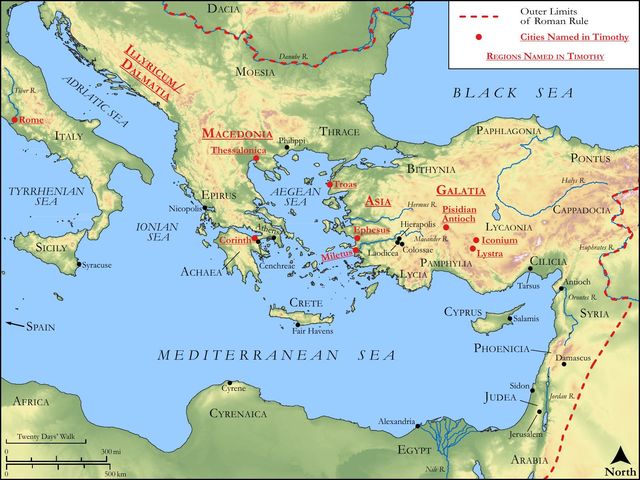
See on the biblical-era map

Study this verse
Public-domain commentary
Matthew Henry
From his Commentary on the Whole Bible. Henry comments on passages, not single verses — this entry covers 2 Timothy 2:8–13. His three-level outline is real structure in the source text, so it is rendered as structure.
I.To encourage Timothy in suffering, the apostle puts him in mind of the resurrection of Christ (Ti2 2:8):
Remember that Jesus Christ, of the seed of David, was raised from the dead, according to my gospel. This is the great proof of his divine mission, and therefore a great confirmation of the truth of the Christian religion; and the consideration of it should make us faithful to our Christian profession, and should particularly encourage us in suffering for it. Let suffering saints remember this. Observe,
1.We are to look to Jesus, the author and finisher of our faith, who, for the joy that was set before him, endured the cross, despised the shame, and has now sat down at the right hand of the throne of God, Heb 12:2.
2.The incarnation and resurrection of Jesus Christ, heartily believed and rightly considered, will support a Christian under all sufferings in the present life.
II.Another thing to encourage him in suffering was that he had Paul for an example. Observe,
1.How the apostle suffered (Ti2 2:9): Wherein I suffer as an evil-doer; and let not Timothy the son expect any better treatment than Paul the father. Paul was a man who did good, and yet suffered as an evil-doer: we must not think it strange if those who do well fare ill in this world, and if the best of men meet with the worst of treatment; but this was his comfort that the word of God was not bound. Persecuting powers may silence ministers and restrain them, but they cannot hinder the operation of the word of God upon men's hearts and consciences; that cannot be bound by any human force. This might encourage Timothy not to be afraid of bonds for the testimony of Jesus; for the word of Christ, which ought to be dearer to him than liberty, or life itself, should in the issue suffer nothing by those bonds. Here we see,
(1.)The good apostle's treatment in the world: I suffer trouble; to this he was called and appointed.
(2.)The pretence and colour under which he suffered: I suffer as an evil-doer; so the Jews said to Pilate concerning Christ, If he were not a malefactor, we would not have delivered him up to thee, Joh 18:30.
(3.)The real and true cause of his suffering trouble as an evil-doer: Wherein; that is, in or for the sake of the gospel. The apostle suffered trouble unto bonds, and afterwards he resisted unto blood, striving against sin, Heb 12:4. Though the preachers of the word are often bound, yet the word is never bound.
2.Why he suffered cheerfully: I endure all things for the elects' sake, Ti2 2:10. Observe,
(1.)Good ministers may and should encourage themselves in the hardest services and the hardest sufferings, with this, that God will certainly bring good to his church, and benefit to his elect, out of them. - That they may obtain the salvation which is in Christ Jesus. Next to the salvation of our own souls we should be willing to do and suffer any thing to promote the salvation of the souls of others.
(2.)The elect are designed to obtain salvation: God hath not appointed us to wrath, but to obtain salvation, Th1 5:9.
(3.)This salvation is in Christ Jesus, in him as the fountain, the purchaser, and the giver of it; and it is accompanied with eternal glory: there is no salvation in Christ Jesus without it.
(4.)The sufferings of our apostle were for the elects' sake, for their confirmation and encouragement.
III.Another thing with which he encourages Timothy is the prospect of a future state.
1.Those who faithfully adhere to Christ and to his truths and ways, whatever it cost them, will certainly have the advantage of it in another world: If we be dead with him, we shall live with him, Ti2 2:11. If we be dead with him, we shall live with him, Ti2 2:11. If, in conformity to Christ, we be dead to this world, its pleasures, profits, and honours, we shall go to live with him in a better world, to be for ever with him. Nay, though we be called out to suffer for him, we shall not lose by that. Those who suffer for Christ on earth shall reign with Christ in heaven, Ti2 2:12. Those who suffered with David in his humiliation were preferred with him in his exaltation: so it will be with those who suffer with the Son of David.
2.It is at our peril if we prove unfaithful to him: If we deny him, he also will deny us. If we deny him before man, he will deny us before his Father, Mat 10:33. And that man must needs be for ever miserable whom Christ disowns at last. This will certainly be the issue, whether we believe it or no (Ti2 2:13): If we believe not, yet he abideth faithful; he cannot deny himself. He is faithful to his threatenings, faithful to his promises; neither one nor the other shall fall to the ground, no, not the least, jot nor tittle of them. If we be faithful to Christ, he will certainly be faithful to us. If we be false to him, he will be faithful to his threatenings: he cannot deny himself, cannot recede from any word that he hath spoken, for he is yea, and amen, the faithful witness. Observe,
(1.)Our being dead with Christ precedes our living with him, and is connected with it: the one is in order to the other; so our suffering for him is the way to reign with him. You that have followed me in the regeneration, when the Son of man shall sit on the throne of his glory, you also shall sit upon twelve thrones, judging the twelve tribes of Israel Mat 19:28.
(2.)This is a faithful saying, and may be depended on and ought to be believed. But,
(3.)If we deny him, out of fear, or shame, or for the sake of some temporal advantage, he will deny and disown us, and will not deny himself, but will continue faithful to his word when he threatens as well as when he promises.
Historical interpretation
Eight Centuries of Reception
6 surviving comments on this verse. Each one is dated, so this reads as a timeline rather than a list.
Select a marker to jump to its quote. Markers stagger vertically where authors wrote within a few decades of each other.
Knowing, then, that "God is not mocked," we ought to walk worthy of His commandment and glory. In like manner should the deacons be blameless before the face of His righteousness, as being the servants of God and Christ, and not of men. They must not be slanderers, double-tongued, or lovers of money, but temperate in all things, compassionate, industrious, walking according to the truth of the Lord, who was the servant of all. If we please Him in this present world, we shall receive also the future world, according as He has promised to us that He will raise us again from the dead, and that if we live worthily of Him, "we shall also reign together with Him," provided only we believe.
But "whosoever shall be ashamed of Me in the presence of men, of him will I too be ashamed," says He, "in the presence of my Father who is in the heavens."
Accordingly, I beseech you, let us so perform all our actions that we may not fail to obtain such glory as this. To obtain it is by no means difficult, if we desire it, or arduous, if we apply ourselves to it. For, "If we endure, we shall also reign." What is the meaning of "If we endure"? If we patiently bear tribulations and persecutions; if we walk the narrow path. The narrow path is unattractive by nature but becomes easy when we choose to follow it, because of our hope for the future.
"If we suffer, we shall also reign with Him," not absolutely, we shall reign, but "if we suffer," showing that it is not enough to die once, (the blessed man himself died daily,) but there was need of much patient endurance; and especially Timothy had need of it. For tell me not, he says, of your first sufferings, but that you continue to suffer. Then on the other side he exhorts him, not from the good, but from the evil. For if wicked men were to partake of the same things, this would be no consolation. And if having endured they were to reign with Him, but not having endured were not indeed to reign with Him, but were to suffer no worse evil, though this were terrible, yet it would not be enough to affect most men with concern. Wherefore he speaks of something more dreadful still. If we deny Him, He will also deny us. So then there is a retribution not of good things only, but of the contrary. And consider What it is probable that he will suffer, who is denied in that kingdom. "Whosoever shall deny Me, him will I also deny." (Matt. x. 33.) And the retribution is not equal, though it seems so expressed. For we who deny Him are men, but He who denies us is God; and how great is the distance between God and man, it is needless to say. Besides, we injure ourselves; Him we cannot injure.
In him therefore is our hope of eternal life, and in him also is the pattern of our patience. “If we suffer with him, we shall also reign with him,” since, as the apostle says, “those who claim that they remain in Christ ought themselves to walk just as Christ walked.” Otherwise we are appearing under the likeness of a false profession if we do not follow the commands of him in whose name we glory. And these would indeed not be burdensome to us and would free us from all dangers, if we would only love what he commands us to love.
The saying is trustworthy. For if we have died with him, we will also live with him. If we endure, we will also reign with him. If we deny him, he also will deny us. If we are faithless, he remains faithful. He cannot deny himself.
The saying is trustworthy. Those who are chosen obtain glorious and eternal salvation. For some have doubted concerning the resurrection, and this assurance was needed. That the saying is trustworthy is also established from reasoning.
For if we have died with Christ, (by which I mean death both through baptism and through sufferings, this indeed being the sensible one,) we shall also reign with him." For no one, Paul says, who has shared in sorrows with others can be deprived of good things and prosperity: let alone Christ, who is goodness and kindness itself.
If we deny him, he also will deny us. Then also fear them who are evil. But consider what is likely to happen to one who is denied by Christ.
If we are faithless, he remains faithful. If we are faithless concerning that he rose from the dead, or that he is God, he remains faithful, that is, true. For having said that he will rise, and that he is God (for this was signified in many ways), he is faithful. For he rose and he is God. He says that he cannot deny himself, so as not to be God or to have risen. Just as he said: There will be no change because of our denial, but he remains faithful and true concerning himself. And to deny, that is, to lie to himself, he cannot do, in not having risen or not being God. For having promised concerning himself, he cannot lie to himself and fail to fulfill the promises. For neither by believing do we make him not God, nor by being unfaithful do we cast out the divine nature, but both in our believing and in our unbelief he himself is God. Therefore, we who believe reap the benefit. But the "It is not possible," instead of, "It is not permitted." "He remains faithful." Therefore, for our salvation, he demands from us consent to him. For, he says, it is not harmed by our denial.
Continue studying 2 Timothy 2:12 across the web’s major study libraries — every link below opens this exact verse, chapter, or book on the destination site.
Read & Compare
 BibleGatewayThis verse in more than 200 translations and 70 languages.
 Bible.comThe YouVersion reader — hundreds of translations, reading plans, and highlights.
 ESV.orgCrossway's official English Standard Version reader.
 NET BibleThe NET translation with 60,000+ translators' notes on every rendering decision.
 STEP BibleTyndale House's free study tool — original text, vocabulary, and scholarly resources.
 BibliaLogos Bible Software's free web reader.
 USCCBThe New American Bible (Revised Edition) with the U.S. bishops' study notes.
Commentaries
 BibleHub CommentariesDozens of classic commentaries on this verse, gathered on one page.
 StudyLightMore than 100 commentary sets — the largest collection on the web.
 BibleRefPlain-English commentary on what this verse means, verse by verse.
 Enduring WordDavid Guzik's free commentary on this chapter, widely used by Bible teachers.
 Bible Study ToolsVerse commentary alongside Greek and Hebrew study aids.
Original Language & Research
- BibleHub InterlinearThe verse word by word — original language, transliteration, and English.
- BibleHub LexiconEvery word's original-language definition and Strong's entry.
 Blue Letter BibleDeep-study tools — Strong's numbers, concordance, and word studies.
 CNTR CollationThe earliest Greek manuscripts of this verse, collated letter by letter.
Sermons, Hymns & Audio


TrulyRandomVerse is not affiliated with these sites and doesn’t control their content. They’re linked because they’re genuinely useful.
Summary
2 Timothy 2:12 presents a profound and dualistic principle central to Christian discipleship: the promise of future co-regency with Christ for those who faithfully endure suffering for His sake, contrasted sharply with the severe consequence of being denied by Christ for those who disavow Him. This verse serves as both a powerful encouragement for perseverance in the face of hardship and a sobering warning against apostasy, underscoring the reciprocal nature of our relationship with the Lord.
Context
ShowHideLiterary Context
This verse is embedded within a "faithful saying" (πιστὸς ὁ λόγος, pistos ho logos) found in 2 Timothy 2:11-13. These "faithful sayings" often functioned as early Christian creeds or maxims, easily memorized and recited, providing foundational theological truths. Paul, writing from likely Roman imprisonment and facing imminent martyrdom, is urging his spiritual son, Timothy, to remain steadfast and courageous in ministry despite widespread apostasy and persecution. The preceding verses (2 Timothy 2:3-7) use vivid metaphors of a soldier, athlete, and farmer to illustrate the discipline, endurance, and hard work required for effective ministry. Following this, Paul calls Timothy to be an "approved workman" who "rightly divides the word of truth" (2 Timothy 2:15). Thus, 2 Timothy 2:12 serves as a core theological anchor within Paul's broader exhortation for faithful endurance and sound doctrine.
Historical & Cultural Context
Paul's second letter to Timothy is widely believed to be his last canonical epistle, written during a period of intense persecution of Christians under the Roman Empire, likely Nero's reign. Paul himself is a prisoner, awaiting execution, which lends a profound urgency and weight to his words. Timothy, as a young leader in the church at Ephesus, faced significant challenges, including false teachers, internal dissent, and external pressure. The concept of "suffering" for Christ was not abstract but a tangible reality, involving social ostracism, economic hardship, imprisonment, and even martyrdom. The idea of "reigning with" a king or emperor would have been a well-understood concept in the Roman world, where co-regency or shared authority was practiced. Conversely, "denial" carried severe social and legal implications, often involving public disavowal under duress, which could save one's life but at the cost of one's allegiance and identity.
Key Themes
ShowHide2 Timothy 2:12 powerfully encapsulates several major themes prevalent throughout Paul's letters and the New Testament. Firstly, the theme of suffering and glory is central, positing that present suffering for Christ is intimately linked to future vindication and participation in His glorious reign. This is a consistent motif, as seen in Romans 8:17, where Paul states that "if we suffer with him, that we may be also glorified together." Secondly, the verse highlights the gravity of allegiance and denial. It underscores the absolute necessity of unwavering faithfulness to Christ, particularly in times of pressure or persecution. To deny Christ is not merely a verbal slip but a profound repudiation of one's identity and commitment, carrying eternal consequences, as Jesus Himself warned in Matthew 10:33. Finally, the verse illustrates a principle of divine reciprocity and justice, where our actions towards Christ directly determine His response to us, emphasizing personal responsibility and the serious nature of our covenant relationship with God. This theme is further reinforced by the subsequent verse, 2 Timothy 2:13, which affirms God's unwavering faithfulness even if we are faithless, because "he cannot deny himself."
Exposition and Analysis
ShowHideKey Word Analysis
ShowHideThis word, derived from hypó (under) and ménō (to remain), literally means "to stay under" or "to remain behind." Figuratively, it denotes the act of enduring, bearing trials, or having fortitude. In the context of 2 Timothy 2:12, it refers to the active and patient endurance of hardship, affliction, or persecution for the sake of Christ and the Gospel. It's not passive resignation but active perseverance despite adversity.
This compound word combines sýn (with) and basileúō (to reign as king). It specifically means "to be co-regent" or "to rule together with." This term signifies a profound promise of shared authority and participation in Christ's future kingdom and glory. It implies a literal co-regency with Christ in His eschatological reign, a high honor and reward for those who have been faithful.
This verb signifies to contradict, disavow, reject, or abnegate. It implies a deliberate act of renunciation, often under pressure or threat. In the spiritual sense, it means to repudiate one's faith in Christ, to disown Him, or to refuse to acknowledge Him as Lord, particularly in public or before hostile authorities. This is a serious act with severe spiritual repercussions.
Verse Breakdown
ShowHide"If we suffer"
This conditional clause introduces the first premise. "Suffer" here refers to enduring hardship, persecution, or affliction specifically for Christ's sake. It implies a conscious choice to remain faithful despite external pressures or internal struggles that arise from one's commitment to the Gospel.
"we shall also reign with [him]:"
This is the glorious consequence of the first premise. The promise is that those who endure suffering for Christ will share in His future kingly reign. This speaks to an eschatological reality where faithful believers will participate in Christ's authority and glory in His coming kingdom, a profound reward for steadfastness.
"if we deny [him],"
This second conditional clause introduces the antithetical premise. "Deny" signifies a deliberate act of repudiating or disowning Christ, especially in the face of pressure or persecution. It implies a renunciation of one's faith and allegiance to Jesus.
"he also will deny us:"
This is the stark and severe consequence of the second premise. Just as we deny Him, He will deny us. This refers to Christ's public disavowal of those who have disowned Him, particularly before the Father, implying exclusion from His kingdom and the benefits of salvation. It highlights the principle of divine reciprocity and the critical importance of unwavering allegiance.
Literary Devices
ShowHide2 Timothy 2:12 is structured around a powerful Antithetical Parallelism, presenting two contrasting conditional statements and their respective outcomes. The first clause, "If we suffer, we shall also reign with him," sets up a positive cause-and-effect relationship, while the second, "if we deny him, he also will deny us," provides a stark negative counterpoint. This Juxtaposition effectively highlights the binary choice facing believers: faithfulness leading to glory, or unfaithfulness leading to rejection. The use of Conditional Clauses ("If we...") emphasizes the personal responsibility and choice involved in one's walk with Christ. The verse also functions as an Aphorism or maxim, part of a larger "faithful saying," designed to be memorable and instructive, distilling complex theological truths into concise, impactful statements. The Reciprocity evident in both parts of the verse ("we suffer" -> "we reign," "we deny" -> "he denies") underscores the direct and just nature of God's response to human allegiance or apostasy.
Theological and Thematic Connections
ShowHideThe profound theological truth embedded in 2 Timothy 2:12 is the inseparable link between present suffering for Christ and future glory with Him, contrasted with the dire consequences of denying Him. This verse articulates a core New Testament theology of redemptive suffering, where participation in Christ's afflictions is a prerequisite for sharing in His triumph. It underscores the costly nature of true discipleship, demanding unwavering allegiance even unto death. The promise of "reigning with him" points to an eschatological hope that transcends earthly trials, offering a profound motivation for perseverance. Conversely, the warning against denial highlights the absolute necessity of public confession and steadfast faith, revealing the seriousness with which Christ views our commitment to Him, as our actions here on earth have eternal ramifications. This divine reciprocity ensures that ultimate justice will be served, with faithfulness rewarded and apostasy condemned.
Reflection and Application
ShowHide2 Timothy 2:12 serves as a timeless anchor for believers navigating a world often indifferent or hostile to Christian values. It calls us to embrace a realistic view of discipleship, acknowledging that faithfulness to Christ may indeed involve suffering—whether it be neglect, professional setbacks, or even overt persecution—for the sake of the Gospel. Yet, this suffering is not without purpose or reward; it is the pathway to sharing in Christ's eternal glory and reign. This verse profoundly challenges us to examine the depth of our commitment: are we willing to endure for Him, or will we compromise our faith when tested? It reminds us that our ultimate identity and destiny are bound up in our allegiance to Jesus. Living with this eternal perspective empowers us to prioritize Christ above all earthly comforts, fears, or fleeting gains, knowing that our steadfastness now secures an unimaginable future with Him.
Questions for Reflection
ShowHideFAQ
ShowHideWhat does "suffer" mean in the context of this verse, and is it only about physical persecution?
ShowHideIn 2 Timothy 2:12, "suffer" (Greek, hypoménō) refers to enduring hardship, affliction, or persecution for the sake of Christ. While it certainly includes physical persecution, especially in Paul's context of imprisonment and impending martyrdom, it is broader. It encompasses any difficulty, opposition, or cost incurred as a direct result of one's allegiance to Jesus and commitment to His Gospel. This can include social ostracism, ridicule, professional setbacks, financial hardship, emotional distress, or any form of adversity faced because one chooses to live according to Christ's teachings in a world often at odds with them. The emphasis is on patient endurance and perseverance, rather than merely experiencing pain.
What does the promise "we shall also reign with him" imply for believers?
ShowHideThe promise "we shall also reign with him" (Greek, symbasileúō) is a profound eschatological hope for faithful believers. It implies a literal co-regency and shared authority with Christ in His future kingdom, particularly during His millennial reign and beyond, as described in passages like Revelation 20:4-6. This is not merely a symbolic participation but a real sharing in Christ's kingly power and glory. It signifies ultimate vindication, honor, and reward for those who have endured suffering and remained faithful to Him. It speaks to the believer's future role in the administration of God's kingdom, serving as a powerful motivation for steadfastness in the present.
What constitutes "denying him," and does it mean losing salvation?
ShowHide"Denying him" (Greek, arnéomai) in 2 Timothy 2:12 refers to a deliberate and conscious repudiation or disavowal of Christ, especially in the face of pressure, persecution, or temptation. It's more than a momentary lapse or a struggle with doubt; it implies a fundamental renunciation of one's faith and allegiance to Jesus as Lord. While the New Testament affirms the security of salvation for those genuinely in Christ, this warning is directed at those who apostatize—those who, by their actions, demonstrate that they were never truly part of the faith or who willfully abandon it. Jesus Himself warned, "Whosoever therefore shall confess me before men, him will I confess also before my Father which is in heaven. But whosoever shall deny me before men, him will I also deny before my Father which is in heaven" (Matthew 10:32-33). This denial results in Christ's disavowal of them before the Father, implying exclusion from His kingdom and the benefits of salvation. It serves as a sober warning against the ultimate act of unfaithfulness.
Christ-Centered Fulfillment
ShowHide2 Timothy 2:12 finds its ultimate Christ-centered fulfillment in Jesus Himself, who perfectly embodies both the suffering and the subsequent reign. He is the supreme example of one who "suffered" (Hebrews 2:10), enduring the cross, despising the shame (Hebrews 12:2), and experiencing the ultimate form of denial and rejection by humanity (Isaiah 53:3). Yet, because He suffered and remained faithful unto death, God "highly exalted him and gave him the name that is above every name" (Philippians 2:8-9), establishing Him as King of kings and Lord of lords (Revelation 19:16). Our suffering, therefore, is a participation in His suffering (Philippians 3:10), and our future reign is a sharing in His already established kingship (Ephesians 2:6). Conversely, to deny Christ is to deny the very one who suffered for us and now reigns on our behalf, thus forfeiting the redemptive work He accomplished. The verse powerfully reminds us that our destiny is inextricably linked to our relationship with this suffering and reigning Christ: to be united with Him in His cross is to be united with Him in His crown; to reject Him is to be rejected by the one who holds all authority in heaven and on earth (Matthew 28:18).