


2 Timothy 2:1
- ΣὺSuYou yourselfG4771P-2NSPersonal pronoun Nominative 2nd Singular
- οὖνounthereforeG3767CONJConjunction
- τέκνονteknonchildG5043N-VSNNoun Vocative Singular Neuter
- μουmouof mineG3165P-1GSPersonal pronoun Genitive 1st Singular
- ἐνδυναμοῦendunamoudo be strongG1743V-PPM-2SVerb Present Passive Imperative 2nd Singular
- ἐνeninG1722PREPPreposition
- τῇtēatheG3588T-DSFDefinite article Dative Singular Feminine
- χάριτιcharitigraceG5485N-DSFNoun Dative Singular Feminine
- τῇtēathat [is]G3588T-DSFDefinite article Dative Singular Feminine
- ἐνeninG1722PREPPreposition
- ΧριστῷChristōChristG5547N-DSM-TNoun Dative Singular Masculine Title
- ἸησοῦIēsouJesusG2424N-DSM-PNoun Dative Singular Masculine Individual
English is a literal word-by-word gloss of the Greek, not the KJV's wording. Why?
This is the original text the KJV's translators worked from — each Greek word with its own literal English meaning in this verse, prepared by scholars at Tyndale House, Cambridge. The KJV translates whole sentences, not word by word, so its wording differs: one Greek word can become several English words, and the KJV may choose “charity” where the gloss reads “love”. Both are faithful — they answer different questions. For the KJV's own rendering, switch to the KJV text.
Details
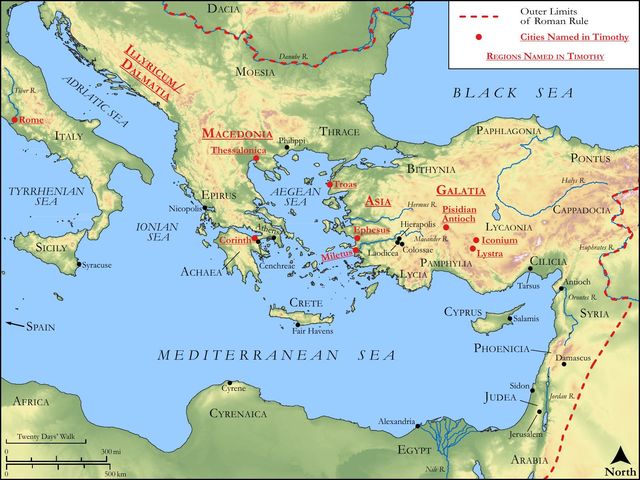
See on the biblical-era map

Study this verse
Public-domain commentary
Matthew Henry
From his Commentary on the Whole Bible. Henry comments on passages, not single verses — this entry covers 2 Timothy 2:1–7. His two-level outline is real structure in the source text, so it is rendered as structure.
Here Paul encourages Timothy to constancy and perseverance in his work: Be strong in the grace that is in Christ Jesus, Ti2 2:1. Observe, Those who have work to do for God must stir up themselves to do it, and strengthen themselves for it. Being strong in the grace that is in Christ Jesus may be understood in opposition to the weakness of grace. Where there is the truth of grace there must be a labouring after the strength of grace. As our trials increase, we have need to grow stronger and stronger in that which is good; our faith stronger, our resolution stronger, our love to God and Christ stronger. Or it may be understood in opposition to our being strong in our own strength: "Be strong, not confiding in thy own sufficiency, but in the grace that is in Jesus Christ." Compare Eph 6:10, Be strong in the Lord, and in the power of his might. When Peter promised rather to die for Christ than to deny him he was strong in his own strength; had he been strong in the grace that is in Christ Jesus, he would have kept his standing better. Observe, 1. There is grace in Christ Jesus; for the law was given by Moses, but grace and truth came by Jesus Christ, Joh 1:17. There is grace enough in him for all of us. 2. We must be strong in this grace; not in ourselves, in our own strength, or in the grace we have already received, but in the grace that is in him, and that is the way to be strong in grace. 3. As a father exhorts his son, so does Paul exhort Timothy, with great tenderness and affection: Thou, therefore, my son, be strong, etc. Observe,
I.Timothy must count upon sufferings, even unto blood, and therefore he must train up others to succeed him in the ministry of the gospel, Ti2 2:2. He must instruct others, and train them up for the ministry, and so commit to them the things which he had heard; and he must also ordain them to the ministry, lodge the gospel as a trust in their hands, and so commit to them the things which he had heard. Two things he must have an eye to in ordaining ministers: - Their fidelity or integrity ("Commit them to faithful men, who will sincerely aim at the glory of God, the honour of Christ, the welfare of souls, and the advancement of the kingdom of the Redeemer among men"), and also their ministerial ability. They must not only be knowing themselves, but be able to teach others also, and be apt to teach. Here we have,
1.The things Timothy was to commit to others - what he had heard of the apostle among many witnesses; he must not deliver any thing besides, and what Paul delivered to him and others he had received of the Lord Jesus Christ.
2.He was to commit them as a trust, as a sacred deposit, which they were to keep, and to transmit pure and uncorrupt unto others.
3.Those to whom he was to commit these things must be faithful, that is, trusty men, and who were skilful to teach others.
4.Though men were both faithful and able to teach others, yet these things must be committed to them by Timothy, a minister, a man in office; for none must intrude themselves into the ministry, but must have these things committed to them by those already in that office.
II.He must endure hardness (Ti2 2:3): Thou therefore, etc.
1.All Christians, but especially ministers, are soldiers of Jesus Christ; they fight under his banner, in his cause, and against his enemies, for he is the captain of our salvation, Heb 2:10.
2.The soldiers of Jesus Christ must approve themselves good soldiers, faithful to their captain, resolute in his cause, and must not give over fighting till they are made more than conquerors, through him that loved them, Rom 8:37.
3.Those who would approve themselves good soldiers of Jesus Christ must endure hardness; that is, we must expect it and count upon it in this world, must endure and accustom ourselves to it, and bear it patiently when it comes, and not be moved by it from our integrity.
III.He must not entangle himself in the affairs of this world, Ti2 2:4.
A soldier, when he has enlisted, leaves his calling, and all the business of it, that he may attend his captain's orders. If we have given up ourselves to be Christ's soldiers, we must sit loose to this world; and though there is no remedy, but we must employ ourselves in the affairs of this life while we are here (we have something to do here), we must not entangle ourselves with those affairs, so as by them to be diverted and drawn aside from our duty to God and the great concerns of our Christianity. Those who will war the good warfare must sit loose to this world. That we may please him who hath chosen us to be soldiers. Observe, 1. The great care of a soldier should be to please his general; so the great care of a Christian should be to please Christ, to approve ourselves to him. The way to please him who hath chosen us to be soldiers is not to entangle ourselves with the affairs of this life, but to be free from such entanglements as would hinder us in our holy warfare.
IV.He must see to it that in carrying on the spiritual warfare he went by rule, that he observed the laws of war (Ti2 2:5):
If a man strive for masteries, yet is he not crowned, except he strive lawfully. We are striving for mastery, to get the mastery of our lusts and corruptions, to excel in that which is good, but we cannot expect the prize unless we observe the laws. In doing that which is good we must take care that we do it in a right manner, that our good may not be evil spoken of. Observe here,
1.A Christian is to strive for masteries; he must aim at mastering his own lusts and corruptions.
2.Yet he must strive according to the laws given to him; he must strive lawfully.
3.Those who do so shall be crowned at last, after a complete victory is obtained.
V.He must be willing to wait for a recompence (Ti2 2:6):
The husbandman that laboureth must be first partaker of the fruits. Or, as it should be read, The husbandman labouring first must partake of the fruits, as appears by comparing it with Jam 5:7. If we would be partakers of the fruits, we must labour; if we would gain the prize, we must run the race. And, further, we must first labour as the husbandman does, with diligence and patience, before we are partakers of the fruit; we must do the will of God, before we receive the promises, for which reason we have need of patience, Heb 10:36.
The apostle further commends what he had said to the attention of Timothy, and expresses his desire and hope respecting him: Consider what I say, and the Lord give thee understanding in all things, Ti2 2:7. Here, 1. Paul exhorts Timothy to consider those thing about which he admonished him. Timothy must be reminded to use his considering faculties about the things of God. Consideration is as necessary to a good conversation as to a sound conversion. 2. He prays for him: The Lord give thee understanding in all things. Observe, It is God who gives understanding. The most intelligent man needs more and more of this gift. If he who gave the revelation in the word does not give the understanding in the heart, we are nothing. Together with our prayers for others, that the Lord would give them understanding in all things, we must exhort and stir them up to consider what we say, for consideration is the way to understand, remember, and practise, what we hear or read.
Historical interpretation
Eight Centuries of Reception
4 surviving comments on this verse. Each one is dated, so this reads as a timeline rather than a list.
Select a marker to jump to its quote. Markers stagger vertically where authors wrote within a few decades of each other.
If the "Station" has received its name from the example of military life-for we withal are God's military -of course no gladness or sadness chanting to the camp abolishes the "stations" of the soldiers: for gladness will carry out discipline more willingly, sadness more carefully.
As it was your desire, my beloved brother Theophilus, to be thoroughly informed on those topics which I put summarily before you, I have thought it right to set these matters of inquiry clearly forth to your view, drawing largely from the Holy Scriptures themselves as from a holy fountain, in order that you may not only have the pleasure of hearing them on the testimony of men, but may also be able, by surveying them in the light of (divine) authority, to glorify God in all. For this will be as a sure supply furnished you by us for your journey in this present life, so that by ready argument applying things ill understood and apprehended by most, you may sow them in the ground of your heart, as in a rich and clean soil. By these, too, you will be able to silence those who oppose and gainsay the word of salvation. Only see that you do not give these things over to unbelieving and blasphemous tongues, for that is no common danger. But impart them to pious and faithful men, who desire to live holily and righteously with fear. For it is not to no purpose that the blessed apostle exhorts Timothy, and says, "O Timothy, keep that which is committed to thy trust, avoiding profane and vain babblings, and oppositions of science falsely so called; which some professing have erred concerning the faith." And again, "Thou therefore, my son, be strong in the grace that is in Christ Jesus. And the things that thou hast heard of me in many exhortations, the same commit thou to faithful men, who shall be able to teach others also." If, then, the blessed (apostle) delivered these things with a pious caution, which could be easily known by all, as he perceived in the spirit that "all men have not faith," how much greater will be our danger, if, rashly and without thought, we commit the revelations of God to profane and unworthy men?
The young sailor at sea is inspired with great confidence, if the Master of the ship has been preserved in a shipwreck. For he will not consider that it is from his inexperience that he is exposed to the storm, but from the nature of things; and this has no little effect upon his mind. In war also the Captain, who sees his General wounded and recovered again, is much encouraged. And thus it produces some consolation to the faithful, that the Apostle should have been exposed to great sufferings, and not rendered weak by the utmost of them. And had it not been so, he would not have related his sufferings. For when Timothy heard, that he who possessed so great powers, who had conquered the whole world, is a prisoner, and afflicted, yet is not impatient, nor discontented upon the desertion of his friends; he, if ever exposed to the same sufferings himself, would not consider that it proceeded from human weakness, nor from the circumstance of his being a disciple, and inferior to Paul, since his teacher too suffered the like, but that all this happened from the natural course of things. For Paul himself did this, and related what had befallen him, that he might strengthen Timothy, and renew his courage. And he shows that it was for this reason he mentioned his trials and afflictions, in that he has added, "Thou, therefore, my son, be strong in the grace that is in Christ Jesus." What sayest thou? Thou hast shaken us with terrors, thou hast told us that thou art in chains, in afflictions, that all have forsaken thee, and, as if thou hadst said thou hadst not suffered anything, nor been abandoned by any, thou addest, "Thou therefore, my son, be strong"?-And justly too. For these things were to thy strengthening more than to his. For if I, Paul, endure these things, much more oughtest thou to bear them. If the master, much more the disciple. And this exhortation he introduces with much affection, calling him "son," and not only so, but "my son." If thou art a son, he means, imitate thy father. If thou art a son, be strong in consideration of the things which I have said, or rather be strong, not merely from what I have told you, but "of God." "Be strong," he says, "in the grace that is in Christ Jesus"; that is, "through the grace of Christ." That is, stand firmly. Thou knowest the battle. For elsewhere he says, "We wrestle not against flesh and blood." (Eph. vi. 12.) And this he says not to depress but to excite them. Be sober therefore, he means, and watch have the grace of the Lord cooperating with thee, and aiding thee in thy contest, contribute thy own part with much alacrity and resolution.
You therefore, my child, be strong in the grace that is in Christ Jesus.
Paul indicates great kindness by what is added, "my child." "If you are my child," he says, "imitate your father." For the teacher's rebuke is accustomed to add boldness to the student.
Therefore, Paul says: "be strong." If anything of this kind happens to you, do not fall, but look to the reward.
be strong in the grace. But be strengthened, Paul says, not only by my example, but also through the grace given through Christ. For if he did not justify by his own blood, the grace of the Spirit would not have come. Therefore, he says, have the Spirit as an ally.
Continue studying 2 Timothy 2:1 across the web’s major study libraries — every link below opens this exact verse, chapter, or book on the destination site.
Read & Compare
 BibleGatewayThis verse in more than 200 translations and 70 languages.
 Bible.comThe YouVersion reader — hundreds of translations, reading plans, and highlights.
 ESV.orgCrossway's official English Standard Version reader.
 NET BibleThe NET translation with 60,000+ translators' notes on every rendering decision.
 STEP BibleTyndale House's free study tool — original text, vocabulary, and scholarly resources.
 BibliaLogos Bible Software's free web reader.
 USCCBThe New American Bible (Revised Edition) with the U.S. bishops' study notes.
Commentaries
 BibleHub CommentariesDozens of classic commentaries on this verse, gathered on one page.
 StudyLightMore than 100 commentary sets — the largest collection on the web.
 BibleRefPlain-English commentary on what this verse means, verse by verse.
 Enduring WordDavid Guzik's free commentary on this chapter, widely used by Bible teachers.
 Bible Study ToolsVerse commentary alongside Greek and Hebrew study aids.
Original Language & Research
- BibleHub InterlinearThe verse word by word — original language, transliteration, and English.
- BibleHub LexiconEvery word's original-language definition and Strong's entry.
 Blue Letter BibleDeep-study tools — Strong's numbers, concordance, and word studies.
 CNTR CollationThe earliest Greek manuscripts of this verse, collated letter by letter.
Sermons, Hymns & Audio


TrulyRandomVerse is not affiliated with these sites and doesn’t control their content. They’re linked because they’re genuinely useful.
Summary
In this foundational exhortation, the Apostle Paul charges his beloved spiritual son Timothy to draw strength not from his own capabilities or resolve, but from the inexhaustible grace found uniquely in Christ Jesus. This command serves as a vital reminder for all believers that true spiritual resilience, endurance in ministry, and perseverance through life's challenges are rooted solely in God's divine enablement, freely given through His Son.
Context
ShowHideLiterary Context
This verse serves as a pivotal transition from Paul's personal reflections and commendations in 2 Timothy 1 to his more direct instructions regarding Timothy's ministerial duties and the challenges he will face. The opening "therefore" explicitly connects this command to the preceding chapter, particularly Paul's urgent call for Timothy to guard the "good deposit" of truth (2 Timothy 1:13-14) and not to be ashamed of the gospel or of Paul's imprisonment (2 Timothy 1:8). Paul is setting the stage for the rigorous demands of faithful ministry in a hostile world, emphasizing that divine strength is indispensable for such a task.
Historical & Cultural Context
Paul writes this epistle from Roman imprisonment, likely facing imminent execution, making this his final written communication. Timothy, his protégé, is ministering in Ephesus, a city known for its syncretism, idolatry, and burgeoning false teachings. The early church was experiencing significant persecution from both Roman authorities and Jewish opposition, alongside internal threats from doctrinal error. In this environment, leaders like Timothy needed extraordinary resilience. Paul's emphasis on "grace" would have resonated deeply, as it stood in stark contrast to the self-reliance and merit-based systems prevalent in both Roman and some Jewish religious thought. The concept of "son" highlights the deeply personal, familial bond and the mentorship dynamic crucial for leadership succession in the early church.
Key Themes
ShowHide2 Timothy is saturated with themes of perseverance, faithfulness in ministry, and the preservation of sound doctrine. This verse introduces the foundational theme of divine empowerment, asserting that strength for ministry and Christian living comes from God's grace, not human effort. It underscores the sufficiency of Christ as the ultimate source of all spiritual resources. The epistle also emphasizes the intergenerational transfer of faith and leadership, as Paul, the spiritual father, entrusts the gospel to Timothy, his spiritual son. Furthermore, it highlights the necessity of endurance in the face of suffering and opposition, a theme Paul develops throughout the chapter by using various metaphors such as a soldier, an athlete, and a farmer (2 Timothy 2:3-6).
Exposition and Analysis
ShowHideKey Word Analysis
ShowHideFrom en (in) and dynamóō (to empower), this verb means "to empower," "to strengthen," or "to be made able." It signifies an internal strengthening that comes from an external, divine power, rather than merely a command to exert self-effort. It implies a passive reception of power that enables active living.
This term denotes "graciousness (as gratifying)," encompassing God's unmerited favor, divine influence upon the heart, and its reflection in the life. It refers to the spiritual power and enablement God freely provides, not based on human merit, but for the purpose of righteous living, effective service, and perseverance.
A primary preposition indicating "fixed position (in place, time or state)," and by implication, "instrumentality." Here, it denotes the sphere or realm within which this strength and grace are found. It emphasizes that the strength is not merely through Christ, but within the very being and reality of Christ Jesus, highlighting a deep union.
Verse Breakdown
ShowHide"Thou therefore, my son,"
Paul addresses Timothy directly and intimately. "Thou" emphasizes the personal nature of the charge, while "therefore" links this command logically to the preceding chapter's exhortations regarding steadfastness in the face of challenges. The tender address "my son" underscores the deep spiritual mentorship and affection between Paul and Timothy, giving the command a paternal weight.
"be strong"
This is a command, an imperative verb. As discussed in the key word analysis, it's not a call for Timothy to generate strength from within himself, but to actively receive and be empowered by an external source. It implies a continuous state of being strengthened.
"in the grace"
This phrase identifies the sphere and source of the strength. The strength is not self-generated but is found in God's unmerited favor and divine enablement. This grace is the wellspring of spiritual power, freely given by God.
"that is in Christ Jesus."
This final clause specifies the ultimate locus and mediator of this grace. The strength and grace are not abstract concepts but are concretely embodied "in" the person of Christ Jesus. This emphasizes union with Christ as the means by which believers access and experience God's empowering grace, making Christ the indispensable source of all spiritual fortitude.
Literary Devices
ShowHidePaul employs several literary devices in this concise verse. The opening "Thou therefore, my son" utilizes Direct Address and Paternal Language, immediately establishing a personal, authoritative, and affectionate tone. This personal appeal underscores the urgency and importance of the command, drawing Timothy into a familial relationship with the apostle. The command "be strong" is a Metaphor for spiritual empowerment, drawing on the common human understanding of physical strength but applying it to the spiritual realm, emphasizing resilience and endurance. The phrase "in the grace that is in Christ Jesus" functions as a Locative Metaphor, portraying grace and Christ as the essential environment or sphere within which true spiritual strength is found. This highlights the Dependence on an external, divine source, contrasting with self-reliance. The entire verse serves as a foundational Exhortation, a strong encouragement and command designed to motivate and guide Timothy's future ministry.
Theological and Thematic Connections
ShowHideThis verse encapsulates a core tenet of Pauline theology: the absolute dependence of the believer on God's unmerited favor for all aspects of Christian life and ministry. It refutes any notion of self-sufficiency or strength derived from human effort or merit. The strength Paul commands Timothy to possess is not a self-generated resolve but a continuous empowerment by the Holy Spirit, mediated through union with Christ. This divine enablement is essential for enduring suffering, resisting temptation, faithfully proclaiming the gospel, and fulfilling God's call. It positions Christ as the sole wellspring of spiritual vitality, ensuring that all glory redounds to God alone.
Reflection and Application
ShowHideFor believers today, Paul's charge to Timothy remains profoundly relevant. In a world that often champions self-reliance, personal achievement, and strength derived from external circumstances or internal willpower, this verse redirects our focus to the true and inexhaustible source of spiritual resilience: the grace found in Christ Jesus. To "be strong in the grace" means to consciously and consistently draw upon God's divine enablement for every challenge, temptation, and calling. It calls us to relinquish our own perceived strengths and instead to humble ourselves, acknowledging our inherent weakness, and to depend entirely on the Lord's empowering presence. This grace enables us not only to endure hardship but also to serve with joy, to love unconditionally, and to stand firm in our faith, even when circumstances seem overwhelming. It is a call to live a life of active faith, where our daily walk is sustained by the unmerited favor and dynamic power of Christ, transforming our weaknesses into opportunities for God's glory to be displayed.
Questions for Reflection
ShowHideFAQ
ShowHideDoes "be strong" mean I need to try harder?
ShowHideNo, the Greek verb endynamóō (G1743) does not primarily mean to "try harder" through human effort. Instead, it means "to be empowered" or "to be strengthened" by an external source. Paul's command is an imperative to receive and rely on the divine strength that God provides. It's about drawing from God's inexhaustible grace, not generating strength from within yourself. This is consistent with Paul's teaching that our sufficiency comes from God (2 Corinthians 3:5).
What exactly is "grace" in this context?
ShowHideIn this verse, "grace" (Greek: cháris, G5485) refers to God's unmerited favor and divine enablement. It is not merely a passive concept of forgiveness, but an active, empowering force that God freely bestows upon believers. This grace provides the spiritual power necessary for living a righteous life, enduring suffering, resisting sin, and faithfully fulfilling God's calling. It is the very power that sustains Christian life and ministry, as Paul himself testified in 1 Corinthians 15:10.
How does being "in Christ Jesus" relate to this strength?
ShowHideThe phrase "in Christ Jesus" (G1722, en G5547, Christós G2424, Iēsoûs) signifies the source and sphere of this divine strength and grace. It emphasizes that these spiritual resources are not abstract but are found uniquely through a personal, living union with Jesus Christ. It is through our spiritual identification with Him, His death, and His resurrection that we access God's power. This concept of being "in Christ" is foundational to Pauline theology, indicating a new spiritual reality and identity from which all blessings flow, as seen in passages like Ephesians 1:3.
Christ-Centered Fulfillment
ShowHide2 Timothy 2:1 finds its ultimate Christ-centered fulfillment in the person and work of Jesus, who is the embodiment and dispenser of all grace and strength. He is the one in whom "all the fullness of God was pleased to dwell" (Colossians 1:19), and from His fullness, we "have all received, grace upon grace" (John 1:16). Jesus perfectly modeled what it means to live in dependence on the Father's strength, even to the point of enduring the cross (Philippians 2:8). His resurrection power, which raised Him from the dead, is the very power now at work within believers, enabling them to "be strong" (Ephesians 1:19-20). Therefore, the command to Timothy is not merely a moral exhortation but an invitation to participate in the dynamic, indwelling life of Christ, who empowers His followers to live victoriously and faithfully serve His kingdom, transforming their weakness into a display of His perfect strength (2 Corinthians 12:9).