


1 Corinthians 15:10
Bible text: King James Version (1769 Blayney text) · Public domain
Bible text: King James Version with Strong's numbers · Public domain
Bible text: Berean Standard Bible · Public domain
Bible text: American Standard Version (1901) · Public domain
Bible text: World English Bible, Messianic edition · Public domain
Bible text: Geneva Bible (1599) · Public domain
Bible text: Young's Literal Translation · Public domain
- χάριτιcharitiBy [the] graceG5485N-DSFNoun Dative Singular Feminine
- δὲdehoweverG1161CONJConjunction
- θεοῦtheouof GodG2316N-GSM-TNoun Genitive Singular Masculine Title
- εἰμιeimiI amG1510V-PAI-1SVerb Present Active Indicative 1st Singular
- ὅhowhatG3739R-NSNRelative pronoun Nominative Singular Neuter
- εἰμιeimiI amG1510V-PAI-1SVerb Present Active Indicative 1st Singular
- καὶkaiandG2532CONJConjunction
- ἡhētheG3588T-NSFDefinite article Nominative Singular Feminine
- χάριςcharisgraceG5485N-NSFNoun Nominative Singular Feminine
- αὐτοῦautouof HimG846P-GSMPersonal pronoun Genitive Singular Masculine
- ἡhē<the>G3588T-NSFDefinite article Nominative Singular Feminine
- εἰςeistowardG1519PREPPreposition
- ἐμὲememe myselfG1473P-1ASPersonal pronoun Accusative 1st Singular
- οὐounotG3756PRT-NNegative Particle Negative
- κενὴkenēvoidG2756A-NSFAdjective Nominative Singular Feminine
- ἐγενήθηegenēthēhas beenG1096V-2AOI-3SVerb 2nd Aorist Passive Deponent Indicative 3rd Singular
- ἀλλὰallaRatherG235CONJConjunction
- περισσότερονperissoteronmore excessiveG4054ADV-CAdverb Comparative
- αὐτῶνautōnthan themG846P-GPMPersonal pronoun Genitive Plural Masculine
- πάντωνpantōnallG3956A-GPMAdjective Genitive Plural Masculine
- ἐκοπίασαekopiasaI toiledG2872V-AAI-1SVerb Aorist Active Indicative 1st Singular
- οὐκouknotG3756PRT-NNegative Particle Negative
- ἐγὼegōI myselfG1473P-1NSPersonal pronoun Nominative 1st Singular
- δέdehoweverG1161CONJConjunction
- ἀλλ᾽all᾽butG235CONJConjunction
- ἡhētheG3588T-NSFDefinite article Nominative Singular Feminine
- χάριςcharisgraceG5485N-NSFNoun Nominative Singular Feminine
- τοῦtou<the>G3588T-GSMDefinite article Genitive Singular Masculine
- θεοῦtheouof GodG2316N-GSM-TNoun Genitive Singular Masculine Title
- ἡhēthat [was]G3588T-NSFDefinite article Nominative Singular Feminine
- σὺνsunwithG4862PREPPreposition
- ἐμοίemoime myselfG1473P-1DSPersonal pronoun Dative 1st Singular
English is a literal word-by-word gloss of the Greek, not the KJV's wording. Why?
This is the original text the KJV's translators worked from — each Greek word with its own literal English meaning in this verse, prepared by scholars at Tyndale House, Cambridge. The KJV translates whole sentences, not word by word, so its wording differs: one Greek word can become several English words, and the KJV may choose “charity” where the gloss reads “love”. Both are faithful — they answer different questions. For the KJV's own rendering, switch to the KJV text.
Details
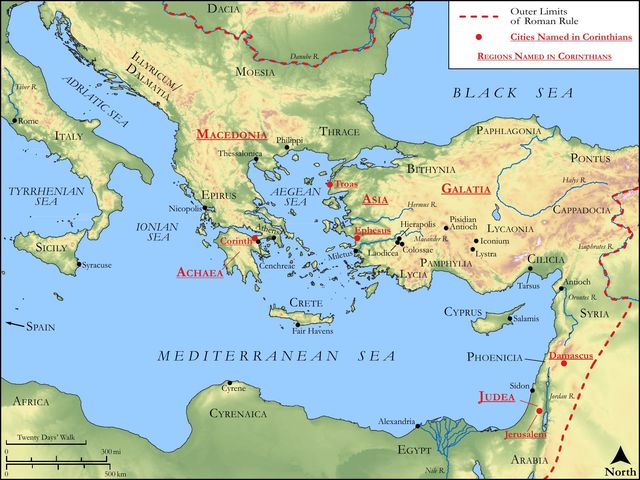
See on the biblical-era maps

Study this verse
Public-domain commentary
Matthew Henry
From his Commentary on the Whole Bible. Henry comments on passages, not single verses — this entry covers 1 Corinthians 15:1–11. His three-level outline is real structure in the source text, so it is rendered as structure.
It is the apostle's business in this chapter to assert and establish the doctrine of the resurrection of the dead, which some of the Corinthians flatly denied, Co1 15:12. Whether they turned this doctrine into allegory, as did Hymeneus and Philetus, by saying it was already past (Ti2 2:17, Ti2 2:18), and several of the ancient heretics, by making it mean no more than a changing of their course of life; or whether they rejected it as absurd, upon principles of reason and science; it seems they denied it in the proper sense. And they disowned a future state of recompences, by denying the resurrection of the dead. Now that heathens and infidels should deny this truth does not seem so strange; but that Christians, who had their religion by revelation, should deny a truth so plainly discovered is surprising, especially when it is a truth of such importance. It was time for the apostle to confirm them in this truth, when the staggering of their faith in this point was likely to shake their Christianity; and they were yet in great danger of having their faith staggered. He begins with an epitome or summary of the gospel, what he had preached among them, namely, the death and resurrection of Christ. Upon this foundation the doctrine of the resurrection of the dead is built. Note, Divine truths appear with greatest evidence when they are looked upon in their mutual connection. The foundation may be strengthened, that the superstructure may be secured. Now concerning the gospel observe,
I.What a stress he lays upon it (Co1 15:1, Co1 15:2): Moreover, brethren, I declare unto you the gospel which I preached to you.
1.It was what he constantly preached. His word was not yea and nay: he always preached the same gospel, and taught the same truth. He could appeal to his hearers for this. Truth is in its own nature invariable; and the infallible teachers of divine truth could never be at variance with themselves or one another. The doctrine which Paul had heretofore taught, he still taught.
2.It was what they had received; they had been convinced of the faith, believed it in their hearts, or at least made profession of doing so with their mouths. It was no strange doctrine. It was that very gospel in which, or by which, they had hitherto stood, and must continue to stand. If they gave up this truth, they left themselves no ground to stand upon, no footing in religion. Note, The doctrine of Christ's death and resurrection is at the foundation of Christianity. Remove this foundation, and the whole fabric falls, all our hopes for eternity sink at once. And it is by holding this truth firmly that Christians are made to stand in a day of trial, and kept faithful to God.
3.It was that alone by which they could hope for salvation (Co1 15:2), for there is no salvation in any other name; no name given under heaven by which we may be saved, but by the name of Christ. And there is no salvation in his name, but upon supposition of his death and resurrection. These are the saving truths of our holy religion. The crucifixion of our Redeemer and his conquest over death are the very source of our spiritual life and hopes. Now concerning these saving truths observe,
(1.)They must be retained in mind, they must be held fast (so the word is translated, Heb 10:23): Let us hold fast the profession of our faith. Note, The saving truths of the gospel must be fixed in our mind, revolved much in our thoughts, and maintained and held fast to the end, if we would be saved. They will not save us, if we do not attend to them, and yield to their power, and continue to do so to the end. He only that endureth to the end shall be saved, Mat 10:22.
(2.)We believe in vain, unless we continue and persevere in the faith of the gospel. We shall be never the better for a temporary faith; nay, we shall aggravate our guilt by relapsing into infidelity. And in vain is it to profess Christianity, or our faith in Christ, if we deny the resurrection; for this must imply and involve the denial of his resurrection; and, take away this, you make nothing of Christianity, you leave nothing for faith or hope to fix upon.
II.Observe what this gospel is, on which the apostle lays such stress.
It was that doctrine which he had received, and delivered to them, en prōtois - among the first, the principal. It was a doctrine of the first rank, a most necessary truth, That Christ died for our sins, and was buried, and rose again: or, in other words, that he was delivered for our offences and rose again for our justification (Rom 4:25), that he was offered in sacrifice for our sins, and rose again, to show that he had procured forgiveness for them, and was accepted of God in this offering. Note, Christ's death and resurrection are the very sum and substance of evangelical truth. Hence we derive our spiritual life now, and here we must found our hopes of everlasting life hereafter.
III.Observe how this truth is confirmed,
1.By Old Testament predictions. He died for our sins, according to the scriptures; he was buried, and rose from the dead, according to the scriptures, according to the scripture-prophecies, and scripture-types. Such prophecies as Psa 16:10; Isa 53:4-6; Dan 9:26, Dan 9:27; Hos 6:2. Such scripture-types as Jonah (Mat 12:4), as Isaac, who is expressly said by the apostle to have been received from the dead in a figure, Heb 11:19. Note, It is a great confirmation of our faith of the gospel to see how it corresponds with ancient types and prophecies.
2.By the testimony of many eye-witnesses, who saw Christ after he had risen from the dead. He reckons up five several appearances, beside that to himself. He was seen of Cephas, or Peter, then of the twelve, called so, though Judas was no longer among them, because this was their usual number; then he was seen of above five hundred brethren at once, many of whom were living when the apostle wrote this epistle, though some had fallen asleep. This was in Galilee, Mat 28:10. After that, he was seen of James singly, and then by all the apostles when he was taken up into heaven. This was on mount Olivet, Luk 24:50. Compare Act 1:2, Act 1:5-7. Note, How uncontrollably evident was Christ's resurrection from the dead, when so many eyes saw him at so many different times alive, and when he indulged the weakness of one disciple so far as to let him handle him, to put his resurrection out of doubt! And what reason have we to believe those who were so steady in maintaining this truth, though they hazarded all that was dear to them in this world, by endeavouring to assert and propagate it! Even Paul himself was last of all favoured with the sight of him. It was one of the peculiar offices of an apostle to be a witness of our Saviour's resurrection (Luk 24:48); and, when Paul was called to the apostolical office, he was made an evidence of this sort; the Lord Jesus appeared to him by the way to Damascus, Act 9:17. Having mentioned this favour, Paul takes occasion from it to make a humble digression concerning himself. He was highly favoured of God, but he always endeavoured to keep up a mean opinion of himself, and to express it. So he does here, by observing,
(1.)That he was one born out of due time (Co1 15:8), an abortive, ektrōma, a child dead born, and out of time. Paul resembled such a birth, in the suddenness of his new birth, in that he was not matured for the apostolic function, as the others were, who had personal converse with our Lord. He was called to the office when such conversation was not to be had, he was out of time for it. He had not known nor followed the Lord, nor been formed in his family, as the others were, for this high and honourable function. This was in Paul's account a very humbling circumstance.
(2.)By owning himself inferior to the other apostles: Not meet to be called an apostle. The least, because the last of them; called latest to the office, and not worthy to be called an apostle, to have either the office or the title, because he had been a persecutor of the church of God, Co1 15:9. Indeed, he tells us elsewhere that he was not a whit behind the very chief apostles (Co2 11:5) - for gifts, graces, service, and sufferings, inferior to none of them. Yet some circumstances in his case made him think more meanly of himself than of any of them. Note, A humble spirit, in the midst of high attainments, is a great ornament to any man; it sets his good qualities off to much greater advantage. What kept Paul low in an especial manner was the remembrance of his former wickedness, his raging and destructive zeal against Christ and him members. Note, How easily God can bring a good out of the greatest evil! When sinners are by divine grace turned into saints, he makes the remembrance of their former sins very serviceable, to make them humble, and diligent, and faithful.
(3.)By ascribing all that was valuable in him to divine grace: But by the grace of God I am what I am, Co1 15:10. It is God's prerogative to say, I am that I am; it is our privilege to be able to say, "By God's grace we are what we are." We are nothing but what God makes us, nothing in religion but what his grace makes us. All that is good in us is a stream from this fountain. Paul was sensible of this, and kept humble and thankful by this conviction; so should we. Nay, though he was conscious of his own diligence, and zeal, and service, so that he could say of himself, the grace of God was not given him in vain, but he laboured more abundantly than they all: he thought himself so much more the debtor to divine grace. Yet not I, but the grace of God which was with me. Note, Those who have the grace of God bestowed on them should take care that it be not in vain. They should cherish, and exercise, and exert, this heavenly principle. So did Paul, and therefore laboured with so much heart and so much success. And yet the more he laboured, and the more good he did, the more humble he was in his opinion of himself, and the more disposed to own and magnify the favour of God towards him, his free and unmerited favour. Note, A humble spirit will be very apt to own and magnify the grace of God. A humble spirit is commonly a gracious one. Where pride is subdued there it is reasonable to believe grace reigns.
After this digression, the apostle returns to his argument, and tells them (Co1 15:11) that he not only preached the same gospel himself at all times, and in all places, but that all the apostles preached the same: Whether it were they or I, so we preached, and so you believed. Whether Peter, or Paul, or any other apostle, had converted them to Christianity, all maintained the same truth, told the same story, preached the same doctrine, and confirmed it by the same evidence. All agreed in this that Jesus Christ, and him crucified and slain, and then rising from the dead, was the very sum and substance of Christianity; and this all true Christians believe. All the apostles agreed in this testimony; all Christians agree in the belief of it. By this faith they live. In this faith they die.
Historical interpretation
Two Centuries of Reception
10 surviving comments on this verse. Each one is dated, so this reads as a timeline rather than a list.
Select a marker to jump to its quote. Markers stagger vertically where authors wrote within a few decades of each other.
Wherefore also Paul, since he was the apostle of the Gentiles, says, "I laboured more than they all."
This is the perfect and consummate glory in God: not to exult in one’s own righteousness, but recognizing oneself as lacking true righteousness, to be justified by faith in Christ alone. Paul gloried in despising his own righteousness. In seeking after the righteousness by faith which is of God through Christ, he sought only to know him and the power of his resurrection and the fellowship of his sufferings, being made conformable to his death, so as to attain to the resurrection from the dead.… It is God who grants efficacy to our labors.
He who spends his time in softness and all laxity because of his luxurious living, who is clothed in purple and fine linen and feasting every day in splendid fashion and who flees the labors imposed by virtue has neither labored in this life nor will live in the future, but he will see life afar off, while being racked in the fire of the furnace.
Paul says all this in order to show that despite his great sins and unworthiness, the grace of God was not given to him for nothing.
"But by the grace of God I am what I am."
Seest thou again another excess of humility? in that the defects he imputes to himself, but of the good deeds nothing; rather he refers all to God. Next, lest he might hereby render his hearer supine, he saith, "And His grace which was bestowed upon me was not found vain." And this again with reserve: in that he said not, "I have displayed a diligence worthy of His grace," but, "it was not found vain."
"But I labored more abundantly than they all." He said not, "I was honored," but, "I labored;" and when he had perils and deaths to speak of, by the name of labor he again abates his expression.
Then again practicing his wonted humility, this also he speedily passes by and refers the whole to God, saying, "Yet not I, but the grace of God which was with me." What can be more admirable than such a soul? who having in so many ways depressed himself and uttered but one lofty word, not even this doth he call his own; on every side finding ways, both from the former things and from them that follow after, to contract this lofty expression, and that because it was of necessity that he came to it.
You are familiar with Paul, who labored so much and erected so many trophies in combat with the devil. He physically marched throughout the known world. He orbited the earth, ocean, air—he circled the world as if he had wings. He was stoned, beaten and murdered. He suffered everything for the name of God, called from above by a heavenly voice.… We know, we understand, he said, the grace we have received, and it did not find me inattentive.
Did you see how he reaped the benefit of God's liberality and then how abundantly he contributed his own share, by his zeal, his fervor, his faith, his courage, his patience, his lofty mind and his undaunted will? This is why he deserved a larger measure of help from above.
Gladly and with the eyes of faith do all in the City of God look up to this great man, Paul, this athlete of Christ, who was anointed by Christ and instructed by him. With him he was nailed to the cross, and through him made glorious. This man was made a spectacle to the world, to angels and to men. He lawfully carried on a great conflict in the theater of this world and strained forward to the prize of his heavenly calling.
Paul did not labor in order to receive grace, but he received grace so that he might labor.
How, then, is God’s commandment accomplished, even with difficulty, without his help, since if the Lord does not build, the builder is said to have labored in vain.
Continue studying 1 Corinthians 15:10 across the web’s major study libraries — every link below opens this exact verse, chapter, or book on the destination site.
Read & Compare
 BibleGatewayThis verse in more than 200 translations and 70 languages.
 Bible.comThe YouVersion reader — hundreds of translations, reading plans, and highlights.
 ESV.orgCrossway's official English Standard Version reader.
 NET BibleThe NET translation with 60,000+ translators' notes on every rendering decision.
 STEP BibleTyndale House's free study tool — original text, vocabulary, and scholarly resources.
 BibliaLogos Bible Software's free web reader.
 USCCBThe New American Bible (Revised Edition) with the U.S. bishops' study notes.
Commentaries
 BibleHub CommentariesDozens of classic commentaries on this verse, gathered on one page.
 StudyLightMore than 100 commentary sets — the largest collection on the web.
 BibleRefPlain-English commentary on what this verse means, verse by verse.
 Enduring WordDavid Guzik's free commentary on this chapter, widely used by Bible teachers.
 Bible Study ToolsVerse commentary alongside Greek and Hebrew study aids.
Original Language & Research
- BibleHub InterlinearThe verse word by word — original language, transliteration, and English.
- BibleHub LexiconEvery word's original-language definition and Strong's entry.
 Blue Letter BibleDeep-study tools — Strong's numbers, concordance, and word studies.
 CNTR CollationThe earliest Greek manuscripts of this verse, collated letter by letter.
Sermons, Hymns & Audio


TrulyRandomVerse is not affiliated with these sites and doesn’t control their content. They’re linked because they’re genuinely useful.
Summary
1 Corinthians 15:10 serves as a profound declaration by the Apostle Paul, articulating that his very identity, his calling as an apostle, and the extraordinary fruitfulness of his tireless ministry were not products of his own merit or strength, but solely the result of God's unmerited favor. This verse encapsulates the paradox of divine empowerment and human diligence, demonstrating that while believers are called to labor abundantly, all credit and glory for their effectiveness must be attributed to the sovereign and empowering grace of God.
Context
ShowHideLiterary Context
This powerful statement is situated within 1 Corinthians 15, often referred to as the "Resurrection Chapter," where Paul meticulously defends the foundational truth of Christ's bodily resurrection and its implications for the resurrection of believers. Having presented a list of witnesses to the risen Christ, Paul culminates with himself, acknowledging his unique encounter "as of one born out of due time" (1 Corinthians 15:8). Immediately preceding verse 10, Paul expresses his profound humility and sense of unworthiness, stating that he is "the least of the apostles, that am not meet to be called an apostle, because I persecuted the church of God" (1 Corinthians 15:9). Thus, verse 10 serves as Paul's explanation for how, despite his past and unworthiness, he could not only be an apostle but also labor with such extraordinary effectiveness, attributing it entirely to the transformative and empowering grace of God.
Historical & Cultural Context
Paul, originally known as Saul of Tarsus, was a highly educated and zealous Pharisee who actively persecuted the nascent Christian church (Acts 9:1-2). His dramatic conversion on the road to Damascus (Acts 9:3-9) was a pivotal, divinely orchestrated event that transformed him from a persecutor into the most prolific apostle to the Gentiles. This personal history profoundly shaped his theology, particularly his understanding of grace. Among Greeks and Romans who highly valued human achievement, rhetoric, and social standing, Paul's consistent emphasis on God's unmerited favor as the sole basis for his identity and ministry was counter-cultural. His tireless missionary journeys, enduring immense suffering, hardship, and opposition (2 Corinthians 11:23-28), provide a tangible demonstration of the "abundant labor" he references. Yet, despite these monumental efforts, Paul consistently deflected praise from himself, ensuring that God alone received the glory.
Key Themes
ShowHide1 Corinthians 15:10 contributes significantly to several major theological and narrative themes found throughout Paul's epistles and the broader New Testament.
The Sovereignty and Efficacy of Divine Grace
The verse unequivocally establishes that Paul's identity and calling are rooted in God's unmerited favor, not his own merit. This underscores the New Testament's consistent teaching that salvation (Ephesians 2:8-9) and spiritual gifting (Romans 12:6) are entirely gifts of grace. Furthermore, grace is not passive; it is an active, empowering force that enables believers to fulfill their divine calling and produce fruit.
The Paradox of Human Effort and Divine Power
Paul's declaration of having "laboured more abundantly than they all" is immediately qualified by "yet not I, but the grace of God which was with me." This highlights a central biblical paradox: believers are called to exert maximum effort and diligence in their service, yet recognize that all true effectiveness and fruitfulness stem from God's empowering presence and work within them (Philippians 2:12-13).
Humility and the Glory of God
Despite his immense accomplishments, Paul consistently points away from himself and towards God as the source of his strength and success. This models profound humility and ensures that all glory for spiritual achievements is rightly ascribed to God alone, a theme prevalent throughout Paul's writings, such as in 2 Corinthians 3:5.
Exposition and Analysis
ShowHideKey Word Analysis
ShowHideThis term fundamentally means "graciousness (as gratifying)," encompassing unmerited favor, divine influence upon the heart, and its reflection in the life, including gratitude. In 1 Corinthians 15:10, Paul's repeated use of cháris emphasizes that God's undeserved kindness not only saved him from his past as a persecutor but also called him to apostleship and continuously empowered him for his demanding ministry. It is the active, enabling presence of God.
This is the first person singular present indicative form of the verb "to be," used emphatically. Paul's declaration, "I am what I am," is a humble yet firm assertion of his current identity and status. It signifies that his very existence, his transformed nature, and his divinely appointed role as an apostle are entirely a product of God's sovereign will and gracious action, not his own inherent qualities or past achievements.
This word means "empty" or "without effect," literally or figuratively. Paul's assertion that God's grace "was not in vain" signifies that the divine favor bestowed upon him was not barren, unproductive, or without purpose. On the contrary, it yielded abundant fruit in his diligent labor and successful ministry, demonstrating that God's grace is inherently dynamic and effective, always achieving its intended transformative and empowering purpose.
Verse Breakdown
ShowHide"But by the grace of God I am what I am"
Paul begins with a strong adversative conjunction ("But"), contrasting his present state with his previous unworthiness mentioned in 1 Corinthians 15:9. His entire identity, his transformed being, and his divinely appointed status as an apostle are not self-derived but are a direct, unmerited gift from God. This clause emphasizes God's sovereign initiative and Paul's complete dependence on divine favor for his very existence and calling.
"and his grace which [was bestowed] upon me was not in vain"
This clause highlights the active and productive nature of God's grace. The grace God extended to Paul was not a passive gift, nor was it ineffective. Instead, it was a dynamic force that achieved its intended purpose in Paul's life and ministry. It implies that divine grace empowers, transforms, and produces tangible results, leading to purposeful action rather than mere inert acceptance.
"but I laboured more abundantly than they all"
Here, Paul asserts his extraordinary diligence and tireless effort in ministry, even claiming to have surpassed other apostles in his work. This is a factual statement reflecting his extensive missionary journeys, church planting, teaching, and enduring immense suffering for the Gospel. It underscores the human responsibility to respond actively and diligently to the empowering grace of God.
"yet not I, but the grace of God which was with me."
This concluding clause serves as the theological climax and crucial qualification to Paul's claim of abundant labor. Despite his immense personal effort and accomplishments, Paul immediately deflects all credit from himself ("not I"). He attributes the true agency and power behind his labor and its fruitfulness to "the grace of God which was with me." This demonstrates profound humility and ensures that God receives all glory, illustrating the synergistic yet divinely-initiated nature of Christian service, where human effort is real but divinely enabled.
Literary Devices
ShowHide1 Corinthians 15:10 is rich in rhetorical and literary devices that amplify its theological message. The most prominent is Paradox, evident in Paul's simultaneous assertion of his diligent labor ("I laboured more abundantly than they all") and his immediate qualification that it was "not I, but the grace of God which was with me." This creates a tension that highlights the divine-human cooperation in ministry, where human effort is genuine and necessary, yet divine power is the ultimate source of effectiveness and fruitfulness. The verse also employs Repetition of the word "grace" (Greek, cháris) three times, underscoring its absolute centrality to Paul's identity, calling, and ministry. This strategic repetition emphasizes that grace is the sole origin, sustaining power, and ultimate explanation for everything Paul is and does. Furthermore, Paul uses Contrast effectively, particularly with the opening "But" (Greek, dé) which sets his current state of grace-enabled apostleship apart from his past as a persecutor, and the "yet not I, but..." construction, which starkly contrasts human agency with divine enablement. This rhetorical device ensures the reader understands that the ultimate source of Paul's effectiveness and identity is God alone.
Theological and Thematic Connections
ShowHide1 Corinthians 15:10 offers a profound theological insight into the nature of Christian existence and service. It teaches that grace is not merely a concept for initial salvation, but an ongoing, active, and empowering force that shapes our identity, enables our service, and sustains our efforts. Paul's experience demonstrates that true spiritual effectiveness is a product of God's unmerited favor working through willing human vessels. This verse challenges any notion of self-sufficiency in ministry or spiritual life, compelling believers to acknowledge God as the ultimate source of their strength, abilities, and accomplishments. It fosters a deep sense of humility and gratitude, redirecting all glory to the One who truly enables.
Reflection and Application
ShowHide1 Corinthians 15:10 provides timeless lessons for every believer. Firstly, it calls us to embrace our identity in Christ as a gift of divine grace. Our worth, purpose, and spiritual standing are not based on our achievements, failures, or inherent qualities, but entirely on God's loving acceptance and sovereign calling. This truth liberates us from the burden of performance-based identity. Secondly, Paul's example reminds us that God's grace is not passive; it is an active, empowering force that should motivate us to diligent action, not complacency. His grace enables us to labor, to serve, and to live a life that honors Him. We are called to work hard in our vocations, ministries, and daily lives, but always with the profound understanding that our strength, wisdom, and effectiveness come from God alone. This perspective guards against both the pride that can accompany success and the despair that can arise from perceived weakness. Ultimately, this verse compels us to consistently attribute all our successes, spiritual growth, and transformative impact to the One who truly enables them, fostering a spirit of profound gratitude and unwavering dependence on God rather than self-reliance.
Questions for Reflection
ShowHideFAQ
ShowHideWhat does Paul mean by "I am what I am"?
ShowHideWhen Paul states, "I am what I am," he is making a humble yet firm declaration of his divinely appointed identity and status as an apostle. Given his past as a persecutor of the church (1 Corinthians 15:9), he acknowledges that his current position and effectiveness are not due to any personal merit or past achievements. Instead, his very existence, his transformation, and his apostolic calling are entirely dependent on God's unmerited favor. It echoes a divine self-declaration (e.g., "I AM THAT I AM" in Exodus 3:14) but applies it to Paul's divinely defined and sustained identity.
How can grace be "not in vain"?
ShowHideThe phrase "his grace which was bestowed upon me was not in vain" highlights the active and productive nature of divine grace. God's grace is not a passive or inert gift; it is an empowering force that produces tangible results. For Paul, this meant that the grace he received enabled him to "labour more abundantly than they all." It signifies that divine grace, when received and responded to, leads to purposeful action, transformation, and fruitfulness in the believer's life and ministry, ensuring that God's purposes are fulfilled through human instruments.
Christ-Centered Fulfillment
ShowHide1 Corinthians 15:10 finds its ultimate fulfillment and deepest meaning in Jesus Christ, who is the very embodiment and source of all grace. Paul's experience of being "what I am" by God's grace is a direct consequence of Christ's redemptive work. It was through Christ's death and resurrection that God's grace was poured out, making salvation and empowerment for service available to humanity (John 1:16-17). Paul's transformation from persecutor to apostle is a powerful testament to the sovereign and transformative power of Christ's grace, which calls the unworthy and equips them for extraordinary service. Furthermore, Paul's diligent labor, empowered by grace, mirrors Christ's own tireless work in fulfilling the Father's will, even to the point of self-emptying (2 Corinthians 8:9). Our ability to labor effectively, like Paul's, is not from ourselves but is a participation in Christ's ongoing work through His indwelling Spirit (Colossians 1:29). Thus, the verse ultimately points to Christ as the one "through whom we have gained access by faith into this grace in which we now stand" (Romans 5:2), enabling us to do "all things through Christ who strengthens me" (Philippians 4:13), ensuring that all glory redounds to Him.