


1 Corinthians 15:8
Bible text: King James Version (1769 Blayney text) · Public domain
Bible text: Berean Standard Bible · Public domain
Bible text: American Standard Version (1901) · Public domain
Bible text: World English Bible, Messianic edition · Public domain
Bible text: Geneva Bible (1599) · Public domain
Bible text: Young's Literal Translation · Public domain
- ἔσχατονeschatonLastG2078A-ASNAdjective Accusative Singular Neuter
- δὲdethenG1161CONJConjunction
- πάντωνpantōnof allG3956A-GPNAdjective Genitive Plural Neuter
- ὡσπερεὶhōspereiasG5619CONJConjunction
- τῷtōanG3588T-DSNDefinite article Dative Singular Neuter
- ἐκτρώματιektrōmatiuntimely birthG1626N-DSNNoun Dative Singular Neuter
- ὤφθηōphthēHe appearedG3700V-API-3SVerb Aorist Passive Indicative 3rd Singular
- κἀμοίkamoialso to meG2532P-1DS + G2532=CONJ
English is a literal word-by-word gloss of the Greek, not the KJV's wording. Why?
This is the original text the KJV's translators worked from — each Greek word with its own literal English meaning in this verse, prepared by scholars at Tyndale House, Cambridge. The KJV translates whole sentences, not word by word, so its wording differs: one Greek word can become several English words, and the KJV may choose “charity” where the gloss reads “love”. Both are faithful — they answer different questions. For the KJV's own rendering, switch to the KJV text.
Details
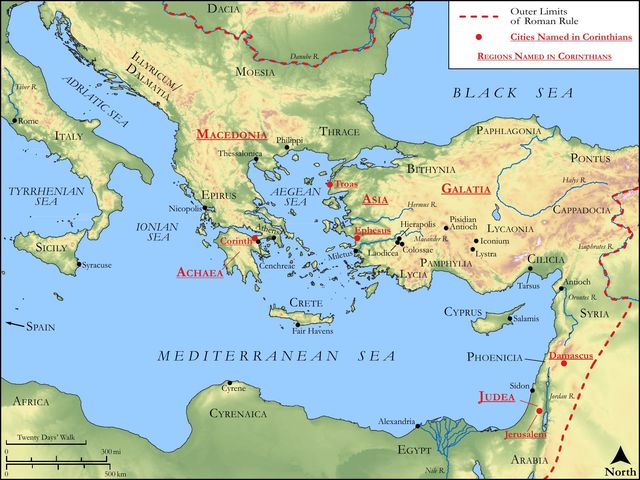
See on the biblical-era maps

Study this verse
Public-domain commentary
Matthew Henry
From his Commentary on the Whole Bible. Henry comments on passages, not single verses — this entry covers 1 Corinthians 15:1–11. His three-level outline is real structure in the source text, so it is rendered as structure.
It is the apostle's business in this chapter to assert and establish the doctrine of the resurrection of the dead, which some of the Corinthians flatly denied, Co1 15:12. Whether they turned this doctrine into allegory, as did Hymeneus and Philetus, by saying it was already past (Ti2 2:17, Ti2 2:18), and several of the ancient heretics, by making it mean no more than a changing of their course of life; or whether they rejected it as absurd, upon principles of reason and science; it seems they denied it in the proper sense. And they disowned a future state of recompences, by denying the resurrection of the dead. Now that heathens and infidels should deny this truth does not seem so strange; but that Christians, who had their religion by revelation, should deny a truth so plainly discovered is surprising, especially when it is a truth of such importance. It was time for the apostle to confirm them in this truth, when the staggering of their faith in this point was likely to shake their Christianity; and they were yet in great danger of having their faith staggered. He begins with an epitome or summary of the gospel, what he had preached among them, namely, the death and resurrection of Christ. Upon this foundation the doctrine of the resurrection of the dead is built. Note, Divine truths appear with greatest evidence when they are looked upon in their mutual connection. The foundation may be strengthened, that the superstructure may be secured. Now concerning the gospel observe,
I.What a stress he lays upon it (Co1 15:1, Co1 15:2): Moreover, brethren, I declare unto you the gospel which I preached to you.
1.It was what he constantly preached. His word was not yea and nay: he always preached the same gospel, and taught the same truth. He could appeal to his hearers for this. Truth is in its own nature invariable; and the infallible teachers of divine truth could never be at variance with themselves or one another. The doctrine which Paul had heretofore taught, he still taught.
2.It was what they had received; they had been convinced of the faith, believed it in their hearts, or at least made profession of doing so with their mouths. It was no strange doctrine. It was that very gospel in which, or by which, they had hitherto stood, and must continue to stand. If they gave up this truth, they left themselves no ground to stand upon, no footing in religion. Note, The doctrine of Christ's death and resurrection is at the foundation of Christianity. Remove this foundation, and the whole fabric falls, all our hopes for eternity sink at once. And it is by holding this truth firmly that Christians are made to stand in a day of trial, and kept faithful to God.
3.It was that alone by which they could hope for salvation (Co1 15:2), for there is no salvation in any other name; no name given under heaven by which we may be saved, but by the name of Christ. And there is no salvation in his name, but upon supposition of his death and resurrection. These are the saving truths of our holy religion. The crucifixion of our Redeemer and his conquest over death are the very source of our spiritual life and hopes. Now concerning these saving truths observe,
(1.)They must be retained in mind, they must be held fast (so the word is translated, Heb 10:23): Let us hold fast the profession of our faith. Note, The saving truths of the gospel must be fixed in our mind, revolved much in our thoughts, and maintained and held fast to the end, if we would be saved. They will not save us, if we do not attend to them, and yield to their power, and continue to do so to the end. He only that endureth to the end shall be saved, Mat 10:22.
(2.)We believe in vain, unless we continue and persevere in the faith of the gospel. We shall be never the better for a temporary faith; nay, we shall aggravate our guilt by relapsing into infidelity. And in vain is it to profess Christianity, or our faith in Christ, if we deny the resurrection; for this must imply and involve the denial of his resurrection; and, take away this, you make nothing of Christianity, you leave nothing for faith or hope to fix upon.
II.Observe what this gospel is, on which the apostle lays such stress.
It was that doctrine which he had received, and delivered to them, en prōtois - among the first, the principal. It was a doctrine of the first rank, a most necessary truth, That Christ died for our sins, and was buried, and rose again: or, in other words, that he was delivered for our offences and rose again for our justification (Rom 4:25), that he was offered in sacrifice for our sins, and rose again, to show that he had procured forgiveness for them, and was accepted of God in this offering. Note, Christ's death and resurrection are the very sum and substance of evangelical truth. Hence we derive our spiritual life now, and here we must found our hopes of everlasting life hereafter.
III.Observe how this truth is confirmed,
1.By Old Testament predictions. He died for our sins, according to the scriptures; he was buried, and rose from the dead, according to the scriptures, according to the scripture-prophecies, and scripture-types. Such prophecies as Psa 16:10; Isa 53:4-6; Dan 9:26, Dan 9:27; Hos 6:2. Such scripture-types as Jonah (Mat 12:4), as Isaac, who is expressly said by the apostle to have been received from the dead in a figure, Heb 11:19. Note, It is a great confirmation of our faith of the gospel to see how it corresponds with ancient types and prophecies.
2.By the testimony of many eye-witnesses, who saw Christ after he had risen from the dead. He reckons up five several appearances, beside that to himself. He was seen of Cephas, or Peter, then of the twelve, called so, though Judas was no longer among them, because this was their usual number; then he was seen of above five hundred brethren at once, many of whom were living when the apostle wrote this epistle, though some had fallen asleep. This was in Galilee, Mat 28:10. After that, he was seen of James singly, and then by all the apostles when he was taken up into heaven. This was on mount Olivet, Luk 24:50. Compare Act 1:2, Act 1:5-7. Note, How uncontrollably evident was Christ's resurrection from the dead, when so many eyes saw him at so many different times alive, and when he indulged the weakness of one disciple so far as to let him handle him, to put his resurrection out of doubt! And what reason have we to believe those who were so steady in maintaining this truth, though they hazarded all that was dear to them in this world, by endeavouring to assert and propagate it! Even Paul himself was last of all favoured with the sight of him. It was one of the peculiar offices of an apostle to be a witness of our Saviour's resurrection (Luk 24:48); and, when Paul was called to the apostolical office, he was made an evidence of this sort; the Lord Jesus appeared to him by the way to Damascus, Act 9:17. Having mentioned this favour, Paul takes occasion from it to make a humble digression concerning himself. He was highly favoured of God, but he always endeavoured to keep up a mean opinion of himself, and to express it. So he does here, by observing,
(1.)That he was one born out of due time (Co1 15:8), an abortive, ektrōma, a child dead born, and out of time. Paul resembled such a birth, in the suddenness of his new birth, in that he was not matured for the apostolic function, as the others were, who had personal converse with our Lord. He was called to the office when such conversation was not to be had, he was out of time for it. He had not known nor followed the Lord, nor been formed in his family, as the others were, for this high and honourable function. This was in Paul's account a very humbling circumstance.
(2.)By owning himself inferior to the other apostles: Not meet to be called an apostle. The least, because the last of them; called latest to the office, and not worthy to be called an apostle, to have either the office or the title, because he had been a persecutor of the church of God, Co1 15:9. Indeed, he tells us elsewhere that he was not a whit behind the very chief apostles (Co2 11:5) - for gifts, graces, service, and sufferings, inferior to none of them. Yet some circumstances in his case made him think more meanly of himself than of any of them. Note, A humble spirit, in the midst of high attainments, is a great ornament to any man; it sets his good qualities off to much greater advantage. What kept Paul low in an especial manner was the remembrance of his former wickedness, his raging and destructive zeal against Christ and him members. Note, How easily God can bring a good out of the greatest evil! When sinners are by divine grace turned into saints, he makes the remembrance of their former sins very serviceable, to make them humble, and diligent, and faithful.
(3.)By ascribing all that was valuable in him to divine grace: But by the grace of God I am what I am, Co1 15:10. It is God's prerogative to say, I am that I am; it is our privilege to be able to say, "By God's grace we are what we are." We are nothing but what God makes us, nothing in religion but what his grace makes us. All that is good in us is a stream from this fountain. Paul was sensible of this, and kept humble and thankful by this conviction; so should we. Nay, though he was conscious of his own diligence, and zeal, and service, so that he could say of himself, the grace of God was not given him in vain, but he laboured more abundantly than they all: he thought himself so much more the debtor to divine grace. Yet not I, but the grace of God which was with me. Note, Those who have the grace of God bestowed on them should take care that it be not in vain. They should cherish, and exercise, and exert, this heavenly principle. So did Paul, and therefore laboured with so much heart and so much success. And yet the more he laboured, and the more good he did, the more humble he was in his opinion of himself, and the more disposed to own and magnify the favour of God towards him, his free and unmerited favour. Note, A humble spirit will be very apt to own and magnify the grace of God. A humble spirit is commonly a gracious one. Where pride is subdued there it is reasonable to believe grace reigns.
After this digression, the apostle returns to his argument, and tells them (Co1 15:11) that he not only preached the same gospel himself at all times, and in all places, but that all the apostles preached the same: Whether it were they or I, so we preached, and so you believed. Whether Peter, or Paul, or any other apostle, had converted them to Christianity, all maintained the same truth, told the same story, preached the same doctrine, and confirmed it by the same evidence. All agreed in this that Jesus Christ, and him crucified and slain, and then rising from the dead, was the very sum and substance of Christianity; and this all true Christians believe. All the apostles agreed in this testimony; all Christians agree in the belief of it. By this faith they live. In this faith they die.
Historical interpretation
Four Centuries of Reception
6 surviving comments on this verse. Each one is dated, so this reads as a timeline rather than a list.
Select a marker to jump to its quote. Markers stagger vertically where authors wrote within a few decades of each other.
Remember in your prayers the Church in Syria, which now has God for its shepherd, instead of me. Jesus Christ alone will oversee it, and your love [will also regard it]. But as for me, I am ashamed to be counted one of them; for indeed I am not worthy, as being the very last of them, and one born out of due time. But I have obtained mercy to be somebody, if I shall attain to God. My spirit salutes you, and the love of the Churches that have received me in the name of Jesus Christ, and not as a mere passer-by. For even those Churches which were not near to me in the way, I mean according to the flesh, have gone before me, city by city, [to meet me.]
And that the Saviour appeared to her when she lay outside of the Pleroma as a kind of abortion, they affirm Paul to have declared in his Epistle to the Corinthians
After these points, Celsus proceeds to bring against the Gospel narrative a charge which is not to be lightly passed over, saying that "if Jesus desired to show that his power was really divine, he ought to have appeared to those who had ill-treated him, and to him who had condemned him, and to all men universally." For it appears to us also to be true, according to the Gospel account, that He was not seen after His resurrection in the same manner as He used formerly to show Himself — publicly, and to all men. But it is recorded in the Acts, that "being seen during forty days," He expounded to His disciples "the things pertaining to the kingdom of God." [Acts 1:3] And in the Gospels it is not stated that He was always with them; but that on one occasion He appeared in their midst, after eight days, when the doors were shut [John 20:26], and on another in some similar fashion. And Paul also, in the concluding portions of the first Epistle to the Corinthians, in reference to His not having publicly appeared as He did in the period before He suffered, writes as follows: "For I delivered unto you first of all that which I also received, how that Christ died for our sins according to the Scriptures; and that He was seen of Cephas, then of the twelve: after that He was seen of above five hundred brethren at once, of whom the greater part remain unto the present time, but some are fallen asleep. After that He was seen of James, then of all the apostles. And last of all He was seen of me also, as of one born out of due time." [1 Corinthians 15:3-8] I am of opinion now that the statements in this passage contain some great and wonderful mysteries, which are beyond the grasp not merely of the great multitude of ordinary believers, but even of those who are far advanced (in Christian knowledge), and that in them the reason would be explained why He did not show Himself, after His resurrection from the dead, in the same manner as before that event.
By “untimely” Paul means that he was born again outside time, because he received his apostleship from Christ after the latter had ascended into heaven.
"And last of all, as unto one born out of due time, he appeared to me also."
This is rather an expression of modesty than any thing else. For not because he was the least, therefore did he appear to him after the rest. Since even if He did call him last, yet he appeared more illustrious than many which were before him, yea rather than all. And the five hundred brethren too were not surely better than James, because He appeared to them before him.
Why did He not appear to all at the same time? That He might first sow the seeds of faith. For he that saw Him first and was exactly and fully assured, told it unto the residue: then their report coming first placed the hearer in expectation of this great wonder, and made way before for the faith of sight. Therefore neither did He appear to all together, nor in the beginning to many, but to one alone first, and him the leader of the whole company and the most faithful: since indeed there was great need of a most faithful soul to be first to receive this sight. For those who saw him after others had seen him, and heard it from them, had in their testimony what contributed in no small degree to their own faith and tended to prepare their mind beforehand; but he who was first counted worthy to see Him, had need, as I have said, of great faith, not to be confounded by a sight so contrary to expectation.
But after Peter, He appears also to each at intervals, and at one time to fewer, at another to more, hereby making them witnesses and teachers of each other, and rendering His apostles trustworthy in all that they said.
What mean here his expressions of humility, or wherein are they seasonable? For if he wishes to show himself worthy of credit and to enrol himself among the witnesses of the resurrection, he is doing the contrary of what he wishes: since it were meet that he exalt himself and show that he was great, which in many places he doth, the occasion calling for it. Well, the very reason why he here also speaks modestly is his being about to do this. Not straightway, however, but with his own peculiar good sense: in that having first spoken modestly and heaped up against himself many charges, he then magnifies the things concerning himself. What may the reason be? That, when he comes to utter that great and lofty expression concerning himself, "I labored more abundantly than all," his discourse may be rendered more acceptable, both hereby, and by its being spoken as a consequence of what went before and not as a leading topic. Therefore also writing to Timothy, and intending to say great things concerning himself, he first sets down his charges against himself. For so all persons, when speaking in high terms of others, speak out freely and with boldness: but he that is compelled to praise himself, and especially when he also calls himself to witness, is disconcerted and blushes. Therefore also this blessed man first declares his own misery, and then utters that lofty expression. This then he doth, partly to abate the offensiveness of speaking about himself, and partly that he might hereby recommend to their belief what he had to say afterwards. For he that truly states what things are discreditable to him and conceals none of them, such as that he persecuted the Church, that he laid waste the faith, doth hereby cause the things that are honorable to him also to be above suspicion.
And consider the exceeding greatness of his humility. For having said, "and last of all He appeared to me also," he was not content with this: "For many that are last shall be first," saith He, "and the first last." Therefore he added, "as unto one born out of due time." Neither did he stop here, but adds also his own judgment and with a reason.
But consider how he abounds in the expressions of humility. For so, "to me last of all He appeared," saith he. Wherefore neither doth he with himself mention any other, and saith, "as of one born out of due time," and that himself is "the least of the apostles," and not even worthy of this appellation. And he was not content even with these, but that he might not seem in mere words to be humble-minded, he states both reasons and proofs: of his being "one born out of due time," his seeing Jesus last; and of his being unworthy even of the name of an apostle, "his persecuting the Church." For he that is simply humble-minded doeth not this: but he that also sets down the reasons utters all from a contrite mind. Wherefore also he elsewhere makes mention of these same things, saying, "And I thank him that enabled me; even Christ Jesus our Lord, for that He counted me faithful, appointing me to his service, though I was before a blasphemer, and a persecutor, and injurious."
Paul compares himself here to an aborted fetus which is not even regarded by some as fully born.
Continue studying 1 Corinthians 15:8 across the web’s major study libraries — every link below opens this exact verse, chapter, or book on the destination site.
Read & Compare
 BibleGatewayThis verse in more than 200 translations and 70 languages.
 Bible.comThe YouVersion reader — hundreds of translations, reading plans, and highlights.
 ESV.orgCrossway's official English Standard Version reader.
 NET BibleThe NET translation with 60,000+ translators' notes on every rendering decision.
 STEP BibleTyndale House's free study tool — original text, vocabulary, and scholarly resources.
 BibliaLogos Bible Software's free web reader.
 USCCBThe New American Bible (Revised Edition) with the U.S. bishops' study notes.
Commentaries
 BibleHub CommentariesDozens of classic commentaries on this verse, gathered on one page.
 StudyLightMore than 100 commentary sets — the largest collection on the web.
 BibleRefPlain-English commentary on what this verse means, verse by verse.
 Enduring WordDavid Guzik's free commentary on this chapter, widely used by Bible teachers.
 Bible Study ToolsVerse commentary alongside Greek and Hebrew study aids.
Original Language & Research
- BibleHub InterlinearThe verse word by word — original language, transliteration, and English.
- BibleHub LexiconEvery word's original-language definition and Strong's entry.
 Blue Letter BibleDeep-study tools — Strong's numbers, concordance, and word studies.
 CNTR CollationThe earliest Greek manuscripts of this verse, collated letter by letter.
Sermons, Hymns & Audio


TrulyRandomVerse is not affiliated with these sites and doesn’t control their content. They’re linked because they’re genuinely useful.
Summary
In 1 Corinthians 15:8, the Apostle Paul concludes his compelling list of eyewitnesses to the resurrection of Jesus Christ, uniquely positioning his own transformative encounter with the risen Lord. This verse serves as a profound testament to the historical reality of Christ's resurrection, while simultaneously offering a window into Paul's deep humility and the extraordinary, grace-filled nature of his apostolic calling, emphasizing that even the most unlikely individuals can be radically transformed and commissioned by divine power.
Context
ShowHideLiterary Context
Paul's argument in 1 Corinthians 15 is a robust defense of the bodily resurrection of Christ and, by extension, the future resurrection of believers. He begins by establishing the core gospel message—Christ's death, burial, and resurrection according to the Scriptures (1 Corinthians 15:3-4). To substantiate this, he meticulously lists a series of post-resurrection appearances: to Peter, then to the twelve, then to over five hundred brethren at once, then to James, and finally to all the apostles (1 Corinthians 15:5-7). Verse 8, therefore, functions as the climactic and personal capstone to this irrefutable chain of testimony, highlighting Paul's own direct, albeit distinct, experience with the resurrected Lord, which he then contrasts with his past as a persecutor in the subsequent verses (1 Corinthians 15:9-10).
Historical & Cultural Context
The city of Corinth was a bustling, cosmopolitan port city, notorious for its moral laxity and diverse philosophical currents, including various forms of Greek thought that often disdained the idea of bodily resurrection. Within the Corinthian church, some members were denying the resurrection of the dead, likely influenced by these prevailing Hellenistic philosophies that valued the spiritual over the physical. Paul's forceful articulation of the resurrection was thus a direct challenge to these cultural assumptions and a foundational assertion against theological error. Furthermore, Paul himself was a Jew of the tribe of Benjamin, a Pharisee, and a zealous persecutor of the early Christian church (Philippians 3:5-6). His dramatic conversion on the Damascus Road, where he encountered the risen Christ (Acts 9:1-19), was a pivotal historical event that transformed him from an enemy of the gospel into its most ardent proponent, lending unique weight and credibility to his testimony.
Key Themes
ShowHideThis verse powerfully contributes to several overarching themes within 1 Corinthians and Paul's broader theology. Firstly, it underscores The Certainty and Centrality of the Resurrection, presenting Paul's personal encounter as undeniable proof that validates the entire Christian message. Without the resurrection, faith is futile (1 Corinthians 15:14). Secondly, it highlights God's Sovereign Grace and Unconventional Calling, demonstrating that God can choose and transform anyone, regardless of their past. Paul, who considered himself the "least of the apostles" (1 Corinthians 15:9), was called by divine initiative, not human merit. This theme resonates with God's pattern of choosing the weak and foolish to confound the wise (1 Corinthians 1:27-29). Thirdly, it speaks to The Nature of Apostolic Authority, as Paul's direct vision of the risen Christ was essential for his claim to apostleship, placing him on par with those who had seen Jesus before His ascension.
Exposition and Analysis
ShowHideKey Word Analysis
ShowHideThis word, a superlative, denotes something that is farthest, final, or uttermost in terms of place or time. Paul's use of "last of all" (ἔσχατον πάντων) emphasizes the chronological order of Christ's appearances, positioning his own encounter as the ultimate, concluding manifestation in this specific sequence of resurrection testimonies. It highlights the definitive and conclusive nature of his vision, marking the end of the initial post-resurrection appearances to individuals and groups.
This verb describes a specific kind of seeing—a gazing with wide-open eyes, as at something remarkable or awe-inspiring. It implies a direct, personal, and profound visual experience, distinct from mere casual observation. Paul's choice of this word emphasizes that his encounter with the risen Christ was not a dream or a fleeting thought, but a vivid, undeniable, and transformative revelation that fundamentally altered the course of his life and ministry.
This vivid and somewhat shocking term literally refers to a miscarriage, an abortion, or something prematurely born. Paul uses this powerful metaphor to describe himself with profound humility and self-awareness. It conveys several layers of meaning: his calling was "irregular" or "abnormal" compared to the other apostles who followed Jesus during His earthly ministry; it reflects his deep sense of unworthiness due to his past as a persecutor of the church; and it underscores the sudden, abrupt, and miraculous nature of his spiritual birth and apostolic commissioning, a direct and unexpected intervention of God.
Verse Breakdown
ShowHide"And last of all"
This phrase marks the culmination of Paul's preceding list of Christ's resurrection appearances. It signifies that Paul's encounter was the final one in this specific series of personal testimonies, underscoring its unique position and perhaps its definitive nature as the last direct, physical appearance of the resurrected Lord to an individual for the purpose of establishing apostolic witness.
"he was seen of me also"
This clause asserts Paul's direct, personal, and undeniable experience of seeing the risen Christ. The passive voice ("he was seen") emphasizes that the initiative came from Christ, a divine revelation rather than a human quest. The inclusion of "also" (καγώ) links his experience directly to the preceding witnesses, affirming the same resurrected Lord appeared to him as to Peter, James, and the others, thereby validating his apostolic claim.
"as of one born out of due time"
This powerful and humble self-description reveals Paul's profound sense of unworthiness and the irregular nature of his calling. The Greek term éktrōma (miscarriage or untimely birth) conveys that his apostleship was not "on schedule" or "normal" like the others who were discipled by Jesus during His earthly ministry. It highlights the sudden, unexpected, and grace-filled intervention of God that transformed him from a persecutor into an apostle, acknowledging his past while magnifying God's sovereign choice and power.
Literary Devices
ShowHidePaul employs several potent literary devices in this concise verse. The most prominent is Metaphor, specifically the striking image of being "born out of due time" (éktrōma). This vivid and somewhat jarring metaphor powerfully conveys Paul's profound Humility and sense of unworthiness, contrasting his violent past as a persecutor with the unexpected grace of his divine calling. It also highlights the Irregularity and Suddenness of his apostolic commissioning, which occurred post-ascension and without the prior discipleship experienced by the other apostles. Furthermore, there's an element of Irony in Paul, the former persecutor, being the "last" but profoundly effective witness, chosen by the very Christ he sought to destroy. The use of "last of all" also functions as a Climax in his enumeration of witnesses, drawing attention to his unique and personal testimony.
Theological and Thematic Connections
ShowHideThis verse profoundly underscores the sovereign and transformative power of God's grace, demonstrating His ability to call and use anyone for His purposes, regardless of their past or perceived unworthiness. Paul's encounter with the risen Christ was not merely a personal vision but a divine commissioning that validated his apostleship and the gospel he proclaimed. It asserts that the resurrection is not just a theological concept but a historical reality attested by multiple, diverse witnesses, culminating in Paul's own dramatic conversion. This serves as a powerful reminder that God's redemptive plan often unfolds through unexpected instruments, magnifying His glory rather than human merit.
Reflection and Application
ShowHidePaul's testimony in 1 Corinthians 15:8 offers profound encouragement and vital lessons for believers today. His radical transformation from a zealous persecutor to a fervent apostle by a direct encounter with the risen Christ reminds us that no one is beyond the reach of God's redemptive power. This verse challenges any notion that our past mistakes, perceived inadequacies, or unconventional journeys disqualify us from God's service. Instead, it magnifies God's boundless grace, demonstrating His capacity to choose the weak, the unlikely, and even the hostile to accomplish His glorious purposes. For us, this means embracing humility, recognizing that any effectiveness in ministry flows from God's enabling grace rather than our own merit, and remaining open to God's surprising calls, even if they feel "out of due time" or unconventional by human standards. It invites us to trust that the same Risen Lord who appeared to Paul desires to work powerfully in and through our lives, transforming us and equipping us for His kingdom.
Questions for Reflection
ShowHideFAQ
ShowHideWhy does Paul refer to himself as "one born out of due time"?
ShowHidePaul's self-description as "one born out of due time" (Greek: éktrōma) is a profound expression of his humility and self-awareness, stemming from several factors. Firstly, it refers to the irregular and unexpected nature of his apostolic call. Unlike the other apostles who walked with Jesus during His earthly ministry and were discipled over time, Paul's encounter with the risen Christ occurred suddenly and dramatically on the Damascus Road, after Christ's ascension (Acts 9:3-6). This was not the "normal" way an apostle was commissioned. Secondly, it reflects his deep sense of unworthiness due to his past as a zealous persecutor of the early church, a fact he often lamented (1 Corinthians 15:9). The term éktrōma literally means a miscarriage or an untimely birth, conveying a sense of abnormality or being unfit. By using this vivid metaphor, Paul emphasizes that his apostleship was entirely a result of God's sovereign grace and not his own merit or a natural progression, thereby magnifying the power and mercy of God who chose even him.
Christ-Centered Fulfillment
ShowHidePaul's testimony in 1 Corinthians 15:8, where he declares that the risen Christ "was seen of me also, as of one born out of due time," is profoundly Christ-centered. It culminates his litany of resurrection appearances, solidifying the historical reality of Jesus' triumph over death, which is the cornerstone of Christian faith. Paul's encounter was not merely a personal vision but a direct manifestation of the living Lord, essential for his apostolic commission to proclaim the gospel to the Gentiles (Galatians 1:15-16). The very fact that Christ appeared to Paul, a former persecutor, powerfully demonstrates the boundless reach of His redemptive grace and the extent of His victory. It underscores that the resurrected Christ is not limited by human expectations or past failures, but actively intervenes in history to transform lives and advance His kingdom. This appearance to Paul foreshadows Christ's ongoing work through His Spirit, empowering believers for ministry, just as He empowered Paul, to be witnesses of His resurrection and the new life it brings (Acts 1:8). Thus, this verse is a testament to the living, reigning Christ, who continues to call, transform, and equip His people by His sovereign power and grace, making even the "unlikely" instruments of His glorious purpose.