


1 Corinthians 9:1
- ΟὐκOukSurelyG3756PRT-NNegative Particle Negative
- εἰμὶeimiI amG1510V-PAI-1SVerb Present Active Indicative 1st Singular
- ἐλεύθερος;eleutherosfree?G1658A-NSMAdjective Nominative Singular Masculine
- οὐκoukSurelyG3756PRT-NNegative Particle Negative
- εἰμὶeimiI amG1510V-PAI-1SVerb Present Active Indicative 1st Singular
- ἀπόστολος;apostolosan apostleG652N-NSMNoun Nominative Singular Masculine
- οὐχὶouchiSurelyG3780PRT-NNegative Particle Negative
- ἸησοῦνIēsounJesusG2424N-ASM-PNoun Accusative Singular Masculine Individual
- ΧριστὸνChristonChristG5547N-ASM-TNoun Accusative Singular Masculine Title
- τὸνtontheG3588T-ASMDefinite article Accusative Singular Masculine
- κύριονkurionLordG2962N-ASM-TNoun Accusative Singular Masculine Title
- ἡμῶνhēmōnof usG3165P-1GPPersonal pronoun Genitive 1st Plural
- ἑόρακα;he'orakahave I seen?G3708V-RAI-1SVerb Perfect Active Indicative 1st Singular
- οὐouSurelyG3756PRT-NNegative Particle Negative
- τὸtotheG3588T-NSNDefinite article Nominative Singular Neuter
- ἔργονergonworkG2041N-NSNNoun Nominative Singular Neuter
- μουmouof mineG3165P-1GSPersonal pronoun Genitive 1st Singular
- ὑμεῖςhumeisyou yourselvesG4771P-2NPPersonal pronoun Nominative 2nd Plural
- ἐστεesteareG1510V-PAI-2PVerb Present Active Indicative 2nd Plural
- ἐνeninG1722PREPPreposition
- κυρίῳ;kuriō[the] Lord?G2962N-DSM-TNoun Dative Singular Masculine Title
English is a literal word-by-word gloss of the Greek, not the KJV's wording. Why?
This is the original text the KJV's translators worked from — each Greek word with its own literal English meaning in this verse, prepared by scholars at Tyndale House, Cambridge. The KJV translates whole sentences, not word by word, so its wording differs: one Greek word can become several English words, and the KJV may choose “charity” where the gloss reads “love”. Both are faithful — they answer different questions. For the KJV's own rendering, switch to the KJV text.
Details
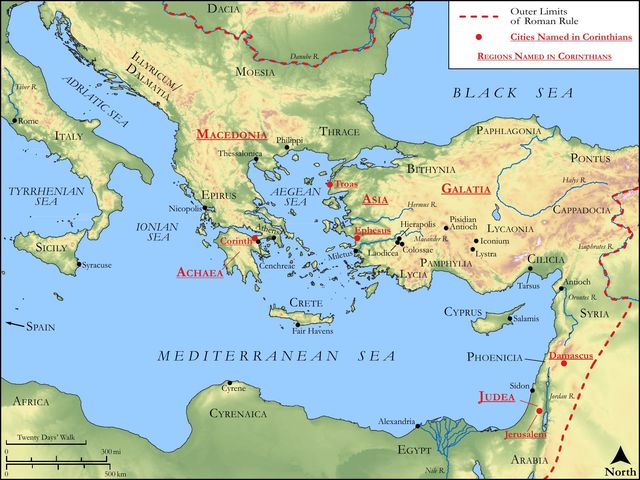
See on the biblical-era map

Study this verse
Public-domain commentary
Matthew Henry
From his Commentary on the Whole Bible. Henry comments on passages, not single verses — this entry covers 1 Corinthians 9:1–2.
Blessed Paul, in the work of his ministry, not only met with opposition from those without, but discouragement from those within. He was under reproach; false brethren questioned his apostleship, and were very industrious to lessen his character and sink his reputation; particularly here at Corinth, a place to which he had been instrumental in doing much good, and from which he had deserved well; and yet there were those among them who upon these heads created him great uneasiness. Note, It is no strange nor new thing for a minister to meet with very unkind returns for great good-will to a people, and diligent and successful services among them. Some among the Corinthians questioned, if they did not disown, his apostolical character. To their cavils he here answers, and in such a manner as to set forth himself as a remarkable example of that self-denial, for the good of others, which he had been recommending in the former chapter. And, 1. He asserts his apostolical mission and character: Am I not an apostle? Have I not seen Jesus Christ our Lord? To be a witness of his resurrection was one great branch of the apostolical charge. "Now," says Paul, "have not I seen the Lord, though not immediately after his resurrection, yet since his ascent?" See Co1 4:8. "Am I not free? Have I not the same commission, and charge, and powers, with the other apostles? What respect, or honour, or subsistence, can they challenge, which I am not at liberty to demand as well as they?" It was not because he had no right to live of the gospel that he maintained himself with his own hands, but for other reasons. 2. He offers the success of his ministry among them, and the good he had done to them, as a proof of his apostleship: "Are not you my work in the Lord? Through the blessing of Christ on my labours, have not I raised a church among you? The seal of my apostleship are you in the Lord. Your conversion by my means is a confirmation from God of my mission." Note, The ministers of Christ should not think it strange to be put upon the proof of their ministry by some who have had experimental evidence of the power of it and the presence of God with it. 3. He justly upbraids the Corinthians with their disrespect: "Doubtless, if I am not an apostle to others, I am so to you, Co1 9:2. I have laboured so long, and with so much success, among you, that you, above all others, should own and honour my character, and not call it in question." Note, It is no new thing for faithful ministers to meet with the worst treatment where they might expect the best. This church at Corinth had as much reason to believe, and as little reason to question, his apostolical mission, as any; they had as much reason, perhaps more than any church, to pay him respect. He had been instrumental in bringing them to the knowledge and faith of Christ; he laboured long among them, nearly two years, and he laboured to good purpose, God having much people among them. See Act 18:10, Act 18:11. It was aggravated ingratitude for this people to call in question his authority.
Historical interpretation
Two Centuries of Reception
4 surviving comments on this verse. Each one is dated, so this reads as a timeline rather than a list.
Select a marker to jump to its quote. Markers stagger vertically where authors wrote within a few decades of each other.
Nor indeed, if, among the Greeks, in accordance with the carelessness of custom, women and wives are classed under a common name-however, there is a name proper to wives-shall we therefore so interpret Paul as if he demonstrates the apostles to have had wives? For if he were disputing about marriages, as he does in the sequel, where the apostle could better have named some particular example, it would appear right for him to say, "For have we not the power of leading about wives, like the other apostles and Cephas? "But when he subjoins those (expressions)which show his abstinence from (insisting on) the supply of maintenance, saying, "For have we not the power of eating and drinking? "he does not demonstrate that "wives" were led about by the apostles, whom even such as have not still have the power of eating and drinking; but simply "women," who used to minister to them in the stone way (as they did) when accompanying the Lord.
"No man hath seen God at any time." What God does he mean? The Word? But he has already said: "Him we have seen and heard, and our hands have handled the Word of life." Well, (I must again ask, ) what God does he mean? It is of course the Father, with whom was the Word, the only begotten Son, who is in the bosom of the Father, and has Himself declared Him. He was both heard and seen and, that He might not be supposed to be a phantom, was actually handled. Him, too, did Paul behold; but yet he saw not the Father. "Have I not," he says, "seen Jesus Christ our Lord? " Moreover, he expressly called Christ God, saying: "Of whom are the fathers, and of whom as concerning the flesh Christ came, who is over all, God blessed for ever."
And, "(I think) God hath selected us the apostles (as) hindmost, like men appointed to fight with wild beasts; since we have been made a spectacle to this world, both to angels and to men: "And, "We have been made the offscourings of this world, the refuse of all: "And, "Am I not free? am I not an apostle? have I not seen Christ Jesus our Lord? " With what kind of superciliousness, on the contrary, was he compelled to declare, "But to me it is of small moment that I be interrogated by you, or by a human court-day; for neither am I conscious to myself (of any guilt); "and, "My glory none shall make empty.
"Am I not an Apostle? am I not free? have I not seen Jesus Christ our Lord? are not ye my work in the Lord?"
Inasmuch as he had said, "If meat make my brother to stumble I will eat no flesh forever;" a thing which he had not yet done, but professed he would do if need require: lest any man should say, "Thou vauntest thyself at random, and art severe in discourse, and utterest words of promise, a thing easy to me or to any body; but if these sayings come from thy heart, shew by deeds something which thou hast slighted in order to avoid making thy brother stumble:" for this cause, I say, in what follows he is compelled to enter on the proof of this also, and to point out how he was used to forego even things permitted that he might not give offence, although without any law to enforce his doing so.
And we are not yet come to the admirable part of the matter: though it be admirable that he abstain even from things lawful to avoid offence: but it is his habit of doing so at the cost of so much trouble and danger "For why," saith he, "speak of the idol sacrifices? Since although Christ had enjoined that those who preach the Gospel should live at the charge of their disciples, I did not so, but chose, if need were, to end my life with famine and die the most grievous of deaths, so I might avoid receiving of those whom I instruct."
Not because they would otherwise be made to stumble, but because his not receiving would edify them: a much greater thing for him to do. And to witness this he summons themselves, among whom he was used to live in toil and in hunger, nourished by others, and put to straits, in order not to offend them. And yet there was no ground for their taking offence, for it would but have been a law which he was fulfilling. But for all this, by a sort of supererogation he used to spare them.
"Am I not an Apostle?" For besides all that hath been said, this also makes no small difference that Paul himself is the person thus conducting himself. As thus: To prevent their alleging, "You may taste of the sacrifices, sealing at the same time:" for a while he withstands not that statement, but argues, "Though it were lawful, your brethren's harm should keep you from doing so;" and afterwards he proves that it is not even lawful. In this particular place, however, he establishes the former point from circumstances relating to himself. And intending presently to say that he had received nothing from them, he sets it not down at once, but his own dignity is what he first affirms: "Am I not an Apostle? am I not free?"
Thus, to hinder their saying, "True; thou didst not receive, but the reason thou didst not was its not being lawful;" he sets down therefore first the causes why he might reasonably have received, had he been willing to do so.
Further: that there might not seem to be any thing invidious in regard of Peter and such as Peter, in his saying these things, (for they did not use to decline receiving;) he first shows that they had authority to receive, and then that no one might say, "Peter had authority to receive but thou hadst not," he possesses the hearer beforehand with these encomiums of himself. And perceiving that he must praise himself, (for that was the way to correct the Corinthians,) yet disliking to say any great thing of himself, see how he hath tempered both feelings as the occasion required: limiting his own panegyric, not by what he knew of himself, but by what the subject of necessity required. For he might have said, "I most of all had a right to receive, even more than they, because 'I labored more abundantly than they.'" But this he omits, being a point wherein he surpassed them; and those points wherein they were great and which were just grounds for their receiving, those only he sets down.
"Am I not an Apostle? am I not free?" i.e. "have I not authority over myself? am I under any, to overrule me and forbid my receiving?"
"But they have an advantage over you, in having been with Christ."
"Nay, neither is this denied me." With a view to which he saith, "Have I not seen Jesus Christ our Lord?" For "last of all," saith he, "as unto one born out of due time, He appeared unto me also." Now this likewise was no small dignity: since "many Prophets," saith He, "and righteous men have desired to see the things which ye see, and have not seen them:" and, "Days will come when ye shall desire to see one of these days."
"What then, though thou be 'an Apostle,' and 'free,' and hast 'seen Christ,' if thou hast not exhibited any work of an Apostle; how then can it be right for thee to receive?" Wherefore after this he adds, "Are not ye my work in the Lord?" For this is the great thing; and those others avail nothing, apart from this. Even Judas himself was "an Apostle," and "free," and "saw Christ;" but because he had not "the work of an Apostle," all those things profited him not. You see then why he adds this also, and calls themselves to be witnesses of it.
Moreover, because it was a great thing which he had uttered, see how he chastens it, adding, "In the Lord:" i.e., "the work is God's, not mine."
Continue studying 1 Corinthians 9:1 across the web’s major study libraries — every link below opens this exact verse, chapter, or book on the destination site.
Read & Compare
 BibleGatewayThis verse in more than 200 translations and 70 languages.
 Bible.comThe YouVersion reader — hundreds of translations, reading plans, and highlights.
 ESV.orgCrossway's official English Standard Version reader.
 NET BibleThe NET translation with 60,000+ translators' notes on every rendering decision.
 STEP BibleTyndale House's free study tool — original text, vocabulary, and scholarly resources.
 BibliaLogos Bible Software's free web reader.
 USCCBThe New American Bible (Revised Edition) with the U.S. bishops' study notes.
Commentaries
 BibleHub CommentariesDozens of classic commentaries on this verse, gathered on one page.
 StudyLightMore than 100 commentary sets — the largest collection on the web.
 BibleRefPlain-English commentary on what this verse means, verse by verse.
 Enduring WordDavid Guzik's free commentary on this chapter, widely used by Bible teachers.
 Bible Study ToolsVerse commentary alongside Greek and Hebrew study aids.
Original Language & Research
- BibleHub InterlinearThe verse word by word — original language, transliteration, and English.
- BibleHub LexiconEvery word's original-language definition and Strong's entry.
 Blue Letter BibleDeep-study tools — Strong's numbers, concordance, and word studies.
 CNTR CollationThe earliest Greek manuscripts of this verse, collated letter by letter.
Sermons, Hymns & Audio


TrulyRandomVerse is not affiliated with these sites and doesn’t control their content. They’re linked because they’re genuinely useful.
Summary
In 1 Corinthians 9:1, the Apostle Paul initiates a vigorous defense of his apostolic authority and personal liberty, setting the stage for his subsequent discourse on the rights and responsibilities of Christian ministry. Through a series of four probing rhetorical questions, Paul directly challenges any doubts or accusations leveled against his legitimate calling, asserting his divine commission, his freedom in Christ, his unique encounter with the resurrected Lord, and the Corinthian believers themselves as irrefutable evidence of his authentic ministry. This verse is foundational to understanding Paul's sacrificial approach to ministry and his unwavering commitment to the unimpeded proclamation of the gospel.
Context
ShowHideLiterary Context
This verse marks a significant transition in Paul's letter to the Corinthians. Having just concluded his discussion on Christian liberty and the importance of not causing others to stumble (chapters 8-10), particularly concerning eating meat offered to idols, Paul now pivots to defend his own apostolic practices. The Corinthians were likely questioning his decision to forgo financial support, perhaps seeing it as a sign of weakness or lack of true apostleship, especially when compared to other teachers or "super-apostles" who did accept support. Paul's defense here is not self-serving but aims to establish his authority so that his teachings on self-sacrifice for the sake of the gospel will be received with the weight they deserve. This section (9:1-27) serves as a personal illustration of the principles of self-denial and seeking the good of others that he has just expounded.
Historical & Cultural Context
First-century Corinth was a bustling, cosmopolitan port city, a melting pot of cultures, philosophies, and religions. It was known for its wealth, but also its moral laxity and a strong emphasis on rhetoric and public speaking. In this environment, religious teachers and philosophers often charged fees for their instruction, and their status was sometimes tied to their material success or the support they received from patrons. Paul, by contrast, often worked with his hands (e.g., tentmaking, Acts 18:3) to support himself, which might have been perceived by some Corinthians as a sign of inferiority or a lack of divine backing, as true "masters" were expected to be supported by their disciples. Paul's defense, therefore, directly confronts these cultural expectations, asserting that his freedom to waive his rights was a strength, not a weakness, and was done for the strategic advancement of the gospel.
Key Themes
ShowHideThe overarching theme of Apostolic Authority is central to 1 Corinthians 9:1. Paul is not merely asserting his personal status but defending the very nature of the gospel he preaches, which derives its power from its divinely appointed messengers. His declaration "Am I not free?" introduces the theme of Christian Liberty, a concept he has explored extensively in previous chapters (e.g., 1 Corinthians 8:9). Here, he applies it to his own life, demonstrating that true freedom involves the voluntary surrender of rights for a greater purpose. The mention of having "seen Jesus Christ our Lord" underscores the theme of Divine Commission and Revelation, a unique hallmark of the apostleship, particularly for Paul whose call was outside the original twelve. Finally, the rhetorical question "are not ye my work in the Lord?" highlights the theme of Evidential Ministry, where the fruit of one's labor, specifically the conversion and spiritual growth of believers, serves as tangible proof of God's anointing and the authenticity of the minister's calling. This theme resonates throughout the chapter as Paul points to the Corinthians themselves as his "seal of apostleship" (1 Corinthians 9:2).
Exposition and Analysis
ShowHideKey Word Analysis
ShowHideFrom ἀποστέλλω; a delegate; specially, an ambassador of the Gospel; officially a commissioner of Christ ("apostle") (with miraculous powers). Paul's use of "apostle" is not merely a title but a declaration of his divine commission. It signifies someone "sent forth" by a supreme authority with a specific message and mission, implying direct authorization from Christ himself, which was critical for validating his gospel message.
Probably from the alternate of ἔρχομαι; unrestrained (to go at pleasure), i.e. (as a citizen) not a slave (whether freeborn or manumitted), or (genitive case) exempt (from obligation or liability). Paul's question "am I not free?" refers to his liberty in Christ, particularly his freedom from the obligation to receive financial support, and his autonomy in making choices concerning his ministry, all exercised for the strategic advancement of the gospel.
From a primary (but obsolete) (to work); toil (as an effort or occupation); by implication, an act. When Paul refers to the Corinthians as his "work," he is emphasizing that their very existence as a church, their conversion, and their spiritual growth are the tangible, undeniable results of his labor and God's power working through him. They are the fruit and proof of his legitimate apostolic ministry.
Verse Breakdown
ShowHide"Am I not an apostle?"
This opening rhetorical question immediately asserts Paul's primary claim to authority. It challenges any doubt about his divinely appointed status as one specifically commissioned by Christ, placing him on par with other apostles despite not being one of the original twelve.
"am I not free?"
This second question addresses Paul's personal liberty, particularly his freedom from external constraints or obligations, including the right to financial support. It sets up his argument that he voluntarily chose to forgo this right for the sake of the gospel, showcasing his autonomy and self-sacrifice.
"have I not seen Jesus Christ our Lord?"
This is a crucial validation of Paul's apostleship. Direct eyewitness testimony of the resurrected Christ was a primary qualification for apostleship (Acts 1:21-22). Paul's unique Damascus Road experience (e.g., Acts 9:3-6) provided this personal, revelatory encounter, establishing the legitimacy of his commission despite not having walked with Jesus during His earthly ministry.
"are not ye my work in the Lord?"
This final question points to the Corinthian believers themselves as living, undeniable proof of Paul's authentic ministry. Their conversion, the establishment of their church, and their spiritual formation were direct results of his apostolic labor, performed "in the Lord," meaning by divine power and for God's glory. They are the "seal" or validation of his apostleship.
Literary Devices
ShowHidePaul masterfully employs Rhetorical Questions throughout this verse, not to elicit information, but to make forceful assertions and challenge his opponents. Each question ("Am I not an apostle? Am I not free? Have I not seen Jesus Christ our Lord? Are not ye my work in the Lord?") serves as an undeniable declaration, designed to lead the audience to an inescapable affirmative conclusion. This technique is highly persuasive, compelling the reader to agree with Paul's self-evident claims. Furthermore, the verse functions as an Apostolic Defense, where Paul systematically presents his credentials, moving from his divinely bestowed title to his personal experience with Christ, and finally to the tangible evidence of his ministry in the lives of the Corinthians. This layered argumentation builds an irrefutable case for his authority and legitimacy. The phrase "my work in the Lord" also contains Metonymy, where "work" stands for the fruit or result of his labor, emphasizing the spiritual transformation of the Corinthians as the ultimate validation of his calling.
Theological and Thematic Connections
ShowHidePaul's defense in 1 Corinthians 9:1 is not merely about personal vindication but underscores profound theological truths about the nature of apostolic authority, Christian freedom, and the validating power of spiritual fruit. His unique encounter with the resurrected Christ highlights the direct, personal call that undergirds true ministry, a call that transcends human qualifications or endorsements. The Corinthian believers themselves serve as a powerful testament to God's work through Paul, demonstrating that authentic ministry is ultimately evidenced by transformed lives. This passage reminds us that while God calls individuals, He also provides the enabling power, and the ultimate proof of His calling is seen in the spiritual harvest.
Reflection and Application
ShowHidePaul's passionate self-defense in 1 Corinthians 9:1 offers timeless principles for believers today. It challenges us to consider the source and validation of spiritual authority, reminding us that true ministry is rooted in a divine call and evidenced by the fruit it produces in the lives of others. We are called to exercise our Christian liberty not for selfish gain, but with a view towards the advancement of the gospel and the edification of others, being willing to forgo personal rights for the sake of a greater good. This verse encourages us to reflect on our own "work in the Lord" – how are we serving, and what fruit is God producing through our lives? It also prompts us to stand firm in our convictions and God-given calling, even when faced with skepticism or opposition, always pointing to Christ as the ultimate source of our identity and purpose.
Questions for Reflection
ShowHideFAQ
ShowHideWas Paul's claim to have "seen Jesus Christ" a literal, physical sighting, or a spiritual vision?
ShowHidePaul's claim to have "seen Jesus Christ our Lord" (G3708, horáō) refers to a literal, personal, and transformative encounter with the resurrected Christ. While his initial encounter on the Damascus Road (as recounted in Acts 9, Acts 22, and Acts 26) was certainly a visionary experience, it was understood by Paul and the early church as a direct, personal appearance of the risen Lord, akin to the post-resurrection appearances to the other apostles. This experience was crucial for validating his apostleship, as direct eyewitness testimony of the resurrected Christ was a key qualification for being an apostle (Acts 1:21-22). Paul considered this encounter to be as real and authoritative as those experienced by Peter or James, even though it occurred after Christ's ascension.
Christ-Centered Fulfillment
ShowHidePaul's powerful self-defense in 1 Corinthians 9:1 finds its ultimate fulfillment and meaning in the person and work of Jesus Christ. Paul's apostleship, his freedom, his vision of the Lord, and the fruit of his ministry are all direct outpourings of Christ's sovereign will and redemptive power. The very concept of an "apostle" is Christ-centered, as it signifies one "sent" by Christ himself, mirroring Christ's own mission as the ultimate "sent one" from the Father (John 20:21). Paul's freedom is not an arbitrary human right but a liberty granted and empowered by Christ, enabling him to serve without constraint for the gospel's sake, embodying the sacrificial love of Christ who, though free, "made himself nothing" (Philippians 2:7). His seeing "Jesus Christ our Lord" is the very foundation of his authority, directly connecting his ministry to the resurrected Head of the Church, who continues to commission and empower His servants (Matthew 28:18-20). Finally, the Corinthian believers being Paul's "work in the Lord" points to Christ as the true builder of His church (Matthew 16:18), with Paul merely an instrument. Their transformation is a testament to the life-changing power of the gospel of Christ, demonstrating that all true spiritual fruit is ultimately "in the Lord," accomplished by His Spirit and for His glory, making Christ the source, substance, and goal of all authentic ministry.