


2 Corinthians 10:8
Bible text: King James Version (1769 Blayney text) · Public domain
Bible text: King James Version with Strong's numbers · Public domain
Bible text: Berean Standard Bible · Public domain
Bible text: American Standard Version (1901) · Public domain
Bible text: World English Bible, Messianic edition · Public domain
Bible text: Geneva Bible (1599) · Public domain
Bible text: Young's Literal Translation · Public domain
- ἐάνeanIfG1437CONDConjunction
- τεteevenG5037CONJConjunction
- γὰρgarforG1063CONJConjunction
- καὶkaiandG2532CONJConjunction
- περισσότερόνperissoteronmore excessiveG4055A-ASN-CAdjective Accusative Singular Neuter Comparative
- τιtisomewhatG5100X-ASNIndefinite pronoun Accusative Singular Neuter
- καυχήσωμαιkauchēsōmaiI shall boastG2744V-ADS-1SVerb Aorist Middle Deponent Subjunctive 1st Singular
- περὶpericoncerningG4012PREPPreposition
- τῆςtēstheG3588T-GSFDefinite article Genitive Singular Feminine
- ἐξουσίαςexousiasauthorityG1849N-GSFNoun Genitive Singular Feminine
- ἡμῶνhēmōnof usG3165P-1GPPersonal pronoun Genitive 1st Plural
- ἧςhēswhichG3739R-GSFRelative pronoun Genitive Singular Feminine
- ἔδωκενedōkenhas givenG1325V-AAI-3SVerb Aorist Active Indicative 3rd Singular
- ὁhotheG3588T-NSMDefinite article Nominative Singular Masculine
- κύριοςkuriosLordG2962N-NSM-TNoun Nominative Singular Masculine Title
- ἡμῖνhēminto usG3165P-1DPPersonal pronoun Dative 1st Plural
- εἰςeisforG1519PREPPreposition
- οἰκοδομὴνoikodomēnbuilding [you] upG3619N-ASFNoun Accusative Singular Feminine
- καὶkaiandG2532CONJConjunction
- οὐκouknotG3756PRT-NNegative Particle Negative
- εἰςeisforG1519PREPPreposition
- καθαίρεσινkathairesintearing downG2506N-ASFNoun Accusative Singular Feminine
- ὑμῶνhumōnyouG4771P-2GPPersonal pronoun Genitive 2nd Plural
- οὐκouknotG3756PRT-NNegative Particle Negative
- αἰσχυνθήσομαι·aischunthēsomaiI will be ashamedG153V-FPI-1SVerb Future Passive Indicative 1st Singular
English is a literal word-by-word gloss of the Greek, not the KJV's wording. Why?
This is the original text the KJV's translators worked from — each Greek word with its own literal English meaning in this verse, prepared by scholars at Tyndale House, Cambridge. The KJV translates whole sentences, not word by word, so its wording differs: one Greek word can become several English words, and the KJV may choose “charity” where the gloss reads “love”. Both are faithful — they answer different questions. For the KJV's own rendering, switch to the KJV text.
Details
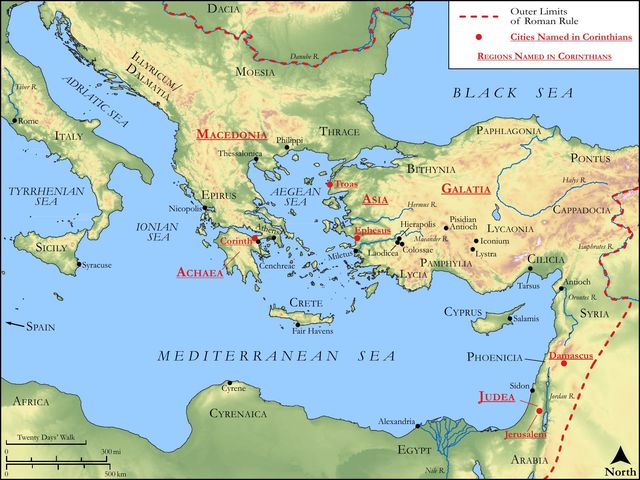
See on the biblical-era maps

Study this verse
Public-domain commentary
Matthew Henry
From his Commentary on the Whole Bible. Henry comments on passages, not single verses — this entry covers 2 Corinthians 10:7–11. His two-level outline is real structure in the source text, so it is rendered as structure.
In these verses the apostle proceeds to reason the case with the Corinthians, in opposition to those who despised him, judged him, and spoke hardly of him: "Do you," says he, "look on things after the outward appearance? Co2 10:7. Is this a fit measure or rule to make an estimate of things or persons by, and to judge between me and my adversaries?" In outward appearance, Paul was mean and despicable with some; he did not make a figure, as perhaps some of his competitors might do: but this was a false rule to make a judgment by. It should seem that some boasted mighty things of themselves, and made a fair show. But there are often false appearances. A man may seem to be learned who has not learned Christ, and appear virtuous when he has not a principle of grace in his heart. However, the apostle asserts two things of himself: -
I.His relation to Christ:
If any man trust to himself that he is Christ's, even so are we Christ's, Co2 10:7. It would seem by this that Paul's adversaries boasted of their relation to Christ as his ministers and servants. Now the apostle reasons thus with the Corinthians: "Suppose it to be so, allowing what they say to be true (and let us observe that, in fair arguing, we should allow all that may be reasonably granted, and should not think it impossible but those who differ from us very much may yet belong to Christ, as well as we), allowing them," might the apostle say, "what they boast of, yet they ought also to allow this to us, that we also are Christ's." Note,
1.We must not, by the most charitable allowances we make to others who differ from us, cut ourselves off from Christ, nor deny our relation to him. For,
2.There is room in Christ for many; and those who differ much from one another may yet be one in him. It would help to heal the differences that are among us if we would remember that, how confident soever we may be that we belong to Christ, yet, at the same time, we must allow that those who differ from us may belong to Christ too, and therefore should be treated accordingly. We must not think that we are the people, and that none belong to Christ but ourselves. This we may plead for ourselves, against those who judge us and despise us that, how weak soever we are, yet, as they are Christ's, so are we: we profess the same faith, we walk by the same rule, we build upon the same foundation, and hope for the same inheritance.
II.His authority from Christ as an apostle.
This he had mentioned before (Co2 10:6), and now he tells them that he might speak of it again, and that with some sort of boasting, seeing it was a truth, that the Lord had given it to him, and it was more than his adversaries could justly pretend to. It was certainly what he should not be ashamed of, Co2 10:8. Concerning this observe,
1.The nature of his authority: it was for edification, and not for destruction. This indeed is the end of all authority, civil and ecclesiastical, and was the end of that extraordinary authority which the apostles had, and of all church-discipline.
2.The caution with which he speaks of his authority, professing that his design was not to terrify them with big words, nor by angry letters, Co2 10:9. Thus he seems to obviate an objection that might have been formed against him, Co2 10:10. But the apostle declares he did not intend to frighten those who were obedient, nor did he write any thing in his letters that he was not able to make good by deeds against the disobedient; and he would have his adversaries know this (Co2 10:11), that he would, by the exercise of his apostolical power committed to him, make it appear to have a real efficacy.
Historical interpretation
Historical reception
1 surviving comment on this verse from the historical church.
"For though I should glory somewhat abundantly concerning our authority which the Lord gave for building you up, and not for casting you down, I shall not be put to shame."
For since he was going to say somewhat great, observe how he softens it. For nothing doth so offend the majority of hearers as for any one to praise himself. Wherefore to cut at the root of this offensiveness, he says, "For though I should glory somewhat abundantly." And he did not say, 'if any man trust that he is Christ's let him think that he is far short of us. For I possess much authority from Him, so as to punish and to kill whomsoever I choose;' but what? "For though I should glory even somewhat abundantly." And yet he possessed more than can be told, but nevertheless he lowers it in his way of speaking. And he said not, 'I glory,' but, "if I should glory," if I should choose to do so: at once both showing modesty, and declaring his superiority. If therefore he says, "I should glory concerning the authority which the Lord gave me." Again, he ascribes the whole to Him, and makes the gift common. "For building up, and not for casting down." Seest thou how again he allays the envy his praises might give rise to, and draws the hearer over to himself by mentioning the use for which he received it? Then why doth he say, "Casting down imaginations?" Because this is itself an especial form of building up, the removing of hindrances, and detecting the unsound, and laying the true together in the building. For this end therefore we received it, that we might build up. But if any should spar and battle with us, and be incurable, we will use that other power also, destroying and overthrowing him. Wherefore also he says, "I shall not be put to shame," that is, I shall not be proved a liar or a boaster.
Continue studying 2 Corinthians 10:8 across the web’s major study libraries — every link below opens this exact verse, chapter, or book on the destination site.
Read & Compare
 BibleGatewayThis verse in more than 200 translations and 70 languages.
 Bible.comThe YouVersion reader — hundreds of translations, reading plans, and highlights.
 ESV.orgCrossway's official English Standard Version reader.
 NET BibleThe NET translation with 60,000+ translators' notes on every rendering decision.
 STEP BibleTyndale House's free study tool — original text, vocabulary, and scholarly resources.
 BibliaLogos Bible Software's free web reader.
 USCCBThe New American Bible (Revised Edition) with the U.S. bishops' study notes.
Commentaries
 BibleHub CommentariesDozens of classic commentaries on this verse, gathered on one page.
 StudyLightMore than 100 commentary sets — the largest collection on the web.
 BibleRefPlain-English commentary on what this verse means, verse by verse.
 Enduring WordDavid Guzik's free commentary on this chapter, widely used by Bible teachers.
 Bible Study ToolsVerse commentary alongside Greek and Hebrew study aids.
Original Language & Research
- BibleHub InterlinearThe verse word by word — original language, transliteration, and English.
- BibleHub LexiconEvery word's original-language definition and Strong's entry.
 Blue Letter BibleDeep-study tools — Strong's numbers, concordance, and word studies.
 CNTR CollationThe earliest Greek manuscripts of this verse, collated letter by letter.
Sermons, Hymns & Audio


TrulyRandomVerse is not affiliated with these sites and doesn’t control their content. They’re linked because they’re genuinely useful.
Summary
In 2 Corinthians 10:8, the Apostle Paul confidently asserts the divine origin and benevolent purpose of his apostolic authority. He declares that even if he were to boast further about the power entrusted to him by the Lord, he would have no cause for shame, as this authority is consistently exercised for the spiritual growth and strengthening of the Corinthian believers, never for their detriment or destruction. This statement underscores the integrity of his ministry and the foundational principle that true spiritual power is always constructive.
Context
ShowHideLiterary Context
This verse is situated within a highly polemical section of Paul's Second Epistle to the Corinthians (chapters 10-13), where he directly addresses the challenges to his apostolic authority and defends his ministry against accusations from certain factions within the Corinthian church, likely influenced by "super-apostles" (as mentioned in 2 Corinthians 11:5). Paul has been accused of being impressive in his letters but weak in person (2 Corinthians 10:10). In the preceding verses, Paul describes his spiritual warfare, emphasizing that his weapons are not carnal but divine, capable of demolishing strongholds and taking every thought captive to Christ (2 Corinthians 10:4-5). Verse 8 serves as a direct justification for the firmness he intends to display, framing his authority not as self-aggrandizement but as a divinely appointed tool for the church's well-being.
Historical & Cultural Context
The Corinthian church was a complex and often tumultuous community, influenced by the diverse philosophical and rhetorical traditions of the Greeks and Romans around it. False teachers or rival apostles had infiltrated the church, questioning Paul's legitimacy, his personal demeanor, and his financial practices. These opponents likely boasted of their own rhetorical prowess, impressive credentials, and perhaps even miraculous signs, in stark contrast to Paul's more humble and direct approach. Paul's defense here is a classic example of apologia, a reasoned defense, common in ancient rhetoric. He is not merely defending himself but defending the integrity of the gospel he preached and the divine authority by which he preached it, which was being undermined by those who sought to lead the Corinthians astray.
Key Themes
ShowHideThe verse powerfully articulates several key themes pervasive in 2 Corinthians and Paul's broader theology. Foremost is the Divine Mandate of Authority, emphasizing that true spiritual authority is not self-derived but "which the Lord hath given us." This divine origin legitimizes Paul's ministry and distinguishes it from the self-appointed claims of his rivals. Closely related is the Purpose of Spiritual Authority, which Paul unequivocally states is "for edification, and not for your destruction." This establishes a crucial criterion for evaluating all Christian leadership: its ultimate aim must be to build up the body of Christ, fostering spiritual growth and maturity, rather than to tear down, control, or exploit. This principle resonates with Paul's teaching on spiritual gifts, all of which are given for the common good and the "building up of the body of Christ" (Ephesians 4:12). Finally, Paul's declaration, "I should not be ashamed," highlights his Unashamed Confidence in his God-given commission, despite the intense personal attacks and challenges he faced. His confidence stems from the purity of his motives and the divine source and constructive intent of his authority.
Exposition and Analysis
ShowHideKey Word Analysis
ShowHideMeaning "privilege, i.e. (subjectively) force, capacity, competency, freedom, or (objectively) mastery (concretely, magistrate, superhuman, potentate, token of control), delegated influence." Paul's use of exousía emphasizes that his power is not inherent to him but is a delegated right and capacity to act, specifically given by God. It implies both the right to command and the power to enforce.
A primary verb meaning "to give (used in a very wide application, properly, or by implication, literally or figuratively; greatly modified by the connection):--adventure, bestow, bring forth, commit, deliver (up), give, grant, hinder, make, minister, number, offer, have power, put, receive, set, shew, smite (+ with the hand), strike (+ with the palm of the hand), suffer, take, utter, yield." This verb highlights the active bestowal of authority by the Lord, underscoring its divine origin and making it clear that Paul's power is a gift, not a personal acquisition.
Meaning "architecture, i.e. (concretely) a structure; figuratively, confirmation." This term literally refers to the act of building a house or structure. In a spiritual context, it signifies the process of building up, strengthening, and maturing believers and the church as a whole. It implies growth, stability, and spiritual development.
Meaning "demolition; figuratively, extinction." This word is the direct antonym of oikodomḗ. It refers to the act of pulling down, demolishing, or bringing to ruin. Paul uses it to starkly contrast the true purpose of his authority (building up) with what it is decidedly not for (tearing down or causing ruin).
Verse Breakdown
ShowHide"For though I should boast somewhat more of our authority"
Paul acknowledges the possibility of further asserting his apostolic authority, even beyond what he has already done. The phrase "somewhat more" (G5100 tìs and G4055 perissóteros) suggests that he has a greater reserve of authority than he has yet fully displayed or boasted about, implying a potential for even firmer action if necessary.
"which the Lord hath given us"
This crucial clause establishes the divine source of Paul's authority. It is not self-proclaimed, humanly conferred, or based on personal charisma, but directly bestowed by "the Lord" (G2962 kýrios), referring to Jesus Christ. This divine origin is the bedrock of its legitimacy and power.
"for edification, and not for your destruction"
This is the core statement of purpose. Paul's authority is inherently constructive. It is intended "for edification" (G1519 eis G3619 oikodomḗ), meaning to build up, strengthen, and promote the spiritual growth of the Corinthian believers. Crucially, it is explicitly "not for your destruction" (G3756 ou G1519 eis G5216 hymōn G2506 kathaíresis), meaning it is never intended to tear down, demolish faith, or cause ruin to the church or individuals within it. This sets a clear boundary for the legitimate use of spiritual power.
"I should not be ashamed"
Paul expresses his unwavering confidence and integrity. Because his authority originates from the Lord and is always exercised for the good of the church, he has no reason to feel shame (G153 aischýnomai), even when asserting it boldly or facing accusations. His actions align with God's benevolent purposes, validating his ministry.
Literary Devices
ShowHidePaul employs several powerful literary devices in this verse. The most prominent is Contrast, specifically an antithesis between "edification" (building up) and "destruction" (tearing down). This stark opposition highlights the fundamental and non-negotiable purpose of true apostolic authority, distinguishing it from any misuse of power. By explicitly stating what his authority is for and what it is not for, Paul clarifies his motives and the divine standard by which his ministry operates. Additionally, there is an element of Apostolic Apologia, as Paul is defending his ministry and character against detractors. His declaration "I should not be ashamed" serves as a confident assertion of his integrity, implying that his opponents' accusations are baseless and that his actions are righteous before God. The phrase "which the Lord hath given us" also points to the Divine Passive, a grammatical construction where the agent of an action is God, even if not explicitly named. This emphasizes that God is the ultimate source and giver of Paul's authority, reinforcing its sacred and legitimate nature.
Theological and Thematic Connections
ShowHideThis verse profoundly shapes our understanding of spiritual authority within the Christian church. It establishes that all true spiritual power, whether apostolic, pastoral, or otherwise, is a divine entrustment, not a human acquisition, and its ultimate purpose is always to build up the body of Christ. This means fostering spiritual maturity, strengthening faith, correcting error with grace, and promoting unity, rather than tearing down individuals, controlling consciences, or creating division. Any exercise of authority that leads to the spiritual, emotional, or relational destruction of believers stands in direct opposition to God's design and purpose for leadership. Paul's unashamed confidence stems from his alignment with God's benevolent will, providing a model for all who serve in positions of influence within the church.
Reflection and Application
ShowHidePaul's declaration in 2 Corinthians 10:8 offers timeless principles for believers today, particularly concerning leadership, influence, and the exercise of power within any sphere of life. It challenges us to critically examine the purpose and impact of our words and actions, especially when we are in positions of authority or influence. Do we use our gifts, knowledge, or positions to build up those around us—to encourage, equip, correct with grace, and foster growth—or do we inadvertently or intentionally tear down, discourage, or diminish others? This verse calls for a deep introspection into our motives: is our "boasting" (our confidence, our assertions) rooted in a divine commission and aimed at the well-being of others, or is it self-serving and potentially destructive? When we operate within God's will and for His redemptive purposes, we can stand with the same unashamed confidence as Paul, knowing that our efforts contribute to the spiritual construction of individuals and communities, reflecting the very heart of God.
Questions for Reflection
ShowHideFAQ
ShowHideWhat does Paul mean by "boast somewhat more of our authority"?
ShowHidePaul is not boasting out of pride, but rather asserting the legitimate, God-given nature of his apostolic authority. The phrase "somewhat more" (G5100 tìs G4055 perissóteros) suggests that he has a greater degree of authority than he has yet fully demonstrated or even spoken about. He is indicating that he has the power to act with even greater firmness if the situation in Corinth demands it, but he would do so without shame because his authority comes from the Lord and is always for the church's good, not its harm. This is a subtle warning to his opponents that he possesses the power to address their challenges decisively, but his preference is always to build up rather than to tear down.
How can we discern if spiritual authority is being used "for edification" or "for destruction" today?
ShowHideDiscerning the true purpose of spiritual authority requires careful observation of its fruit. Authority used "for edification" (G3619 oikodomḗ) will lead to the spiritual growth, maturity, and unity of believers, fostering love, faith, and obedience to Christ. It will empower individuals, promote their freedom in Christ, and encourage their service. Conversely, authority used "for destruction" (G2506 kathaíresis) will lead to control, manipulation, fear, division, spiritual stagnation, or the suppression of individual conscience. It often leaves people feeling diminished, discouraged, or exploited. The ultimate test is whether the exercise of power points people to Christ and builds up His body, or if it serves the personal agenda or ego of the leader, causing harm to the flock, as Jesus warned about false shepherds in John 10:12-13.
Christ-Centered Fulfillment
ShowHide2 Corinthians 10:8, while a defense of Paul's apostolic authority, ultimately points to the supreme authority of Jesus Christ, who perfectly embodies the principle of power used for edification and not for destruction. All authority, whether in heaven or on earth, has been given to Christ (Matthew 28:18). Yet, His exercise of this infinite power was never for His own gain or for the destruction of humanity, but for our redemption and restoration. He came not to condemn the world but to save it (John 3:17). Christ's entire ministry was one of building up: He built His church upon the confession of His identity (Matthew 16:18), He healed the sick, taught the lost, and ultimately laid down His life to reconcile humanity to God, thereby "edifying" us into a new creation. The cross, seemingly an act of destruction, was the ultimate act of edification, tearing down the barrier of sin to build a bridge to God. Through His Spirit, Christ continues to empower His church to grow up into Him in all things, "from whom the whole body, joined and knit together by what every joint supplies, according to the effective working by which every part does its share, causes growth of the body for the edifying of itself in love" (Ephesians 4:15-16). Thus, Paul's authority, and all true spiritual authority, is a reflection and extension of Christ's own redemptive and constructive power.