


1 Corinthians 3:6
Bible text: King James Version (1769 Blayney text) · Public domain
Bible text: Berean Standard Bible · Public domain
Bible text: American Standard Version (1901) · Public domain
Bible text: World English Bible, Messianic edition · Public domain
Bible text: Geneva Bible (1599) · Public domain
Bible text: Young's Literal Translation · Public domain
- ἐγὼegōI myselfG1473P-1NSPersonal pronoun Nominative 1st Singular
- ἐφύτευσαephuteusaplantedG5452V-AAI-1SVerb Aorist Active Indicative 1st Singular
- ἈπολλῶςApollōsApollosG625N-NSM-PNoun Nominative Singular Masculine Individual
- ἐπότισενepotisenwateredG4222V-AAI-3SVerb Aorist Active Indicative 3rd Singular
- ἀλλ᾽all᾽butG235CONJConjunction
- ὁho<the>G3588T-NSMDefinite article Nominative Singular Masculine
- θεὸςtheosGodG2316N-NSM-TNoun Nominative Singular Masculine Title
- ηὔξανεν·ēuxanenwas [it] growingG837V-IAI-3SVerb Imperfect Active Indicative 3rd Singular
English is a literal word-by-word gloss of the Greek, not the KJV's wording. Why?
This is the original text the KJV's translators worked from — each Greek word with its own literal English meaning in this verse, prepared by scholars at Tyndale House, Cambridge. The KJV translates whole sentences, not word by word, so its wording differs: one Greek word can become several English words, and the KJV may choose “charity” where the gloss reads “love”. Both are faithful — they answer different questions. For the KJV's own rendering, switch to the KJV text.
Details
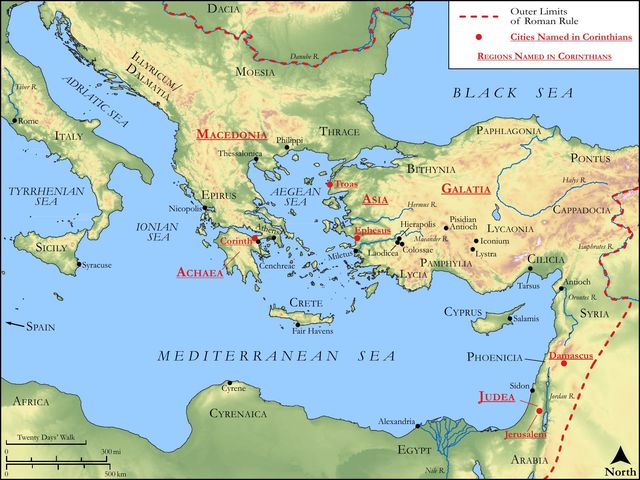
See on the biblical-era maps

Study this verse
Public-domain commentary
Matthew Henry
From his Commentary on the Whole Bible. Henry comments on passages, not single verses — this entry covers 1 Corinthians 3:5–10.
Here the apostle instructs them how to cure this humour, and rectify what was amiss among them upon this head,
I.By reminding them that the ministers about whom they contended were but ministers:
Who then is Paul, and who is Apollos, but ministers by whom you believed? Even as the Lord gave to every man, Co1 3:5. They are but ministers, mere instruments used by the God of all grace. Some of the factious people in Corinth seem to have made more of them, as if they were lords of their faith, authors of their religion. Note, We should take care not to deify ministers, nor put them into the place of God. Apostles were not the authors of our faith and religion, though they were authorized and qualified to reveal and propagate it. They acted in this office as God gave to every man. Observe, All the gifts and powers that even apostles discovered and exerted in the work of the ministry were from God. They were intended to manifest their mission and doctrine to be divine. It was perfectly wrong, upon their account, to transfer that regard to the apostles which was solely to be paid to the divine authority by which they acted, and to God, from whom they had their authority. Paul had planted and Apollos had watered, Co1 3:6. Both were useful, one for one purpose, the other for another. Note, God makes use of variety of instruments, and fits them to their several uses and intentions. Paul was fitted for planting work, and Apollos for watering work, but God gave the increase. Note, The success of the ministry must be derived from the divine blessing: Neither he that planteth is any thing, nor he that watereth, but God who giveth the increase, Co1 3:7. Even apostolical ministers are nothing of themselves, can do nothing with efficacy and success unless God give the increase. Note, The best qualified and most faithful ministers have a just sense of their own insufficiency, and are very desirous that God should have all the glory of their success. Paul and Apollos are nothing at all in their own account, but God is all in all.
II.By representing to them the unanimity of Christ's ministers:
He that planteth and he that watereth are one (Co1 3:8), employed by one Master, entrusted with the same revelation, busied in one work, and engaged in one design - in harmony with one another, however they may be set in opposition to each other by factious party-makers. They have their different gifts from one and the same Spirit, for the very same purposes; and they heartily carry on the same design. Planters and waterers are but fellow-labourers in the same work. Note, All the faithful ministers of Christ are one in the great business and intention of their ministry. They may have differences of sentiment in minor things; they may have their debates and contests; but they heartily concur in the great design of honouring God and saving souls, by promoting true Christianity in the world. All such may expect a glorious recompence of their fidelity, and in proportion to it: Every man shall receive his own reward, according to his own labour. Their business is one, but some may mind it more than others: their end or design is one, but some may pursue it more closely than others: their Master also is one, and yet this good and gracious Master may make a difference in the rewards he gives, according to the different service they do: Every one's own work shall have its own reward. Those that work hardest shall fare best. Those that are most faithful shall have the greatest reward; and glorious work it is in which all faithful ministers are employed. They are labourers with God, sunergoi - co-workers, fellow-labourers (Co1 3:9), not indeed in the same order and degree, but in subordination to him, as instruments in his hand. They are engaged in his business. They are working together with God, in promoting the purposes of his glory, and the salvation of precious souls; and he who knows their work will take care they do not labour in vain. Men may neglect and vilify one minister while they cry up another, and have no reason for either: they may condemn when they should commend, and applaud what they should neglect and avoid; but the judgment of God is according to truth. He never rewards but upon just reason, and he ever rewards in proportion to the diligence and faithfulness of his servants. Note, Faithful ministers, when they are ill used by men, should encourage themselves in God. And it is to God, the chief agent and director of the great work of the gospel, to whom those that labour with him should endeavour to approve themselves. They are always under his eye, employed in his husbandry and building; and therefore, to be sure, he will carefully look over them: "You are God's husbandry, you are God's building; and therefore are neither of Paul nor of Apollos; neither belong to one nor the other, but to God: they only plant and water you, but it is the divine blessing on his own husbandry that alone can make it yield fruit. You are not our husbandry, but God's. We work under him, and with him, and for him. It is all for God that we have been doing among you. You are God's husbandry and building." He had employed the former metaphor before, and now he goes on to the other of a building: According to the grace of God which is given unto me, as a wise master-builder, I have laid the foundation, and another buildeth thereon. Paul here calls himself a wise master-builder, a character doubly reflecting honour on him. It was honourable to be a master-builder in the edifice of God; but it added to his character to be a wise one. Persons may be in an office for which they are not qualified, or not so thoroughly qualified as this expression implies Paul was. But, though he gives himself such a character, it is not to gratify his own pride, but to magnify divine grace. He was a wise master-builder, but the grace of God made him such. Note, It is no crime in a Christian, but much to his commendation, to take notice of the good that is in him, to the praise of divine grace. Spiritual pride is abominable: it is making use of the greatest favours of God to feed our own vanity, and make idols of ourselves. But to take notice of the favours of God to promote our gratitude to him, and to speak of them to his honour (be they of what sort they will), is but a proper expression of the duty and regard we own him. Note, Ministers should not be proud of their gifts or graces; but the better qualified they are for their work, and the more success they have in it, the more thankful should they be to God for his distinguishing goodness: I have laid the foundation, and another buildeth thereon. As before he had said, I have planted, Apollos watered. It was Paul that laid the foundation of a church among them. He had begotten them through the gospel, Co1 4:15. Whatever instructors they had besides, they had not many fathers. He would derogate from none that had done service among them, nor would he be robbed of his own honour and respect. Note, Faithful ministers may and ought to have a concern for their own reputation. Their usefulness depends much upon it. But let every man take heed how he buildeth thereon. This is a proper caution; there may be very indifferent building on a good foundation. It is easy to err here; and great care should be used, not only to lay a sure and right foundation, but to erect a regular building upon it. Nothing must be laid upon it but what the foundation will bear, and what is of a piece with it. Gold and dirt must not be mingled together. Note, Ministers of Christ should take great care that they do not build their own fancies or false reasonings on the foundation of divine revelation. What they preach should be the plain doctrine of their Master, or what is perfectly agreeable with it.
Historical interpretation
Four Centuries of Reception
5 surviving comments on this verse. Each one is dated, so this reads as a timeline rather than a list.
Select a marker to jump to its quote. Markers stagger vertically where authors wrote within a few decades of each other.
But the new law's wont was to point to clemency, and to convert to tranquillity the pristine ferocity of "glaives" and "lances," and to remodel the pristine execution of "war" upon the rivals and foes of the law into the pacific actions of "ploughing" and "tilling" the land. Therefore as we have shown above that the coming cessation of the old law and of the carnal circumcision was declared, so, too, the observance of the new law and the spiritual circumcision has shone out into the voluntary obediences of peace.
To plant is to evangelize and to bring to faith, to water is to baptize with the approved form of words. To forgive sins, however, and to give the Spirit belongs to God alone. We know that the Holy Spirit is given by God without the laying on of hands, and it has happened that an unbaptized person has received the forgiveness of his sins. Was such a person invisibly baptized, considering that he received the gift which belongs to baptism?
"I planted, Apollos watered, but God gave the increase."
That is, I first cast the word into the ground; but, in order that the seeds might not wither away through temptations, Apollos added his own part. But the whole was of God.
I have been planted in the house of the Lord, I mean in the church; not in the walls but in its doctrines. Everyone who has been planted in the house of the Lord, who has put down roots there, brings forth flowers.
And there is a divinity present according to nature in the Spirit into wit, what subsists as the Spirit of God-according to Paul's statement, "Ye are the temple of God, and the Spirit of God dwelleth in you."
Continue studying 1 Corinthians 3:6 across the web’s major study libraries — every link below opens this exact verse, chapter, or book on the destination site.
Read & Compare
 BibleGatewayThis verse in more than 200 translations and 70 languages.
 Bible.comThe YouVersion reader — hundreds of translations, reading plans, and highlights.
 ESV.orgCrossway's official English Standard Version reader.
 NET BibleThe NET translation with 60,000+ translators' notes on every rendering decision.
 STEP BibleTyndale House's free study tool — original text, vocabulary, and scholarly resources.
 BibliaLogos Bible Software's free web reader.
 USCCBThe New American Bible (Revised Edition) with the U.S. bishops' study notes.
Commentaries
 BibleHub CommentariesDozens of classic commentaries on this verse, gathered on one page.
 StudyLightMore than 100 commentary sets — the largest collection on the web.
 BibleRefPlain-English commentary on what this verse means, verse by verse.
 Enduring WordDavid Guzik's free commentary on this chapter, widely used by Bible teachers.
 Bible Study ToolsVerse commentary alongside Greek and Hebrew study aids.
Original Language & Research
- BibleHub InterlinearThe verse word by word — original language, transliteration, and English.
- BibleHub LexiconEvery word's original-language definition and Strong's entry.
 Blue Letter BibleDeep-study tools — Strong's numbers, concordance, and word studies.
 CNTR CollationThe earliest Greek manuscripts of this verse, collated letter by letter.
Sermons, Hymns & Audio


TrulyRandomVerse is not affiliated with these sites and doesn’t control their content. They’re linked because they’re genuinely useful.
Summary
First Corinthians 3:6 succinctly articulates a fundamental principle of Christian ministry and spiritual growth: while human agents faithfully sow the seeds of the Gospel and nurture the budding faith of believers, it is the sovereign power of God alone that grants the increase, bringing about conversion, maturity, and fruitfulness. This verse serves as a powerful reminder that all true spiritual progress is a divine work, diminishing human pride and fostering a humble reliance on God's sustaining power.
Context
ShowHideLiterary Context
This verse is situated within Paul's impassioned address to the Corinthian church concerning their divisive factions. In 1 Corinthians 1:10-17, Paul confronts the believers for aligning themselves with different leaders ("I am of Paul," "I am of Apollos," "I am of Cephas"). He then transitions in 1 Corinthians 3:1-4 to explain that their divisions reveal spiritual immaturity, describing them as "carnal" and "babes in Christ." Verse 6, therefore, provides the theological rationale for why such divisions are misguided: human ministers are merely servants, and the true source of growth is God. The agricultural metaphor continues through 1 Corinthians 3:7-9, emphasizing that all workers are united in God's service and that the church is "God's husbandry" and "God's building."
Historical & Cultural Context
The city of Corinth was a bustling, cosmopolitan hub in the Roman province of Achaia, known for its wealth, trade, and diverse religious practices. Its strategic location on an isthmus connecting two seas made it a melting pot of cultures and philosophies. This environment likely contributed to the Corinthians' tendency to elevate human wisdom and charismatic leaders, leading to the formation of cliques around prominent figures like Paul (who founded the church) and Apollos (who followed Paul, teaching and nurturing the believers). The agricultural metaphor used by Paul would have been readily understood by his audience, as farming was a foundational aspect of life in that day, with a clear understanding that human effort in planting and watering was dependent on natural forces (like rain and sunshine) for growth, which were often attributed to divine provision.
Key Themes
ShowHideThe primary theme in this section of 1 Corinthians is unity in the body of Christ, particularly as it relates to the proper understanding of Christian leadership and ministry. Paul systematically dismantles the basis for factionalism by asserting that ministers are merely servants, instruments through whom God works, as articulated in 1 Corinthians 3:5. This leads to the overarching theme of divine sovereignty in spiritual growth, where God alone is the source of life and increase, a truth that humbles human pride and redirects all glory to Him. The passage also subtly introduces the theme of complementary roles in ministry, illustrating how different individuals contribute distinct but equally valuable efforts to the overall work of God, much like Paul's initial planting and Apollos's subsequent watering.
Exposition and Analysis
ShowHideKey Word Analysis
ShowHideThis verb signifies "to set out in the earth," "to implant," or "to instil doctrine." In this context, Paul uses it metaphorically to describe his foundational work of evangelism in Corinth, where he first preached the Gospel and established the church, effectively "planting" the seeds of faith.
Derived from a word meaning "to furnish drink" or "to irrigate," this term denotes the act of nurturing and sustaining growth. Apollos's role, as described by Paul, was to follow up on the initial planting, providing further instruction, discipleship, and encouragement to the nascent believers, thus "watering" the seeds Paul had sown.
This refers to the supreme Divinity, the ultimate source of all being and power. Paul's emphatic declaration that "God gave the increase" underscores the divine agency behind all spiritual fruitfulness, asserting that human effort, while necessary, is entirely dependent on God's life-giving power.
This prolonged form of a primary verb means "to grow," "to wax," or "to enlarge," encompassing both literal and figurative growth, active or passive. In this verse, it specifically refers to the spiritual growth, development, and multiplication of believers and the church, which Paul attributes solely to God's work.
Verse Breakdown
ShowHide"I have planted,"
Paul refers to his initial ministry in Corinth, where he was instrumental in bringing the Gospel to the city and establishing the first community of believers. This "planting" represents the foundational work of evangelism and conversion.
"Apollos watered;"
This clause describes Apollos's subsequent ministry. After Paul's departure, Apollos came to Corinth and continued to teach and nurture the young church, providing further instruction and strengthening the believers in their faith, much like a gardener waters newly planted seeds to ensure their growth.
"but God gave the increase."
This is the pivotal statement of the verse, introducing a strong contrast with the preceding clauses. Despite the essential human efforts of planting and watering, Paul asserts that the actual growth, the spiritual fruit, the transformation of lives, and the expansion of the church, is solely the work of God. Human labor prepares the ground, but divine power brings forth the life.
Literary Devices
ShowHideThe dominant literary device in 1 Corinthians 3:6 is a vivid Metaphor, where the spiritual work of evangelism and discipleship is compared to the agricultural process of planting and cultivating crops. Paul is the "planter," Apollos is the "waterer," and the spiritual growth of believers is the "increase." This metaphor effectively illustrates the complementary roles of different ministers and highlights the ultimate dependence on God for fruitfulness. There is also an element of Synecdoche, where Paul and Apollos stand in for all ministers, demonstrating that no single individual is solely responsible for spiritual growth. Furthermore, the verse employs Contrast ("I have planted, Apollos watered; but God gave the increase"), sharply distinguishing between human effort and divine power, emphasizing that while human actions are necessary, they are insufficient without God's sovereign intervention.
Theological and Thematic Connections
ShowHideThis verse profoundly shapes our understanding of divine sovereignty and human responsibility in the work of the Kingdom. It asserts that while God calls and equips individuals to participate in His mission, their efforts are merely instruments in His hands. The ultimate power to transform hearts, to grant spiritual understanding, and to bring about genuine growth rests solely with God. This truth humbles human pride, dismantles the basis for sectarianism, and redirects all glory to the divine source. It underscores that the church is not built on the charisma or wisdom of human leaders, but on the living power of God working through His chosen servants, fostering a deep reliance on Him for all spiritual fruit.
Reflection and Application
ShowHide1 Corinthians 3:6 offers profound liberation and a call to humility for every believer, whether in formal ministry or everyday life. For those who "plant" by sharing the Gospel or "water" by discipling others, it alleviates the immense pressure to produce results, reminding us that our faithfulness is in the effort, not the outcome. The "increase" is God's domain. This truth guards against burnout and discouragement, shifting our focus from our limited capabilities to God's unlimited power. For all believers, it fosters a vital sense of unity, recognizing that we are all co-laborers in God's field, each contributing uniquely but ultimately dependent on the same divine source for life. It challenges us to celebrate God's work through others, rather than competing or comparing, and to give Him all the glory for any spiritual fruit we witness. This verse calls us to faithful stewardship of our gifts and opportunities, while resting in the assurance that God is the one who truly makes things grow.
Questions for Reflection
ShowHideFAQ
ShowHideWhat does the agricultural metaphor of planting and watering signify in this verse?
ShowHideThe agricultural metaphor in 1 Corinthians 3:6 signifies the distinct but complementary roles of ministers in the process of spiritual growth. "Planting" refers to the initial work of evangelism, where the Gospel message is first sown into the hearts of unbelievers, leading to conversion and the establishment of a new faith community, as Paul did in Corinth. "Watering" refers to the ongoing work of discipleship, teaching, and nurturing, which helps new believers mature in their faith and grow in their understanding of Christ, a role exemplified by Apollos. Both are essential human efforts, but neither can produce life on its own.
Why does Paul emphasize that "God gave the increase" rather than attributing it to human effort?
ShowHidePaul emphasizes God's role in giving the increase to correct the Corinthian church's carnal divisions and their tendency to elevate human leaders. By stating that "God gave the increase," Paul powerfully asserts divine sovereignty in spiritual matters. Human ministers are merely servants, instruments in God's hands (1 Corinthians 3:5), and any true spiritual growth, whether in conversion or sanctification, originates from God's life-giving power. This truth deflates human pride, removes any basis for rivalry among ministers, and ensures that all glory for spiritual fruitfulness is directed to God alone, as He is the one who provides the life, nourishment, and power.
Christ-Centered Fulfillment
ShowHideWhile 1 Corinthians 3:6 primarily addresses the roles of ministers and the sovereignty of God in spiritual growth, its Christ-centered fulfillment is profound. Jesus Himself is the ultimate "planter" and "waterer" of the Kingdom, the one who sows the "seed" of the Word (Matthew 13:3-9) and nurtures His disciples. More significantly, He is the very source of the "increase" that God gives. It is through Christ's atoning work on the cross and His resurrection that new life is made possible (John 3:16). The spiritual growth of believers is a direct result of their union with Him, for He is the "true vine," and believers are the branches that bear fruit only by abiding in Him (John 15:1-5). The "increase" is not merely numerical growth but the transformation into Christlikeness, a process empowered by the Holy Spirit whom Christ sent (John 16:7-8). Thus, any planting or watering done by human hands is effective only because it participates in Christ's ongoing work of building His church, and all spiritual fruit ultimately testifies to His life-giving power and glory (Ephesians 4:15-16).