


2 Corinthians 10:14
Bible text: King James Version (1769 Blayney text) · Public domain
Bible text: King James Version with Strong's numbers · Public domain
Bible text: Berean Standard Bible · Public domain
Bible text: American Standard Version (1901) · Public domain
Bible text: World English Bible, Messianic edition · Public domain
Bible text: Geneva Bible (1599) · Public domain
Bible text: Young's Literal Translation · Public domain
- οὐouNotG3756PRT-NNegative Particle Negative
- γὰρgarforG1063CONJConjunction
- ὡςhōsasG5613PRTParticle or Disjunctive
- μὴmēnotG3361PRT-NNegative Particle Negative
- ἐφικνούμενοιephiknoumenoireachingG2185V-PNP-NPMVerb Present Middle Or Passive Deponent Participle Nominative Plural Masculine
- εἰςeistoG1519PREPPreposition
- ὑμᾶςhumasyouG4771P-2APPersonal pronoun Accusative 2nd Plural
- ὑπερεκτείνομενhuperekteinomenwe are overextendingG5239V-PAI-1PVerb Present Active Indicative 1st Plural
- ἑαυτούς·he'autousourselvesG1438F-1APMReflexive pronoun Accusative 1st Plural Masculine
- ἄχριachrias far asG891PREPPreposition
- γὰρgarforG1063CONJConjunction
- καὶkaialsoG2532CONJConjunction
- ὑμῶνhumōnyouG4771P-2GPPersonal pronoun Genitive 2nd Plural
- ἐφθάσαμενephthasamenwe cameG5348V-AAI-1PVerb Aorist Active Indicative 1st Plural
- ἐνeninG1722PREPPreposition
- τῷtōtheG3588T-DSNDefinite article Dative Singular Neuter
- εὐαγγελίῳeuangeliōgospelG2098N-DSNNoun Dative Singular Neuter
- τοῦtou<the>G3588T-GSMDefinite article Genitive Singular Masculine
- Χριστοῦ·Christouof ChristG5547N-GSM-TNoun Genitive Singular Masculine Title
English is a literal word-by-word gloss of the Greek, not the KJV's wording. Why?
This is the original text the KJV's translators worked from — each Greek word with its own literal English meaning in this verse, prepared by scholars at Tyndale House, Cambridge. The KJV translates whole sentences, not word by word, so its wording differs: one Greek word can become several English words, and the KJV may choose “charity” where the gloss reads “love”. Both are faithful — they answer different questions. For the KJV's own rendering, switch to the KJV text.
Details
See on the biblical-era maps
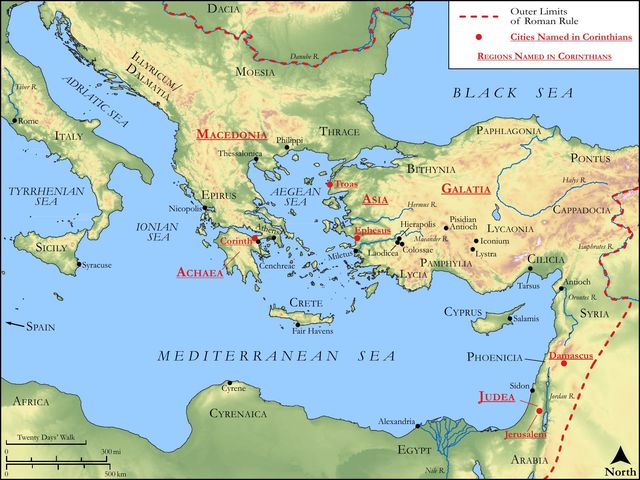

Study this verse
Public-domain commentary
Matthew Henry
From his Commentary on the Whole Bible. Henry comments on passages, not single verses — this entry covers 2 Corinthians 10:12–18.
In these verses observe,
I.The apostle refuses to justify himself, or to act by such rules as the false apostles did, Co2 10:12.
He plainly intimates that they took a wrong method to commend themselves, in measuring themselves by themselves, and comparing themselves among themselves, which was not wise. They were pleased, and did pride themselves, in their own attainments, and never considered those who far exceeded them in gifts and graces, in power and authority; and this made them haughty and insolent. Note, If we would compare ourselves with others who excel us, this would be a good method to keep us humble; we should be pleased and thankful for what we have of gifts or graces, but never pride ourselves therein, as if there were none to be compared with us or that did excel us. The apostle would not be of the number of such vain men: let us resolve that we will not make ourselves of that number.
II.He fixes a better rule for his conduct, namely, not to boast of things without his measure, which was the measure God had distributed to him, Co2 10:13. His meaning is, either that he would not boast of more gifts or graces, or power and authority, than God had really bestowed on him; or, rather, that he would not act beyond his commission as to persons or things, nor go beyond the line prescribed to him, which he plainly intimates the false apostles did, while they boasted of other men's labors. The apostle's resolution was to keep within his own province, and that compass of ground which God had marked out for him. His commission as an apostle was to preach the gospel every where, especially among the Gentiles, and he was not confined to one place; yet he observed the directions of Providence, and the Holy Spirit, as to the particular places whither he went or where he did abide.
III.He acted according to this rule:
We stretch not ourselves beyond our measure, Co2 10:14. And, particularly, he acted according to this rule in preaching at Corinth, and in the exercise of his apostolical authority there; for he came thither by divine direction, and there he converted many to Christianity; and, therefore, in boasting of them as his charge, he acted not contrary to his rule, he boasted not of other men's labours, Co2 10:15.
IV.He declares his success in observing this rule.
His hope was that their faith was increased, and that others beyond them, even in the remoter parts of Achaia, would embrace the gospel also; and in all this he exceeded not his commission, nor acted in another man's line.
V.He seems to check himself in this matter, as if he had spoken too much in his own praise.
The unjust accusations and reflections of his enemies had made it needful he should justify himself; and the wrong methods they took gave him good occasion to mention the better rule he had observed: yet he is afraid of boasting, or taking any praise to himself, and therefore he mentions two things which ought to be regarded: - 1. He that glorieth should glory in the Lord, Co2 10:17. If we are able to fix good rules for our conduct, or act by them, or have any good success in so doing, the praise and glory of all are owing unto God. Ministers in particular must be careful not to glory in their performances, but must give God the glory of their work, and the success thereof. 2. Not he that commendeth himself is approved, but he whom the Lord commendeth, Co2 10:18. Of all flattery, self-flattery is the worst, and self-applause is seldom any better than self-flattery and self-deceit. At the best, self-commendation is no praise, and it is oftentimes as foolish and vain as it is proud; therefore, instead of praising or commending ourselves, we should strive to approve ourselves to God, and his approbation will be our best commendation.
Historical interpretation
Historical reception
2 surviving comments on this verse. Each one is dated, so this reads as a timeline rather than a list.
Select a marker to jump to its quote. Markers stagger vertically where authors wrote within a few decades of each other.
Paul did not go too far in what he was doing but stayed within the limits set for his task by God. He makes this explicit here so that the Corinthians will know that God has sent him to them and so they ought to obey his warnings. Otherwise they might appear to be resisting God, by whom Paul was sent.
"For we stretch not ourselves overmuch, as though we reached not unto you: for we came even as far as unto you in preaching the Gospel of Christ."
Not simply 'we came,' but, 'we announced, we preached, we persuaded, we succeeded.' For it is probable that they having merely come to the disciples of the Apostles, ascribed the whole to themselves, from their bare presence among them. 'But not so we: nor can any one say that we were not able to come as far as to you, and that we stretched our boasting as far as to you in words only; for we also preached the word to you.'
Continue studying 2 Corinthians 10:14 across the web’s major study libraries — every link below opens this exact verse, chapter, or book on the destination site.
Read & Compare
 BibleGatewayThis verse in more than 200 translations and 70 languages.
 Bible.comThe YouVersion reader — hundreds of translations, reading plans, and highlights.
 ESV.orgCrossway's official English Standard Version reader.
 NET BibleThe NET translation with 60,000+ translators' notes on every rendering decision.
 STEP BibleTyndale House's free study tool — original text, vocabulary, and scholarly resources.
 BibliaLogos Bible Software's free web reader.
 USCCBThe New American Bible (Revised Edition) with the U.S. bishops' study notes.
Commentaries
 BibleHub CommentariesDozens of classic commentaries on this verse, gathered on one page.
 StudyLightMore than 100 commentary sets — the largest collection on the web.
 BibleRefPlain-English commentary on what this verse means, verse by verse.
 Enduring WordDavid Guzik's free commentary on this chapter, widely used by Bible teachers.
 Bible Study ToolsVerse commentary alongside Greek and Hebrew study aids.
Original Language & Research
- BibleHub InterlinearThe verse word by word — original language, transliteration, and English.
- BibleHub LexiconEvery word's original-language definition and Strong's entry.
 Blue Letter BibleDeep-study tools — Strong's numbers, concordance, and word studies.
 CNTR CollationThe earliest Greek manuscripts of this verse, collated letter by letter.
Sermons, Hymns & Audio


TrulyRandomVerse is not affiliated with these sites and doesn’t control their content. They’re linked because they’re genuinely useful.
Summary
In 2 Corinthians 10:14, the Apostle Paul passionately defends the legitimacy and divine origin of his apostolic ministry to the Corinthian church. He asserts that his presence and work among them were not an overreach or an intrusion into another's established spiritual territory, but rather a direct fulfillment of his God-given commission, as evidenced by his being the first to bring the transformative gospel of Christ to them. This verse underscores Paul's conviction that his authority in Corinth was foundational and divinely sanctioned, contrasting it with the unwarranted claims of rival teachers.
Context
ShowHideLiterary Context
This verse is situated within 2 Corinthians 10-13, a section often referred to as Paul's "Fool's Speech" or "Apostolic Defense." Here, Paul directly confronts the criticisms and challenges to his authority from certain individuals within the Corinthian church who likely favored other teachers. Specifically, 2 Corinthians 10:7-18 addresses accusations that Paul was weak in person but forceful in his letters, and that he boasted beyond his legitimate sphere of influence. Paul counters these claims by asserting the spiritual power of his ministry, which operates not according to worldly standards but by divine authority. Verse 14 serves as a crucial point in his argument, explaining why his ministry in Corinth is legitimate: he was the one who initially brought them the gospel, thereby establishing a foundational relationship that others could not claim. This sets the stage for his subsequent discussion about not boasting in the labors of others, as seen in 2 Corinthians 10:15-16.
Historical & Cultural Context
The city of Corinth was a bustling, cosmopolitan Roman colony, known for its trade, wealth, and diverse religious practices. Its strategic location meant it was a melting pot of various philosophies and cults, which often led to a competitive environment, even among religious leaders. Within this context, itinerant teachers and rhetoricians were common, often boasting of their eloquence, wisdom, or spiritual power to gain followers and influence. Paul's opponents in Corinth likely adopted similar tactics, perhaps emphasizing their oratorical skills or Jewish heritage, and accusing Paul of lacking such impressive credentials. The concept of "measure" or "sphere of influence" (Greek: kanon, though not directly in this verse, the concept is implied by hyperekteinō) was important in that day, referring to an assigned territory or standard. Paul's defense here is rooted in the understanding that God had specifically assigned him the task of evangelizing the Gentiles, and Corinth fell squarely within that divine commission, as described in passages like Romans 15:19-20.
Key Themes
ShowHide2 Corinthians 10:14 significantly contributes to several overarching themes in Paul's letters. Firstly, it powerfully articulates the theme of Apostolic Authority and Legitimacy. Paul's defense is not merely about personal vindication but about upholding the integrity of the gospel he preaches and the divine commission he has received. He emphasizes that his authority is not self-appointed but divinely bestowed, validated by the fruit of his ministry in Corinth. Secondly, the verse highlights the Foundation of Ministry and Evangelism. Paul's claim to authority is directly linked to his role as the spiritual founder of the Corinthian church, having been the first to preach the gospel to them. This underscores the principle that true ministry builds upon the foundation laid by Christ and His chosen apostles, as Paul also teaches in 1 Corinthians 3:10-11. Finally, the verse implicitly stresses the Power and Centrality of the Gospel of Christ. Paul's entire mission and the validation of his authority are inextricably tied to the "gospel of Christ" itself, which is the divine power unto salvation, as he states in Romans 1:16.
Exposition and Analysis
ShowHideKey Word Analysis
ShowHideThis word, meaning "to extend inordinately" or "stretch beyond," vividly portrays the action Paul denies. It implies an overreach, an intrusion, or a transgression of a proper boundary. Paul is asserting that his ministry in Corinth was not an unwarranted expansion beyond his God-given limits, but rather a legitimate operation within his assigned sphere.
This verb means "to be beforehand," "anticipate," or "to have arrived at." In this context, it emphasizes Paul's priority in evangelizing Corinth. He "arrived" there first with the gospel, establishing the church. This "firstness" is crucial to his argument for legitimate authority, distinguishing him from later arrivals or those who would boast in others' labors.
While the KJV translates this as "preaching the gospel," the Greek word euangélion itself means "a good message" or "the gospel." It refers to the core message of salvation through Jesus Christ. Paul's entire ministry is defined by this message, and its successful proclamation in Corinth is the ultimate proof of his divine commission and the legitimacy of his "measure."
Verse Breakdown
ShowHide"For we stretch not ourselves beyond [our measure], as though we reached not unto you:"
Paul begins by refuting the accusation that he is overstepping his bounds or boasting in an area not divinely assigned to him. The phrase "beyond [our measure]" (the KJV adds "our measure" for clarity, but the Greek implies a limit or sphere of activity) indicates a divinely appointed sphere of ministry. Paul is asserting that his work in Corinth is not an illegitimate intrusion, as if he had not yet reached them through his legitimate apostolic efforts. He is not acting like someone who has no prior claim or connection to the Corinthians.
"for we are come as far as to you also in [preaching] the gospel of Christ:"
This clause provides the irrefutable justification for Paul's legitimate authority in Corinth. The reason he is not overreaching is precisely because he was the one who initially brought the "gospel of Christ" to them. His arrival in Corinth with the good news of salvation established a foundational spiritual relationship and validated his apostolic claim. The phrase "as far as to you" emphasizes that Corinth was within the legitimate scope of his evangelistic endeavors, not an arbitrary or opportunistic target.
Literary Devices
ShowHidePaul employs several literary devices in this verse to strengthen his argument. The primary device is Apologia, a formal defense or justification of one's actions, beliefs, or character. Paul is directly rebutting accusations against his ministry, presenting a reasoned argument for his legitimate authority. There is also an element of Antithesis or Contrast implied, as Paul implicitly contrasts his legitimate, divinely appointed "measure" with the illegitimate boasting or overreach of his opponents. His statement that he has "come as far as to you" functions as a Statement of Fact and Evidence, serving as undeniable proof of his foundational role in their spiritual lives. The phrase "gospel of Christ" acts as a Metonymy, where the gospel stands for the entire redemptive work of Christ and the divine power that accompanied Paul's proclamation, validating his ministry.
Theological and Thematic Connections
ShowHide2 Corinthians 10:14 profoundly shapes our understanding of legitimate spiritual authority and the nature of Christian ministry. It teaches that true apostolic authority is not self-appointed or based on human charisma, but on a divine commission and the tangible fruit of pioneering evangelism. Paul's argument underscores the principle that God assigns specific spheres of influence, and genuine ministers operate within these boundaries, not boasting in others' labors but in the work God has accomplished through them. This verse also highlights the foundational importance of the gospel message itself as the basis for all legitimate ministry, emphasizing that the power of God, not human eloquence, is what validates spiritual work.
Reflection and Application
ShowHideThis verse calls believers to a profound reflection on the source and nature of authority, both in their own lives and within the broader church. It challenges us to discern true spiritual leadership, recognizing those whose ministry is validated by a clear divine calling, faithful proclamation of the gospel, and the genuine fruit of conversion and discipleship, rather than by human credentials or self-promotion. For those in ministry, it serves as a powerful reminder to operate within one's God-given "measure," respecting the boundaries and contributions of others, and always rooting one's authority in the transformative power of the gospel of Christ, not in personal ambition. It encourages humility, integrity, and a focus on building upon the true foundation, which is Jesus Christ.
Questions for Reflection
ShowHideFAQ
ShowHideWhat does Paul mean by "stretch not ourselves beyond [our measure]"?
ShowHidePaul is using a metaphor drawn from surveying or building, where a "measure" (implied by the Greek kanon, a measuring rod or standard) refers to an assigned boundary or sphere of activity. He is asserting that his ministry to the Corinthians was not an illegitimate intrusion or an unwarranted expansion into another apostle's territory. Instead, it was well within the divinely appointed scope of his apostolic commission, particularly his mission to the Gentiles. He is contrasting his legitimate work with those who might boast in areas where they had not personally laid the spiritual foundation, as he further explains in 2 Corinthians 10:15-16.
Why was it important for Paul to emphasize that he "came as far as to you also in preaching the gospel of Christ"?
ShowHideThis statement is Paul's primary justification for his authority and legitimacy in Corinth. By emphasizing that he was the one who initially brought the "gospel of Christ" to them, he established his foundational relationship with the Corinthian church. This "firstness" meant he was not building on another's foundation, but rather, the Corinthians were the direct fruit of his own divinely sanctioned evangelistic labor. This fact served as irrefutable evidence against those who questioned his apostolic credentials or tried to undermine his influence by claiming a superior or prior connection to the Corinthian believers. His ministry was validated by the very existence of the church in Corinth, which was born from his preaching of the gospel, as seen in 1 Corinthians 3:10.
Christ-Centered Fulfillment
ShowHideWhile 2 Corinthians 10:14 directly concerns Paul's apostolic authority, its Christ-centered fulfillment lies in how Paul's legitimate "measure" and the "gospel of Christ" he preached find their ultimate source and validation in Jesus Himself. Paul's authority was not self-derived but was a direct commission from the risen Lord, as powerfully recounted in his conversion experience on the road to Damascus (Acts 9:1-19). The "gospel of Christ" that Paul faithfully proclaimed is the very message of God's redemptive work accomplished through the life, death, and resurrection of Jesus (1 Corinthians 15:3-4). Thus, Paul's claim to have "come as far as to you" with this gospel is a testament to Christ's sovereign plan for the spread of His kingdom through His chosen vessels. Every legitimate ministry, every sphere of influence, and every proclamation of the "good news" ultimately flows from and points back to Christ, the Head of the Church (Ephesians 1:22-23), who empowers His servants to extend His saving message to the ends of the earth (Matthew 28:18-20).