


Romans 15:20
Bible text: King James Version (1769 Blayney text) · Public domain
Bible text: Berean Standard Bible · Public domain
Bible text: American Standard Version (1901) · Public domain
Bible text: World English Bible, Messianic edition · Public domain
Bible text: Geneva Bible (1599) · Public domain
Bible text: Young's Literal Translation · Public domain
- οὕτωςhoutōsthusG3779ADVAdverb
- δὲdenowG1161CONJConjunction
- φιλοτιμούμενονphilotimoumenonbeing ambitiousG5389V-PNP-ASMVerb Present Middle Or Passive Deponent Participle Accusative Singular Masculine
- εὐαγγελίζεσθαιeuangelizesthaito evangeliseG2097V-PMNVerb Present Middle Infinitive
- οὐχouchnotG3756PRT-NNegative Particle Negative
- ὅπουhopouwhereG3699CONJConjunction
- ὠνομάσθηōnomasthēwas namedG3687V-API-3SVerb Aorist Passive Indicative 3rd Singular
- ΧριστόςChristosChristG5547N-NSM-TNoun Nominative Singular Masculine Title
- ἵναinaso thatG2443CONJConjunction
- μὴmēnotG3361PRT-NNegative Particle Negative
- ἐπ᾽ep᾽uponG1909PREPPreposition
- ἀλλότριονallotrionanother’sG245A-ASMAdjective Accusative Singular Masculine
- θεμέλιονthemelionfoundationG2310N-ASMNoun Accusative Singular Masculine
- οἰκοδομῶoikodomōI may buildG3618V-PAS-1SVerb Present Active Subjunctive 1st Singular
English is a literal word-by-word gloss of the Greek, not the KJV's wording. Why?
This is the original text the KJV's translators worked from — each Greek word with its own literal English meaning in this verse, prepared by scholars at Tyndale House, Cambridge. The KJV translates whole sentences, not word by word, so its wording differs: one Greek word can become several English words, and the KJV may choose “charity” where the gloss reads “love”. Both are faithful — they answer different questions. For the KJV's own rendering, switch to the KJV text.
Details
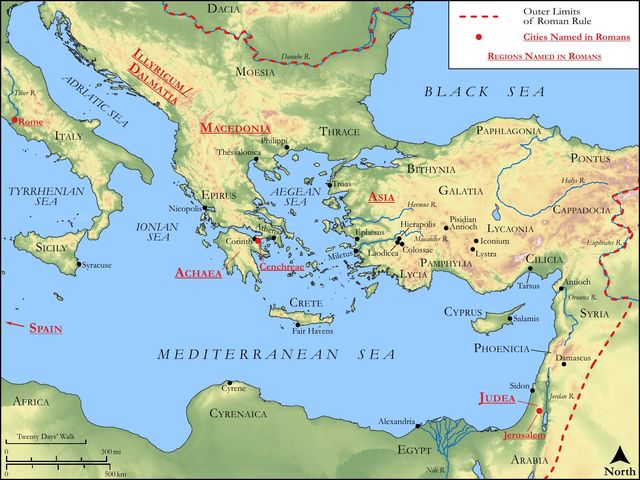
See on the biblical-era maps

Study this verse
Public-domain commentary
Matthew Henry
From his Commentary on the Whole Bible. Henry comments on passages, not single verses — this entry covers Romans 15:17–21. His three-level outline is real structure in the source text, so it is rendered as structure.
The apostle here gives some account of himself and of his own affairs. Having mentioned his ministry and apostleship, he goes on further to magnify his office in the efficacy of it, and to mention to the glory of God the great success of his ministry and the wonderful things that God had done by him, for encouragement to the Christian church at Rome, that they were not alone in the profession of Christianity, but though, compared with the multitude of their idolatrous neighbours, they were but a little flock, yet, up and down the country, there were many that were their companions in the kingdom and patience of Jesus Christ. It was likewise a great confirmation of the truth of the Christian doctrine that it had such strange success, and was so far propagated by such weak and unlikely means, such multitudes captivated to the obedience of Christ by the foolishness of preaching. Therefore Paul gives them this account, which he makes the matter of his glorying; not vain glory, but holy gracious glorying, which appears by the limitations; it is through Jesus Christ. Thus does he centre all his glorying in Christ; he teaches us so to do, Co1 1:31. Not unto us, Psa 115:1. And it is in those things which pertain to God. The conversion of souls is one of those things that pertain to God, and therefore is the matter of Paul's glorying; not the things of the flesh. Whereof I may glory, echō oun kauchēsin en Christō lēsou ta pros Theon. I would rather read it thus: Therefore I have a rejoicing in Christ Jesus (it is the same word that is used, Co2 1:12, and Phi 3:3, where it is the character of the circumcision that they rejoice - kauchōmenoi, in Christ Jesus) concerning the things of God; or those things that are offered to God - the living sacrifices of the Gentiles, Rom 15:16. Paul would have them to rejoice with him in the extent and efficacy of his ministry, of which he speaks not only with the greatest deference possible to the power of Christ, and the effectual working of the Spirit as all in all; but with a protestation of the truth of what he said (Rom 15:18): I will not dare to speak of any of those things which Christ hath not wrought by me. He would not boast of things without his line, nor take the praise of another man's work, as he might have done when he was writing to distant strangers, who perhaps could not contradict him; but (says he) I dare not do it: a faithful man dares not lie, however he be tempted, dares be true, however he be terrified. now, in this account of himself, we may observe,
I.His unwearied diligence and industry in his work. He was one that laboured more abundantly than they all.
1.He preached in many places: From Jerusalem, whence the law went forth as a lamp that shineth, and round about unto Illyricum, many hundred miles distant from Jerusalem. We have in the book of the Acts an account of Paul's travels. There we find him, after he was sent forth to preach to the Gentiles (Acts 13), labouring in that blessed work in Seleucia, Cyprus, Pamphylia, Pisidia, and Lycaonia (Acts 13 and 14), afterwards travelling through Syria and Cilicia, Phrygia, Galatia, Mysia, Troas, and thence called over to Macedonia, and so into Europe, Acts 15 and 16. Then we find him very busy at Thessalonica, Berea, Athens, Corinth, Ephesus, and the parts adjacent. Those that know the extent and distance of these countries will conclude Paul an active man, rejoicing as a strong man to run a race. Illyricum is the country now called Sclavonia, bordering upon Hungary. Some take it for the same with Bulgaria; others for the lower Pannonia: however, it was a great way from Jerusalem. Now it might be suspected that if Paul undertook so much work, surely he did it by the halves. "No," says he, "I have fully preached the Gospel of Christ - have given them a full account of the truth and terms of the gospel, have not shunned to declare the whole counsel of God (Act 20:27), have kept back nothing that was necessary for them to know." Filled the gospel, so the word is; peplērōkenai to euangelion, filled it as the net is filled with fishes in a large draught; or filled the gospel, that is, filled them with the gospel. Such a change does the gospel make that, when it comes in power to any place, it fills the place. Other knowledge is airy, and leaves souls empty, but he knowledge of the gospel is filling.
2.He preached in places that had not heard the gospel before, Rom 15:20, Rom 15:21. He broke up the fallow ground, laid the first stone in many places, and introduced Christianity where nothing had reigned for many ages but idolatry and witchcraft, and all sorts of diabolism. Paul broke the ice, and therefore must needs meet with the more difficulties and discouragements in his work. Those who preached in Judea had upon this account a much easier task than Paul, who was the apostle of the Gentiles; for they entered into the labours of others, Joh 4:38. Paul, being a hardy man, was called out to the hardest work; there were many instructors, but Paul was the great father - many that watered, but Paul was the great planter. Well, he was a bold man that made the first attack upon the palace of the strong man armed in the Gentile world, that first assaulted Satan's interest there, and Paul was that man who ventured the first onset in many places, and suffered greatly for it. He mentions this as a proof of his apostleship; for the office of the apostles was especially to bring in those that were without, and to lay the foundations of the new Jerusalem; see Rev 21:14. Not but that Paul preached in many places where others had been at work before him; but he principally and mainly laid himself out for the good of those that sat in darkness. He was in care not to build upon another man's foundation, lest he should thereby disprove his apostleship, and give occasion to those who sought occasion to reflect upon him. He quotes a scripture for this out of Isa 52:15, To whom he was not spoken of, they shall see. That which had not been told them, shall they see; so the prophet has it, much to the same purport. This made the success of Paul's preaching the more remarkable. The transition from darkness to light is more sensible than the after-growth and increase of that light. And commonly the greatest success of the gospel is at its first coming to a place; afterwards people become sermon-proof.
II.The great and wonderful success that he had in his work:
It was effectual to make the Gentiles obedient. The design of the gospel is to bring people to be obedient; it is not only a truth to be believed, but a law to be obeyed. This Paul aimed at in all his travels; not his own wealth and honour (if he had, he had sadly missed his aim), but the conversion and salvation of souls: this his heart was upon, and for this he travailed in birth again. Now how was this great work wrought?
1.Christ was the principal agent. He does not say, "which I worked," but "which Christ wrought by me," Rom 15:18. Whatever good we do, it is not we, but Christ by us, that does it; the work is his, the strength his; he is all in all, he works all our works, Phi 2:13; Isa 26:12. Paul takes all occasions to own this, that the whole praise might be transmitted to Christ.
2.Paul was a very active instrument: By word and deed, that is, by his preaching, and by the miracles he wrought to confirm his doctrine; or his preaching and his living. Those ministers are likely to win souls that preach both by word and deed, by their conversation showing forth the power of the truths they preach. This is according to Christ's example, who began both to do and teach, Act 1:1. - Through mighty signs and wonders: en dunamei sēmeiōn - by the power, or in the strength, of signs and wonders. These made the preaching of the word so effectual, being the appointed means of conviction, and the divine seal affixed to the gospel-charter, Mar 16:17, Mar 16:18.
3.The power of the Spirit of God made this effectual, and crowned all with the desired success, Rom 15:19.
(1.)The power of the Spirit in Paul, as in the other apostles, for the working of those miracles. Miracles were wrought by the power of the Holy Ghost (Act 1:8), therefore reproaching the miracles is called the blasphemy against the Holy Ghost. Or,
(2.)The power of the Spirit in the hearts of those to whom the word was preached, and who saw the miracles, making these means effectual to some and not to others. It is the Spirit's operation that makes the difference. Paul himself, as great a preacher as he was, with all his might signs and wonders, could not make one soul obedient further than the power of the Spirit of God accompanied his labours. It was the Spirit of the Lord of hosts that made those great mountains plain before this Zerubbabel. This is an encouragement to faithful ministers, who labour under the sense of great weakness and infirmity, that it is all one to the blessed Spirit to work by many, or by those that have on power. The same almighty Spirit that wrought with Paul often perfects strength in weakness, and ordains praise out of the mouths of babes and sucklings. This success which he had in preaching is that which he here rejoices in; for the converted nations were his joy and crown of rejoicing: and he tells them of it, not only that they might rejoice with him, but that they might be the more ready to receive the truths which he had written to them, and to own him whom Christ had thus signally owned.
Historical interpretation
Historical reception
5 surviving comments on this verse. Each one is dated, so this reads as a timeline rather than a list.
Select a marker to jump to its quote. Markers stagger vertically where authors wrote within a few decades of each other.
It was not without reason that Paul says that he tried to preach in places where Christ had not been named. For he knew that false apostles went about sharing Christ in ways which were wrong in order to ensnare the people by some other teaching under the name of Christ, which was then very difficult to put right afterward. Therefore he wanted to get there first, in order to preach the right message.
Paul was not trying to avoid the other apostles, but he thought it was wrong and unfair to steal the credit for what someone else had done.
"Yea, so have I strived to preach the Gospel, not where Christ was named."
See here another preeminence; that he had not only preached the Gospel to so many, and persuaded them, but he did not even go to those who had become disciples. So far was he from thrusting himself upon other men's disciples, and from doing this for glory's sake, that he even made it a point to teach those who had not heard. For neither does he say where they were not persuaded, but "where Christ was not even named," which is more. And what was the reason why he had this ambition? "Lest I should build," he says, "upon another man's foundation."
This he says to show himself a stranger to vanity, and to instruct them that it was not from any love of glory, or of honor from them, that he came to write, but as fulfilling his ministry, as perfecting his priestly duty, as loving their salvation. But he calls the foundation of the Apostles "another man's," not in regard to the quality of the person, or the nature of preaching, but in regard to the question of reward. For it was not that the preaching was that of another man, but so far as it went to another man's reward. For the reward of the labors of others was, to this man, another man's.
A man who builds on someone else’s foundation is not doing anything wrong, as long as he builds with gold and such. Here Paul is referring to those false apostles who always went to converts and never to the Gentiles because they could not work miracles. Paul also shows that he had done a good job, for he both laid the foundation and also built on top of it.
The explanation as to why Paul had not yet managed to visit the Romans seems to be that he believed that Peter had already come to them as their teacher, so he went to places where as yet no one had preached the gospel of Christ.
Continue studying Romans 15:20 across the web’s major study libraries — every link below opens this exact verse, chapter, or book on the destination site.
Read & Compare
 BibleGatewayThis verse in more than 200 translations and 70 languages.
 Bible.comThe YouVersion reader — hundreds of translations, reading plans, and highlights.
 ESV.orgCrossway's official English Standard Version reader.
 NET BibleThe NET translation with 60,000+ translators' notes on every rendering decision.
 STEP BibleTyndale House's free study tool — original text, vocabulary, and scholarly resources.
 BibliaLogos Bible Software's free web reader.
 USCCBThe New American Bible (Revised Edition) with the U.S. bishops' study notes.
Commentaries
 BibleHub CommentariesDozens of classic commentaries on this verse, gathered on one page.
 StudyLightMore than 100 commentary sets — the largest collection on the web.
 BibleRefPlain-English commentary on what this verse means, verse by verse.
 Enduring WordDavid Guzik's free commentary on this chapter, widely used by Bible teachers.
 Bible Study ToolsVerse commentary alongside Greek and Hebrew study aids.
Original Language & Research
- BibleHub InterlinearThe verse word by word — original language, transliteration, and English.
- BibleHub LexiconEvery word's original-language definition and Strong's entry.
 Blue Letter BibleDeep-study tools — Strong's numbers, concordance, and word studies.
 CNTR CollationThe earliest Greek manuscripts of this verse, collated letter by letter.
Sermons, Hymns & Audio


TrulyRandomVerse is not affiliated with these sites and doesn’t control their content. They’re linked because they’re genuinely useful.
Summary
The Apostle Paul, in Romans 15:20, articulates a foundational principle of his apostolic ministry: a zealous commitment to pioneering evangelism. He explains his ambition to preach the gospel exclusively in regions where the name of Christ had not yet been proclaimed, thereby ensuring he would not build upon the established work or spiritual "foundation" laid by another missionary. This strategic approach highlights his dedication to expanding the reach of the Good News into unreached territories and his profound respect for the distinct spheres of labor within the early Christian movement.
Context
ShowHideLiterary Context
Romans 15:20 is situated within Paul's concluding remarks to the Roman church, where he explains his long-anticipated visit and his future missionary plans. Chapters 14-15 focus on the unity of Jewish and Gentile believers in Christ, emphasizing mutual acceptance and living for the glory of God. Paul's discussion of his travel itinerary, particularly his desire to visit Rome on his way to Spain (Romans 15:23-24), serves to justify his delayed arrival and to invite their partnership in his mission. Verse 20 specifically clarifies his apostolic strategy, explaining why he has not yet visited Rome, a city where the gospel had already taken root. It underscores his unique calling to break new ground rather than tend to existing congregations, which aligns with his broader vision for the global spread of the gospel, as seen in his earlier statements about his ministry to the Gentiles in Romans 1:5.
Historical & Cultural Context
Paul's missionary endeavors took place within the vast Roman Empire, a complex network of cities, trade routes, and diverse cultures. While the gospel had spread rapidly since Pentecost, vast regions remained unreached. The concept of "foundation" was literal, referring to the bedrock or initial layer upon which a building was constructed. Spiritually, it referred to the initial evangelism and establishment of a Christian community. Paul's strategy was not merely geographical but also deeply theological, reflecting his understanding of his unique commission as the "apostle to the Gentiles" Romans 11:13. His avoidance of "another man's foundation" also speaks to the potential for rivalry or perceived competition among early Christian leaders, which Paul sought to avoid, valuing unity and distinct callings within the burgeoning church.
Key Themes
ShowHideThis verse contributes significantly to several key themes within Romans and Paul's broader theology. It exemplifies Pioneering Evangelism, showcasing Paul's unwavering commitment to reaching the unreached and extending the kingdom of God into new frontiers, a theme echoed in Isaiah 52:15. It also highlights Apostolic Strategy and Wisdom, demonstrating Paul's intentional and disciplined approach to ministry, maximizing impact by focusing resources where they were most needed. Furthermore, it underscores Respect for Other Laborers, revealing Paul's humility and recognition of the legitimate work of other apostles and evangelists. He sought to complement rather than duplicate or undermine their efforts, fostering a sense of shared mission with distinct roles, as he later explains in 1 Corinthians 3:10-11. Ultimately, Paul's ambition was not for personal glory but for the glory of Christ, whose name he sought to proclaim universally.
Exposition and Analysis
ShowHideKey Word Analysis
ShowHideThis word means "to be fond of honor," or more accurately in this context, "to be ambitious," "to eagerly aspire," or "to make it one's ambition." It denotes an intense zeal and deliberate ambition, not for personal gain, but for the advancement of the gospel in new territories. Paul's striving was a noble ambition, driven by divine calling.
Meaning "to announce good news," specifically the good news of Jesus Christ. This term emphasizes the core content of Paul's mission: the proclamation of salvation through Christ. His striving was directed specifically towards this act of evangelism.
This word means "to name," "to assign an appellation," or by extension, "to utter," "mention," or "profess." In this context, "where Christ was named" signifies where the gospel had already been proclaimed and a Christian community established, where Christ's name was known and confessed.
Refers to "something put down," a "substruction," or the "base or groundwork" of a building. Figuratively, in a spiritual sense, it represents the initial proclamation of the gospel that establishes a Christian community or the fundamental truths upon which faith is built. Paul's desire was to lay new spiritual foundations, not to build upon those already laid by others.
Verse Breakdown
ShowHide"Yea, so have I strived to preach the gospel"
Paul asserts his intense and deliberate ambition (from philotiméomai) to proclaim the good news of Christ. This is not a casual endeavor but a focused, zealous pursuit, indicating the deep conviction and purposeful direction of his missionary work. His entire life was oriented around this singular, paramount goal.
"not where Christ was named"
This clause defines the specific scope and limitation of Paul's ambition. He intentionally avoided regions or cities where the gospel had already been preached and where Christian communities had already been established. This was a strategic choice to prevent redundant efforts and to maximize the global reach of the gospel.
"lest I should build upon another man's foundation"
This phrase explains the rationale behind his strategy. Paul desired to avoid constructing his ministry on the spiritual groundwork already laid by other apostles or evangelists. This demonstrates his respect for their work, his commitment to unity within the broader Christian mission, and his unique calling to be a pioneer, establishing new outposts for the gospel rather than expanding existing ones.
Literary Devices
ShowHideRomans 15:20 employs several literary devices to convey Paul's missionary philosophy. The most prominent is Metaphor, specifically the building metaphor, where the work of evangelism and establishing Christian communities is likened to laying a foundation and constructing a building. Paul's statement, "lest I should build upon another man's foundation," uses this imagery to clearly articulate his desire to be a pioneer, initiating the work rather than continuing someone else's. This metaphor also implies the stability and permanence of the work, rooted in the initial proclamation of Christ. Furthermore, there is an underlying Antithesis between "where Christ was named" and "another man's foundation," contrasting established Christian presence with unreached territories, underscoring Paul's unique focus on the latter. This reflects his Apostolic Ethos, a deep sense of calling and purpose that guided his every missionary decision.
Theological and Thematic Connections
ShowHidePaul's strategic principle in Romans 15:20 is deeply theological, revealing God's overarching plan for the global dissemination of the gospel and the diverse yet unified nature of Christian ministry. His ambition to preach where Christ had not been named reflects the missional heart of God, who desires all peoples to hear and respond to the good news. It underscores the urgency and necessity of reaching the unreached, ensuring that the light of Christ penetrates every dark corner of the world. Paul's respect for "another man's foundation" also highlights the importance of stewardship in ministry, avoiding duplication of effort and recognizing the unique gifts and callings God bestows upon different individuals for the expansion of His kingdom. This principle fosters collaboration and mutual respect among ministers, rather than competition, ensuring that the focus remains on the glory of God and the spread of His truth.
Reflection and Application
ShowHidePaul's pioneering spirit and strategic approach in Romans 15:20 offer profound lessons for believers today, challenging us to consider our role in the ongoing mission of God. While not all are called to be apostolic pioneers in the same sense as Paul, his principle encourages us to identify and engage with the "unreached" in our own spheres of influence, whether geographically, culturally, or socially. This might involve stepping out of our comfort zones to share the gospel with those who have never truly heard it, or engaging with communities where Christian presence is minimal. Furthermore, Paul's respect for "another man's foundation" calls us to humility and collaboration within the body of Christ. Instead of competing or duplicating efforts, we are called to discern our unique gifts and callings, supporting and complementing the work of others, and always seeking to build up the kingdom of God collectively. Our focus should be on the advancement of Christ's name, not on personal recognition or territorialism, ensuring that every effort serves the greater purpose of making disciples of all nations.
Questions for Reflection
ShowHideFAQ
ShowHideWhy was Paul so determined to preach only where Christ was not named?
ShowHidePaul's determination stemmed from his unique apostolic calling and strategic vision for the global spread of the gospel. As the "apostle to the Gentiles" Romans 11:13, he felt a specific commission to bring the good news to those who had never heard it, fulfilling the prophecy in Isaiah 52:15 that "those who have not been told of him will see, and those who have not heard will understand." His aim was to expand the geographical and cultural reach of Christianity, not merely to strengthen existing communities. This approach maximized the impact of his ministry by focusing on pioneering work, avoiding redundancy, and respecting the established work of other evangelists, as he explains in 2 Corinthians 10:15-16.
What does "another man's foundation" mean in this context?
ShowHide"Another man's foundation" refers to the initial work of evangelism and the establishment of a Christian community in a particular area by another missionary or apostle. Paul uses a building metaphor, where the "foundation" is the initial preaching of the gospel that forms the basis of a local church or group of believers. His principle was not to build upon a spiritual structure that someone else had already initiated. This reflects his desire to avoid perceived competition, to honor the distinct spheres of ministry, and to focus his efforts on breaking new ground, ensuring that the gospel was proclaimed in regions previously untouched by Christian witness. While human ministers lay foundations, Paul always understood that the ultimate and true foundation for all Christian work is Jesus Christ Himself.
Christ-Centered Fulfillment
ShowHideRomans 15:20, while articulating Paul's missionary strategy, profoundly points to Christ as the ultimate object and enabler of all evangelistic endeavor. Paul's "striving to preach the gospel" is not for his own glory, but for the universal proclamation of the name of Christ, the one who is the very content of the good news. The "foundation" he seeks not to build upon, yet simultaneously yearns to lay anew in unreached lands, is ultimately Christ Himself, for as Paul declares elsewhere, "no one can lay any foundation other than the one already laid, which is Jesus Christ" (1 Corinthians 3:11). Christ is the divine architect and the cornerstone Ephesians 2:20 upon whom the entire spiritual edifice of the church is built. Paul's ambition to reach the unreached is a direct outworking of Christ's Great Commission to "make disciples of all nations" Matthew 28:19, extending the reign and redemptive work of the crucified and resurrected Lord to the ends of the earth. Thus, Paul's strategy is not merely logistical but deeply Christological, driven by the imperative that every knee should bow and every tongue confess that Jesus Christ is Lord, to the glory of God the Father.