


Romans 1:5
- δι᾽di᾽throughG1223PREPPreposition
- οὗhouwhomG3739R-GSMRelative pronoun Genitive Singular Masculine
- ἐλάβομενelabomenwe have receivedG2983V-2AAI-1PVerb 2nd Aorist Active Indicative 1st Plural
- χάρινcharingraceG5485N-ASFNoun Accusative Singular Feminine
- καὶkaiandG2532CONJConjunction
- ἀποστολὴνapostolēnapostleshipG651N-ASFNoun Accusative Singular Feminine
- εἰςeisuntoG1519PREPPreposition
- ὑπακοὴνhupakoēnobedienceG5218N-ASFNoun Accusative Singular Feminine
- πίστεωςpisteōsof faithG4102N-GSFNoun Genitive Singular Feminine
- ἐνenamongG1722PREPPreposition
- πᾶσινpasinallG3956A-DPNAdjective Dative Plural Neuter
- τοῖςtoistheG3588T-DPNDefinite article Dative Plural Neuter
- ἔθνεσινethnesinGentilesG1484N-DPNNoun Dative Plural Neuter
- ὑπὲρhuperon behalf ofG5228PREPPreposition
- τοῦtoutheG3588T-GSNDefinite article Genitive Singular Neuter
- ὀνόματοςonomatosnameG3686N-GSNNoun Genitive Singular Neuter
- αὐτοῦautouof HimG846P-GSMPersonal pronoun Genitive Singular Masculine
English is a literal word-by-word gloss of the Greek, not the KJV's wording. Why?
This is the original text the KJV's translators worked from — each Greek word with its own literal English meaning in this verse, prepared by scholars at Tyndale House, Cambridge. The KJV translates whole sentences, not word by word, so its wording differs: one Greek word can become several English words, and the KJV may choose “charity” where the gloss reads “love”. Both are faithful — they answer different questions. For the KJV's own rendering, switch to the KJV text.
Details
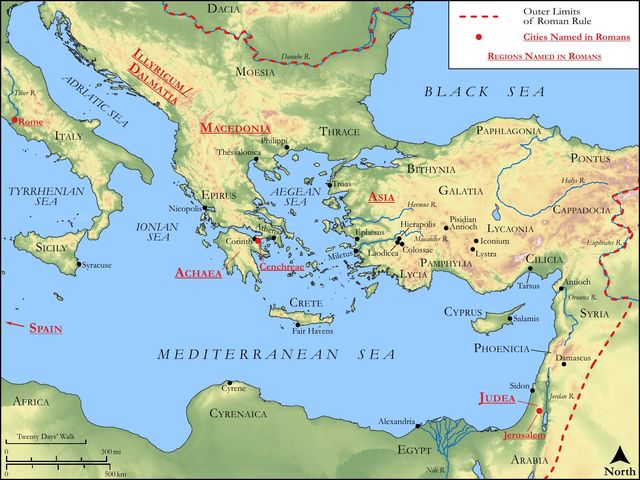
See on the biblical-era map

Study this verse
Public-domain commentary
Matthew Henry
From his Commentary on the Whole Bible. Henry comments on passages, not single verses — this entry covers Romans 1:1–7. His three-level outline is real structure in the source text, so it is rendered as structure.
In this paragraph we have,
I.The person who writes the epistle described (Rom 1:1):
Paul, a servant of Jesus Christ; this is his title of honour, which he glories in, not as the Jewish teachers, Rabbi, Rabbi; but a servant, a more immediate attendant, a steward in the house. Called to be an apostle. Some think he alludes to his old name Saul, which signifies one called for, or enquired after: Christ sought him to make an apostle of him, Act 9:15. He here builds his authority upon his call; he did not run without sending, as the false apostles did; klētos apostolos - called an apostle, as if this were the name he would be called by, though he acknowledged himself not meet to be called so, Co1 15:9. Separated to the gospel of God. The Pharisees had their name from separation, because they separated themselves to the study of the law, and might be called aphōrismenoi eis ton nomon; such a one Paul had formerly been; but now he had changed his studies, was aphōrismenos eis to Euangelion, a gospel Pharisee, separated by the counsel of God (Gal 1:15), separated from his mother's womb, by an immediate direction of the Spirit, and a regular ordination according to that direction (Act 13:2, Act 13:3), by a dedication of himself to this work. He was an entire devotee to the gospel of God, the gospel which has God for its author, the origin and extraction of it divine and heavenly.
II.Having mentioned the gospel of God, he digresses, to give us an encomium of it.
1.The antiquity of it. It was promised before (Rom 1:2); it was no novel upstart doctrine, but of ancient standing in the promises and prophecies of the old Testament, which did all unanimously point at the gospel, the morning-beams that ushered in the sun of righteousness; this not by word of mouth only, but in the scriptures.
2.The subject-matter of it: it is concerning Christ, Rom 1:3, Rom 1:4. The prophets and apostles all bear witness to him; he is the true treasure hid in the field of the scriptures. Observe, When Paul mentions Christ, how he heaps up his names and titles, his Son Jesus Christ our Lord, as one that took a pleasure in speaking of him; and, having mentioned him, he cannot go on in his discourse without some expression of love and honour, as here, where in one person he shows us his two distinct natures.
(1.)His human nature: Made of the seed of David (Rom 1:3), that is, born of the virgin Mary, who was of the house of David (Luk 1:27), as was Joseph his supposed father, Luk 2:4. David is here mentioned, because of the special promises made to him concerning the Messiah, especially his kingly office; Sa2 7:12; Psa 132:11, compared with Luk 1:32, Luk 1:33.
(2.)His divine nature: Declared to be the Son of God (Rom 1:4), the Son of God by eternal generation, or, as it is here explained, according to the Spirit of holiness. According to the flesh, that is, his human nature, he was of the seed of David; but, according to the Spirit of holiness, that is, the divine nature (as he is said to be quickened by the Spirit, Pe1 3:18, compared with Co2 13:4), he is the Son of God. The great proof or demonstration of this is his resurrection from the dead, which proved it effectually and undeniably. The sign of the prophet Jonas, Christ's resurrection, was intended for the last conviction, Mat 12:39, Mat 12:40. Those that would not be convinced by that would be convinced by nothing. So that we have here a summary of the gospel doctrine concerning Christ's two natures in one person.
3.The fruit of it (Rom 1:5); By whom, that is, by Christ manifested and made known in the gospel, we (Paul and the rest of the ministers) have received grace and apostleship, that is, the favour to be made apostles, Eph 3:8. The apostles were made a spectacle to the world, led a life of toil, and trouble, and hazard, were killed all the day long, and yet Paul reckons the apostleship a favour: we may justly reckon it a great favour to be employed in any work or service for God, whatever difficulties or dangers we may meet with in it. This apostleship was received for obedience to the faith, that is, to bring people to that obedience; as Christ, so his ministers, received that they might give. Paul's was for this obedience among all nations, for he was the apostle of the Gentiles, Rom 11:13. Observe the description here given of the Christian profession: it is obedience to the faith. It does not consist in a notional knowledge or a naked assent, much less does it consist in perverse disputings, but in obedience. This obedience to the faith answers the law of faith, mentioned Rom 3:27. The act of faith is the obedience of the understanding to God revealing, and the product of that is the obedience of the will to God commanding. To anticipate the ill use which might be made of the doctrine of justification by faith without the works of the law, which he was to explain in the following epistle, he here speaks of Christianity as an obedience. Christ has a yoke. "Among whom are you, Rom 1:6. You Romans in this stand upon the same level with other Gentile nations of less fame and wealth; you are all one in Christ." The gospel salvation is a common salvation, Jde 1:3. No respect of persons with God. The called of Jesus Christ; all those, and those only, are brought to an obedience of the faith that are effectually called of Jesus Christ.
III.The persons to whom it is written (Rom 1:7):
To all that are in Rome, beloved of God, called to be saints; that is, to all the professing Christians that were in Rome, whether Jews or Gentiles originally, whether high or low, bond or free, learned or unlearned. Rich and poor meet together in Christ Jesus. Here is,
1.The privilege of Christians: They are beloved of God, they are members of that body which is beloved, which is God's Hephzibah, in which his delight is. We speak of God's love by his bounty and beneficence, and so he hath a common love to all mankind and a peculiar love for true believers; and between these there is a love he hath for all the body of visible Christians.
2.The duty of Christians; and that is to be holy, for hereunto are they called, called to be saints, called to salvation through sanctification. Saints, and only saints, are beloved of God with a special and peculiar love. Klētois hagiois - called saints, saints in profession; it were well if all that are called saints were saints indeed. Those that are called saints should labour to answer to the name; otherwise, though it is an honour and a privilege, yet it will be of little avail at the great day to have been called saints, if we be not really so.
IV.The apostolical benediction (Rom 1:7):
Grace to you and peace. This is one of the tokens in every epistle; and it hath not only the affection of a good wish, but the authority of a blessing. The priests under the law were to bless the people, and so are gospel ministers, in the name of the Lord. In this usual benediction observe,
1.The favours desired: Grace and peace. The Old Testament salutation was, Peace be to you; but now grace is prefixed - grace, that is, the favour of God towards us or the work of God in us; both are previously requisite to true peace. All gospel blessings are included in these two: grace and peace. Peace, that is all good; peace with God, peace in your own consciences, peace with all that are about you; all these founded in grace.
2.The fountain of those favours, from God our Father, and the Lord Jesus Christ. All good comes,
(1.)From God as a Father; he hath put himself into that relation to engage and encourage our desires and expectations; we are taught, when we come for grace and peace, to call him our Father.
(2.)From the Lord Jesus Christ, as Mediator, and the great feoffee in trust for the conveying and securing of these benefits. We have them from his fulness, peace from the fulness of his merit, grace from the fulness of his Spirit.
Historical interpretation
Ten Centuries of Reception
6 surviving comments on this verse. Each one is dated, so this reads as a timeline rather than a list.
Select a marker to jump to its quote. Markers stagger vertically where authors wrote within a few decades of each other.
Paul says that he has received grace and apostleship through Christ, the mediator between God and men—grace with respect to his patience in many labors and apostleship with respect to his preaching authority. For Christ was himself called an apostle, i.e., one who was sent by the Father, because he said that he had been sent to preach the gospel to the poor. And everything which is his, he gives to his disciples also. Grace is said to be spread on his lips. For he gives grace to his apostles, by which those who are struggling may say: “I worked harder than any of them, though it was not I but the grace of God which is with me.” … It was only through the grace which had been given to the apostles that the Gentiles, who were strangers from the covenant of God and from the life of Israel, could believe in the gospel. Through this grace it is said that they came to faith because of the preaching of the apostles, and it is recorded that by the grace given to them the sound of the name of Christ went out into all the world, reaching even those who were at Rome.
After the resurrection Christ was revealed as the Son of God in power. He gave grace to make sinners righteous and appointed apostles, of whom Paul says here that he is one, so that the apostleship might be granted by the grace of God’s gift and not because the apostles were Jews. They received this authority from God the Father through Christ the Lord, so that as representatives of the Lord they might make his teaching acceptable by signs of power. Unbelieving Jews, who had been jealous of this power when they saw it in the Savior, were all the more tormented at seeing it admired by the masses in his servants. For power bears witness to the teaching, so that although what is preached is incredible to the world, it might be made credible by deeds. He says that the apostles have been sent to preach the faith to all nations, that they might obey and be saved, that the gift of God may appear to have been granted not only to the Jews but to all the nations, and that this is the will of God, to have pity on all in Christ and through Christ, by the preaching of his ambassadors.
"By Whom we have received grace and Apostleship for obedience to the faith."
See the candor of the servant. He wishes nothing to be his own, but all his Master's. And indeed it was the Spirit that gave this. Wherefore He saith, "I have many things to say unto you, but ye cannot bear them now. Howbeit when He, the Spirit of Truth, is come, He will guide you into all truth": and again, "Separate Me Paul and Barnabas." And in the Epistle to the Corinthians, he says, that "to one is given by the Spirit the word of wisdom, to another the word of knowledge"; and that It divideth all as It willeth. And in addressing the Milesians, he says, "Over which the Holy Ghost hath made you shepherds and overseers." You see, he calls the things of the Spirit, the Son's, and the things of the Son, the Spirit's. "Grace and Apostleship;" that is, it is not we that have achieved for ourselves, that we should become Apostles. For it was not by having toiled much and labored that we had this dignity allotted to us, but we received grace, and the successful result is a part of the heavenly gift. "For obedience to the faith." So it was not the Apostles that achieved it, but grace that paved the way before them. For it was their part to go about and preach, but to persuade was of God, Who wrought in them. As also Luke saith, that "He opened their heart"; and again, To whom it was given to hear the word of God. "To obedience;" he says not, to questioning and parade of argument but "to obedience." For we were not sent, he means, to argue, but to give those things which we had trusted to our hands. For when the Master declareth aught, they that hear should not be nice and curious handlers of what is told them, but receivers only; for this is why the Apostles were sent, to speak what they had heard, not to add aught from their own stock, and that we for our part should believe-that we should believe what?-"concerning His Name." Not that we should be curious about the essence, but that we should believe on the Name; for this it was which also wrought the miracles. For it says, "in the Name of Jesus Christ rise up and walk." And this too requireth faith, neither can one grasp aught of these things by reasoning. "Among all nations, among whom are ye also the called of Jesus Christ." What? did Paul preach then to all the nations? Now that he ran through the whole space from Jerusalem to Illyricum, and from thence again went forth to the very ends of the earth, is plain from what he writes to the Romans; but even if he did not come to all, yet still what he says is not false, for he speaks not of himself alone, but of the twelve Apostles, and all who declared the word after them. And in another sense, one should not see any fault to find with the phrase, if about himself, when one considers his ready mind, and how that after death he ceaseth not to preach in all parts of the world. And consider how he extols the gift, and shows that it is great and much more lofty than the former, since the old things were with one nation, but this gift drew sea and land to itself.
Paul received grace in baptism and apostleship when he was sent by the Holy Spirit, for apostle means “sent” in Greek. The purpose of this was that the Gentiles might submit not to the law but to faith.
Paul preserves the main point of his case very well, so that no one would dare say that he has been led to the gospel because of the merits of his previous life. How could one claim this, when even the apostles themselves … could not have received their own apostleship unless they had first … received grace, which cleanses and justifies sinners?
60. After commending Christ in his origin and power [n. 28], he now commends him in his generosity, which is shown by the gifts he conferred on believers. And he sets out two gifts [n. 61]. One is common to all believers, namely grace, by which we are restored. We receive this from God through Christ; hence, he says, through whom we believers have received grace; "Grace and truth came through Jesus Christ" (Jn 1:17); and below (5:2): "Through him we have obtained access to this grace in which we stand." For it is fitting that just as all things were made by the Word (Jn 1:3), so by the Word as by the art of God Almighty all things should be restored; as an artisan repairs a house by means of the same art as he built it: "God was pleased to reconcile through him all things, whether on earth or in heaven" (Col 1:20). 61. The other spiritual gift was conferred on the apostles. This he touches on when he says, and apostleship, which is the chief office in the Church: "God has appointed in the church, first, apostles" (1 Cor 12:28). Apostle is the same as sent. For they were sent by Christ, bearing, as it were, his authority and office: "As the Father has sent me, even so I send you" (Jn 20:21), i.e., with full authority. Hence Christ himself is called an apostle: "Consider Jesus, the apostle and 38 high priest of our confession" (Heb 3:1); hence, too, through him as chief apostle or "one sent," the others secondarily obtained apostleship: "He chose twelve whom he called apostles" (Luke 6:13). Now he sets out the grace of apostleship as a preface both because they obtained apostleship not through their merits but from grace: "I am the least of the apostles, unfit to be called an apostle; but by the grace of God I am what I am" (1 Cor 15:9); and because apostleship cannot be worthily obtained unless sanctifying grace precedes it: "Grace was given to each of us according to the measure of Christ’s gift" (Eph 4:7). 62. Then he describes this apostleship: first, from its aim when he adds, to bring about the obedience of faith. As if to say: We have been sent with this aim, to induce men to obey the faith. Obedience finds its scope in things we can do voluntarily; in matter of faith, since they are above reason, we consent voluntarily. For no one believes unless he will to, as Augustine says. Consequently, in matters of faith, the following has a place: "You have become obedient from the heart to the standard of teaching to which you were committed" (Rom 6:17). Concerning this aim Jn (15:16) says: "I appointed you that you should go and bear fruit and that your fruit should abide." 63. Secondly, it is described from its extent when he says, among all the nations, because they were directed to instruct not only the Jews but all nations: "Go, therefore, and make disciples of all nations" (Mt 28:19). Paul in particular had received a mandate to all nations, so that the words of Is (49:6) apply to him: "It is too light a thing that you should be my servant to raise up the tribes of Jacob and to restore the preserved of Israel: I will give you as a light to the 39 nations." Yet the Jews were not excluded from his apostolate, especially those who lived among the Gentiles: "Inasmuch as I am an apostle to the Gentiles, I magnify my ministry in order to make my fellow Jews jealous, and thus save some of them" (Rom 11:13-14). 64. Thirdly, from the completeness of its power when he says, for the sake of his name, i.e., in His place and with His authority. For as Christ is said to have come in the Father’s name and had the Father’s full authority, so the apostles are said to have come in Christ’s name, as though in Christ’s person : "What I have forgiven, if I have forgiven anything, has been for your sake in the person of Christ" (2 Cor 2:10). Or by these words it is described from its end, i.e., to broadcast His came without seeking any earthly reward for himself: "He is a chosen instrument of mine to carry my name before kings and the Gentiles and the children of Israel" (Ac 9:15). Hence, he urged all believers to do the same: "Do everything in the name of Jesus Christ (Col 3:17). 65. Fourthly, as to his power over those to whom he was writing and who were subject to his apostleship. Hence h says, including yourselves, i.e. I number among those subject to my apostolate even you Romans howsoever lofty: "He lays it low, the lofty city," the foot of the poor, i.e., of Christ, tramples it, "the steps of the needy," namely, of the apostles Peter and Paul (Is 26:5-6); "We were the first to come all the way to you with the gospel of Christ" (2 Cor 10:14). He adds, the called of Jesus Christ, in accord with Hos 1(:9), "I will call ‘not my people’ mine"; or, you are called that you may be of Jesus Christ, as is said below (8:30), "Those whom he predestined he also called." Or, you are called of Jesus Christ, i.e., you 40 are named from Christ, "Christians": "So that at Antioch the disciples were first named Christians" (Acts 11:21). 66. Then the persons greeted are described: first [n. 67], from their place when he says to all in Rome. To all, indeed, because he sought the salvation of all: "I wish that all were as I myself am" (1 Cor 7:7); also the Lord had said to him: "You must bear witness also at Rome" (Ac 23:10). 67. Secondly, they are described from their gift of grace, God’s beloved. First [n. 68ff.], the primary source of grace is mentioned, namely, God’s love: "He loved his people, all those consecrated to him were in his hand" (Dt 33:3); "Not that we loved God first, but that he first loved us" (1 Jn 4:10). For God’s love is not called forth by any goodness in a creature, as human love is; rather, He causes the creature’s goodness, because to love is to will goodness to the beloved. But God’s love is the cause of things: "Whatever the Lord pleases, he makes" (Ps 135:6). 68. Secondly, their calling when he adds, called. This call is twofold. One is outward, as when He called Peter and Andrew (Mt 4), while the other is inward, when it is according to an interior inspiration: "I called and you refused to listen" (Pr 1:24). 69. Thirdly, he mentions the grace of justification when he says, to be saints, i.e., sanctified by grace and the sacrament of grace: "But you were washed, you were sanctified," to be beloved by God, called to be saints (1 Cor 6:11). 70. Then [cf. n 15] the blessings he wishes them are mentioned. These are grace and peace. One of these, namely, grace is the first among God’s gifts, because by it the 41 sinner is made holy: "They are justified by his grace as a gift" (Rom 3:24). The other, namely, peace, is His last gift, which is completed in happiness: "He makes peace in your borders" (Ps 147:14). For perfect peace will exist when the will is at rest in the fullness of all good, a state that results from being free of all evil: "My people will abide in the beauty of peace" (Is 32:18). Consequently, in these two blessings all those between are understood. 71. Then he shows from whom these blessings are to be expected when he adds, from God our Father: "Every good endowment and every perfect gift is from above, coming down from the Father of lights" (Jas 1:17) "The Lord bestows grace and glory" (Ps 84:11). He adds, and from the Lord Jesus Christ, because, as stated in Jn (1:17): "Grace and truth came through Jesus Christ." He Himself says: "My peace I give to you" (Jn 14:27). 72. The phrase, God the Father, can be taken for the whole Trinity, which called Father, because names implying a relationship to the creature are common to the whole Trinity, for example, Creator and Lord. But he adds, and the Lord Jesus Christ, not to imply that He is another person distinct from the three, but to stress the human nature by whose mystery the gifts of grace come to us: "Through whom he has granted to us his precious and very great promises" (2 Pt 1:4). Or it might be said that the phrase, God the Father, stands for the person of the Father, Who is called the Father of Christ by propriety, but our Father by appropriation: "I am ascending to my Father and to your Father" (Jn 20:17). 42 73. Then the person of the Son is meant when he says, and the Lord Jesus Christ. The person of the Holy Spirit is not expressly mentioned, because he is understood in his gifts, which are grace and peace, or even because He is understood whenever there is mention of the Father and of the Son, for He is their union and bond.
Continue studying Romans 1:5 across the web’s major study libraries — every link below opens this exact verse, chapter, or book on the destination site.
Read & Compare
 BibleGatewayThis verse in more than 200 translations and 70 languages.
 Bible.comThe YouVersion reader — hundreds of translations, reading plans, and highlights.
 ESV.orgCrossway's official English Standard Version reader.
 NET BibleThe NET translation with 60,000+ translators' notes on every rendering decision.
 STEP BibleTyndale House's free study tool — original text, vocabulary, and scholarly resources.
 BibliaLogos Bible Software's free web reader.
 USCCBThe New American Bible (Revised Edition) with the U.S. bishops' study notes.
Commentaries
 BibleHub CommentariesDozens of classic commentaries on this verse, gathered on one page.
 StudyLightMore than 100 commentary sets — the largest collection on the web.
 BibleRefPlain-English commentary on what this verse means, verse by verse.
 Enduring WordDavid Guzik's free commentary on this chapter, widely used by Bible teachers.
 Bible Study ToolsVerse commentary alongside Greek and Hebrew study aids.
Original Language & Research
- BibleHub InterlinearThe verse word by word — original language, transliteration, and English.
- BibleHub LexiconEvery word's original-language definition and Strong's entry.
 Blue Letter BibleDeep-study tools — Strong's numbers, concordance, and word studies.
 CNTR CollationThe earliest Greek manuscripts of this verse, collated letter by letter.
Sermons, Hymns & Audio


TrulyRandomVerse is not affiliated with these sites and doesn’t control their content. They’re linked because they’re genuinely useful.
Summary
Romans 1:5 serves as a pivotal statement in Paul's opening address, articulating the divine source and global scope of his apostolic ministry. Through Jesus Christ, Paul and his fellow apostles received both unmerited favor (grace) and their specific commission (apostleship), all for the singular purpose of fostering a faith-filled obedience among all Gentile nations, thereby bringing glory and recognition to Christ's name.
Context
ShowHideLiterary Context
This verse immediately follows Paul's self-identification as a "servant of Jesus Christ, called to be an apostle, set apart for the gospel of God" (Romans 1:1). Having established his divine commission and the gospel's focus on Jesus Christ (Romans 1:2-4), Paul now explains the means by which he received this authority ("by whom") and the purpose of his ministry ("for obedience to the faith among all nations, for his name"). It transitions from the gospel's content to its global mission and the apostolic role in it, setting the stage for the letter's overarching themes of justification by faith and the inclusion of Gentiles.
Historical & Cultural Context
Paul wrote this letter to the church in Rome, a diverse community comprising both Jewish and Gentile believers, in a city that was the heart of the Roman Empire. The concept of "apostleship" in the early church was distinct, referring to those directly commissioned by the resurrected Christ to be foundational witnesses and authoritative messengers of the gospel, particularly to new territories. Paul, as the "apostle to the Gentiles" (Romans 11:13), was keenly aware of the ethnic divisions and theological debates regarding the inclusion of non-Jews into God's covenant people. His emphasis on "all nations" directly addresses this historical reality and the universal scope of God's redemptive plan, challenging the ethnocentric views prevalent in some Jewish Christian circles.
Key Themes
ShowHideRomans 1:5 contributes significantly to several key themes woven throughout the book of Romans. It underscores the divine origin and authority of the gospel ministry, emphasizing that both the call and the enablement (grace) come from Christ, not human merit or appointment. It highlights the universal scope of the gospel, making clear that God's saving purposes extend beyond Israel to "all nations" (Gentiles), a theme Paul elaborates on extensively in chapters 9-11. Furthermore, the phrase "obedience to the faith" introduces the crucial theme of faith as the proper response to God's revelation, a faith that is not merely intellectual assent but leads to active submission and transformation, which is central to Paul's argument for justification by faith in Romans 3:21-26. Finally, the ultimate aim "for his name" establishes the glory of Christ as the supreme motivation and goal of all apostolic labor and indeed, all Christian life, echoing the broader biblical narrative that all things exist for God's praise.
Exposition and Analysis
ShowHideKey Word Analysis
ShowHideMeaning "graciousness (as gratifying), of manner or act (abstract or concrete; literal, figurative or spiritual; especially the divine influence upon the heart, and its reflection in the life; including gratitude)." Here, "grace" refers to God's unmerited favor, specifically the divine enablement and spiritual gift that empowers Paul for his apostolic calling and ministry, rather than a general sense of salvation. It is the divine benevolence that makes his commission possible and effective.
Meaning "commission, i.e. (specially) apostolate." This term denotes the specific office and authority given to Paul as an apostle, a divinely appointed messenger with a unique commission to proclaim the gospel, particularly to the Gentiles. It signifies his authoritative role in establishing churches and teaching doctrine, directly received from Christ.
Meaning "a race (as of the same habit), i.e. a tribe; specially, a foreign (non-Jewish) one (usually, by implication, pagan):--Gentile, heathen, nation, people." In this context, "nations" explicitly refers to the non-Jewish peoples, the Gentiles. This highlights the universal, cross-cultural reach of the gospel and Paul's specific calling to bring the message of salvation to those outside of the covenant people of Israel.
Verse Breakdown
ShowHide"By whom we have received grace and apostleship"
This clause identifies Jesus Christ (referred to in the preceding verses) as the ultimate source of Paul's spiritual endowment ("grace") and his specific calling ("apostleship"). It emphasizes that Paul's authority and ability to minister are not self-derived or humanly conferred, but are a direct, unmerited gift from the risen Lord. The pairing of "grace" and "apostleship" suggests that the calling itself is an act of grace, and grace is the empowering force for fulfilling that calling.
"for obedience to the faith"
This phrase, hypakoe pisteos in Greek, is rich with meaning. It can be understood as "obedience that comes from faith" (subjective genitive, where faith is the source of obedience) or "obedience to the faith" (objective genitive, where "the faith" refers to the body of Christian truth or the gospel message that is to be obeyed). Both interpretations are likely intended: the proper response to the gospel is a trusting submission to God's truth, and this very act of believing is itself an act of obedience to God's command to believe. It signifies a transformative yielding to God's will, initiated by genuine faith.
"among all nations"
This specifies the global scope and target audience of the apostolic mission. "All nations" (Greek panta ta ethnē) unequivocally refers to the Gentiles, non-Jewish peoples from every ethnic and cultural background. This underscores the universal nature of the gospel and God's expansive redemptive plan, which transcends ethnic boundaries and is not limited to Israel. It sets the stage for Paul's later arguments in Romans regarding the inclusion of Gentiles into God's family.
"for his name"
This final phrase declares the ultimate purpose and highest aim of the entire apostolic endeavor. All the grace, apostleship, and the resulting obedience to the faith among the nations are ultimately "for his name"—that is, for the glory, honor, reputation, and recognition of Jesus Christ. It means that Christ's character, authority, and saving power are to be magnified and made known throughout the world, establishing His rightful supremacy.
Literary Devices
ShowHidePaul employs several literary devices to convey his message with precision and power. The use of Purpose Clauses is prominent, with "for obedience to the faith" and "for his name" clearly articulating the dual objectives of his ministry. This structure highlights the teleological nature of God's work, emphasizing that divine actions have specific, intended outcomes. There is also a strong sense of Emphasis through juxtaposition, as "grace" and "apostleship" are presented together as gifts received "by whom" (Christ), underscoring the divine origin of both the enabling power and the specific calling. Furthermore, the phrase "for his name" functions as a form of Metonymy, where "name" stands for the entire person, reputation, and authority of Jesus Christ, signifying that the ultimate goal is the exaltation and recognition of Christ Himself.
Theological and Thematic Connections
ShowHideRomans 1:5 profoundly shapes our understanding of Christian ministry, revealing it as a divine initiative rooted in grace and aimed at global transformation for Christ's glory. It teaches that true spiritual authority and effectiveness do not come from human credentials or effort, but are sovereignly bestowed by God through Jesus Christ. This verse connects the unmerited favor of God (grace) directly to the specific calling (apostleship), illustrating that God's gifts are always for a purpose—to bring people into a saving relationship with Him that manifests as "obedience to the faith." This obedience is not legalistic adherence but a joyful submission stemming from trust in the gospel, a response God desires from "all nations." The ultimate goal, "for his name," elevates Christ's honor above all human endeavors, reminding us that all ministry and indeed all of life should be directed toward magnifying His worth.
Reflection and Application
ShowHideRomans 1:5 offers profound insights for every believer, not just those in formal ministry. It reminds us that any spiritual gift, calling, or opportunity we possess is fundamentally a "grace" received from Christ, not earned. This understanding cultivates humility and gratitude, shifting our focus from self-reliance to dependence on God's unmerited favor. The purpose of this grace and any calling is to foster "obedience to the faith"—a life where our belief in Christ translates into active submission to His teachings and will. This obedience is not a burden but a joyful response to His saving work, leading to genuine transformation. Furthermore, the global scope of "all nations" challenges us to consider our role in God's worldwide mission. Are we living out our faith in a way that impacts those around us, both locally and globally? Is our ultimate aim to bring glory to Christ's name in all that we do? This verse calls us to embrace our God-given purpose with a Christ-centered focus, participating in His grand plan to draw people from every tribe and tongue to Himself.
Questions for Reflection
ShowHideFAQ
ShowHideWhat is the meaning of "obedience to the faith"?
ShowHideThe phrase "obedience to the faith" (Greek: hypakoē pisteōs) is a rich theological concept. It can be understood in two primary ways, both of which are likely intended. First, it can mean "obedience that comes from faith," implying that genuine faith is not merely intellectual assent but a dynamic, active trust in God that naturally leads to a life of submission and obedience to His will. Second, it can mean "obedience to the faith" as in obeying the gospel message itself. The gospel is not just information; it is a divine command to repent and believe (Acts 17:30). Therefore, responding to the gospel with belief is an act of obedience. Ultimately, it signifies a transformative response to God's saving truth, where one's entire life is brought into alignment with God's purposes through the power of faith.
Why is "all nations" significant in this verse?
ShowHideThe phrase "all nations" (Greek: panta ta ethnē) is highly significant because it explicitly refers to the Gentiles, or non-Jewish peoples. In the context of first-century Judaism, salvation and covenant blessings were often perceived as exclusive to Israel. Paul, however, consistently emphasizes that God's redemptive plan, revealed through Jesus Christ, is universal in scope. This emphasis on "all nations" highlights that the gospel message and the call to salvation are not limited by ethnic or national boundaries but are intended for humanity worldwide. It foreshadows Paul's extensive theological argument in Romans about the inclusion of Gentiles into God's family through faith, establishing the foundational principle of the church's global mission, a mission rooted in Christ's own Great Commission.
Christ-Centered Fulfillment
ShowHideRomans 1:5 finds its ultimate fulfillment and deepest meaning in Jesus Christ, who is not merely the subject of the gospel but the divine source and ultimate goal of all ministry. It is "by whom" – Jesus Christ, the Son of God, raised from the dead (Romans 1:3-4) – that Paul received both grace and apostleship. Christ's finished work on the cross and His resurrection are the very foundation upon which God's unmerited favor (grace) flows to humanity, enabling individuals like Paul to be called and empowered for service. The "obedience to the faith" is a response to Christ's saving work, a submission to His Lordship, and a trust in His atoning sacrifice. This faith-obedience is to be proclaimed "among all nations," fulfilling the Old Testament prophecies of a Messiah who would be a light to the Gentiles (Isaiah 49:6) and Christ's own commission to His disciples to make disciples of all nations (Matthew 28:18-20). Ultimately, all of this global mission and the transformative power of the gospel are "for his name," meaning for the exaltation and renown of Jesus Christ. He is the one whose glory is to fill the earth, the one whose name is above every name (Philippians 2:9-11), and the one through whom all things are reconciled to God (Colossians 1:19-20). Thus, Romans 1:5 powerfully declares Christ as the beginning, the means, and the end of God's redemptive purpose in the world.