


Galatians 1:15
Bible text: King James Version (1769 Blayney text) · Public domain
Bible text: Berean Standard Bible · Public domain
Bible text: American Standard Version (1901) · Public domain
Bible text: World English Bible, Messianic edition · Public domain
Bible text: Geneva Bible (1599) · Public domain
Bible text: Young's Literal Translation · Public domain
- ὅτεhoteWhenG3753CONJConjunction
- δὲdehoweverG1161CONJConjunction
- εὐδόκησενeudokēsenwas pleasedG2106V-AAI-3SVerb Aorist Active Indicative 3rd Singular
- ὁho<the>G3588T-NSMDefinite article Nominative Singular Masculine
- θεὸςtheosGodG2316N-NSM-TNoun Nominative Singular Masculine Title
- ὁhothe [One]G3588T-NSMDefinite article Nominative Singular Masculine
- ἀφορίσαςaphorisashaving selectedG873V-AAP-NSMVerb Aorist Active Participle Nominative Singular Masculine
- μεmemeG3165P-1ASPersonal pronoun Accusative 1st Singular
- ἐκekfromG1537PREPPreposition
- κοιλίαςkoilias[the] wombG2836N-GSFNoun Genitive Singular Feminine
- μητρόςmētrosof motherG3384N-GSFNoun Genitive Singular Feminine
- μουmouof mineG3165P-1GSPersonal pronoun Genitive 1st Singular
- καὶkaiandG2532CONJConjunction
- καλέσαςkalesashaving called [me]G2564V-AAP-NSMVerb Aorist Active Participle Nominative Singular Masculine
- διὰdiathroughG1223PREPPreposition
- τῆςtēstheG3588T-GSFDefinite article Genitive Singular Feminine
- χάριτοςcharitosgraceG5485N-GSFNoun Genitive Singular Feminine
- αὐτοῦautouof HimG846P-GSMPersonal pronoun Genitive Singular Masculine
English is a literal word-by-word gloss of the Greek, not the KJV's wording. Why?
This is the original text the KJV's translators worked from — each Greek word with its own literal English meaning in this verse, prepared by scholars at Tyndale House, Cambridge. The KJV translates whole sentences, not word by word, so its wording differs: one Greek word can become several English words, and the KJV may choose “charity” where the gloss reads “love”. Both are faithful — they answer different questions. For the KJV's own rendering, switch to the KJV text.
Details
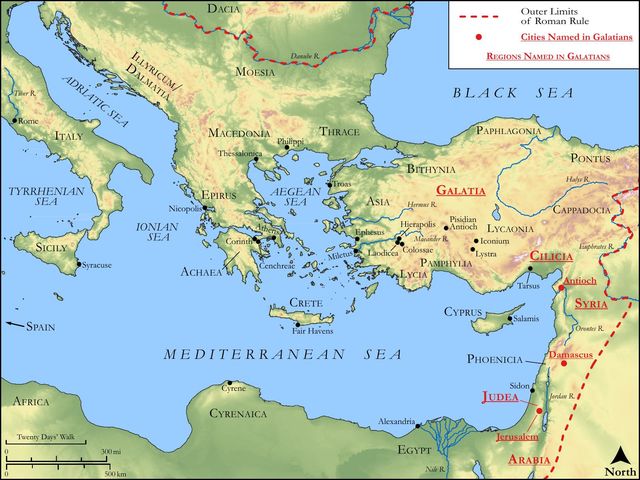
See on the biblical-era maps

Study this verse
Public-domain commentary
Matthew Henry
From his Commentary on the Whole Bible. Henry comments on passages, not single verses — this entry covers Galatians 1:10–24. His two-level outline is real structure in the source text, so it is rendered as structure.
What Paul had said more generally, in the preface of this epistle, he now proceeds more particularly to enlarge upon. There he had declared himself to be an apostle of Christ; and here he comes more directly to support his claim to that character and office. There were some in the churches of Galatia who were prevailed with to call this in question; for those who preached up the ceremonial law did all they could to lessen Paul's reputation, who preached the pure gospel of Christ to the Gentiles: and therefore he here sets himself to prove the divinity both of his mission and doctrine, that thereby he might wipe off the aspersions which his enemies had cast upon him, and recover these Christians into a better opinion of the gospel he had preached to them. This he gives sufficient evidence of,
I.From the scope and design of his ministry, which was not to persuade men, but God, etc.
The meaning of this may be either that in his preaching the gospel he did not act in obedience to men, but God, who had called him to this work and office; or that his aim therein was to bring persons to the obedience, not of men, but of God. As he professed to act by a commission from God; so that which he chiefly aimed at was to promote his glory, by recovering sinners into a state of subjection to him. And as this was the great end he was pursuing, so, agreeably hereunto, he did not seek to please men. He did not, in his doctrine, accommodate himself to the humours of persons, either to gain their affection or to avoid their resentment; but his great care was to approve himself to God. The judaizing teachers, by whom these churches were corrupted, had discovered a very different temper; they mixed works with faith, and the law with the gospel, only to please the Jews, whom they were willing to court and keep in with, that they might escape persecution. But Paul was a man of another spirit; he was not so solicitous to please them, nor to mitigate their rage against him, as to alter the doctrine of Christ either to gain their favour or to avoid their fury. And he gives this very good reason for it, that, if he yet pleased men, he would not be the servant of Christ. These he knew were utterly inconsistent, and that no man could serve two such masters; and therefore, though he would not needlessly displease any, yet he dared not allow himself to gratify men at the expense of his faithfulness to Christ. Thus, from the sincerity of his aims and intentions in the discharge of his office, he proves that he was truly an apostle of Christ. And from this his temper and behaviour we may note,
1.That the great end which ministers of the gospel should aim at is to bring men to God.
2.That those who are faithful will not seek to please men, but to approve themselves to God.
3.That they must not be solicitous to please men, if they would approve themselves faithful servants to Christ. But, if this argument should not be thought sufficient, he goes on to prove his apostleship,
II.From the manner wherein he received the gospel which he preached to them, concerning which he assures them (Gal 1:11, Gal 1:12) that he had it not by information from others, but by revelation from heaven. One thing peculiar in the character of an apostle was that he had been called to, and instructed for, this office immediately by Christ himself. And in this he here shows that he was by no means defective, whatever his enemies might suggest to the contrary. Ordinary ministers, as they receive their call to preach the gospel by the mediation of others, so it is by means of the instruction and assistance of others that they are brought to the knowledge of it. But Paul acquaints them that he had his knowledge of the gospel, as well as his authority to preach it, directly from the Lord Jesus: the gospel which he preached was not after man; he neither received it of man, nor was he taught it by man, but by immediate inspiration, or revelation from Christ himself. This he was concerned to make out, to prove himself an apostle: and to this purpose,
1.He tells them what his education was, and what, accordingly, his conversation in time past had been, Gal 1:13, Gal 1:14. Particularly, he acquaints them that he had been brought up in the Jewish religion, and that he had profited in it above many his equals of his own nation - that he had been exceedingly zealous of the traditions of the elders, such doctrines and customs as had been invented by their fathers, and conveyed down from one generation to another; yea, to such a degree that, in his zeal for them, he had beyond measure persecuted the church of God, and wasted it. He had not only been a rejecter of the Christian religion, notwithstanding the many evident proofs that were given of its divine origin; but he had been a persecutor of it too, and had applied himself with the utmost violence and rage to destroy the professors of it. This Paul often takes notice of, for the magnifying of that free and rich grace which had wrought so wonderful a change in him, whereby of so great a sinner he was made a sincere penitent, and from a persecutor had become an apostle. And it was very fit to mention it here; for it would hence appear that he was not led to Christianity, as many others are, purely by education, since he had been bred up in an enmity and opposition to it; and they might reasonably suppose that it must be something very extraordinary which had made so great a change in him, which had conquered the prejudices of his education, and brought him not only to profess, but to preach, that doctrine, which he had before so vehemently opposed.
2.In how wonderful a manner he was turned from the error of his ways, brought to the knowledge and faith of Christ, and appointed to the office of an apostle, Gal 1:15, Gal 1:16. This was not done in an ordinary way, nor by ordinary means, but in an extraordinary manner; for, (1.) God had separated him hereunto from his mother's womb: the change that was wrought in him was in pursuance of a divine purpose concerning him, whereby he was appointed to be a Christian and an apostle, before he came into the world, or had done either good or evil. (2.) he was called by his grace. All who are savingly converted are called by the grace of God; their conversion is the effect of his good pleasure concerning them, and is effected by his power and grace in them. But there was something peculiar in the case of Paul, both in the suddenness and in the greatness of the change wrought in him, and also in the manner wherein it was effected, which was not by the mediation of others, as the instruments of it, but by Christ's personal appearance to him, and immediate operation upon him, whereby it was rendered a more special and extraordinary instance of divine power and favour. (3.) He had Christ revealed in him. He was not only revealed to him, but in him. It will but little avail us to have Christ revealed to us if he is not also revealed in us; but this was not the case of Paul. It pleased God to reveal his Son in him, to bring him to the knowledge of Christ and his gospel by special and immediate revelation. And, (4.) It was with this design, that he should preach him among the heathen; not only that he should embrace him himself, but preach him to others; so that he was both a Christian and an apostle by revelation.
3.He acquaints them how he behaved himself hereupon, from Gal 1:16, to the end. Being thus called to his work and office, he conferred not with flesh and blood. This may be taken more generally, and so we may learn from it that, when God calls us by his grace, we must not consult flesh and blood. But the meaning of it here is that he did not consult men; he did not apply to any others for their advice and direction; neither did he go up to Jerusalem, to those that were apostles before him, as though he needed to be approved by them, or to receive any further instructions or authority from them: but, instead of that, he steered another course, and went into Arabia, either as a place of retirement proper for receiving further divine revelations, or in order to preach the gospel there among the Gentiles, being appointed to be the apostle of the Gentiles; and thence he returned again to Damascus, where he had first begun his ministry, and whence he had with difficulty escaped the rage of his enemies, Acts 9. It was not till three years after his conversion that he went up to Jerusalem, to see Peter; and when he did so he made but a very short stay with him, no more than fifteen days; nor, while he was there, did he go much into conversation; for others of the apostles he saw none, but James, the Lord's brother. So that it could not well be pretended that he was indebted to any other either for his knowledge of the gospel or his authority to preach it; but it appeared that both his qualifications for, and his call to, the apostolic office were extraordinary and divine. This account being of importance, to establish his claim to this office, to remove the unjust censures of his adversaries, and to recover the Galatians from the impressions they had received to his prejudice, he confirms it by a solemn oath (Gal 1:20), declaring, as in the presence of God, that what he had said was strictly true, and that he had not in the least falsified in what he had related, which, though it will not justify us in solemn appeals to God upon every occasion, yet shows that, in matters of weight and moment, this may sometimes not only be lawful, but duty. After this he acquaints them that he came into the regions of Syria and Cilicia: having made this short visit to Peter, he returns to his work again. He had no communication at that time with the churches of Christ in Judea, they had not so much as seen his face; but, having heard that he who persecuted them in times past now preached the faith which he once destroyed, they glorified God because of him; thanksgivings were rendered by many unto God on that behalf; the very report of this mighty change in him, as it filled them with joy, so it excited them to give glory to God on the account of it.
Historical interpretation
Five Centuries of Reception
9 surviving comments on this verse. Each one is dated, so this reads as a timeline rather than a list.
Select a marker to jump to its quote. Markers stagger vertically where authors wrote within a few decades of each other.
And that he, the apostle, was the very same person who had been born from the womb, that is, of the ancient substance of flesh, he does himself declare in the Epistle to the Galatians: "But when it pleased God, who separated me from my mother's womb, and called me by His grace, to reveal His Son in me, that I might preach Him among the Gentiles".
And Paul, too, says in like manner, "But when it pleased God, who separated me from my mother's womb, that I might declare Him among the nations."
The God who caused me to be born, who separated me from my mother’s womb, also called me through his grace. For no one knows God except one who has been called.
Just as he said to Jeremiah, “Before I formed you in the womb I knew you,” so, knowing what Paul would be, God called him because he was able to serve.
"To reveal His Son in me."
Christ says in another place, "No one knoweth who the Son is, save the Father; and who the Father is, save the Son, and he to whomsoever the Son willeth to reveal Him." You observe that the Father reveals the Son, and the Son the Father; so it is as to Their glory, the Son glorifies the Father, and the Father the Son; "glorify Thy Son, that the Son may glorify Thee," and, "as I have glorified Thee." But why does he say, "to reveal His Son in me," and not "to me?" it is to signify, that he had not only been instructed in the faith by words, but that he was richly endowed with the Spirit;-that the revelation had enlightened his whole soul, and that he had Christ speaking within him.
"That I might preach Him among the Gentiles." For not only his faith, but his election to the Apostolic office proceeded from God. The object, says he, of His thus specially revealing Himself to me, was not only that I might myself behold Him, but that I might also manifest Him to others. And he says not merely, "others," but, "that I might preach Him among the Gentiles," thus touching beforehand on that great ground of his defence which lay in the respective characters of the disciples; for it was necessary to preach differently to the Jews and to the heathen.
"And called me through His grace."
God indeed says that He called him on account of his excellent capacity, as He said to Ananias, "for he is a chosen vessel unto Me, to bear my name before the Gentiles, and kings," that is to say, capable of service, and the accomplishment of great deeds. God gives this as the reason for his call. But he himself everywhere ascribes it to grace, and to God's inexpressible mercy, as in the words, "Howbeit for this cause I obtained mercy," not that I was sufficient or even serviceable, but "that in me as chief might Jesus Christ show forth all His long-suffering, for an ensample of them which should hereafter believe on Him unto eternal life." Behold his overflowing humility; I obtained mercy, says he, that no one might despair, when the worst of men had shared His bounty. For this is the force of the words, "that He might show forth all His long-suffering for an ensample of them which should hereafter believe on Him."
"Immediately I conferred not with flesh and blood."
Here he alludes to the Apostles, naming them after their physical nature; however, that he may have meant to include all mankind, I shall not deny.
"But when it was the good pleasure of God, Who separated me, even from my mother's womb, and called me through His grace, to reveal His Son in me, that I might preach Him among the Gentiles, immediately I conferred not with flesh and blood."
Here his object is to show, that it was by some secret providence that he was left for a time to himself. For if he was set apart from his mother's womb to be an Apostle and to be called to that ministry, yet was not actually called till that juncture, which summons he instantly obeyed, it is evident that God had some hidden reason for this delay. What this purpose was, you are perhaps eager to learn from me, and primarily, why he was not called with the twelve.
(Verse 15) But when it pleased Him who separated me from my mother's womb, and called me by His grace, to reveal His Son in me, that I might preach Him among the Gentiles, I did not immediately confer with flesh and blood, nor did I go up to Jerusalem to those who were apostles before me; but I went to Arabia, and returned again to Damascus. Then after three years I went up to Jerusalem to see Peter, and remained with him fifteen days. But I saw none of the other apostles except James, the Lord's brother. (Now concerning the things which I write to you, indeed, before God, I do not lie.) Afterward I went into the regions of Syria and Cilicia. And I was unknown by face to the churches of Judea which were in Christ. But they were hearing only, "He who formerly persecuted us now preaches the faith which he once tried to destroy." And they glorified God in me. But I make known to you, brethren, that the gospel which was preached by me is not according to man. For I neither received it from man, nor was I taught it, but it came through the revelation of Jesus Christ. David sings against sinners: For behold, I was conceived in iniquities, and my mother conceived me in sins (Ps. 50:7). And in another place: Sinners are estranged from the womb (Ps. 57:4). And even before the children were born, God loved Jacob but hated Esau (Malachi 1:1, 2). Heretics find a place where they claim there are different natures, namely spiritual, animal, and earthly, and that one is saved, another perishes, and another exists between the two, so that neither the righteous would be chosen before doing anything good, nor would the sinner be hated before committing a sin, unless there were different natures of those who perish and those who are saved. To which it can be simply answered: this happens from God's foreknowledge, that he loves whom he knows will be just before they are born from the womb, and hates whom he knows will be a sinner before they sin; not that in God there is injustice in love and hatred, but that he must not have them otherwise, knowing either that they will be sinners or that they will be just: we as humans can only judge based on the present, but He to whom the future is already made known can pass judgment on the end of things, not on their beginnings. And indeed, these things have been said in a simpler manner: and without a deeper discussion, they can please the reader in some way. Moreover, those who try to assert that God is unjust, after what we have previously stated, have strayed from the womb, and they also bring forth the other things that follow: They have gone astray from the womb, they have uttered falsehoods. And they say, how is it that sinners have immediately gone astray from the womb and have uttered falsehoods, when they could not even have speech or understanding? But what is this justice of the foreknowledge of God, to love and guard one before they are born, and to detest another? And the causes of this matter refer to a previous life, that each person is assigned to good or evil angels according to their merit, immediately from their first birth. And that whole passage about Jacob and Esau, which we mention now, is discussed in such a way in the letter to the Romans (Rom. IX), that it cannot be answered without sweat and Chrysippus' hellebore. However, it is not the same for him to reveal his Son in me, as if he were to say, to reveal his Son to me. For whoever something is revealed, to him it can be revealed, which was not in him before. But in whom it is revealed, that is revealed which was in him before, and later revealed. It is similar to what is said in the Gospel: Among you stands one whom you do not know (John 1:26). And elsewhere: He was the true light, which enlightens every person coming into the world (ibid., 9). From which it becomes clear that the knowledge of God is inherent in all of nature, and no one is born without Christ, and does not have the seeds of wisdom, justice, and other virtues within them. Hence, many without faith and the Gospel of Christ, either wisely do certain things, or piously, such as obeying their parents, extending help to the needy, not oppressing their neighbors, not plundering others, and therefore become more susceptible to the judgment of God because, having within them the principles of virtues and the seeds of God, they do not believe in Him without whom they cannot exist. It is possible to take it in another way in the letter of Paul, Sons of God revealed: that, when he preached, he was acknowledged by the Gentiles, whom they previously did not know.
If he were indeed called to the mission from the mother’s belly, how did he become a persecutor? He has indeed solved this inextricable difficulty in another place, in saying: “So that Christ might first demonstrate in me his entire long-suffering, providing a type for those who were to believe in him unto eternal life” (I Tim. 1:16).
Continue studying Galatians 1:15 across the web’s major study libraries — every link below opens this exact verse, chapter, or book on the destination site.
Read & Compare
 BibleGatewayThis verse in more than 200 translations and 70 languages.
 Bible.comThe YouVersion reader — hundreds of translations, reading plans, and highlights.
 ESV.orgCrossway's official English Standard Version reader.
 NET BibleThe NET translation with 60,000+ translators' notes on every rendering decision.
 STEP BibleTyndale House's free study tool — original text, vocabulary, and scholarly resources.
 BibliaLogos Bible Software's free web reader.
 USCCBThe New American Bible (Revised Edition) with the U.S. bishops' study notes.
Commentaries
 BibleHub CommentariesDozens of classic commentaries on this verse, gathered on one page.
 StudyLightMore than 100 commentary sets — the largest collection on the web.
 BibleRefPlain-English commentary on what this verse means, verse by verse.
 Enduring WordDavid Guzik's free commentary on this chapter, widely used by Bible teachers.
 Bible Study ToolsVerse commentary alongside Greek and Hebrew study aids.
Original Language & Research
- BibleHub InterlinearThe verse word by word — original language, transliteration, and English.
- BibleHub LexiconEvery word's original-language definition and Strong's entry.
 Blue Letter BibleDeep-study tools — Strong's numbers, concordance, and word studies.
 CNTR CollationThe earliest Greek manuscripts of this verse, collated letter by letter.
Sermons, Hymns & Audio


TrulyRandomVerse is not affiliated with these sites and doesn’t control their content. They’re linked because they’re genuinely useful.
Summary
Galatians 1:15 is a pivotal verse in Paul's defense of his apostolic authority and the divine origin of his gospel. It reveals God's sovereign initiative in Paul's life, asserting that God set him apart for a specific purpose even before his birth and called him into ministry purely by His unmerited grace. This declaration underscores that Paul's apostleship was not a human appointment or a result of his own merit, but a direct, pre-ordained act of God, thereby validating the authenticity and authority of the message he preached to the Galatians.
Context
ShowHideLiterary Context
Galatians 1 opens with Paul's direct and forceful assertion of his apostleship, emphasizing that it came "not from men nor through man, but through Jesus Christ and God the Father" (Galatians 1:1). This immediate declaration sets the stage for his subsequent defense against the Judaizers who were undermining his authority and corrupting the gospel in Galatia. Following his initial greeting and a sharp rebuke of the Galatians for quickly abandoning the true gospel (Galatians 1:6-9), Paul launches into a personal testimony. He explains that his gospel was not received from any human source but by revelation from Jesus Christ (Galatians 1:11-12). Verse 15, therefore, serves as a crucial piece of this autobiographical defense, demonstrating the supernatural and sovereign nature of his call, contrasting it sharply with any human origin or training he might have received.
Historical & Cultural Context
Paul, formerly Saul of Tarsus, was a zealous Pharisee who actively persecuted the early Christian church (Galatians 1:13-14). His conversion on the road to Damascus was a dramatic and unexpected event, marking a radical shift from persecutor to apostle. In the Jewish tradition, the idea of God setting someone apart from birth for a special purpose was not new; prophets like Jeremiah (Jeremiah 1:5) and Isaiah (Isaiah 49:1) were described in similar terms. Paul draws upon this established concept to legitimize his own calling, aligning himself with these revered figures and emphasizing the divine, rather than human, origin of his mission. The Galatian churches were facing an infiltration of Judaizers who insisted that Gentile converts must observe Jewish law, including circumcision, to be truly saved. Paul's personal testimony, highlighting God's direct and gracious call, served to dismantle the legalistic arguments of these opponents and re-establish the gospel of grace.
Key Themes
ShowHideThis verse powerfully contributes to several overarching themes in Galatians and Pauline theology. First, it underscores Divine Sovereignty and Election, asserting that God's plan for Paul's life was established even before his birth, demonstrating His active and deliberate involvement in human history. Second, it highlights the Centrality of God's Grace, emphasizing that Paul's calling was entirely unmerited, a pure act of divine favor, directly contrasting with any notion of salvation or ministry earned through human effort or adherence to law. This theme is foundational to Paul's argument against the legalism of the Judaizers throughout the epistle, particularly in his emphasis on justification by faith apart from works of the law (Galatians 2:16). Finally, the verse reinforces Apostolic Authority, as Paul's divinely initiated and pre-ordained calling provides irrefutable evidence for the legitimacy of his apostleship, which was essential for the Galatians to accept his gospel message over the false teachings.
Exposition and Analysis
ShowHideKey Word Analysis
ShowHideThis word signifies to "think well of," "approve," or "take pleasure in." It conveys God's sovereign and benevolent will, indicating that Paul's calling was not a reluctant concession or a mere necessity, but a joyful and deliberate act of divine favor. It speaks to God's good pleasure in choosing and setting apart Paul for His purposes.
Derived from "to mark off by boundaries," this term means "to set apart," "to appoint," or "to distinguish for a specific purpose." It implies a decisive and intentional act of divine designation, indicating that Paul's life and ministry were divinely pre-ordained and distinct, not a random occurrence or a self-appointed role. This separation was not merely passive but an active, purposeful setting apart by God Himself.
This crucial theological term refers to "graciousness," "unmerited favor," or "divine influence upon the heart and its reflection in the life." In this context, it profoundly emphasizes that Paul's calling was entirely undeserved, a pure gift from God, independent of any human merit, past actions (especially his persecution of Christians), or worthiness. It highlights the radical nature of God's love and transforming power.
Verse Breakdown
ShowHide"But when it pleased God,"
This opening clause immediately attributes the initiative for Paul's calling entirely to God's sovereign will and benevolent disposition. It was not Paul's decision or human planning, but God's divine pleasure that set the course for his life and ministry.
"who separated me from my mother's womb,"
This phrase emphasizes the pre-ordained nature of Paul's calling. God's purpose for Paul was established even before his birth, signifying a profound, intentional, and sovereign act of election, similar to how Old Testament prophets were called. This highlights the depth and certainty of God's plan for Paul.
"and called [me] by his grace,"
This final clause clarifies the basis of Paul's calling: it was solely by God's unmerited favor. Despite Paul's past as a persecutor of the church, God's call was an act of pure grace, underscoring that his apostleship was not earned but freely given, demonstrating the transformative power of divine favor.
Literary Devices
ShowHidePaul employs several literary devices to emphasize the divine origin and authority of his apostleship. The most prominent is Autobiographical Apologia, where he uses his personal testimony as a defense of his gospel and authority. By recounting his past and God's intervention, he presents irrefutable evidence for his claims. The phrase "separated me from my mother's womb" is a powerful example of Hyperbole or Prophetic Language, drawing a parallel to the calling of Old Testament prophets like Jeremiah, thereby elevating the significance and divine sanction of his own mission. This also functions as Allusion to established biblical precedents of divine election. The contrast between his past as a persecutor and his present as an apostle, called "by his grace," exemplifies Antithesis, highlighting the radical and transformative power of God's unmerited favor.
Theological and Thematic Connections
ShowHideGalatians 1:15 is a foundational statement about divine election and the nature of God's calling, not only for Paul but for all believers. It underscores that God's purposes are sovereign and often initiated long before human awareness or effort. This verse dismantles any notion that spiritual service or salvation is earned through human merit, firmly rooting it in God's unmerited favor. It also provides a powerful theological basis for understanding God's ability to transform even the most unlikely individuals for His glory, turning a persecutor into a pivotal apostle. This radical grace is the heart of the gospel Paul preached, offering hope and validation to all who feel unworthy.
Reflection and Application
ShowHideGalatians 1:15 offers profound encouragement and a robust theological framework for every believer. It reminds us that God's plan for our lives is not accidental or dependent on our perfection, but rooted in His sovereign will and boundless grace. Just as Paul was "separated from his mother's womb" and "called by His grace," we too are chosen and gifted by God for His purposes, not because of our own merit, but solely because of His unmerited favor. This truth should humble us, eliminating pride in our achievements, and simultaneously empower us, knowing that God equips those He calls. It challenges us to embrace our unique calling, even when we feel inadequate or when our past seems to disqualify us, trusting that God's grace is sufficient to transform and use us for His glory.
Questions for Reflection
ShowHideFAQ
ShowHideDoes "separated me from my mother's womb" mean Paul had no free will in his conversion?
ShowHideThis phrase emphasizes God's sovereign initiative and pre-ordained purpose for Paul's life, aligning with Old Testament prophetic callings where individuals were designated for divine service from birth (e.g., Jeremiah 1:5). It highlights that Paul's apostleship was not a human invention or a result of his own choosing, but a divine appointment. However, it does not negate Paul's personal response or responsibility. While God sovereignly initiated the call, Paul actively responded to it, as seen in his subsequent obedience and dedication to Christ. The emphasis is on the source of the call being divine, rather than human, which was crucial for Paul's argument in Galatians.
Christ-Centered Fulfillment
ShowHideGalatians 1:15, while speaking of Paul's individual calling, ultimately points to the broader Christ-centered narrative of God's redemptive plan. The "grace" by which Paul was called is the very grace embodied and extended through Jesus Christ, who is the ultimate expression of God's unmerited favor towards humanity (John 1:14). Just as Paul was set apart for a specific mission, so too was Christ "set apart" and sent into the world by the Father's will to accomplish salvation (John 3:16). Paul's transformation from persecutor to apostle, solely by grace, powerfully illustrates the gospel's ability to reconcile sinners to God through Christ's atoning work (2 Corinthians 5:17-19). Therefore, Paul's calling by grace is a microcosm of the divine calling extended to all believers, inviting them into a new life and purpose in Christ, empowered not by their own merit but by the same boundless grace that transformed Saul into Paul (Ephesians 2:4-7).