


Galatians 1:14
Bible text: King James Version (1769 Blayney text) · Public domain
Bible text: King James Version with Strong's numbers · Public domain
Bible text: Berean Standard Bible · Public domain
Bible text: American Standard Version (1901) · Public domain
Bible text: World English Bible, Messianic edition · Public domain
Bible text: Geneva Bible (1599) · Public domain
Bible text: Young's Literal Translation · Public domain
- καὶkaiAndG2532CONJConjunction
- προέκοπτονproekoptonI was advancingG4298V-IAI-1SVerb Imperfect Active Indicative 1st Singular
- ἐνeninG1722PREPPreposition
- τῷtō<the>G3588T-DSMDefinite article Dative Singular Masculine
- ἸουδαϊσμῷIoudaismōJudaismG2454N-DSM-TNoun Dative Singular Masculine Title
- ὑπὲρhuperbeyondG5228PREPPreposition
- πολλοὺςpollousmanyG4183A-APMAdjective Accusative Plural Masculine
- συνηλικιώταςsunēlikiōtascontemporariesG4915N-APMNoun Accusative Plural Masculine
- ἐνeninG1722PREPPreposition
- τῷtōtheG3588T-DSNDefinite article Dative Singular Neuter
- γένειgeneicountrymenG1085N-DSNNoun Dative Singular Neuter
- μουmouof mineG3165P-1GSPersonal pronoun Genitive 1st Singular
- περισσοτέρωςperissoterōsmore abundantlyG4056ADV-CAdverb Comparative
- ζηλωτὴςzēlōtēszealousG2207N-NSM-TNoun Nominative Singular Masculine Title
- ὑπάρχωνhuparchōnbeingG5225V-PAP-NSMVerb Present Active Participle Nominative Singular Masculine
- τῶνtōnof theG3588T-GPFDefinite article Genitive Plural Feminine
- πατρικῶνpatrikōnfathersG3967A-GPFAdjective Genitive Plural Feminine
- μουmouof mineG3165P-1GSPersonal pronoun Genitive 1st Singular
- παραδόσεωνparadoseōntraditionsG3862N-GPFNoun Genitive Plural Feminine
English is a literal word-by-word gloss of the Greek, not the KJV's wording. Why?
This is the original text the KJV's translators worked from — each Greek word with its own literal English meaning in this verse, prepared by scholars at Tyndale House, Cambridge. The KJV translates whole sentences, not word by word, so its wording differs: one Greek word can become several English words, and the KJV may choose “charity” where the gloss reads “love”. Both are faithful — they answer different questions. For the KJV's own rendering, switch to the KJV text.
Details
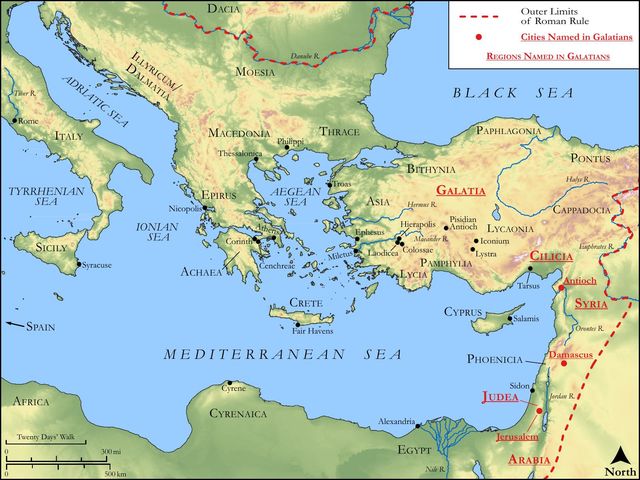
See on the biblical-era maps

Study this verse
Public-domain commentary
Matthew Henry
From his Commentary on the Whole Bible. Henry comments on passages, not single verses — this entry covers Galatians 1:10–24. His two-level outline is real structure in the source text, so it is rendered as structure.
What Paul had said more generally, in the preface of this epistle, he now proceeds more particularly to enlarge upon. There he had declared himself to be an apostle of Christ; and here he comes more directly to support his claim to that character and office. There were some in the churches of Galatia who were prevailed with to call this in question; for those who preached up the ceremonial law did all they could to lessen Paul's reputation, who preached the pure gospel of Christ to the Gentiles: and therefore he here sets himself to prove the divinity both of his mission and doctrine, that thereby he might wipe off the aspersions which his enemies had cast upon him, and recover these Christians into a better opinion of the gospel he had preached to them. This he gives sufficient evidence of,
I.From the scope and design of his ministry, which was not to persuade men, but God, etc.
The meaning of this may be either that in his preaching the gospel he did not act in obedience to men, but God, who had called him to this work and office; or that his aim therein was to bring persons to the obedience, not of men, but of God. As he professed to act by a commission from God; so that which he chiefly aimed at was to promote his glory, by recovering sinners into a state of subjection to him. And as this was the great end he was pursuing, so, agreeably hereunto, he did not seek to please men. He did not, in his doctrine, accommodate himself to the humours of persons, either to gain their affection or to avoid their resentment; but his great care was to approve himself to God. The judaizing teachers, by whom these churches were corrupted, had discovered a very different temper; they mixed works with faith, and the law with the gospel, only to please the Jews, whom they were willing to court and keep in with, that they might escape persecution. But Paul was a man of another spirit; he was not so solicitous to please them, nor to mitigate their rage against him, as to alter the doctrine of Christ either to gain their favour or to avoid their fury. And he gives this very good reason for it, that, if he yet pleased men, he would not be the servant of Christ. These he knew were utterly inconsistent, and that no man could serve two such masters; and therefore, though he would not needlessly displease any, yet he dared not allow himself to gratify men at the expense of his faithfulness to Christ. Thus, from the sincerity of his aims and intentions in the discharge of his office, he proves that he was truly an apostle of Christ. And from this his temper and behaviour we may note,
1.That the great end which ministers of the gospel should aim at is to bring men to God.
2.That those who are faithful will not seek to please men, but to approve themselves to God.
3.That they must not be solicitous to please men, if they would approve themselves faithful servants to Christ. But, if this argument should not be thought sufficient, he goes on to prove his apostleship,
II.From the manner wherein he received the gospel which he preached to them, concerning which he assures them (Gal 1:11, Gal 1:12) that he had it not by information from others, but by revelation from heaven. One thing peculiar in the character of an apostle was that he had been called to, and instructed for, this office immediately by Christ himself. And in this he here shows that he was by no means defective, whatever his enemies might suggest to the contrary. Ordinary ministers, as they receive their call to preach the gospel by the mediation of others, so it is by means of the instruction and assistance of others that they are brought to the knowledge of it. But Paul acquaints them that he had his knowledge of the gospel, as well as his authority to preach it, directly from the Lord Jesus: the gospel which he preached was not after man; he neither received it of man, nor was he taught it by man, but by immediate inspiration, or revelation from Christ himself. This he was concerned to make out, to prove himself an apostle: and to this purpose,
1.He tells them what his education was, and what, accordingly, his conversation in time past had been, Gal 1:13, Gal 1:14. Particularly, he acquaints them that he had been brought up in the Jewish religion, and that he had profited in it above many his equals of his own nation - that he had been exceedingly zealous of the traditions of the elders, such doctrines and customs as had been invented by their fathers, and conveyed down from one generation to another; yea, to such a degree that, in his zeal for them, he had beyond measure persecuted the church of God, and wasted it. He had not only been a rejecter of the Christian religion, notwithstanding the many evident proofs that were given of its divine origin; but he had been a persecutor of it too, and had applied himself with the utmost violence and rage to destroy the professors of it. This Paul often takes notice of, for the magnifying of that free and rich grace which had wrought so wonderful a change in him, whereby of so great a sinner he was made a sincere penitent, and from a persecutor had become an apostle. And it was very fit to mention it here; for it would hence appear that he was not led to Christianity, as many others are, purely by education, since he had been bred up in an enmity and opposition to it; and they might reasonably suppose that it must be something very extraordinary which had made so great a change in him, which had conquered the prejudices of his education, and brought him not only to profess, but to preach, that doctrine, which he had before so vehemently opposed.
2.In how wonderful a manner he was turned from the error of his ways, brought to the knowledge and faith of Christ, and appointed to the office of an apostle, Gal 1:15, Gal 1:16. This was not done in an ordinary way, nor by ordinary means, but in an extraordinary manner; for, (1.) God had separated him hereunto from his mother's womb: the change that was wrought in him was in pursuance of a divine purpose concerning him, whereby he was appointed to be a Christian and an apostle, before he came into the world, or had done either good or evil. (2.) he was called by his grace. All who are savingly converted are called by the grace of God; their conversion is the effect of his good pleasure concerning them, and is effected by his power and grace in them. But there was something peculiar in the case of Paul, both in the suddenness and in the greatness of the change wrought in him, and also in the manner wherein it was effected, which was not by the mediation of others, as the instruments of it, but by Christ's personal appearance to him, and immediate operation upon him, whereby it was rendered a more special and extraordinary instance of divine power and favour. (3.) He had Christ revealed in him. He was not only revealed to him, but in him. It will but little avail us to have Christ revealed to us if he is not also revealed in us; but this was not the case of Paul. It pleased God to reveal his Son in him, to bring him to the knowledge of Christ and his gospel by special and immediate revelation. And, (4.) It was with this design, that he should preach him among the heathen; not only that he should embrace him himself, but preach him to others; so that he was both a Christian and an apostle by revelation.
3.He acquaints them how he behaved himself hereupon, from Gal 1:16, to the end. Being thus called to his work and office, he conferred not with flesh and blood. This may be taken more generally, and so we may learn from it that, when God calls us by his grace, we must not consult flesh and blood. But the meaning of it here is that he did not consult men; he did not apply to any others for their advice and direction; neither did he go up to Jerusalem, to those that were apostles before him, as though he needed to be approved by them, or to receive any further instructions or authority from them: but, instead of that, he steered another course, and went into Arabia, either as a place of retirement proper for receiving further divine revelations, or in order to preach the gospel there among the Gentiles, being appointed to be the apostle of the Gentiles; and thence he returned again to Damascus, where he had first begun his ministry, and whence he had with difficulty escaped the rage of his enemies, Acts 9. It was not till three years after his conversion that he went up to Jerusalem, to see Peter; and when he did so he made but a very short stay with him, no more than fifteen days; nor, while he was there, did he go much into conversation; for others of the apostles he saw none, but James, the Lord's brother. So that it could not well be pretended that he was indebted to any other either for his knowledge of the gospel or his authority to preach it; but it appeared that both his qualifications for, and his call to, the apostolic office were extraordinary and divine. This account being of importance, to establish his claim to this office, to remove the unjust censures of his adversaries, and to recover the Galatians from the impressions they had received to his prejudice, he confirms it by a solemn oath (Gal 1:20), declaring, as in the presence of God, that what he had said was strictly true, and that he had not in the least falsified in what he had related, which, though it will not justify us in solemn appeals to God upon every occasion, yet shows that, in matters of weight and moment, this may sometimes not only be lawful, but duty. After this he acquaints them that he came into the regions of Syria and Cilicia: having made this short visit to Peter, he returns to his work again. He had no communication at that time with the churches of Christ in Judea, they had not so much as seen his face; but, having heard that he who persecuted them in times past now preached the faith which he once destroyed, they glorified God because of him; thanksgivings were rendered by many unto God on that behalf; the very report of this mighty change in him, as it filled them with joy, so it excited them to give glory to God on the account of it.
Historical interpretation
Two Centuries of Reception
3 surviving comments on this verse. Each one is dated, so this reads as a timeline rather than a list.
Select a marker to jump to its quote. Markers stagger vertically where authors wrote within a few decades of each other.
"When I was a child," he says, "as a child I spake, as a child I understood; but when I became a man, those (things) which had been the child's I abandoned: " so truly did he turn away from his early opinions: nor did he sin by becoming an emulator not of ancestral but of Christian traditions, wishing even the precision of them who advised the retention of circumcision.
"And I advanced in the Jews' religion beyond many of mine own age among my countrymen, being more exceedingly zealous for the traditions of my fathers."
To obviate the notion that his persecution arose from passion, vain-glory, or enmity, he shows that he was actuated by zeal, not indeed "according to knowledge," still by a zealous admiration of the traditions of his fathers. This is his argument;-if my efforts against the Church sprung not from human motives, but from religious though mistaken zeal, why should I be actuated by vain-glory, now that I am contending for the Church, and have embraced the truth? If it was not this motive, but a godly zeal, which possessed me when I was in error, much more now that I have come to know the truth, ought I to be free from such a suspicion. As soon as I passed over to the doctrines of the Church I shook off my Jewish prejudices, manifesting on that side a zeal still more ardent; and this is a proof that my conversion is sincere, and that the zeal which possesses me is from above. What other inducement could I have to make such a change, and to barter honor for contempt, repose for peril, security for distress? none surely but the love of truth.
He prudently inserts the statement that he served not so much God’s law as the paternal traditions—that is, those of the Pharisees, who teach doctrines and precepts of men and reject the law of God to set up their own traditions.
Continue studying Galatians 1:14 across the web’s major study libraries — every link below opens this exact verse, chapter, or book on the destination site.
Read & Compare
 BibleGatewayThis verse in more than 200 translations and 70 languages.
 Bible.comThe YouVersion reader — hundreds of translations, reading plans, and highlights.
 ESV.orgCrossway's official English Standard Version reader.
 NET BibleThe NET translation with 60,000+ translators' notes on every rendering decision.
 STEP BibleTyndale House's free study tool — original text, vocabulary, and scholarly resources.
 BibliaLogos Bible Software's free web reader.
 USCCBThe New American Bible (Revised Edition) with the U.S. bishops' study notes.
Commentaries
 BibleHub CommentariesDozens of classic commentaries on this verse, gathered on one page.
 StudyLightMore than 100 commentary sets — the largest collection on the web.
 BibleRefPlain-English commentary on what this verse means, verse by verse.
 Enduring WordDavid Guzik's free commentary on this chapter, widely used by Bible teachers.
 Bible Study ToolsVerse commentary alongside Greek and Hebrew study aids.
Original Language & Research
- BibleHub InterlinearThe verse word by word — original language, transliteration, and English.
- BibleHub LexiconEvery word's original-language definition and Strong's entry.
 Blue Letter BibleDeep-study tools — Strong's numbers, concordance, and word studies.
 CNTR CollationThe earliest Greek manuscripts of this verse, collated letter by letter.
Sermons, Hymns & Audio


TrulyRandomVerse is not affiliated with these sites and doesn’t control their content. They’re linked because they’re genuinely useful.
Summary
Galatians 1:14 offers a profound glimpse into the Apostle Paul's pre-conversion life, revealing his exceptional dedication and advancement within first-century Judaism. He recounts his fervent zeal for the ancestral traditions and his prominent standing among his peers, establishing a stark contrast with his subsequent radical transformation by divine revelation. This personal testimony serves to underscore the supernatural origin and unadulterated truth of the gospel he now proclaims, which he insists was not received from human instruction but directly from Jesus Christ.
Context
ShowHideLiterary Context
This verse is an integral part of Paul's autobiographical defense of his apostleship and the gospel he preaches, found in Galatians 1:11-24. Having just declared that his gospel is not "from man" (Galatians 1:11), Paul begins to recount his past life to demonstrate the divine origin of his message and call. Galatians 1:13 describes his former persecution of the church, setting the stage for verse 14, which elaborates on the depth of his commitment to Judaism that fueled such actions. This detailed personal history serves to convince the Galatian believers that his conversion was not a gradual shift or a human invention, but a profound, supernatural intervention by God's grace, thereby validating the unique authority of his message of justification by faith alone.
Historical & Cultural Context
Paul, originally known as Saul of Tarsus, was a devout Jew and a Pharisee, a sect renowned for its meticulous adherence to the Mosaic Law and the oral traditions that had developed around it. In the first century, "Judaism" (as referred to in this verse) encompassed not only the written Torah but also an elaborate system of ancestral customs, interpretations, and legal rulings passed down through generations. Paul's statement that he "profited... above many my equals in mine own nation" indicates his superior intellectual acumen and religious standing, likely a result of his rigorous training under esteemed teachers like Gamaliel (Acts 22:3). His "exceeding zeal" for these traditions was a highly valued trait within Jewish society, often manifesting as fervent devotion and strict observance, which, in Paul's case, extended to persecuting those he deemed heretical, namely the early Christians.
Key Themes
ShowHideGalatians 1:14 contributes to several major themes in Galatians. Firstly, it highlights Paul's former zeal and human achievement, showcasing his pre-conversion "resume" as a highly accomplished and respected figure within Judaism. This sets up a powerful contrast with his later declaration that he counts all such achievements as "loss for the sake of Christ" (Philippians 3:7). Secondly, the verse underscores the nature of "Judaism" and "tradition" as a system of human effort and external observance, which Paul contrasts sharply with the grace-based salvation offered through faith in Christ alone (Galatians 2:16). Finally, it emphasizes the radical nature of Paul's conversion, demonstrating that only a divine intervention could transform someone so deeply entrenched in and zealous for a system antithetical to the gospel of grace. This personal testimony reinforces the divine origin of the gospel Paul preaches, a central argument throughout Galatians chapter 1.
Exposition and Analysis
ShowHideKey Word Analysis
ShowHideFrom πρό and κόπτω; to drive forward (as if by beating), i.e. (figuratively and intransitively) to advance (in amount, to grow; in time, to be well along). Paul uses this word to convey his significant progress and advancement in the Jewish religious system. It suggests a successful, upward trajectory, indicating he was not a fringe figure but a rising star.
From Ἰουδαΐζω; "Judaism", i.e. the Jewish faith and usages. This term refers to the comprehensive system of Jewish religious practice, encompassing the Mosaic Law, the temple cult, and crucially for Paul, the extensive body of oral traditions and interpretations developed by the rabbis, particularly the Pharisees. It signifies a complete immersion in and adherence to this religious framework.
From παραδίδωμι; transmission, i.e. (concretely) a precept; specially, the Jewish traditionary law. These were the unwritten customs and interpretations passed down from generation to generation, which the Pharisees held to be as authoritative as the written Law. Paul's zeal for these traditions highlights his commitment to the most stringent and detailed aspects of Jewish piety.
Verse Breakdown
ShowHide"And profited in the Jews' religion"
This clause reveals Paul's intellectual and spiritual success within the framework of Judaism. He wasn't merely a participant but one who excelled, gaining significant knowledge, standing, and perhaps influence. It speaks to his diligent study and rigorous observance of Jewish practices and laws.
"above many my equals in mine own nation"
This phrase further emphasizes Paul's exceptional standing. He wasn't just proficient; he surpassed his contemporaries—those of similar age, background, and educational level. This highlights his unique dedication and achievement, presenting him as a leading figure among his peers within the Jewish community.
"being more exceedingly zealous of the traditions of my fathers."
This final clause provides the motivation and character of his advancement. His superiority stemmed from an intense, fervent, and even excessive devotion to the ancestral customs and oral laws that supplemented the written Torah. This "exceeding zeal" was a defining characteristic of his pre-Christian identity, driving his actions, including his persecution of the nascent Christian movement.
Literary Devices
ShowHidePaul employs Autobiographical Narrative as a key rhetorical device in this section. By recounting his own past, he establishes credibility and demonstrates the profound, divine nature of his conversion, which in turn validates the gospel he preaches. The use of Hyperbole or Emphasis is evident in the phrase "more exceedingly zealous," which, using the Greek adverb perissotérōs (G4056), underscores the extraordinary intensity of his devotion, surpassing that of his peers. This vivid description creates a powerful Contrast between his former life of zealous adherence to human traditions and his present life as an apostle of Christ, where salvation is by grace through faith, not works of the Law. This contrast is fundamental to Paul's argument throughout the letter.
Theological and Thematic Connections
ShowHidePaul's pre-conversion life, as described in Galatians 1:14, serves as a powerful theological statement about the inadequacy of human effort and religious zeal to achieve righteousness before God. His exceptional "profit" in Judaism, far from bringing him closer to God's true purposes, actually led him to oppose them by persecuting the church. This highlights the critical distinction between a righteousness based on human performance and one freely given by divine grace. It underscores the New Testament truth that salvation is not earned through adherence to religious systems or traditions, no matter how meticulously observed, but is a gift received through faith in Jesus Christ. Paul's own experience becomes a living parable of the futility of legalism and the transformative power of God's unmerited favor.
Reflection and Application
ShowHidePaul's pre-conversion story in Galatians 1:14 offers profound lessons for contemporary believers. It reminds us that sincerity and intense religious fervor, while often admirable, are not in themselves guarantees of alignment with God's will. Zeal, when misdirected or rooted in human traditions rather than divine truth, can lead us astray, even causing us to oppose God's true work, much as Paul persecuted the early church. This verse challenges us to examine the foundations of our faith and practice, ensuring that our devotion is grounded in the revealed Word of God and the finished work of Christ, rather than in human-made rules, cultural norms, or even well-intentioned but ultimately unbiblical traditions. It also serves as an incredible testimony to God's transformative power, demonstrating that no one is beyond the reach of His saving grace, no matter how deeply entrenched in a system of self-righteousness or how vehemently opposed to the gospel they may be.
Questions for Reflection
ShowHideFAQ
ShowHideWhat were the "traditions of my fathers" Paul refers to?
ShowHideThe "traditions of my fathers" primarily refer to the Oral Law, also known as the Mishnaic or rabbinic traditions, which were developed by Jewish religious leaders, particularly the Pharisees, over centuries. These traditions were interpretations and elaborations of the written Mosaic Law, intended to provide further guidance on how to live righteously. For example, they included detailed rules for Sabbath observance, dietary laws (kosher), ritual purity, and tithing. While the written Law was from God, these oral traditions were human interpretations, which by Paul's time, had gained significant authority, sometimes even overshadowing the written Law itself, as Jesus often pointed out (Mark 7:8-13). Paul, as a Pharisee, would have been exceptionally devoted to these traditions.
Why does Paul emphasize his past achievements and zeal in this letter?
ShowHidePaul emphasizes his past achievements and zeal in Galatians 1:14 for several crucial reasons. Firstly, it demonstrates that his conversion to Christianity was not a result of failure or disillusionment with Judaism. He was not a disgruntled outcast but a highly successful, respected, and zealous leader within the Jewish system. This makes his radical shift to preaching Christ all the more compelling, proving that it was a divine intervention, a direct call from God, rather than a mere change of career or a humanly devised theological evolution. Secondly, by highlighting his former commitment to the Law and traditions, Paul sets up a powerful contrast with the gospel of grace he now proclaims. His own life becomes the ultimate proof that righteousness cannot be attained through human effort or adherence to the Law, but only through faith in Jesus Christ (Galatians 2:16).
Christ-Centered Fulfillment
ShowHidePaul's pre-conversion life, characterized by an "exceeding zeal" for the "traditions of my fathers" and remarkable "profit" in the "Jews' religion," stands as a profound illustration of humanity's futile attempts to achieve righteousness apart from Christ. In his former life, Paul embodied the very essence of self-righteousness and legalistic striving, believing that meticulous adherence to the Law and human traditions could earn him favor with God. This zeal, however, was "without knowledge" (Romans 10:2), leading him to actively oppose God's true plan of salvation revealed in Jesus Christ. The Christ-centered fulfillment of this verse lies in the radical transformation that occurs when such human striving encounters divine grace. Jesus is the fulfillment of the Law (Romans 10:4), providing the perfect righteousness that Paul and all humanity desperately need but cannot achieve through their own efforts or traditions. Paul's dramatic conversion, from persecutor to apostle, powerfully demonstrates that in Christ, God's grace triumphs over human merit, transforming even the most zealous opponents into fervent proponents of the gospel. His former "profit" became "loss" for the surpassing worth of knowing Christ (Philippians 3:7-8), revealing that true spiritual advancement and zeal are found not in human systems or ancestral traditions, but in a living relationship with the resurrected Lord, who alone is the Way, the Truth, and the Life (John 14:6).