


Acts 22:3
“Paul's Defense and Jewish Credentials”Acts 22:1–5
Bible text: King James Version (1769 Blayney text) · Public domain
Bible text: King James Version with Strong's numbers · Public domain
Bible text: Berean Standard Bible · Public domain
Bible text: American Standard Version (1901) · Public domain
Bible text: World English Bible, Messianic edition · Public domain
Bible text: Geneva Bible (1599) · Public domain
Bible text: Young's Literal Translation · Public domain
- ἐγώegōI myselfG1473P-1NSPersonal pronoun Nominative 1st Singular
- μένmenindeedG3303PRTParticle or Disjunctive
- εἰμιeimiamG1510V-PAI-1SVerb Present Active Indicative 1st Singular
- ἀνὴρanēra manG435N-NSMNoun Nominative Singular Masculine
- ἸουδαῖοςIoudaiosJewishG2453A-NSM-PGAdjective Nominative Singular Masculine Person Gentilic
- γεγεννημένοςgegennēmenosbornG1080V-RPP-NSMVerb Perfect Passive Participle Nominative Singular Masculine
- ἐνeninG1722PREPPreposition
- ΤαρσῷTarsōTarsusG5019N-DSF-LNoun Dative Singular Feminine Location
- τῆςtēs[the]G3588T-GSFDefinite article Genitive Singular Feminine
- ΚιλικίαςKilikiasof CiliciaG2791N-GSF-LNoun Genitive Singular Feminine Location
- ἀνατεθραμμένοςanatethrammenosbrought upG397V-RPP-NSMVerb Perfect Passive Participle Nominative Singular Masculine
- δὲdehoweverG1161CONJConjunction
- ἐνeninG1722PREPPreposition
- τῇtēa[the]G3588T-DSFDefinite article Dative Singular Feminine
- πόλειpoleicityG4172N-DSFNoun Dative Singular Feminine
- ταύτῃtautēthisG3778D-DSFDemonstrative pronoun Dative Singular Feminine
- παρὰparaatG3844PREPPreposition
- τοὺςtoustheG3588T-APMDefinite article Accusative Plural Masculine
- πόδαςpodasfeetG4228N-APMNoun Accusative Plural Masculine
- ΓαμαλιὴλGamaliēlof GamalielG1059N-GSM-PNoun Genitive Singular Masculine Individual
- πεπαιδευμένοςpepaideumenosinstructedG3811V-RPP-NSMVerb Perfect Passive Participle Nominative Singular Masculine
- κατὰkataaccording to [the]G2596PREPPreposition
- ἀκρίβειανakribeianexactnessG195N-ASFNoun Accusative Singular Feminine
- τοῦtouof theG3588T-GSMDefinite article Genitive Singular Masculine
- πατρῴουpatrōouof our FathersG3971A-GSM-TAdjective Genitive Singular Masculine Title
- νόμουnomoulawG3551N-GSMNoun Genitive Singular Masculine
- ζηλωτὴςzēlōtēsa zealous oneG2207N-NSM-TNoun Nominative Singular Masculine Title
- ὑπάρχωνhuparchōnbeingG5225V-PAP-NSMVerb Present Active Participle Nominative Singular Masculine
- τοῦtou[the]G3588T-GSMDefinite article Genitive Singular Masculine
- θεοῦtheoufor GodG2316N-GSM-TNoun Genitive Singular Masculine Title
- καθὼςkathōseven asG2531CONJConjunction
- πάντεςpantesallG3956A-NPMAdjective Nominative Plural Masculine
- ὑμεῖςhumeisyou yourselvesG4771P-2NPPersonal pronoun Nominative 2nd Plural
- ἐστεesteareG1510V-PAI-2PVerb Present Active Indicative 2nd Plural
- σήμερονsēmeronthis dayG4594ADVAdverb
English is a literal word-by-word gloss of the Greek, not the KJV's wording. Why?
This is the original text the KJV's translators worked from — each Greek word with its own literal English meaning in this verse, prepared by scholars at Tyndale House, Cambridge. The KJV translates whole sentences, not word by word, so its wording differs: one Greek word can become several English words, and the KJV may choose “charity” where the gloss reads “love”. Both are faithful — they answer different questions. For the KJV's own rendering, switch to the KJV text.
Words in [ ] are added by the English.
Details
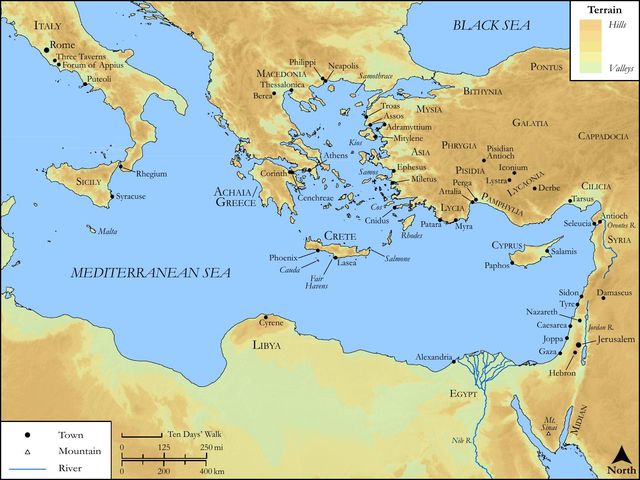
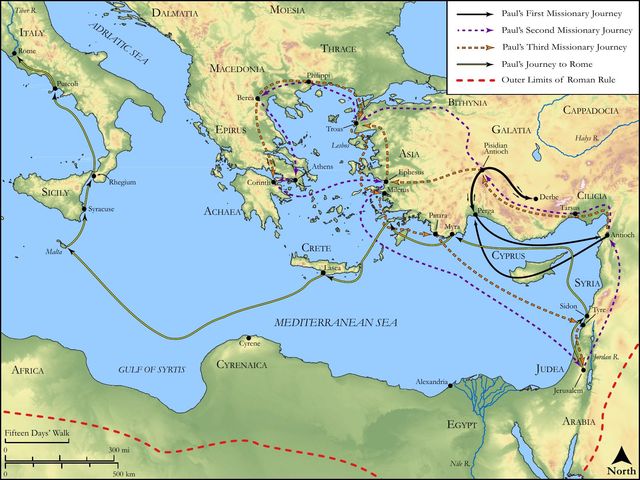
See on the biblical-era maps
Study this verse
Public-domain commentary
Matthew Henry
From his Commentary on the Whole Bible. Henry wrote on whole passages, and this entry covers Acts 22:3–21. He set out his notes in a four-level outline, kept here as he numbered it.
Paul here gives such an account of himself as might serve not only to satisfy the chief captain that he was not that Egyptian he took him to be, but the Jews also that he was not that enemy to their church and nation, to their law and temple, they took him to be, and that what he did in preaching Christ, and particularly in preaching him to the Gentiles, he did by a divine commission. He here gives them to understand,
I.What his extraction and education were.
1. That he was one of their own nation, of the stock of Israel, of the seed of Abraham, a Hebrew of the Hebrews, not of any obscure family, or a renegado of some other nation: "No, I am verily a man who is a Jew, anēr Ioudaios - a Jewish man; I am a man, and therefore ought not to be treated as a beast; a man who is a Jew, not a barbarian; I am a sincere friend to your nation, for I am one of it, and should defile my own nest if I should unjustly derogate from the honour of your law and your temple." 2. That he was born in a creditable reputable place, in Tarsus, a city of Cilicia, and was by his birth a freeman of that city. He was not born in servitude, as some of the Jews of the dispersion, it is likely, were; but he was a gentleman born, and perhaps could produce his certificate of his freedom in that ancient and honourable city. This was, indeed, but a small matter to make any boast of, and yet it was needful to be mentioned at this time to those who insolently trampled upon him, as if he were to be ranked with the children of fools, yea, the children of base men, Job 30:8. 3. That he had a learned and liberal education. He was not only a Jew, and a gentleman, but a scholar. He was brought up in Jerusalem, the principal seat of the Jewish learning, and at the feet of Gamaliel, whom they all knew to be an eminent doctor of the Jewish law, of which Paul was designed to be himself a teacher; and therefore he could not be ignorant of their law, nor be thought to slight it because he did not know it. His parents had brought him very young to this city, designing him for a Pharisee; and some think his being brought up at the feet of Gamaliel intimates, not only that he was one of his pupils, but that he was, above any other, diligent and constant in attending his lectures, observant of him, and obsequious to him, in all he said, as Mary, that sat at Jesus' feet, and heard his word. 4. That he was in his early days a very forward and eminent professor of the Jews' religion; his studies and learning were all directed that way. So far was he from being principled in his youth with any disaffection to the religious usages of the Jews that there was not a young man among them who had a greater and more entire veneration for them than he had, was more strict in observing them himself, or more hot in enforcing them upon others. (1.) He was an intelligent professor of their religion, and had a clear head. He minded his business at Gamaliel's feet, and was there taught according to the perfect manner of the law of the fathers. What departures he had made from the law were not owing to any confused or mistaken notions of it, for he understood it to a nicety, kata akribeian - according to the most accurate and exact method. He was not trained up in the principles of the latitudinarians, had nothing in him of a Sadducee, but was of that sect that was most studious in the law, kept most close to it, and, to make it more strict than it was, added to it the traditions of the elders, the law of the fathers, the law which was given to them, and which they gave to their children, and so it was handed down to us. Paul had as great a value for antiquity, and tradition, and the authority of the church, as any of them had; and there was never a Jew of them all that understood his religion better than Paul did, or could better give an account of it or a reason for it. (2.) He was an active professor of their religion, and had a warm heart: I was zealous towards God, as you all are this day. Many that are very well skilled in the theory of religion are willing to leave the practice of it to others, but Paul was as much a zealot as a rabbi. He was zealous against every thing that the law prohibited, and for every thing that the law enjoined; and this was zeal towards God, because he thought it was for the honour of God and the service of his interests; and here he compliments his hearers with a candid and charitable opinion of them, that they all were this day zealous towards God; he bears them record (Romans 10:2), that they have a zeal for God, but not according to knowledge. In hating him, and casting him out, they said, Let the Lord be glorified (Isaiah 66:5), and, though this did by no means justify their rage, yet it enabled those that prayed, Father, forgive them, to plead, as Christ did, For they know not what they do. And when Paul owns that he had been zealous for God in the law of Moses, as they were this day, he intimates his hope that they might be zealous for God, in Christ, as he was this day.
II.What a fiery furious persecutor he had been of the Christian religion in the beginning of his time, Acts 22:4, Acts 22:5.
He mentions this to make it the more plainly and evidently to appear that the change which was wrought upon him, when he was converted to the Christian faith, was purely the effect of a divine power; for he was so far from having any previous inclinations to it, or favourable opinions of it, that immediately before that sudden change was wrought in him he had the utmost antipathy imaginable to Christianity, and was filled with rage against it to the last degree. And perhaps he mentions it to justify God in his present trouble; how unrighteous soever those were that persecuted him, God was righteous, who permitted them to do it, for time was when he was a persecutor; and he may have a further view in it to invite and encourage those people to repent, for he himself had been a blasphemer, and a persecutor, and yet obtained mercy. Let us view Paul's picture of himself when he was a persecutor.
1.He hated Christianity with a mortal enmity: I persecuted this way unto the death, that is, "Those that walked in this way I aimed, if possible, to be the death of." He breathed out slaughter against them, Acts 9:1. When they were put to death, he gave his voice against them, Acts 26:10. Nay, he persecuted not only those that walked in this way, but the way itself, Christianity, which was branded as a byway, a sect; he aimed to persecute this to the death, to be the ruin of this religion. He persecuted it to the death, that is, he could have been willing himself to die in his opposition to Christianity, so some understand it. He would contentedly have lost his life, and would have thought it well laid out, in defence of the laws and traditions of the fathers.
2.He did all he could to frighten people from this way, and out of it, by binding and delivering into prison both men and women; he filled the jails with Christians. Now that he himself was bound, he lays a particular stress upon this part of his charge against himself, that he had bound the Christians, and carried them to prison; he likewise reflects upon it with a special regret that he had imprisoned not only the men, but the women, the weaker sex, who ought to be treated with particular tenderness and compassion.
3.He was employed by the great sanhedrim, the high priest, and all the estate of the elders, as an agent for them, in suppressing this new sect; so much had he already signalized himself for his zeal against it, Acts 22:5. The high priest can witness for him that he was ready to be employed in any service against the Christians. When they heard that many of the Jews at Damascus had embraced the Christian faith, to deter others from doing the like they resolved to proceed against them with the utmost severity, and could not think of a fitter person to be employed in that business, nor one more likely to go through with it, than Paul. They therefore sent him, and letters by him, to the Jews at Damascus, here called the brethren, because they all descended from one common stock, and were of one family in religion too, ordering them to be assisting to Paul in seizing those among them that had turned Christians, and bringing them up prisoners to Jerusalem, in order to their being punished as deserters from the faith and worship of the God of Israel; and so might either be compelled to retract, or be put to death for a terror to others. Thus did Saul make havoc of the church, and was in a fair way, if he had gone on awhile, to ruin it, and root it out. "Such a one," says Paul, "I was at first, just such as you now are. I know the heart of a persecutor, and therefore pity you, and pray that you may know the heart of a convert, as God soon made me to do. And who was I that I could withstand God?"
III.In what manner he was converted and made what he now was.
It was not from any natural or external causes; he did not change his religion from an affectation of novelty, for he was then as well affected to antiquity as he used to be; nor did it arise from discontent because he was disappointed in his preferment, for he was now, more than ever, in the way of preferment in the Jewish church; much less could it arise from covetousness, or ambition, or any hope of mending his fortune in the world by turning Christian, for it was to expose himself to all manner of disgrace and trouble; nor had he any conversation with the apostles or any other Christians, by whose subtlety and sophistry he might be thought to have been wheedled into this change. No, it was the Lord's doing, and the circumstances of the doing of it were enough to justify him in the change, to all those who believe there is a supernatural power; and none can condemn him for it, without reflecting upon that divine energy by which he was herein overruled. He relates the story of his conversion here very particularly, as we had it before (ch. 9), aiming to show that it was purely the act of God.
1.He was a fully bent upon persecuting the Christians just before Christ arrested him as ever. He made his journey, and was come nigh to Damascus (Acts 22:6), and had no other thought than to execute the cruel design he was sent upon; he was not conscious of the least compassionate relentings towards the poor Christians, but still represented them to himself as heretics, schismatics, and dangerous enemies both to church and state.
2.It was a light from heaven that first startled him, a great light, which shone suddenly round about him, and the Jews knew that God is light, and his angels angels of light, and that such a light as this shining at noon, and therefore exceeding that of the sun, must be from God. Had it shone in upon him into some private room, there might have been a cheat in it, but it shone upon him in the open road, at high noon, and so strongly that it struck him to the ground (Acts 22:7), and all that were with him, Acts 26:14. They could not deny but that surely the Lord was in this light.
3.It was a voice from heaven that first begat in him awful thoughts of Jesus Christ, of whom before he had had nothing but hateful spiteful thoughts. The voice called to him by name, to distinguish him from those that journeyed with him, Saul, Saul, why persecutest thou me? And when he asked, Who art thou, Lord? it was answered, I am Jesus of Nazareth, whom thou persecutest, Acts 22:8. By which it appeared that this Jesus of Nazareth, whom they also were now persecuting, was one that spoke from heaven, and they knew it was dangerous resisting one that did so, Hebrews 12:25.
4.Lest it should be objected, "How came this light and voice to work such a change upon him, and not upon those that journeyed with him?" (though, it is very probable, it had a good effect upon them, and that they thereupon became Christians), he observes that his fellow travellers saw indeed the light, and were afraid they should be consumed with fire from heaven, their own consciences, perhaps, now telling them that the way they were in was not good, but like Balaam's when he was going to curse Israel, and therefore they might expect to meet an angel with a flaming glittering sword; but, though the light made them afraid, they heard not the voice of him that spoke to Paul, that is, they did not distinctly hear the words. Now faith comes by hearing, and therefore that change was now presently wrought upon him that heard the words, and heard them directed to himself, which was not wrought upon those who only saw the light; and yet it might afterwards be wrought upon them too.
5.He assures them that when he was thus startled he referred himself entirely to a divine guidance; he did not hereupon presently cry out, "Well, I will be a Christian," but, "What shall I do, Lord? Let the same voice from heaven that has stopped me in the wrong way guide me into the right way, Acts 22:10. Lord, tell me what I shall do, and I will do it." And immediately he had directions to go to Damascus, and there he should hear further from him that now spoke to him: "No more needs to be said from heaven, there it shall be told thee, by a man like thyself, in the name of him that now speaks to thee, all things which are appointed for thee to do." The extraordinary ways of divine revelation, by visions, and voices, and the appearance of angels, were designed, both in the Old Testament and in the New, only to introduce and establish the ordinary method by the scriptures and a standing ministry, and therefore were generally superseded when these were settled. The angel did not preach to Cornelius himself, but bade him send for Peter; so the voice here tells not Paul what he shall do, but bids him go to Damascus, and there it shall be told him.
6.As a demonstration of the greatness of that light which fastened upon him, he tells them of the immediate effect it had upon his eye-sight (Acts 22:11): I could not see for the glory of that light. It struck him blind for the present. Nimium sensibile laedit sensum - Its radiance dazzled him. Condemned sinners are struck blind, as the Sodomites and Egyptians were, by the power of darkness, and it is a lasting blindness, like that of the unbelieving Jews; but convinced sinners are struck blind, as Paul here was, not by darkness, but by light: they are for the present brought to be at a loss within themselves, but it is in order to their being enlightened, as the putting of clay upon the eyes of the blind man was the designed method of his cure. Those that were with Paul had not the light so directly darted into their faces as Paul had unto his, and therefore they were not blinded, as he was; yet, considering the issue, who would not rather have chosen his lot than theirs? They, having their sight, led Paul by the hand into the city. Paul, being a Pharisee, was proud of his spiritual eyesight. The Pharisees said, Are we blind also? John 9:40. Nay, they were confident that they themselves were guides to the blind, and lights to those that were in darkness, Romans 2:19. Now Paul was thus struck with bodily blindness to make him sensible of his spiritual blindness, and his mistake concerning himself, when he was alive without the law, Romans 7:9.
IV.How he was confirmed in the change he had made, and further directed what he should do, by Ananias who lived at Damascus.
Observe, 1. The character here given of Ananias. He was not a man that was any way prejudiced against the Jewish nation or religion, but was himself a devout man according to the law; if not a Jew by birth, yet one that had been proselyted to the Jewish religion, and therefore called a devout man, and thence advanced further to the faith of Christ; and he conducted himself so well that he had a good report of all the Jews that dwelt at Damascus. This was the first Christian that Paul had any friendly communication with, and it was not likely that he should instil into him any such notions as they suspected him to espouse, injurious to the law or to this holy place.
2.The cure immediately wrought by him upon Paul's eyes, which miracle was to confirm Ananias's mission to Paul, and to ratify all that he should afterwards say to him. He came to him (Acts 22:13); and, to assure him that he came to him from Christ (the very same who had torn and would heal him, had smitten, but would bind him up, had taken away his sight, but would restore it again, with advantage), he stood by him, and said, Brother Saul, receive thy sight. Power went along with this word, and the same hour, immediately, he recovered his sight, and looked up upon him, ready to receive from him the instructions sent by him.
3.The declaration which Ananias makes to him of the favour, the peculiar favour, which the Lord Jesus designed him above any other.
(1.)In the present manifestation of himself to him (Acts 22:14): The God of our fathers has chosen thee. This powerful call is the result of a particular choice; his calling God the God of our fathers intimates that Ananias was himself a Jew by birth, that observed the law of the fathers, and lived upon the promise made unto the fathers; and he gives a reason why he said Brother Saul, when he speaks of God as the God of our fathers: This God of our fathers has chosen thee that thou shouldst,
[1.]Know his will, the will of his precept that is to be done by thee, the will of his providence that is to be done concerning thee. He hath chosen thee that thou shouldst know it in a more peculiar manner; not of man nor by man, but immediately by the revelation of Christ, Galatians 1:1, Galatians 1:12. Those whom God hath chosen he hath chosen to know his will, and to do it.
[2.]That thou shouldst see that Just One, and shouldst hear the voice of his mouth, and so shouldst know his will immediately from himself. This was what Paul was, in a particular manner, chosen to above others; it was a distinguishing favour, that he should see Christ here upon earth after his ascension into heaven. Stephen saw him standing at the right hand of God, but Paul saw him standing at his right hand. This honour none had but Paul. Stephen saw him, but we do not find that he heard the voice of his mouth, as Paul did, who says, he was last of all seen of me, as of one born out of due time, 1 Corinthians 15:8. Christ is here called that Just One; for he is Jesus Christ the righteous, and suffered wrongfully. Observe, Those whom God has chosen to know his will must have an eye to Christ, and must see him, and hear the voice of his mouth; for it is by him that God has made known his will, his good-will to us, and he has said, Hear you him.
(2.)In the after-manifestation of himself by him to others (Acts 22:15): "Thou shalt be his witness, not only a monument of his grace, as a pillar may be, but a witness viva voce - by word of mouth; thou shalt publish his gospel, as that which thou hast experienced the power of, and been delivered into, the mould of; thou shalt be his witness unto all men, Gentiles as well as Jews, of what thou hast seen and heard, now at the very first." And finding Paul so particularly relating the manner of his conversation in his apologies for himself, here and ch. 26, we have reason to think that he frequently related the same narrative in his preaching for the conversion of others; he told them what God had done for his soul, to encourage them to hope that he would do something for their souls.
4.The counsel and encouragement he gave him to join himself to the Lord Jesus by baptism (Acts 22:16): Arise, and be baptized, He had in his circumcision been given up to God, but he must now by baptism be given up to God in Christ - must embrace the Christian religion and the privileges of it, in submission to the precepts of it. This must now be done immediately upon his conversion, and so was added to his circumcision: but to the seed of the faithful it comes in the room of it; for it is, as that was to Abraham and his believing seed, a seal of the righteousness which is by faith.
(1.)The great gospel privilege which by baptism we have sealed to us is the remission of sins: Be baptized and wash away thy sins; that is, "Receive the comfort of the pardon of thy sins in the through Jesus Christ and lay hold of his righteousness for that purpose, and receive power against sin for the mortifying of thy corruption;" for our being washed includes our being both justified and sanctified, 1 Corinthians 6:11. Be baptized, and rest not in the sign, but make sure of the thing signified, the putting away of the filth of sin.
(2.)The great gospel duty which by our baptism we are bound to is to call on the name of the Lord, the Lord Jesus; to acknowledge him to be our Lord and our God, and to apply to him accordingly; to give honour to him, to put all our petitions in his hand. To call on the name of Jesus Christ our Lord (Son of David, have mercy on us) is the periphrasis of a Christian, 1 Corinthians 1:2. We must wash away our sins, calling on the name of the Lord; that is, we must seek for the pardon of our sins in Christ's name, and in dependence on him and his righteousness. In prayer, we must not any longer call God the God of Abraham, but the Father of our Lord Jesus Christ, and in him our Father; in every prayer, our eye must be to Christ.
(3.)We must do this quickly. Why tarriest thou? Our covenanting with God in Christ is needful work, that must not be deferred. The case is so plain that it is needless to deliberate; and the hazard so great that it is folly to delay. Why should not that be done at the present time that must be done some time, or we are undone?
V.How he was commissioned to go and preach the gospel to the Gentiles.
This was the great thing for which they were so angry at him, and therefore it was requisite he should for this, in a special manner, produce a divine warrant; and here he does it. This commission he did not receive presently upon his conversion, for this was at Jerusalem, whither he did not go till three years after, or more (Galatians 1:18); and whether it was then, or afterwards, that he had this vision here spoken of, we are not certain. But, to reconcile them, if possible, to his preaching the gospel among the Gentiles, he tells them,
1.That he received his orders to do it when he was at prayer, begging of God to appoint him his work and to show him the course he should steer; and (which was a circumstance that would have some weight with those he was now speaking to) he was at prayer in the temple, which was to be called a house of prayer for all people; not only in which all people should pray, but in which all people should be prayed for. Now as Paul's praying in the temple was an evidence, contrary to their malicious suggestion, that he had a veneration for the temple, though he did not make an idol of it as they did; so God's giving him this commission there in the temple was an evidence that the sending him to the Gentiles would be no prejudice to the temple, unless the Jews by their infidelity made it so. Now it would be a great satisfaction to Paul afterwards, in the execution of this commission, to reflect upon it that he received it when he was at prayer.
2.He received it in a vision. He fell into a trance (Acts 22:17), his external senses, for the present, locked up; he was in an ecstasy, as when he was caught up into the third heaven, and was not at that time sensible whether he was in the body or out of the body. In this trance he saw Jesus Christ, not with the eyes of his body, as at his conversion, but represented to the eye of his mind (Acts 22:18): I saw him saying unto me. Our eye must be upon Christ when we are receiving the law from his mouth; and we must not only hear him speak, but see him speaking to us.
3.Before Christ gave him a commission to go to the Gentiles, he told him it was to no purpose for him to think of doing any good at Jerusalem; so that they must not blame him, but themselves, if he be sent to the Gentiles. Paul came to Jerusalem full of hopes that, by the grace of God, he might be instrumental to bring those to the faith of Christ who had stood it out against the ministry of the other apostles; and perhaps this was what he was now praying for, that he, having had his education at Jerusalem and being well known there, might be employed in gathering the children of Jerusalem to Christ that were not yet gathered, which he thought he had particular advantages for doing of. But Christ crosses the measures he had laid: "Make haste," says he, "and get thee quickly out of Jerusalem;" for, though thou thinkest thyself more likely to work upon them than others, thou wilt find they are more prejudiced against thee than against any other, and therefore "will not receive thy testimony concerning me." As God knows before who will receive the gospel, so he knows who will reject it.
4.Paul, notwithstanding this, renewed his petition that he might be employed at Jerusalem, because they knew, better than any did, what he had been before his conversion, and therefore must ascribe so great a change in him to the power of almighty grace, and consequently give the greater regard to his testimony; thus he reasoned, both with himself and with the Lord, and thought he reasoned justly (Acts 22:19, Acts 22:20): "Lord," says he, "they know that I was once of their mind, that I was as bitter an enemy as any of them to such as believed on thee, that I irritated the civil power against them, and imprisoned them, and turned the edge of the spiritual power against them too, and beat them in every synagogue." And therefore they will not impute my preaching Christ to education nor to any prepossession in his favour (as they do that of other ministers), but will the more readily regard what I say because they know I have myself been one of them: particularly in Stephen's case; they know that when he was stoned I was standing by, I was aiding and abetting and consenting to his death, and in token of this kept the clothes of those that stoned him. Now "Lord," says he, "if I appear among them, preaching the doctrine that Stephen preached and suffered for, they will no doubt receive my testimony." "No," says Christ to him, "they will not; but will be more exasperated against thee as a deserter fRom. than against others whom they look upon only as strangers to, their constitution." 5. Paul's petition for a warrant to preach the gospel at Jerusalem is overruled, and he has peremptory orders to go among the Gentiles (Acts 22:21): Depart, for I will send thee far hence, unto the Gentiles. Note, God often gives gracious answers to the prayers of his people, not in the thing itself that they pray for, but in something better. Abraham prays, O that Ishmael may live before thee; and God hears him for Isaac. So Paul here prays that he may be an instrument of converting souls at Jerusalem: "No," says Christ, "but thou shalt be employed among the Gentiles, and more shall be the children of the desolate than those of the married wife." It is God that appoints his labourers both their day and their place, and it is fit they should acquiesce in his appointment, though it may cross their own inclinations. Paul hankers after Jerusalem: to be a preacher there was the summit of his ambition; but Christ designs him greater preferment. He shall not enter into other men's labours (as the other apostles did, John 4:38), but shall break up new ground, and preach the gospel where Christ was not named, Romans 15:20. So often does Providence contrive better for us than we for ourselves; to the guidance of that we must therefore refer ourselves. He shall choose our inheritance for us. Observe, Paul shall not go to preach among the Gentiles without a commission: I will send thee. And, if Christ send him, his Spirit will go along with him, he will stand by him, will carry him on, and bear him out, and give him to see the fruit of his labours. Let not Paul set his heart upon Jerusalem, for he must be sent far hence; his call must be quite another way, and his work of another kind. And it might be a mitigation of the offence of this to the Jews that he did not set up a Gentile church in the neighbouring nations; others did this in their immediate vicinity; he was sent to places at a distance, a vast way off, where what he did could not be thought an annoyance to them.
Now, if they would lay all this together, surely they would see that they had no reason to be angry with Paul for preaching among the Gentiles, or construe it as an act of ill-will to his own nation, for he was compelled to it, contrary to his own mind, by an overruling command from heaven.
Historical interpretation
Three Centuries of Reception
4 surviving comments on this verse. Each one is dated, so this reads as a timeline rather than a list.
Select a marker to jump to its quote. Markers stagger vertically where authors wrote within a few decades of each other.
He does not just say “in the school of Gamaliel” but “at the feet of Gamaliel.” By these words, he shows his patient endurance, his loving attentiveness, his eagerness to listen and his tremendous reverence for the man.
He does not simply say “the law” but “the law of our fathers.” This shows what type of person he had been, someone not ignorant of the law. Now this seems to be said for the benefit of his audience, but in fact, it is an accusation. For what if, with all his knowledge, he had been negligent? What if you have a thorough knowledge of the law but do not fulfill it? You do not love it, then, do you? [Paul] then states plainly that he was a zealot. So after he has delivered a great encomium about himself, he then extends this praise by adding, “just as all of you are today," and thus points out that what they are doing is not just for a human purpose but for their zeal for God. By bestowing this favor on them he also captures their understanding from the beginning.
"I am a man," he says, "which am a Jew:" which thing they liked most of all to hear; "born in Tarsus, a city of Cilicia." That they may not again think him to be of another nation, he adds his religion: "but brought up in this city." He shows how great was his zeal for the worship, inasmuch as having left his native city, which was so great and so remote too, he chose to be brought up here for the Law's sake. See how from the beginning he attached himself to the law. But this he says, not only to defend himself to them, but to show that not by human intent was he led to the preaching of the Gospel, but by a Divine power: else, having been so educated, he would not have suddenly changed. For if indeed he had been one of the common order of men, it might have been reasonable to suspect this: but if he was of the number of those who were most of all bound by the law, it was not likely that he should change lightly, and without strong necessity. But perhaps some one may say: "To have been brought up here proves nothing: for what if thou camest here for the purpose of trading, or for some other cause?" Therefore he says, "at the feet of Gamaliel:" and not simply, "by Gamaliel," but "at his feet," showing his perseverance, his assiduity, his zeal for the hearing, and his great reverence for the man. "Taught according to the perfect manner of the law of the fathers." Not simply, "the law," but "the law of the fathers;" showing that he was such from the beginning, and not merely one that knew the Law. All this seems indeed to be spoken on their side, but in fact it told against them, since he, knowing the law, forsook it. "Yes: but what if thou didst indeed know the law accurately, but dost not vindicate it, no, nor love it?" "Being a zealot," he adds: not simply one that knew it. Then, since it was a high encomium he had passed upon himself, he makes it theirs as well as his, adding, "As ye all are this day." For he shows that they act not from any human object, but from zeal for God; gratifying them, and preoccupying their minds, and getting a hold upon them in a way that did no harm.
Educated according to the truth, being a zealot of the paternal law. In Greek it is added more: Being a zealot of God, according to that in Romans: For I bear them witness that they have a zeal for God, but not according to knowledge.
Continue studying Acts 22:3 across the web’s major study libraries — every link below opens this exact verse, chapter, or book on the destination site.
Read & Compare
 BibleGatewayThis verse in more than 200 translations and 70 languages.
 Bible.comThe YouVersion reader — hundreds of translations, reading plans, and highlights.
 ESV.orgCrossway's official English Standard Version reader.
 NET BibleThe NET translation with 60,000+ translators' notes on every rendering decision.
 STEP BibleTyndale House's free study tool — original text, vocabulary, and scholarly resources.
 BibliaLogos Bible Software's free web reader.
 USCCBThe New American Bible (Revised Edition) with the U.S. bishops' study notes.
Commentaries
 BibleHub CommentariesDozens of classic commentaries on this verse, gathered on one page.
 StudyLightMore than 100 commentary sets — the largest collection on the web.
 BibleRefPlain-English commentary on what this verse means, verse by verse.
 Enduring WordDavid Guzik's free commentary on this chapter, widely used by Bible teachers.
 Bible Study ToolsVerse commentary alongside Greek and Hebrew study aids.
Original Language & Research
- BibleHub InterlinearThe verse word by word — original language, transliteration, and English.
- BibleHub LexiconEvery word's original-language definition and Strong's entry.
 Blue Letter BibleDeep-study tools — Strong's numbers, concordance, and word studies.
 CNTR CollationThe earliest Greek manuscripts of this verse, collated letter by letter.
Sermons, Hymns & Audio


TrulyRandomVerse is not affiliated with these sites and doesn’t control their content. They’re linked because they’re genuinely useful.
Written with AI assistance. Always check it against Scripture.
This verse
Paul tells them he is a Jew, born in Tarsus but brought up in Jerusalem under Gamaliel, taught the law of the fathers exactly, and as zealous for God as they are.
“I am verily a man which am a Jew, born in Tarsus, a city in Cilicia,”
A Jew by birth (gennáō), from a great city of Asia Minor with a large Jewish community.
“yet brought up in this city at the feet of Gamaliel,”
Raised in Jerusalem and formally taught by Gamaliḗl, the most respected Pharisee of his day.
“and taught according to the perfect manner of the law of the fathers,”
Trained (paideúō) with exactness (akríbeia) in the law handed down from their ancestors (patrōios).
“and was zealous toward God, as ye all are this day.”
zēlōtḗs, a zealot. Paul names the fervour he once shared with the crowd before him.
Passage studyActs 22:1–5
Paul Defends Himself as a Zealous Jew
Summary
Rescued by Roman soldiers from a mob in the temple courts, Paul stands on the steps of the barracks and speaks to the people who wanted him dead. He calls them men, brethren and fathers, asks them to hear his defence, and speaks in the Hebrew tongue, so the crowd grows quieter still. Then he tells them who he was: a Jew born in Tarsus, brought up in Jerusalem at the feet of Gamaliel, taught the law of the fathers exactly, and as zealous for God as they are. He persecuted the Way to the death, bound men and women, and carried letters from the high priest and the council to Damascus to bring believers back for punishment. These five verses prepare for his account of meeting the risen Christ, and they show how far God’s grace reached when it took hold of him.
How Paul gains a hearing from a furious crowd
Acts 21 tells how Paul came back to Jerusalem, wanting to show that he still kept the customs of his people. Jews from Asia accused him of teaching against the law and of bringing Gentiles into the temple, and the crowd was beating him when the Roman tribune, Claudius Lysias, stepped in and carried him off to the barracks (Acts 21:27–36). Paul spoke to the tribune in Greek, which surprised him, told him he was a Jew of Tarsus, and asked leave to speak to the people (Acts 21:37–40). These verses are the opening of what he said, and the whole speech runs through Acts 22.
Men, brethren, and fathers
“Men, brethren, and fathers” was a traditional and respectful way to address a Jewish assembly. “Men” (anḗr) speaks to the men of the crowd in general. “Brethren” (adelphós, a brother, near or remote) claims the bond of one people and one heritage. “Fathers” (patḗr) means a father, and the word also covers parents and ancestors. Here it is a title of honour for the older men and leaders, those with authority among the people. The address moves from the general to the bond of kinship and then to respect for their elders, and Paul offers it to men who had just tried to tear him apart.
That gentleness in the face of hatred is part of what the verse teaches. Paul is innocent and sent by God, yet he opens with courtesy and claims common ground before he says anything hard. He later wrote that he became all things to all men in order to win some (1 Corinthians 9:19–23), and here he lives it out. He also asks for something he will ask for again and again through his trials, beginning before the council in Acts 23: a fair hearing.
Hear ye my defence
“Hear ye” is akoúō, to hear in various senses, which includes to give audience. Paul asks them to listen to him with attention. “Defence” is apología, a plea, an answer for oneself, a clearing of oneself. Our word “apology” comes from it, and here it keeps its older meaning: a reasoned account given to clear his name. He means to explain and defend what he has done, and he stands by the facts. “Which I make now unto you” points to this moment and these hearers. He speaks directly to the very people who accused him and stood ready to condemn him.
Why the crowd fell quieter
When the people heard that he spoke to them “in the Hebrew tongue”, they became stiller than before. The phrase joins Hebraḯs, the Hebrew or Jewish language, to diálektos, a mode of speech, a language or dialect. In Jerusalem at this time, Aramaic was the language of everyday life, Greek was the common tongue of the empire, and Hebrew was used mainly for Scripture and learned study. So the “Hebrew tongue” here was most likely Aramaic, the speech of the Jews of Judea, and that is what the crowd recognised. The verb for “heard” is the same akoúō that Paul used in verse 1.
Hearing their own language changed how they saw him. They had been told that he had abandoned the customs of his people (Acts 21:28), and now a man who might have been taken for a foreigner or a Greek-speaking apostate addressed them as one of their own. “They kept the more silence”: mâllon is “more”, in a greater degree, and hēsychía is stillness, a ceasing from noise and talk. The shouting gave way to a deeper quiet, and Paul was able to begin. The words “and he saith” lead into his account in Acts 22:3–21.
A proverb speaks of the joy of a fitting answer and of how good a word spoken at the right time is (Proverbs 15:23). God gave his servant the wisdom to speak a word this crowd would hear, and it opened a door for his testimony. Paul shows the same care for his hearers later, when he speaks before King Agrippa (Acts 26:1–29).
Who Paul had been: a Jew trained in the law
“I am verily a man which am a Jew” answers the charge at once. He is a Jew by birth, neither a Gentile nor a proselyte. “Born” is gennáō, to beget or bring forth, used here of his birth in Tarsus. Tarsus, in Cilicia, was a major Greek-speaking city, a centre of learning and trade and a Roman provincial capital, with a large Jewish community. Paul was also a Roman citizen (Acts 16:37), but before this crowd he stresses that he is a Jew.
“Yet brought up in this city” means Jerusalem, the heart of Jewish life, where he was raised from his youth. “At the feet of Gamaliel” is a way of saying that he was formally taught as a disciple of that master. Gamaliḗl, a name of Hebrew origin, was the revered Pharisee and teacher of the law usually called Gamaliel I, a leading member of the council, known for wisdom and moderation. Acts shows him counselling the council to leave the apostles alone, in case they should be found fighting against God (Acts 5:34–39). To name him as one’s teacher was to claim the finest religious education of the day.
“Taught according to the perfect manner of the law of the fathers” says the same thing in another way. “Taught” is paideúō, to train up a child or to educate. “Perfect manner” is akríbeia, exactness, so he was trained in the law with strict precision. “Of the fathers” is patrōios, belonging to one’s fathers, inherited, the law handed down from their ancestors. Verse 1 shares the English “fathers”, and there the Greek is patḗr. His training covered the written law of Moses and the body of tradition and interpretation handed down with it, which was central to the Pharisees.
“And was zealous toward God, as ye all are this day.” “Zealous” is zēlōtḗs, a zealot, one full of fervent devotion, from a root meaning to be hot or to boil. Paul sets his past beside their present: what they are today, he was. He credits them with real zeal for God, and the same words gently suggest that their zeal, like his own once was, may be sincere and still aimed the wrong way. Elsewhere Paul writes that his zeal showed itself in persecuting the church (Philippians 3:4–7) and that he advanced in Judaism beyond many of his own age (Galatians 1:13–16).
God was preparing him through all of this. The learning he gained under Gamaliel, which he first turned against the church, later equipped him to explain the Scriptures and defend the gospel. The Lord told Ananias that Saul was his chosen vessel to carry his name (Acts 9:15).
Persecutor of the Way
“And I persecuted this way unto the death.” “Persecuted” is diṓkō, a strengthened form of a verb meaning to flee, so it means to pursue, to put to flight. It can mean simply to follow after, and here it means to hunt down with hostile intent. Paul names himself as the one who did it.
What “this way” means
“Way” is hodós, a road, and by extension a manner or means of life. In Acts “the Way” is a name for the followers of Jesus, used when Saul sought letters against any he found “of this way” (Acts 9:2), when some in Ephesus spoke evil of “that way” (Acts 19:9), and when Paul confesses before Felix that he worships God “after the way which they call heresy” (Acts 24:14). The name speaks of a whole manner of life centred on following Jesus Christ, who said, “I am the way, the truth, and the life” (John 14:6). Saul once thought this Way a dangerous sect that had to be stamped out.
Unto the death
“Death” is thánatos. “Unto the death” can be read in two ways. It may mean that his persecution led to believers being killed, or that he pursued them so far that death was the intended end. Either way it shows how severe his campaign was. He was present at the stoning of Stephen (Acts 7:54–60), and Acts records how he went on to ravage the church (Acts 8:1–3).
“Binding and delivering into prisons” describes his methods. “Binding” is desmeúō, to put a prisoner in chains, “delivering” is paradídōmi, to hand over or deliver up, and “prisons” is phylakḗ, a guard or a place of guarding. These are arrests and formal imprisonment, and they show that he acted with authority. “Both men and women” shows that he spared no one. He was a Pharisee, and he counted this a faithful service to God and the law.
Witnesses and warrants from the high priest
“As also the high priest doth bear me witness, and all the estate of the elders.” “Bear witness” is martyréō, to be a witness, to testify. Paul calls on the highest authorities of his people as men who can confirm his story. “The estate of the elders” is presbytérion, the order of elders. The word can name a Christian presbytery, and here it is the Sanhedrin, the supreme council of chief priests, scribes and elders. His persecution was sanctioned by the very council his hearers honoured.
“From whom also I received letters unto the brethren.” The letters (epistolḗ, a written message) served as warrants, giving him legal standing to arrest believers in Jesus far from Judea. “Brethren” is the same word adelphós that Paul used of the crowd in verse 1. It means his fellow Jews, the Jews of Damascus, and the people he went to arrest were Jewish believers in Jesus.
“And went to Damascus, to bring them which were there bound unto Jerusalem.” Damascus was a major city of Syria with a large Jewish population, and the faith had already taken root there. Acts tells this journey in full (Acts 9:1–19). “Bound” here is déō, to bind or tie, while the “binding” of verse 4 is desmeúō, so the two verses share only the English word. He meant to bring them back as prisoners for trial before the council.
“For to be punished.” The verb timōréō means properly to protect one’s honour, and so to avenge or inflict a penalty. The penalty in view could range from flogging, which Paul himself later received from the Jews (2 Corinthians 11:24), to imprisonment, and in the worst cases death, as Stephen’s stoning shows. And there is a deep irony here. The man who once bound believers and led them away for punishment now stands bound himself, on trial for the faith he tried to destroy.
Did the council have authority as far as Damascus?
The council’s authority reached the Jewish communities of the empire in religious matters. Rome kept political control but generally left the internal religious affairs of the Jews to them, and the synagogues of cities like Damascus kept close ties with Jerusalem. Letters from the council would have been respected and acted on by synagogue leaders there. That authority covered Jews and their own religious disputes, and it gave no power over Roman citizens or Gentiles.
Why Paul tells the story of his past
Paul recounts all this to show that his change came from God. He knew the law thoroughly and served it with his whole heart, and he was utterly convinced that he was serving God. He later told Agrippa that he thought he ought to do many things against the name of Jesus (Acts 26:9). To him the claim that Jesus was the Messiah was blasphemy, and he believed he was defending the law and the traditions of his fathers. That is why the next part of his speech, his meeting with the risen Christ on the Damascus road (Acts 22:6–16), is so striking. Acts tells this conversion three times: in Acts 9 when it happened, here before the crowd, and again before Agrippa (Acts 26:9–18), each told for its own hearers.
His story shows that sincere zeal can still set a man against God. Saul was fervent and devout, and he was persecuting the church of God. Salvation came to him as a gift of grace through faith, unearned by any religious effort (Ephesians 2:8–9). Paul later counted all his credentials as loss for the sake of Christ (Philippians 3:7–8), for Christ is the end of the law for righteousness to everyone who believes (Romans 10:4). He called himself the chief of sinners and said that he obtained mercy so that Christ might show in him all longsuffering, as a pattern to those who would believe after him (1 Timothy 1:12–16).
Christ behind Paul’s defense
Paul pleads his case before his accusers. Jesus, when he stood before his, offered no defence at all, as Isaiah foretold: “he was oppressed, and he was afflicted, yet he opened not his mouth” (Isaiah 53:7). God vindicated him by raising him from the dead, declaring him to be the Son of God with power (Romans 1:4), and he now pleads for us as our advocate with the Father (1 John 2:1). The punishment Saul wanted to bring on believers fell on Christ himself, who was wounded for our transgressions (Isaiah 53:5). The high priest of verse 5 signed letters to bind and punish, while Jesus, our great high priest (Hebrews 4:14), sets his people free.
Paul’s choice to speak in the people’s own tongue is a small picture of what Christ did on a far greater scale. He “made himself of no reputation, and took upon him the form of a servant, and was made in the likeness of men” (Philippians 2:7), the Word made flesh who lived among us (John 1:14). The hush that fell on the crowd is a faint echo of the authority of Jesus, who stilled a storm with a word (Mark 4:39) and whose teaching astonished the crowds (Matthew 7:28–29). And the gospel Paul was about to proclaim crosses every barrier of language, as Pentecost showed when people from many nations heard the wonderful works of God in their own tongues (Acts 2:4–11).
The Way that Saul persecuted belonged to Jesus, the Lamb of God who takes away the sin of the world (John 1:29). Jesus had told his followers that they would be hated for his name’s sake (Matthew 10:22), and the persecutor became one of them, suffering beatings, prisons and dangers for Christ (2 Corinthians 11:23–27). His whole life became a witness that the gospel is the power of God unto salvation to everyone who believes (Romans 1:16).
Grace that reached the persecutor
These verses give us a man who stood among his enemies with courtesy and courage, and who told the truth about the worst things he had done. They show us a God who chose Saul while he was still dragging believers to prison, and who used even his training under Gamaliel for the gospel he once fought. No one in the crowd that day was further from Christ than Paul had been.
Paul’s way of speaking is a pattern for the answer Peter tells us always to be ready to give for the hope that is in us, with meekness and fear (1 Peter 3:15). It is speech seasoned with grace (Colossians 4:6), given in the defence and confirmation of the gospel (Philippians 1:7). And it is a reason to pray with hope for the fiercest opponents of the faith, because the Lord who turned Saul around is the same today.
Acts 22:1
“Men, brethren, and fathers,”
A respectful address to a Jewish assembly. anḗr speaks to the men in general, adelphós to them as kin, and patḗr honours the elders and leaders.
“hear ye my defence”
akoúō asks them to give audience, and apología is a spoken defence that clears his name.
“which I make now unto you.”
He speaks at once and directly to the people who had accused him.
Acts 22:2
“And when they heard that he spake in the Hebrew tongue to them,”
Hebraḯs with diálektos, most likely the Aramaic spoken by the Jews of Judea, their own everyday speech.
“they kept the more silence:”
mâllon (“more”) with hēsychía (“stillness”). The crowd, already quieter, grew stiller still.
“and he saith,”
The words lead into the account of his life that follows.
Acts 22:3 This verse
“I am verily a man which am a Jew, born in Tarsus, a city in Cilicia,”
A Jew by birth (gennáō), from a great city of Asia Minor with a large Jewish community.
“yet brought up in this city at the feet of Gamaliel,”
Raised in Jerusalem and formally taught by Gamaliḗl, the most respected Pharisee of his day.
“and taught according to the perfect manner of the law of the fathers,”
Trained (paideúō) with exactness (akríbeia) in the law handed down from their ancestors (patrōios).
“and was zealous toward God, as ye all are this day.”
zēlōtḗs, a zealot. Paul names the fervour he once shared with the crowd before him.
Acts 22:4
“And I persecuted this way”
diṓkō, to pursue with hostile intent, and hodós, “the Way”, a name for the followers of Jesus.
“unto the death,”
thánatos. His persecution went as far as death, whether in result or in intent.
“binding and delivering into prisons”
Chaining prisoners (desmeúō) and handing them over (paradídōmi) to prison (phylakḗ).
“both men and women.”
He spared no one.
Acts 22:5
“As also the high priest doth bear me witness, and all the estate of the elders:”
martyréō, to testify, and presbytérion, the order of elders, the Sanhedrin. The leaders the crowd honoured could confirm his story.
“from whom also I received letters unto the brethren,”
Written warrants (epistolḗ) addressed to the Jews of Damascus, whom he still calls brethren.
“and went to Damascus, to bring them which were there bound unto Jerusalem,”
déō, to bind. Believers were to be brought back as prisoners for trial.
“for to be punished.”
timōréō, to inflict a penalty, from a root that speaks of protecting one’s honour.
Last revised