


1 Corinthians 6:11
Bible text: King James Version (1769 Blayney text) · Public domain
Bible text: King James Version with Strong's numbers · Public domain
Bible text: Berean Standard Bible · Public domain
Bible text: American Standard Version (1901) · Public domain
Bible text: World English Bible, Messianic edition · Public domain
Bible text: Geneva Bible (1599) · Public domain
Bible text: Young's Literal Translation · Public domain
- καὶkaiAndG2532CONJConjunction
- ταῦτάtautasuchG3778D-NPNDemonstrative pronoun Nominative Plural Neuter
- τινεςtinessome [of]G5100X-NPMIndefinite pronoun Nominative Plural Masculine
- ἦτε·ēteyou wereG1510V-IAI-2PVerb Imperfect Active Indicative 2nd Plural
- ἀλλ᾽all᾽butG235CONJConjunction
- ἀπελούσασθεapelousastheyou were washedG628V-AMI-2PVerb Aorist Middle Indicative 2nd Plural
- ἀλλ᾽all᾽butG235CONJConjunction
- ἡγιάσθητεhēgiasthēteyou were sanctifiedG37V-API-2PVerb Aorist Passive Indicative 2nd Plural
- ἀλλ᾽all᾽butG235CONJConjunction
- ἐδικαιώθητεedikaiōthēteyou were justifiedG1344V-API-2PVerb Aorist Passive Indicative 2nd Plural
- ἐνeninG1722PREPPreposition
- τῷtōtheG3588T-DSNDefinite article Dative Singular Neuter
- ὀνόματιonomatinameG3686N-DSNNoun Dative Singular Neuter
- τοῦtouof theG3588T-GSMDefinite article Genitive Singular Masculine
- κυρίουkuriouLordG2962N-GSM-TNoun Genitive Singular Masculine Title
- ἸησοῦIēsouJesusG2424N-GSM-PNoun Genitive Singular Masculine Individual
- καὶkaiandG2532CONJConjunction
- ἐνenbyG1722PREPPreposition
- τῷtōtheG3588T-DSNDefinite article Dative Singular Neuter
- πνεύματιpneumatiSpiritG4151N-DSNNoun Dative Singular Neuter
- τοῦtouof theG3588T-GSMDefinite article Genitive Singular Masculine
- θεοῦtheouGodG2316N-GSM-TNoun Genitive Singular Masculine Title
- ἡμῶνhēmōnof usG3165P-1GPPersonal pronoun Genitive 1st Plural
English is a literal word-by-word gloss of the Greek, not the KJV's wording. Why?
This is the original text the KJV's translators worked from — each Greek word with its own literal English meaning in this verse, prepared by scholars at Tyndale House, Cambridge. The KJV translates whole sentences, not word by word, so its wording differs: one Greek word can become several English words, and the KJV may choose “charity” where the gloss reads “love”. Both are faithful — they answer different questions. For the KJV's own rendering, switch to the KJV text.
Details
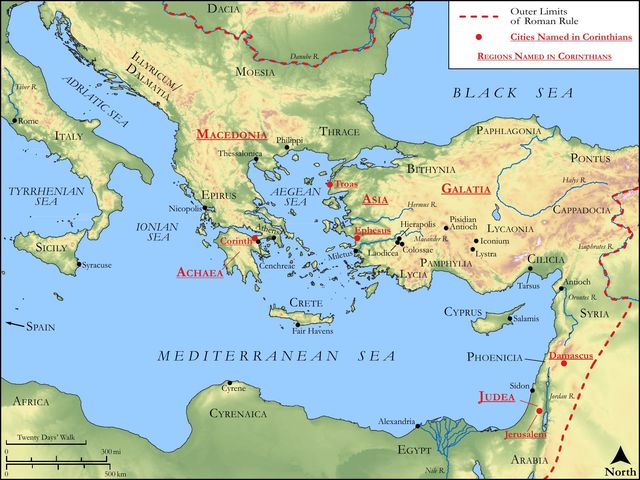
See on the biblical-era maps

Study this verse
Public-domain commentary
Matthew Henry
From his Commentary on the Whole Bible. Henry comments on passages, not single verses — this entry covers 1 Corinthians 6:9–11.
Here he takes occasion to warn them against many heinous evils, to which they had been formerly addicted.
I.He puts it to them as a plain truth, of which they could not be ignorant, that such sinners should not inherit the kingdom of God.
The meanest among them must know thus much, that the unrighteous shall not inherit the kingdom of God (Co1 6:9), shall not be owned as true members of his church on earth, nor admitted as glorious members of the church in heaven. All unrighteousness is sin; and all reigning sin, nay, every actual sin committed deliberately, and not repented of, shuts out of the kingdom of heaven. He specifies several sorts of sins: against the first and second commandments, as idolaters; against the seventh, as adulterers, fornicators, effeminate, and Sodomites; against the eighth, as thieves and extortioners, that by force or fraud wrong their neighbours; against the ninth, as revilers; and against the tenth, as covetous and drunkards, as those who are in a fair way to break all the rest. Those who knew any thing of religion must know that heaven could never be intended for these. The scum of the earth are no ways fit to fill the heavenly mansions. Those who do the devil's work can never receive God's wages, at least no other than death, the just wages of sin, Rom 6:23.
II.Yet he warns them against deceiving themselves:
Be not deceived. Those who cannot but know the fore-mentioned truth are but too apt not to attend to it. Men are very much inclined to flatter themselves that God is such a one as themselves, and that they may live in sin and yet die in Christ, may lead the life of the devil's children and yet go to heaven with the children of God. But this is all a gross cheat. Note, It is very much the concern of mankind that they do not cheat themselves in the matters of their souls. We cannot hope to sow to the flesh and yet reap everlasting life.
III.He puts them in mind what a change the gospel and grace of God had made in them:
Such were some of you (Co1 6:11), such notorious sinners as he had been reckoning up. The Greek word is tauta - such things were some of you, very monsters rather than men. Note, Some that are eminently good after their conversion have been as remarkably wicked before. Quantum mutatus ab illo! How glorious a change does grace make! It changes the vilest of men into saints and the children of God. Such were some of you, but you are not what you were. You are washed, you are sanctified, you are justified in the name of Christ, and by the Spirit of our God. Note, The wickedness of men before conversion is no bar to their regeneration and reconciliation to God. The blood of Christ, and the washing of regeneration, can purge away all guilt and defilement. Here is a rhetorical change of the natural order: You are sanctified, you are justified. Sanctification is mentioned before justification: and yet the name of Christ, by which we are justified, is placed before the Spirit of God, by whom we are sanctified. Our justification is owing to the merit of Christ; our sanctification to the operation of the Spirit: but both go together. Note, None are cleansed from the guilt of sin, and reconciled to God through Christ, but those who are also sanctified by his Spirit. All who are made righteous in the sight of God are made holy by the grace of God.
Historical interpretation
Four Centuries of Reception
8 surviving comments on this verse. Each one is dated, so this reads as a timeline rather than a list.
Select a marker to jump to its quote. Markers stagger vertically where authors wrote within a few decades of each other.
And such were some of you; but ye have been washed, but ye have been sanctified in the name of our Lord."
"And such were some of you"-such manifestly as those still are whom you do not forgive; "but ye are washed," not simply as the rest, but with knowledge; ye have cast off the passions of the soul, in order to become assimilated, as far as possible, to the goodness of God's providence by long-suffering, and by forgiveness "towards the just and the unjust," casting on them the gleam of benignity in word and deeds, as the sun.
" And if so, the apostle too was in error when he said in his epistle, "Ye were at one time darkness, (but now are ye light in the Lord: )" and, "We also were by nature children of wrath; " and, "Such were some of you, but ye are washed." The statements, however, of holy Scripture will never be discordant with truth.
The Corinthians had received all the benefits of purity in their baptism, which is the foundation of the truth of the gospel. In baptism the believer is washed clean from all sins and is made righteous in the name of the Lord, and through the Spirit of God he is adopted as God’s child. With these words, Paul is reminding them how great and how special is the grace which they have received in the true tradition. But afterward, by thinking which is contrary to this baptismal rule of faith, they had stripped themselves of these benefits. For this reason he is trying to bring them back to their original way of thinking, so that they can recover what they had once received.
"And such were some of you: but ye were washed, but ye were sanctified."
In a way to abash them exceedingly, he adds this: as if he said, "Consider from what evils God delivered us; how great an experiment and demonstration of loving-kindness He afforded us! He did not limit His redemption to mere deliverance, but greatly extended the benefit: for He also made thee clean. Was this then all? Nay: but He also "sanctified." Nor even is this all: He also "justified." Yet even bare deliverance from our sins were a great gift: but now He also filled thee with countless blessing. And this He hath done, "In the Name of our Lord Jesus Christ;" not in this name or in that: yea also, "In the Spirit of our God."
Knowing therefore these things, beloved, and bearing in mind the greatness of the blessing which hath been wrought, let us both continue to live soberly, being pure from all things that have been enumerated; and let us avoid the tribunals which are in the forums of the Gentiles; and the noble birth which God hath freely given us, the same let us preserve to the end.
The Corinthians were not to bother about the sins they committed before baptism. All that should concern them now was that they should not sin again in the future.
Paul says that they have been changed for the better, not so as to lose concupiscence altogether, a condition never realized in this life, but so as to not obey the desire to sin.
And again: "But ye are washed, but ye are justified in the name of our Lord Jesus, and by the Spirit of our God."
Continue studying 1 Corinthians 6:11 across the web’s major study libraries — every link below opens this exact verse, chapter, or book on the destination site.
Read & Compare
 BibleGatewayThis verse in more than 200 translations and 70 languages.
 Bible.comThe YouVersion reader — hundreds of translations, reading plans, and highlights.
 ESV.orgCrossway's official English Standard Version reader.
 NET BibleThe NET translation with 60,000+ translators' notes on every rendering decision.
 STEP BibleTyndale House's free study tool — original text, vocabulary, and scholarly resources.
 BibliaLogos Bible Software's free web reader.
 USCCBThe New American Bible (Revised Edition) with the U.S. bishops' study notes.
Commentaries
 BibleHub CommentariesDozens of classic commentaries on this verse, gathered on one page.
 StudyLightMore than 100 commentary sets — the largest collection on the web.
 BibleRefPlain-English commentary on what this verse means, verse by verse.
 Enduring WordDavid Guzik's free commentary on this chapter, widely used by Bible teachers.
 Bible Study ToolsVerse commentary alongside Greek and Hebrew study aids.
Original Language & Research
- BibleHub InterlinearThe verse word by word — original language, transliteration, and English.
- BibleHub LexiconEvery word's original-language definition and Strong's entry.
 Blue Letter BibleDeep-study tools — Strong's numbers, concordance, and word studies.
 CNTR CollationThe earliest Greek manuscripts of this verse, collated letter by letter.
Sermons, Hymns & Audio


TrulyRandomVerse is not affiliated with these sites and doesn’t control their content. They’re linked because they’re genuinely useful.
Summary
First Corinthians 6:11 stands as a powerful declaration of the radical transformation experienced by believers in Christ, serving as a climactic affirmation following Paul's stern rebuke of the Corinthian church's moral failings. It emphatically contrasts their former sinful identities with their new, Spirit-wrought standing, asserting that they have been spiritually cleansed, set apart, and declared righteous through the redemptive work of the Lord Jesus and the active power of the Holy Spirit. This verse not only highlights the comprehensive nature of salvation but also underscores the profound change in identity that calls believers to live in accordance with their new reality in Christ.
Context
ShowHideLiterary Context
This verse provides a stark and hopeful contrast to the preceding verses in 1 Corinthians 6, where Paul addresses the Corinthians' scandalous legal disputes among themselves and, more critically, their tolerance of gross sexual immorality within the church. In 1 Corinthians 6:9-10, Paul explicitly lists various categories of unrighteous individuals—including fornicators, idolaters, adulterers, homosexuals, thieves, covetous, drunkards, revilers, and extortioners—stating unequivocally that "such shall not inherit the kingdom of God." Verse 11 then immediately follows, pivoting from condemnation to a profound declaration of God's transformative grace. The "And such were some of you" directly references the preceding list, emphasizing that the Corinthians themselves, despite their past, now stand redeemed, thereby providing the theological foundation for Paul's subsequent ethical exhortations against immorality.
Historical & Cultural Context
The city of Corinth was a bustling, wealthy Roman provincial capital and a major port city, notorious among the Greeks and Romans for its moral laxity and diverse pagan cults. Its strategic location facilitated trade but also exposed its inhabitants to a wide array of influences and temptations, including widespread prostitution and idolatrous practices. The phrase "to Corinthianize" was synonymous with immoral living. Many converts in the Corinthian church would have come directly from the very lifestyles Paul condemns in 1 Corinthians 6:9-10. This background makes Paul's declaration in 1 Corinthians 6:11 all the more powerful: it was not merely a theoretical statement but a radical affirmation of God's power to transform individuals out of deeply entrenched sinful cultures and identities. The believers' past was a stark reality, but their present identity in Christ was a new, divine reality that demanded a different way of life.
Key Themes
ShowHide1 Corinthians 6:11 powerfully encapsulates several key themes central to Paul's theology and the broader message of 1 Corinthians. Foremost is the theme of Radical Transformation, highlighting that conversion to Christ involves a complete break from one's former sinful life and identity, as explicitly stated by "And such were some of you." This transformation is not merely behavioral modification but a fundamental shift in one's standing before God. Secondly, the verse underscores the Triune Work of Salvation, attributing the believer's new status to the "name of the Lord Jesus" and "by the Spirit of our God," implicitly involving the Father's overarching plan. This emphasizes the unified action of the Godhead in bringing about redemption. Finally, the verse establishes the Believer's New Identity and Standing before God, characterized by being "washed," "sanctified," and "justified." These three terms describe the comprehensive nature of salvation, providing the theological bedrock for Paul's ethical calls for holiness and purity that permeate the rest of the letter, particularly as he transitions into discussions about the body as a temple of the Holy Spirit in 1 Corinthians 6:19-20.
Exposition and Analysis
ShowHideKey Word Analysis
ShowHideFrom ἀπό and λούω, meaning "to wash fully, i.e. (figuratively) have remitted (reflexively)." This term signifies a complete spiritual cleansing from the defilement and guilt of sin. It speaks to the removal of impurity, making one clean in God's sight, often carrying connotations of purification rites or baptism, though the primary emphasis is on an internal, spiritual reality brought about by God.
From ἅγιος, meaning "to make holy, i.e. (ceremonially) purify or consecrate; (mentally) to venerate." This word denotes being set apart for God's special use and possession. It implies a positional holiness, where believers are declared holy and consecrated to God at conversion, and also points to the ongoing process of progressive sanctification, where believers are continually made more like Christ in character and conduct.
From δίκαιος, meaning "to render (i.e. show or regard as) just or innocent:--free, justify(-ier), be righteous." This is a forensic or legal term, signifying God's declaration that a person is righteous in His sight. It means to be acquitted of guilt, pronounced not guilty, and credited with righteousness, not based on personal merit but solely on the basis of Christ's perfect righteousness imputed through faith.
Verse Breakdown
ShowHide"And such were some of you:"
This opening clause serves as a powerful and direct reference to the preceding list of unrighteous individuals in 1 Corinthians 6:9-10. It acknowledges the past sinful lifestyles and identities of many Corinthian believers, emphasizing the stark contrast between their former state and their present reality in Christ. It highlights the universality of sin and the radical nature of God's redemptive work.
"but ye are washed,"
The conjunction "but" introduces a dramatic shift, emphasizing the profound change. "Washed" signifies a complete spiritual cleansing from the defilement and guilt of sin. This is not a self-cleansing but a divine act, implying a thorough purification that removes the stain of past transgressions and makes one spiritually clean before God.
"but ye are sanctified,"
This clause further elaborates on the believer's new status. To be "sanctified" means to be set apart as holy unto God, consecrated for His exclusive possession and purpose. This is both a positional reality (declared holy by God at conversion) and the beginning of a progressive process of growing in holiness and conformity to Christ's character.
"but ye are justified"
This third declaration completes the triadic description of salvation. To be "justified" means to be declared righteous in God's sight, acquitted of all charges, and given a righteous standing before His holy law. This is a legal declaration, not based on human merit, but entirely on the imputed righteousness of Christ, providing a complete and irreversible standing of innocence.
"in the name of the Lord Jesus,"
This phrase identifies the ultimate authority and basis for the believer's washing, sanctification, and justification. "In the name" signifies the authority, person, and redemptive work of Jesus Christ—His atoning death, resurrection, and ascension. All aspects of salvation are accomplished through Him and His finished work on the cross.
"and by the Spirit of our God."
This final phrase highlights the active agent through whom these transformative realities are applied to the believer. The Holy Spirit is the one who regenerates, purifies, sets apart, and empowers believers, making the work of Christ effective in their lives. He is the divine power who brings about this radical change and sustains the new life in God.
Literary Devices
ShowHidePaul employs several powerful literary devices in 1 Corinthians 6:11 to underscore his message. The most prominent is Contrast, specifically between the past sinful identity ("And such were some of you") and the present redeemed identity ("but ye are washed, but ye are sanctified, but ye are justified"). This sharp juxtaposition highlights the radical nature of God's grace and the complete transformation available in Christ. The repeated use of "but ye are" (Greek: ἀλλὰ ἀπελούσασθε, ἀλλὰ ἡγιάσθητε, ἀλλὰ ἐδικαιώθητε) demonstrates Anaphora, where the repetition of a word or phrase at the beginning of successive clauses creates emphasis and rhythm, driving home the certainty and comprehensiveness of the believers' new status. Furthermore, the three distinct yet complementary terms—washed, sanctified, and justified—form a Triadic Structure, a common rhetorical device in biblical literature that conveys completeness and theological depth, illustrating the multifaceted nature of salvation. The concept of being "washed" also functions as a Metaphor for spiritual cleansing, drawing on the familiar imagery of purification to convey the removal of sin's defilement.
Theological and Thematic Connections
ShowHide1 Corinthians 6:11 is a cornerstone verse for understanding the comprehensive nature of Christian salvation, demonstrating that it is not merely forgiveness of sins but a radical re-creation of identity and standing before God. It powerfully articulates the forensic (justification), ethical (sanctification), and experiential (washing) dimensions of redemption, all rooted in the work of the Triune God. This verse underscores the foundational truth that believers are no longer defined by their past sins but by their new relationship with Christ, which demands a corresponding new way of life. It serves as a theological anchor for Christian ethics, asserting that because we are washed, sanctified, and justified, we should live in a manner consistent with that new reality, reflecting God's holiness.
Reflection and Application
ShowHide1 Corinthians 6:11 offers profound hope and a clear call to live in alignment with our new identity in Christ. For those burdened by a past marked by sin, this verse is a liberating declaration that "such were some of you" but are no longer. It assures us that no sin is too great for God's transformative grace to overcome, offering a complete spiritual cleansing, a setting apart for His holy purposes, and a righteous standing before Him. This truth should ignite deep gratitude and humility, reminding us that our salvation is entirely God's unmerited favor, not a result of our own efforts. Living out this new identity means actively pursuing holiness, recognizing that our bodies are temples of the Holy Spirit, and striving to honor God in all areas of life, empowered by the very Spirit who brought about our transformation. It is a constant reminder to shed the old self and embrace the new creation we are in Christ, allowing our present conduct to reflect the glorious truth of who we have become.
Questions for Reflection
ShowHideFAQ
ShowHideWhat does it mean that "such were some of you," and why is it important?
ShowHideThe phrase "such were some of you" directly refers to the preceding list of unrighteous individuals in 1 Corinthians 6:9-10, which includes various categories of sinners like fornicators, idolaters, adulterers, thieves, and drunkards. Its importance lies in its powerful affirmation of God's radical grace and transformative power. It acknowledges the sinful past of many believers in Corinth, demonstrating that no one is beyond the reach of God's redemption. This statement highlights that conversion to Christ involves a complete break from one's former identity and lifestyle, emphasizing that believers are no longer defined by their past sins but by their new status in Christ. It provides both a stark reminder of where they came from and a glorious declaration of where they now stand.
Is justification a one-time event or an ongoing process?
ShowHideAccording to 1 Corinthians 6:11 and broader New Testament theology, justification is primarily a one-time, definitive legal declaration by God. When a person places faith in Jesus Christ, God declares them righteous in His sight, acquitting them of all guilt and imputing Christ's perfect righteousness to them. This is a completed act, as indicated by the aorist tense of the Greek verb for "justified" (ἐδικαιώθητε), signifying a past, completed action with ongoing results. While sanctification is an ongoing, progressive process of becoming more like Christ (as also mentioned in this verse), justification is a settled, irreversible verdict that establishes a believer's righteous standing before God from the moment of conversion. This truth provides ultimate assurance for the believer, as seen in passages like Romans 8:30.
Christ-Centered Fulfillment
ShowHide1 Corinthians 6:11 finds its profound Christ-centered fulfillment in the person and work of Jesus, who is the sole basis for the believer's radical transformation. The "washing" spoken of here is ultimately accomplished through the cleansing power of Christ's atoning blood, which purifies us from all sin, as affirmed in Revelation 1:5. Our "sanctification" is not merely a setting apart but a being made holy in Christ, for He Himself is our sanctification (1 Corinthians 1:30), and we are set apart by His once-for-all sacrifice (Hebrews 10:10). Most critically, our "justification" is entirely dependent on Christ's perfect obedience and sacrificial death, through which His righteousness is imputed to us, making us righteous in God's sight, as declared in Romans 5:18-19. Thus, every aspect of the believer's new identity—washed, sanctified, and justified—is inextricably linked to and fulfilled "in the name of the Lord Jesus," whose finished work on the cross and ongoing intercession (Hebrews 7:25) secures our standing before God and empowers our new life "by the Spirit of our God," the very Spirit of Christ who indwells believers (Romans 8:9-11).