


1 Corinthians 6:12
- ΠάνταPantaAll thingsG3956A-NPNAdjective Nominative Plural Neuter
- μοιmoito meG3165P-1DSPersonal pronoun Dative 1st Singular
- ἔξεστινexestinare lawfulG1832V-PAI-3SVerb Present Active Indicative 3rd Singular
- ἀλλ᾽all᾽butG235CONJConjunction
- οὐounotG3756PRT-NNegative Particle Negative
- πάνταpantaall thingsG3956A-NPNAdjective Nominative Plural Neuter
- συμφέρει·sumphereido profitG4851V-PAI-3SVerb Present Active Indicative 3rd Singular
- πάνταpantaAll thingsG3956A-NPNAdjective Nominative Plural Neuter
- μοιmoito meG3165P-1DSPersonal pronoun Dative 1st Singular
- ἔξεστινexestinare lawfulG1832V-PAI-3SVerb Present Active Indicative 3rd Singular
- ἀλλ᾽all᾽butG235CONJConjunction
- οὐκouknotG3756PRT-NNegative Particle Negative
- ἐγὼegōI myselfG1473P-1NSPersonal pronoun Nominative 1st Singular
- ἐξουσιασθήσομαιexousiasthēsomaiwill be masteredG1850V-FPI-1SVerb Future Passive Indicative 1st Singular
- ὑπόhupobyG5259PREPPreposition
- τινοςtinosanythingG5100X-GSNIndefinite pronoun Genitive Singular Neuter
English is a literal word-by-word gloss of the Greek, not the KJV's wording. Why?
This is the original text the KJV's translators worked from — each Greek word with its own literal English meaning in this verse, prepared by scholars at Tyndale House, Cambridge. The KJV translates whole sentences, not word by word, so its wording differs: one Greek word can become several English words, and the KJV may choose “charity” where the gloss reads “love”. Both are faithful — they answer different questions. For the KJV's own rendering, switch to the KJV text.
Details
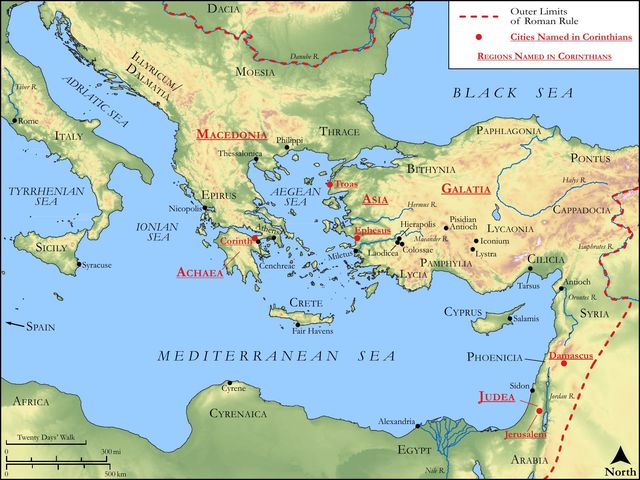
See on the biblical-era map

Study this verse
Public-domain commentary
Matthew Henry
From his Commentary on the Whole Bible. Henry comments on passages, not single verses — this entry covers 1 Corinthians 6:12–20.
The twelfth verse and former part of the thirteenth seem to relate to that early dispute among Christians about the distinction of meats, and yet to be prefatory to the caution that follows against fornication. The connection seems plain enough if we attend to the famous determination of the apostles, Acts 15, where the prohibition of certain foods was joined with that of fornication. Now some among the Corinthians seem to have imagined that they were as much at liberty in the point of fornication as of meats, especially because it was not a sin condemned by the laws of their country. They were ready to say, even in the case of fornication, All things are lawful for me. This pernicious conceit Paul here sets himself to oppose: he tells them that many things lawful in themselves were not expedient at certain times, and under particular circumstances; and Christians should not barely consider what is in itself lawful to be done, but what is fit for them to do, considering their profession, character, relations, and hopes: they should be very careful that by carrying this maxim too far they be not brought into bondage, either to a crafty deceiver or a carnal inclination. All things are lawful for me, says he, but I will not be brought under the power of any, Co1 6:12. Even in lawful things, he would not be subject to the impositions of a usurped authority: so far was he from apprehending that in the things of God it was lawful for any power on earth to impose its own sentiments. Note, There is a liberty wherewith Christ has made us free, in which we must stand fast. But surely he would never carry this liberty so far as to put himself into the power of any bodily appetite. Though all meats were supposed lawful, he would not become a glutton nor a drunkard. And much less would he abuse the maxim of lawful liberty to countenance the sin of fornication, which, though it might be allowed by the Corinthian laws, was a trespass upon the law of nature, and utterly unbecoming a Christian. He would not abuse this maxim about eating and drinking to encourage any intemperance, nor indulge a carnal appetite: "Though meats are for the belly and the belly for meats (Co1 6:13), though the belly was made to receive food, and food was originally ordained to fill the belly, yet if it be not convenient for me, and much more if it be inconvenient, and likely to enslave me, if I am in danger of being subjected to my belly and appetite, I will abstain. But God shall destroy both it and them, at least as to their mutual relation. There is a time coming when the human body will need no further recruits of food." Some of the ancients suppose that this is to be understood of abolishing the belly as well as the food; and that though the same body will be raised at the great day, yet not with all the same members, some being utterly unnecessary in a future state, as the belly for instance, when the man is never to hunger, nor thirst, nor eat, nor drink more. But, whether this be true or no, there is a time coming when the need and use of food shall be abolished. Note, The expectation we have of being without bodily appetites in a future life is a very good argument against being under their power in the present life. This seems to me the sense of the apostle's argument; and that this passage is plainly to be connected with his caution against fornication, though some make it a part of the former argument against litigious law-suits, especially before heathen magistrates and the enemies of true religion. These suppose that the apostle argues that though it may be lawful to claim our rights yet it is not always expedient, and it is utterly unfit for Christians to put themselves into the power of infidel judges, lawyers, and solicitors, on these accounts. But this connection seems not so natural. The transition to his arguments against fornication, as I have laid it, seems very natural: But the body is not for fornication, but for the Lord, and the Lord for the body, Co1 6:13. Meats and the belly are for one another; not so fornication and the body.
I.The body is not for fornication, but for the Lord.
This is the first argument he uses against this sin, for which the heathen inhabitants of Corinth were infamous, and the converts to Christianity retained too favourable an opinion of it. It is making things to cross their intention and use. The body is not for fornication; it was never formed for any such purpose, but for the Lord, for the service and honour of God. It is to be an instrument of righteousness to holiness (Rom 6:19), and therefore is never to be made an instrument of uncleanness. It is to be a member of Christ, and therefore must not be made the member of a harlot, Co1 6:15. And the Lord is for the body, that is, as some think, Christ is to be Lord of the body, to have property in it and dominion over it, having assumed a body and been made to partake of our nature, that he might be head of his church, and head over all things, Heb 2:5, Heb 2:18. Note, We must take care that we do not use what belongs to Christ as if it were our own, and much less to his dishonour.
II.Some understand this last passage, The Lord is for the body, thus:
He is for its resurrection and glorification, according to what follows, Co1 6:14, which is a second argument against this sin, the honour intended to be put on our bodies: God hath both raised up our Lord, and will raise us up by his power (Co1 6:14), by the power of him who shall change our vile body, and make it like to his glorious body by that power whereby he is able to subdue all things to himself, Phi 3:21. It is an honour done to the body that Jesus Christ was raised from the dead: and it will be an honour to our bodies that they will be raised. Let us not abuse those bodies by sin, and make them vile, which, if they be kept pure, shall, notwithstanding their present vileness, be made like to Christ's glorious body. Note, The hopes of a resurrection to glory should restrain Christians from dishonouring their bodies by fleshly lusts.
III.A third argument is the honour already put on them:
Know you not that your bodies are the members of Christ? Co1 6:15. If the soul be united to Christ by faith, the whole man is become a member of his mystical body. The body is in union with Christ as well as the soul. How honourable is this to the Christian! His very flesh is a part of the mystical body of Christ. Note, It is good to know in what honourable relations we stand, that we may endeavour to become them. But now, says the apostle, shall I take the members of Christ, and make them the members of a harlot? God forbid. Or, take away the members of Christ? Would not this be a gross abuse, and the most notorious injury? Would it not be dishonouring Christ, and dishonouring ourselves to the very last degree? What, make a Christ's members the members of a harlot, prostitute them to so vile a purpose! The thought is to be abhorred. God forbid. Know you not that he who is joined to a harlot is one body with hers? For two, says he, shall be one flesh. But he who is joined to the Lord is one spirit, Co1 6:16, Co1 6:17. Nothing can stand in greater opposition to the honourable relations and alliances of a Christian man than this sin. He is joined to the Lord in union with Christ, and made partaker by faith of his Spirit. One spirit lives and breathes and moves in the head and members. Christ and his faithful disciples are one, Joh 17:21, Joh 17:22. But he that is joined to a harlot is one body, for two shall be one flesh, by carnal conjunction, which was ordained of God only to be in a married state. Now shall one in so close a union with Christ as to be one spirit with him yet be so united to a harlot as to become one flesh with her? Were not this a vile attempt to make a union between Christ and harlots? And can a greater indignity he offered to him or ourselves? Can any thing be more inconsistent with our profession or relation? Note, The sin of fornication is a great injury in a Christian to his head and lord, and a great reproach and blot on his profession. It is no wonder therefore that the apostle should say, "Flee fornication (Co1 6:18), avoid it, keep out of the reach of temptations to it, of provoking objects. Direct the eyes and mind to other things and thoughts." Alia vitia pugnando, sola libido fugiendo vincitur - Other vices may be conquered in fight, this only by flight; so speak many of the fathers.
IV.A fourth argument is that it is a sin against our own bodies.
Every sin that a man does is without the body; he that committeth fornication sinneth against his own body (Co1 6:18); every sin, that is, every other sin, every external act of sin besides, is without the body. It is not so much an abuse of the body as of somewhat else, as of wine by the drunkard, food by the glutton, etc. Nor does it give the power of the body to another person. Nor does it so much tend to the reproach of the body and render it vile. This sin is in a peculiar manner styled uncleanness, pollution, because no sin has so much external turpitude in it, especially in a Christian. He sins against his own body; he defiles it, he degrades it, making it one with the body of that vile creature with whom he sins. He casts vile reproach on what he Redeemer has dignifies to the last degree by taking it into union with himself. Note, We should not make our present vile bodies more vile by sinning against them.
V.The fifth argument against this sin is that the bodies of Christians are the temples of the Holy Ghost which is in them, and which they have of God, Co1 6:19. He that is joined to Christ is one spirit. He is yielded up to him, is consecrated thereby, and set apart for his use, and is hereupon possessed, and occupied, and inhabited, by his Holy Spirit. This is the proper notion of a temple - a place where God dwells, and sacred to his use, by his own claim and his creature's surrender. Such temples real Christians are of the Holy Ghost. Must he not therefore be God? But the inference is plain that hence we are not our own. We are yielded up to God, and possessed by and for God; nay, and this is virtue of a purchase made of us: You are bought with a price. In short, our bodies were made for God, they were purchased for him. If we are Christians indeed they are yielded to him, and he inhabits and occupies them by his Spirit: so that our bodies are not our own, but his. And shall we desecrate his temple, defile it, prostitute it, and offer it up to the use and service of a harlot? Horrid sacrilege! This is robbing God in the worst sense. Note, The temple of the Holy Ghost must be kept holy. Our bodies must be kept as his whose they are, and fit for his use and residence.
VI.The apostle argues from the obligation we are under to glorify God both with our body and spirit, which are his, Co1 6:20.
He made both, he bought both, and therefore both belong to him and should be used and employed for him, and therefore should not be defiled, alienated from him, and prostituted by us. No, they must be kept as vessels fitted for our Master's use. We must look upon our whole selves as holy to the Lord, and must use our bodies as property which belongs to him and is sacred to his use and service. We are to honour him with our bodies and spirits, which are his; and therefore, surely, must abstain from fornication; and not only from the outward act, but from the adultery of the heart, as our Lord calls it, Mat 5:28. Body and spirit are to be kept clean, that God may be honoured by both. But God is dishonoured when either is defiled by so beastly a sin. Therefore flee fornication, nay, and every sin. Use your bodies for the glory and service of their Lord and Maker. Note, We are not proprietors of ourselves, nor have power over ourselves, and therefore should not use ourselves according to our own pleasure, but according to his will, and for his glory, whose we are, and whom we should serve, Act 27:23.
Historical interpretation
Three Centuries of Reception
6 surviving comments on this verse. Each one is dated, so this reads as a timeline rather than a list.
Select a marker to jump to its quote. Markers stagger vertically where authors wrote within a few decades of each other.
For it is in man's power to disobey God, and to forfeit what is good; but
"Ye are made, so to speak, by Him to be righteous as He is, and are blended as far as possible with the Holy Spirit. For "are not all things lawful to me? yet I will not be brought under the power of any".
so as to do, or think, or speak aught contrary to the Gospel. "Meats for the belly, and the belly for meats, which God shall destroy"
All things are lawful, but that is obviously premised upon self-discipline.
By “all things” Paul presumably means those things which are contained in the natural law and which were also lawful for his fellow apostles. It would not refer to the law of Moses, because Moses forbade many things owing to the hardness of heart of an unbelieving and stiff-necked people.
Here he glances at the gluttons. For since he intends to assail the fornicator again, and fornication arises from luxuriousness and want of moderation, he strongly chastises this passion. It cannot be that he speaks thus with regard to things forbidden, such not being "lawful:" but of things which seem to be indifferent. To illustrate my meaning: "It is lawful," he says, "to eat and to drink; but it is not expedient with excess." And so that marvellous and unexpected turn of his, which he is often wont to adopt; bringing his argument clear round to its contrary, this he manages to introduce here also; and he signifies that to do what is in one's power not only is not expedient, but even is not a part of power, but of slavery.
And first, he dissuades them on the ground of the inexpediency of the thing, saying, "they are not expedient:" in the next place, on that of its contrariety to itself, saying, "I will not be brought under the power of any." This is his meaning: "You are at liberty to eat," says he; "well then, remain in liberty, and take heed that you do not become a slave to this appetite: for he who uses it properly, he is master of it; but he that exceeds the proper measure is no longer its master but its slave, since gluttony reigns paramount within him." Do you perceive how, where the man thought he had authority Paul points out that he is under authority? For this is his custom, as I was saying before, to give all objections a turn the contrary way. It is just this which he has done here. For mark; each of them was saying, "I have power to live luxuriously." He replies, "In doing so, thou art not so much acting as one who had power over a thing, but rather as being thyself subject to some such power. For thou hast not power even over thine own belly, so long as thou art dissolute, but it hath power over thee." And the same we may say both of riches and of other things.
Now that we are no longer under the law, we have the freedom to make choices, but we need to realize that some choices are right and others wrong.
Continue studying 1 Corinthians 6:12 across the web’s major study libraries — every link below opens this exact verse, chapter, or book on the destination site.
Read & Compare
 BibleGatewayThis verse in more than 200 translations and 70 languages.
 Bible.comThe YouVersion reader — hundreds of translations, reading plans, and highlights.
 ESV.orgCrossway's official English Standard Version reader.
 NET BibleThe NET translation with 60,000+ translators' notes on every rendering decision.
 STEP BibleTyndale House's free study tool — original text, vocabulary, and scholarly resources.
 BibliaLogos Bible Software's free web reader.
 USCCBThe New American Bible (Revised Edition) with the U.S. bishops' study notes.
Commentaries
 BibleHub CommentariesDozens of classic commentaries on this verse, gathered on one page.
 StudyLightMore than 100 commentary sets — the largest collection on the web.
 BibleRefPlain-English commentary on what this verse means, verse by verse.
 Enduring WordDavid Guzik's free commentary on this chapter, widely used by Bible teachers.
 Bible Study ToolsVerse commentary alongside Greek and Hebrew study aids.
Original Language & Research
- BibleHub InterlinearThe verse word by word — original language, transliteration, and English.
- BibleHub LexiconEvery word's original-language definition and Strong's entry.
 Blue Letter BibleDeep-study tools — Strong's numbers, concordance, and word studies.
 CNTR CollationThe earliest Greek manuscripts of this verse, collated letter by letter.
Sermons, Hymns & Audio


TrulyRandomVerse is not affiliated with these sites and doesn’t control their content. They’re linked because they’re genuinely useful.
Summary
First Corinthians 6:12 encapsulates a foundational principle of Christian liberty, asserting that while believers are indeed free from legalistic constraints, this freedom is not an unbridled license. Apostle Paul masterfully qualifies the Corinthian slogan "All things are lawful unto me" by introducing two crucial ethical filters: expediency (what is truly beneficial or constructive) and mastery (avoiding enslavement to anything other than Christ). This verse serves as a vital guide for discerning Christian conduct, urging believers to evaluate actions not merely by their permissibility but by their edifying impact and their potential to compromise spiritual freedom.
Context
ShowHideLiterary Context
This verse stands at a pivotal point within Paul's letter, specifically within a section (1 Corinthians 5-7) where he addresses various moral issues plaguing the Corinthian church. Immediately preceding 1 Corinthians 6:12, Paul has sternly rebuked the Corinthians for tolerating sexual immorality among their members (1 Corinthians 5:1-13) and for settling disputes in pagan courts rather than among believers (1 Corinthians 6:1-8). He then transitions to a powerful theological argument regarding the sanctity of the believer's body, proclaiming it a "temple of the Holy Spirit" and "members of Christ" (1 Corinthians 6:15-20). Thus, 1 Corinthians 6:12 acts as a bridge, challenging a potentially misused concept of freedom that could justify the very immoralities Paul condemns. It sets the stage for Paul's subsequent discussions on marriage, food sacrificed to idols, and the proper exercise of spiritual gifts, all of which are framed by the principles of expediency and avoiding enslavement.
Historical & Cultural Context
Ancient Corinth was a prominent Roman colony, a bustling port city renowned for its commercial prosperity and notorious for its pervasive immorality. The city was a melting pot of diverse cultures, philosophies, and religious practices, including the worship of Aphrodite, which often involved temple prostitution. This environment fostered a culture where self-indulgence and a pursuit of pleasure were common. Within this context, many new converts to Christianity, having been liberated from paganism and the Mosaic Law, may have misinterpreted their newfound freedom in Christ as an absolute license to engage in any behavior, believing that "all things are lawful." This slogan likely circulated among some Corinthian believers, possibly as a justification for behaviors that, while not explicitly forbidden by the Law (which they were no longer under), were nonetheless detrimental to their spiritual well-being or their witness. Paul's nuanced response directly confronts this cultural backdrop, guiding them toward a mature understanding of Christian liberty that transcends mere permissibility.
Key Themes
ShowHide1 Corinthians 6:12 contributes significantly to several overarching themes in Paul's letter. Firstly, it develops the theme of Christian Liberty, emphasizing that freedom in Christ is not an end in itself but a means to glorify God and serve others. This liberty is not absolute license but is qualified by love and wisdom, a concept further elaborated in 1 Corinthians 8-10. Secondly, the verse introduces the theme of Expediency and Edification, highlighting that actions should be evaluated not just by their permissibility but by their beneficial and constructive impact on oneself and the community. This principle is foundational to Paul's ethical framework, as seen in his discussion of food sacrificed to idols, where he prioritizes the edification of the weaker brother over the exercise of one's freedom (1 Corinthians 8:9-13). Thirdly, it addresses the theme of Self-Mastery and Avoiding Enslavement, asserting that believers must not allow anything to gain dominion over them, lest it hinder their devotion to Christ. This speaks to the importance of spiritual discipline and discerning what truly promotes spiritual health versus what might become a controlling habit or addiction. This theme is closely linked to the Sanctity of the Body, as Paul argues that the body, as a temple of the Holy Spirit, must be used for God's glory and not for sin (1 Corinthians 6:19-20).
Exposition and Analysis
ShowHideKey Word Analysis
ShowHideThis word (G1832) is derived from a compound meaning "to be out in public," and impersonally, it signifies "it is right" or "it is permissible." In the context of the Corinthian slogan, it denotes an action that is not forbidden by law or custom, implying a sense of freedom or allowance. Paul affirms this aspect of Christian liberty, acknowledging that many things are indeed permissible for the believer who is no longer under the Mosaic Law. However, he immediately qualifies this permissibility, indicating that "lawful" does not equate to "beneficial."
From symphérō (G4851), meaning "to bear together" or "to contribute," this word, when used impersonally, refers to what is advantageous, profitable, or beneficial. It carries the sense of what is "good for" or "conduces to" a positive outcome. Paul introduces this crucial qualifier to the "lawful" statement, shifting the focus from mere permissibility to practical utility and spiritual benefit. An action might be permissible, but if it does not build up, edify, or contribute to spiritual health, it is not "expedient."
This verb (G1850) means "to control" or "to exercise authority upon." In the passive voice, as used here, it means "to be controlled" or "to be brought under the power of." Paul's declaration, "I will not be brought under the power of any," asserts his spiritual independence and self-mastery. It highlights the danger of allowing even permissible things to become masters, creating a dependency or addiction that diminishes one's freedom in Christ and shifts allegiance away from God. This speaks to the internal freedom that should characterize a believer, free from the dominion of anything other than the Lord.
Verse Breakdown
ShowHide"All things are lawful unto me"
This phrase is widely understood to be a slogan or common saying among some within the Corinthian church. It reflects a legitimate understanding of Christian liberty, signifying that believers are no longer bound by the ceremonial or civil laws of the Old Testament, nor by the legalistic interpretations of the Pharisees. In Christ, they have freedom from sin's dominion and the law's condemnation. However, this statement, if taken in isolation, could be twisted into a justification for licentiousness, implying that anything goes.
"but all things are not expedient"
Here, Paul introduces the first critical qualification to the Corinthian slogan. The conjunction "but" (Greek, allá) signals a strong contrast. While something may be permissible ("lawful"), it might not be "expedient" (beneficial, advantageous, or profitable) for spiritual growth, for the well-being of others, or for the advancement of the gospel. This introduces a higher ethical standard than mere legality, urging believers to consider the constructive and edifying impact of their actions.
"all things are lawful for me"
Paul repeats the slogan, reinforcing his agreement with the premise of Christian liberty. This repetition serves to acknowledge the truth of their freedom while simultaneously preparing the ground for his second, equally vital qualification. It shows that Paul is not denying their freedom but rather refining their understanding of it.
"but I will not be brought under the power of any."
This is Paul's second, personal qualification, and it speaks to the issue of mastery and spiritual autonomy. Even if an action is lawful and potentially expedient, Paul declares that he will not allow anything to gain control or dominion over him. This is a powerful assertion of self-control and a warning against addiction or dependency. True Christian freedom means being free from the power of sin and from the power of anything that could enslave the believer, diverting their ultimate allegiance from Christ.
Literary Devices
ShowHidePaul employs several effective literary devices in 1 Corinthians 6:12 to convey his profound theological point. The most prominent is Antithesis, where Paul sets up a direct contrast between two ideas: "lawful" versus "not expedient," and "lawful" versus "not brought under the power of any." This sharp juxtaposition highlights the nuance of Christian liberty, moving beyond a simplistic understanding of permissibility. The Repetition of "All things are lawful unto me" serves to acknowledge the Corinthians' assertion of freedom, affirming its truth before immediately qualifying it. This rhetorical move allows Paul to validate their premise while simultaneously correcting their potential misapplication. Furthermore, Paul's use of a likely Slogan or Proverb ("All things are lawful unto me") demonstrates his pastoral wisdom. By quoting their own saying, he meets them where they are, engaging directly with their prevailing thought, and then subtly redefines its meaning within a Christ-centered framework. This approach makes his correction more relatable and impactful.
Theological and Thematic Connections
ShowHidePaul's declaration in 1 Corinthians 6:12 is a cornerstone of New Testament ethics, establishing that Christian liberty is not a license for self-indulgence but a call to responsible, Christ-honoring living. It teaches that freedom in Christ is always to be exercised within the bounds of love, wisdom, and the pursuit of God's glory. This principle prevents antinomianism (the belief that Christians are free from moral law) while upholding the true spiritual freedom gained through Christ. It challenges believers to move beyond a minimalist "what can I get away with?" mentality to a maximalist "what will most glorify God and edify others?" perspective. The verse underscores the importance of self-control and discerning what truly builds up the individual and the community, rather than merely what is permissible.
Reflection and Application
ShowHideFirst Corinthians 6:12 offers timeless wisdom for navigating the complexities of Christian living in a world full of choices. It compels us to critically examine our actions, habits, and pursuits through a dual lens: "Is it beneficial?" and "Does it control me?" In an age saturated with options—from entertainment and technology to dietary choices and financial habits—this verse calls for a mature and discerning spirituality. It challenges us to look beyond mere permissibility and consider the broader impact of our choices on our spiritual health, our witness to the world, and the well-being of our community. True freedom in Christ is not the absence of boundaries, but the power to choose what is truly good, constructive, and glorifying to God, rather than being enslaved by anything that might diminish our devotion or hinder our walk with Him. This requires self-awareness, prayerful discernment, and a willingness to surrender even "lawful" things if they prove to be unexpedient or enslaving.
Questions for Reflection
ShowHideFAQ
ShowHideWhat does Paul mean by "lawful" in this verse?
ShowHideWhen Paul states "All things are lawful unto me," he is likely quoting a common slogan or belief held by some in the Corinthian church. "Lawful" (Greek, éxesti) means permissible or allowed. In the context of Christian liberty, it signifies that believers are no longer under the strict regulations of the Mosaic Law or bound by legalistic external rules. Their freedom in Christ means they are not condemned for actions that were once forbidden by the Law but are not inherently sinful, nor are they bound by human traditions. However, Paul immediately qualifies this, indicating that "lawful" does not automatically mean "beneficial" or "wise."
How does "expedient" differ from "lawful"?
ShowHide"Lawful" refers to what is permissible or allowed, not explicitly forbidden. "Expedient" (Greek, symphérō) goes beyond mere permissibility; it means what is advantageous, beneficial, profitable, or constructive. Paul introduces "expedient" as a crucial filter for Christian behavior. An action might be lawful (not forbidden), but if it does not build up, edify, or promote spiritual well-being for oneself or others, then it is not expedient. For example, eating certain foods might be lawful, but if it causes a weaker brother to stumble, it is not expedient (1 Corinthians 8:9-13).
What does it mean to "not be brought under the power of any"?
ShowHideThis phrase means not allowing anything, even a lawful activity, to gain control or mastery over one's life. The Greek word for "brought under the power" (exousiázō) implies being dominated or enslaved. Paul is asserting his spiritual independence, refusing to let any habit, desire, or pursuit become an addiction or a controlling force that detracts from his devotion to Christ. This speaks to the importance of self-control and discerning when a permissible activity crosses the line into a dependency that hinders one's freedom in Christ and allegiance to God. It is a call to ensure that Christ alone remains the ultimate master of one's life.
Christ-Centered Fulfillment
ShowHideFirst Corinthians 6:12, though addressing practical ethical dilemmas, finds its ultimate fulfillment and deepest meaning in Christ. Our freedom from the law's condemnation and sin's dominion is entirely a gift purchased by Christ's atoning sacrifice on the cross (Galatians 3:13). He did not come to abolish the law but to fulfill it (Matthew 5:17), demonstrating perfect obedience and living a life entirely expedient and never brought under the power of sin or any earthly thing. Jesus himself, though having all authority, consistently chose what was beneficial for the Kingdom and never allowed worldly desires or even legitimate needs to control Him (Matthew 4:1-11). He freely submitted His will to the Father's, even to the point of death on a cross (Philippians 2:8). For believers, true liberty is not found in boundless license but in being "slaves of Christ" (1 Corinthians 7:22), whose perfect freedom empowers us through the Holy Spirit to choose what is expedient and to resist being mastered by anything other than God's will. The Spirit enables us to bear the fruit of self-control (Galatians 5:22-23), transforming our desires so that our freedom is exercised in a way that honors Christ and builds up His body, reflecting His own perfect example of love and self-sacrifice.