


1 Corinthians 10:23
- ΠάνταPantaAll thingsG3956A-NPNAdjective Nominative Plural Neuter
- μοιmoito meG3165P-1DSPersonal pronoun Dative 1st Singular
- ἔξεστινexestinare lawfulG1832V-PAI-3SVerb Present Active Indicative 3rd Singular
- ἀλλ᾽all᾽butG235CONJConjunction
- οὐounotG3756PRT-NNegative Particle Negative
- πάνταpantaall thingsG3956A-NPNAdjective Nominative Plural Neuter
- συμφέρει·sumphereiare profitableG4851V-PAI-3SVerb Present Active Indicative 3rd Singular
- πάνταpantaAll thingsG3956A-NPNAdjective Nominative Plural Neuter
- μοιmoito meG3165P-1DSPersonal pronoun Dative 1st Singular
- ἔξεστινexestinare lawfulG1832V-PAI-3SVerb Present Active Indicative 3rd Singular
- ἀλλ᾽all᾽butG235CONJConjunction
- οὐounotG3756PRT-NNegative Particle Negative
- πάνταpantaallG3956A-NPNAdjective Nominative Plural Neuter
- οἰκοδομεῖoikodomeiedifyG3618V-PAI-3SVerb Present Active Indicative 3rd Singular
English is a literal word-by-word gloss of the Greek, not the KJV's wording. Why?
This is the original text the KJV's translators worked from — each Greek word with its own literal English meaning in this verse, prepared by scholars at Tyndale House, Cambridge. The KJV translates whole sentences, not word by word, so its wording differs: one Greek word can become several English words, and the KJV may choose “charity” where the gloss reads “love”. Both are faithful — they answer different questions. For the KJV's own rendering, switch to the KJV text.
Details
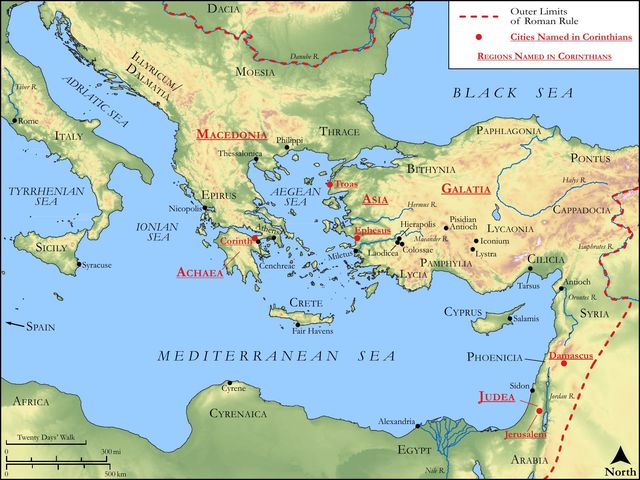
See on the biblical-era map

Study this verse
Public-domain commentary
Matthew Henry
From his Commentary on the Whole Bible. Henry comments on passages, not single verses — this entry covers 1 Corinthians 10:23–33.
In this passage the apostle shows in what instances, notwithstanding, Christians might lawfully eat what had been sacrificed to idols. They must not eat it out of religious respect to the idol, nor go into his temple, and hold a feast there, upon what they knew was an idol-sacrifice; nor perhaps out of the temple, if they knew it was a feast held upon a sacrifice, but there were cases wherein they might without sin eat what had been offered. Some such the apostle here enumerates. - But,
I.He gives a caution against abusing our liberty in lawful things.
That may be lawful which is not expedient, which will not edify. A Christian must not barely consider what is lawful, but what is expedient, and for the use of edification. A private Christian should do so even in his private conduct. He must not seek his own only, but his neighbour's wealth. He must be concerned not to hurt his neighbour, nay, he must be concerned to promote his welfare; and must consider how to act so that he may help others, and not hinder them in their holiness, comfort, or salvation. Those who allow themselves in every thing not plainly sinful in itself will often run into what is evil by accident, and do much mischief to others. Every thing lawful in itself to be done is not therefore lawfully done. Circumstances may make that a sin which in itself is none. These must be weighed, and the expediency of an action, and its tendency to edification, must be considered before it be done. Note, The welfare of others, as well as our own convenience, must be consulted in many things we do, if we would do them well.
II.He tells them that what was sold in the shambles they might eat without asking questions.
The priest's share of heathen sacrifices was thus frequently offered for sale, after it had been offered in the temple. Now the apostle tells them they need not be so scrupulous as to ask the butcher in the market whether the meat he sold had been offered to an idol? It was there sold as common food, and as such might be bought and used; for the earth is the Lord's, and the fulness thereof (Co1 10:26), and the fruit and products of the earth were designed by him, the great proprietor, for the use and subsistence of mankind, and more especially of his own children and servants. Every creature of God is good, and nothing to be refused, if it be received with thanksgiving; for it is sanctified by the word of God and prayer, Ti1 4:4, Ti1 4:5. To the pure all things are pure, Tit 1:15. Note, Though it is sinful to use any food in an idolatrous manner, it is no sin, after such abuse, to apply it, in a holy manner, to its common use.
III.He adds that if they were invited by any heathen acquaintances to a feast, they might go, and eat what was set before them, without asking questions (Co1 10:27), nay, though they knew things sacrificed to idols were served up at such entertainments, as well as sold in the shambles. Note, The apostle does not prohibit their going to a feast upon the invitation of those that believed not. There is a civility owing even to infidels and heathens. Christianity does by no means bind us up from the common offices of humanity, nor allow us an uncourteous behaviour to any of our own kind, however they may differ from us in religious sentiments or practices. And when Christians were invited to feast with infidels they were not to ask needless questions about the food set before them, but eat without scruple. Needless enquiries might perplex their minds and consciences, for which reason they were to be avoided. Any thing fit to be eaten, that was set before them at a common entertainment, they might lawfully eat. And why then should they scrupulously enquire whether what was set before them had been sacrificed? It is to be understood of civil feasting, not religious; for the latter among the heathens was feasting upon their sacrifices, which he had condemned before as a participation in their idolatrous worship. At a common feast they might expect common food; and they needed not to move scruples in their own minds whether what was set before them was otherwise or no. Note, Though Christians should be very careful to know and understand their duty, yet they should not, by needless enquiries, perplex themselves.
IV.Yet, even at such an entertainment, he adds, if any should say it was a thing that had been offered to idols, they should refrain:
Eat not, for his sake that showed it, and for conscience' sake. Whether it were the master of the feast or any of the guests, whether it were spoken in the hearing of all or whispered in the ear, they should refrain for his sake who suggested this to them, whether he were an infidel or an infirm Christian; and for conscience' sake, out of regard to conscience, that they might show a regard to it in themselves, and keep up a regard to it in others. This he backs with the same reason as the former: For the earth is the Lord's. There is food enough provided by our common Lord, of which we maya eat without scruple. The same doctrine may be variously improved, as here: "The earth is the Lord's, therefore you may eat any thing without scruple that is set before you as common food; and yet, because the earth is the Lord's, eat nothing that will give offence, lay a stumbling-block before others, and encourage some in idolatry, or tempt others to eat when they are not clear in their own mind that it is lawful, and so sin, and wound their own consciences." Note, Christians should be very cautious of doing what may thus prejudice the consciences of others, and weaken their authority with them, which is by all means to be kept up.
V.He urges them to refrain where they will give offence, while yet he allows it lawful to eat what was et before them as common food, though it had been offered in sacrifice. "Another man's conscience is no measure to our conduct. What he thinks unlawful is not thereby made unlawful to me, but may be a matter of liberty still; and as long as I own God as a giver of my food, and render him thanks for it, it is very unjust to reproach me for using it." This must be understood abstracted from the scandal given by eating in the circumstance mentioned. Though some understand it to mean, "Why should I, by using the liberty I have, give occasion to those who are scandalized to speak evil of me?" According to that advice of the apostle (Rom 14:16), Let not your good be evil spoken of. Note, Christians should take care not to use their liberty to the hurt of others, nor their own reproach.
VI.The apostle takes occasion from this discourse to lay down a rule for Christians' conduct, and apply it to this particular case (Co1 10:31, Co1 10:32), namely, that in eating and drinking, and in all we do, we should aim at the glory of God, at pleasing and honouring him. This is the fundamental principle of practical godliness. The great end of all practical religion must direct us where particular and express rules are wanting. Nothing must be done against the glory of God, and the good of our neighbours, connected with it. Nay, the tendency of our behaviour to the common good, and the credit of our holy religion, should give direction to it. And therefore nothing should be done by us to offend any, whether Jew, or Gentile, or the church, Co1 10:32. The Jews should not be unnecessarily grieved nor prejudiced, who have such an abhorrence of idols that they reckon every thing offered to them thereby defiled, and that it will pollute and render culpable all who partake of it; nor should heathens be countenanced in their idolatry by any behaviour of ours, which they may construe as homage or honour done to their idols; nor young converts from Gentilism take any encouragement from our conduct to retain any veneration for the heathen gods and worship, which they have renounced: nor should we do any thing that may be a means to pervert any members of the church from their Christian profession or practice. Our own humour and appetite must not determine our practice, but the honour of God and the good and edification of the church. We should not so much consult our own pleasure and interest as the advancement of the kingdom of God among men. Note, A Christian should be a man devoted to God, and of a public spirit.
VII.He presses all upon them by his own example:
Even as I please all men (or study to do it) in all things (that I lawfully can), not seeking my own profit, but that of many, that they may be saved, Co1 10:33. Note, A preacher may press his advice home with boldness and authority when he can enforce it with his own example. He is most likely to promote a public spirit in others who can give evidence of it in himself. And it is highly commendable in a minister to neglect his own advantage that he may promote the salvation of his hearers. This shows that he has a spirit suitable to his function. It is a station for public usefulness, and can never be faithfully discharged by a man of a narrow spirit and selfish principles.
Historical interpretation
Two Centuries of Reception
10 surviving comments on this verse. Each one is dated, so this reads as a timeline rather than a list.
Select a marker to jump to its quote. Markers stagger vertically where authors wrote within a few decades of each other.
Let the mention we make for our present purpose suffice, as it is not unsuitable to the flowers of the Word; and we have often done this, drawing to the urgent point of the question the most beneficial fountain, in order to water those who have been planted by the Word. "For if it is lawful for me to partake of all things, yet all things are not expedient." For those that do all that is lawful, quickly fall into doing what is unlawful. And just as righteousness is not attained by avarice, nor temperance by excess; so neither is the regimen of a Christian formed by indulgence.
Truly, "all things are lawful, but all things are not expedient," says the apostle: "all things are lawful for me, but all things edify not." And, "Let no one seek his own advantage, but also that of his neighbour," so as to be able at once to do and to teach, building and building up.
For how far more usefully and cautiously shall we act, if we hazard the presumption that all these things were indeed provided at the beginning and placed in the world by God, in order that there should now be means of putting to the proof the discipline of His servants, in order that the licence of using should be the means whereby the experimental trials of continence should be conducted? Do not wise heads of families purposely offer and permit some things to their servants in order to try whether and how they will use the things thus permitted whether (they will do so) with honesty, or with moderation? But how far more praiseworthy (the servant) who abstains entirely; who has a wholesome fear even of his lord's indulgence! Thus, therefore, the apostle too: "All things," says he, "are lawful, but not all are expedient." How much more easily will he fear what is unlawful who has a reverent dread of what is lawful?
To marry otherwise is, to believers, not "lawful; "is not "expedient."
But how much more is the rule of reverence and modesty incumbent on laymen-seeing that these powers belong to their superiors-lest they assume to themselves the specific function of the bishop! Emulation of the episcopal office is the mother of schisms. The most holy apostle has said, that "all things are lawful, but not all expedient." Let it suffice assuredly, in cases of necessity, to avail yourself (of that rule , if at any time circumstance either of place, or of time, or of person compels you (so to do); for then the stedfast courage of the succourer, when the situation of the endangered one is urgent, is exceptionally admissible; inasmuch as he will be guilty of a human creature's loss if he shall refrain from bestowing what he had free liberty to bestow.
Let it now be granted that repetition of marriage is lawful, if everything which is lawful is good. The same apostle exclaims: "All things are lawful, but all are not profitable." Pray, can what is "not profitable" be called good? If even things which do not make for salvation are "lawful," it follows that even things which are not good are "lawful.
It is much easier for one to dread what is forbidden if he has a reverential fear of what is permitted.
You say that you are wealthy and rich. But not everything that can be done ought also to be done; nor ought the broad desires that arise out of the pride of the world to be extended beyond the honour and modesty of virginity; since it is written, "All things are lawful, but all things are not expedient: all things are lawful, but all things edify not." For the rest, if you dress your hair sumptuously, and walk so as to draw attention in public, and attract the eyes of youth upon you, and draw the sighs of young men after you, nourish the lust of concupiscence, and inflame the fuel of sighs, so that, although you yourself perish not, yet you cause others to perish, and offer yourself, as it were, a sword or poison to the spectators; you cannot be excused on the pretence that you are chaste and modest in mind. Your shameful dress and immodest ornament accuse you; nor can yon be counted now among Christ's maidens and virgins, since yon live in such a manner as to make yourselves objects of desire.
That not everything is to be done which is lawful. Paul, in the first Epistle to the Corinthians: "All things are lawful, but all things are not expedient: all things are lawful, but all things edify not."
"All things are lawful for me, but all things are not expedient: all things are lawful for me, but all things edify not. Let no man seek his own, but each his neighbor's good."
Seest thou his exact wisdom? Because it was likely that they might say, "I am perfect and master of myself, and it does me no harm to partake of what is set before me;" "Even so," saith he, "perfect thou art and master of thyself; do not however look to this, but whether the result involve not injury, nay subversion." For both these he mentioned, saying, "All things are not expedient, all things edify not;" and using the former with reference to one's self, the latter, to one's brother: since the clause, "are not expedient," is a covert intimation of the ruin of the person to whom he speaks; but the clause, "edify not," of the stumbling block to the brother.
Wherefore also he adds, "Let no man seek his own;" which he every where through the whole Epistle insists upon and in that to the Romans; when he says, "For even Christ pleased not Himself:" and again, "Even as I please all men in all things, not seeking mine own profit." And again in this place; he does not, however, fully work it out here. That is, since in what had gone before he had established it at length, and shown that he no where "seeks his own," but both "to the Jews became as a Jew and to them that are without law as without law," and used not his own "liberty" and "right" at random, but to the profit of all, serving all; he here broke off, content with a few words, by these few guiding them to the remembrance of all which had been said.
Continue studying 1 Corinthians 10:23 across the web’s major study libraries — every link below opens this exact verse, chapter, or book on the destination site.
Read & Compare
 BibleGatewayThis verse in more than 200 translations and 70 languages.
 Bible.comThe YouVersion reader — hundreds of translations, reading plans, and highlights.
 ESV.orgCrossway's official English Standard Version reader.
 NET BibleThe NET translation with 60,000+ translators' notes on every rendering decision.
 STEP BibleTyndale House's free study tool — original text, vocabulary, and scholarly resources.
 BibliaLogos Bible Software's free web reader.
 USCCBThe New American Bible (Revised Edition) with the U.S. bishops' study notes.
Commentaries
 BibleHub CommentariesDozens of classic commentaries on this verse, gathered on one page.
 StudyLightMore than 100 commentary sets — the largest collection on the web.
 BibleRefPlain-English commentary on what this verse means, verse by verse.
 Enduring WordDavid Guzik's free commentary on this chapter, widely used by Bible teachers.
 Bible Study ToolsVerse commentary alongside Greek and Hebrew study aids.
Original Language & Research
- BibleHub InterlinearThe verse word by word — original language, transliteration, and English.
- BibleHub LexiconEvery word's original-language definition and Strong's entry.
 Blue Letter BibleDeep-study tools — Strong's numbers, concordance, and word studies.
 CNTR CollationThe earliest Greek manuscripts of this verse, collated letter by letter.
Sermons, Hymns & Audio


TrulyRandomVerse is not affiliated with these sites and doesn’t control their content. They’re linked because they’re genuinely useful.
Summary
First Corinthians 10:23 encapsulates a foundational principle of Christian liberty, asserting that while believers are free from legalistic constraints, this freedom is not an absolute license. The Apostle Paul qualifies the Corinthian slogan "All things are lawful for me" by introducing two crucial criteria: expediency (profitability) and edification (building up). This verse serves as a pivotal ethical guide, challenging believers to evaluate their actions not merely by their permissibility but by their ultimate benefit to themselves, the community of faith, and the glory of God.
Context
ShowHideLiterary Context
This verse is strategically placed within Paul's broader discussion concerning Christian freedom, particularly in the contentious issue of eating meat sacrificed to idols (chapters 8-10). Having addressed the dangers of idolatry by referencing Israel's history in the wilderness (1 Corinthians 10:1-13), Paul transitions to practical application regarding food. The phrase "All things are lawful for me" is a Corinthian slogan, which Paul previously quoted and qualified in 1 Corinthians 6:12, where the emphasis was on avoiding personal enslavement to anything. Here, in 1 Corinthians 10, the focus shifts from individual self-control to the impact of one's actions on the conscience of others and the unity of the community, leading into specific instructions about eating in various social settings (1 Corinthians 10:25-33).
Historical & Cultural Context
The city of Corinth was a bustling, cosmopolitan port city, a hub of trade, wealth, and diverse religious practices, including numerous pagan temples where meat was routinely offered to idols before being sold in the marketplace. For many Corinthian Christians, particularly those with a strong understanding of monotheism and the non-existence of idols (1 Corinthians 8:4-6), eating such meat was a matter of indifference. However, for others, especially those recently converted from paganism or with weaker consciences, consuming idol-meat could be a stumbling block, potentially leading them back to idolatrous practices or violating their conscience. Paul's teaching here directly addresses the tension between the "knowledge" of the strong and the "conscience" of the weak, a theme also explored in Romans 14.
Key Themes
ShowHideThis verse contributes significantly to several major themes in 1 Corinthians. Firstly, it underscores the theme of Christian Liberty vs. Responsibility. While believers are indeed liberated from the Mosaic Law and the power of sin, this freedom is not a license for self-indulgence but must be exercised with consideration for God's glory and the welfare of others. Secondly, the concept of Expediency (Profitability) is introduced, challenging believers to move beyond mere permissibility to consider whether an action truly serves a good purpose or brings about positive, advantageous results for spiritual growth and the community. Finally, the paramount theme of Edification (Building Up) is highlighted. Paul consistently emphasizes that all Christian actions, especially those related to spiritual gifts and communal practices, should aim to strengthen, encourage, and promote the spiritual growth of the body of Christ, rather than causing division or stumbling, as seen throughout his discourse on love in 1 Corinthians 13.
Exposition and Analysis
ShowHideKey Word Analysis
ShowHideThis word (G1832) impersonally means "it is right" or "it is permissible." It denotes that which is legitimate or allowed, often in a legal or moral sense. In the context of Christian liberty, it refers to the freedom believers have in Christ from the strictures of the Mosaic Law and human traditions that do not align with the Gospel. Paul acknowledges the truth of this statement regarding the believer's freedom, but immediately qualifies it.
Derived from syn ("together") and pherō ("to bear"), this word (G4851) literally means "to bear together" or "to bring together." Figuratively, it signifies what is advantageous, profitable, beneficial, or conducive to a good outcome. Paul uses this term to pivot from mere permissibility to practical utility, urging believers to consider whether their actions, though permissible, are truly advantageous for the common good and spiritual well-being.
This verb (G3618) means "to build a house," "to construct," or "to build up." In a spiritual sense, it refers to the act of strengthening, encouraging, and promoting the spiritual growth and maturity of individuals and the church as a whole. Paul's repeated use of this term throughout 1 Corinthians emphasizes that the ultimate goal of Christian conduct should be the spiritual strengthening and unity of the body of Christ.
Verse Breakdown
ShowHide"All things are lawful for me,"
This phrase likely represents a slogan or principle adopted by some in the Corinthian church, asserting their freedom in Christ. Paul acknowledges the theological truth that, in Christ, believers are indeed free from the legalistic burdens and ceremonial laws that once bound them, and that no external thing in itself defiles a person (Mark 7:18-19).
"but all things are not expedient:"
Paul immediately introduces a crucial qualification. While an action might be permissible (lawful), it does not automatically mean it is beneficial, advantageous, or profitable. This challenges believers to consider the practical consequences and spiritual utility of their choices beyond mere legality. An action might be "allowed" but not "helpful" for spiritual growth or the good of others.
"all things are lawful for me,"
The repetition of the slogan reinforces Paul's affirmation of Christian liberty, ensuring his audience understands he is not denying their freedom. This rhetorical device emphasizes that the issue is not about the legality of the action itself, but its broader implications.
"but all things edify not."
This second qualification is even more profound, shifting the focus from individual benefit to communal good. "Edify" means to build up or strengthen. Paul asserts that while an action might be permissible, it may not contribute to the spiritual growth, unity, or well-being of the church. True Christian liberty is exercised in a way that builds up the body of Christ, rather than tearing it down or causing others to stumble.
Literary Devices
ShowHidePaul employs several effective literary devices in this verse. The most prominent is Repetition, with the phrase "All things are lawful for me" appearing twice. This serves to acknowledge and affirm the Corinthian believers' understanding of their freedom, demonstrating that Paul is not dismissing their liberty but rather refining its application. Following this, he uses Antithesis or Contrast by juxtaposing "lawful" with "not expedient" and "not edify." This creates a powerful tension, highlighting that mere permissibility is insufficient criteria for Christian conduct. The structure is a form of Parallelism, where the second clause mirrors the first in its structure ("All things are lawful for me, but..."), reinforcing the two distinct but related qualifications Paul introduces. The entire verse functions as a Proverbial Statement, a concise, memorable maxim designed to guide ethical decision-making within the Christian community.
Theological and Thematic Connections
ShowHideFirst Corinthians 10:23 stands as a cornerstone for understanding the ethical implications of Christian liberty. It moves beyond a simplistic legalistic framework to embrace a theology of love and responsibility, where freedom is always exercised with consideration for the spiritual welfare of others and the glory of God. This principle underscores that Christian freedom is not an end in itself, but a means to serve and build up the body of Christ. It calls believers to a higher standard of discernment, where choices are evaluated not just by what is permissible, but by what is truly beneficial and constructive for the community. This holistic view of liberty prevents it from devolving into self-serving license and instead channels it towards Christ-like self-sacrifice for the good of the church.
Reflection and Application
ShowHideFirst Corinthians 10:23 challenges believers to move beyond a minimalist approach to faith—one that merely asks "Is this a sin?"—to a maximalist one that asks, "Does this action contribute to the flourishing of God's kingdom and the spiritual well-being of others?" In a world that often champions individual rights and personal autonomy, this verse calls us to a counter-cultural posture of self-sacrificial love. It compels us to consider the ripple effects of our choices, recognizing that our actions, even seemingly innocuous ones, can either build up or tear down the fabric of Christian community. True freedom in Christ is not found in exercising every right, but in voluntarily limiting our rights for the sake of love, unity, and the advancement of the Gospel. This requires discernment, empathy, and a profound commitment to the common good, mirroring Christ's own example of laying down His rights for our salvation.
Questions for Reflection
ShowHideFAQ
ShowHideWhat is the difference between "lawful," "expedient," and "edify" in this verse?
ShowHide"Lawful" (Greek, éxesti') refers to what is permissible or legitimate according to Christian freedom. It acknowledges that believers are no longer bound by the Old Testament Law in a legalistic sense or by human traditions that do not align with God's will. "Expedient" (Greek, symphérō') means what is advantageous, profitable, or beneficial. It shifts the focus from mere legality to practical utility, asking whether an action truly serves a good purpose. "Edify" (Greek, oikodoméō') means to build up, strengthen, or promote spiritual growth. This term focuses on the communal impact, asking whether an action contributes to the spiritual well-being, unity, and maturity of the church, as opposed to causing division or stumbling. Paul's point is that while something might be permissible, it may not be beneficial for spiritual growth or constructive for the community.
Does this verse mean Christians should never do anything that might offend someone?
ShowHideNot necessarily. Paul is not advocating for a life paralyzed by fear of offending anyone, but rather for a life lived with intentional love and consideration, especially for those with "weaker consciences" (1 Corinthians 8:9). The core principle is love, which "seeketh not her own" (1 Corinthians 13:5). The goal is to avoid causing a brother or sister to stumble into sin or violate their conscience, not to cater to every personal preference or unreasonable demand. Discerning when to exercise liberty and when to restrict it requires wisdom, prayer, and a deep understanding of the specific context and individuals involved, always aiming for the glory of God and the good of the neighbor (1 Corinthians 10:31-33).
Christ-Centered Fulfillment
ShowHideFirst Corinthians 10:23 finds its ultimate fulfillment and perfect example in the person and work of Jesus Christ. While "all things were lawful" for Him—indeed, He was without sin and perfectly free—He consistently chose not to exercise His divine prerogatives for His own benefit, but for the "expediency" and "edification" of humanity. Though equal with God, He "made himself of no reputation, and took upon him the form of a servant" (Philippians 2:7). He did not come to be served, but to serve, and to give His life as a ransom for many (Matthew 20:28). His entire ministry, culminating in His death on the cross, was the supreme act of self-limitation for the sake of others' spiritual benefit and eternal edification. Jesus perfectly embodied the principle of love that "does not seek its own" (1 Corinthians 13:5), choosing the path of humility and sacrifice to build up His church and reconcile humanity to God. Therefore, our exercise of Christian liberty, guided by expediency and edification, is not merely an ethical guideline but a call to imitate the self-giving love of our Savior, who perfectly fulfilled this principle for us.