


1 Corinthians 10:29
Bible text: King James Version (1769 Blayney text) · Public domain
Bible text: Berean Standard Bible · Public domain
Bible text: American Standard Version (1901) · Public domain
Bible text: World English Bible, Messianic edition · Public domain
Bible text: Geneva Bible (1599) · Public domain
Bible text: Young's Literal Translation · Public domain
- συνείδησινsuneidēsin[the] conscienceG4893N-ASFNoun Accusative Singular Feminine
- δὲdenowG1161CONJConjunction
- λέγωlegōI am sayingG3004V-PAI-1SVerb Present Active Indicative 1st Singular
- οὐχὶouchi[is] notG3780PRT-NNegative Particle Negative
- τὴνtēn<the>G3588T-ASFDefinite article Accusative Singular Feminine
- ἑαυτοῦhe'autouyour ownG1438F-2GSMReflexive pronoun Genitive 2nd Singular Masculine
- ἀλλὰallabutG235CONJConjunction
- τὴνtēnthatG3588T-ASFDefinite article Accusative Singular Feminine
- τοῦtouof theG3588T-GSMDefinite article Genitive Singular Masculine
- ἑτέρουheterouotherG2087A-GSMAdjective Genitive Singular Masculine
- ἱνατίhinatiso whyG5101CONJ + G5101=I-NSN
- γὰρgarforG1063CONJConjunction
- ἡhētheG3588T-NSFDefinite article Nominative Singular Feminine
- ἐλευθερίαeleutheriafreedomG1657N-NSFNoun Nominative Singular Feminine
- μουmouof mineG3165P-1GSPersonal pronoun Genitive 1st Singular
- κρίνεταιkrinetaiis judgedG2919V-PPI-3SVerb Present Passive Indicative 3rd Singular
- ὑπὸhupobyG5259PREPPreposition
- ἄλληςallēsanother’sG243A-GSFAdjective Genitive Singular Feminine
- συνειδήσεως;suneidēseōsconscience?G4893N-GSFNoun Genitive Singular Feminine
English is a literal word-by-word gloss of the Greek, not the KJV's wording. Why?
This is the original text the KJV's translators worked from — each Greek word with its own literal English meaning in this verse, prepared by scholars at Tyndale House, Cambridge. The KJV translates whole sentences, not word by word, so its wording differs: one Greek word can become several English words, and the KJV may choose “charity” where the gloss reads “love”. Both are faithful — they answer different questions. For the KJV's own rendering, switch to the KJV text.
Details
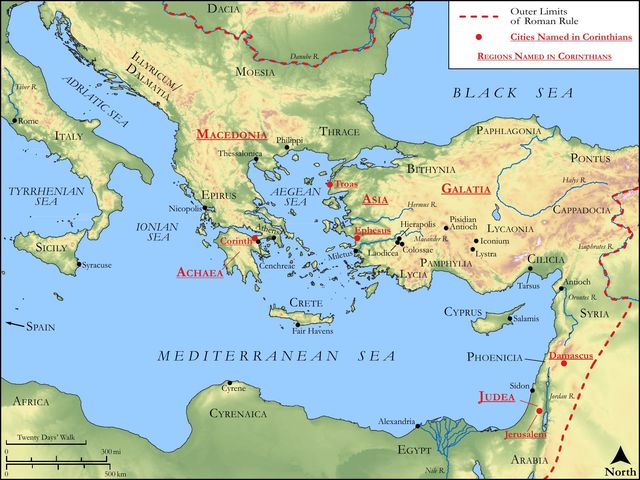
See on the biblical-era maps

Study this verse
Public-domain commentary
Matthew Henry
From his Commentary on the Whole Bible. Henry comments on passages, not single verses — this entry covers 1 Corinthians 10:23–33.
In this passage the apostle shows in what instances, notwithstanding, Christians might lawfully eat what had been sacrificed to idols. They must not eat it out of religious respect to the idol, nor go into his temple, and hold a feast there, upon what they knew was an idol-sacrifice; nor perhaps out of the temple, if they knew it was a feast held upon a sacrifice, but there were cases wherein they might without sin eat what had been offered. Some such the apostle here enumerates. - But,
I.He gives a caution against abusing our liberty in lawful things.
That may be lawful which is not expedient, which will not edify. A Christian must not barely consider what is lawful, but what is expedient, and for the use of edification. A private Christian should do so even in his private conduct. He must not seek his own only, but his neighbour's wealth. He must be concerned not to hurt his neighbour, nay, he must be concerned to promote his welfare; and must consider how to act so that he may help others, and not hinder them in their holiness, comfort, or salvation. Those who allow themselves in every thing not plainly sinful in itself will often run into what is evil by accident, and do much mischief to others. Every thing lawful in itself to be done is not therefore lawfully done. Circumstances may make that a sin which in itself is none. These must be weighed, and the expediency of an action, and its tendency to edification, must be considered before it be done. Note, The welfare of others, as well as our own convenience, must be consulted in many things we do, if we would do them well.
II.He tells them that what was sold in the shambles they might eat without asking questions.
The priest's share of heathen sacrifices was thus frequently offered for sale, after it had been offered in the temple. Now the apostle tells them they need not be so scrupulous as to ask the butcher in the market whether the meat he sold had been offered to an idol? It was there sold as common food, and as such might be bought and used; for the earth is the Lord's, and the fulness thereof (Co1 10:26), and the fruit and products of the earth were designed by him, the great proprietor, for the use and subsistence of mankind, and more especially of his own children and servants. Every creature of God is good, and nothing to be refused, if it be received with thanksgiving; for it is sanctified by the word of God and prayer, Ti1 4:4, Ti1 4:5. To the pure all things are pure, Tit 1:15. Note, Though it is sinful to use any food in an idolatrous manner, it is no sin, after such abuse, to apply it, in a holy manner, to its common use.
III.He adds that if they were invited by any heathen acquaintances to a feast, they might go, and eat what was set before them, without asking questions (Co1 10:27), nay, though they knew things sacrificed to idols were served up at such entertainments, as well as sold in the shambles. Note, The apostle does not prohibit their going to a feast upon the invitation of those that believed not. There is a civility owing even to infidels and heathens. Christianity does by no means bind us up from the common offices of humanity, nor allow us an uncourteous behaviour to any of our own kind, however they may differ from us in religious sentiments or practices. And when Christians were invited to feast with infidels they were not to ask needless questions about the food set before them, but eat without scruple. Needless enquiries might perplex their minds and consciences, for which reason they were to be avoided. Any thing fit to be eaten, that was set before them at a common entertainment, they might lawfully eat. And why then should they scrupulously enquire whether what was set before them had been sacrificed? It is to be understood of civil feasting, not religious; for the latter among the heathens was feasting upon their sacrifices, which he had condemned before as a participation in their idolatrous worship. At a common feast they might expect common food; and they needed not to move scruples in their own minds whether what was set before them was otherwise or no. Note, Though Christians should be very careful to know and understand their duty, yet they should not, by needless enquiries, perplex themselves.
IV.Yet, even at such an entertainment, he adds, if any should say it was a thing that had been offered to idols, they should refrain:
Eat not, for his sake that showed it, and for conscience' sake. Whether it were the master of the feast or any of the guests, whether it were spoken in the hearing of all or whispered in the ear, they should refrain for his sake who suggested this to them, whether he were an infidel or an infirm Christian; and for conscience' sake, out of regard to conscience, that they might show a regard to it in themselves, and keep up a regard to it in others. This he backs with the same reason as the former: For the earth is the Lord's. There is food enough provided by our common Lord, of which we maya eat without scruple. The same doctrine may be variously improved, as here: "The earth is the Lord's, therefore you may eat any thing without scruple that is set before you as common food; and yet, because the earth is the Lord's, eat nothing that will give offence, lay a stumbling-block before others, and encourage some in idolatry, or tempt others to eat when they are not clear in their own mind that it is lawful, and so sin, and wound their own consciences." Note, Christians should be very cautious of doing what may thus prejudice the consciences of others, and weaken their authority with them, which is by all means to be kept up.
V.He urges them to refrain where they will give offence, while yet he allows it lawful to eat what was et before them as common food, though it had been offered in sacrifice. "Another man's conscience is no measure to our conduct. What he thinks unlawful is not thereby made unlawful to me, but may be a matter of liberty still; and as long as I own God as a giver of my food, and render him thanks for it, it is very unjust to reproach me for using it." This must be understood abstracted from the scandal given by eating in the circumstance mentioned. Though some understand it to mean, "Why should I, by using the liberty I have, give occasion to those who are scandalized to speak evil of me?" According to that advice of the apostle (Rom 14:16), Let not your good be evil spoken of. Note, Christians should take care not to use their liberty to the hurt of others, nor their own reproach.
VI.The apostle takes occasion from this discourse to lay down a rule for Christians' conduct, and apply it to this particular case (Co1 10:31, Co1 10:32), namely, that in eating and drinking, and in all we do, we should aim at the glory of God, at pleasing and honouring him. This is the fundamental principle of practical godliness. The great end of all practical religion must direct us where particular and express rules are wanting. Nothing must be done against the glory of God, and the good of our neighbours, connected with it. Nay, the tendency of our behaviour to the common good, and the credit of our holy religion, should give direction to it. And therefore nothing should be done by us to offend any, whether Jew, or Gentile, or the church, Co1 10:32. The Jews should not be unnecessarily grieved nor prejudiced, who have such an abhorrence of idols that they reckon every thing offered to them thereby defiled, and that it will pollute and render culpable all who partake of it; nor should heathens be countenanced in their idolatry by any behaviour of ours, which they may construe as homage or honour done to their idols; nor young converts from Gentilism take any encouragement from our conduct to retain any veneration for the heathen gods and worship, which they have renounced: nor should we do any thing that may be a means to pervert any members of the church from their Christian profession or practice. Our own humour and appetite must not determine our practice, but the honour of God and the good and edification of the church. We should not so much consult our own pleasure and interest as the advancement of the kingdom of God among men. Note, A Christian should be a man devoted to God, and of a public spirit.
VII.He presses all upon them by his own example:
Even as I please all men (or study to do it) in all things (that I lawfully can), not seeking my own profit, but that of many, that they may be saved, Co1 10:33. Note, A preacher may press his advice home with boldness and authority when he can enforce it with his own example. He is most likely to promote a public spirit in others who can give evidence of it in himself. And it is highly commendable in a minister to neglect his own advantage that he may promote the salvation of his hearers. This shows that he has a spirit suitable to his function. It is a station for public usefulness, and can never be faithfully discharged by a man of a narrow spirit and selfish principles.
Historical interpretation
Two Centuries of Reception
2 surviving comments on this verse. Each one is dated, so this reads as a timeline rather than a list.
Select a marker to jump to its quote. Markers stagger vertically where authors wrote within a few decades of each other.
"Conscience, I say, not his own," for it is endued with knowledge, "but that of the other," lest he be trained badly, and by imitating in ignorance what he knows not, he become a despiser instead of a strong-minded man. "For why is my liberty judged of by another conscience? For if I by grace am a partaker, why am I evil spoken of for that for which I give thanks? Whatever ye do, do all to the glory of God"—what you are commanded to do by the rule of faith.
"Conscience, I say, not thine own, but the other's."
But perhaps some one may say, "The brethren indeed, as is natural, thou sparest, and dost not suffer us to taste for their sakes, lest their conscience being weak might be emboldened to eat the idol sacrifices. But if it be some heathen, what is this man to thee? Was it not thine own word, 'What have I to do with judging them that are without?' Wherefore then dost thou on the contrary care for them?" "Not for him is my care," he replies, "but in this case also for thee." To which effect also he adds,
"For why is my liberty judged by another conscience?" meaning by "liberty," that which is left without caution or prohibition. For this is liberty, freed from Jewish bondage. And what he means is this: "God hath made me free and above all reach of injury, but the Gentile knoweth not how to judge of my rule of life, nor to see into the liberality of my Master, but will condemn and say to himself, Christianity is a fable; they abstain from the idols, they shun demons, and yet cleave to the things offered to them: great is their gluttony."
"And what then?" it may be said. "What harm is it to us, should he judge us unfairly?" But how much better to give him no room to judge at all! For if thou abstain, he will not even say this. "How," say you, "will he not say it? For when he seeth me not making these inquiries, either in the shambles or in the banquet; what should hinder him from using this language and condemning me, as one who partakes without discrimination?" It is not so at all. For thou partakest, not as of idol-sacrifices, but as of things clean. And if thou makest no nice enquiry, it is that thou mayest signify that thou fearest not the things set before thee; this being the reason why, whether thou enterest a house of Gentiles or goest into the market, I suffer thee not to ask questions; viz. lest thou become timid and perplexed, and occasion thyself needless trouble.
Continue studying 1 Corinthians 10:29 across the web’s major study libraries — every link below opens this exact verse, chapter, or book on the destination site.
Read & Compare
 BibleGatewayThis verse in more than 200 translations and 70 languages.
 Bible.comThe YouVersion reader — hundreds of translations, reading plans, and highlights.
 ESV.orgCrossway's official English Standard Version reader.
 NET BibleThe NET translation with 60,000+ translators' notes on every rendering decision.
 STEP BibleTyndale House's free study tool — original text, vocabulary, and scholarly resources.
 BibliaLogos Bible Software's free web reader.
 USCCBThe New American Bible (Revised Edition) with the U.S. bishops' study notes.
Commentaries
 BibleHub CommentariesDozens of classic commentaries on this verse, gathered on one page.
 StudyLightMore than 100 commentary sets — the largest collection on the web.
 BibleRefPlain-English commentary on what this verse means, verse by verse.
 Enduring WordDavid Guzik's free commentary on this chapter, widely used by Bible teachers.
 Bible Study ToolsVerse commentary alongside Greek and Hebrew study aids.
Original Language & Research
- BibleHub InterlinearThe verse word by word — original language, transliteration, and English.
- BibleHub LexiconEvery word's original-language definition and Strong's entry.
 Blue Letter BibleDeep-study tools — Strong's numbers, concordance, and word studies.
 CNTR CollationThe earliest Greek manuscripts of this verse, collated letter by letter.
Sermons, Hymns & Audio


TrulyRandomVerse is not affiliated with these sites and doesn’t control their content. They’re linked because they’re genuinely useful.
Summary
In 1 Corinthians 10:29, the Apostle Paul continues his nuanced discussion on Christian liberty, particularly regarding the consumption of food previously offered to idols. This verse serves as a pivotal point, asserting that while a believer's personal freedom is valid, its exercise must always be tempered by a profound consideration for the conscience of others, especially those who may be weaker in faith or hold different convictions. Paul emphasizes that the ultimate aim of Christian liberty is not self-assertion but the spiritual edification and protection of the community.
Context
ShowHideLiterary Context
This verse is situated within Paul's extensive discourse in 1 Corinthians 8-10, addressing the complex issue of eating meat sacrificed to idols. Paul begins in 1 Corinthians 8 by establishing that idols are nothing and that knowledge without love is destructive. He then transitions in 1 Corinthians 9 to discuss his own willingness to forgo his apostolic rights for the sake of the gospel, setting a personal example of self-denial for the benefit of others. Chapter 10 further develops this by warning against idolatry and drawing lessons from Israel's wilderness experiences, highlighting the dangers of presumption and self-indulgence. Paul then returns to the specific issue of food, advising against participation in pagan feasts (1 Corinthians 10:14-22). He then introduces the principle of "all things are lawful, but not all things are profitable" (1 Corinthians 10:23), which directly precedes our verse, laying the groundwork for the emphasis on the other's conscience.
Historical & Cultural Context
First-century Corinth was a major Roman port city, a melting pot of cultures, religions, and philosophical ideas. Pagan temples were ubiquitous, and meat sacrificed to idols was commonly sold in public markets or served at social gatherings. For many gentile converts, the transition from polytheism to monotheism was profound, and the lingering associations with idolatry, even for seemingly innocuous acts like eating meat, could be deeply troubling. Some believers, possessing "knowledge" that idols were not real, felt free to eat such meat without reservation. Others, particularly those with a weaker or more sensitive conscience, might view this as participating in idolatry or compromising their new faith. This created tension and potential stumbling blocks within the nascent Christian community, necessitating Paul's careful pastoral guidance.
Key Themes
ShowHideThe overarching theme in this section of 1 Corinthians is the responsible exercise of Christian liberty. Paul consistently teaches that while believers are indeed free in Christ, this freedom is not an end in itself, nor is it a license for selfish indulgence. Instead, it is to be wielded with love and consideration for the spiritual well-being of others. This ties into the theme of edification, where all actions within the church should aim to build up, not tear down. Furthermore, the concept of avoiding stumbling blocks is paramount, as Paul repeatedly warns against actions that might cause a weaker brother or sister to sin against their conscience or fall away from faith. This highlights the vital importance of unity and mutual care within the body of Christ, even over personal rights.
Exposition and Analysis
ShowHideKey Word Analysis
ShowHideThis term refers to an inner moral awareness or self-judgment, the faculty by which one determines right from wrong for oneself. Paul's use here emphasizes that this internal standard can vary among individuals, and a believer's actions, though permissible by their own conscience, might violate another's.
This word signifies freedom, particularly legitimate moral or ceremonial freedom. In this context, it refers to the Christian's freedom from the Law and from the power of idols, allowing them to eat meat without defilement. Paul is not denying this liberty but rather regulating its application in community.
Properly, to distinguish or decide, mentally or judicially; by implication, to try, condemn, or punish. Here, it refers to the negative judgment or condemnation that might arise in the mind of another believer who observes an action they deem sinful, even if the action is permissible for the one performing it.
Verse Breakdown
ShowHide"Conscience, I say, not thine own, but of the other"
Paul explicitly directs the believer's focus away from their personal, internal moral compass and towards that of their fellow believer. He assumes the "strong" believer's conscience is clear regarding the meat, but insists that the other's conscience is the one that now matters in the context of their interaction. This is a call to self-denial and empathy, prioritizing the spiritual state of the weaker brother over one's own perceived right.
"for why is my liberty judged of another [man's] conscience?"
This rhetorical question underscores the problem Paul is addressing. It's not a complaint, but a logical consequence of misusing liberty. If one's freedom (e.g., eating idol-meat) causes another to stumble or to pass a negative judgment (either on the strong believer or on their own faith), then that freedom, though valid in itself, has become counterproductive. The "why" implies that such an outcome is undesirable and avoidable, as it undermines the unity and witness of the church. The liberty, while legitimate, loses its positive impact if it becomes a source of division or condemnation from others.
Literary Devices
ShowHidePaul employs a powerful Rhetorical Question ("for why is my liberty judged of another [man's] conscience?") to highlight the absurdity and spiritual detriment of exercising personal freedom in a way that causes another to stumble. This question is not seeking an answer but is designed to provoke thought and emphasize the negative consequences of such actions. Furthermore, the verse utilizes Antithesis by contrasting "thine own" conscience with "the other's" conscience, creating a clear dichotomy that underscores the shift in focus Paul demands. This juxtaposition effectively emphasizes the need for outward-looking, community-minded consideration over individualistic self-assertion.
Theological and Thematic Connections
ShowHideThis verse encapsulates a profound theological truth: Christian liberty, while a precious gift, is never meant to be absolute or exercised in isolation. It is always framed by the law of love, which prioritizes the spiritual well-being of others over personal rights. The freedom we have in Christ is not merely freedom from sin or the law, but freedom for service and love. When our actions, though permissible for us, cause a brother or sister to stumble or violate their conscience, we are not truly living out the spirit of Christ, who sacrificially laid down His rights for us. This principle extends beyond dietary laws to all areas where believers may hold differing convictions, urging a posture of humility and self-sacrifice for the sake of unity and gospel witness.
Reflection and Application
ShowHide1 Corinthians 10:29 challenges believers to move beyond a purely individualistic understanding of faith and to embrace a communal ethic rooted in love. It calls us to cultivate a deep empathy for others, recognizing that not everyone shares our level of understanding, spiritual maturity, or personal convictions. True Christian maturity is not merely knowing what is permissible, but discerning what is beneficial and edifying for the body of Christ. This means being willing to voluntarily restrict our own freedoms, not out of legalism, but out of genuine love and a desire to see others grow in their faith without hindrance. It prompts us to consider how our choices—in entertainment, social media, lifestyle, or even political engagement—might impact those around us, especially those with tender consciences or those new to the faith. Our liberty is a powerful tool, and its proper use is to build up, not to tear down, to unite, not to divide.
Questions for Reflection
ShowHideFAQ
ShowHideDoes this verse mean I should always let others' consciences dictate my actions?
ShowHideNot entirely. Paul is not advocating for a life dictated by the weakest conscience, which could lead to legalism or an inability to exercise legitimate Christian freedom. Rather, he is teaching a principle of love and self-sacrifice in specific contexts where one's actions could genuinely cause a brother or sister to sin against their own conscience or to be led astray. The emphasis is on avoiding being a "stumbling block" (1 Corinthians 10:32) and seeking the edification of others (1 Corinthians 10:23-24). The goal is not to abandon one's own convictions but to exercise them responsibly, prioritizing the spiritual health of the community over the assertion of personal rights, especially in matters that are morally neutral.
Christ-Centered Fulfillment
ShowHide1 Corinthians 10:29 finds its ultimate fulfillment and perfect example in the person and work of Jesus Christ. Paul's call for believers to consider the conscience of others and to willingly limit their own liberty for the sake of love is a direct reflection of Christ's unparalleled self-emptying. Though He possessed all divine rights and privileges, Christ "did not please himself" (Romans 15:3). Instead, He laid aside His heavenly glory and prerogatives, taking on the form of a servant and humbling Himself even to the point of death on a cross (Philippians 2:5-8). His entire earthly ministry was characterized by a profound sensitivity to human weakness and a willingness to bear the burdens of others, ultimately offering Himself as the perfect sacrifice to free humanity from the bondage of sin and a guilty conscience (Hebrews 9:14). Thus, the exercise of Christian liberty, as taught by Paul, is not merely a pragmatic rule for church harmony but a profound imitation of Christ, who perfectly embodied sacrificial love, using His freedom not for personal gain but for the redemption and edification of His people.