


Titus 1:15
Bible text: King James Version (1769 Blayney text) · Public domain
Bible text: King James Version with Strong's numbers · Public domain
Bible text: Berean Standard Bible · Public domain
Bible text: American Standard Version (1901) · Public domain
Bible text: World English Bible, Messianic edition · Public domain
Bible text: Geneva Bible (1599) · Public domain
Bible text: Young's Literal Translation · Public domain
- ΠάνταPantaAll things [are]G3956A-NPNAdjective Nominative Plural Neuter
- μὲνmenindeedG3303PRTParticle or Disjunctive
- καθαρὰkatharapureG2513A-NPNAdjective Nominative Plural Neuter
- τοῖςtoisto theG3588T-DPMDefinite article Dative Plural Masculine
- καθαροῖς·katharoispureG2513A-DPMAdjective Dative Plural Masculine
- τοῖςtoisto thoseG3588T-DPMDefinite article Dative Plural Masculine
- δὲdehoweverG1161CONJConjunction
- μεμιαμμένοιςmemiammenoisdefiledG3392V-RPP-DPMVerb Perfect Passive Participle Dative Plural Masculine
- καὶkaiandG2532CONJConjunction
- ἀπίστοιςapistoisunbelievingG571A-DPMAdjective Dative Plural Masculine
- οὐδὲνoudenno [thing]G3762A-NSNAdjective Nominative Singular Neuter
- καθαρόνkatharon[is] pureG2513A-NSNAdjective Nominative Singular Neuter
- ἀλλὰallaInsteadG235CONJConjunction
- μεμίανταιmemiantaihave been defiledG3392V-RPI-3SVerb Perfect Passive Indicative 3rd Singular
- αὐτῶνautōnof themG846P-GPMPersonal pronoun Genitive Plural Masculine
- καὶkaibothG2532CONJConjunction
- ὁho<the>G3588T-NSMDefinite article Nominative Singular Masculine
- νοῦςnousmindG3563N-NSMNoun Nominative Singular Masculine
- καὶkaiandG2532CONJConjunction
- ἡhē<the>G3588T-NSFDefinite article Nominative Singular Feminine
- συνείδησιςsuneidēsisconscienceG4893N-NSFNoun Nominative Singular Feminine
English is a literal word-by-word gloss of the Greek, not the KJV's wording. Why?
This is the original text the KJV's translators worked from — each Greek word with its own literal English meaning in this verse, prepared by scholars at Tyndale House, Cambridge. The KJV translates whole sentences, not word by word, so its wording differs: one Greek word can become several English words, and the KJV may choose “charity” where the gloss reads “love”. Both are faithful — they answer different questions. For the KJV's own rendering, switch to the KJV text.
Details
See on the biblical-era maps

Study this verse
Public-domain commentary
Matthew Henry
From his Commentary on the Whole Bible. Henry comments on passages, not single verses — this entry covers Titus 1:6–16. His four-level outline is real structure in the source text, so it is rendered as structure.
The apostle here gives Titus directions about ordination, showing whom he should ordain, and whom not.
I.Of those whom he should ordain.
He points out their qualifications and virtues; such as respect their life and manners, and such as relate to their doctrine: the former in the sixth, seventh, and eighth verses, and the latter in the ninth.
1.Their qualifications respecting their life and manners are,
(1.)More general: If any be blameless; not absolutely without fault, so none are, for there is none that liveth and sinneth not; nor altogether unblamed, this is rare and difficult. Christ himself and his apostles were blamed, though not worthy of it. In Christ thee was certainly nothing blamable; and his apostles were not such as their enemies charged them to be. But the meaning is, He must be one who lies not under an ill character; but rather must have good report, even from those that are without; not grossly or scandalously guilty, so as would bring reproach upon the holy function; he must not be such a one.
(2.)More particularly.
[1.]There is his relative character. In his own person, he must be of conjugal chastity: The husband of one wife. The church of Rome says the husband of no wife, but from the beginning it was not so; marriage is an ordinance from which no profession nor calling is a bar. Co1 9:5, Have I not power, says Paul, to lead about a sister, a wife, as well as other apostles? Forbidding to marry is one of the erroneous doctrines of the antichristian church, Ti1 4:3. Not that ministers must be married; this is not meant; but the husband of one wife may be either not having divorced his wife and married another (as was too common among those of the circumcision, even for slight causes), or the husband of one wife, that is, at one and the same time, no bigamist; not that he might not be married to more than one wife successively, but, being married, he must have but one wife at once, not two or more, according to the too common sinful practice of those times, by a perverse imitation of the patriarchs, from which evil custom our Lord taught a reformation. Polygamy is scandalous in any, as also having a harlot or concubine with his lawful wife; such sin, or any wanton libidinous demeanour, must be very remote from such as would enter into so sacred a function. And, as to his children, having faithful children, obedient and good, brought up in the true Christian faith, and living according to it, at least as far as the endeavours of the parents can avail. It is for the honour of ministers that their children be faithful and pious, and such as become their religion. Not accused of riot, nor unruly, not justly so accused, as having given ground and occasion for it, for otherwise the most innocent may be falsely so charged; they must look to it therefore that there be no colour for such censure. Children so faithful, and obedient, and temperate, will be a good sign of faithfulness and diligence in the parent who has so educated and instructed them; and, from his faithfulness in the less, there may be encouragement to commit to him the greater, the rule and government of the church of God. The ground of this qualification is shown from the nature of his office (Tit 1:7): For a bishop must be blameless, as the steward of God. Those before termed presbyters, or elders, are in this verse styled bishops; and such they were, having no ordinary fixed and standing officers above them. Titus's business here, it is plain, was but occasional, and his stay short, as was before noted. Having ordained elders, and settled in their due form, he went and left all (for aught that appears in scripture) in the hands of those elders whom the apostle here calls bishops and stewards of God. We read not in the sacred writings of any successor he had in Crete; but to those elders or bishops was committed the full charge of feeding, ruling, and watching over their flock; they wanted not any powers necessary for carrying on religion and the ministry of it among them, and committing it down to succeeding ages. Now, being such bishops and overseers of the flock, who were to be examples to them, and God's stewards to take care of the affairs of his house, to provide for and dispense to them things needful, there is great reason that their character should be clear and good, that they should be blameless. How else could it be but that religion must suffer, their work be hindered, and souls prejudiced and endangered, whom they were set to save? These are the relative qualifications with the ground of them.
[2.]The more absolute ones are expressed, First, Negatively, showing what an elder or bishop must not be: Not self-willed. The prohibition is of large extent, excluding self-opinion, or overweening conceit of parts and abilities, and abounding in one's own sense, - self-love, and self-seeking, making self the centre of all, - also self-confidence and trust, and self-pleasing, little regarding or setting by others, - being proud, stubborn, froward, inflexible, set on one's own will and way, or churlish as Nabal: such is the sense expositors have affixed to the term. A great honour it is to a minister not to be thus affected, to be ready to ask and to take advice, to be ready to defer as much as reasonably may be to the mind and will of others, becoming all things to all men, that they may gain some. Not soon angry, mē orgilon, not one of a hasty angry temper, soon and easily provoked and inflamed. How unfit are those to govern a church who cannot govern themselves, or their own turbulent and unruly passions! The minister must be meek and gentle, and patient towards all men. Not given to wine; thee is no greater reproach on a minister than to be a wine-bibber, one who loves it, and gives himself undue liberty this way who continues at the wine or strong drink till it inflames him. Seasonable and moderate use of this, as of the other good creatures of God, is not unlawful. Use a little wine for thy stomach's sake, and thine often infirmities, said Paul to Timothy, Ti1 5:23. But excess therein is shameful in all, especially in a minister. Wine takes away the heart, turns the man into a brute: here most proper is that exhortation of the apostle (Eph 5:18), Be not drunk with wine, wherein is excess; but be filled with the Spirit. Here is no exceeding, but in the former too easily there may: take heed therefore of going too near the brink. No striker, in any quarrelsome or contentious manner, not injuriously nor out of revenge, with cruelty or unnecessary roughness. Not given to filthy lucre; not greedy of it (as Ti1 3:3), whereby is not meant refusing a just return for their labours, in order to their necessary support and comfort; but not making gain their first or chief end, not entering into the ministry nor managing it with base worldly views. Nothing is more unbecoming a minister, who is to direct his own and others' eyes to another world, than to be too intent upon this. It is called filthy lucre, from its defiling the soul that inordinately affects or greedily looks after it, as if it were any otherwise desirable than for the good and lawful uses of it. Thus of the negative part of the bishop's character. But, Secondly, Positively: he must be (Tit 1:8) a lover of hospitality, as an evidence that he is not given to filthy lucre, but is willing to use what he has to the best purposes, not laying up for himself, so as to hinder charitable laying out for the good of others; receiving and entertaining strangers (as the word imports), a great and necessary office of love, especially in those times of affliction and distress, when Christians were made to fly and wander for safety from persecution and enemies, or in travelling to and fro where there were not such public houses for reception as in our days, nor, it may be, had many poor saints sufficiency of their own for such uses - then to receive and entertain them was good and pleasing to God. And such a spirit and practice, according to ability and occasion, are very becoming such as should be examples of good works. A lover of good men, or of good things; ministers should be exemplary in both; this will evince their open piety, and likeness to God and their Master Jesus Christ: Do good to all, but especially to those of the household of faith, those who are the excellent of the earth, in whom should be all our delight. Sober, or prudent, as the word signifies; a needful grace in a minister both for his ministerial and personal carriage and management. He should be a wise steward, and one who is not rash, or foolish, or heady; but who can govern well his passions and affections. Just in things belonging to civil life, and moral righteousness, and equity in dealings, giving to all their due. Holy, in what concerns religion; one who reverences and worships God, and is of a spiritual and heavenly conversation. Temperate; it comes from a word that signifies strength, and denotes one who has power over his appetite and affections, or, in things lawful, can, for good ends, restrain and hold them in. Nothing is more becoming a minister than such things as these, sobriety, temperance, justice, and holiness - sober in respect of himself, just and righteous towards all men, and holy towards God. And thus of the qualifications respecting the minister's life and manners, relative and absolute, negative and positive, what he must not, and what he must, be and do.
2.As to doctrine,
(1.)Here is his duty: Holding fast the faithful word, as he has been taught, keeping close to the doctrine of Christ, the word of his grace, adhering thereto according to the instructions he has received - holding it fast in his own belief and profession, and in teaching others. Observe,
[1.]The word of God, revealed in the scripture, is a true and infallible word; the word of him that is the amen, the true and faithful witness, and whose Spirit guided the penmen of it. Holy men of God spoke as they were moved by the Holy Ghost.
[2.]Ministers must hold fast, and hold forth, the faithful word in their teaching and life. I have kept the faith, was Paul's comfort (Ti2 4:7), and not shunned to declare the whole counsel of God; there was his faithfulness, Act 20:27.
(2.)Here is the end: That he may be able, by sound doctrine, both to exhort, and to convince the gainsayers, to persuade and draw others to the true faith, and to convince the contrary-minded. How should he do this if he himself were uncertain or unsteady, not holding fast that faithful word and sound doctrine which should be the matter of this teaching, and the means and ground of convincing those that oppose the truth? We see here summarily the great work of the ministry - to exhort those who are willing to know and do their duty, and to convince those that contradict, both which are to be done by sound doctrine, that is, in a rational instructive way, by scripture-arguments and testimonies, which are the infallible words of truth, what all may and should rest and be satisfied in and determined by. And thus of the qualifications of the elders whom Titus was to ordain.
II.The apostle's directory shows whom he should reject or avoid - men of another character, the mention of whom is brought in as a reason of the care he had recommended about the qualifications of ministers, why they should be such, and only such, as he had described. The reasons he takes both from bad teachers and hearers among them, Tit 1:10, to the end.
1.From bad teachers.
(1.)Those false teachers are described. They were unruly, headstrong and ambitious of power, refractory and untractable (as some render it), and such as would not bear nor submit themselves to the discipline and necessary order in the church, impatient of good government and of sound doctrine. And vain talkers and deceivers, conceiting themselves to be wise, but really foolish, and thence great talkers, falling into errors and mistakes, and fond of them, and studious and industrious to draw others into the same. Many such there were, especially those of the circumcision, converts as they pretended, at least, from the Jews, who yet were for mingling Judaism and Christianity together, and so making a corrupt medley. These were the false teachers.
(2.)Here is the apostle's direction how to deal with them (Tit 1:11): Their mouths must be stopped; not by outward force (Titus had no such power, nor was this the gospel method), but by confutation and conviction, showing them their error, not giving place to them even for an hour. In case of obstinacy indeed, breaking the peace of the church, and corrupting other churches, censures are to have place, the last means for recovering the faulty and preventing the hurt of many. Observe, Faithful ministers must oppose seducers in good time, that, their folly being made manifest, they may proceed no further.
(3.)The reasons are given for this.
[1.]From the pernicious effects of their errors: They subvert whole houses, teaching things which they ought not (namely, the necessity of circumcision, and of keeping the law of Moses, etc.), so subverting the gospel and the souls of men; not some few only, but whole families. It was unjustly charged on the apostles that they turned the world upside down; but justly on these false teachers that they drew many from the true faith to their ruin: the mouths of such should be stopped, especially considering,
[2.]Their base end in what they do: For filthy lucre's sake, serving a worldly interest under pretence of religion. Love of money is the root of all evil. Most fit it is that such should be resisted, confuted, and put to shame, by sound doctrine, and reasons from the scriptures. Thus of the grounds respecting the bad teachers.
II.In reference to their people or hearers, who are described from ancient testimony given of them.
1.Here is the witness (Tit 1:12): One of themselves, even a prophet of their own, that is, one of the Cretans, not of the Jews, Epimenides a Greek poet, likely to know and unlikely to slander them. A prophet of their own; so their poets were accounted, writers of divine oracles; these often witnessed against the vices of the people: Aratus, Epimenides, and others among the Greeks; Horace, Juvenal, and Persius, among the Latins: much smartness did they use against divers vices.
2.Here is the matter of his testimony: Krētes aei pseustaî kaka thēriâ gasteres argai - The Cretans are always liars, evil beasts, slow bellies. Even to a proverb, they were infamous for falsehood and lying; kretizein, to play the Cretan, or to lie, is the same; and they were compared to evil beasts for their sly hurtfulness and savage nature, and called slow bellies for their laziness and sensuality, more inclined to eat than to work and live by some honest employment. Observe, Such scandalous vices as were the reproach of heathens should be far from Christians: falsehood and lying, invidious craft and cruelty, all beastly and sensual practices, with idleness and sloth, are sins condemned by the light of nature. For these were the Cretans taxed by their own poets.
3.Here is the verification of this by the apostle himself: Tit 1:13. This witness is true, The apostle saw too much ground for that character. The temper of some nations is more inclined to some vices than others. The Cretans were too generally such as here described, slothful and ill-natured, false and perfidious, as the apostle himself vouches. And thence,
4.He instructs Titus how to deal with them: Wherefore rebuke them sharply. When Paul wrote to Timothy he bade him instruct with meekness; but now, when he writes to Titus, he bids him rebuke them sharply. The reason of the difference may be taken from the different temper of Timothy and Titus; the former might have more keenness in his disposition, and be apt to be warm in reproving, whom therefore he bids to rebuke with meekness; and the latter might be one of more mildness, therefore he quickens him, and bids him rebuke sharply. Or rather it was from the difference of the case and people: Timothy had a more polite people to deal with, and therefore he must rebuke them with meekness; and Titus had to do with those who were more rough and uncultivated, and therefore he must rebuke them sharply; their corruptions were many and gross, and committed without shame or modesty, and therefore should be dealt with accordingly. There must in reproving be a distinguishing between sins and sins; some are more gross and heinous in their nature, or in the manner of their commission, with openness and boldness, to the greater dishonour of God and danger and hurt to men: and between sinners and sinners; some are of a more tender and tractable temper, apter to be wrought on by gentleness, and to be sunk and discouraged by too much roughness and severity; others are more hardy and stubborn, and need more cutting language to beget in them remorse and shame. Wisdom therefore is requisite to temper and manage reproofs aright, as may be most likely to do good. Jde 1:22, Jde 1:23, Of some have compassion, making a difference; and others save with fear, pulling them out of the fire. The Cretans' sins and corruptions were many, great, and habitual; therefore they must be rebuked sharply. But that such direction might not be misconstrued,
5.Here is the end of it noted: That they may be sound in the faith (Tit 1:14), not giving heed to Jewish fables, and commandments of men, that turn from the truth; that is, that they may be and show themselves truly and effectually changed from such evil tempers and manners as those Cretans in their natural state lived in, and may not adhere to nor regard (as some who were converted might be too ready to do) the Jewish traditions and the superstitions of the Pharisees, which would be apt to make them disrelish the gospel, and the sound and wholesome truths of it. Observe,
(1.)The sharpest reproofs must aim at the good of the reproved: they must not be of malice, nor hatred, nor ill-will, but of love; not to gratify pride, passion, nor any evil affection in the reprover, but to reclaim and reform the erroneous and the guilty.
(2.)Soundness in the faith is most desirable and necessary. This is the soul's health and vigour, pleasing to God, comfortable to the Christian, and what makes ready to be cheerful and constant in duty.
(3.)A special means to soundness in the faith is to turn away the ear from fables and the fancies of men (Ti1 1:4): Neither give heed to fables and endless genealogies, that minister questions rather than godly edifying, which is in faith. So Ti1 4:7, Refuse profane and old wives' fables, and exercise thyself rather to godliness. Fancies and devices of men in the worship of God are contrary to truth and piety. Jewish ceremonies and rites, that were at first divine appointments, the substance having come and their season and use being over, are now but unwarranted commands of men, which not only stand not with, but turn fRom. the truth, the pure gospel truth and spiritual worship, set up by Christ instead of that bodily service under the law.
(4.)A fearful judgment it is to be turned away from the truth, to leave Christ for Moses, the spiritual worship of the gospel for the carnal ordinances of the law, or the true divine institutions and precepts for human inventions and appointments. Who hath bewitched you (said Paul to the Galatians, Gal 3:1, Gal 3:3) that you should not obey the truth? Having begun in the Spirit, are you made perfect by the flesh? Thus having shown the end of sharply reproving the corrupt and vicious Cretans, that they might be sound in the faith, and not heed Jewish fables and commands of men,
6.He gives the reasons of this, from the liberty we have by the gospel from legal observances, and the evil and mischief of a Jewish spirit under the Christian dispensation in the last two verses. To good Christians that are sound in the faith and thereby purified all things are pure. Meats and drinks, and such things as were forbidden under the law (the observances of which some still maintain), in these there is now no such distinction, all are pure (lawful and free in their use), but to those that are defiled and unbelieving nothing is pure; things lawful and good they abuse and turn to sin; they suck poison out of that from which others draw sweetness; their mind and conscience, those leading faculties, being defiled, a taint is communicated to all they do. The sacrifice of the wicked is an abomination to the Lord, Pro 15:8. And Pro 21:4, The ploughing of the wicked is sin, not in itself, but as done by him; the carnality of the mind and heart mars all the labour of the hand.
Objection. But are not these judaizers (as you call them) men who profess religion, and speak well of God, and Christ, and righteousness of life, and should they be so severely taxed? Answer, They profess that they know God; but in works they deny him, being abominable, and disobedient, and to every good work reprobate, Tit 1:16. There are many who in word and tongue profess to know God, and yet in their lives and conversations deny and reject him; their practice is a contradiction to their profession. They come unto thee as the people cometh, and they sit before thee as my people, and they hear thy words, but they will not do them: with their mouth they show much love, but their heart goeth after their covetousness, Eze 33:31. Being abominable, and disobedient, and to every good work reprobate. The apostle, instructing Titus to rebuke sharply, does himself rebuke sharply; he gives them very hard words, yet doubtless no harder than their case warranted and their need required. Being abominable - bdeluktoi, deserving that God and good men should turn away their eyes from them as nauseous and offensive. And disobedient - apeitheis, unpersuadable and unbelieving. They might do divers things; but it was not the obedience of faith, nor what was commanded, or short of the command. To every good work reprobate, without skill or judgment to do any thing aright. See the miserable condition of hypocrites, such as have a form of godliness, but without the power; yet let us not be so ready to fix this charge on others as careful that it agree not to ourselves, that there be not in us an evil heart of unbelief, in departing from the living God; but that we be sincere and without offence till the day of Christ, being filled with the fruits of righteousness, which are by Jesus Christ unto the glory and praise of God, Phi 1:10, Phi 1:11.
Historical interpretation
Seven Centuries of Reception
13 surviving comments on this verse. Each one is dated, so this reads as a timeline rather than a list.
Select a marker to jump to its quote. Markers stagger vertically where authors wrote within a few decades of each other.
For, with respect to what you say, that the aspect of an infant in the first days after its birth is not pure, so that any one of us would still shudder at kissing it, we do not think that this ought to be alleged as any impediment to heavenly grace. For it is written, "To the pure all things are pure." Nor ought any of us to shudder at that which God hath condescended to make. For although the infant is still fresh from its birth, yet it is not such that any one should shudder at kissing it in giving grace and in making peace; since in the kiss of an infant every one of us ought for his very religion's sake, to consider the still recent hands of God themselves, which in some sort we are kissing, in the man lately formed and freshly born, when we are embracing that which God has made. For in respect of the observance of the eighth day in the Jewish circumcision of the flesh, a sacrament was given beforehand in shadow and in usage; but when Christ came, it was fulfilled in truth. For because the eighth day, that is, the first day after the Sabbath, was to be that on which the Lord should rise again, and should quicken us, and give us circumcision of the spirit, the eighth day, that is, the first day after the Sabbath, and the Lord's day, went before in the figure; which figure ceased when by and by the truth came, and spiritual circumcision was given to us.
All things made by God are beautiful and pure, for the Word of God has made nothing useless or impure.… But since the devil’s darts are varied and subtle, he contrives to trouble those who are of simpler mind, and tries to hinder the ordinary exercises of the brethren, scattering secretly among them thoughts of uncleanness and defilement. Come, let us briefly dispel the error of the evil one by the grace of the Savior and confirm the mind of the simple.… For tell me, beloved and most pious friend, what sin or uncleanness there is in any natural secretion—as though a man were minded to make a culpable matter of the cleanings of the nose or the sputa from the mouth? And we may add also the secretions of the belly, such as are of a physical necessity of animal life. Moreover if we believe man to be, as the divine Scriptures say, a work of God’s hands, how could any defiled work proceed from a pure Power?… But when any bodily excretion takes place independently of will, then we experience this, like other things, by a necessity of nature.
Everything created by God is good; for those who do not know this, they become impure.
Ver. 15. "Unto the pure," he says, "all things are pure."
Thou seest that this is said to a particular purpose.
"But unto them that are defiled and unbelieving is nothing pure."
Things then are not clean or unclean from their own nature, but from the disposition of him who partakes of them.
"But even their mind and conscience is defiled."
The swine therefore is clean. Why then was it forbidden as unclean? It was not unclean by nature; for, "all things are pure." Nothing is more unclean than a fish, inasmuch as it even feeds upon human flesh. But it was permitted and considered clean. Nothing is more unclean than a bird, for it eats worms; or than a stag, which is said to have its name from eating serpents. Yet all these were eaten. Why then was the swine forbidden, and many other things? Not because they were unclean, but to check excessive luxury. But had this been said, they would not have been persuaded; they were restrained therefore by the fear of uncleanness. For tell me, if we enquire nicely into these things, what is more unclean than wine; or than water, with which they mostly purified themselves? They touched not the dead, and yet they were cleansed by the dead, for the victim was dead, and with that they were cleansed. This therefore was a doctrine for children. In the composition of wine, does not dung form a part? For as the vine draws moisture from the earth, so does it from the dung that is thrown upon it. In short, if we wish to be very nice, everything is unclean, otherwise if we please not to be nice, nothing is unclean. Yet all things are pure. God made nothing unclean, for nothing is unclean, except sin only. For that reaches to the soul, and defiles it. Other uncleanness is human prejudice.
"But unto them that are defiled and unbelieving is nothing pure; but even their mind and conscience is defiled."
For how can there be anything unclean among the pure? But he that has a weak soul makes everything unclean, and if there be set abroad a scrupulous enquiry into what is clean or unclean, he will touch nothing. For even these things are not clean, I speak of fish, and other things, according to their notions; (for "their mind and conscience," he says, "is defiled,") but all are impure. Yet Paul says not so; he turns the whole matter upon themselves. For nothing is unclean, he says, but themselves, their mind and their conscience; and nothing is more unclean than these; but an evil will is unclean.
"All things are clean to the clean, but to the unclean and unbelieving nothing is clean; instead, both their mind and their conscience are corrupted." For he had said earlier: "For there are many rebellious people who deceive others with their empty talk and false teaching. This is especially true of those who insist on circumcision for salvation. They must be silenced, because they are turning whole families away from the truth by their false teaching. And they do it only for money." So he is telling Titus to sharply rebuke them, so that their faith will be healthy and they will not waste their time in endless discussion of myths and spiritual pedigrees. This kind of talk only leads to meaningless speculations, which don't help people live a life of faith in God. The Bible clearly states that all things are clean to those who believe in Jesus Christ and know that everything God created is good. But to those who are defiled by sin and unbelief, nothing is clean; in fact, both their mind and their conscience are corrupted. Therefore, even things that are clean by nature become unclean to them. This is not because there is anything inherently unclean or clean, but because of the kind of people who eat them. So, the clean remain clean for the clean, and the unclean become defiled for those who are defiled. Otherwise, even the unbelievers and defiled do not benefit from the bread of blessing and the Lord's cup; for whoever eats of that bread and drinks from the cup unworthily eats and drinks judgment upon themselves (1 Cor. 11). Everything has been cleansed by the coming of Christ. We cannot partake of what He has purified. But let us consider that in handling this, we do not give occasion to that heresy which, according to the Apocalypse (Chapter 2) and even the Apostle Paul himself writing to the Corinthians, thinks that it is right to eat of things offered to idols because all things are clean to the clean (1 Cor. 8). For the Apostle did not intend to discuss those things which are sacrificed to demons, but rather those who, according to the discipline of the abolished Law, regarded some things as clean and others as unclean. For we cannot partake of the Lord's table and the table of demons: nor can we drink the cup of the Lord and the cup of demons at the same time (1 Cor. 10:20-21). Therefore, it is up to us to eat clean or unclean. For if we are clean, then the creature is clean for us. But if we are unclean and faithless, then all things become common to us, whether through the heresy that dwells in our hearts or through the consciousness of sins. Moreover, if our conscience does not condemn us, and we have confidence in God's mercy, then we will pray with our spirit and with our mind, we will sing praises with our spirit and with our mind (1 Corinthians 14), and we will be far from those of whom it is now written: "Their mind and conscience are defiled."
God has made all things pure. If anything is unclean, the use to which it is put makes it so.
Those likewise are to be detested who deny that our Lord Jesus Christ had Mary as his mother on earth. That dispensation did honor to both sexes male and female and showed that both had a part in God’s care; not only that which he assumed but that also through which he assumed it, being a man born of a woman.… Nor should our faith be lessened by any reference to “a woman’s internal organs,” as if it might appear that we must reject any such generation of our Lord because sordid people think that sordid. “The foolishness of God is wiser than men”; and “to the pure all things are pure.”
But now, when you abstain for the sake of chastising the body from various kinds of food that are in themselves quite permissible, remember that “to the pure all things are pure”; don’t regard anything as impure except what unbelief has defiled; “for to the impure and unbelievers,” the apostle says, nothing is pure. But naturally, when the faithful are reducing their bodies to slavery, whatever is deducted from bodily pleasure is credited to spiritual health.
The Jews, you see, had accepted that there were certain animals which they could not eat, and others from which they must abstain. The apostle Paul makes it clear that they received this law as a symbolic sign of future realities.
With all this, no one is pressed to endure hardships for which he is unfit. Nothing is imposed on anyone against his will, nor is he condemned by the rest because he confesses himself too feeble to imitate them. They bear in mind how strongly Scripture enjoins charity on all.… Accordingly, all their endeavors are concerned not about the rejection of kinds of food as polluted but about the subjugation of inordinate desire and the maintenance of brotherly love.
“If a man has attained to that which the apostle speaks of ‘to the pure, everything is pure,’ he sees himself less than all creatures.” The brother said, “How can I deem myself less than a murderer?” The old man said, “When a man has really comprehended this saying, if he sees a man committing a murder he says, ‘He has only committed this one sin, but I commit sin every day.’ ”
For, as in the Old Testament outward acts were attended to, so in the New Testament it is not so much what is done outwardly as what is thought inwardly that is regarded with close attention, that it may be punished with searching judgment.
Things are always pure to the pure; but to the defiled and unbelieving, nothing is pure, but both their mind and conscience are defiled.
— [OECUMENIUS] What then was the law given to the Jews concerning uncleanness? And we say, not because they were unclean did God legislate accordingly, but by this law cutting off much luxury and indifference among the Jews. For what is clean and unclean depends chiefly on the character of those receiving it. Since by nature all things are clean to those who do not examine too closely; but to those who are not such, all things are unclean, though not actually unclean. For only sin is truly unclean. [end of the excerpt by Oecumenius A f. 185v; B f. 224v; G f. 314v] —
but to the defiled. Therefore, impure things come from a defiled mind: just as for a person suffering from an illness, all things are unpleasant because of the disease.
but both their mind and conscience are defiled. No food is indeed impure, Paul says, but the mind and conscience of those people are impure, and their skepticism makes foods impure and useless.
Continue studying Titus 1:15 across the web’s major study libraries — every link below opens this exact verse, chapter, or book on the destination site.
Read & Compare
 BibleGatewayThis verse in more than 200 translations and 70 languages.
 Bible.comThe YouVersion reader — hundreds of translations, reading plans, and highlights.
 ESV.orgCrossway's official English Standard Version reader.
 NET BibleThe NET translation with 60,000+ translators' notes on every rendering decision.
 STEP BibleTyndale House's free study tool — original text, vocabulary, and scholarly resources.
 BibliaLogos Bible Software's free web reader.
 USCCBThe New American Bible (Revised Edition) with the U.S. bishops' study notes.
Commentaries
 BibleHub CommentariesDozens of classic commentaries on this verse, gathered on one page.
 StudyLightMore than 100 commentary sets — the largest collection on the web.
 BibleRefPlain-English commentary on what this verse means, verse by verse.
 Enduring WordDavid Guzik's free commentary on this chapter, widely used by Bible teachers.
 Bible Study ToolsVerse commentary alongside Greek and Hebrew study aids.
Original Language & Research
- BibleHub InterlinearThe verse word by word — original language, transliteration, and English.
- BibleHub LexiconEvery word's original-language definition and Strong's entry.
 Blue Letter BibleDeep-study tools — Strong's numbers, concordance, and word studies.
 CNTR CollationThe earliest Greek manuscripts of this verse, collated letter by letter.
Sermons, Hymns & Audio


TrulyRandomVerse is not affiliated with these sites and doesn’t control their content. They’re linked because they’re genuinely useful.
Summary
Titus 1:15 articulates a profound spiritual principle that distinguishes between genuine inner purity and spiritual defilement, asserting that one's internal state fundamentally determines how all external realities are perceived and engaged. For those whose hearts are cleansed by faith, everything is pure and can be used for God's glory; conversely, for those who are defiled by unbelief, nothing remains pure, as their corrupted minds and consciences taint their entire perception and interaction with truth.
Context
ShowHideLiterary Context
This verse is strategically placed within Paul's instructions to Titus regarding the qualifications and conduct of elders in the Cretan churches, immediately following a stern warning against false teachers. Paul has just exhorted Titus to "rebuke them sharply, that they may be sound in the faith" Titus 1:13. The "them" refers to the "many unruly and vain talkers and deceivers, specially they of the circumcision" Titus 1:10, who were subverting households by teaching things they ought not, for dishonest gain. These false teachers often emphasized external rituals, dietary laws, and Jewish fables, leading people away from true godliness. Verse 15 directly refutes their legalistic and superficial understanding of purity by shifting the focus from external observances to the internal condition of the heart and mind.
Historical & Cultural Context
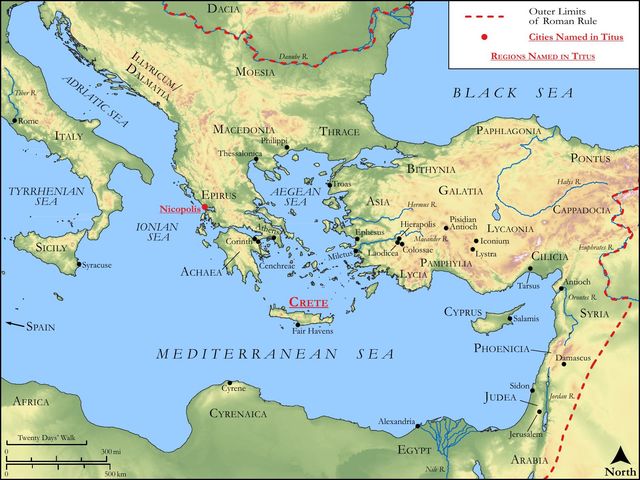
Crete, where Titus was ministering, was known for its difficult and morally lax culture. Paul himself quotes a Cretan prophet, Epimenides, in Titus 1:12, stating, "The Cretians are alway liars, evil beasts, slow bellies." This cultural backdrop of deceit, laziness, and moral corruption made the task of establishing sound doctrine and godly living particularly challenging. Furthermore, the presence of "those of the circumcision" Titus 1:10 indicates a strong influence of Jewish legalism, which often focused on ceremonial purity, dietary restrictions, and adherence to traditions rather than a heart transformed by the Gospel. Paul's teaching in Titus 1:15 directly confronts this externalism, asserting that true purity is an internal, spiritual reality, not a matter of outward adherence to rules.
Key Themes
ShowHideThe central theme of Titus 1 is the establishment of sound doctrine and godly order within the church, contrasting it sharply with the destructive influence of false teaching. Within this chapter, Titus 1:15 contributes significantly to the theme of true purity versus externalism. It underscores that genuine godliness stems from an internal state of being, cleansed by faith, rather than from adherence to ceremonial laws or avoidance of certain foods, a concept Paul also addresses in Romans 14:14. Another key theme is the corrupting nature of unbelief and defilement. The verse highlights how a defiled mind and conscience, rooted in unbelief, distort one's perception and render everything impure, demonstrating the profound spiritual consequences of rejecting truth. This ties into the broader call for spiritual discernment and adherence to "sound doctrine" Titus 1:9 that permeates the entire letter.
Exposition and Analysis
ShowHideKey Word Analysis
ShowHideThis word (G2513) signifies being clean, unmixed, or free from defilement, whether literally or figuratively. In this context, it refers to a moral and spiritual state of being cleansed and uncorrupted, particularly in one's inner disposition and motives. It is not merely about ceremonial cleanliness but about an internal sanctification that influences one's entire perception and interaction with the world.
Derived from G3392, this verb means to sully, taint, pollute, or contaminate. When applied to the mind and conscience, it describes a deep moral and spiritual corruption that stains one's inner being, rendering them impure and incapable of discerning truth or righteousness. This defilement is not superficial but penetrates to the core of one's understanding and moral faculty.
This term (G571) denotes a state of being without Christian faith, actively disbelieving, or being untrustworthy. In Titus 1:15, it directly links the state of defilement to a lack of faith in God and His truth. It suggests that spiritual impurity is intrinsically tied to a rejection of divine revelation and a refusal to trust in God's redemptive work.
Verse Breakdown
ShowHide"Unto the pure all things are pure"
This clause establishes the foundational principle that for those whose hearts and intentions are genuinely pure—cleansed by faith in Christ and indwelt by the Holy Spirit—all aspects of creation and life are pure. This does not imply moral relativism, but rather that a pure heart perceives and uses things in a way that aligns with God's will, free from the defiling influence of sin, legalism, or superstition. It speaks to a sanctified perspective where even ordinary things can be received with gratitude and used for God's glory.
"but unto them that are defiled and unbelieving is nothing pure; but even their mind and conscience is defiled"
This contrasting clause reveals the tragic spiritual reality of those who lack genuine faith and are therefore internally corrupted. For such individuals, nothing is truly pure because their own defiled inner state—their distorted perceptions, corrupted motives, and hardened hearts—contaminates everything they encounter. The emphasis on "mind and conscience" highlights that their very faculties for understanding truth and discerning right from wrong are impaired and polluted, leading to a comprehensive spiritual blindness and moral perversion.
Literary Devices
ShowHideThe verse primarily employs Antithesis, a literary device that contrasts two opposing ideas to highlight their differences. Here, the "pure" are sharply contrasted with the "defiled and unbelieving," and the outcome for each group ("all things are pure" vs. "nothing pure") is presented in stark opposition. This creates a powerful rhetorical effect, emphasizing the radical difference that one's internal spiritual state makes. Furthermore, there is a clear instance of Parallelism, specifically antithetical parallelism, where the two clauses mirror each other in structure but present opposing concepts. The phrase "even their mind and conscience is defiled" serves as a form of Hyperbole or emphatic statement, underscoring the pervasive nature of their defilement, which extends beyond external actions to the very core of their intellectual and moral being.
Theological and Thematic Connections
ShowHideTitus 1:15 profoundly impacts our understanding of purity, shifting the focus from external observances to the internal condition of the heart. It aligns with the New Testament's consistent emphasis on inward transformation over outward ritualism, asserting that true defilement originates not from what enters a person, but from what proceeds from within, as Jesus taught. This verse underscores the critical role of faith in spiritual purity, demonstrating that unbelief is not merely an intellectual assent but a moral and spiritual state that corrupts one's entire being, leading to a distorted perception of truth and reality. It highlights that genuine purity is a gift of God, received through faith, which then enables a sanctified perspective on all of life.
Reflection and Application
ShowHideTitus 1:15 serves as a potent reminder that our spiritual health and the way we perceive the world are fundamentally shaped by the condition of our hearts. It challenges us to look beyond superficial religious practices and to examine the true state of our inner being. If our hearts are pure—cleansed by faith in Christ and continually renewed by His Spirit—then we are equipped to engage with all of life in a way that honors God, seeing His hand in all things and using them for His glory. Conversely, if our minds and consciences are defiled by unbelief, cynicism, or unconfessed sin, then everything we encounter, even good things, can become tainted and lead us astray. This verse calls us to prioritize the cultivation of a pure heart through consistent repentance, reliance on the Holy Spirit, and diligent study of God's Word, ensuring that our inner world is aligned with God's truth, enabling us to discern His will clearly and live a life that genuinely reflects His purity.
Questions for Reflection
ShowHideFAQ
ShowHideDoes "all things are pure" mean that there are no moral absolutes or that anything is permissible?
ShowHideNo, "all things are pure" in Titus 1:15 does not negate moral absolutes or endorse a relativistic view where anything is permissible. Instead, it speaks to the spiritual perspective of a person whose heart is pure. For such an individual, external things (like certain foods, activities, or social interactions that legalists might deem inherently "unclean") are not inherently defiling. The purity or impurity comes from the heart and conscience of the one engaging with them. As Paul states elsewhere, "I know, and am persuaded by the Lord Jesus, that there is nothing unclean of itself: but to him that esteemeth any thing to be unclean, to him it is unclean" Romans 14:14. The verse emphasizes that true defilement originates from within, from a corrupted mind and conscience, not from external objects or situations. A pure heart is able to discern, receive, and use things in a way that is consistent with God's will and for His glory, while a defiled heart will corrupt even inherently good things.
Christ-Centered Fulfillment
ShowHideTitus 1:15 finds its ultimate fulfillment and resolution in Jesus Christ, who is the source and embodiment of all purity. Humanity's inherent defilement and unbelief, which corrupts the mind and conscience, is precisely what Christ came to redeem. He is the one who, "through the eternal Spirit offered himself without spot to God," thereby cleansing "your conscience from dead works to serve the living God" Hebrews 9:14. It is through faith in His atoning sacrifice that believers are made "pure," not by their own efforts or adherence to external rules. Christ's work on the cross purifies us from the inside out, transforming our defiled minds and consciences into instruments of righteousness. As the "Lamb of God, which taketh away the sin of the world" John 1:29, He offers a radical cleansing that enables us to see "all things" as pure, because our relationship with God is restored and our perspective is sanctified by His indwelling Spirit. This internal transformation, wrought by Christ, empowers believers to live lives of genuine purity, reflecting His holiness in every aspect. Indeed, He "gave himself for us, that he might redeem us from all iniquity, and purify unto himself a peculiar people, zealous of good works" Titus 2:14.