


1 Timothy 4:5
Bible text: King James Version (1769 Blayney text) · Public domain
Bible text: Berean Standard Bible · Public domain
Bible text: American Standard Version (1901) · Public domain
Bible text: World English Bible, Messianic edition · Public domain
Bible text: Geneva Bible (1599) · Public domain
Bible text: Young's Literal Translation · Public domain
- ἁγιάζεταιhagiazetaiit is sanctifiedG37V-PPI-3SVerb Present Passive Indicative 3rd Singular
- γὰρgarforG1063CONJConjunction
- διὰdiathroughG1223PREPPreposition
- λόγουlogou[the] wordG3056N-GSMNoun Genitive Singular Masculine
- θεοῦtheouof GodG2316N-GSM-TNoun Genitive Singular Masculine Title
- καὶkaiandG2532CONJConjunction
- ἐντεύξεωςenteuxeōsprayerG1783N-GSFNoun Genitive Singular Feminine
English is a literal word-by-word gloss of the Greek, not the KJV's wording. Why?
This is the original text the KJV's translators worked from — each Greek word with its own literal English meaning in this verse, prepared by scholars at Tyndale House, Cambridge. The KJV translates whole sentences, not word by word, so its wording differs: one Greek word can become several English words, and the KJV may choose “charity” where the gloss reads “love”. Both are faithful — they answer different questions. For the KJV's own rendering, switch to the KJV text.
Details
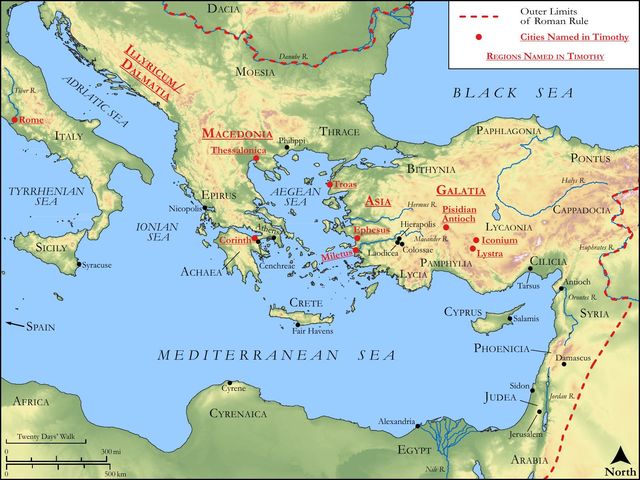
See on the biblical-era maps

Study this verse
Public-domain commentary
Matthew Henry
From his Commentary on the Whole Bible. Henry comments on passages, not single verses — this entry covers 1 Timothy 4:1–5. His four-level outline is real structure in the source text, so it is rendered as structure.
We have here a prophecy of the apostasy of the latter times, which he had spoken of as a thing expected and taken for granted among Christians, 2 Th. 2.
I.In the close of the foregoing chapter, we had the mystery of godliness summed up; and therefore very fitly, in the beginning of this chapter, we have the mystery of iniquity summed up: The Spirit speaks expressly that in the latter times some shall depart from the faith; whether he means the Spirit in the Old Testament, or the Spirit in the prophets of the New Testament, or both. The prophecies concerning antichrist, as well as the prophecies concerning Christ, came from the Spirit. The Spirit in both spoke expressly of a general apostasy from the faith of Christ and the pure worship of God. This should come in the latter times, during the Christian dispensation, for these are called the latter days; in the following ages of the church, for the mystery of iniquity now began to work. Some shall depart from the faith, or there shall be an apostasy from the faith. Some, not all; for in the worst of times God will have a remnant, according to the election of grace. They shall depart from the faith, the faith delivered to the saints (Jde 1:3), which was delivered at once, the sound doctrine of the gospel. Giving heed to seducing spirits, men who pretended to the Spirit, but were not really guided by the Spirit, Jo1 4:1. Beloved, believe not every spirit, every one who pretends to the Spirit. Now here observe,
1.One of the great instances of the apostasy, namely, giving heed to doctrines of demons, or concerning demons; that is, those doctrines which teach the worship of saints and angels, as a middle sort of deities, between the immortal God and mortal men, such as the heathen called demons, and worshipped under that notion. Now this plainly agrees to the church of Rome, and it was one of the first steps towards that great apostasy, the enshrining of the relics of martyrs, paying divine honours to them, erecting altars, burning incense, consecrating images and temples, and making prayers and praises to the honour of saints departed. This demon-worship is paganism revived, the image of the first beast.
2.The instruments of promoting and propagating this apostasy and delusion.
(1.)It will be done by hypocrisy of those that speak lies, the agents and emissaries of Satan, who promote these delusions by lies and forgeries and pretended miracles, Ti1 4:2. It is done by their hypocrisy, professing honour to Christ, and yet at the same time fighting against all his anointed offices, and corrupting or profaning all his ordinances. This respects also the hypocrisy of those who have their consciences seared with a red-hot iron, who are perfectly lost to the very first principles of virtue and moral honesty. If men had not their consciences seared as with a hot iron, they could never maintain a power to dispense with oaths for the good of the catholic cause, could never maintain that no faith is to be kept with heretics, could never divest themselves of all remains of humanity and compassion, and clothe themselves with the most barbarous cruelty, under pretence of promoting the interest of the church.
(2.)Another part of their character is that they forbid to marry, forbid their clergy to marry, and speak very reproachfully of marriage, though an ordinance of God; and that they command to abstain from meats, and place religion in such abstinence at certain times and seasons, only to exercise a tyranny over the consciences of men.
3.On the whole observe,
(1.)The apostasy of the latter times should not surprise us, because it was expressly foretold by the Spirit.
(2.)The Spirit is God, otherwise he could not certainly foresee such distant events, which as to us are uncertain and contingent, depending on the tempers, humours, and lusts of men.
(3.)The difference between the predictions of the Spirit and the oracles of the heathen is remarkable; the Spirit speaks expressly, but the oracles of the heathen were always doubtful and uncertain.
(4.)It is comfortable to think that in such general apostasies all are not carried away, but only some.
(5.)It is common for seducers and deceivers to pretend to the Spirit, which is a strong presumption that all are convinced that this is the most likely to work in us an approbation of what pretends to come from the Spirit.
(6.)Men must be hardened, and their consciences seared, before they can depart from the faith, and draw in others to side with them.
(7.)It is a sign that men have departed from the faith when they will command what God has forbidden, such as saint and angel or demon-worship; and forbid what God has allowed or commanded, such as marriage and meats.
II.Having mentioned their hypocritical fastings, the apostle takes occasion to lay down the doctrine of the Christian liberty, which we enjoy under the gospel, of using God's good creatures, - that, whereas under the law there was a distinction of meats between clean and unclean (such sorts of flesh they might eat, and such they might not eat), all this is now taken away; and we are to call nothing common or unclean, Act 10:15. Here observe,
1.We are to look upon our food as that which God has created; we have it from him, and therefore must use it for him.
2.God, in making those things, had a special regard to those who believe and know the truth, to good Christians, who have a covenant right to the creatures, whereas others have only a common right.
3.What God has created is to be received with thanksgiving. We must not refuse the gifts of God's bounty, nor be scrupulous in making differences where God has made none; but receive them, and be thankful, acknowledging the power of God the Maker of them, and the bounty of God the giver of them: Every creature of God is good, and nothing to be refused, Ti1 4:4. This plainly sets us at liberty from all the distinctions of meats appointed by the ceremonial law, as particularly that of swine's flesh, which the Jews were forbidden to eat, but which is allowed to us Christians, by this rule, Every creature of God is good, etc. Observe, God's good creatures are then good, and doubly sweet to us, when they are received with thanksgiving. - For it is sanctified by the word of God and prayer, Ti1 4:5. It is a desirable thing to have a sanctified use of our creature-comforts. Now they are sanctified to us,
(1.)By the word of God; not only his permission, allowing us the liberty of the use of these things, but his promise to feed us with food convenient for us. This gives us a sanctified use of our creature-comforts.
(2.)By prayer, which blesses our meat to us. The word of God and prayer must be brought to our common actions and affairs, and then we do all in faith. Here observe,
[1.]Every creature is God's, for he made all. Every beast in the forest is mine (says God), and the cattle upon a thousand hills. I know all the fowls of the mountains, and the wild beasts of the field are mine, Psa 50:10, Psa 50:11.
[2.]Every creature of God is good: when the blessed God took a survey of all his works, God saw all that was made, and, behold, it was very good, Gen 1:31.
[3.]The blessing of God makes every creature nourishing to us; man lives not by bread alone, but by every word that proceeds out of the mouth of God (Mat 4:4), and therefore nothing ought to be refused.
[4.]We ought therefore to ask his blessing by prayer, and so to sanctify the creatures we receive by prayer.
Historical interpretation
Eight Centuries of Reception
9 surviving comments on this verse. Each one is dated, so this reads as a timeline rather than a list.
Select a marker to jump to its quote. Markers stagger vertically where authors wrote within a few decades of each other.
And no doubt of such people it is reasonable when, "the Spirit says expressly that in the last times some shall depart from the faith, giving heed to spirits of error and the teaching inspired by daemons, through hypocritical sophists who are seated in conscience and forbid marriage, and demand abstinence from foods which God created to be eaten with thanksgiving by believers who know the truth. Everything created by God is good, and none is to be rejected but accepted with thanksgiving. For it is sanctified by the Word of God and by prayer." It necessarily follows, then, that it is wrong to forbid marriage and indeed eating meat or drinking wine.
This, assuredly, appeared to me to be ridiculous—to vow to abstain from pork. Therefore, teach them to refrain from foolish prayers and promises; nevertheless, allow the use to be a matter of indifference. No creature of God which is received with thanksgiving is to be rejected. Therefore, the vow is ridiculous; the abstinence is not necessary.
The whole of creation is in inward harmony, since the bond of concord is nowhere broken by the natural opposition. In the same way the divine wisdom also provides a blending and admixture of the sensible with the intelligible nature, so that all things equally participate in the good and no existing thing is deprived of a share in the higher nature. Now the sphere corresponding to the intelligible nature is a subtle and mobile essence, which by virtue of its special nature and its transcending the world has a great affinity with the intelligible. Yet, for the reason given, a superior wisdom provides a mingling of the intelligible with the sensible creation. In that way, as the apostle says, “no part of creation is to be rejected,” and no part fails to share in the divine fellowship. On this account the divine nature produces in man a blending of the intelligible and the sensible, just as the account of creation teaches.
Let it be observed that there is no such thing in the world as evil irrespective of a will. Evil is not discoverable in a substance apart from willing. Every creature of God is good, and nothing of his “to be rejected.” All that God made was “very good.” But the habit of sinning entered as we have described, and with fatal quickness, into the life of man. From that small beginning spread into this infinitude of evil. Then that godly beauty of the soul which was an imitation of the Archetypal Beauty, like fine steel blackened with vicious rust, preserved no longer the glory of its familiar essence but was disfigured with the ugliness of sin.
But if it is good, why is it "sanctified by the word of God and prayers"? For it must be unclean, if it is to be sanctified? Not so, here he is speaking to those who thought that some of these things were common; therefore he lays down two positions: first, that no creature of God is unclean: secondly, that if it were become so, you have a remedy, seal it, give thanks, and glorify God, and all the uncleanness passes away.
As there is an unconscious worship of idols and devils in the fanciful legends of the Manichaeans, so they knowingly serve the creature in their worship of the sun and the moon. And in what they call their service of the Creator they really serve their own fancy, and not the Creator at all. For they deny that God created those things which the apostle plainly declares to the creatures of God, when he says of food, "Every creature of God is good, and nothing to be refused, if it is received with thanksgiving." This is sound doctrine.… The apostle praises the creature of God but forbids the worship of it. And in the same way Moses gives due praise to the sun and moon, while at the same time he states the fact of their having been made by God. They have been placed by him in their courses—the sun to rule the day, and the moon to rule the night.
It is not the uncleanness of meat that I fear, but the uncleanness of an incontinent appetite.
The first cause of sin crept in from the enjoyment of food. What more salutary gift of God does our redeemed liberty use than that the will, which once did not know how to restrain itself from forbidden things, now knows how to restrain itself from lawful things? “Every creature of God is good, and nothing ought to be rejected, which is received with the giving of thanks.” We were not created to seek out all the riches of the world with a foul and shameless greed. We can restrain voluntarily from what is lawful.
that every creature of God is good, and nothing is to be rejected if it is received with thanksgiving. For it is sanctified by the word of God and prayer.
that every creature of God is good. Paul speaks concerning things that are edible. He already anticipates the heresy of those introducing uncreated matter and said that those were foods.
and nothing is to be rejected. Therefore, neither should the idol's food be rejected, provided it is taken with prayer, if you are unaware: since by law you become guilty who are commanded not to be defiled by the food of idols; therefore, by transgressing the law, one is defiled: just as even what is entirely pure, and taken without thanksgiving, becomes defiled because of your voluntary ingratitude.
For it is sanctified by the word of God and prayer. If it is sanctified, then is it unclean? Far from it! For everything is clean; but here two points are made against those who say that some foods are unclean. First, that every creature of God is good, and nothing is unclean. But if anyone considers something to be unclean, there is also such a thing as medicine [φάρμακον], he says. For it is sanctified by the word of God, that is, by prayer. Moreover, it is stated earlier: For it is by the word and prayer made to God that it is sanctified.
Continue studying 1 Timothy 4:5 across the web’s major study libraries — every link below opens this exact verse, chapter, or book on the destination site.
Read & Compare
 BibleGatewayThis verse in more than 200 translations and 70 languages.
 Bible.comThe YouVersion reader — hundreds of translations, reading plans, and highlights.
 ESV.orgCrossway's official English Standard Version reader.
 NET BibleThe NET translation with 60,000+ translators' notes on every rendering decision.
 STEP BibleTyndale House's free study tool — original text, vocabulary, and scholarly resources.
 BibliaLogos Bible Software's free web reader.
 USCCBThe New American Bible (Revised Edition) with the U.S. bishops' study notes.
Commentaries
 BibleHub CommentariesDozens of classic commentaries on this verse, gathered on one page.
 StudyLightMore than 100 commentary sets — the largest collection on the web.
 BibleRefPlain-English commentary on what this verse means, verse by verse.
 Enduring WordDavid Guzik's free commentary on this chapter, widely used by Bible teachers.
 Bible Study ToolsVerse commentary alongside Greek and Hebrew study aids.
Original Language & Research
- BibleHub InterlinearThe verse word by word — original language, transliteration, and English.
- BibleHub LexiconEvery word's original-language definition and Strong's entry.
 Blue Letter BibleDeep-study tools — Strong's numbers, concordance, and word studies.
 CNTR CollationThe earliest Greek manuscripts of this verse, collated letter by letter.
Sermons, Hymns & Audio


TrulyRandomVerse is not affiliated with these sites and doesn’t control their content. They’re linked because they’re genuinely useful.
Summary
First Timothy 4:5 succinctly articulates the principle by which believers are to engage with God's creation, particularly in light of false teachings that advocate for asceticism. It declares that all things, when received with gratitude, are made holy and permissible for Christian use through the authoritative declaration of God's Word and the act of prayer. This verse serves as a foundational statement against legalistic restrictions, affirming the goodness of creation and the spiritual means by which it is consecrated for the believer.
Context
ShowHideLiterary Context
This verse is deeply embedded within Paul's urgent warning to Timothy concerning "latter times" apostasy. In 1 Timothy 4:1-3, Paul explicitly identifies the characteristics of these deceptive teachings: forbidding marriage and advocating abstinence from certain foods. Verse 4 then provides the immediate theological counter-argument, stating that "every creature of God is good, and nothing to be refused, if it be received with thanksgiving". Therefore, 1 Timothy 4:5 functions as the explanatory "for" (Greek: gar), detailing how these good things are made holy and acceptable for the believer, thereby directly refuting the asceticism promoted by the false teachers. It completes Paul's argument for Christian liberty in the use of God's good creation.
Historical & Cultural Context
The early Christian church, particularly in regions like Ephesus where Timothy ministered, faced various philosophical and religious influences. One prominent stream was Gnosticism, or proto-Gnostic tendencies, which often held a dualistic view of reality, positing that spirit was good and matter was evil. This belief frequently led to ascetic practices, such as abstaining from marriage and certain foods, under the misguided notion that such self-denial led to greater spiritual purity or enlightenment. Paul's instruction here directly confronts this worldview, asserting a robust biblical understanding of creation's goodness, which stands in stark contrast to the prevailing pagan and emerging heretical ideas that denigrated the physical world.
Key Themes
ShowHide1 Timothy 4 as a whole addresses the vital themes of sound doctrine versus false teaching, Christian liberty, and the proper conduct of a minister. Verse 5 specifically contributes to the theme of Christian liberty by affirming that believers are free to enjoy God's creation without legalistic restrictions, provided it is received with a thankful heart. It also underscores the authority of God's Word as the ultimate standard for truth and practice, contrasting it with human-made rules. Furthermore, it highlights the importance of prayer and thanksgiving as essential spiritual disciplines that consecrate and transform the ordinary aspects of life into acts of worship, echoing the broader call to live a life of gratitude found in passages like Philippians 4:6.
Exposition and Analysis
ShowHideKey Word Analysis
ShowHideMeaning "to make holy," "to set apart for God," or "to purify." In this context, it does not imply that the object (e.g., food) is inherently defiled and needs cleansing from sin. Rather, it signifies that something common is set apart for a sacred purpose or rendered fit for use by those who are holy (believers), thereby honoring God. It's about consecration and proper use within a godly framework.
Referring to "something said," "divine expression," or "authoritative teaching." When combined with "of God" (G2316, theós'), "the word of God" (G3056 G2316) refers to God's revealed truth, His authoritative declaration, particularly as found in Scripture. It is God's decree and revealed will that establishes the goodness and permissibility of His creation.
Meaning "an interview" or, more specifically, "supplication" or "intercession." In this context, "prayer" encompasses the act of addressing God, acknowledging His sovereignty and provision. Coupled with the implicit "thanksgiving" from the preceding verse, it signifies the believer's grateful reception of God's gifts and their consecration of these gifts back to Him.
Verse Breakdown
ShowHide"For it is sanctified"
This clause provides the reason (indicated by "For," G1063, gár') why "every creature of God is good, and nothing to be refused" (verse 4). The "it" refers to "every creature of God," particularly the foods and marriage mentioned in the immediate context. The verb "sanctified" (G37, hagiázō') means it is made holy or set apart for sacred use, indicating that God's creation is not inherently defiled but can be used by believers in a way that honors God.
"by the word of God"
This phrase identifies the primary means of sanctification. The "word of God" (G3056 G2316, lógos_ _theós') refers to God's authoritative revelation, His divine decree found in Scripture. It is God's declaration that His creation is good and permissible for use, thereby establishing the theological basis for its sanctity and refuting any human-made prohibitions.
"and prayer"
This phrase identifies the secondary, yet equally vital, means of sanctification. "Prayer" (G1783, énteuxis') here signifies the believer's active engagement with God. It involves acknowledging God as the giver of all good things, expressing gratitude (as implied by verse 4), and consecrating the use of these gifts to Him. Through prayer, the believer receives God's provisions with a thankful heart, transforming an ordinary act into an act of worship.
Literary Devices
ShowHidePaul employs several literary devices in 1 Timothy 4:5 to convey his message effectively. The verse functions as a Theological Assertion, providing a definitive statement of truth that counters the false doctrines previously mentioned. It uses Contrast implicitly, setting the divine means of sanctification (Word and prayer) against the human-imposed restrictions of the false teachers (forbidding marriage and certain foods). The conjunction "For" (G1063, gár') indicates Causal Reasoning, linking the sanctification process directly to the goodness of creation asserted in the preceding verse. The pairing of "word of God" and "prayer" creates a powerful Synecdoche, where these two spiritual disciplines represent the entirety of a believer's proper posture before God: aligning with His revealed truth and engaging in communion with Him. This concise statement is a powerful Rebuttal to legalism, emphasizing God's grace and the believer's liberty.
Theological and Thematic Connections
ShowHideThe theological significance of 1 Timothy 4:5 is profound, affirming the inherent goodness of God's creation and establishing the means by which believers can partake of it with a clear conscience. It fundamentally challenges any dualistic worldview that devalues the physical realm, asserting that true holiness is not achieved through ascetic self-denial but through acknowledging God's sovereignty over all things and receiving His gifts with gratitude, grounded in His authoritative Word. This verse highlights that spiritual purity is not about what we abstain from, but how we consecrate and use what God has provided, transforming ordinary acts into expressions of worship and trust in His benevolent provision. It underscores the vital interplay between divine revelation and human response, where God's truth enables our thankful obedience.
Reflection and Application
ShowHide1 Timothy 4:5 offers timeless guidance for believers navigating a world filled with both God's good gifts and various human philosophies. It calls us to live with a robust theology of creation, recognizing that all things created by God are inherently good and intended for our enjoyment, not our avoidance. This freedom, however, is not license but is bounded by the authority of God's Word, which guides our discernment and use of His gifts. Our response to God's goodness should be one of profound gratitude, expressed through prayer, which transforms the mundane act of eating a meal or entering a relationship into an act of worship. This verse encourages us to cultivate a spirit of thankfulness in all circumstances, actively consecrating our daily lives to God and resisting any temptation to impose or submit to legalistic burdens that God has not ordained. It reminds us that true spirituality is found not in self-deprivation but in thankful reception and responsible stewardship of God's abundant provisions.
Questions for Reflection
ShowHideFAQ
ShowHideDoes this verse mean that anything can be sanctified by prayer, even if it's inherently sinful?
ShowHideNo, 1 Timothy 4:5 does not imply that prayer can make something inherently sinful or contrary to God's revealed will "holy." The context of the verse, particularly 1 Timothy 4:4, explicitly states, "For every creature of God is good, and nothing to be refused, if it be received with thanksgiving." The verse is addressing things that are already good by God's creation, such as food and marriage, which false teachers were wrongly forbidding. Sanctification here means setting apart for proper, godly use, not cleansing something that is intrinsically evil. God's Word defines what is good and permissible; prayer then consecrates our use of those good things.
How does "the word of God" sanctify something? Is it by quoting Scripture over it?
ShowHideWhile quoting Scripture can be part of it, "the word of God" (G3056 G2316, lógos_ _theós') in this context primarily refers to God's authoritative revelation and decree that His creation is good and permissible for use. It's the truth of God's Word that establishes the inherent goodness of creation and liberates believers from man-made restrictions. For example, God's Word declares that food is good (Genesis 9:3), and marriage is honorable (Hebrews 13:4). So, it's not a magical incantation, but rather living in accordance with and acknowledging the truth revealed in Scripture. Our understanding and acceptance of God's Word provide the foundation for receiving and using His gifts in a sanctified manner.
Christ-Centered Fulfillment
ShowHideWhile 1 Timothy 4:5 directly addresses the sanctification of created things through God's Word and prayer, its deeper Christ-centered fulfillment lies in the person and work of Jesus Christ. He is the ultimate "Word of God" (John 1:1, John 1:14), through whom all things were created and in whom all things hold together (Colossians 1:16-17). Therefore, the goodness of creation affirmed in this verse is intrinsically linked to Christ, the one through whom God's creative power was expressed. Furthermore, Christ's perfect life, atoning death, and resurrection are the ultimate means by which believers themselves are sanctified and made holy (Hebrews 10:10). It is in union with Him that we gain the spiritual freedom to receive God's gifts without guilt, understanding that our very lives, including our eating and drinking, can be done to the glory of God through Him (1 Corinthians 10:31). Our prayers are made effective through His intercession (Hebrews 7:25), and it is by His Spirit that the Word of God transforms our hearts and minds, enabling us to discern and live in the freedom of His grace. Thus, the sanctification of creation for the believer is a testament to the comprehensive work of Christ, who redeems not only humanity but also our relationship with the created order.